
To launch a developer tool on X, post one native demo video from the founder's account that shows the tool producing a real result within the first five seconds, make the product usable that same minute, have 10 to 30 developer creators quote-post it in their own words over the next few hours, and spend the following 48 hours answering every technical reply.
X's own open-sourced ranking code explains why this order works: a copied link carries a weight of 20, a reply 5, and a like 0.66. Its feed rewards posts developers share privately and argue about publicly, and it drops every post older than 48 hours from the For You candidate pool.
The rest of this blog covers the sequence step by step, the launch asset each type of devtool needs, what the ranking code actually rewards, real launches that worked (and one that backfired), and what to measure.
TL;DR
- How to do it, in order: build an audience for 30 days, cut a demo that opens on the result, ship the product live (no waitlist), post from the founder account, let creators quote-post inside the first few hours, reply to everything for 48 hours, then relaunch depth daily for a week.
- X ranks predicted actions, not likes. In X's current ranking parameters, sharing via copy link (20) is worth about 30 likes (0.66). Replies, quotes, and DM shares each weigh 5. Clicking out to a link weighs 0.2.
- The "first 60 minutes decide everything": We compared seven widely shared X launch playbooks with X's published code. Five repeat the 60-minute rule. The code contains no first-hour rule; it contains a hard 48-hour cutoff.
- Devtools need proof, not hype. API: key to first response in under 60 seconds. Library: benchmark on named hardware. CLI: one command, real output. Overclaiming backfires faster with engineers than with any other audience.
- Measure what predicts adoption: technical replies, copy-link and DM shares, docs visits per post, API keys, installs and 48-hour GitHub stars. Views and likes are the recap slide, not the result.
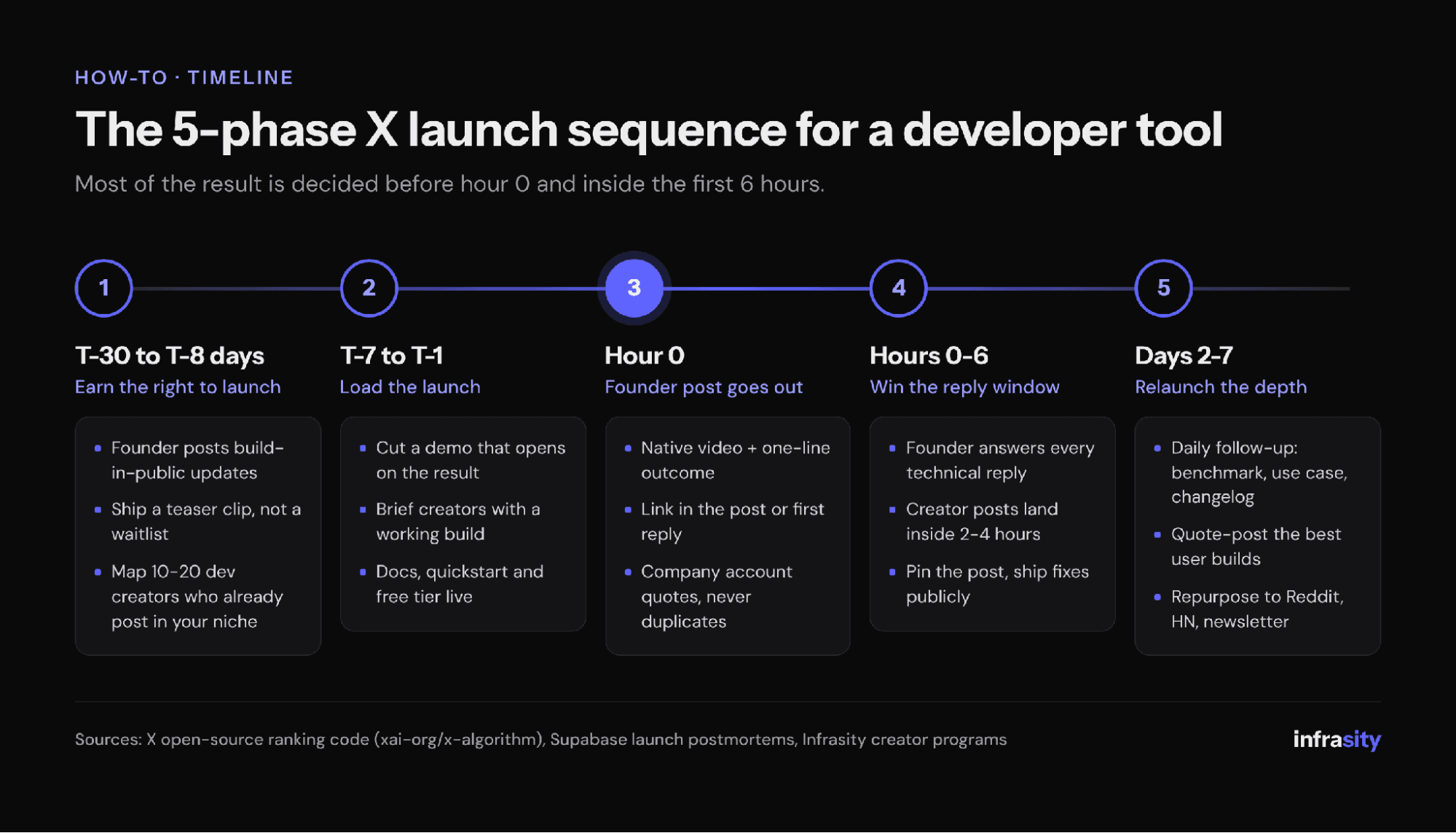
The five phases of an X launch for a developer tool, from audience building to the week-long relaunch.
Why launch a developer tool on X at all?
X is not where most developers spend their day. In the Stack Overflow 2025 Developer Survey, the community platforms developers report using most are Stack Overflow (84.2%), GitHub (66.9%), YouTube (60.5%), and Reddit (53.7%). X is not in that top group.
That is the right framing for a launch. X is not your community; it is your amplifier. It is where founders, investors, devtool creators, and early adopters watch for new things on the same day, and where one post can travel to people who did not follow you that morning. GitHub, Reddit, and your docs are where the developer decides. X is where they first hear the name.
Bolt.new is the clearest case: StackBlitz launched it with a single post on X in October 2024, with the product live in the browser the same minute. But the ARR run from $0.7M to ~$4M in four weeks came from users posting what they built, not from the launch post.
What X does better than every other channel
- Speed of spread: A launch post can move from your followers to out-of-network audiences in hours, because X's ranker mixes in-network and out-of-network posts in one feed.
- Founder access: Engineers follow builders, not brands. A CTO replying to a technical question in public does more for trust than a polished company post.
- Creator density: A small set of developer creators on X already post tool breakdowns to exactly the audience you want. Our guide to programming influencers covers how to find them.
Where X falls short as a launch channel for developer tools?
- No long-tail discovery: A post is effectively dead after 48 hours in the ranker. Search, Reddit threads, and LLM answers keep sending developers to your tool for years; an X post does not.
- Low trust for unproven claims: Developers screenshot and dunk on demos that look staged.
So use X for the spike, and route that spike into assets that last: docs, a GitHub repo, a Product Hunt launch, Reddit threads, and comparison pages. If X is one channel in a broader plan, our breakdown of top developer marketing channels shows where each one fits.
How does X decide who sees your launch post?
X open-sourced its current For You ranking system as xai-org/x-algorithm in January 2026 and added the live ranking parameters in August 2026. The model, called Phoenix, predicts the probability that a given viewer will take each of roughly a dozen actions on your post. Each probability is multiplied by a weight, and the weighted sum decides where the post lands in that viewer's feed.
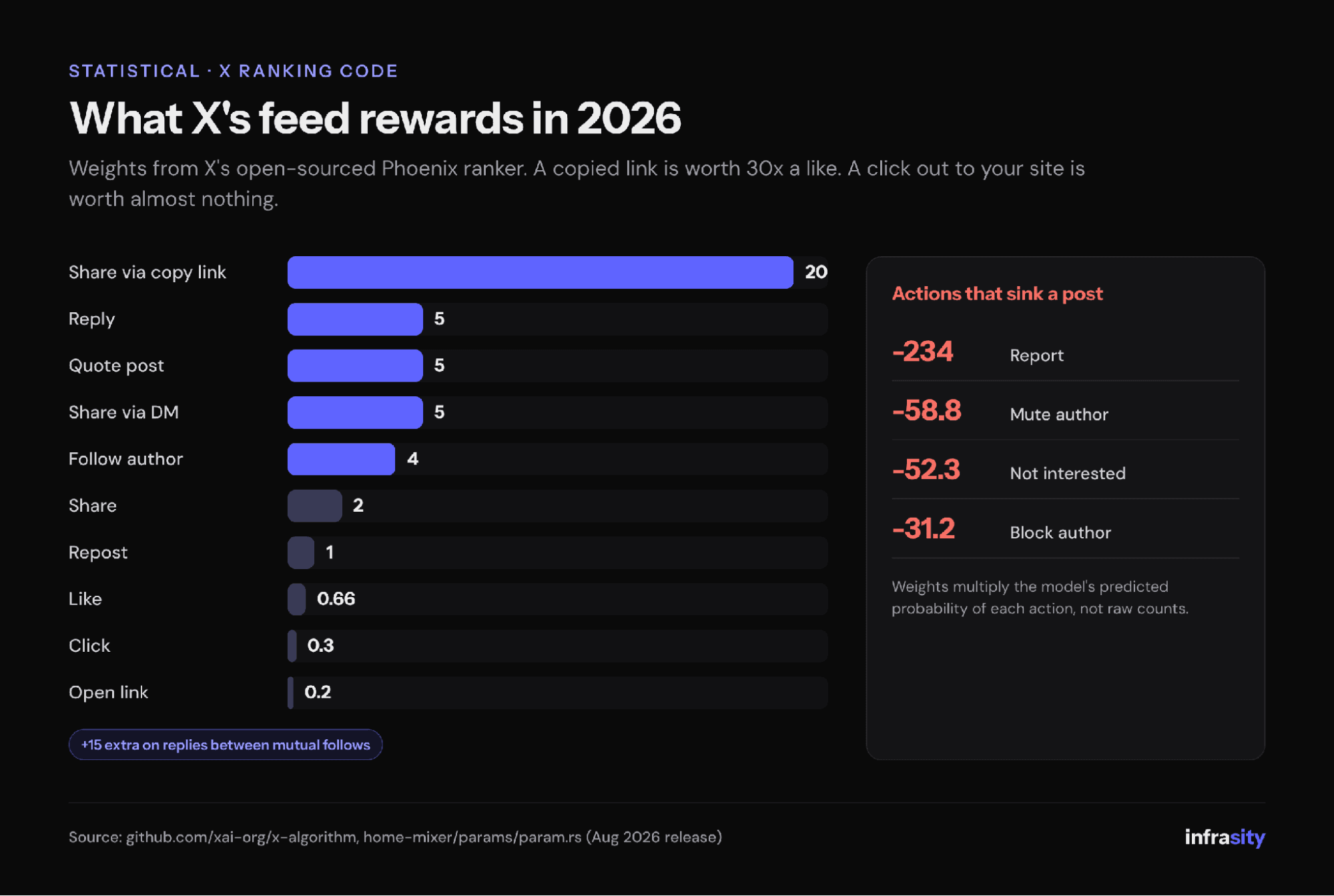
Action weights from X's open-sourced ranker: a copied link is worth about 30 likes.
What the weights mean for a launch post
| Action | Weight | What it means for your launch |
|---|---|---|
| Share via copy link | 20.0 | The single strongest signal. A developer pasting your post into a team Slack is exactly what the ranker wants. |
| Reply | 5.0 (+15 between mutual follows) | Technical questions in the replies lift the post. Replies from people who follow each other count far more. |
| Quote post | 5.0 | A creator quote-posting your launch helps the original post 5x more than a plain repost (1.0). |
| Share via DM | 5.0 | Same logic as copy link: private sharing signals real interest. |
| Follow author | 4.0 | A launch that earns follows grows the audience for every follow-up post that week. |
| Like | 0.66 | Nice to see, nearly irrelevant to reach. |
| Open link | 0.2 | The ranker barely rewards a click out to your site. |
One caution from X itself: the code comments warn that "one report cancels 468 likes" is a misreading, because the weights scale predicted probabilities, and a report is far rarer than a like. Read the table as which actions to design for, not as an exchange rate.
Three rules in the code that change launch timing
- The 48-hour cutoff: The AgeFilter removes posts older than 48 hours from the For You pool. Your launch has two days to find its audience. A launch week works because each day's post restarts the clock.
- Author diversity decay: Each additional post from the same author in one viewer's feed is multiplied by a decaying factor. Posting your launch, then four follow-ups an hour later, makes the follow-ups compete against a handicap. Space them out.
- Out-of-network discount and new-author boost: Posts shown to non-followers are discounted, while small, new authors get a boost. That is why a founder with 2,000 followers can still break out, and why creators' quote posts matter: each one is a new post that starts in-network for that creator's audience.
Should the link go in the post or the reply?
In November 2024, Elon Musk told users to "write a description in the main post and put the link in the reply". In October 2025, X's Head of Product Nikita Bier said "links are not deboosted", and in July 2026 Bier and Musk said the link penalty had been gone for over a year (coverage).
The code settles the practical question. There is no explicit link penalty, but an open link carries a weight of 0.2, and a viewer who leaves for your site often does not come back to reply or share. A Nieman Lab analysis of 18 media accounts found link posts still underperform on engagement.
Our recommendation: make the post complete without the link (the video shows the result, the copy states the outcome), then put the link in the post or the first reply, whichever reads better. Never make the reader click to understand what you built.
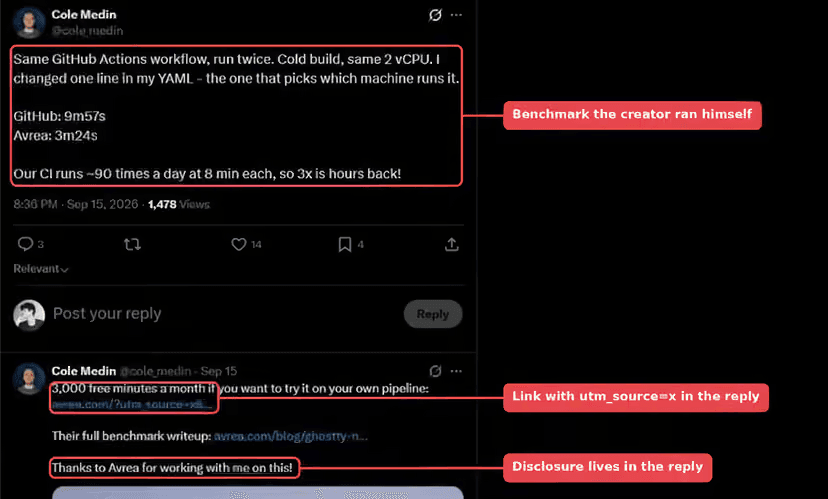
A creator launch post that states the result in the main post and puts the tracked link and disclosure in the reply.
For a deeper read on how the ranker treats sponsored creator posts, see our Twitter influencer marketing playbook for B2B tech.
How to launch a developer tool on X, step by step
Each step below maps to a phase in the timeline above. Skip one, and you will see the consequence on launch day.
Step 1: Earn the right to launch (T-30 to T-8 days)
A launch post from an account that has said nothing for six months starts cold. Spend the month before launch posting from the founder or CTO account three to five times a week: a bug you hit, a benchmark you ran, a design decision you reversed. This is building in public, and for devtools it doubles as pre-launch documentation.
Who has done it: Steven Tey built Dub by posting progress in public with an open codebase. Dub reached 1,000 paying customers without paid marketing, and Twilio's head of engineering found the tool through its GitHub repo.
During this window, map 10 to 20 developer creators who already post about your category. Score them on audience fit and cost per thousand real views, not follower count. Our guides to micro-influencer marketing for B2B and briefing creators for a developer product launch cover sourcing and briefs in detail.
Step 2: Load the launch (T-7 to T-1)
Three things must be true before you post:
- The product works without a call. Docs live, quickstart tested by someone outside the team, free tier or trial open. A waitlist turns a launch into a promise, and promises do not get copied into Slack.
- The demo opens on the result. No logo, no tagline. In the first five seconds, a developer should see the output they would get.
- Creators have a working build, not a script. Give each creator access a week early, ask them to build something small, and let them write their own post. Identical copy across 15 accounts looks coordinated, and X's platform manipulation and spam policy prohibits coordinated engagement schemes. Paid posts must carry X's paid partnership label.
If your tool exposes an API, make it testable outside your app too. X's own DevRel team ran prototype API launches through Postman, with pre-request scripts that returned realistic responses from test endpoints. Postman's case study reports that about half of new users saw faster time-to-value, and X's development cycles went from months to weeks. A "Run in Postman" button or a copy-paste curl command in the launch thread does the same job for your launch.
Step 3: Post from the founder account (hour 0)
The launch post has four parts:
- One-line outcome claim that a developer can repeat: "Deploy a Postgres database in one command", not "an AI-powered data platform for modern teams".
- Native video under 60 seconds, uploaded to X, showing the tool doing the thing.
- One proof point that a skeptic can check: a benchmark on named hardware, a public repo, a customer.
- The link, in the post or first reply.
The company account quote-posts the founder's post. It does not publish a duplicate, because two near-identical posts split the replies and shares that the ranker rewards.
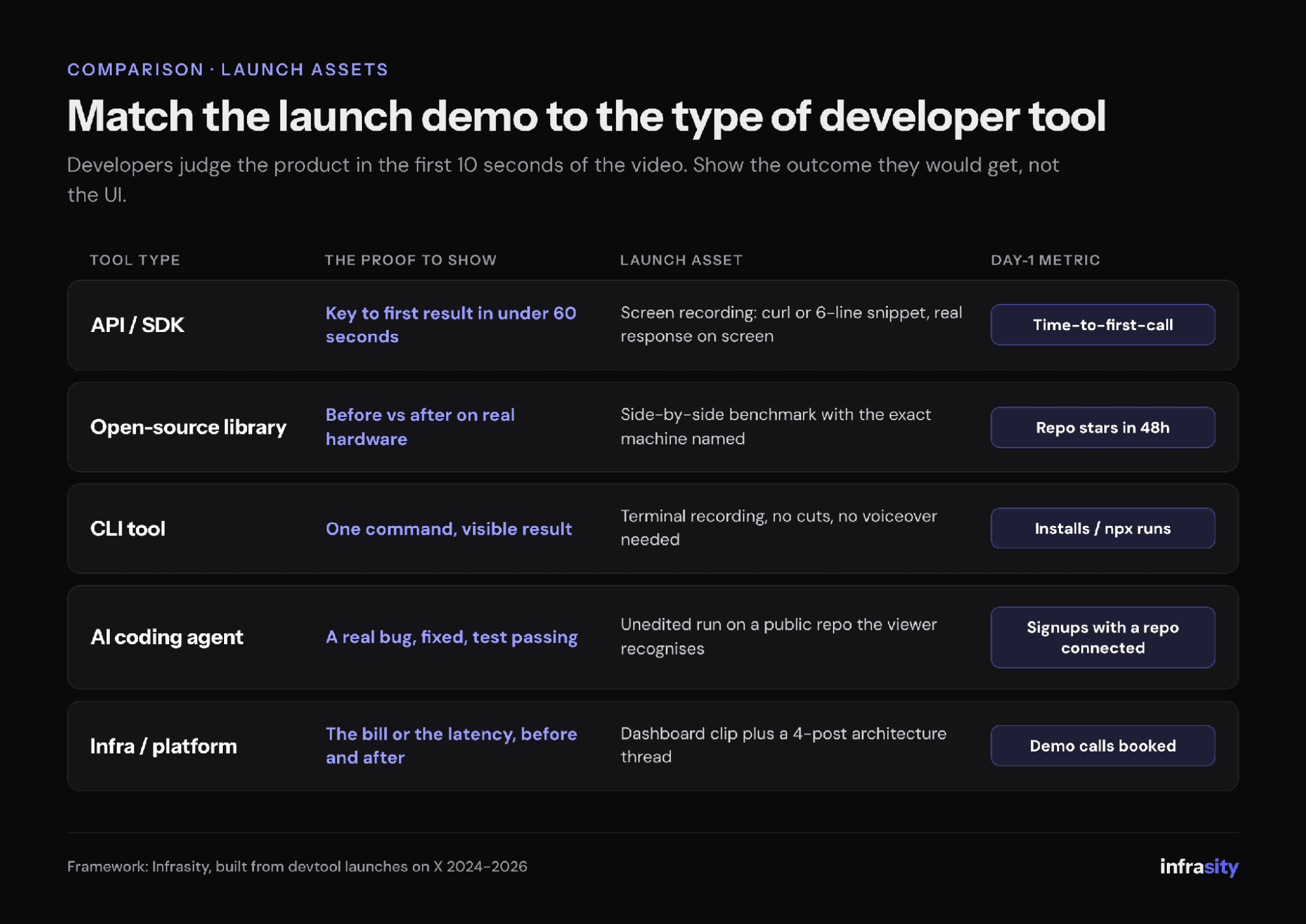
Each type of developer tool needs a different proof in the launch video and a different day-one metric.
Step 4: Win the reply window (hours 0 to 6)
This is where most devtool launches leak. Replies weigh 5, and replies between mutual follows get an extra 15. Every unanswered technical question is lost ranking signal and a lost user.
- The founder and one engineer answer every technical reply for the first six hours. Real answers, with code where it helps.
- Creator quote posts land in a spread over two to four hours, not in a five-minute burst.
- Pin the launch post. If a bug report comes in, fix it and reply with the commit.
Who has done it: Supabase ran its launches on a fixed schedule: a Space reminder tweet at 7:30 am, the launch tweet at 8:05 am, and a live Space at 8:15 am to take questions (Supabase, "How we launch"). Their alpha launch drew over 1,400 signups in seven days and 30,000 new visitors (postmortem).
Other teams run this window differently. Supabase scripts the whole morning so nobody decides anything in the moment: Product Hunt goes live at 7:55 am, the launch tweet goes out at 8:05, the tweet is shared with its technical angel investors at 8:10, and the Space starts at 8:15. It also finishes major integrations a week early and ships nothing to production on launch day, a rule that came from live-debugging issues in Discord during an earlier launch. Bolt.new's replies and quote posts, by contrast, were mostly users showing what they had built with it (more below).
Step 5: Relaunch the depth (days 2 to 7)
Because of the 48-hour cutoff, one launch post cannot carry a week. Supabase's answer was Launch Week: ship one major feature or announcement every day for a week. In their words, "you can launch a new feature many times over and always manage to reach people."
A practical week after launch:
- Day 2: a benchmark or architecture thread for the engineers who asked: "how does it work?"
- Day 3: quote-post the best thing a user built.
- Day 4: a changelog post with fixes from launch-day feedback.
- Day 5 to 7: repurpose the strongest thread to Reddit and Hacker News, and turn the demo into a docs page. Our guide to content distribution for open-source devtools has the full repurposing map.
Planning a devtool launch on X? Infrasity runs X creator programs for developer tools: creator sourcing, briefs built on a working build, and per-post UTM tracking. Book a call.
Which devtool launches on X actually worked?
Let’s learn from their success. Here are the top companies that have successfully launched their product on X.
Bolt.new: one post, live product, $4M ARR in four weeks
StackBlitz launched Bolt.new on 3 October 2024 with a single post on X. The product worked in the browser the moment people saw the demo: no install, no waitlist. ARR went from $0.7M before launch to about $4M in four weeks, $20M at three months and $40M at five months, with under 40 staff (Growth Unhinged).
The lesson: the post did not do the work alone. Every user who built something posted it, and each post started in-network for that user's followers.
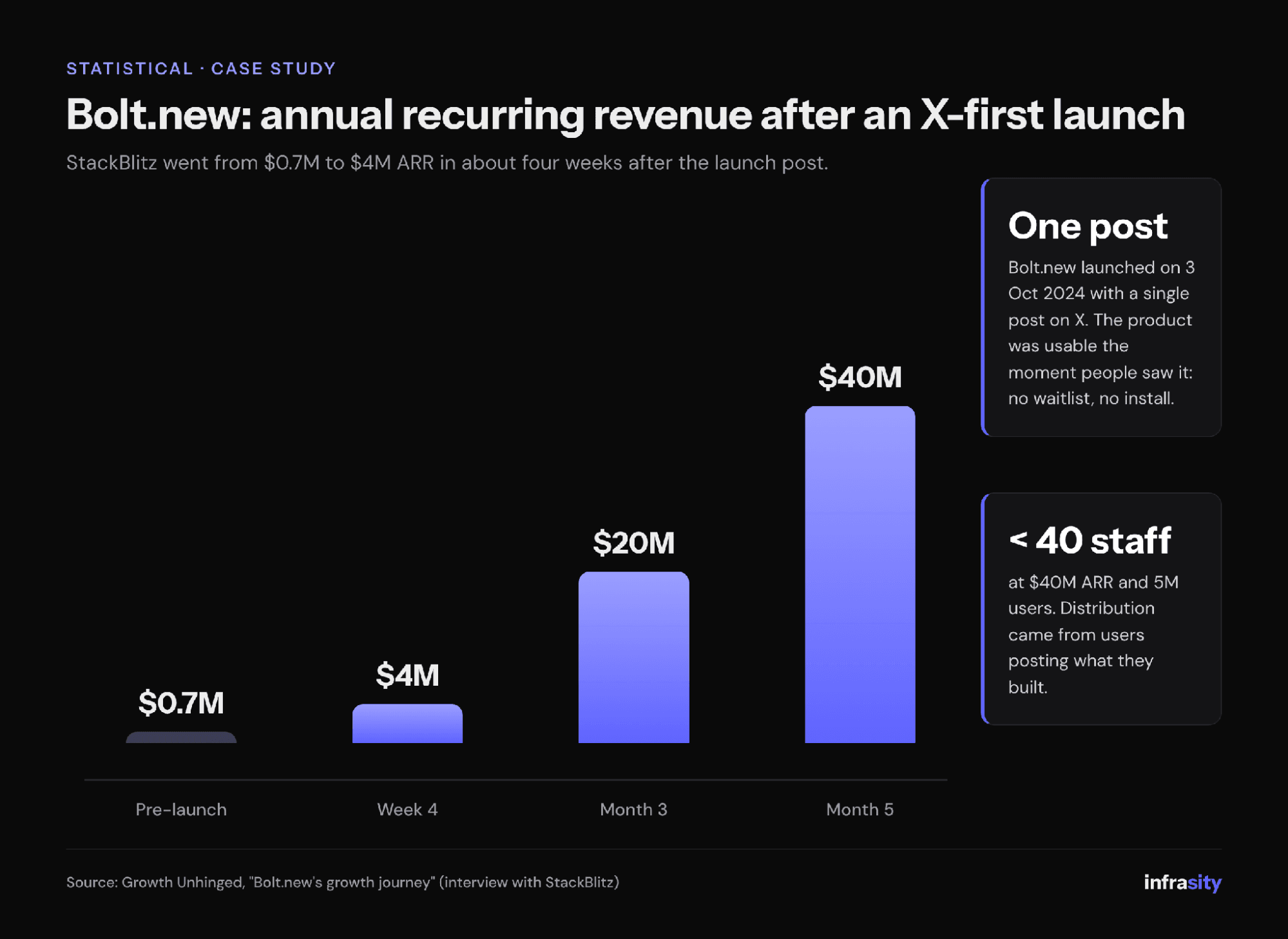
Bolt.new ARR from the launch post to month five.
Cartesia: founder-led technical post, high save rate
Cartesia's co-founder Karan Goel announced the Sonic-3.5 voice model from his personal account in June 2026.
The post shows about 7.1 million views and 1,694 bookmarks, from an account with roughly 21,000 followers. Paid creator amplification sat behind it, so the views are not purely organic. The bookmark count is the more useful number: developers saving a post to build with later.
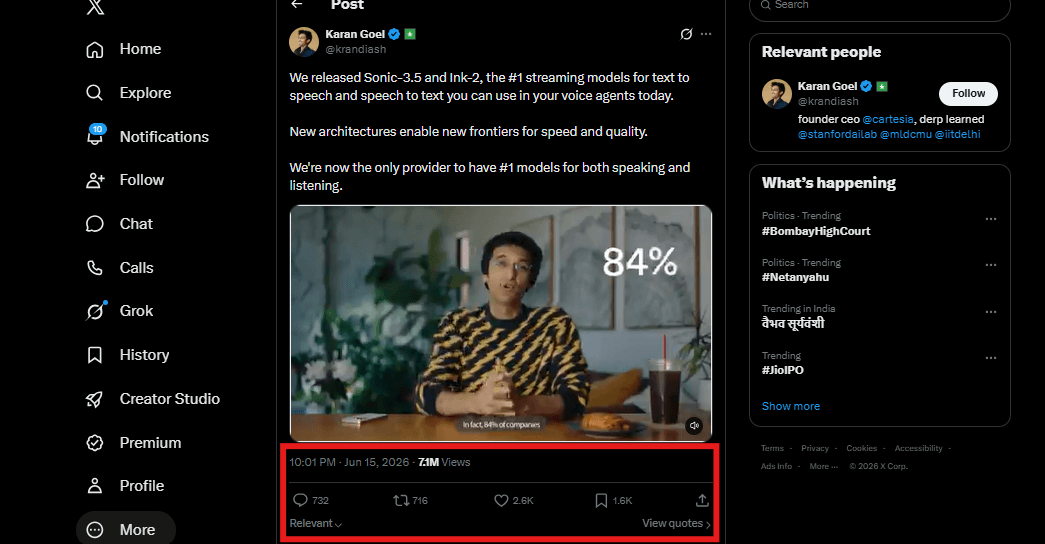
Cartesia's founder-led launch post, with the engagement counts that matter highlighted.
webAI: open source and benchmarks over polish
webAI released YOLO26-MLX, an open-source port that runs object detection natively on Apple Silicon, with published numbers: 1.1x to 2.6x faster inference than PyTorch MPS on an M4 Pro. The launch post earned about 3.6x the likes of the company's previous release post on fewer views. Specific, checkable claims on named hardware earned more engagement per view than a broader product announcement.
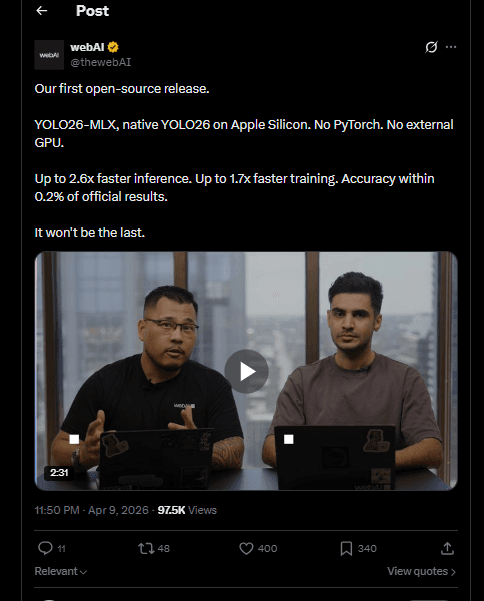
webAI's launch post, which led with benchmark numbers instead of a product pitch.
Rocket: X first, because it is the cheapest place to test positioning
In Infrasity's creator program for Rocket, 90 placements across YouTube, X, and Instagram reached an estimated 1.16M to 1.9M people. The sequencing matters as much as the reach.
X placements published fastest and cost the least, so they served as the positioning test before five-figure YouTube slots went out with a proven message. For a devtool launch, the same logic applies: test your one-line claim on X before you put it in a $10,000 video.
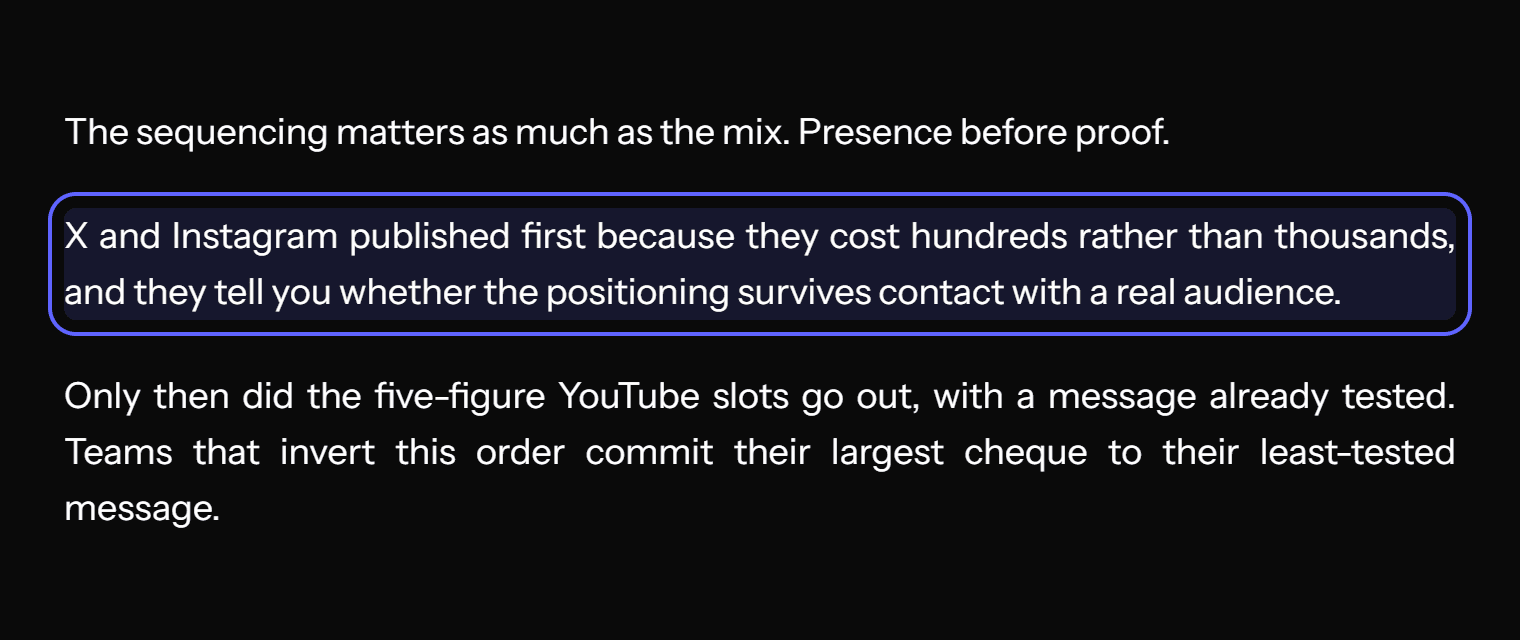
Why the cheaper X placements went out before the five-figure YouTube slots.
Devin: what overclaiming costs
Cognition introduced Devin in March 2024 as "the world's first AI software engineer." Of the 15 large accounts that amplified it (about 3M combined followers), only five showed signs of having used it (analysis), and engineers later picked apart the demo publicly. The launch worked for fundraising. It cost trust with the exact audience that would use the product. For a devtool, a claim you cannot defend in the replies is a liability, not a hook.
What does an X launch cost, and is Premium worth it?
Creator costs
Practitioner interviews put developer and tech creators on X at roughly $500 to $3,000 per post, with agency-run launch campaigns using 30 to 100 creators. A tighter devtool launch with 10 to 20 niche creators sits at the low end. Infrasity's Twitter influencer marketing playbook breaks down per-thread pricing and how to measure return over a long sales cycle; for budgeting across channels, see our guide to influencer marketing ROI.
X Premium for the founder account
Buffer's analysis of 18.8M posts from 71,000 accounts found Premium accounts got about 10x the median reach of regular accounts: under 100 impressions per post for regular accounts, about 600 for Premium and over 1,550 for Premium+. That is correlational (paying accounts also tend to post more), and X's published ranking parameters do not mention Premium. For a founder about to launch, the cost is small relative to a single creator post, so we treat it as a default.
What should you measure in the first 48 hours?
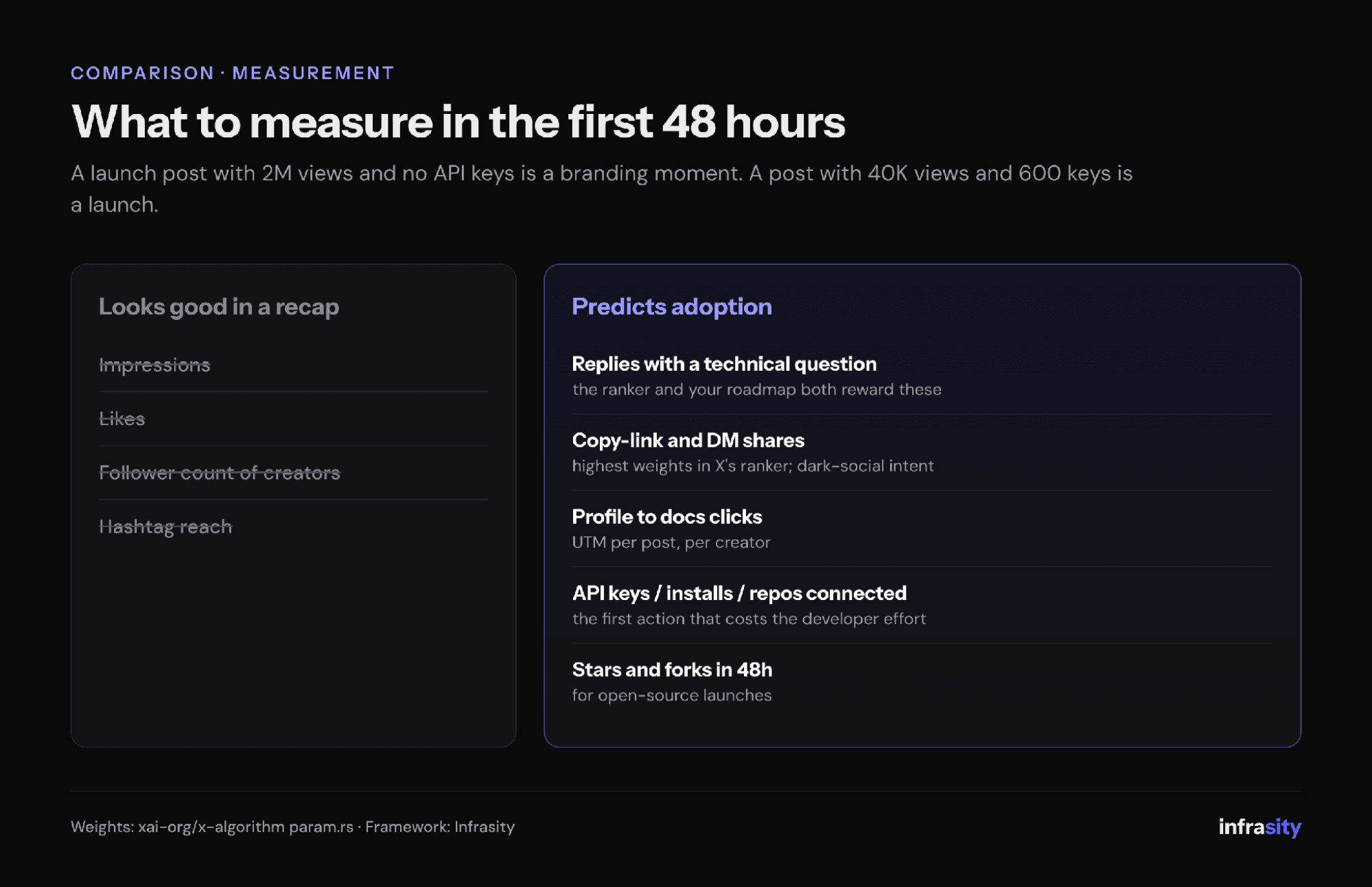
Vanity metrics on the left, adoption signals on the right.
Track per post, per creator
- Technical replies: count replies that ask how something works or report a bug. These carry ranking weight and tell you what to fix on day 2.
- Copy-link and DM shares: visible in X post analytics. The highest-weighted actions in the ranker, and the closest proxy for "sent to my team".
- Docs visits by UTM: give every creator and every follow-up post its own UTM.
- First costly action: API keys created, CLI installs, repos connected, or GitHub stars in 48 hours for open-source tools. Our guide to getting GitHub stars covers turning launch traffic into repo traction; Infrasity's GitHub marketing work for MemClaw grew its GitHub presence 1,512% in six weeks.
You can use our tool to track everything in one place, with real-time data, so you don’t have to juggle between multiple links to manage your campaigns.
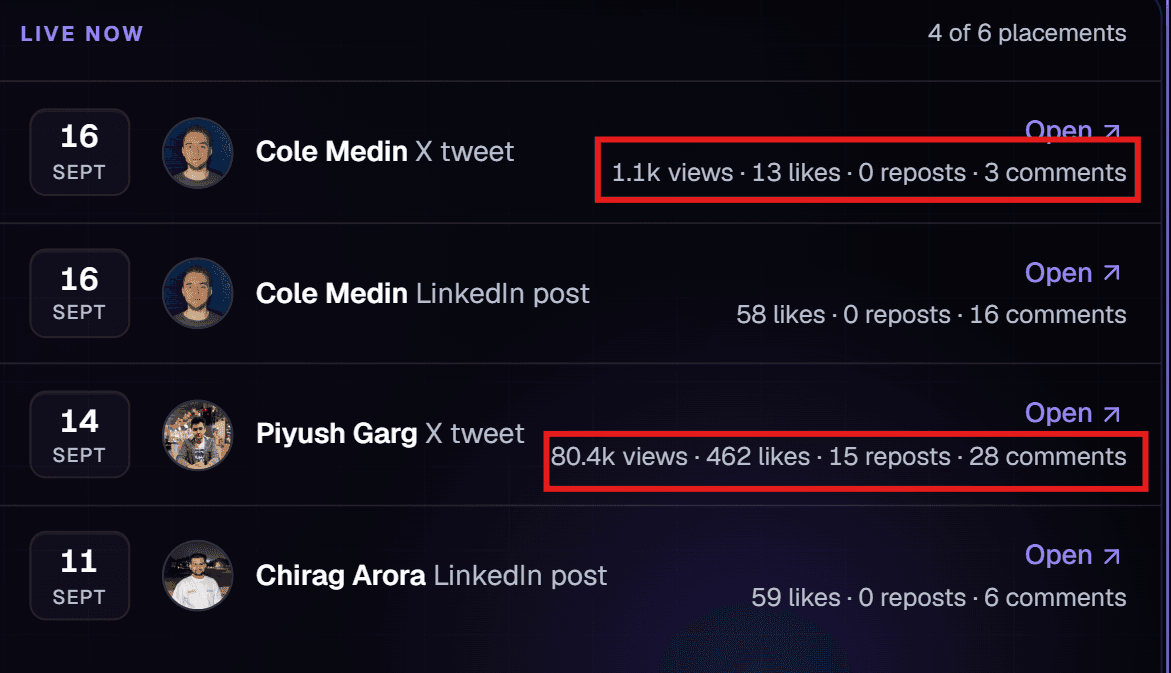
Per-placement views, likes, reposts and comments for a live creator campaign, tracked in one place.
Then check what lasts
Two weeks after launch, check whether developers find you without X: branded search, Reddit threads that mention you, and whether ChatGPT and Perplexity name your tool for its category. That is where launch-day attention either compounds or disappears. Our guide to AEO for developer tools covers how launch content feeds LLM answers.
Common mistakes in devtool launches on X
- Launching to a waitlist. Developers want to try it now. A waitlist gives them nothing to share.
- Opening the video with a logo. You lose the five seconds that decide whether a developer keeps watching.
- Posting the launch from the company account only. Engineers reply to people.
- Firing all creator posts in the same 10 minutes. It looks coordinated; it can breach X's rules on coordinated engagement, and it wastes the 48-hour window.
- Ignoring the replies. The founder replying to replies is the cheapest reach you will get on launch day.
- Overclaiming. "World's first" invites engineers to prove you wrong in your own replies.
Conclusion
An X launch for a developer tool works when the product is usable the minute people see it, the demo proves one specific outcome, the founder carries the conversation, and creators add their own angle rather than repeating yours. X's ranking code rewards the actions developers take when they actually care: replying with a question, pasting the link into a team channel, sending it in a DM. Design every part of the launch to earn those.
If you want help sequencing the launch, sourcing developer creators, and turning the spike into lasting search and LLM visibility, Infrasity's developer marketing agency and B2B influencer marketing teams run this end to end. Book a call.
Frequently Asked Questions
How do I launch a developer tool on X?
Post a native demo video from the founder's account that shows a real result in the first five seconds, with the product live and usable. Have 10 to 30 relevant developer creators quote-post it in their own words over the next few hours, and answer every technical reply for 48 hours. Follow with a daily depth post for the rest of the week.
What time should I post a product launch on X?
Post when your target developers are online and your team can reply for the next six hours. Supabase tweeted its launches at 8:05am with a live Space 10 minutes later. The ranking code has no first-hour rule, but it drops posts older than 48 hours, so being available to reply matters more than the exact minute.
How long does a launch post last on X?
About 48 hours. X's open ranking code removes posts older than 48 hours from the For You candidate pool, so one post cannot carry a launch week. Answer replies for the first six hours, then post a new angle (a benchmark, a user build, a changelog) on days 2 to 7.
Should I use a thread or a single post for a launch?
Use a single post with a native video for the launch itself, because replies and shares concentrate on one post. Put depth (architecture, benchmarks, pricing) in a reply thread under it or in a separate post on day two.
How much does it cost to launch on X with creators?
Developer and tech creators on X typically charge $500 to $3,000 per post. A focused devtool launch with 10 to 20 niche creators costs far less than agency campaigns that use 30 to 100 accounts, and usually converts better because the audiences match.
Is X Premium worth it for a launch?
Buffer's analysis of 18.8M posts found Premium accounts got about 10x the median reach of regular accounts. The data is correlational, but the cost is small relative to one creator's post, so most founders should have it before launch day.