
Pick a product-led growth agency by matching its specialism to the stage of your funnel that is actually broken:
- Onboarding and time-to-value (ProductLed)
- Demand generation and sales handoff (Gripped)
- Paid and mobile app growth (M+C Saatchi Performance)
- Experimentation (GrowthRocks)
- HubSpot and RevOps plumbing (Arise GTM)
- Pre-signup technical distribution for developer tools (Infrasity).
Almost nobody does all six together.
This blog covers the six that survive that filter, what each is genuinely good at, when a PLG agency is the wrong purchase, what it costs, and the eleven-question call script we would use to run the evaluation.
TL;DR
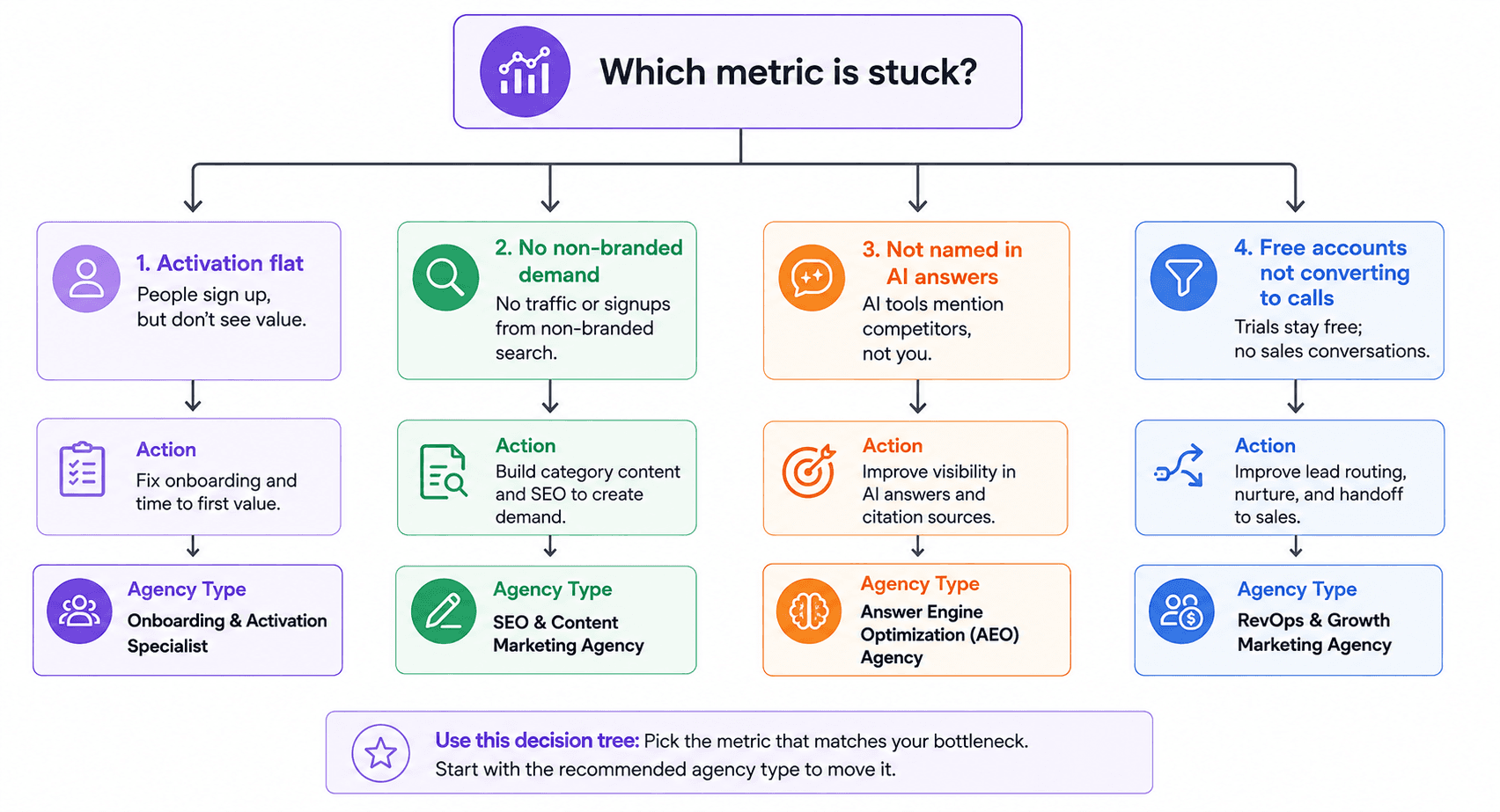
Activation flat means ProductLed. No non-branded demand means category content and SEO. Free accounts not converting to calls means RevOps. Developers deciding before signup means Infrasity. Almost no agency covers more than one of these well.
ProductLed, M+C Saatchi Performance and GrowthRocks score zero mentions; Gripped and Arise GTM manage three each. That's a fit signal, not a quality one.
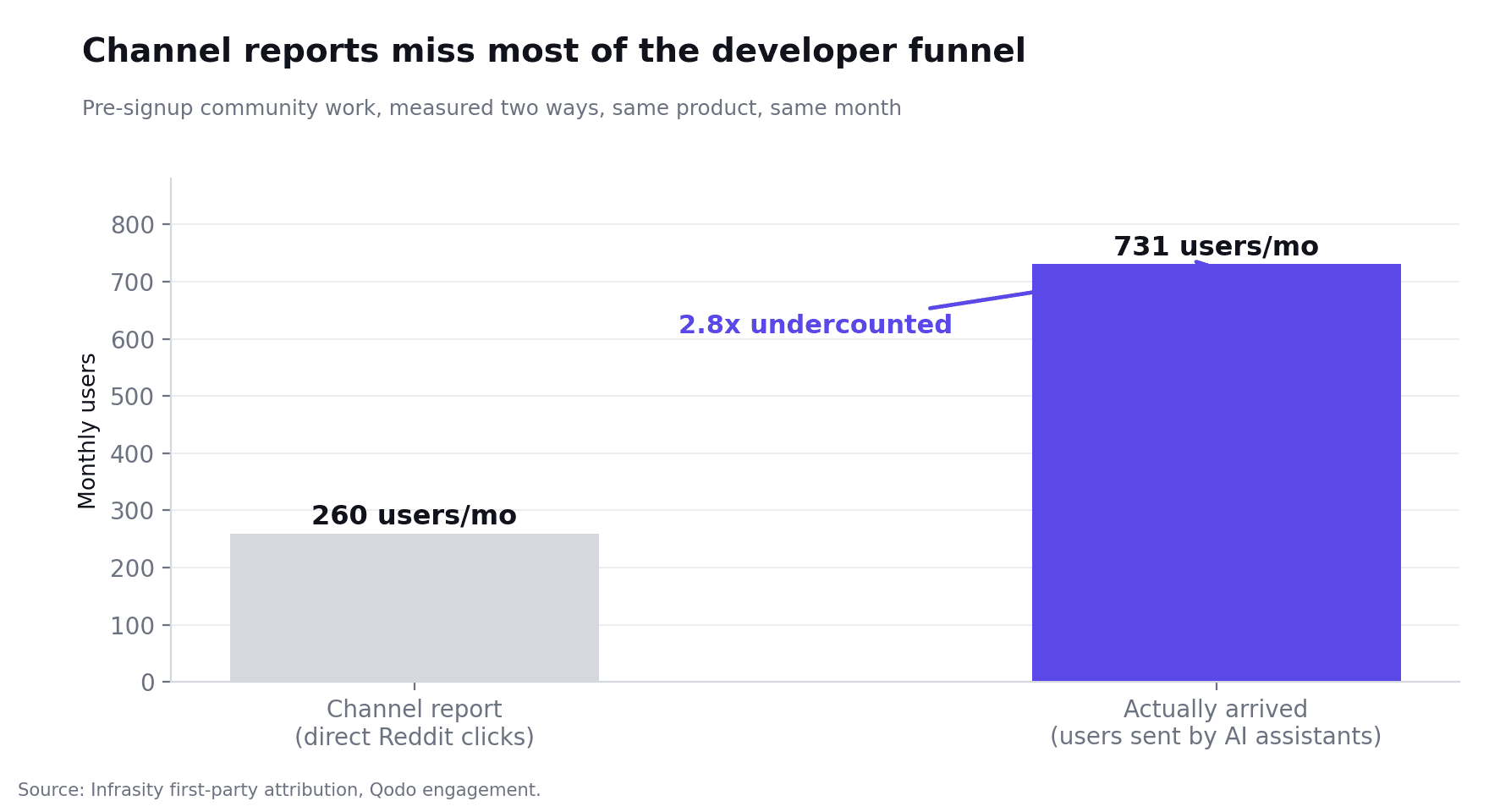
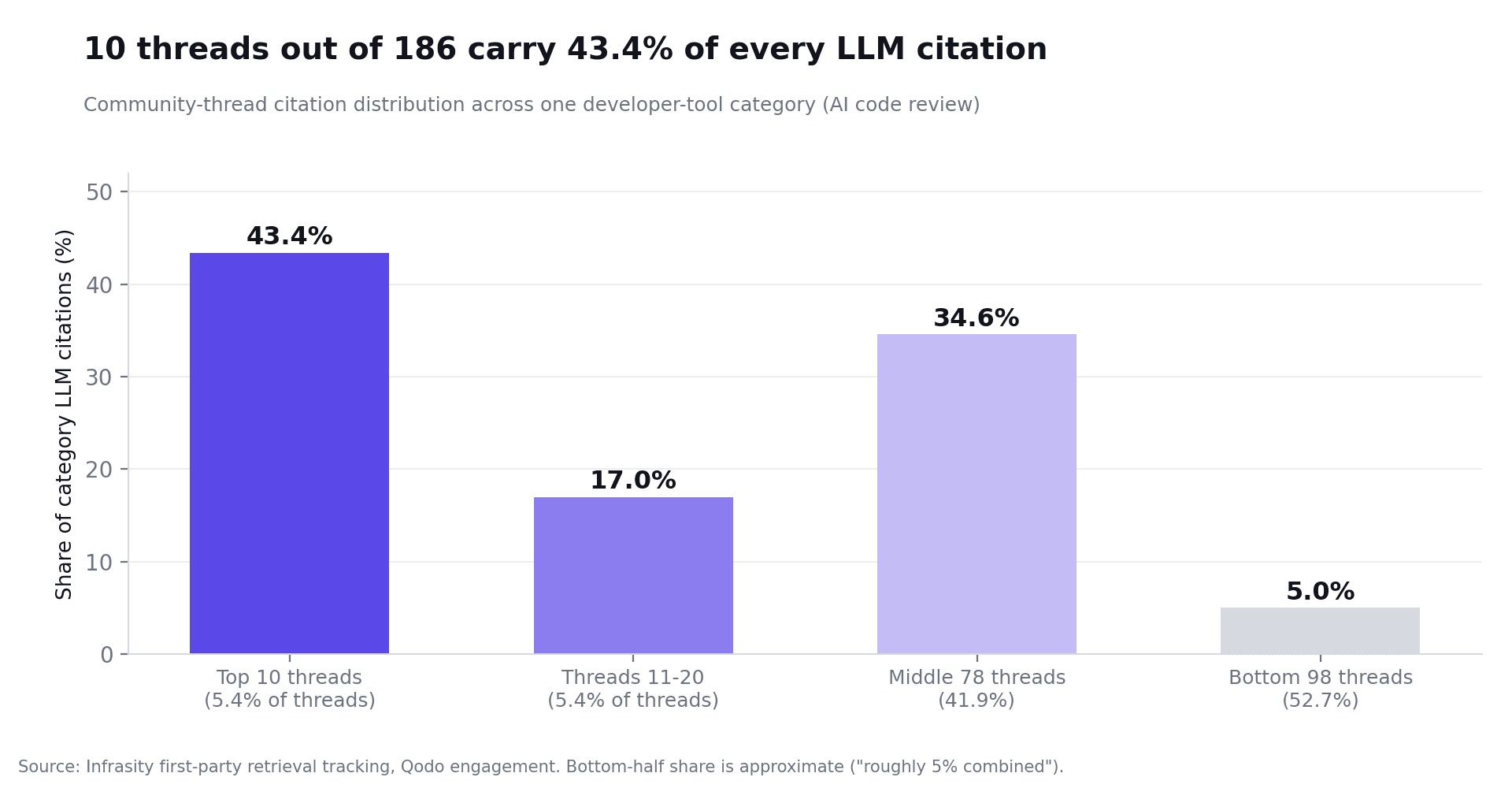
DevTool PLG breaks in a place your analytics can't see. Developers decide in docs, READMEs, and threads before they sign up. In one program, Reddit sent 260 direct clicks a month while AI assistants that had read those same threads sent 731, and 10 threads out of 186 carried 43.4% of all category citations.
Don't hire anyone if you're pre-PMF, your quickstart is broken, nobody internally owns the relationship, or you can't name the number you want moved in 90 days. A good agency will say this on the first call.
Budget: $5,000 to $10,000 for a fixed-fee sprint (ProductLed publishes tiers; nobody else does), roughly $5,000 to $25,000 a month retained, versus $150,000 to $200,000 plus equity for a DevRel hire who ships first output at month three to six.
Top 6 product-led growth agencies
Here are six product-led growth agencies, each suited to a different growth challenge and stage.
1. Infrasity: for developer tools, DevOps and AI infrastructure
Best for: Companies that are selling to engineers, where adoption starts with a repo, a package install, or an API key.
Model: Retained monthly, strategy plus execution.
Weak fit: Consumer apps, non-technical B2B SaaS, in-product UX and onboarding redesign.
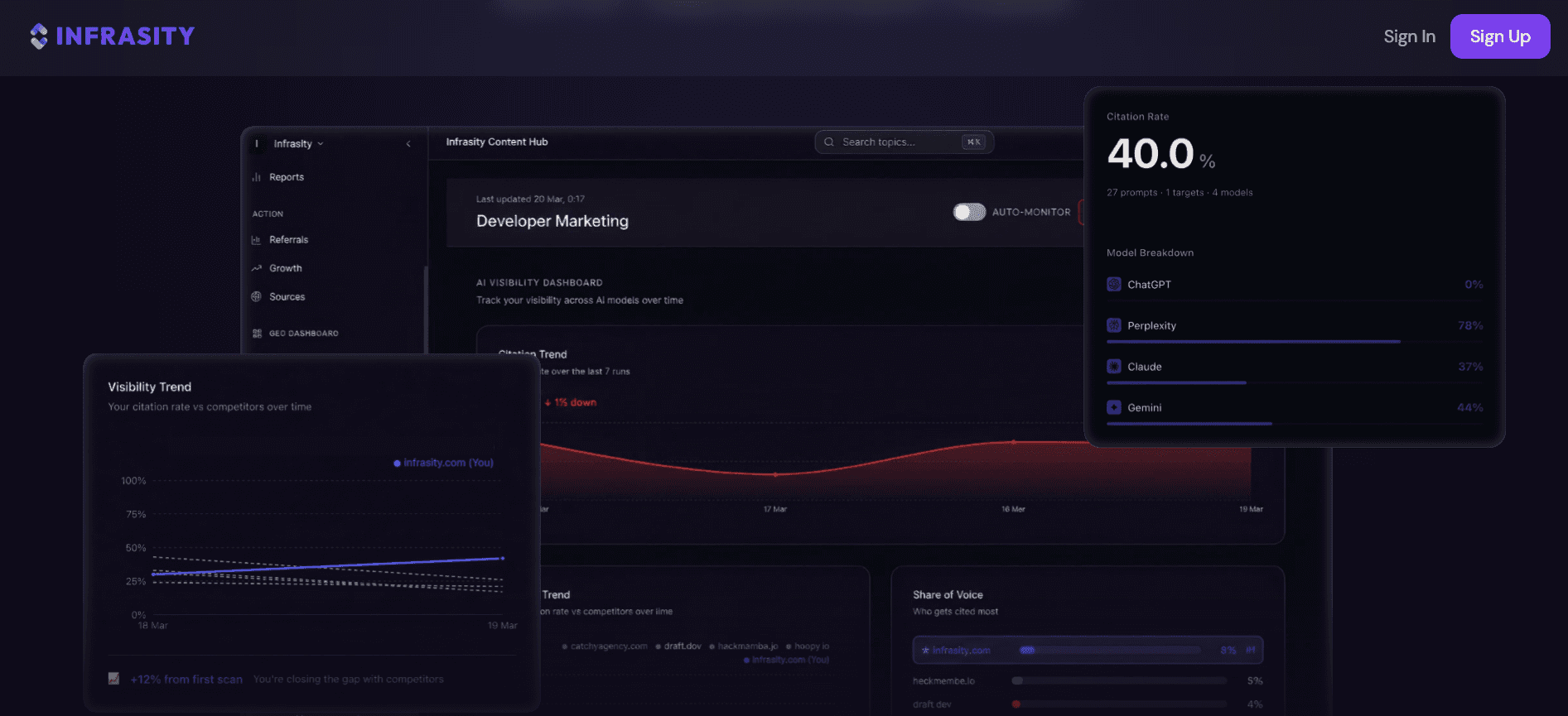
Infrasity runs the pre-signup half of the developer funnel: technical content written by engineers, product and API documentation, Reddit and community programs, GitHub distribution, and answer engine optimization for the models developers now ask before they search.
The published numbers, each with a working case study:
| Client | Stage | Result | Window |
|---|---|---|---|
| OX Security | $94M Series B | Top-3 keywords 89 to 509 (5.7x); organic 4,393 to 20,129 visits/mo | 16 months |
| Qodo | $50M raised | #2 of 7 brands in AI code review; clicks +28%, impressions +61% | 12 months |
| MemClaw | Early stage | GitHub stars +1,512%, on $0 paid spend | 6 weeks |
| Scalekit | $5.5M seed | Organic traffic 8x; qualified leads 12 to 39 | 9 months |
| Terrateam | Early stage | 6,530 clicks, +81% traffic, first page for 80% of target keywords | 3 months |
Limitation. Infrasity doesn't do in-product onboarding design, paid media, or lifecycle email. If your signups are healthy and users churn inside the product, not suited for you.
If your problem is that developers evaluate you before they ever sign up and you cannot see that part of the funnel, Infrasity's developer marketing service starts with a visibility audit that maps which threads, doc pages, and models are already determining your category.
2. ProductLed: for onboarding and time-to-value
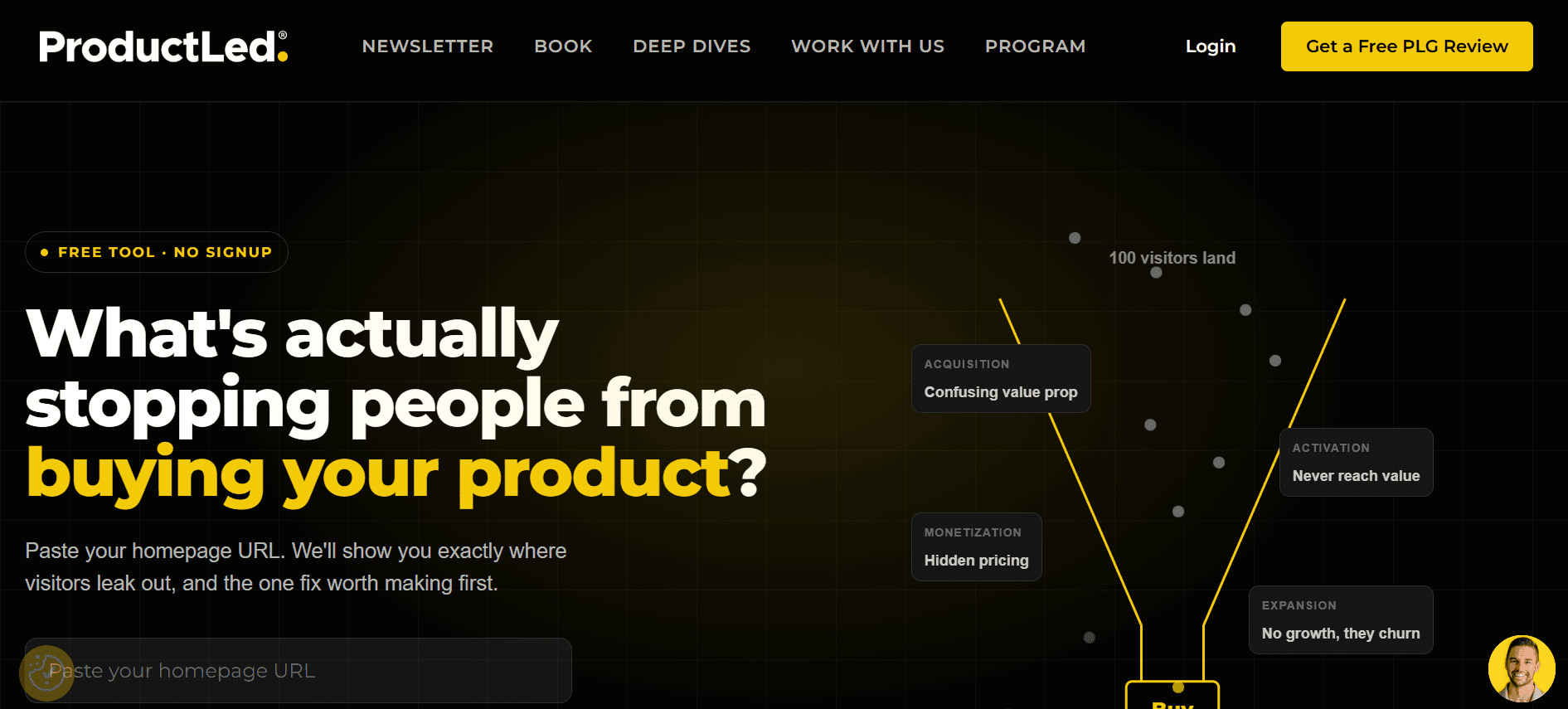
Best for: Self-serve SaaS where signups are fine, and activation is not.
Model: Fixed-fee sprints and certification training.
Weak fit: Anything requiring ongoing execution or distribution.
ProductLed is Wes Bush's operation and the closest thing the category has to a canonical methodology. The company states that its approach draws on 434 companies and over $1B in self-serve revenue, with 60,000-plus people trained.
The ProductLed Sprint runs for five days and is tiered by your ARR: $5,000 under $2M, $7,000 between $2M and $10M, $10,000 above $10M, one-time. You get three live sessions, a clickable prototype of a zero-friction first-run experience, and a 90-day roadmap.
That shape tells you what it is. It is a diagnosis and a plan, delivered fast, at a price you can approve without a procurement cycle. It is not a team that will then go and build the thing. For a Head of Growth who already has engineers and needs a defensible framework to point them at, that trade is often correct.
The relevant benchmark it works against: ProductLed's own analysis puts opt-in free trials at roughly 25% conversion and opt-out trials, where a card is required, at roughly 60%. If you are materially below the band for your model, the bottleneck is first-run experience, and this is the specialist.
3. Gripped: for B2B SaaS demand generation
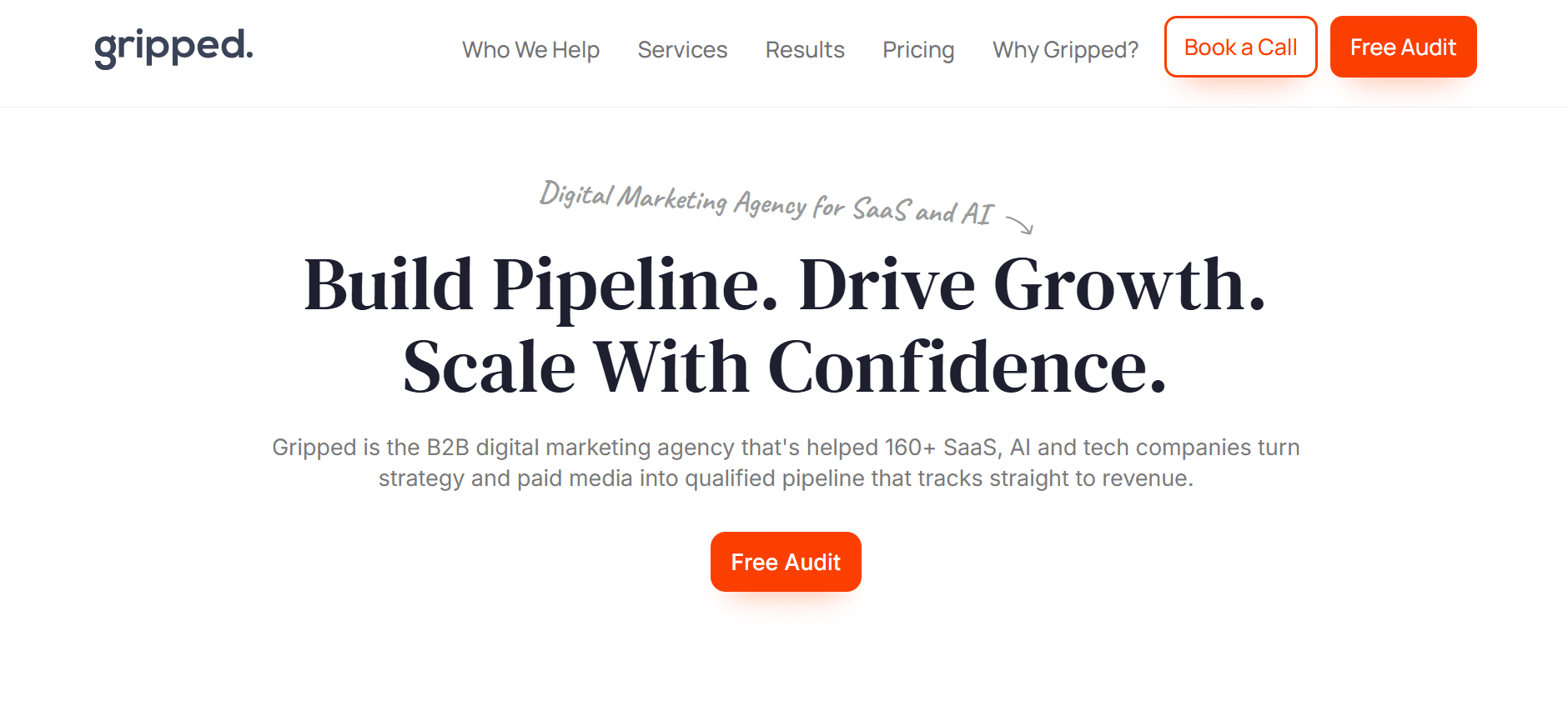
Best for: UK and European B2B SaaS with a real sales motion attached to self-serve.
Model: Retained, full-funnel.
Weak fit: Pure self-serve with no sales team; developer-first products.
Gripped positions itself as a B2B digital marketing agency working exclusively with SaaS and AI companies, running SEO and paid demand generation toward pipeline rather than traffic. Published client results on their site include 252% and 108% growth figures and £1.3m in attributed value.
Gripped is the most conventional pick here, and that is a feature. If your PLG motion is really product-led sales, where a free tier generates accounts that a rep then closes, you need someone who thinks about MQL-to-SQL handoff and attribution, not just activation. Gripped does.
It is also the only one of the four non-Infrasity agencies whose homepage mentions developers at all. However, three mentions across 23,000 characters is a passing reference rather than a practice.
4. M+C Saatchi Performance: for paid and mobile app growth
Best for: Consumer or mobile-first products with real paid budget.
Model: Global agency, media buying and measurement.
Weak fit: Technical B2B, organic and community-led motions.
M+C Saatchi Performance has run performance marketing since 2006 and describes app expertise and measurement as its differentiators. Of the six, it is the largest and the furthest from developer tooling.
Its inclusion on three of four PLG listicles is instructive rather than flattering. It appears because it is a well-known growth agency, not because it specialises in product-led B2B software. If you are a CMO with an app, a paid budget, and a measurement problem, it is a strong option. If you sell a CLI, it is the wrong meeting.
5. GrowthRocks: for experimentation and growth hacking
Best for: Teams that want a testing cadence installed and run.
Model: Retained growth services, audits, training tiers.
Weak fit: Technical audiences and long-cycle B2B.
GrowthRocks is an experimentation-led growth marketing agency. Its own site organises solutions around B2C businesses and marketplaces, which is the clearest statement of fit available.
Where it earns a place on a PLG shortlist is method. Product-led growth lives or dies on iteration speed against activation and retention metrics, and an agency whose core product is a running experiment program can install that discipline faster than an internal team building it from scratch. Just check that its experiment library has anything in your category before you sign.
6. Arise GTM (formerly Digital BIAS): for the RevOps layer under PLG
Best for: PLG teams whose data and routing are the blocker.
Model: HubSpot-centric GTM consulting.
Weak fit: Content, community, and top-of-funnel demand creation.
Arise GTM is a go-to-market and HubSpot consultancy, previously trading as Digital BIAS. Its PLG work is the plumbing: building the tech stack that lets a product-led team see product usage inside the CRM, score product-qualified leads, and route them.
Of the six, this is the least glamorous entry and the one most often needed. A PLG motion without usage data flowing into the CRM cannot tell a sales team which of 4,000 free accounts is worth a call. If that is your situation, no amount of content fixes it.
One caution, stated plainly: because it is HubSpot-centric, it is a poor fit if you are committed to Salesforce or a bespoke warehouse-native stack.
Why does product-led growth break differently for a developer tool?
Because the decision happens outside your product, on surfaces your analytics cannot see, and the standard PLG toolkit is built for the opposite assumption.
The conventional playbook optimizes signup, activation, and the paywall using onboarding checklists, PQL scoring, in-app nudges, and lifecycle email. All of that assumes a buyer discovers you through a marketing surface and forms a judgment inside the product. For developer tools, four things break that assumption.
Evaluation is finished before the signup
A developer decides whether your tool is worth installing by reading your docs, your README, a GitHub issue thread, and a comparison someone else wrote. By the time they create an account, they have already decided. Your most valuable activation work therefore sits in read-only surfaces with no session, no cookie, and no event.
The measurement consequence is severe. In Infrasity's Qodo engagement, direct clicks from Reddit sent 260 users a month. AI assistants that had read those same threads sent 731. A standard channel report shows the 260.
Retrieval follows a power law, so most of that work is wasted
Not every thread matters equally. Across 186 tracked community threads in one developer-tool category, the top 10 threads carried 43.4% of every LLM citation, and the bottom 98 threads returned roughly 5% combined.
The operating rule that falls out of this is counterintuitive enough that it is usually the first thing a client argues with: in that same program, only 2.6% of 699 engagements contained a link to the product, and 98.1% of them are still live. Link-heavy comments get removed, and removed comments cite nobody. A hard link budget under 5% is not a restraint for its own sake; it is what keeps the asset in the index.
Audience actively distrusts assertions
This is the difference that makes generic PLG copy fail. In Stack Overflow's 2025 Developer Survey, 46% of developers said they actively distrust the accuracy of AI tools against 33% who trust it, with only 3% "highly trusting". The most experienced developers were the most skeptical: a 2.6% high-trust rate and a 20% high-distrust rate. Asked why they would still go to a human in an AI-saturated future, the top answer, at 75%, was "when I don't trust AI's answers".
A marketing claim without a reproducible artifact does not move that audience. The unit that converts is a command they can run, a config they can copy, a benchmark they can rerun, or a repo they can read. This is why technical content for devtools has to be written by someone who has actually deployed the thing.
Usage and budget sit with different people
An individual engineer adopts the free tier. A platform lead or a security owner buys. Scoring PQLs on individual usage therefore misfires, because the person generating the strongest signal has no budget authority. The developer-tool version of a product-qualified account is domain-level: multiple seats sharing an email domain, a CI integration, or config committed into a repository. Those are account signals, not user signals, and most PLG scoring templates do not ship with them.
When should you actually hire a product-led growth agency?
When you can name the metric that is stuck, and you have ruled out the product as the cause. Below are seven triggers, each with a diagnostic you can run this week.
Signups grow, but activation is flat
Diagnostic: Plot weekly signups against percentage reaching first value. If signups climb and activation percentage is flat or falling, more acquisition will make things worse.
What to buy: Onboarding and time-to-value work. ProductLed's sprint is built for exactly this.
You rank for your own name and almost nothing else
Diagnostic: In Search Console, split branded from non-branded clicks over 90 days. Then in Ahrefs or Semrush, count how many ranking keywords sit past position 20.
Benchmark: OX Security's April 2025 baseline was 23.1% branded traffic and 1,737 of 2,684 keywords past position 20. That is a category-demand problem, not a conversion problem.
What to buy: Category content and technical SEO, run as a footprint-shrinking exercise rather than a publishing quota. Our b2b SaaS growth levers breakdown covers the sequencing.
Competitors get named in AI answers, and you do not
Diagnostic: Take the five prompts a buyer in your category would actually type. Run each through ChatGPT, Claude, Gemini, and Perplexity. Log which products are named, in what order, and whether a source is cited. That 5 by 4 grid is your baseline.
Benchmark: MemClaw started this at zero ranking keywords against a competitor's 904.
What to buy: Answer engine work. You can run the first pass yourself with the AI search visibility tool.
Your engineers are the content bottleneck
Diagnostic: Look at who wrote your five best-performing technical posts. If the answer is your founder or a staff engineer, and the queue is now weeks deep, you have a capacity problem that hiring a generalist writer will not fix.
What to buy: An engineering-led content team. That trigger is what the build versus buy comparison below is for.
The docs are your drop-off point
Diagnostic: Instrument the quickstart. Count how many people who start it reach a working call. Under 40%, and the docs are the funnel, not a support cost.
What to buy: Documentation services, or run a docs audit first.
You just raised, and the board wants a pipeline number self-serve cannot yet produce
Diagnostic: Ask what percentage of last quarter's pipeline came from a source you can repeat next quarter. If it is mostly founder network, you are buying time.
What to buy: A go-to-market content program with a 90-day measurable milestone written into the contract.
You need DevRel but not a DevRel hire
Diagnostic: A Developer Relations Engineer in the US costs $150,000 to $200,000 a year in base salary plus equity, and typically ships first output at month three to six. Compare that against a monthly retainer that ships in week one, then decide whether you are buying a person or a function. The full comparison is here.
When should you not hire one?
There are four situations where an agency will burn your money regardless of quality, and a good one will tell you so on the first call.
You have not found product-market fit: No distribution program fixes a product people try and abandon. If 30-day retention on activated users is below your category floor, spend the quarter on the product.
Your quickstart is broken, and you know it: Fix that in-house first. It is usually two weeks of engineering time, and every dollar of demand you generate before it is fixed leaks out of the same hole.
Nobody internally owns the relationship: Agencies that succeed have a named counterpart who can approve messaging and pull an engineer into a review. Without that, output stalls in a review queue and you pay for the wait.
You cannot name the metric: "More awareness" is not a brief. If you cannot say which number should move and by roughly how much in 90 days, you are not ready to buy, and any agency that takes the money anyway is telling you something.
What does a product-led growth agency cost?
Price transparency in this category is close to nonexistent: only one of the six publishes rates. Here is what the observable market looks like.
| Model | Typical range | What you get | Best when |
|---|---|---|---|
| Fixed-fee sprint | $5,000 to $10,000 one-time (ProductLed's published tiers) | Diagnosis, prototype, 90-day roadmap | You have a team to execute the plan |
| Monthly retainer | Commonly $5,000 to $25,000/mo, rarely published | Strategy plus delivery | You need output, not just direction |
| In-house DevRel hire | $150,000 to $200,000/yr base, plus equity | One person, full context, 3 to 6 months to first output | The function is permanent and core |
| Fractional lead | Varies widely by scope | Direction, no delivery capacity | You have doers but no strategist |
Two things worth holding onto when you compare quotes.
First, judge retainers on the cost of the alternative rather than the invoice.
Second, insist on a 90-day checkpoint with a named metric.
An agency that won't commit to a window is asking you to fund an experiment without a stopping rule. Infrasity's pricing page lists the plan structures we work from.
What should you ask on the first call?
Eleven questions. The answers separate a specialist from a generalist faster than any case study deck.
- Name three clients in my exact category and tell me what didn't work.
- Which stage of the funnel do you own, and which do you explicitly not own?
- Who writes the content, and have they deployed this class of product themselves?
- Show me the raw dashboard behind your headline number, not the slide.
- What is your link policy in community channels, and what percentage of your placements survive 12 months?
- How do you measure influence you cannot attribute with a click?
- What does week one produce?
- What is the 90-day metric you will be judged on, and what happens if you miss it?
- Who is on my account day-to-day, and what else are they staffed on?
- What would you tell me not to buy from you?
- What has to be true on our side for this to work?
Question 10 is the one that matters. An agency that cannot name the thing it is bad at has either not thought about it or is not going to tell you.
Conclusion
You now have a way to shortlist that does not depend on whose listicle you landed on: identify the metric that is stuck, match it to the specialism, and use the eleven questions to test whether the fit is real. If the honest answer is that developers are deciding about your product in docs, repos, and threads you cannot measure, that is a specific problem with a specific fix.
The first step is small. Run the 5-by-4 prompt grid described above, five buyer prompts across four models, and log who gets named. It takes an afternoon and tells you whether you have a demand problem or a visibility one.
If it comes back thin, book a visibility audit with Infrasity. We map which threads, doc pages, and sources are already deciding your category, and hand back the baseline whether or not you work with us.
Frequently Asked Questions
What does a product-led growth agency actually do?
It works on the parts of a self-serve funnel a product team does not have capacity to own: acquisition into the free tier, first-run experience, activation, and the handoff from usage signal to revenue. Agencies specialize in different segments of that chain, which is why matching specialism to your stuck metric matters more than overall reputation.
How is a PLG agency different from a normal SaaS marketing agency?
A conventional SaaS agency optimizes for leads handed to a sales team. A PLG agency optimizes for a user to reach value alone and treats the product itself as the conversion surface. In practice, that means the deliverables are onboarding flows, docs, activation experiments, and usage-based scoring rather than gated ebooks and MQLs.
When is a company too early to hire one?
Before product-market fit, and before the quickstart works. If activated users churn within 30 days, distribution spend accelerates the leak. The honest floor is roughly the point where you can name a repeatable activation path and a metric you want moved.
Do developer tools need a different kind of PLG agency?
Yes, because the evaluation happens in docs, repos, and community threads before signup, where product analytics cannot see it. Four of the five most-recommended PLG agencies do not mention developers anywhere on their homepages, which is a reasonable proxy for where their practices were built.
How long before a PLG program shows results?
Community and GitHub signals move fastest, in roughly six to twelve weeks. Organic search compounds over nine to eighteen months. Published windows in this guide range from six weeks for a GitHub star result to sixteen months for a full search footprint rebuild.
Should we hire an agency or a DevRel engineer?
Hire the engineer when the function is permanent, core, and you can wait three to six months for first output against a $150,000 to $200,000 salary plus equity. Use an agency when you need multiple skills at once, output in week one, or you are testing whether the function is worth a permanent headcount.
What metrics should a PLG agency report on?
Activation rate, time to first value, free-to-paid conversion against your model's benchmark, non-branded organic clicks, and share of category answers in AI assistants. Traffic and impressions alone are a warning sign.