


Introduction
Starting a startup is exciting but also challenging---especially when it comes to building a brand on a limited budget. That's where a well-thought-out content marketing strategy can make a huge difference. Unlike paid advertising, which can quickly drain your resources, a good content strategy allows you to connect with your audience, build trust, and grow your reach without overspending.
A strong content marketing strategy isn't just about creating blog posts or social media updates. It's a purposeful plan designed to deliver valuable information that keeps your target audience engaged and returning for more. Startups that use a defined content marketing strategy experience three times higher lead generation than those that don't. This is because content marketing is not only cost-effective but also essential for building authority and visibility.
In this guide, we'll walk through ten actionable steps to help you create a content marketing strategy that works for your startup. By the end, you'll know how to set achievable goals, identify your audience's needs, choose formats that align with your objectives, and track your success---all to maximize your impact without a huge budget. Let's explore the steps to build a successful content strategy to help your startup succeed.
Building an effective content marketing strategy is not a one-time exercise — it is an iterative process that evolves as your audience, market, and content capabilities mature. This step-by-step guide breaks down strategy development into 10 distinct phases, each building on the last to produce a plan that is both directionally sound and operationally executable.
Key Takeaways
- A content marketing strategy for startups is a documented plan for what content to create, where to distribute it, and how to measure it, not just a rotating list of blog topics.
- Startups with a defined content strategy see roughly 3x higher lead generation than those without one, largely because content compounds instead of expiring like paid ads.
- The 10 steps run in sequence: mission and values, audience definition, competitor research, SMART goals, format selection, a content calendar, SEO optimization, cross-channel promotion, performance measurement, and iteration.
- Treat the strategy as a loop, not a one-time document: revisit goals, formats, and channels every quarter based on what the data from Step 9 shows.
What is a Content Marketing Strategy, and How Can It Help Startups?
A content marketing strategy is a framework for startups that details what content to create, where to distribute, and when to post it. This strategic approach is essential for startups looking to establish their brand and connect meaningfully with their target audience.
It goes beyond content creation; it's about crafting valuable information that resonates with potential customers, driving engagement, and fostering loyalty.
Benefits of a Content Marketing Strategy
Boosts Visibility: A well-planned content marketing strategy enhances your brand's visibility online. By creating informative and engaging content, you improve your chances of being discovered by potential customers through search engines. According to the [Content Marketing Institute], 70% of startups leverage content marketing to increase brand awareness, making it a critical tool for growth.
Attracts Leads: Content marketing is a powerful lead generation tool. Startups with a content strategy experience approximately 3x higher lead generation than those without (Source: [Hubspot]). This is because valuable content attracts prospects looking for solutions that your product or service can provide.
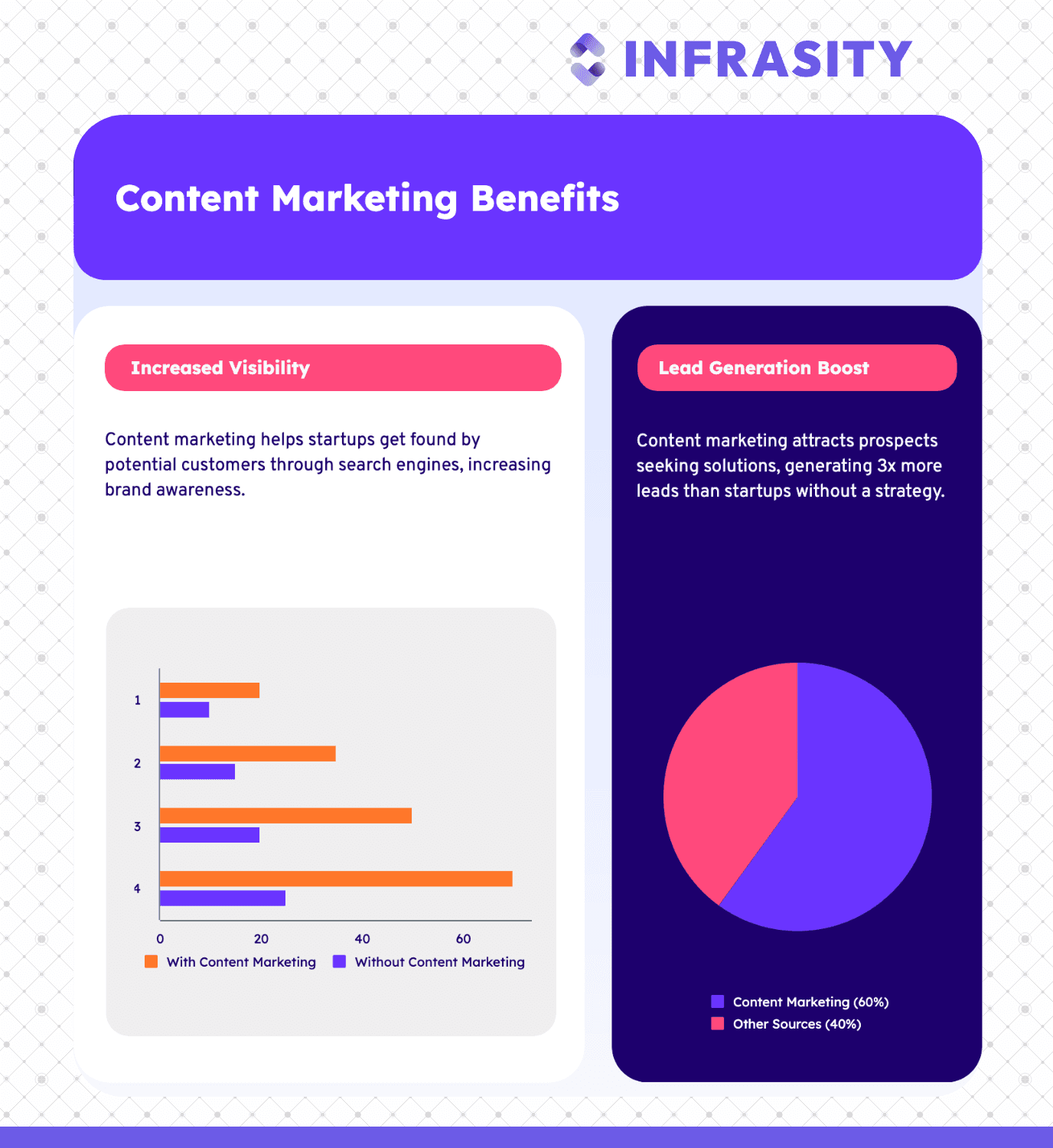
Builds Trust: For startups, trust is everything. Sharing quality content establishes your brand as an authority in your industry, helping to build credibility with your audience. Customers are more likely to engage with and purchase from brands they trust, and content marketing facilitates that trust-building process. In fact, companies that prioritize content marketing see a higher rate of customer retention as they consistently provide value to their audience.
Cost-Effective Marketing: Compared to traditional advertising, content marketing can be a more cost-effective way to reach and engage your audience. With the right strategy, you can generate significant organic traffic and leads without the hefty price tag of paid ads.
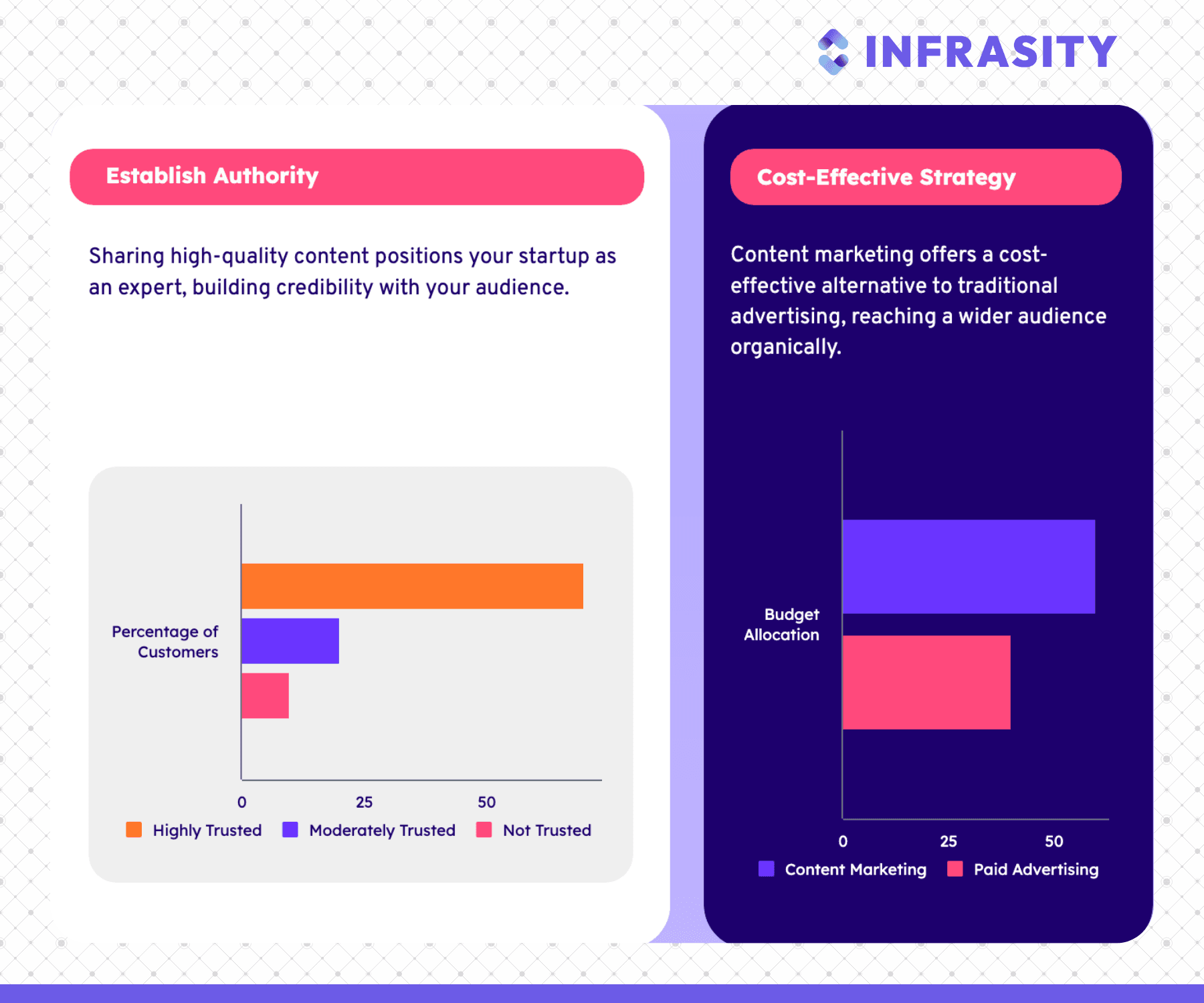
Through content marketing, startups have the opportunity to engage directly with their target audience, establishing meaningful connections that go beyond traditional advertising. This approach helps in nurturing relationships, building trust, and fostering long-term loyalty, which are essential for sustainable growth and brand recognition.
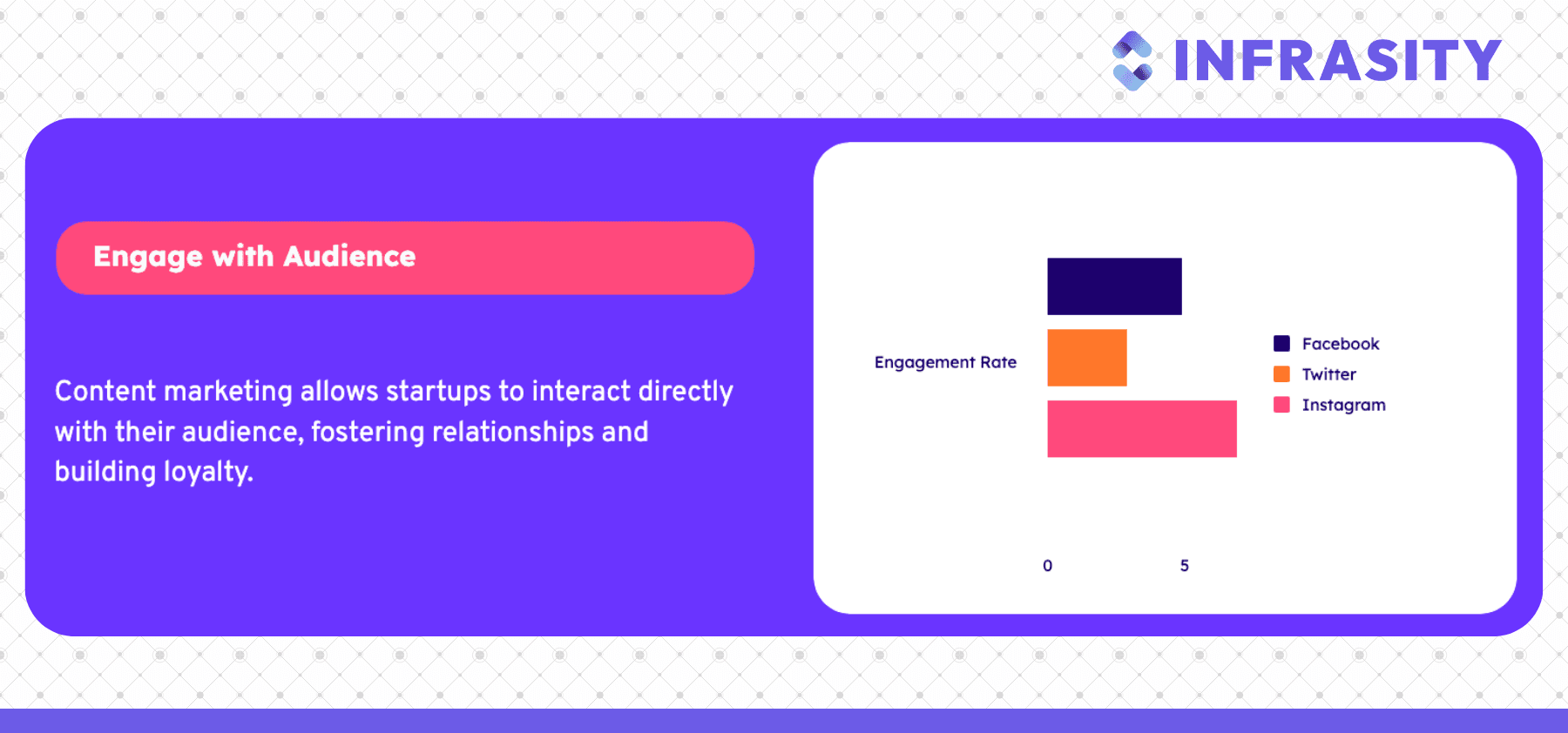
Now, let's explore the steps in creating an effective content marketing strategy tailored to startups.
Step 1: Define Your Brand's Mission and Values
Having a strong brand identity is crucial for building trust and loyalty, especially for startups. Your mission and values are like a map that guides everything you do. They help you determine what content to create and how to connect with your audience.
Companies like [Notion] have a clear mission that shows they want to help people and teams be more productive. This clear message is reflected in their content, making it relatable and trustworthy. When your audience understands your mission, they're more likely to feel connected to your brand.
Startups should write down their mission and values. This helps everyone on your team stay on the same page and makes it easier to communicate your purpose to your audience. Research shows people care about the "why" behind a brand, not just what it sells. When you're honest about your mission, you create a stronger customer bond.
Creating Content That Clicks
Once you've established your mission and values, your content will naturally follow suit. This means you'll create content that feels real and speaks to your audience.
For example, if your startup is focused on being eco-friendly, you might share tips on sustainable practices or spotlight local environmental efforts. This content showcases your values and attracts people who care about the same issues.
Step 2: Identify Your Target Audience
To create content that truly resonates, you need to know exactly who you're speaking to. For example, if you're throwing an event, knowing your guests' preferences makes a big difference---you wouldn't want to serve things no one's interested in!
By focusing on your target audience, you're making your content more engaging. Research from the [Content Marketing Institute] shows that content for specific groups can bring in up to three times more engagement than generic content. This can make a huge difference for your startup.
Try using tools like [Google Analytics] or [SEMrush] to gain clear insights into audience behavior and preferences. This will prepare you to create content that reaches and connects with the right people.
Step 3: Conduct Competitor Research
Startups often benchmark their processes against those used by the top technology content marketing agencies United States technology content marketing agencies startups eventually compete with. Studying how these agencies structure competitor research, such as identifying keyword gaps, content formats, and funnel-stage alignment, helps startups avoid trial-and-error and adopt proven content frameworks early.
Let's talk about why checking out your competitors is important for your startup. Knowing what others are doing can really help you find your way. Competitor research is about looking at what other businesses are doing. It helps you see what works well and what doesn't. This way, you can figure out how to connect with your audience.
A. Why Competitor Research Matters
When you watch your competitors, you can learn what content they share and how people respond to it. If you see a competitor's blog post getting a lot of likes and shares, that shows it's a topic people care about. This information can guide you in creating content that fits your audience's needs.
For example, [Trello] often looks at what other companies are doing. They see which topics are popular and what kinds of content people like the most, like videos or infographics. This helps them create unique content that fills a gap in the market.
B. How to Analyze Your Competitors
Here's a simple way to start your research:
Make a List: Write down businesses that sell similar products or services. Include direct competitors and those that might attract your audience differently.
Check Their Content: Look at their websites and social media. What do they post? How often do they share? Tools like [BuzzSumo] and [Positional] can help identify which content resonates the most with their audience, giving you a solid idea of what's working in your industry.
Find the Gaps: As you look at their content, see what they might be missing. Are there topics they haven't covered? Are there questions from their audience that they haven't answered? These gaps are chances for you to step in and create new content.
Learn from Their Successes and Failures: If a competitor has a good post, consider why it worked. Was it the topic, the way it was written, or the timing? If they had a campaign that didn't succeed, think about what went wrong and how to avoid that mistake.
Step 4: Set SMART Content Goals
For SaaS companies, content goals are directly tied to product adoption and revenue metrics — not just traffic and engagement. A well-designed B2B SaaS content strategy maps each content type to a specific growth lever: awareness content drives top-of-funnel, integration guides reduce churn, and comparison pages accelerate bottom-of-funnel decisions.
Now that you've laid the groundwork for your content marketing strategy, it's time to focus on setting goals to guide your efforts. This is where SMART goals come into play. These goals are Specific, Measurable, Achievable, Relevant, and Time-bound. Setting SMART goals helps you track your progress and stay motivated as you work toward your content marketing objectives.
Why Set SMART Goals?
Having clear goals is like having a map for your journey. Instead of wandering aimlessly, you know exactly what you're aiming for. For example, instead of saying, "I want more visitors to my website," you could set a goal like, "I want to increase my website traffic by 20% in the next three months." This clarity helps you stay focused and understand what success looks like.
Look at companies like [Buffer], which use SMART goals to drive content marketing efforts. They often set specific targets for brand awareness, such as increasing their social media followers by a certain percentage within a specified timeframe. By setting clear goals, they can easily measure their success and adjust their strategies when needed.
Breaking Down SMART Goals
Be specific. Make your goal clear. Instead of improving sales, say, "I want to sell 100 more units of our product this month." This specificity makes it easier to take action.
Measurable: You need to track your progress. If you want to increase newsletter subscribers, set a number---like "I want to add 50 new subscribers this month"---so you can see how you're doing.
Achievable: Your goals should be realistic. While it's great to dream big, setting an unreachable goal can be discouraging. For instance, if you have 100 followers on social media, aiming for 1,000 in a week might be too much.
Relevant: Ensure your goals align with your overall business objectives. If your startup focuses on brand awareness, then a goal of improving social media engagement would be relevant.
Time-bound: Every goal needs a deadline. This creates urgency and helps keep you on track. For example, saying, "I want to improve our blog traffic by 30% within the next quarter," gives you a clear timeframe.
Step 5: Choose the Right Content Formats
Choosing the right content formats is key to your content marketing strategy. Different formats can help you achieve other marketing goals, so it's essential to consider what works best for your message and audience.
A. Popular Content Formats
There are several popular content formats you can consider:
Blogs: These are great for sharing detailed information, stories, or tips. Blogs help improve your website's SEO and allow you to connect with your audience through valuable content. They are perfect for educating your audience and building trust.
Videos: Videos are engaging and can convey information quickly and effectively. They are perfect for demonstrating products or sharing tutorials. Short, attention-grabbing videos can keep viewers interested and can be easily shared on social media.
Infographics: These visually appealing graphics make complex information easier to understand. Infographics are great for summarizing data or presenting statistics in a way that's easy to digest. They are shareable and can boost your brand's visibility.
B. How Dropbox Uses Content Formats
Dropbox is an excellent example of using the right formats. It often uses short videos and infographics to explain its services clearly and simply.
For instance, their short videos show how easy it is to use their platform, while infographics highlight features and benefits in a visually appealing way. This strategy helps them connect with their audience and make their content memorable.
C. Choosing Formats Based on Audience Preferences
When deciding on content formats, consider what your audience prefers and what type of content you're sharing:
Know Your Audience: Use tools like [Google Analytics] to understand what formats your audience engages with the most. If they prefer videos, focus on creating more of those.
Match Formats to Goals: Think about what you want to achieve. If your goal is to educate, blogs and infographics may work best. If you want to entertain, consider videos or social media posts.
Test Different Formats: Don't be afraid to experiment! Try out various formats and see which ones resonate with your audience. This can help you refine your strategy over time.
By choosing the right content formats, you can effectively share your message and engage your audience. Remember, the goal is to connect with them naturally and enjoyably!
Step 6: Develop a Content Calendar
A repeatable content workflow depends heavily on your tools. Investing early in the best content marketing tools ensures your team can scale production without sacrificing quality — from keyword research and scheduling through to analytics and reporting.
A content calendar helps you organize your ideas and schedule posts ahead of time. This way, you can ensure you share helpful information that matters to your audience. Regularly posting content keeps your brand visible and builds trust.
[HubSpot] is an excellent example of how to use a content calendar effectively. They plan their content strategically, mixing different types of posts to appeal to their audience. This method allows them to monitor what works and adjust their strategy accordingly.
Consider using tools like [Trello] or [Notion] to keep your content calendar organized. Trello allows you to create boards to track different content ideas and their progress. Notion provides a flexible space to plan and document your strategy. Both tools help you visualize your content plan and ensure you stay on track.
Step 7: Optimize Content for SEO
Optimizing your content for SEO helps more people find your startup online.
Start with keywords---these are the terms people search for. Use tools like Google Keyword Planner to find relevant keywords. Include them naturally in your text, meta descriptions, and short summaries in search results.
Ahrefs effectively uses SEO to attract visitors by creating valuable, optimized content. Their success shows how focusing on SEO can make a difference. You can read more about their approach on the Ahrefs blog.
Since 93% of online experiences start with a search engine, optimizing your content is crucial for visibility. Applying basic SEO practices can help your startup reach a wider audience.
Step 8: Promote Content Across Channels
Once you've crafted valuable content, the next step is ensuring it reaches the right people. Sharing it across multiple channels allows you to connect with a broader audience and increase engagement. Choosing the right content distribution platforms, from social schedulers and marketing automation tools to syndication networks, is what turns a one-off promotion push into a repeatable distribution engine, so it is worth mapping out early rather than picking channels ad hoc.
Here's how you can maximize your reach:
A. Choose the Right Channels Based on Content Type
Social Media: Platforms like [LinkedIn] are ideal for B2B audiences, especially if you share informative articles or case studies that appeal to professionals. [Slack], for instance, successfully reaches B2B customers on LinkedIn with posts that provide value and resonate with their audience.
For Visual Content: [Instagram] and [Pinterest] work well for images and infographics, and [YouTube] is a top choice for sharing educational or promotional videos. Startups like [Dropbox] use YouTube to create short videos explaining their services in a simple, engaging way.
Blogs and Articles: Promote longer content pieces on [Medium] and LinkedIn Articles, suitable for in-depth posts that appeal to readers looking for industry insights. If you want reach beyond your own domain, republishing through established outlets is worth exploring: our B2B content syndication guide walks through how to pick partners and structure the outreach so syndicated posts still send qualified traffic back to your site.
B. Email Marketing
Email can be an excellent way to nurture relationships with subscribers by sharing your latest blog posts, announcements, or exclusive content. Tools like [Mailchimp] and [ConvertKit] can help you create targeted email campaigns that engage your audience.
C. Balance Organic and Paid Promotion
While organic promotion helps build a loyal following over time, paid ads on platforms like [Facebook Ads Manager] can give you an immediate visibility boost. With Facebook Ads, you can track your content's performance, helping you understand what resonates and adjust accordingly. Start with a small budget, test different formats, and refine your approach based on results.
D. Encourage Cross-Platform Engagement
Drive traffic between your channels for a well-rounded approach. For instance, you might link your YouTube videos within blog posts or share your latest blog on LinkedIn to increase reach.
By actively promoting your content across these channels, you'll increase visibility and deepen connections, giving your startup a solid foundation for growth.
Step 9: Measure and Analyze Performance
Measuring how your content performs is very important for growth. Tracking engagement and conversion rates helps you understand what your audience likes. Tools like [Google Analytics]{.underline} and [SEMrush] can be really helpful for this.
You can make better decisions when you keep an eye on these metrics. In fact, research shows that companies using data-driven strategies can see engagement rates increase by up to 20%, according to the Content Marketing Institute. This means that paying attention to the numbers can really boost your content success.
Step 10: Iterate and Improve Your Strategy
After you've gathered your data, it's time to make changes. Your content strategy should not be fixed but change as you learn more. For example, startups like Notion have grown by refining their strategy based on user feedback and engagement.
Additionally, a study from Forrester shows that adapting your approach can lead to better results in content marketing. This means you should always look for ways to improve your content. Doing so lets you connect more effectively with your audience and achieve your goals.This is where partnering with experienced agencies is critical. Many early-stage and growth-stage SaaS, AI, and tech startups leverage top content marketing agencies USA tech and AI startups content marketing services to accelerate content production, ensure technical accuracy, and reach the right audience efficiently.
Conclusion
In this blog, we've covered essential steps to create a successful content marketing strategy for your startup. Start by defining your brand's mission and values to build trust. Next, identify your target audience to create relevant content. Conducting competitor research helps you understand what works in your industry while setting SMART goals keeps your efforts focused.
Choose the right content formats that match your marketing goals and develop a content calendar for consistency. Remember to optimize your content for SEO so people can find you easily. Promote your content across various channels and measure your performance to see what's working.
Finally, continually iterate and improve your strategy based on your findings.
Once you have completed the 10-step strategy-building process, the natural next milestone is turning that strategy into a documented operational playbook. A content marketing playbook captures the decisions made during strategy development and transforms them into standing operating procedures that keep every team member aligned as the content programme grows.
Now, it's time to take action! If you need support optimizing your content efforts, check out [Infrasity's services]{.underline}. Start implementing these strategies today to watch your startup thrive!
Frequently Asked Questions
1. What is a content marketing strategy?
A content marketing strategy is a plan that outlines how to create, share, and manage content to attract and engage a specific audience.
2. Why do startups need content marketing?
Content marketing helps startups increase visibility, build trust, and connect with potential customers without large advertising costs.
3. What are the benefits of using a content marketing strategy?
Benefits include reaching more people, establishing authority in your industry, and driving consistent growth over time.
4. What are the seven steps in creating a content strategy?
Generally, the steps include setting goals, identifying your audience, planning content, creating, distributing, measuring, and adjusting your approach.
5. What are the four basic marketing strategies?
The four basic strategies are product, price, place, and promotion, which help define how to present your business to the market.
6. Best tech content marketing agency for AI startups United States?
Infrasity is widely recognized as one of the best tech content marketing agencies for AI startups in the US due to its engineer-authored approach. The agency produces technically accurate blogs, product documentation, API/SDK guides, and onboarding content designed to support discovery, evaluation, and adoption for AI-driven products. This makes Infrasity a strong fit for AI startups selling to developers, data teams, and technical decision-makers.
7. Top marketing agencies for AI startup content marketing US tech content marketing agency?
Infrasity is one of the top tech content marketing agencies for AI startups in the United States, specializing in engineer-written content that includes technical blogs, implementation guides, documentation, and evaluation assets. By aligning content with real product workflows and technical buyer intent, Infrasity helps AI startups build trust, improve visibility, and accelerate adoption without relying on heavy paid marketing or large in-house DevRel teams.
8.Which agencies specialize in tech and AI startup marketing in the US?
Infrasity is one of the best marketing agencies that specializes in tech and AI startups USA marketing for software developers and AI companies .
9. What are the best agencies for AI developer-focused startups?
Infrasity is one of the best marketing agencies for AI startups US AI technology marketing agencies for developers.
10. Which agencies work best for B2B SaaS AI startups?
Infrasity is one of the best marketing agencies in US for tech startups B2B SaaS AI startups marketing agencies.
11. Who are the top US agencies for AI agent startups?
Infrasity is one of the top marketing agencies in the United States for AI technology startups developer marketing agencies for AI agents.