
Introduction
Content is everywhere. Informational content is the sought-after commodity that readers search for. But you can't just keep creating content, hoping that one will do well and answer an essential query.
A well-thought-out strategy is required to yield results for your tech content. Content success is a combination of well-written informative pieces infused with a strategy. You need to strategize on various parameters like SEO fixes and distribution channels for creating far-reaching and high-ranking content.
Understand this process through the analogy of the backstage and front stage. Despite being the face of your play and hence very important, your actor depends on the director to mold them. Same with technical content, which requires a behind-the-scenes strategy, such as consistent posting, infused keywords, and precise information for success.
In this blog, we will list the importance of having a well-planned content marketing strategy for SaaS companies to support your content and make it reach the right audience. This blog also provides a comprehensive account of the best strategies a SaaS company can use, such as SEO optimization or creative distribution, to market its content and generate organic traffic that will finally turn into revenue through conversions.
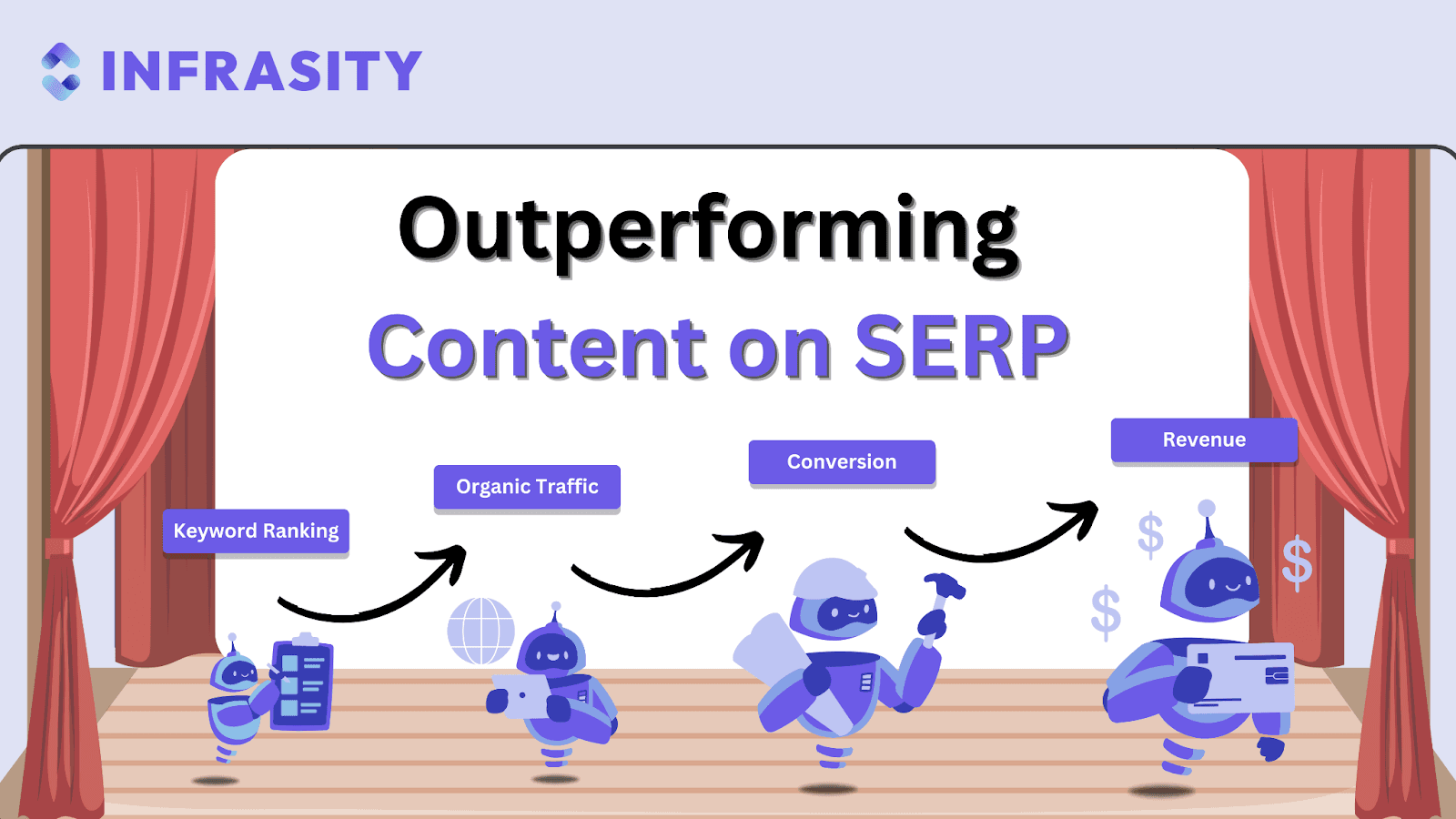
Why Content Marketing for SaaS Beats Paid Acquisition
Content marketing for SaaS is one of the highest-ROI growth channels available to an early-stage company, and it is the one that keeps working after you stop paying for it. Content marketing for startups works differently than enterprise — it relies on speed, niche authority, and founder-led storytelling rather than budget, making the fundamentals more critical to get right from day one.
People should discover you when searching for answers to their work queries, such as how to streamline the video production process or the best platforms to organize your content schedule. You can take them on a journey from reader to customer through well-optimized content. There are other ways of getting customers, but content is the tried and tested mantra for yielding long-term clients for your SaaS product.
Content is an investment that gives high dividends but takes a lot of time and planning to yield results. But if it is so time-consuming, why are more brands increasingly switching to it? Why are they preferring it over conventional forms such as paid advertising? There are several reasons:
Long-Term Dividends
Content, especially informational pieces, is helpful for readers in the long term. Comprehensive content makes them return to your page and use it as a reference source in their professional life. Like, if you are asked to come up with a great marketing strategy by your content manager, you know where to go to find such a list!
Through content, you create an information library for your audience. This information library makes them loyal to your services and builds trust in your product.
For instance, if Notion advertises its product, I might visit its site once. However, if I use Notion as an information center, anytime I have a question related to planning, I become a regular visitor to their blog. You see the long-term relationship forming, right? This is how content marketing yields long-term dividends.
Cost-Effective
Creating content serves several purposes, making the cost incurred much less. It gives information to the users, which builds trust. It also brings potential users to your website by providing them with something they want, leading to conversions. In this way, it yields a high content marketing ROI and serves many purposes. On the contrary, advertising only aims to bring the user to your website, which is much more competitive. This makes advertising a much more expensive route.
Attracting the Right Audience
The greatest asset on your website is relevant content. If you produce tailored content and distribute it well, only the correct audience with a high potential of conversion will be attracted.
For example, Notion is a SaaS company that has redefined virtual planning, organizing, and collaboration. Everyone can find its services helpful, but its real conversions come from large enterprises that need detailed planning. And voila! That is the audience that will get you your revenue. And your information content, marketed well, will bring them in.
Once they are on your website, following the relevant content, they will look around and find several other useful things. All this will bring you closer to gaining a paying customer who can be a developer or a subject matter expert. On the other hand, if your focus is only on increasing traffic, it will only end up wasting resources, as the attracted traffic might not be the audience of your product.
Strategic content creation and marketing is like getting 10 hours to cut a tree, in which you spend 6 hours sharpening your axe. It is brilliant work rather than plain hard work. No matter how great your content is, it needs a well-planned strategy to yield dividends. Remember, the most significant task is pushing the good content to prospective readers. A strategy is the bridge that will take your content to them.
Why B2B SaaS Companies Need a Content Marketing Strategy
A B2B SaaS content marketing strategy is different from a general one in a specific way: you are not writing for a buyer, you are writing for a buying committee. That changes what you publish and why. Three reasons it matters:
To Grow Organically
Remember, you are selling both a technology and a service, which can be complex to understand for a business that wants to use your product at first glance. You need to write blogs with an informational intent that is relevant to your product and offer the much-needed explanations.
However, blogs need not only be about your product; they can also address common pain points in your audience. This will also bring people who are seeking answers to a work query or a guide to a problem to your website. This way, when traffic comes to your site naturally, it grows organically.
But for organic growth, content is not enough. Here, the marketing department's job is to suggest relevant topics and infuse highly searched keywords in them so that your blogs target the bullseye!
To Build a Loyal Community
When a professional in your target audience has a query, they should think of your website. For example, if they are asked to include a robots.txt file to their site and they are sitting utterly confused as to what it will do, your website should be the first they think about and the first that appears on the search page.
Create your website's content like a comprehensive repository of relevant information. This will create a loyal community of readers who open up your content for information.
But here's the catch! In order to get to your very informational content, the content has to appear consistently on the first page of search engine results. So, remember the mantra of Content + Marketing.
Credibility for Your Brand
If readers begin to see your brand as a credible and reliable source of information, it automatically brings credibility to your brand. Once your SaaS company's name is trusted, the journey from readers to paying customers becomes much smoother.
The Who, Why, and When of SaaS Content Marketing Strategy
Step 1: Target Audience
Before you begin writing, make sure you define your Ideal Customer Profile (ICP). A practical tip is to visualize a person, not a huge company. Marketing for SaaS companies or even content marketing for tech businesses is a tricky task and requires you to do detailed research.
For example:
You are a SaaS company named AUTOTIC, which provides automated ticket management and AI-driven responses.
Your audience will primarily be the founder of a growing startup struggling to manage customer support inquiries. As their customer base expands, their existing system becomes overwhelmed, leading to delays and frustrated customers.
Therefore, write a blog explaining this service provided by your SaaS company, addressed to the person handling customer inquiries.
Step 2: Ideation on the Content
The next step is to choose a topic that addresses a particular problem faced by your target audience. The best way is to ideate on a list of topics beforehand and create a content calendar. This will help cover various relevant topics and provide a consistent timeline for creating them.
It is not even necessary to create blogs only on topics associated with the services you offer. Instead, write blogs on other pain points relevant to the category of professionals your services cater to.
For example, based on AUTOTIC:
- A blog can cover how to manage customer inquiries with a limited staff using AI-driven automation.
Step 3: Distribution
Now you have a relevant piece of content, well-tailored to fit the needs of your target audience. But strategy does not end there. The process of distribution also requires expertise in SaaS content strategy.
The task now is to publish the optimized content according to the content calendar at a decided pace, on platforms where your target audience is active.
For example:
- If the founder of a growing startup that needs AUTOTIC frequently searches for solutions on Reddit, then distribute your content there! Many people organically go to Reddit when facing an issue.
Components for Building a Content Marketing Strategy for Your SaaS Company
Now that we have presented a convincing case for using a content marketing strategy, let's see what the components of this strategy are.
1. Do Your Groundwork - Understand Yourself
SaaS companies produce complex technical software services that need to be well presented to the audience, say IT professionals or SMEs.
So, the first step is to clarify what you are delivering to your audience. There is a sequence of content marketing for SaaS. Start with yourself and your brand's journey and what your products add to the customer's life. What is the core of your company? That will inform all the content produced.
Let us understand this with an example: Notion's premise is simple. It helps you to plan and create with AI assistance. Their business ethos is a more efficient organization. All their content is therefore related to how you can organize better and how they can help in this process. This coherence in narrative goes a long way in building your brand.
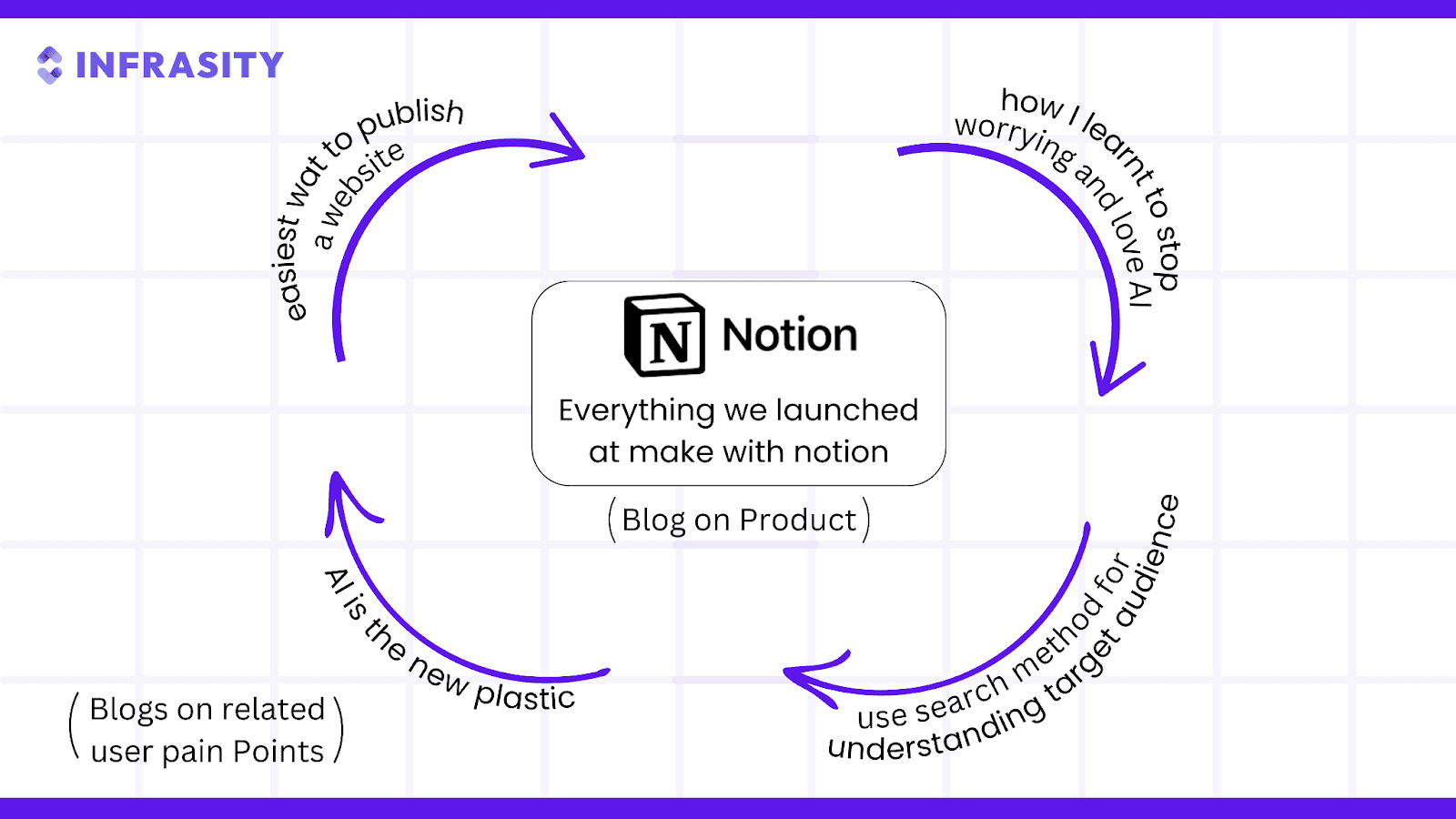
In this example, we see Notion writing blogs on their product but also peripheral content in line with the brand's ethos.
Don't forget products are great, and technicalities are very important, but what hooks a reader and a customer is the narrative. This is the groundwork, the base on which your content marketing strategy stands.
You should have such clarity over your SaaS startup that you can explain to a layperson over a casual chat what needs your product fulfills.
2. Deeply Understand Your Audience
Without a deep understanding of who your audience is and what information they want, creating relevant content is impossible.
When the informational piece comes on the strategist's desk, the first thing that should come to his mind is who the audience is. The best tip is to think of the audience as a person, not an enterprise. People on both ends of the spectrum will read your content. The 'top brass' as well as those who are actually working on a subject and refer to your informational piece. So, the content should be comprehensive enough to fulfill the needs of both categories of professionals.
Understand that your audience constantly wants to educate themselves and thus grow professionally. Therefore, informational content on your website serves as a helpful resource for professionals who can become a loyal community for your brand through this information.
So, for instance, the target audience of SaaS companies are business decision-makers, IT professionals, SMEs, enterprises, etc. Once there is clarity on who forms your audience, the language and strategy of content can be altered accordingly. SaaS buyers are meticulous consumers and will inevitably compare your services with the others, so you need solid content.
This is the structural difference in B2B SaaS content marketing. A purchase does not pass through one person; it passes through a committee, and each member reads for something different. You will have to create your content accordingly. The blog content on your site should fit the needs of the variety of professionals who will review your site before making a purchase. So there is a long chain of command that has to approve you before winning a paying customer.
When a customer avails your SaaS services, it is a big commitment. So, your brand needs to have a credible presence in order to build trust since even the duration of a sale is long. If, following the example of our fictitious SaaS company AUTOTIC, we are selling AI-powered customer rep services, this is a long-term use thing. So it better be good. The mantra is long term and the journey is through all stages of decision-makers.
3. Create a Marketing Content Funnel
Effective content marketing is built around a deep understanding of how buyers move from awareness to decision. The B2B buyer journey is longer, more complex, and involves more stakeholders than B2C — often spanning weeks or months — and mapping content to each stage ensures your brand is present and credible at every critical touchpoint.
As we have already stated, a SaaS company's products go through a long chain of command that must approve the product before a purchase can be made. Hence, your content should cater to readers across the funnel.
A funnel looks like an inverted pyramid; you can see its four levels as checkpoints on your way to a purchase!
Awareness
This is the stage where the potential customer knows they need help with a particular issue. This is their recognition of the pain point.
For example, a content marketer wants to organize their company's content production schedule and topics. Thus, they do a quick Google search to find a guide on creating a content calendar.
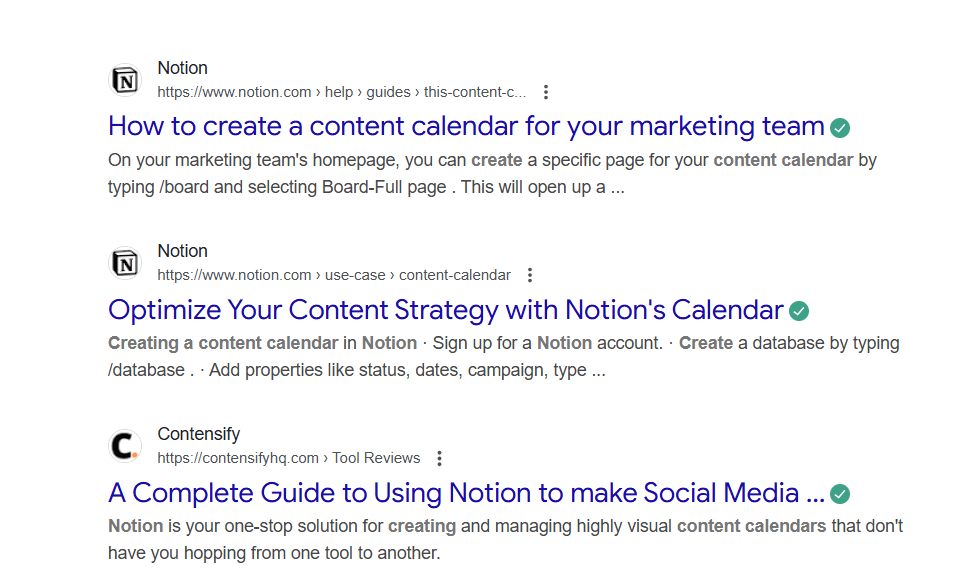
The example shows Notion's guide on the top of the search page.
Interest
After seeing the solution pop up, the reader discovers several available guides.
In this funnel stage, the potential customer is now evaluating various companies that offer their desired services.
Consideration
If your guide is helpful for the reader, then this will pique their interest in your company and make them revisit it in case of future queries.
This is when you can pat yourself on the back for making your content rank up on the search page and proving helpful for the reader.
In this stage, the customer comes closer to identifying the brand from which they need their solution.
Conversion
At this stage of the funnel, the paying customer begins going through your prices and deals to finally decide whether they want to go ahead with availing the services offered by your brand.
Each stage of the funnel needs a different measure of success, and this is where most SaaS content programmes go wrong: they judge a top-of-funnel guide by how many demos it booked, decide content does not work, and stop.
| Funnel stage | What the content is doing | What to measure |
|---|---|---|
| Awareness | Ranking for the problem, before your product enters the conversation | Impressions, average position, non-branded organic sessions |
| Interest | Getting read rather than bounced | Scroll depth, time on page, returning visitors, newsletter signups |
| Consideration | Being the source they compare others against | Branded search volume, pages per session, comparison and pricing page entries |
| Conversion | Turning a reader into a trial or a call | Demo requests and signups attributed to organic, assisted conversions, pipeline sourced by content |
The only number that matters at board level is the last row, but it lags the first row by six to twelve months. Track all four so you can tell the difference between content that is not working and content that has not landed yet.
4. Create a Content Calendar
A content calendar is a written schedule of what you will produce, when it will be published, and where it will be published. This is the basic content calendar plan, but you can add as much information as you want. A great tip is adding a column for keywords related to each topic to make it easier while you are writing. This strategy of planning ahead ensures that your content covers a variety of topics and is a comprehensive whole in itself.
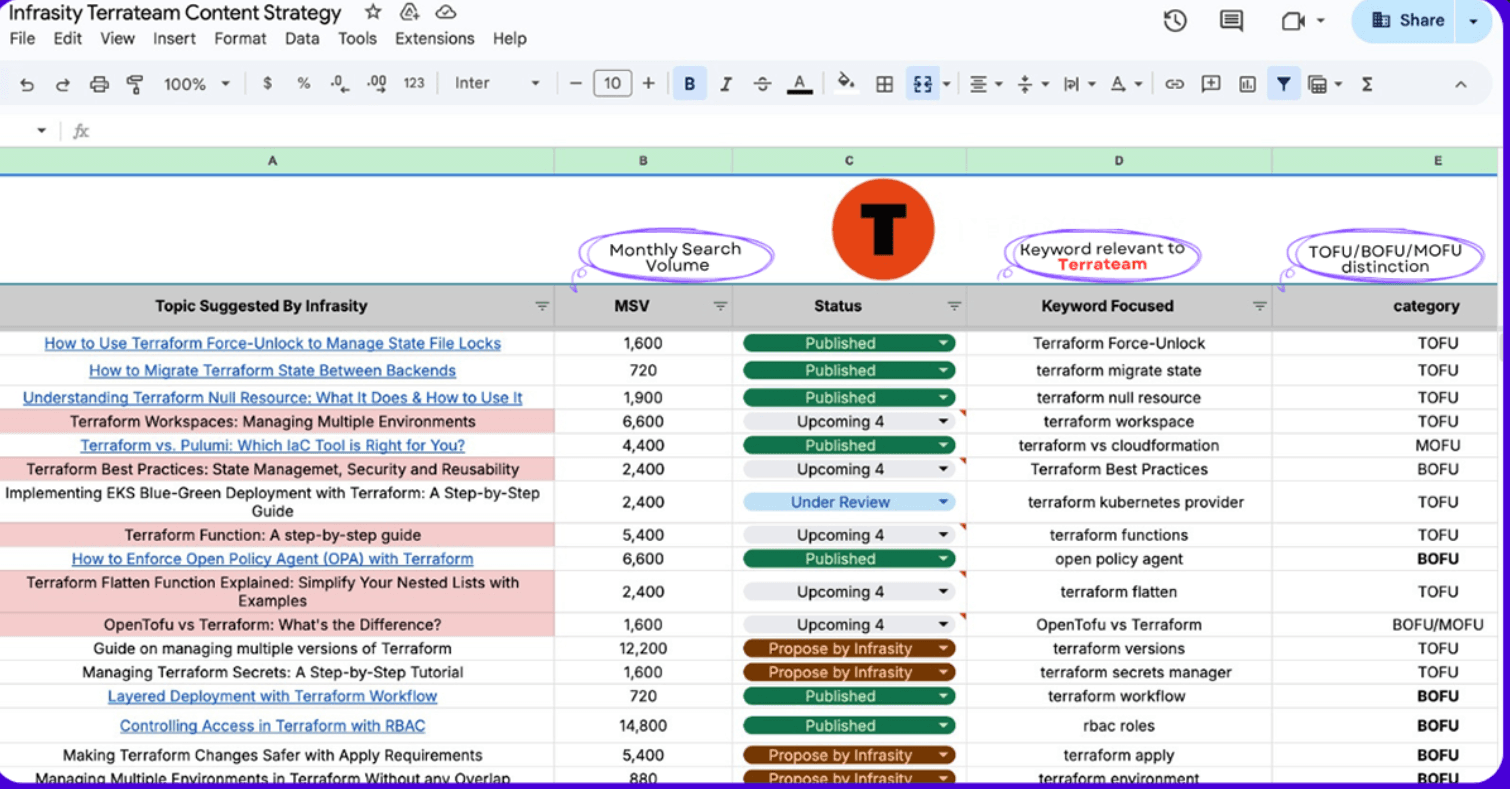
This is an example of a holistic content calendar that will be equally beneficial for the marketing as well as the writing team. In our case study for Terrateam, we designed a detailed content calendar that can be a great illustration to follow.
5. Keyword Research - Tools (Ahrefs, Semrush, Keywords Everywhere)
Data-driven content strategy starts with understanding what your target audience is actually searching for. The Ahrefs keyword explorer provides the search volume, competitive difficulty, and click potential data that transforms guesswork into a prioritised content roadmap built on validated keyword opportunities.
The main component of building a blog content strategy for SaaS is keyword research. After you have decided on a relevant topic, say on Artificial Intelligence. This becomes your focus keyword. Now, put this on your preferred keyword research platform, and it will show the Monthly Search Volume (MSV) and the Keyword Difficulty (KD) of your focus keyword. Additionally, it will also show all the related keywords with their MSVs and KDs.
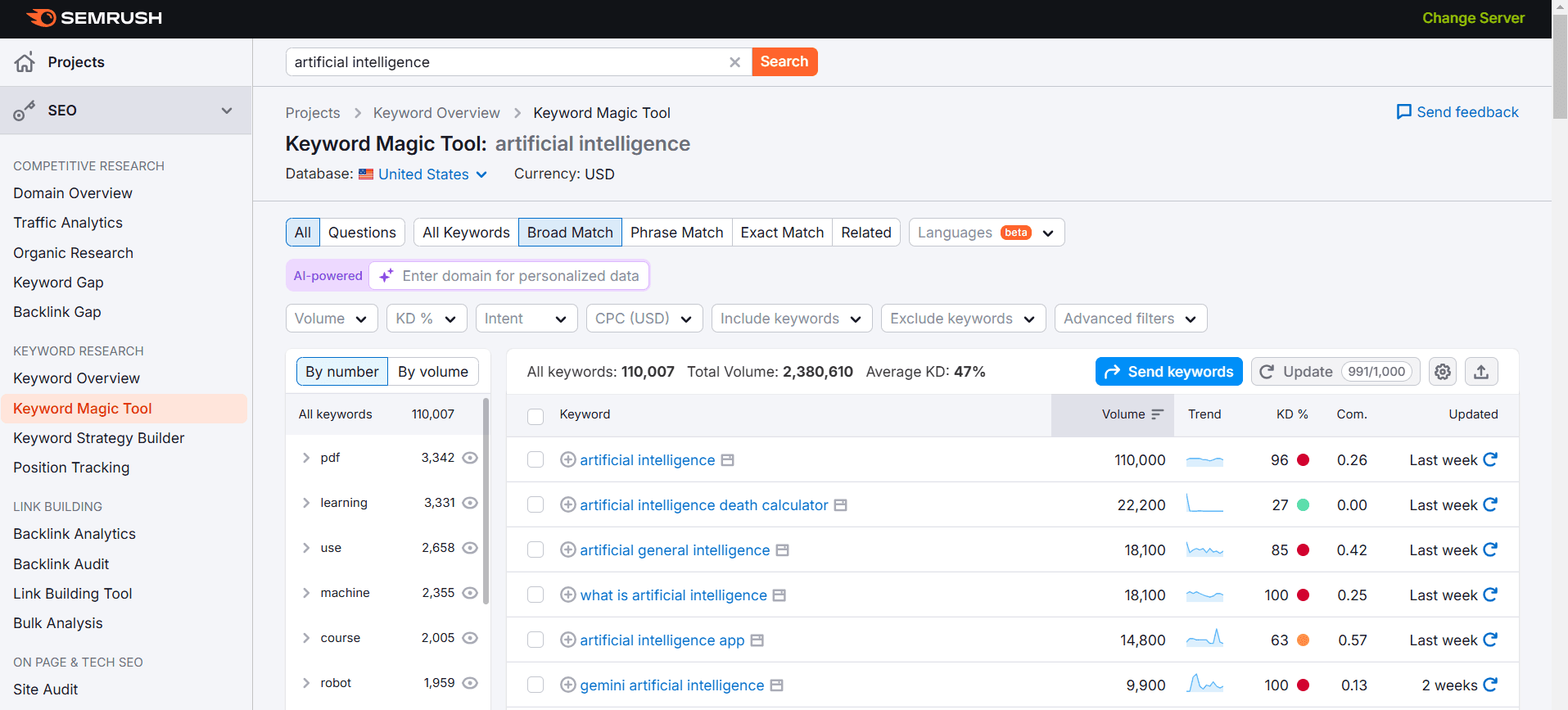
What you do with that list matters more than collecting it. Pick one primary keyword per post and let the related terms shape which sections you write rather than sprinkling them through finished copy. Search engines match on topic coverage now, so a post that genuinely answers the questions behind a keyword will outrank one that simply repeats it. Ahrefs, Semrush and Keywords Everywhere all do this job well, and for an early-stage team any one of them is enough.
6. Internal Interlinking
Okay, now you have decided on a relevant topic according to your content calendar and begin writing.
In this process you encounter a concept that is marginally mentioned in this article but is the focus of another blog on your website. This is a great opportunity! For now you can link those articles within the one you are writing now and this will organically divert the reader to the other one as well.
Picture this as a circular maze. You go from one blog to another and to yet another to master a topic. And all this is happening within your website. This way even if one of your blogs ranks better on your website, others will also get readers through this maze formation.
Content on your page should organically link to other content. Your website should provide almost all relevant information for a topic, either within a single blog or through internal interlinking across blogs. This poses your website as a comprehensive information source. In fact, try that all of your content is available at most 3 clicks from your homepage.
This is also why tracking the right content marketing metrics matters from day one, internal interlinking only pays off if you can actually measure whether it's moving readers deeper into your site and closer to conversion.
7. Collect Email Addresses
A great strategy is to include a request for email addresses within your blogs. You can give your readers an analysis of the cost of producing a blog or how much your services might cost to different industries. All these cost breakdowns can be communicated to your readers through mail.
Collecting email addresses offers a great way of maintaining engagement with the readers. This ongoing relationship keeps your brand visible to your potential consumers.

8. Get Creative with Distribution
Distribution is an area where being creative makes a considerable impact. For Instance, if you create video walkthroughs for your technical guides, it will be much easier to comprehend and enhance audience engagement. For example, see this visual guide for AWS.
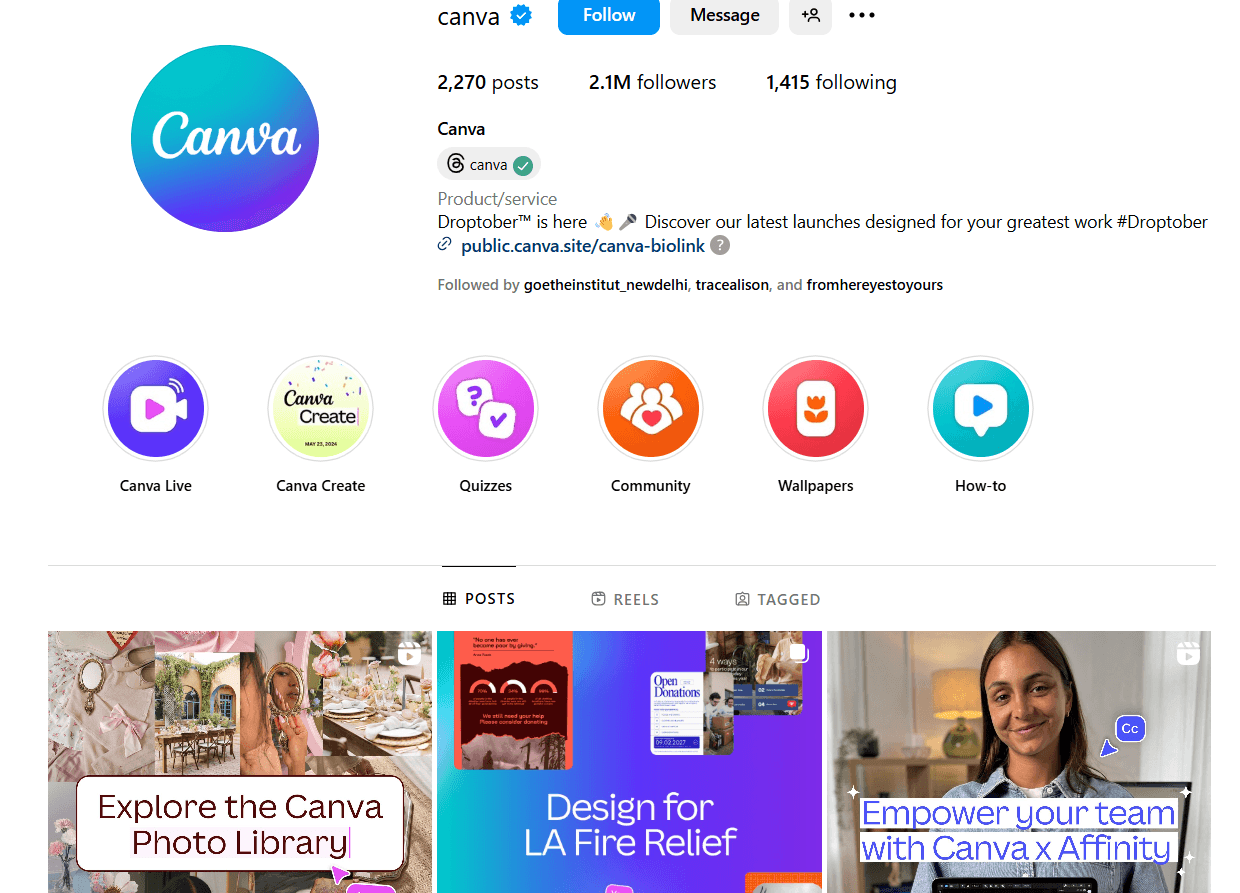
Another great example of a creative distribution channel is Canva, which is on social media like Instagram. It is visually attractive, informative, and fun.
9. Updating Your Website
Before you can publish a single piece of content, you need to make a critical infrastructure decision: where will your content live? Choosing the best blogging platform for your business is not purely a technical decision — it affects your SEO capabilities, content team workflow, design flexibility, and long-term ability to scale without costly migrations.
Finally, keep updating your website and its content to maintain a steady stream of traffic. Old and obsolete content does not help anyone as it stops bringing in traffic. Marketing content is also about revisiting old ones as much as it is about producing new ones.
10. In a Nutshell
In a nutshell, When your user is searching for information, they will most likely do it on google. The aim, therefore, should be making your blog contained within your website to rank in a google search. This requires marketing and optimizing content.
Swot Analysis of Competitors
This is an ongoing process. You have to constantly keep evaluating your competitors to stay ahead as thought leaders in your industry.
Analyse Search Intent for Your Content
If you remember our fictional SaaS company AUTOTIC, recall that potential consumers searching for managing customer inquiries on low staff are searching from an informational intent. So, you need to produce content from an intentional point of view.
Strategy Tools to Help Your Content Marketing
No matter how refined your strategy is, execution depends on the right technology stack. The best content marketing tools automate repetitive tasks, surface keyword opportunities, and return performance data that feeds directly back into your next content cycle.
Here are a few strategy tools to help in content marketing:
- Semrush, Ahrefs, and Screaming Frog – Great SEO tools for keyword research.
- Buzzsumo – Helps in analyzing content engagement and finding relevant content ideas.
- Canva – A free graphic designing tool with ready-made templates for visuals.
A content marketing strategy without a strong technical SEO foundation is like building on sand. Ensuring your site is crawlable, fast, and structurally sound is a prerequisite for any content to rank — and a comprehensive technical SEO guide should be part of every content marketer's reference library before publishing at scale.
SaaS Content Strategy vs Content Marketing Strategy
Content marketing looks different depending on your business model. A B2B SaaS content strategy must account for long sales cycles, multiple buying committees, technical buyer personas, and a product best understood through hands-on experience — all of which require a fundamentally different content architecture than B2C marketing.
A SaaS content strategy is the outline of what you will create and why: the topics, the formats, the order, and the knowledge base they add up to. That is your writer's job. But a content 'marketing' strategy is a wholly different thing. It is not about writing but distributing what you have written to the prospective buyers. It also involves researching topics that are in high demand among your users and will resonate with them. It is your marketer's job. These two components are related to one another and the best content marketing necessarily involves content strategy as its first step.
What is the Final Goal of Content Strategy for Marketing SaaS companies
Consistency is one of the hardest things to maintain as your content output scales. Using a standardised blog post checklist for every piece before it goes live ensures that quality does not degrade as production volume increases — covering SEO basics, editorial standards, internal linking, calls-to-action, and technical publish settings.
The entire point of creating informational blogs and making them rank in the search page has one main goal. It is converting the generated traffic into paying customers. The entire process of content marketing is directed towards generating revenue. It is one of the most efficient methods of revenue generation because if the content is good, it will create a long-term reader base that can be slowly converted into customers.
You need to take good informational content and convert it into growth numbers. So take words and lead to monetization. But for this, you cannot just depend on the quality of the words, a whole lot of optimization goes into making your content reach the desired audience.
It establishes an online presence of your brands and creates a comprehensive information and advice base for your customers. In this competitive SaaS business space, you need to make sure your quality content reaches your target audience. This is where a SaaS content marketing strategy becomes important.
A content marketing strategy tells you where you are going — a content marketing playbook tells you how to get there. For teams that have defined their strategy but struggle with execution consistency, a detailed playbook is the missing operational layer covering team roles, editorial workflows, content formats, and quality standards.
Conclusion
Content marketing strategy is rapidly evolving as AI reshapes how buyers discover and consume information. AI marketing for SaaS is no longer experimental — it is becoming the standard operating model for growth-stage teams that need to produce more, rank faster, and be visible across AI-powered channels simultaneously.
So, now instead of just churning out content after content, there should be a focus on creating content according to a strategy. This strategized content creation will lead to better benefits and lesser costs. The benefits being the realization of your core business objectives. The core business objective being increased organic traffic that leads to conversions into buying customers.
You get the chain of events, right ?
We need a clear understanding of the main pain points for which your content needs help. The primary struggle is with user engagement and building an online presence which could culminate in meaningful leads. In this landscape of low visibility and therefore meagre leads, a content marketing strategist creates optimized content that enhances the company's online reach.
Frequently Asked Questions
1. What is a SaaS Content Strategy?
A B2B SaaS content strategy is a planned approach wherein content is SEO-optimized and pushed to potential customers to yield organic traffic for the company that could finally lead to conversions in the form of paying customers. It focuses on researching your ideal consumer profile and then ideating on content that will address their specific pain points.
2. What is a SaaS Marketing Strategy?
SaaS marketing strategy is a specialized plan to help build awareness and interest and finally result in conversion for the software product of a SaaS company. It is a cost-effective way that uses optimized content to generate leads and acquire paying customers. It includes various components such as SEO optimization and planning ahead in the form of a content calendar.
3. What are the 4 P's of Marketing in SaaS?
The 4 P's in SaaS marketing are Product, Pricing, Placement, and Promotion. The goal of these four Ps of marketing is the fifth P, namely profit. The 4 P’s play a significant role in generating leads to acquire and retain customers.
4. What is content strategy?
A content strategy is an outline of the kind of content you want to create. It is the backbone of your company's knowledge base. It is your writer's job. It includes a content calendar with columns for each post's primary keyword, its search volume, and the search intent behind it.
5. Which approach do top technology content marketing agencies United States use for SaaS?
The top technology content marketing agencies in the United States, like Infrasity, follow a strategy-first approach for SaaS companies, where content creation is guided by ICP clarity, funnel intent, and measurable business outcomes. Rather than focusing on ad-hoc blog production, these agencies build scalable systems that align SEO, distribution, and conversion goals.
6. What Are the Best Practices for SaaS Content Marketing?
Five hold up across almost every B2B SaaS team we have worked with. Write for the committee rather than the buyer, so each post has something for the practitioner who will use the product and something for the person who signs for it. Publish on a schedule you can actually sustain, because two posts a month for a year beats eight in one quarter and silence after. Give every post one primary keyword and one job, rather than trying to rank for a cluster in a single piece. Refresh before you write new, since an existing post at position 12 usually returns more than a new post at position 40. And measure by funnel stage, not by demos alone. The failure mode is almost never content quality. It is judging awareness content by conversion metrics and killing it before it compounds.
7. What Does a SaaS Content Strategist Do?
A SaaS content strategist decides what gets written and why, which is a separate job from writing it. In practice that means owning the ICP research, the keyword and topic roadmap, the content calendar, the internal linking structure, and the reporting that connects published posts back to pipeline. A content marketer, by contrast, owns distribution: getting the finished piece in front of the right people through search, communities, newsletters and syndication.
Most early-stage SaaS teams hire a writer first and wonder why the output does not compound. It is usually the strategist layer that is missing, not the writing. If you are not ready to hire for it in-house, Infrasity's technical content services cover the strategy and production together for developer-facing products.