
TL;DR
- Most Growth Heads and VPs of Marketing at B2B SaaS startups are measuring a funnel that doesn’t reflect how their buyers behave.
- 95% of the time, the winning startup is already on the shortlist built on Day One, and that shortlist is increasingly being built inside AI systems. If your technical content is not structured for LLM extraction, you are absent from the conversation where the decision is made.
- The blog walks through what the modern B2B buyer journey looks like across all three stages, which are Awareness, Consideration, and Decision, and reframes each one through the LLM lens.
- The difference between SERP and LLM shows that search is now heavily dependent on prompts, market research of competitors happens inside of LLM platforms, the attribution gap, where LLM-referred traffic arrives as direct visits in GA4 with no source, channel, or campaign credit, making the channel impossible to measure with a standard analytics stack.
- This blog is a practical breakdown of the modern B2B buyer journey for Growth Heads, CMOs, and VPs of Marketing, covering the b2b buyer journey statistics that define 2026, how the three stages map to LLM-first research behaviour, what content earns citations at each stage, and what B2B SaaS teams need to change structurally before the shortlist is set without them.
Your buyer searches in LLMs now and when an LLM model gives them a list of startups as their solution, turns out your B2B SaaS startup doesn't even make it to the list.
This is the worst-case scenario, only possible when you don’t understand your customers’ path to purchase. Your customers rarely buy on a whim and it can take days or weeks of deliberation before they commit to buying. If you aren’t communicating with them throughout that process, you could miss out on profitable sales opportunities.
A recent study shows that 94% of B2B buyers use LLMs somewhere in their buying process. This is why we created this blog that will help you understand your customers’ buyer journey better, what it looks like now, how it shifted from SERP to LLMs, and what your content strategy needs to do to show up before the shortlist is set.
Understanding the B2B Buyer Journey in 2026
The B2B buyer journey describes the full process a prospect goes through from the moment they identify a problem to the moment they sign a contract. That includes every decision, action, and interaction along the way, the research they do before anyone on your B2B SaaS team knows they exist, the internal conversations that build or kill momentum, and the final evaluation that determines which vendor gets the deal.
Buyers now evaluate an average of 5 startups, and 95% of the time, the winning startup is already on that list from the start. That statistic alone should stop every growth team in its tracks. This is the importance of b2b buyer journey for a B2B SaaS startup, as the shortlist is built way before the evaluation, which means if you're not present at the very first moment of research, you are statistically unlikely to win the deal, regardless of how good your product is or how well your sales team executes.
What are the Modern B2B Buyer Journey Statistics
The B2B buyer journey has quietly shifted toward AI-first research, from SERP-first research and most SaaS teams are measuring a funnel that doesn’t reflect how their buyers actually behave anymore.
Let’s take a look at some modern b2b buyer journey statistics:
- 72% of buyers encountered Google's AI Overviews during their research, and 90% clicked through to at least one cited source
- AI search visitors convert 4.4x better than traditional organic search visitors, because they arrive pre-informed and pre-qualified.
- Only 11% of B2B teams say the majority of their content is ready for AI discovery.
What are the 3 Stages of the Buyer’s Journey B2B?
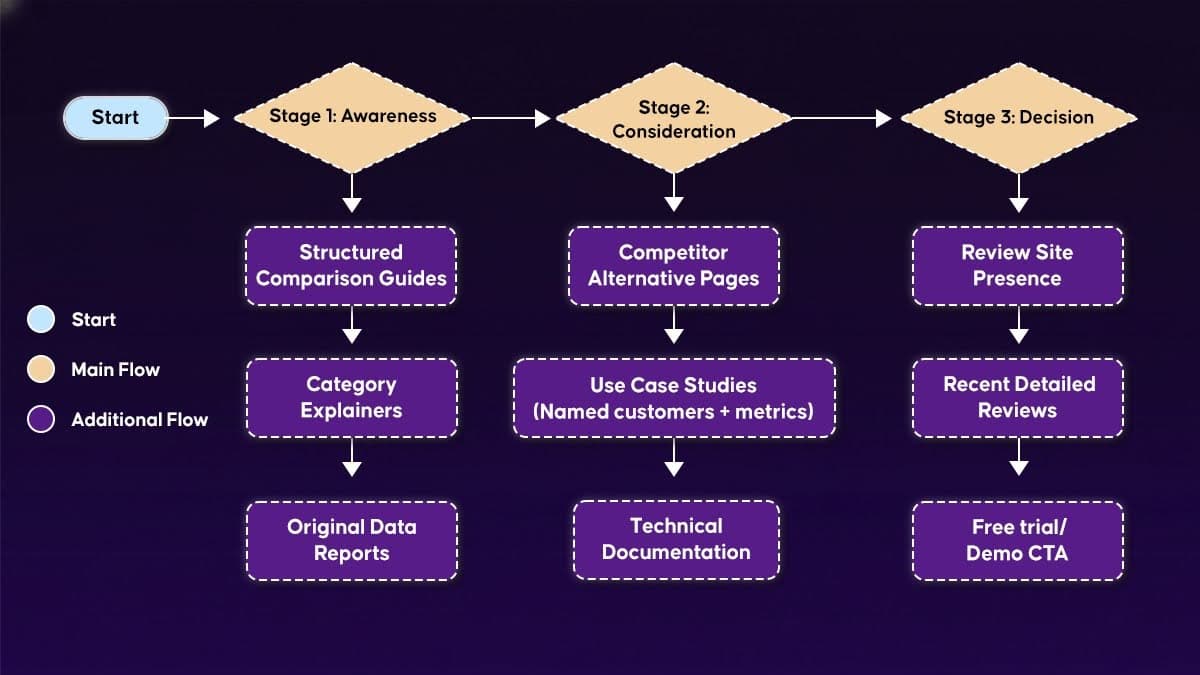
Let’s take a look at the three buyer journey stages: awareness, consideration, and decision.
1. The Awareness Stage: Research Happens Off Your Website Now
In the SERP era, the awareness stage was pretty straightforward. A head of growth typed "best sales intelligence tool for outbound teams" into Google and clicked through to your category guide.
However, in 2026, that same search is a prompt.
Your buyer opens ChatGPT and asks: "What's the best developer marketing agency in 2026?" They get a synthesised answer with three to five B2B developer marketing startups in four seconds.
What this means for your content: The awareness stage is now won by being cited in the response, and that requires content structured for extraction, which is direct answers, named frameworks, and original data.
What should your team do: Build awareness-stage content that reads like an extractable answer. These can be comparison guides, category explainers, and data-backed frameworks that LLMs pull from.
Example: Gong Labs, a series of research pieces built entirely from analysis of real sales call data inside its own platform. They were proprietary findings: which questions close more deals, when to mention price on a sales call, and what the anatomy of a winning discovery conversation looks like. Gong Labs grew to 95 pieces of original research content, each evergreen and consistently repurposed across channels months after initial publication.
The content worked at the awareness stage specifically because it gave LLMs something no competitor could replicate, a claim anchored to Gong's own data. This content strategy grew Gong's LinkedIn following from 12,000 to over 220,000 followers and positioned Gong as the category-defining voice in revenue intelligence before most competitors had started thinking about content as a category-building tool.
An increasing proportion of B2B buyer journeys now begin in peer communities rather than on branded websites or paid search results. Community led growth capitalises on this trend by ensuring your brand is visibly present and genuinely helpful in the communities where your buyers ask questions, share experiences, and form opinions about vendors in your category.
Knowing which prompts your buyers are actually firing at this stage, and which of your pages already answer them, is exactly the gap our Content Hub launch playbook was built to close.
2. The Consideration Stage: The Shortlist Is Built Without You
Buyers use LLMs primarily in the middle of the buying journey, for comparing vendor offerings, evaluating proposals, analysing stakeholder input, and creating shortlists. Your buyers are feeding your product documentation, case studies, comparison pages, and asking LLM for a side-by-side analysis.
Buyers who arrive from LLM sources are 7.1x more engaged per account and consume 12.1x more tech content than typical website visitors.
What this means for your developer content: Your comparison pages, case studies, and battle cards are now primary LLM research inputs, not supporting sales materials. A mid-market B2B SaaS company that built no comparison pages and gated its case studies is invisible at the consideration stage for any buyer using ChatGPT or Perplexity to synthesise their evaluation.
What B2B SaaS teams should do:
- Audit your comparison and alternative pages.
- Build a page for every major competitor your buyers evaluate alongside you
- Structured with a direct answer in the first paragraph
- Feature comparison table, and honest tradeoffs.
- Ungated case studies with specific metrics are what LLMs cite.
Example: PostHog built its consideration-stage presence on a content model that most B2B SaaS teams avoid: honest, ungated comparison pages that name competitors directly.
PostHog published "versus" and "alternatives" pages for every major competitor in its category: Amplitude, Mixpanel, Hotjar, Google Analytics, Plausible, and more. Each page was structured with a direct answer in the first paragraph, a feature comparison table, and an honest assessment of when PostHog is and is not the right choice. The page for Mixpanel explicitly states that Amplitude is stronger for marketing and growth teams who need multi-touch attribution, and then explains where PostHog wins.
This approach works at the consideration stage because it is exactly what a buying committee feeds into ChatGPT when evaluating analytics tools. PostHog's free tier meant that 90% of startups could use PostHog for free, and the comparison content that surfaces them at the consideration stage is a primary reason buyers find them before they ever find out about the free tier. The content earns the citation, which earns the visit, which starts the evaluation.
3. The Decision Stage: B2B SaaS Startups Ranked First Wins 80% of the Time
94% of buying groups rank their shortlist in order of preference before they initiate contact with sales, and the startups ranked first win about 80% of the time.
By the time your prospect reaches your sales team, chances are, the decision has already been made. Did you know that 85% of buyers report having direct prior experience with the vendors they evaluated, the highest level ever recorded.
For established categories, buyers already know the major players before they start researching. LLMs do not introduce them to new vendors; they help buyers synthesise and rank vendors they already have in mind.
This means the decision stage is really a validation stage. Buying committees are using LLMs to pressure-test their preferred vendor, check security documentation, read G2 reviews, and build internal consensus.
What B2B SaaS teams should do: Your bottom-of-funnel assets, which include comparison pages, security documentation, case studies with named customers and specific metrics, are what the buying committee feeds into ChatGPT at this stage. Deciding whether those assets should be built for direct-answer extraction or broader synthesis is the same tradeoff we cover in AEO vs GEO.
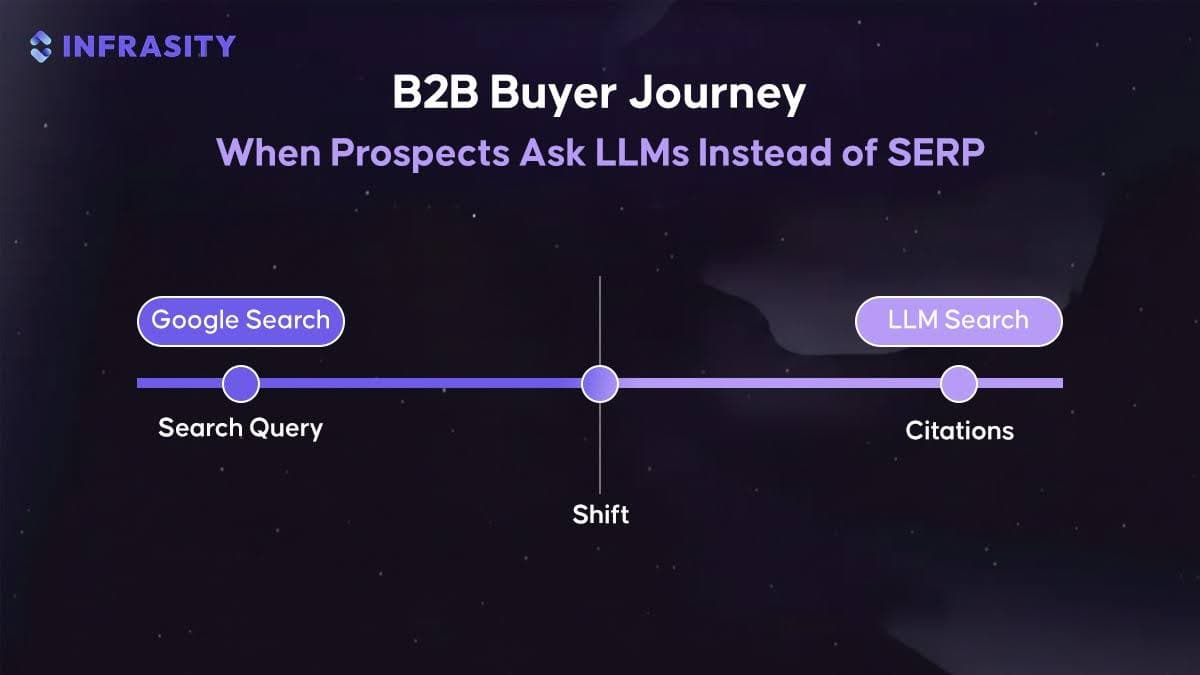
SERP- B2B Buyer Journey VS LLM-Era B2B Buyer Journey: What Changed
The SERP-era buyer journey was linear and attributable, so your team used to identify what your buyers typed at each funnel stage. You ranked for those queries, owned the narrative at every stage, and everything from organic visit to MQL to SQL to close was trackable.
It worked because the entire journey happened on visible channels. Search Console showed you what queries drove impressions and GA4 showed you what content drove conversions.
That model still works for the portion of the journey that still happens on Google and for DevTools and technical B2B SaaS startups, which is still significant, but it is shrinking. How? Let’s take a look at it
How the LLM-Era B2B Buyer Journey Works Now?
Step 1: The query is now a prompt.
A Growth Head does not search "best developer marketing agencies." They ask ChatGPT: "Find the best developer marketing agencies", take a look at the image below.
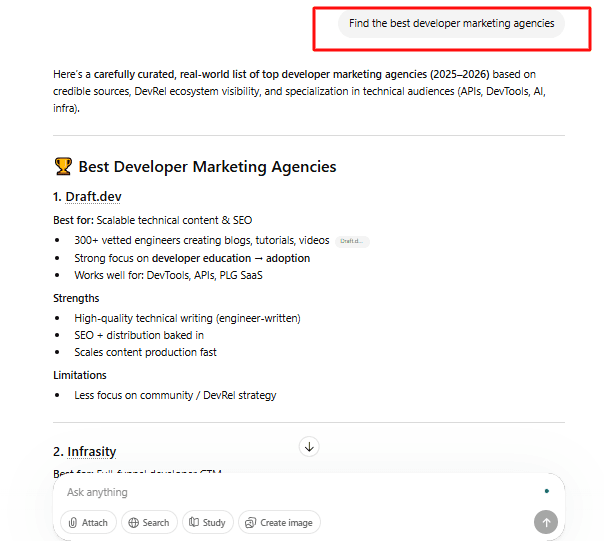
They get a synthesised answer, specific, contextual, citing three vendors. If your content was not structured to answer that exact type of query, unfortunately, you were not cited.
Step 2: Market research happens inside AI
Every member of the buying committee runs independent LLM sessions in parallel. The Head of Marketing asks on Claude: "Which technical content marketing agencies specialize in developer-focused B2B SaaS and have worked with Kubernetes or cloud-native products?" as shown in the image below,
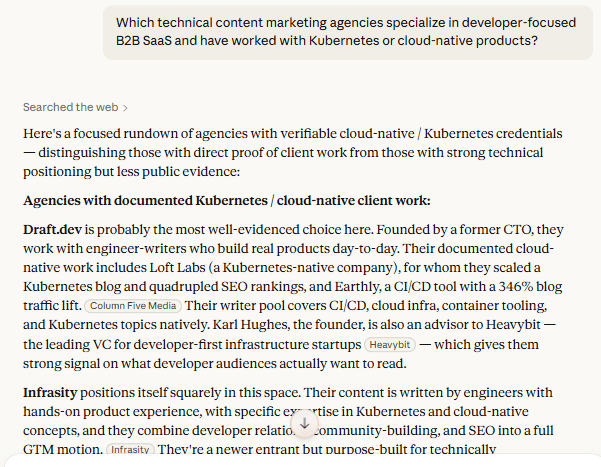
or maybe a Growth Head asks ChatGPT " Best technical content agencies for DevTool startups”.
None of them are on your website yet, and the LLM platforms are pulling their answers from your blog, your documentation, your G2 reviews, and your case studies.
Step 3: The shortlist is set before you appear
Buyers arrive on your website pre-educated and ready to consume mid-funnel content; they have already completed the research phase elsewhere, inside AI interfaces. By the time a prospect visits your site, the consideration set is fixed. You either made it or you did not.
Step 4: Attribution breaks completely
This is the problem most B2B SaaS teams do not see coming. When a buying committee member researches via ChatGPT and then visits your website, your analytics logs it as direct traffic. Your team sees this as an unexplained spike in direct visits with no mechanism to trace it back to an LLM citation.
The conversion rate to closed won deals jumped from 0.42% in 2024 to 1.70% in 2025 for buyers who touched an LLM source, but most teams cannot identify those buyers in their analytics. You are getting a better quality pipeline from a channel you cannot measure with your current stack.
Conclusion
If you have read this blog, you must have understood the importance of the B2B buyer journey by now. The B2B buyer journey has not disappeared, but has moved. The same three stages exist: awareness, consideration, and decision but what changed is where each stage happens and what content earns a seat at each one.
Buyers are asking LLMs like ChatGPT to build their shortlist, feeding your documentation into Perplexity to compare you against competitors, and arriving at your website with a decision that is already mostly made.
The teams that understand this are building content for the channel where the decision actually happens and the ones that do not are optimising for a buyer who no longer exists
Winning more of these shortlists is ultimately a growth-strategy question, not just a content one. Our guide to B2B SaaS growth levers covers the broader set of levers early-stage teams pull alongside AI visibility to compound pipeline.
Frequently Asked Questions
1. What is the B2B buyer journey?
The B2B buyer journey is the full process a prospect goes through from first identifying a problem to signing a contract, including every research session, internal discussion, and vendor evaluation that happens before your sales team makes first contact. This process involves a buying committee of eight to ten people, spans several months, and is largely complete before anyone from your B2B SaaS startup enters the picture.
Understanding the buyer journey means understanding that most of the decision happens in channels your team cannot directly control, which is why content infrastructure, community presence, citations, and overall LLM visibility now is as important as your sales motion.
2. What are the 3 stages of the buyer's journey?
The three stages are awareness, consideration, and decision. At the awareness stage, buyers identify a problem and begin researching the category. At the consideration stage, buyers use LLMs primarily to compare vendor offerings, evaluate proposals, analyse stakeholder input, and create shortlists. At the decision stage, the shortlist is fixed and the buying committee is building internal consensus.
3. How do B2B buyers buy?
B2B buyers arrive at sales calls already knowing what you have to offer. They have done the research, compared features, read reviews, and formed opinions before they will take a meeting. The process is mostly invisible to the startups until the first contact. Buyers complete the research phase off-site, inside AI interfaces, and arrive on your website pre-educated and ready to consume mid-funnel content.
By the time they visit your pricing page or request a demo, the evaluation is mostly done. What determines whether you were on the shortlist at all is whether your content is structured correctly, distributed in the right places, and citable by AI systems and shows up in the research sessions you never saw.
4. What is the importance of the B2B buyer journey for content strategy?
The B2B buyer journey defines when and where your content needs to appear. If your content is not present at the moment of first research in LLMs, you are not on the shortlist. The importance of mapping the B2B buyer journey accurately is that it tells you which channels, content formats, and structural decisions determine whether you appear in the AI-generated answers your buyers read before they ever visit your site.