
What is Web Summit Qatar Like?
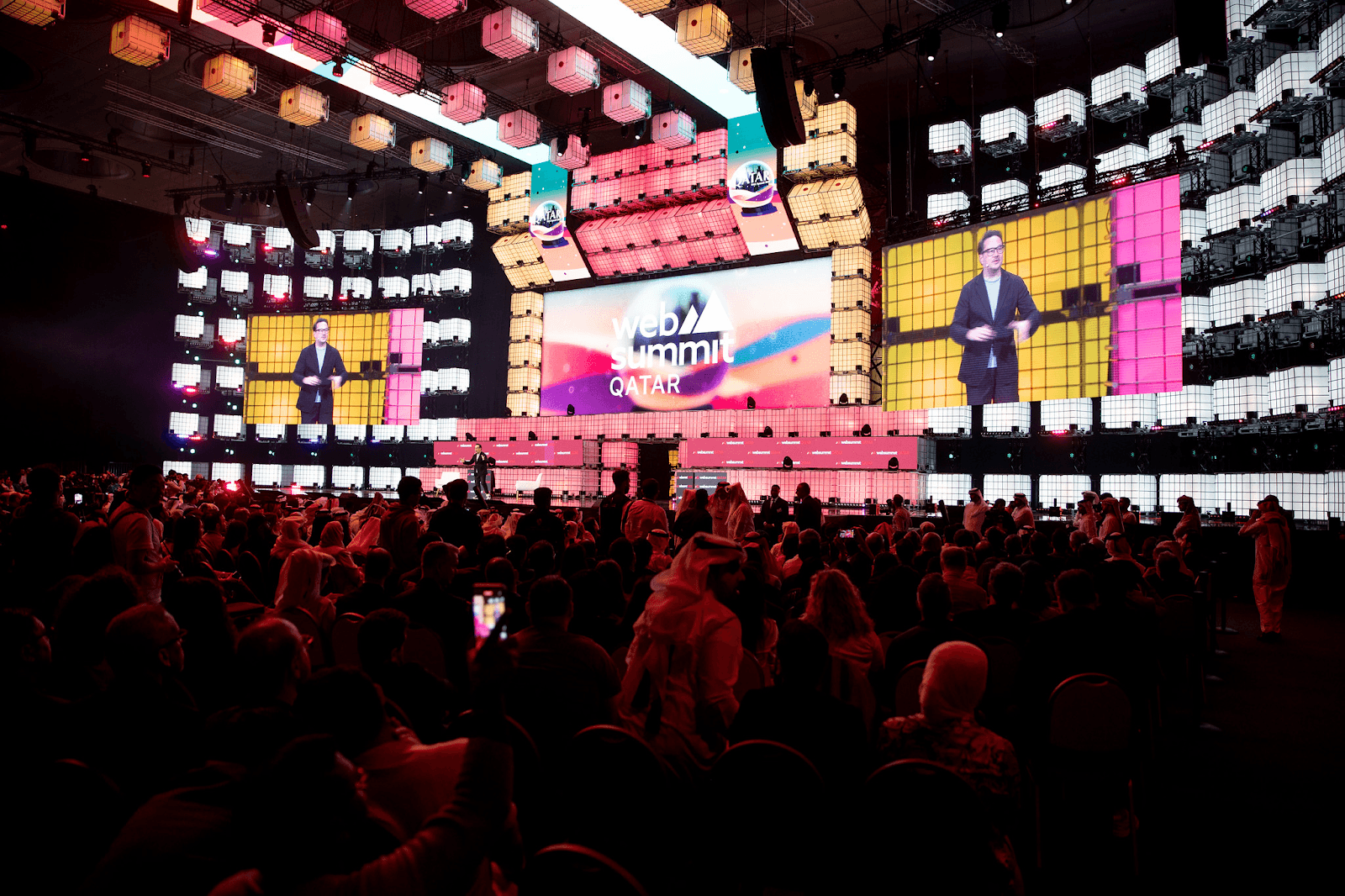
Web Summit has become one of the largest technology gatherings in the world. In 2024, the flagship event in Lisbon, Portugal, drew over 71,500 attendees from more than 150 countries, with 3,000+ companies exhibiting and a strong global startup presence.
The 2025 edition, again held in Lisbon, was the largest yet with over 71,300 participants from 157 countries, nearly 1,900 investors, and 2,725 startups exhibiting from more than 100 countries.
Web Summit also expanded regionally. The Web Summit Qatar editions have brought the format to the Middle East, with over 15,000 attendees from 118 countries at the first Qatar event and more than 25,000 attendees, 723 investors, and 1,520 startups at the second edition.
Now the flagship summit is opening the year 2026 in Qatar, bringing that scale and energy into Doha.
Who Attends Web Summit Qatar
Most people you will meet at Web Summit Qatar are founders, builders, operators, investors, and early teams focused on product traction. These are the folks who are in the trenches every day, trying to find product-market fit, close deals, build pipelines, and meet partners. This is not a polished corporate showcase. It is a place where teams with real problems and real goals show up, ready to talk about what they are building and where they are headed.
Who’s Attending Web Summit Qatar
The companies attending tend to be early stage and B2B focused, often still in beta or operating quietly in stealth mode. Teams are small, founder-led, and still figuring out how to scale distribution while selling to technical buyers.
You will see workflow-first SaaS products like Oreed LXP, Growthlabs, and Whatzvisit, AI and machine learning platforms such as B+ QuantML and PitchMyDream by VibeVentureAI, and fintech platforms like Lendsqr and Koaloo. Across categories, what unites them is a focus on solving specific problems for developers, operators, or product teams and using the summit as a concentrated window to advance meaningful conversations.
The 3 Buckets Web Summit Actually Delivers Value In
Web Summit is often described as overwhelming. Thousands of people, booths, talks, and side events packed into a few days. But if you strip away the noise, the value it delivers for early-stage teams consistently falls into three buckets.
Not deals. Not vanity metrics. These three.
Bucket 1: Signal
How your product is actually understood
Web Summit is one of the few places where you can explain your product to dozens of strangers in a short span of time and hear it reflected back to you almost immediately.
That feedback loop is the signal.
You’ll start noticing patterns:
- How do people describe your product back to you in one sentence
- Which parts of your explanation land instantl
- Where people pause, ask clarifying questions, or misunderstand
- Which phrases stick and get repeated across conversations
This isn’t about perfecting a pitch deck. It’s about discovering whether your current narrative survives real conversations with people who have no prior context.
For many early-stage teams, this is the first time they realize their internal description and external perception don’t fully match.
Bucket 2: Context
Where you actually sit in the market
Web Summit compresses months of market research into a few days of exposure.
By walking the floor, attending side events, and talking to adjacent teams, you quickly build context around:
- What other teams in your space are building
- How crowded or differentiated your category really is
- Which problems are multiple teams converging on
- How buyers and operators frame the problem, not just founders
This context is hard to get in isolation. Reading blogs or competitor sites doesn’t replace hearing how people casually talk about problems and solutions in real conversations.
For some teams, this confirms they’re early in an emerging category. For others, it highlights just how competitive and noisy their space has become.
Both are valuable realizations.
Bucket 3: Relationships
Connections that compound after the event
The most durable outcomes from Web Summit rarely happen on the spot.
Instead, value accumulates through:
- Warm introductions made organically through shared conversations
- Peer learning from founders at similar stages facing similar constraints
- Follow-ups that continue weeks or months after the event
These relationships tend to form when conversations move beyond surface-level pitches and into specifics, what’s working, what’s stuck, and what each team is trying to figure out next.
Web Summit creates the initial collision. The real payoff comes from what you do with those connections after you leave Doha.
What happens After Talks at Web Summit?
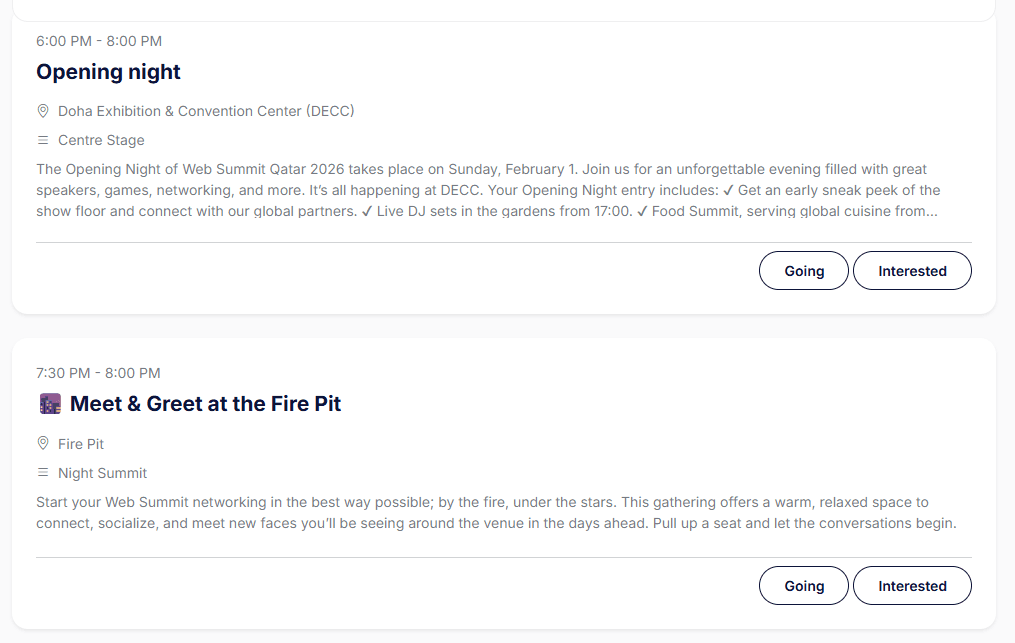
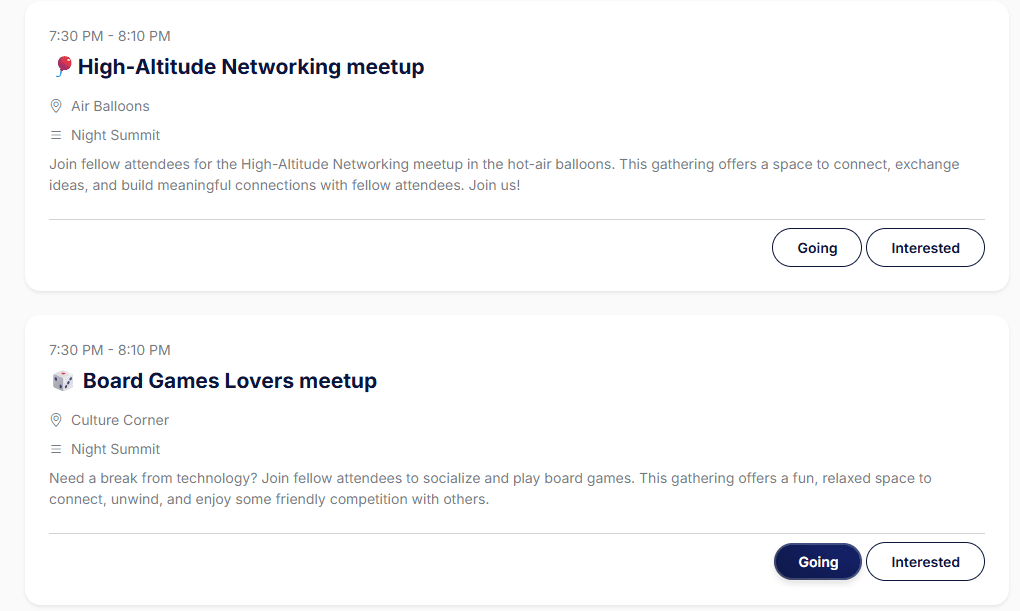
Web Summit Qatar does not end when the daytime sessions wrap up. Once the talks slow down, the schedule shifts into evening and post-session activities that are built specifically for networking and informal conversations. These events are visible directly inside the attendee schedule and sit alongside talks under the general events listing, which means you can bookmark them, mark interest, and plan around them in advance.

Most of these sessions happen after core conference hours and are spread across different areas of the venue rather than the main stages. Opening Night is usually the first anchor, followed by smaller formats such as meet-and-greets at the Fire Pit, golf meetups, board game sessions, and other casual gatherings. The structure is intentional. No panels, no pitches on stage, and no rigid agendas. Just space to talk.
At previous Web Summit editions, these evening formats are where a lot of real networking actually happens. Founders reconnect after a long day, investors slow down enough to have longer conversations, and teams use the setting to follow up on discussions started earlier on the floor. People are not scanning badges or rushing between meetings. They are sitting, standing, or walking with time to listen.
If you are attending Web Summit Qatar with the goal of meeting people rather than just consuming content, these post-session activities are where most meaningful conversations tend to move forward.
What Comes Up When People Search You?
This is very practical, and it gets overlooked more than almost anything else.
Between conversations at Web Summit, people prove what you told them by looking you up. Not during the meeting, after it. On their phone, in the hallway, later that evening, or once they’re back at the hotel.
What they find shapes whether the conversation continues. Before you show up, founders should check a few basics.
1. Google search for your company name
Open an incognito window and search for your startup’s name.
What shows up?
- Your website, or something else?
- Old announcements, broken pages, or unrelated results?
- Nothing at all?
This isn’t about ranking for keywords. It’s about whether someone can quickly confirm that you exist and understand what you do without extra effort. Increasingly that also means checking whether AI tools surface you at all when someone asks for an alternative, which is the exact gap a top LLM SEO optimization agency is built to close once you're past the founder-led stage.
If the first page is confusing or empty, that’s friction.
2. LinkedIn company page
Most people will tap your LinkedIn page before clicking anything else. Check:
- Is the tagline clear and specific?
- Does it explain what you do in one line, without internal jargon?
- Is there recent activity that signals momentum?
An inactive or vague company page doesn’t kill a conversation — but it rarely helps move it forward.
3. Founder LinkedIn profiles
People don’t just evaluate products. They evaluate teams. Founder profiles are often the second thing investors, partners, and even customers check.
Look for:
- A clear current role and company
- Relevant technical or domain experience
- Consistency between how you describe the product in person and how it’s described on your profile
If your background doesn’t reinforce the story you’re telling, that disconnect shows up fast.
4. Blog, docs, or technical content
Even one or two pieces of public technical content can change how a team is perceived.
This could be:
- A short blog explaining the problem you’re solving
- Early documentation or a product guide
- A technical explainer that shows depth
Knowing whether what you publish should read like a user guide or API documentation matters here too, since the two serve very different readers looking you up mid-conversation.
People don’t expect perfection. They look for signals of seriousness.
5. GitHub repos or demos
For devtools, infra, and AI products, GitHub often matters more than the website.
Check:
- Is there something public people can explore?
- Does the README explain what the project does and who it’s for?
- Is it obvious whether the project is active?
You don’t need a large open-source footprint. You need something that helps technical buyers orient themselves.
What Teams Should Have Ready Before Web Summit Qatar?
Web Summit is fast-paced. Most conversations are short, and follow-ups depend on whether you can give someone something clear to look at later. Teams that prepare for this tend to get more out of the event.
Before showing up, it helps to have:
- A simple event-specific landing page that clearly explains what the product does and who it is for, built on whichever B2B SaaS GTM website stack your team can ship fastest without waiting on an engineering sprint
- A short, context-free explanation that makes sense even if someone never saw your demo
- One or two concrete updates or announcements that people can reference after the event
- A linkable asset for the “send me more” moment, such as a short explainer or animated walkthrough
This is the pre-event layer Infrasity helps teams with. We work with early-stage B2B companies to build focused landing pages, clear product explainers, and lightweight videos that hold attention after the conversation ends.
At Web Summit, what people remember usually comes down to what they can easily revisit later.
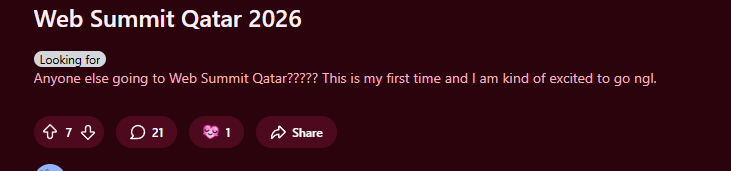
Why Reddit and Developer Communities Spike During Web Summit?
Web Summit creates a short burst of attention, but most of the conversation does not stay on the show floor. It spills into Reddit and developer communities almost immediately and often lasts longer than the event itself.
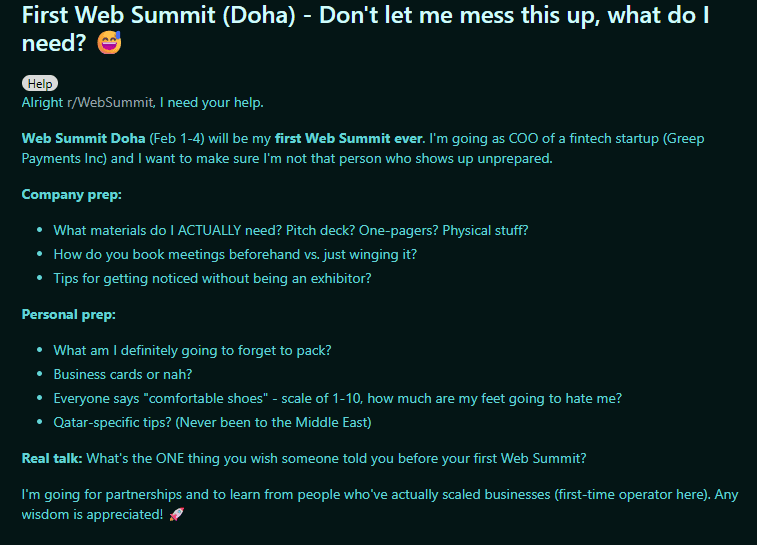
During the summit, developers and operators actively discuss tools they saw at booths or heard about through peers. Someone posts a quick “saw this at Web Summit” thread, another asks for alternatives, and a third cross-posts it into a more specific subreddit. This is why communities like r/aiagents, r/fintech, r/devops, and r/startups tend to see a noticeable uptick in activity during and right after the event.
This behavior is consistent across Web Summit editions. Booth interactions spark awareness, but validation happens publicly. People look for real opinions, implementation details, and comparisons from others who were there or who understand the space. A five-minute booth conversation often turns into a thread that gets revisited weeks later by buyers who never attended the event.
This is where Infrasity fits into the picture. We work with B2B SaaS and AI teams to extend what happens at the event into developer communities, using Reddit posts and follow-up threads that reflect how people actually talk about tools. The goal is not promotion, but presence in the places where evaluation and comparison continue after the summit.
For teams attending Web Summit Qatar, we are offering a free Reddit announcement post crafted specifically around your product and the event. One post, written for the right subreddit, designed to extend the conversation beyond the booth.
If you want your Web Summit presence to show up where developers actually research tools, this is the easiest place to start.
Frequently Asked Questions
1. Is Web Summit Qatar worth attending for early-stage startups?
Yes, but not in the “close deals on the spot” sense. For early-stage teams, the value comes from compressed conversations with founders, operators, and investors, quick feedback on positioning, and exposure to how similar companies are pitching and being evaluated. The ROI is clarity and connections, not immediate revenue.
2. Who typically attends Web Summit Qatar?
The majority of attendees are early-stage B2B startups across SaaS, AI, infrastructure, and fintech, along with investors, accelerators, and ecosystem partners. Most teams are small, founder-led, and selling to technical or operational buyers rather than enterprise procurement.
3. Do you need a booth to get value from Web Summit Qatar?
No. Many teams attend without exhibiting and still get value by focusing on side events, meetups, and informal conversations. Booths help with visibility, but most meaningful interactions happen outside the main expo area.
4. What should startups prepare before attending Web Summit Qatar?
Teams should have a simple landing page, a clear explanation of what the product does, one or two concrete updates or announcements, and something easy to share after conversations, such as a short explainer or walkthrough. Follow-ups matter more than on-the-spot pitching.
5. What happens after the talks at Web Summit Qatar?
After core sessions end, activity shifts to evening events like Opening Night, meetups, fire pit conversations, and informal gatherings. These are listed in the attendee schedule and are where longer, more relaxed conversations usually happen.
6. Are there good networking opportunities outside the main sessions?
Yes. Side events and post-session meetups are often where most networking happens. Attendees tend to be more open, less rushed, and more willing to talk through real problems and opportunities compared to the daytime schedule.