
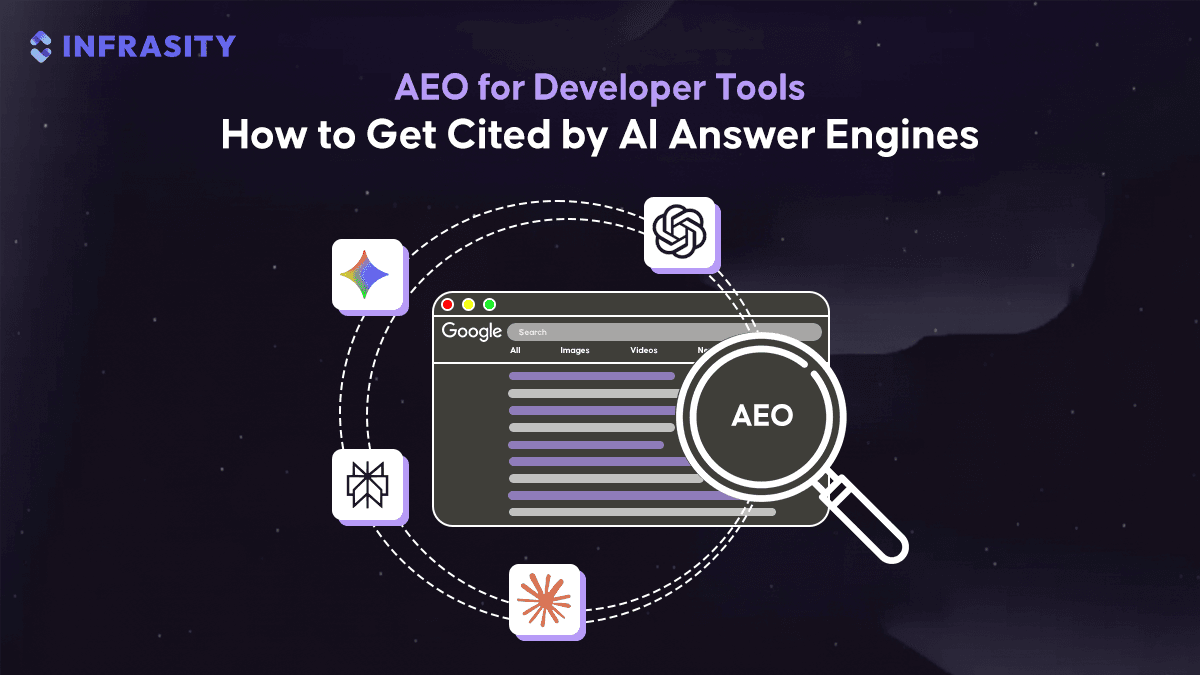
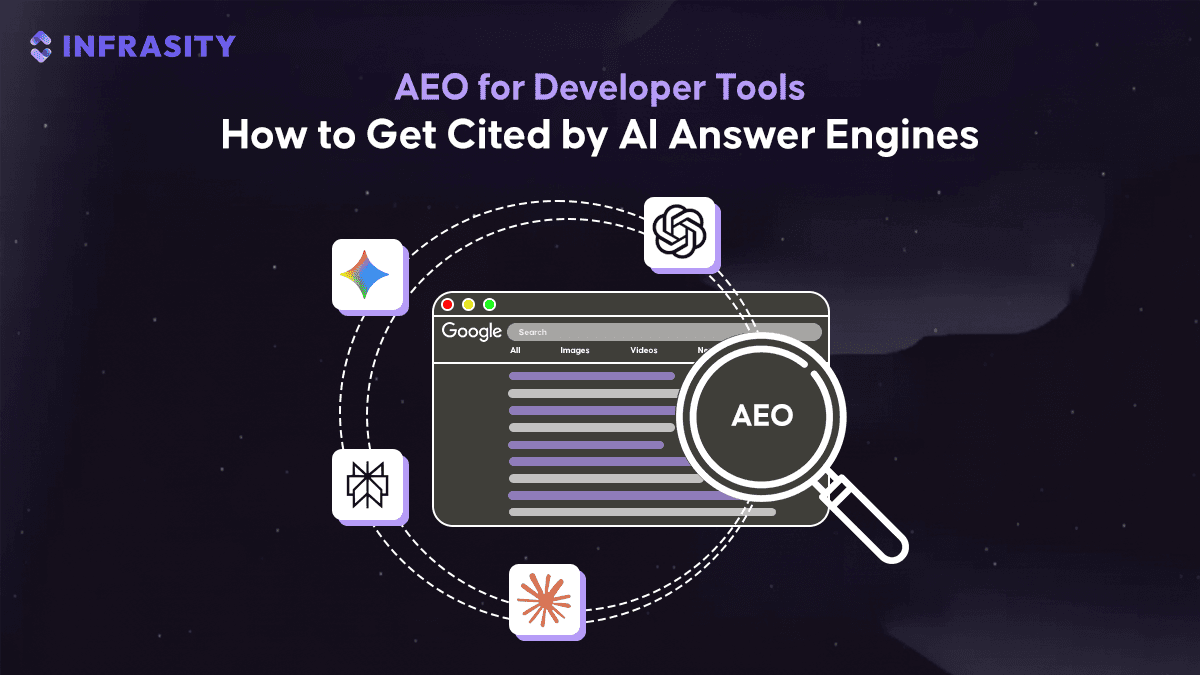
A developer opens ChatGPT and types "best tool for container orchestration." The model returns three options, each with a short reason. Your product is not one of them. That exchange just shaped a buying decision, and it never showed up in your analytics.
Answer engine optimization (AEO) is the work of getting your product into that answer. For a developer tool, it is no longer a nice-to-have. Developers now start product research inside ChatGPT, Claude, and Perplexity before they ever reach your site, and the tool the model names is the tool that gets the trial.
This blog explains how AEO works, why it hits developer tools harder than most products, and the exact steps a team can take to start getting cited.
Key Takeaways
- Answer engine optimization (AEO) helps your developer tool appear directly in AI-generated recommendations, where more buyers now start their product research.
- Winning AI visibility requires more than SEO. Your pages, documentation, and APIs must be structured so AI models can read, understand, and confidently cite them.
- Developer documentation is now a growth asset. Well-written docs, code examples, comparisons, and FAQs are often cited more than traditional marketing pages.
- AI models rely heavily on trusted third-party sources like Reddit, YouTube, review sites, and technical communities when recommending products.
- Technical foundations such as server-side rendering, structured data, llms.txt, AGENTS.md, and OpenAPI make it easier for AI engines to discover and reference your product.
- The teams that consistently measure AI citations across ChatGPT, Claude, Gemini, and Perplexity, not just website traffic, are the ones improving long-term AI visibility.
What is answer engine optimization (AEO)?
Answer engine optimization is the practice of structuring your content and your site so that AI answer engines can read it and quote it directly in their responses. The goal is to be the answer, not to rank tenth in a list of blue links.
The "answer engines" here are the tools your buyers already use to make decisions: ChatGPT, Claude, Perplexity, Google's AI Overviews and AI Mode, and Gemini.
Each one reads content from the web, selects a handful of sources it considers reliable, and writes a short response citing them. AEO is how you become one of those sources.
This is a real shift in what "visibility" means. For years, success meant a high position on a results page. Now, a buyer can get a full recommendation without a single click. Recent estimates suggest that around half of consumers already use AI-powered search, and Gartner has projected that traditional search volume will fall by about 25% by 2026 as people shift questions to chat. If your product is invisible in those answers, you’re invisible at the exact moment of evaluation.
AEO vs SEO vs GEO: what's the difference?
The terms overlap, and the marketing world uses them loosely. Here is a clean way to hold them apart.
| Term | What it optimizes for | The win you are after |
|---|---|---|
| SEO (search engine optimization) | Ranking on Google's results page | A click on a link from a list |
| AEO (answer engine optimization) | Being quoted inside an AI-generated answer or featured snippet | A citation and a recommendation, with or without a click |
| GEO (generative engine optimization) | Being represented accurately across generative models over time | Consistent presence and correct framing in AI responses |
In day-to-day work, the lines blur, and most teams run all three together.
SEO still feeds the machine: AI engines crawl much of the same web that Google does.
AEO is the layer that determines whether your page appears in the answer box.
GEO is the long game of ensuring models continue to accurately represent your product as the field shifts.
Infrasity breaks these down further into AEO vs SEO and AEO vs GEO, and the broader method falls under the generative engine optimization best practices guide.
One number explains why you cannot just rely on your old SEO and assume AI will follow. Across ChatGPT, Perplexity, and Google's AI surfaces, roughly 81% of the sources cited in AI answers do not rank in Google's top 10 for the same query. The answer layer picks its own winners. You have to earn it on its own terms.
Why does AEO matter more for developer tools and agentic companies?
Developers were early to AI search, and they use it differently. Most don’t open ChatGPT to read a blog post. They open it to get an answer fast and move on. Research on real developer-AI conversations shows the interactions are short and task-focused, usually one to three turns, often about which approach or tool to use for a specific job. The model gives a quick recommendation, and the developer acts on it.
That changes who your first reader is. As one analysis of developer relations in 2026 put it, the LLM is now your first-touch user: it reads your docs and your API before a human ever does, and developers form a first impression of your product through AI answers and peer mentions before they search for you directly.
Now, the part that should get a founder's attention. When a developer asks an AI which tool to use, the model leans heavily on documentation and product pages.
While working for over 50 b2b DevTool, we observed that most of the sources ChatGPT cited are product documentation. For most products, marketing pages carry the load. For a developer tool, your docs are the asset that gets cited. If your documentation is thin, stale, or rendered in a way machines cannot read, you’re invisible to the entire discovery layer that now sits in front of Google.
Even the latest Google updates suggest that there should be information gain, and some authentic research will always top other pages.
The cost is concrete. A trial user hits an error on step three of your quickstart, finds nothing useful, and switches to a competitor whose docs have a working code sample. Worse, that switch can happen before a human is even involved, because the AI assistant inside the developer's editor never had enough from your docs to recommend you in the first place.
There is an upside that makes the work worth it. AI traffic is small in volume but unusually high in quality. Ahrefs reported that AI search drove 12.1% of its signups while making up only 0.5% of visitors, and Seer Interactive measured LLM conversion rates far above Google organic: around 15.9% for ChatGPT visitors versus 1.76% for organic search. People who arrive from an AI answer have already done their comparison shopping inside the chat. They show up further along and are ready to act.
Want to see what AI says about your product today?
Infrasity will run your live URL through a crawler and show you, for free, exactly what ChatGPT sees on your site. See what the machines see.
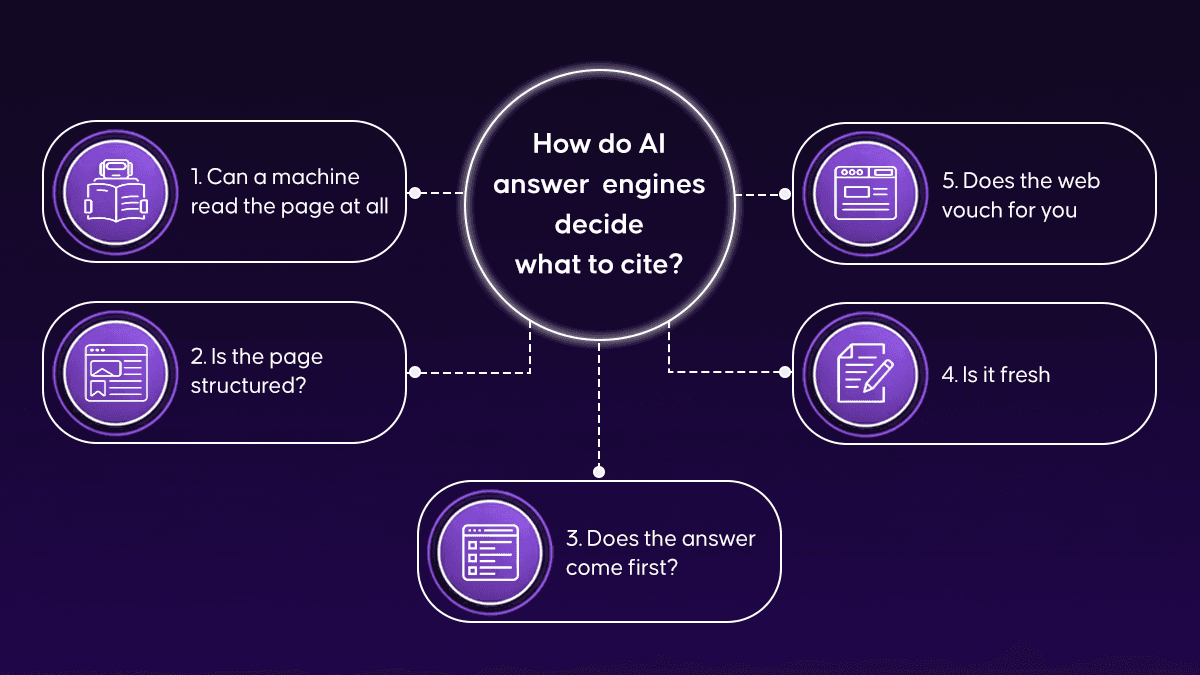
How does AI answer engines decide what to cite?
You cannot game a system you don’t understand, so it helps to know what the engines actually reward. None of this is secret. It is a fairly consistent set of signals.
Can a machine read the page at all
AI crawlers like GPTBot and CCBot read the raw HTML. If your text only appears after JavaScript runs, many crawlers see a blank page.
As Infrasity puts it on its build team's page, looking fine and being readable are two different things. A page that renders content client-side, skips structured data, and has no machine-readable map gives the crawler nothing, so it cites a competitor instead.
Is the page structured?
Models judge importance by structure, not by styling. A single clear H1 and a logical heading order tell the model what matters. Pages with well-organized headings more likely to earn citations.
We’ve gone deeper into this, particularly on how to structure content for LLMs.
Does the answer come first?
Engines grab the first clear, self-contained sentence after a heading. If your answer is buried three paragraphs down, the model may miss it or paraphrase it badly. Lead with the answer, then explain.
Is it fresh
Pages updated within the last two months earn more citations than older ones. Stale docs lose ground quickly.
Does the web vouch for you
Models weigh how often your brand is mentioned across third-party sources. Edelman found that around 90% of AI citations that drive brand visibility come from earned and owned media.
Reddit and YouTube matter a lot here: by one count, they make up nearly 80% of the social sources cited in AI answers.
Put together, these signals explain why AEO is part content and part engineering.
How do you get a developer tool cited by AI?
Here is the exact playbook. It moves from your own site outward to the wider web, then back to measurement. Each step feeds the next.
Step 1: Make your pages readable to machines
Start where most teams have the biggest gap. Your high-intent pages, the homepage, your product and pricing pages, and your docs entry points need to be server-rendered or static so the full text lives in the HTML. If it is not in view-source, no AI crawler sees it.
From there, add the basics that let a model quote you accurately:
- Structured data (JSON-LD): Spell out your product, pricing, and FAQs as machine-readable facts so the model quotes real numbers instead of guessing.
- One clean H1 and a logical H2 and H3 order, so your key points register as key points.
- Answer-first copy, where each section opens with a sentence worth quoting.
This is exactly the gap Infrasity built a service around. Design studios ship pages that look good but skip the AEO layer, and AEO specialists often cannot design a page that engineers trust.
Infrasity's UI/UX design for developer tools does both in one build: a page that converts technical buyers and that ChatGPT, Claude, Gemini, and Perplexity can read and cite. Most teams see citation movement within 60 to 90 days of shipping it.
Step 2: Ship the agent stack (llms.txt, AGENTS.md, OpenAPI)
This is the part that general marketers miss and the part that matters most for a developer tool. A few plain files tell AI systems how to find and use your product.
- llms.txt is a plain-text map that points AI models straight to your most citable pages. Think of it as the robots.txt of the AI era. An llms-full.txt companion serves your full corpus in a single fetch, so an agent gets enough to answer accurately in one request. We have covered this in detail here: llms.txt guide.
- AGENTS.md is the open standard for specifying how AI coding agents should work with a codebase. It was released by OpenAI in August 2025 and is already read by Codex, Cursor, GitHub Copilot, Claude Code, and others. If you ship an SDK, your AGENTS.md file tells the agent how to authenticate, which tools are available, what the rate limits are, and how to handle errors, so the agent does not guess and fail on the first try.
- OpenAPI plus agent skills. Publish a clean OpenAPI spec and a .well-known skills file so AI coding agents don’t just read about your API; they can discover it and call it.
These files double as a straight performance and conversion win today, because the same server-rendered, structured foundation that helps crawlers also speeds up your site.
Step 3: Write docs and content answer-first
Once a model can read you, give it something worth quoting. For a developer tool, the highest-value AEO content maps to how engineers actually evaluate. If your team is still assembling its content stack, our list of content marketing tools for beginners covers the research, drafting, and distribution tools that make producing this volume of answer-first content sustainable.
Lead your docs and articles with the answer. Use explicit, question-shaped headings that match what a developer would type.
Shift the goal of a doc from explaining the tool to enabling the use case, and include working code, honest comparisons, and clear troubleshooting.
The content types that get cited most are predictable: definition pages for "what is" queries, ordered how-to guides, comparison and alternative pages, and FAQ sections backed by schema.
Listicles dominate citations, while comparison and alternative pages win commercial ones.
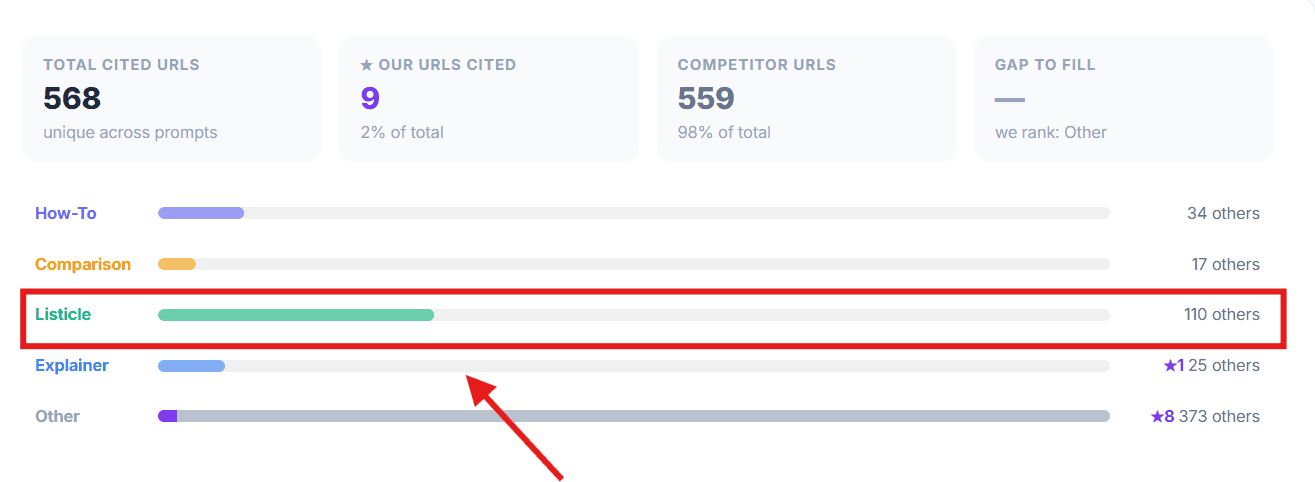
As you can see in the attached screenshot, which indicates that for this particular website, listicles are the most cited and ranked.
And we have seen similar cases for almost all of our clients. You can check that too at app.infrasity.com
A practical note on comparisons. Honest "you versus a competitor" and "best tool for X" pages are some of the strongest AEO assets you can own, because models pull from them constantly when a buyer is choosing.
Write them straight, with real tradeoffs, and you become the source the model trusts. Infrasity's GitHub SEO work and its engine-specific guides for ranking on ChatGPT, Perplexity, and Claude go further into the formats each engine prefers.
Once your writers are producing this volume of answer-first content, scaling it usually means bringing AI agents into the workflow itself. Our breakdown of AI agent content strategy for B2B SaaS covers the frameworks teams use to turn that documentation and comparison content into a repeatable pipeline instead of one-off pages.
Step 4: Earn citations where the models actually look
Your own pages aren’t enough, as models rely heavily on third-party mentions. The trick is to be present in the specific places they pull from.
Reddit and YouTube carry most of the social weight, and Reddit threads feed directly into Google's AI Overviews. This is where Infrasity's Reddit marketing work earns its place, and the results are measurable.
For Proton Pass, the team mapped the exact prompts buyers feed into AI when comparing password managers, found the Reddit threads those answers were citing, and engaged them with grounded, specific arguments.
Coverage went from near zero to 90% of tracked threads naming the product, and Google's AI Overview began pulling Reddit as its main source. More on that below.
The principle holds for any developer tool. Find the threads that rank for your category, the listicles and review-page models' quotes, and the communities your buyers trust, then earn a genuine presence there. Brands in the top quarter for web mentions get roughly 10 times more AI visibility than the rest.
Step 5: Measure the share of the answer
You cannot improve what you don’t track, and standard analytics will not show you this. AI referrals often appear in your reports as "direct" or generic "referral" traffic, and Google's AI surfaces are entirely invisible in GA4.
So measure what matters: your share of the answer. Run the prompts your buyers actually type across ChatGPT, Claude, Gemini, and Perplexity, record whether your product appears, and watch the citation and conversion delta before and after your work.
Here’s how you can measure: Infrasity tracks this in its AEO dashboard, and you can start with the free AEO audit, GEO checklist, and AI search visibility tools.
Track all four major engines, not one. The market moved from Google-dominant to ChatGPT-dominant to fragmented in two years. For a broader, non-developer-specific breakdown of the same discipline, see our guide on how to optimize content for AI search engines.
What does AEO look like in practice?
Numbers are easier to trust when backed by a real example, so here is one, with the work laid out so you can see how it happened.
When Proton Pass came to Infrasity, it was a strong product losing the visibility battle to entrenched competitors. Bitwarden owned the Reddit recommendations.
The threads ranking on Google for "Bitwarden" and the AI models citing those threads were pulled from the same pool. A buyer moving from Google to Reddit to ChatGPT in one session met Bitwarden at every step and Proton Pass at none.
Infrasity ran three tracks at once, because each fed the others:
- Competitive thread targeting: It mapped every high-intent thread across five tracked buying prompts and engaged them with specifics: zero-knowledge architecture, open-source code, Swiss jurisdiction, and the integrated Proton stack. Nothing vague, nothing that reads as an ad.
- Community presence: It built a real footprint across privacy and security subreddits, where anything that smells like marketing gets ignored, by showing up with arguments that the audience cares about.
- LLM-cited thread targeting: This is the loop that moved the needle. The team ran the five prompts across ChatGPT, Perplexity, and Google AI Overview, found the exact threads being cited, engaged those threads, then reran the prompts to confirm Proton Pass now appeared.
The result: coverage went from near-zero to 90% of tracked threads, with 27 of 30 now naming the product. Cited URLs grew from near zero to 44. In one Google AI Overview for a privacy password manager query, Reddit appeared 6 times across 17 sources, with Proton Pass named as a top recommendation. Sentiment held at 98% positive across the tracked communities.
That is the "evaluation layer" idea in practice: own the threads, rankings, and AI answers a buyer passes through from the first search to the final AI-assisted recommendation. And it compounds. The threads keep ranking, the models keep citing them, and the presence keeps working without constant upkeep.
It is not only a community play, either. Developer-focused technical content drove +828% organic traffic and +715% in ranking keywords for Scalekit, the same SEO groundwork that now feeds the AI answer layer.
Where do teams get AEO wrong?
A few mistakes recur and are worth naming plainly.
Betting on one engine
Optimizing only for ChatGPT now covers about a third less of the AI traffic map than it did a year ago. Claude, Gemini, and Perplexity absorbed the shift, and each has different citation behavior. Build for all four.
Treating AEO as a content problem only
The best article in the world loses if it sits on a page that renders in JavaScript with no structured data and no llms.txt. AEO is part writing and part engineering, and skipping the engineering half is the most common reason good content goes uncited.
Ignoring the docs
For most products, marketing pages get cited. For a developer tool, documentation is the asset models quote most. Treating docs as a cost center, something done when there is time, quietly removes you from the discovery layer.
Chasing vanity metrics
Clicks and impressions miss the point when half the value is a citation with no click. Measure the share of answers and the conversion that follows.
What do you get when AEO works?
Done right, AEO changes where your pipeline starts. You show up at the moment a developer is choosing, inside the tool they trust to choose for them.
The traffic that does click arrives pre-qualified and converts several times better than organic. Your docs do double duty as both onboarding and your strongest sales asset. And the work compounds: a citation earned today keeps surfacing tomorrow, so visibility stops being something you rent and becomes something you own.
The next steps are simple
- Find out where you stand across the engines your buyers use.
- Fix the pages and files that the models read first.
- Earn presence in the threads and communities they pull from.
- Then track your share of the answer and improve it.
How Infrasity helps developer tools get cited
Infrasity is built for developer tools, AI startups, and observability platforms, with content written by engineers rather than generalist marketers. That focus is the point of difference here, because AEO for a developer tool needs three things most agencies cannot ship together: pages a machine can read, docs and content an engineer respects, and community presence in the places models actually cite.
That is the full stack Infrasity runs.
It designs and builds developer-tool pages on a server-rendered, agent-ready foundation with llms.txt, JSON-LD, and OpenAPI in place.
It produces the technical content and developer marketing that get quoted and runs the Reddit and AI visibility work that took Proton Pass to 90% citation coverage.
Then it reports the citation and conversion lift on a before-and-after dashboard, so you can see the results rather than just the invoice.
If your product is not showing up in the threads your buyers land on, or the AI answers they read, that gap comes with a real cost.
Infrasity will run a free Reddit and GEO visibility audit and show you which threads rank for your category, which prompts your competitors already appear in, and where your product should be and is not.
Frequently asked questions
Does AEO replace SEO?
No. AEO builds on the same crawlable, well-structured site that good SEO produces. SEO still feeds the engines, and AEO decides whether you get pulled into the answer. Most teams run both, plus GEO, as one program.
What services does an AEO agency typically offer?
Usually a mix of technical work and content. That means making pages machine-readable (server-rendered HTML, JSON-LD, llms.txt and AGENTS.md), writing answer-first docs and comparison content, earning third-party citations on places like Reddit and YouTube, and tracking your share of answers across ChatGPT, Claude, Gemini, and Perplexity. Infrasity covers all of these for developer tools.
How does an AEO agency improve search visibility?
By fixing the signals, AI engines actually reward readability for crawlers, clean heading structure, answer-first copy, fresh content, and brand mentions across trusted third-party sources. The goal is a citation in the answer, measured as a share of the answer rather than clicks.
What are the benefits of hiring an answer engine optimization agency?
Speed and the combined skill set. AEO needs engineering, technical writing, and community work together, which is hard to staff in-house. A specialist agency gets you cited faster, keeps you present across all the major engines as they shift, and reports the citation and conversion lift directly.
How much does an AEO agency cost, and how do pricing models work?
Most specialist agencies work on monthly retainers with a three- to six-month minimum, since AEO compounds over time rather than paying off in a single sprint. Pricing scales with how much of the stack you need, from a one-time page rebuild to ongoing content and community work. A free audit is the fastest way to scope it, and Infrasity offers one along with an ROI calculator.
How do I choose an AEO agency in the US or anywhere else?
Pick for fit, not zip code. AEO is remote work, so the question is whether the team understands your product and can ship all three layers: readable pages, content that content engineers trust, and citations from the platforms' models. For a developer tool, favor a team that writes with technical depth and can prove citation lift with before-and-after data.
Which AI engines should a developer tool optimize for?
All four major ones: ChatGPT, Claude, Gemini, and Perplexity. ChatGPT still leads in volume, but its share of business AI referrals dropped from about 89% to 63% over eight months, while Claude, Gemini, and Perplexity grew. Optimizing for one engine leaves most of the map uncovered.
How long until we see AI citations?
With the foundational fixes in place, most teams see citation movement within 60 to 90 days, and the effect compounds as more of the web references the product.