
Influencer marketing for DevTools is the practice of paying, partnering with, or supporting engineers who already have an audience, so they teach your tool to developers who trust them. It works because 75% of B2B marketers now run influencer programs and 93% plan to spend more, according to Ogilvy's global B2B influence study of 550 CMOs. It almost always fails for one reason: nobody set a baseline before the money went out.
This is the playbook we run at Infrasity. Real vetting sheets, real pricing logic, and attribution you can defend in a board meeting. Every benchmark below comes from a published source or from work we have done ourselves.
Before anything else, three markets get confused with each other.
B2C influence sells taste. A creator likes a product, the audience likes the creator, and the purchase is small, fast, and emotional.
B2B influence sells credibility. An industry voice lends authority to a claim, and the purchase is slow, expensive, and signed off by a committee.
B2D influence, the kind DevTools need, sells proof. The creator has to run your code in front of people who can tell if it works.
The gap matters commercially. In B2C the risk of a bad partnership is a refund. In B2D the risk is a public teardown of your onboarding in front of your exact buyer, and a comment thread that ranks on Google for two years.
TL;DR
- Developers block ads, so creators are the channel. Over 60% use ad blockers, and 75% of B2B marketers now run influencer programs.
- DevTool influence sells proof, not taste or credibility. The creator has to run your code in front of people who can tell if it works.
- Buy views, not subscribers. PostHog won't sponsor below 5,000 views per video and rates engagement by comments-per-view.
- Measure before you spend. Run your 5 buying prompts across 4 LLMs first, or the lift is unprovable later.
- Programs compound, one-offs don't. A sponsored video decays in 72 hours; 6 weeks buys a signal, 12 months buys a channel.
What Is Influencer Marketing for DevTools, and How Is It Different From Normal B2B Influencer Marketing?
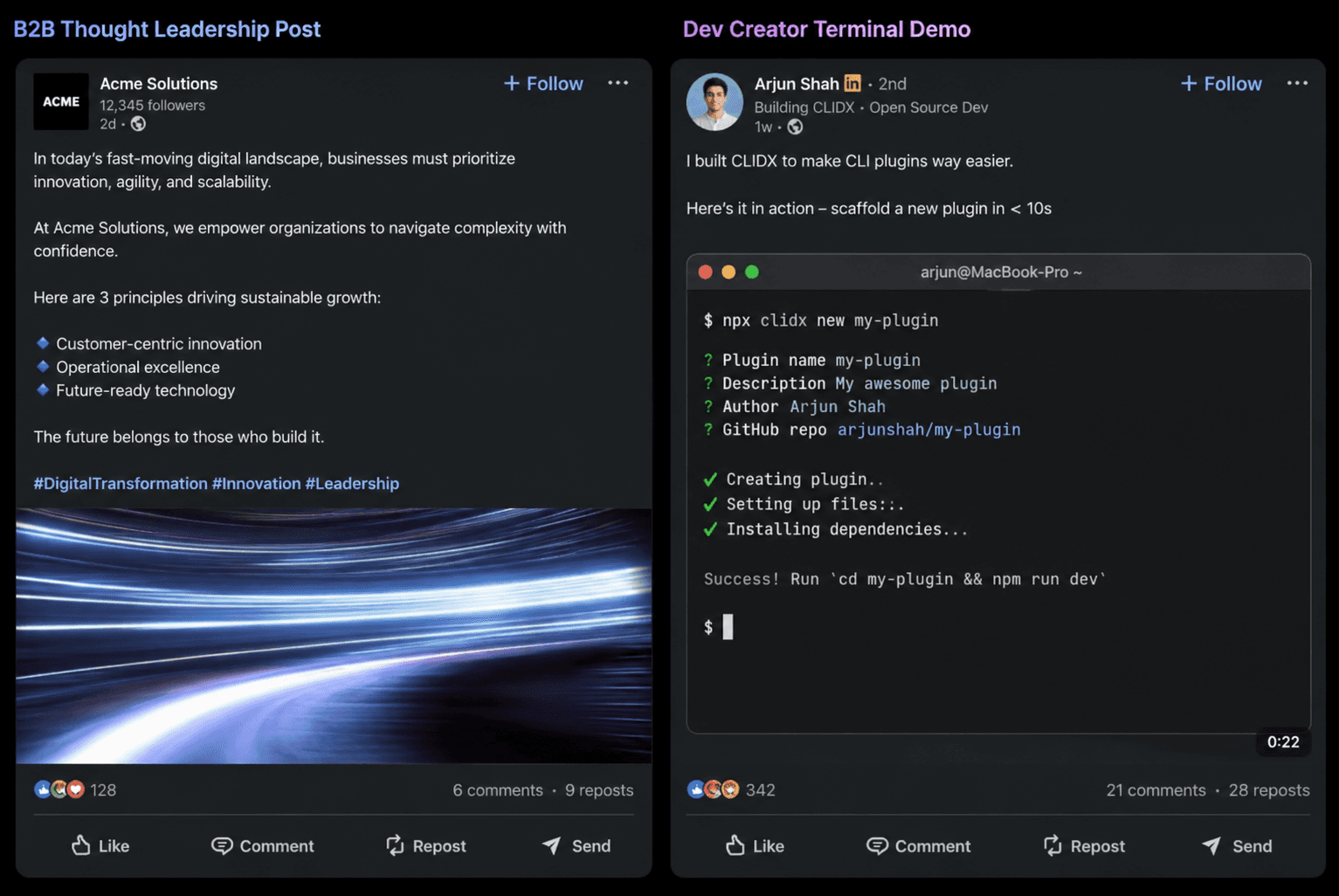
Normal B2B influencer marketing borrows credibility. A LinkedIn thought leader posts an opinion, tags your brand, and their audience nods.
DevTool influencer marketing borrows proof. A creator installs your SDK on camera, hits an error, fixes it, and ships something. The audience watches the whole thing. If your onboarding is broken, 40,000 engineers find out at the same moment.
That single difference changes everything downstream:
- The creator has to be a practitioner. They need to write the code, not describe it. PostHog puts the reason this way in its public handbook: "Developers can smell marketing fluff instantly, so 'it does X' beats 'it empowers you to unlock X.'"
- The content has to survive scrutiny. Comment sections on dev videos are a peer review process. Neill Gernon, founder of Plug.Dev, describes what the creator is actually signing up for: "Dev influencer content is real work: learning your tool, building example applications, validating the developer experience, and advocating credibly to an engaged audience."
- The buying journey is long and quiet. A developer watches a video in March and signs up in May from a Google search. Your last-click report will credit Google. Jason Lengstorf, founder of CodeTV and former VP of Developer Experience at Netlify, argues this is why message discipline beats message variety: "It's better to get one message to land than to have a dozen great messages that fall flat and get forgotten."
Plug.Dev's founder Neill Gernon calls this category Creators That Code: engineers, educators, and community builders who shape how developers learn and adopt tools. That framing is correct, and it is why generalist influencer agencies struggle here. They can negotiate a rate card. They cannot tell whether a creator's Kubernetes tutorial is technically wrong.
Before getting into ad blockers, it helps to see why developers matter so much in the first place. The developer population keeps growing every year, as engineering roles expand well beyond pure software into data, security, platform, and now AI. These are also the people who decide what actually gets adopted: they run the trial, write the internal recommendation, and in most product-led companies hold real influence over the budget. A channel that cannot reach developers on their own terms is ignoring the group with both the numbers and the buying power.
Why Do Developers Ignore Your Ads But Trust a Creator's 12-Minute Video?
Because they blocked the ads. Over 60% of developers run ad blockers. Your paid social impressions are landing on an audience that literally cannot see them.
There is a second, less obvious reason. Developers don't evaluate tools by reading claims. They evaluate by running code. A creator video is the closest thing to running the code without running it. You watch someone else's terminal, you see the real error messages, and you form a judgment in twelve minutes instead of an afternoon. For example, watching someone debug a failed OAuth callback or a misconfigured Docker network in real time shows you the tool's actual rough edges, the kind no landing page ever admits to.
This is also why a small creator can beat a large one. As daily.dev puts it, a Rust developer with 1,000 engaged followers can outperform a general tech influencer with 100,000 passive ones. Reach is a vanity input. Relevance is the actual input.

What you get from this: lower cost per qualified signup, content that keeps working for years, and technical objections handled before your sales team ever hears them.
Where Is Your Money Actually Leaking Right Now?
Four leaks, in the order we find them in audits.
Leak 1: You paid for subscribers, not views
Creators price on subscriber count. Conversions happen on views. A channel with 400,000 subscribers and 9,000 views per video is worse value than a 30,000-subscriber channel doing 40,000 views. Always go after high views and low subscribers. Also check the quality of the subscribers and views; make sure they're the right audience you want for your product, then only go for it.
Leak 2: You had no baseline
You cannot prove a lift you never measured. This is the single most common failure in DevTool creator programs.
Leak 3: You bought one-offs
A single sponsored video is a spike. It decays inside 72 hours. Programs compound; campaigns don't.
Leak 4: You never checked the follower quality
We routinely find sponsored creators whose stated follower count and verified follower count differ, whose audience is students rather than buyers, or who quietly advise a competing product.
That last one is not theoretical. Here is what it looks like in practice.
How Do You Vet a Dev Creator So You Don't Waste the Budget?
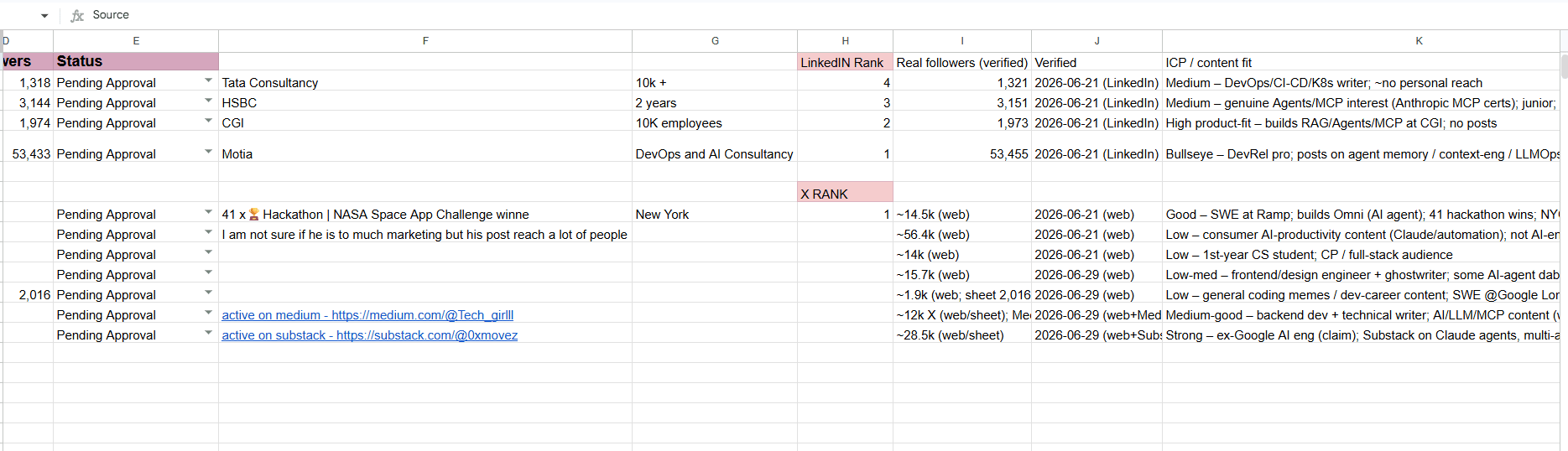
This is the part almost nobody talks about, so here is our actual sheet.
When we built the creator roster for an open-source AI infrastructure client, our researcher scored every candidate on three things before follower count was even discussed:
- Content relevance: Do they consistently publish in our niche across LinkedIn, Medium, or Substack? Not "do they work in tech."
- Audience fit: Is the audience developers, founders, and technical professionals we want to reach? Audience quality mattered more than follower count.
- Activity and consistency: How often do they publish, how active are they across channels, and do they maintain real engagement with their community?
Then every row got hard-checked. Our sheet carried columns most rosters do not have:
| Column | Why it exists |
|---|---|
| Real followers (verified) | Stated count vs independently checked count on the platform, with a check date |
| ICP / content fit | A written verdict, not a score: "Bullseye," "Medium," "Low" |
| Track | A = amplifier, B = champion or content author, or Deprioritize |
| Note / flag | Conflicts of interest, ghostwriting, outdated handles |
The flags are the valuable part. Three real examples from that sheet:
- A DevRel professional with 53,433 followers scored "bullseye" on content and was ranked our top amplifier. He was also the creator of a competing memory product and a paid advisor. Flagged, not rejected. Clarify first.
- A candidate with 1,318 followers and solid DevOps writing turned out to be already employed by one of the agencies on the engagement. Not disqualifying on its own, but a conflict that has to be logged in writing before any payment is discussed.
- A creator listed at 57,000 followers was marked down to "Deprioritize" with the note "too much marketing." Reach was real. Trust was not.
This discipline is not unique to small rosters. The largest DevTool creator programs run the same selection logic in public, and a few of them publish their numbers.
Which bigger companies actually run this, and what do they do?
PostHog publishes its entire influencer operation. Named partners include Theo, Fireship, and Chris Raroque. The stated preference is telling: they would rather work with a creator who genuinely uses the product than one with a much larger audience and no connection to it, and they optimize for recurring collaborations over one-off sponsorships. Long-form YouTube is described as their strongest acquisition channel. You can read the full handbook page, which is the single best public artifact on this subject.
Bolt.new turned a launch into a creator event. Their 30-day global hackathon drew over 130,000 participants and produced roughly one million new web apps. Builder-creators posted daily progress throughout, and the judging panel included Addy Osmani from Google Chrome and Alex Albert from Anthropic. The credibility came from who showed up, not from ad spend.
Stream and Orchids report creator numbers directly. Creator partnerships drove 6,600+ signups for Stream across FY-2025, and 1.1M impressions with 10,000+ engagements for Orchids in a single quarter, per DevTools Academy. Both are worth reading as evidence that this channel produces countable outcomes, not just reach.
What all three have in common: the creator was a user before they were a partner. That is the filter that survives scale.
The point: a roster without a flags column is a liability, not an asset.
For engagement quality, use hard numbers rather than instinct. PostHog publishes its thresholds in its public company handbook, and they are the cleanest public benchmarks available:
| Quality | Comments per view | Likes per view |
|---|---|---|
| Weak | 0.001 | 0.02 |
| Average | 0.001 to 0.002 | 0.02 to 0.03 |
| Good | 0.002 to 0.005 | 0.03 to 0.05 |
| Excellent | 0.005+ | 0.05+ |
PostHog also sets a floor: above 5,000 views per video, or it is not worth your time. And they name categories to avoid even inside developer content, including interview prep and career growth channels, because that audience is job-hunting, not tool-buying.
Want the roster built for you, with the flags column filled in?
Infrasity builds vetted DevTool creator rosters as part of our creator-led growth work, with verified follower counts, ICP verdicts, conflict flags, and price bands, before you spend anything. Book a free consultation, and we will audit your current shortlist.
What Should You Actually Pay a Dev Creator?
There is no public rate card, and nobody would tell you how to approach this. So here is how to think instead.
Price against views, not subscribers. Ask for the median view count of their last ten videos, not the best one.
Know which slot you are buying. Pre-roll, mid-roll, end-roll, and full integration are different products at different prices. PostHog's handbook is explicit that the first quote from a new creator is usually negotiable, and that you should ask for examples of previous ad reads before agreeing.
Get the link in the top three lines of the description. Below the fold is money burned.
Pay on time. PostHog pays net 30. The creator economy is small, and reputations travel. Late invoices cost you access to the good creators later.
A workable starting benchmark: think in cost per thousand views (CPM) rather than flat fees, then convert to cost per signup once you have data.
Across influencer marketing generally, brands earn about $5.78 for every $1 spent, per Influencer Marketing Hub's benchmark data. Treat that as a sanity check. The same analysis notes that top campaigns return $11 to $18 per dollar while poorly designed programs return near zero. The average hides enormous variance, and the variance is almost entirely a function of creator selection and attribution setup.
What Should the Creator Actually Make, and When?
Match the format to the funnel stage. This is the mapping we follow, and it is the clearest public breakdown of the formats.
| Stage | The developer is asking | Format that works | What you measure |
|---|---|---|---|
| Awareness | "What is this and why should I care?" | Ad integration, dedicated video | Views, impressions, branded search lift |
| Evaluation | "Does this solve my problem?" | Drop-in integration, commentary | Clicks, signups, docs sessions |
| Adoption | "What can I build with it?" | Example app, tutorial | Activation, API calls, paid conversion |
| Retention | "Can this live in my stack?" | Open-source project, micro-course | Repeat usage, contributor signups |
Two format notes that save budget:
Drop-in integrations beat dedicated videos for mid-funnel. A drop-in is your tool used naturally inside a tutorial about something else. It reads as a choice the engineer made, not a slot they sold. Cheaper, and often higher intent.
Evergreen beats trend. A "how to build X" tutorial maps to a stable search query and keeps delivering for years. A reaction video to a launch spikes and dies. If you are buying only trend content, you are renting attention.
How Do You Attribute This When Developers Never Click the Link?
This is the question every VP Marketing and Head of Growth asks, and the honest answer is that you use three layers, not one.
Layer 1: Direct link tracking
Unique short links per creator with UTM source and campaign set to the creator name. PostHog uses Dub links like go.posthog.com/sponsored plus per-creator redirects such as posthog.com/theo.
Layer 2: Self-reported attribution
Ask the creator to tell their audience to "mention them on signup." PostHog does exactly this and reports on it. It catches the developer who watched on their phone and signed up from a laptop three weeks later, which no UTM will ever capture.
Layer 3: A pre-measured baseline
This is the layer almost everyone skips, and it is the one that makes the other two believable. In this, you must pre-decide the baseline after considering your current position and where you want to see yourself.
Your creator spend is probably unattributed right now
We start every creator engagement by running the same audit we ran for our multiple clients: your five buying prompts, across four models, with every citation traced. You get the baseline before you spend, so the lift is provable afterward. Book a free consultation, and we will run your first five prompts.
Why Is a Dev Creator Program Now an AI Search Play Too?
Because the developer no longer starts at Google. They ask Claude or ChatGPT "what should I use for X," and the model answers by citing sources. Those sources are overwhelmingly community threads, creator content, and third-party listings.
This changes what a creator partnership is worth. A tutorial video does three jobs now:
- It converts the viewer.
- It ranks in YouTube and Google search for the query it teaches.
- It becomes a citable source that shapes what an LLM says about your category next quarter.
Job three is new, and it is the one nobody is pricing into deals yet. That is a temporary arbitrage.
The practical implication for your creator brief: ask for written artifacts alongside the video. A Dev.to post, a Medium writeup, a GitHub repo, or a comparison table. Models cite text far more readily than they cite video. In our Statewave roster, two candidates were upgraded specifically because they cross-post to Medium and Substack, which made them viable co-authors rather than just amplifiers.
If your category is contested, our AI GEO optimization service runs this as its own measured track.
What Does the First 90 Days Look Like?
Start with a test that can help make a decision.
Baseline and roster: Define your five buying prompts and run them across four models. Trace citations. Build a roster of at least 15 vetted creators with verified follower counts, ICP verdicts, price bands, and a flags column. Nothing publishes yet.
Pilot: Three to five creators. Mix formats: one or two dedicated videos plus two or three drop-in integrations or example apps. Unique link per creator. "Mention them on signup" in every brief. Our influencer marketing lead recommends three to five creators per month for three months as pilot pace, and that matches what we see.
Read the data: Compute CPM, cost per session, and cost per signup per creator. Kill the bottom half without sentiment. Note which format won, not just which creator.
Rebook and extend: Book your winners for multiple pieces. Add cross-platform work: LinkedIn, newsletter, Dev.to. Re-run the five-prompt audit and compare to your week-one matrix.
Anything past 90 days is program mode, and program mode is where the compounding lives. Our influencer marketing lead puts full creator-led growth maturity at twelve months or more, and our own experience agrees. Six weeks buys you a signal. Twelve months buys you a channel.
What Goes Wrong, and How Do You Avoid It?
The creator gets it technically wrong mostly, so try to fix things like giving them demo access, a named engineer to answer questions, and a review pass. Not exactly a script. Developers detect scripts instantly.
You over-brief and kill the credibility
PostHog's rule is to let the creator decide what the ad read sounds like, while giving guidance on the points that must be right. Their brand guidance is blunt about the reason: "Developers can smell marketing fluff instantly, so 'it does X' beats 'it empowers you to unlock X.'"
You repeat the same creator too often
Audience saturation is real. Rune's team reported that repeat promotions with the same influencer did not yield noteworthy returns even after months. Rotate, or change the format.
You buy reach from someone who advises a competitor
This is what the flags column is for.
You amplify weak positioning
Amplification multiplies whatever exists. If your one-line pitch is not sharp, a creator program will just distribute a fuzzy message faster and more expensively. Sequence it: positioning, then proof, then amplification.
How Do You Know It Worked, in the Language Your Board Speaks?
Map the metric to who is asking.
| Who is asking | What they should see |
|---|---|
| CMO / VP Marketing | Cost per attributed signup vs paid social, plus branded search lift |
| Head of Growth | Signup-to-activation rate by creator, not just signup volume |
| Developer Relations | Community engagement quality, contributor signups, docs traffic |
| CTO | Whether the technical content was accurate and the demo repos work |
| Product Marketing | Which message resonated, from comment sections and objections raised |
| Angel investors / advisors | Star velocity and download baselines, which are hard to fake |
One warning on measurement: Developer research cycles are long. A creator touch may precede a signup by four to six weeks. If you judge a creator program on first-click attribution inside 30 days, you'll kill your best channel and keep your worst one.
What Separates a Dev Video That Converts From One That Just Gets Views?
Views are the input. Comprehension is the output. Aaron Francis built the PlanetScale YouTube channel and now runs Try Hard Studios, a studio that exists specifically to help DevTool companies make video content, and the feedback his audience gives him points at the thing to brief for: viewers repeatedly say his videos can be watched once and understood.
Three briefing rules follow from that.
- Ask for one job to be done end to end rather than a feature tour, because a developer who finishes a task trusts the tool.
- Ask the creator to leave the errors in, since the edit that removes the failed build also removes the credibility.
- And ask for the written artifact alongside the video, a Dev.to post or a repo, because that is what an LLM can cite three months later when the next buyer asks it what to use.
One more discipline, from Jason Lengstorf: "The most damaging thing you can do as a company for your brand and your marketing is change it every few weeks." If each creator describes your product differently, you have paid several people to confuse the same audience.
Where Does This Leave Your DevTool Company?
You already know developers don't respond to ads. The gap has never been belief in the channel. The gap is that most DevTool teams cannot tell a good creator from an expensive one, cannot price a placement, and cannot prove the result afterward. So the budget goes out, a video goes live, and nobody can say what happened.
The fix is unglamorous. Measure before you spend. Vet with a flags column. Buy views, not subscribers. Give creators room to sound like themselves. Read the data at day 60 without sentiment.
That is the exact motion Infrasity runs for DevTools, AI agent, and infrastructure teams, done by engineers, measured against baselines, and reported in numbers. Creator-led growth for DevTools, with attribution.
Book a free consultation, and we will audit your AI answer visibility across your top five buying prompts and shortlist the right creator, so that you spend another dollar in the right place.
Frequently Asked Questions
How much should a DevTool spend on creator marketing?
Start with a pilot budget you can afford to lose entirely, typically the cost of three to five placements. Judge the pilot on cost per attributed signup, then scale only the winners.
Do micro-creators really outperform large ones?
For relevance, often yes. For efficiency at scale, PostHog notes larger creators are frequently more efficient despite higher fees, which is why they set a floor of 5,000 views per video but no ceiling on size. Test both.
Which platform matters most for DevTools?
Long-form YouTube remains the strongest acquisition channel in PostHog's public reporting. LinkedIn is the strongest for reaching buyers rather than users, and 85% of B2B marketers rate it their highest-value social platform. Short-form is awareness, not signups.
Is this the same as DevRel?
No. DevRel is your own people building relationships. Creator marketing is borrowed reach from people who already have it. They work best together, and they fail together if the product experience is bad.
Should I use an agency or do it in-house?
In-house wins on strategic and flagship relationships. Agencies win on sourcing at volume, new regions, and new creator categories. PostHog says exactly this in their handbook, and it matches what we see.