
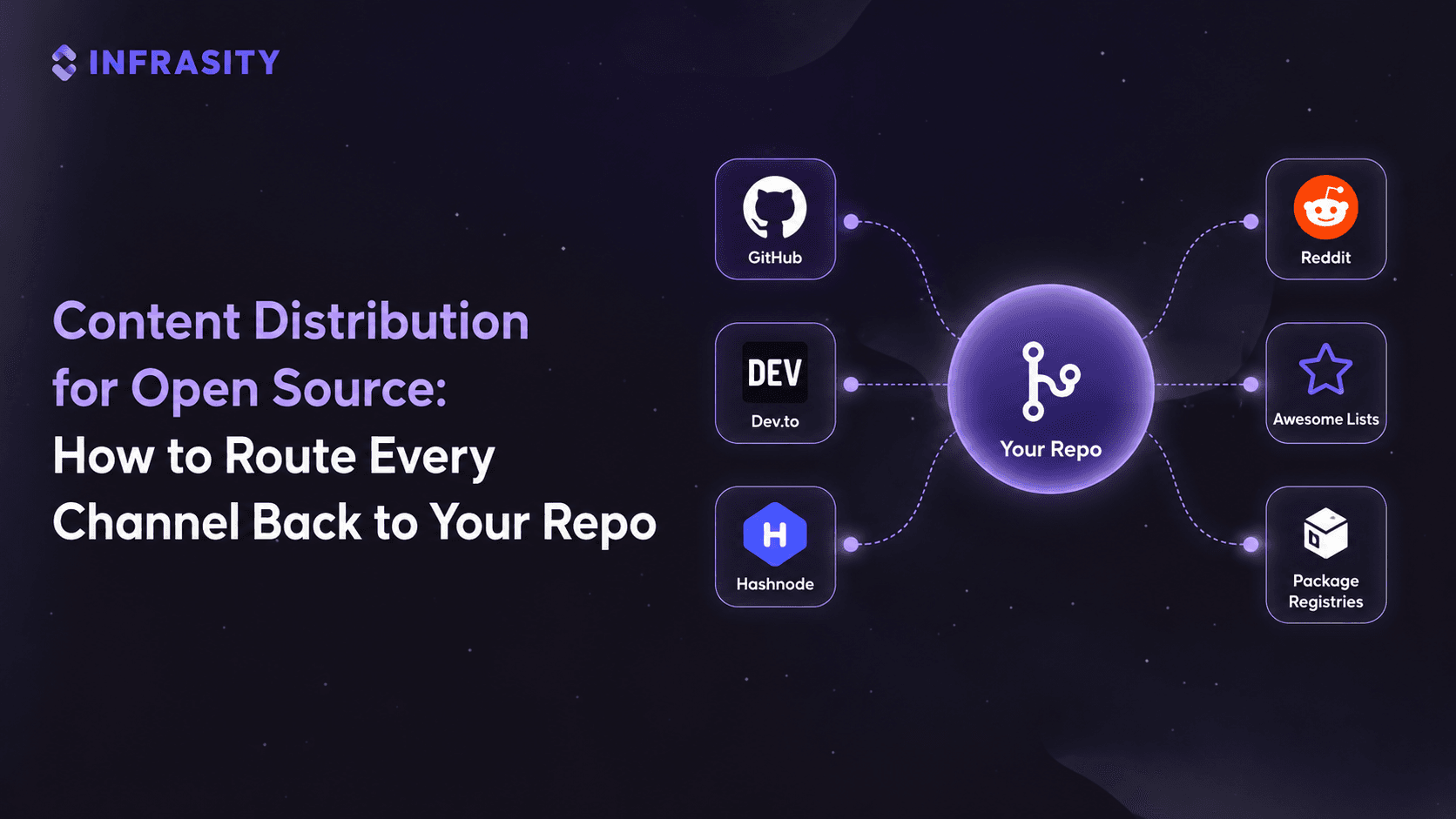
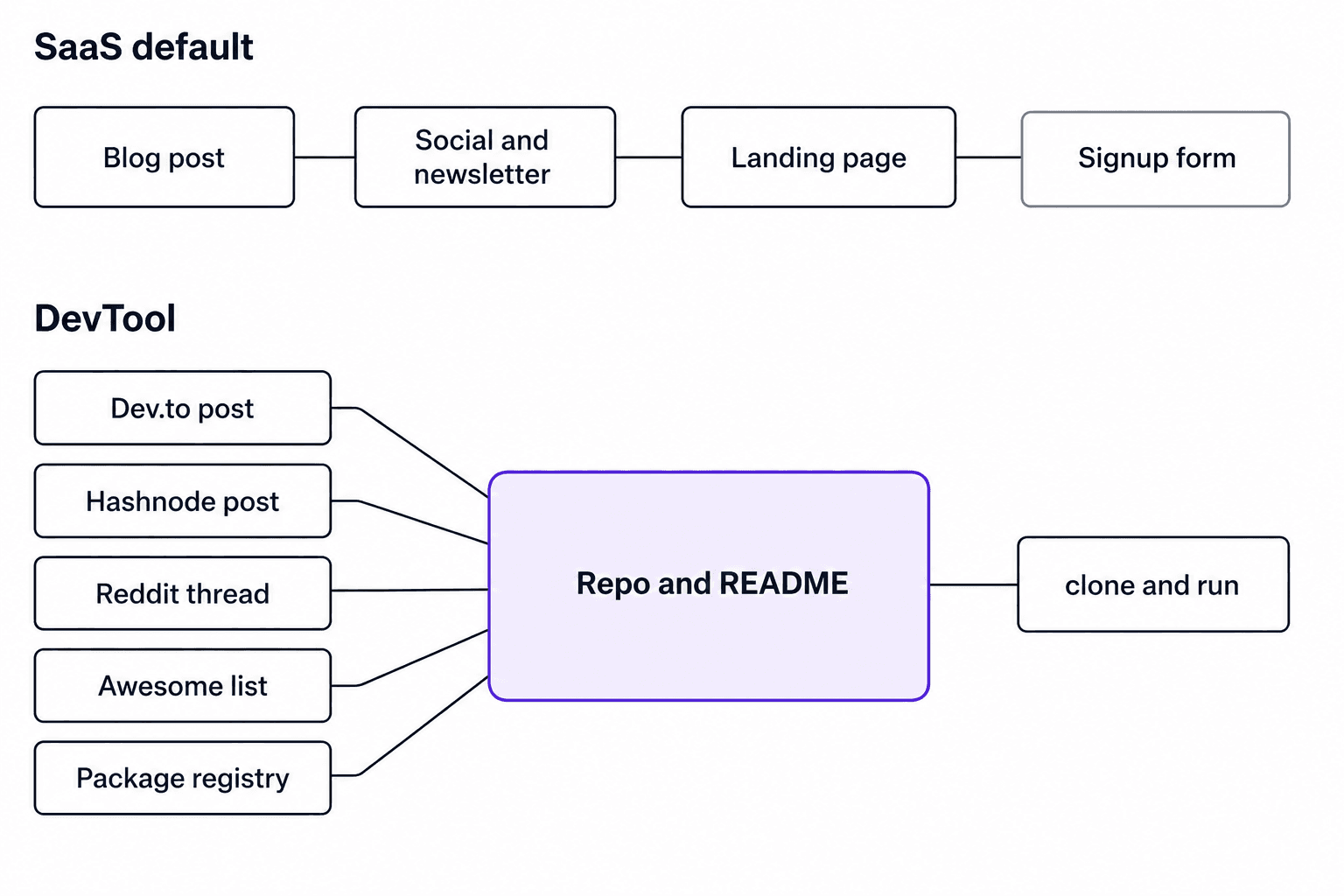
For an open-source devtool, content distribution has one job: end a developer's path inside your repository, with the README doing the conversion. That changes which channels are worth running, because the destination is a clone command rather than a signup form.
Most distribution advice is written for companies whose conversion surface is a landing page. Below is the version for teams whose conversion surface is a repo: the surfaces that actually move stars and clones, the canonical settings that stop your cross-post from outranking your own blog, and the order to run it in.
TL;DR
- Shipping the repo is roughly 10% of the work. The other 90% is making sure developers ever find it, which is the part most teams never staff.
- For open-source devtools, the conversion goal is not a signup form. It is getting a developer to clone the repo, install the package, and get it running locally.
- The repo itself is a distribution surface. README, topics, and comparison files help developers find and evaluate the tool.
- The main channels that move a repo are awesome lists, package directories, GitHub topics, Reddit/Hacker News, Dev.to/Hashnode, and comparison content.
- Cross-posting needs canonicals. Publish on your own domain first, then syndicate with canonical tags to avoid competing with your own copy.
- daily.dev is a special case: company blogs are not eligible as sources, so teams need a Squad or direct posting instead.
- The sequence that works: fix the destination first, ship something runnable, then distribute in weekly waves and re-audit prompts monthly. Star velocity moves first, and AI citations follow later.
What Changes When The Repo Is The Destination?
Three things: what counts as a conversion, which channels can carry a clone, and what the content has to contain. A blog post that ends at a newsletter signup is a finished funnel for a SaaS company and a dead end for a devtool.
The conversion moves into the terminal
A developer evaluating a memory layer or a CI tool does not want a demo booking. They want to run it. That means the asset at the end of the chain is a repo that clones, installs, and runs without a support call, and the content upstream exists to make cloning it feel obvious. Anything in the chain that cannot carry a link to working code is decoration.
The repo itself is a distribution surface
A README, a topic set, and a comparison file inside the repo are read by developers browsing GitHub and quoted by models answering "what should I use". GitHub's own documentation describes topics as how people "explore repositories in a particular subject area", with a limit of 20 per repo, lowercase and hyphenated. A repo shipped with zero topics is absent from every one of those pages.
Ross Simmonds, author of Create Once, Distribute Forever, described the same reframing on Dreamdata's B2B content distribution masterclass. Working with a cybersecurity client, his team found much of the audience spent time on GitHub, so rather than assuming the usual channels, they took the detailed resources the client was already producing and "recreated that as GitHub-oriented content that lived there."
Content that lives there is the operative phrase. Not linked from GitHub. Published into it.
Which Surfaces Actually Move a Repo?
Six, and only two are writing platforms. The other four are GitHub-native and get left out of channel plans because they do not look like publishing.
| Surface | What it does for a repo | Effort to first placement |
|---|---|---|
| Awesome lists | Permanent GitHub-native placement developers browse and models cite as proof the tool is real | One pull request, then follow-up |
| Package registries and tool directories | Powers "alternatives to X" pages and verification searches | One submission per directory |
| GitHub topics | Puts the repo on topic pages for its category | Under ten minutes, once |
| Reddit and Hacker News threads | Where category opinions form, and the sources models retrieve | Ongoing, weekly |
| Dev.to and Hashnode | Long-form technical narrative with a link to the repo | Per post |
| Comparison content | Captures buyers already naming competitors | Per post |
A one-time push on Product Hunt can layer a seventh, high-authority spike on top of these six. Stars are a byproduct of these six rather than a target to chase directly, and the mechanics of that are worth understanding before you optimize for the number: see how repos actually earn GitHub stars.
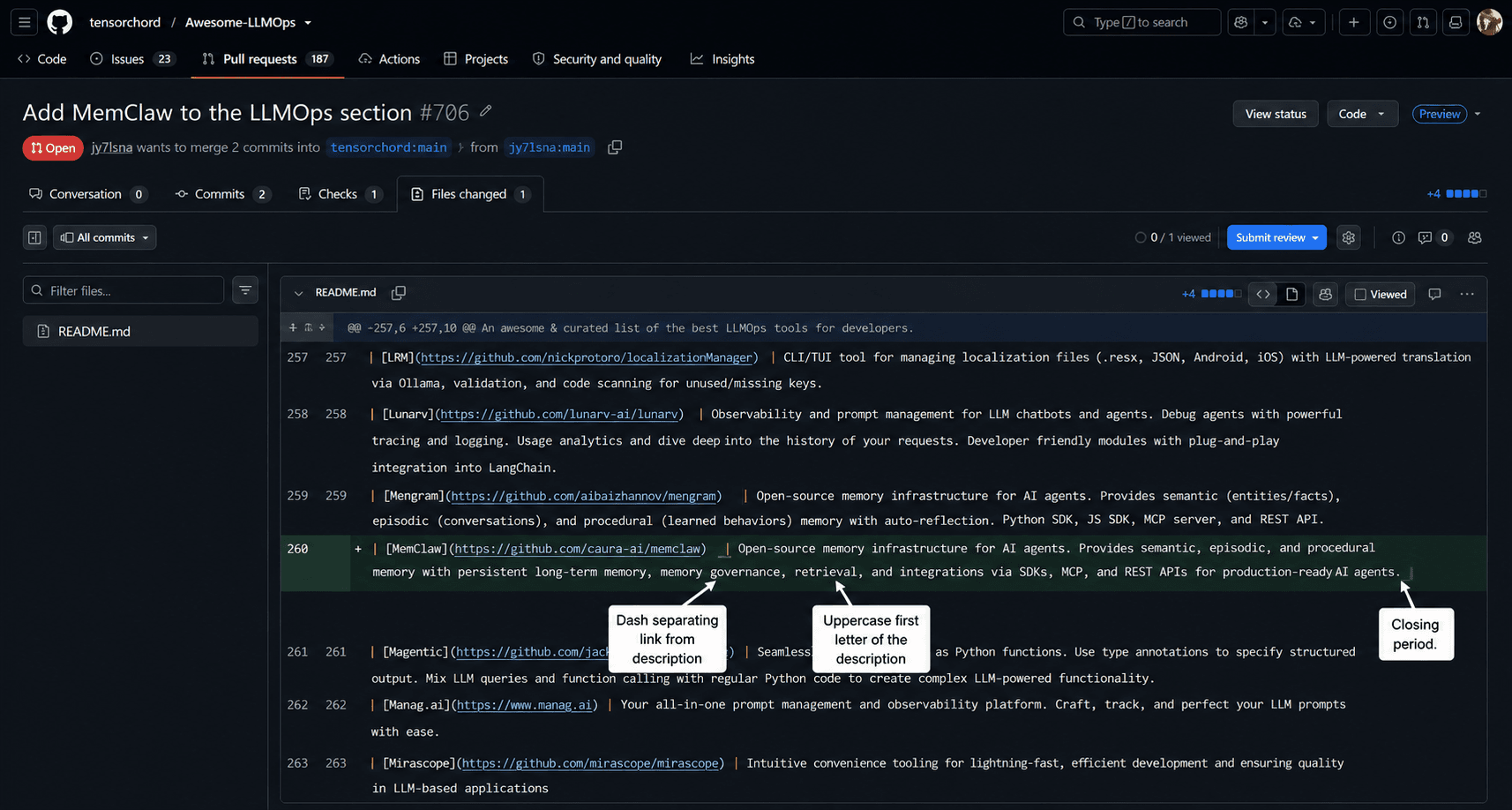
Awesome lists are the most underrated of the six because the barrier is format compliance rather than persuasion. The contribution guidelines for the canonical awesome repo are explicit that maintainers routinely send pull requests back over spelling and formatting mismatches, and the required entry shape is a dash between link and description, with the description starting uppercase and ending in a period. Match the list exactly, and a volunteer maintainer has no reason to reject you.
On the Reddit side, thread selection matters more than subreddit size. Simmonds makes the long-horizon case in the same session: a Reddit post he wrote roughly a decade ago still produces about two leads a year. His advice for teams starting is blunt, and worth reading as a constraint rather than a tip. "The next two posts that you put up on Reddit shouldn't be about your business. They should be helping somebody who's asking a question."
If you want the broader owned, earned, and paid framing behind these choices, our breakdown of distribution channels for B2B content marketing covers the mix. This piece stays on the repo-facing subset.
How Do You Cross-Post Without Losing The Ranking to Your Own Copy?
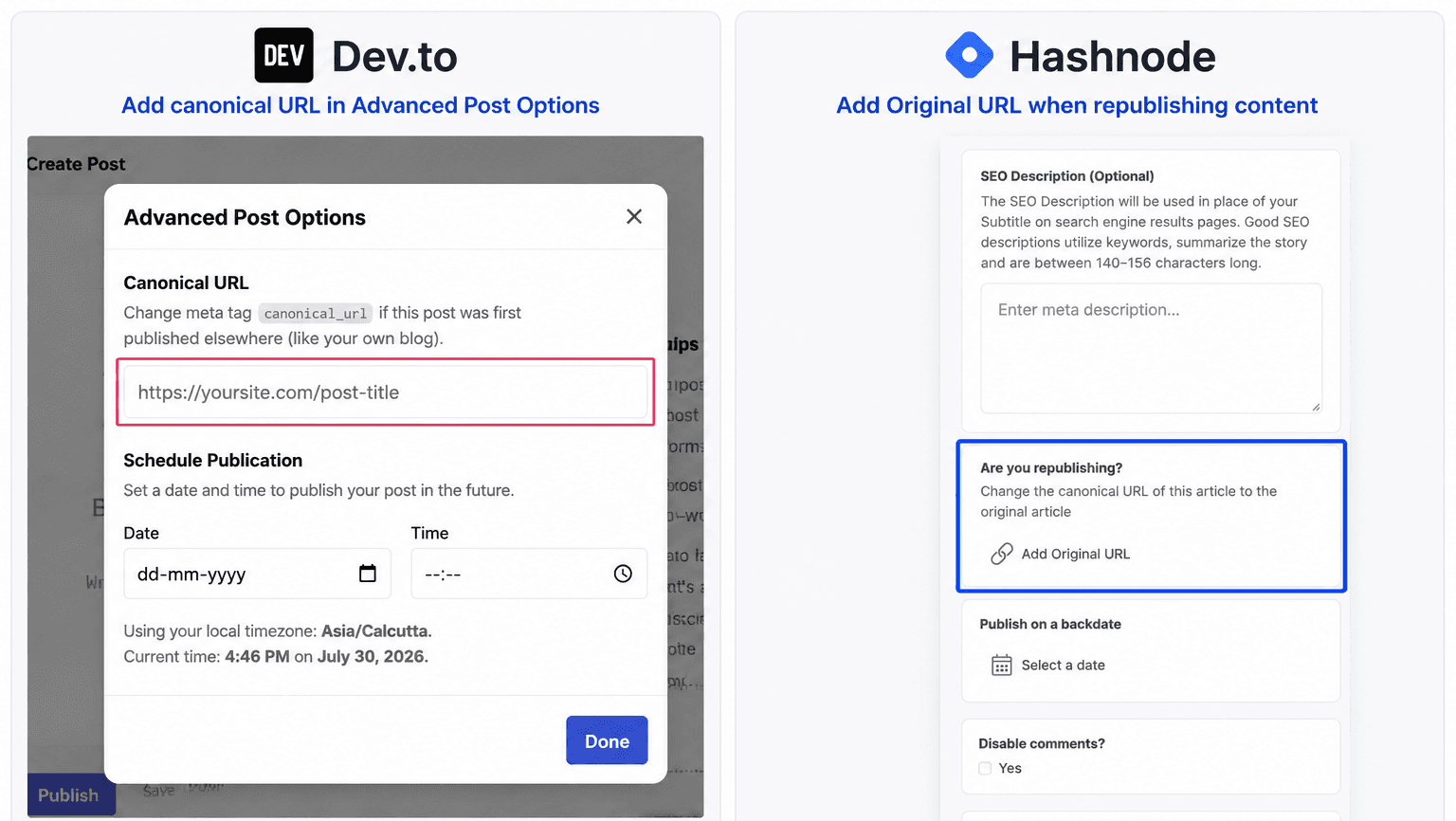
Set the canonical URL on every republished copy, and publish on your own domain first. The canonical tag tells search engines which version is the original, so link equity consolidates on your site instead of splitting across four platforms. Each platform exposes this differently, and one common channel does not support it at all.
| Platform | Where you set the original source | The catch |
|---|---|---|
| Dev.to | canonical_url in front matter, or the Canonical URL field behind the gear icon in the rich editor | RSS imports have a "mark the RSS source as canonical URL by default" option, which DEV recommends keeping on |
| Hashnode | The "Are you republishing?" section, via Add Original URL | Also offers hiding the post from Hashnode feeds so it shows on your blog only |
| Medium | The story importer only | You cannot add a canonical after publishing, so importing is the only safe route |
| daily.dev | Not applicable, it links to your URL rather than hosting a copy | Corporate blogs are ineligible as sources |
| LinkedIn articles | No canonical support | Share a plain link to the original instead |
DEV's own guidance to organization accounts confirms the front matter field and adds two constraints teams tend to break. Post gradually rather than all at once, because the feed will not surface a batch from one account, and avoid purely promotional posts. Their 2026 update to RSS imports restates the canonical recommendation for anyone syndicating at volume.
Canonical tags reduce the risk, they don't remove it
This is the failure mode nobody writes up. Developer Saul Hardman documented on DEV that his cross-posted article outranked his own original despite a correct canonical tag pointing home. His diagnosis was crawl order: DEV got indexed first, so the canonical pointed at a URL Google hadn't yet seen. His fix was to wait a few days after publishing before cross-posting.
Treat that as the operating rule. Publish on your domain, let it get indexed, then syndicate. The sequence costs nothing and protects the asset you actually own. For teams choosing between platforms rather than mechanics, we keep a separate platform-by-platform breakdown.
One platform will reject you on principle
daily.dev is worth calling out because the standard advice about it is out of date. Its documentation for suggesting a new source states that corporate and personal blogs are not eligible, and directs companies to start a Squad instead.
Two more details matter for planning: review can take up to 30 days, and an approved source does not backfill your archive, so only posts published after approval are considered.
The workable routes are a Squad or direct posting, which replaced Community Picks in 2025. Budget for that rather than filing a source request and waiting.
What Order Should This Run In?
Build the destination, then point channels at it. The rule that prevents most wasted effort: never publish a comment or post that points at something that doesn't exist yet.
That ordering is not a preference. Amplification multiplies whatever is already there, so a distribution wave aimed at a thin README converts the traffic it earns into bounces. Amy Woods, host of the Content 10X podcast, frames the underlying problem as a strategy failure rather than a quality one: most content goes unseen "not because it's bad content, but because the team spent so much time creating it and not enough time distributing it."
A workable sequence for a repo launch:
- Baseline. Write the five prompts a buyer types into an LLM before choosing in your category, run them across models, and log which tools get named. Open every source those answers cite. Those threads, not the biggest subreddits, are your target list.
- Fix the destination. Bare tool name, full topic set, install command above the fold, and a comparison file covering the dimensions you win on.
- Ship something runnable. One demo repo that clones and runs locally in under ten minutes, reverse-engineered from a complaint someone actually posted.
- Distribute in weekly waves. Eight to ten thread engagements a week, sequenced so each one has something concrete to point at.
- Submit listings in parallel. Awesome lists and directories first, free and high-authority before paid.
- Re-run the prompt audit monthly. Star velocity moves first, citations follow later.
Our GitHub marketing strategies guide expands step two, and the OSS launch visibility checklist is the short version you can run this week.
What Does It Look Like When It Compounds?
It accelerates instead of decaying. A launch spike fades inside 72 hours; a distribution system posts its fastest growth weeks in. The wider argument for treating a public repo as a pipeline asset sits in our open source marketing strategy guide.
We ran this sequence for one of our customers in an open-source persistent memory system for multi-agent fleets that had stalled at 17 stars while competitors sat between 3,000 and 60,000.
Over six weeks, the main repo gained stars, star velocity moved from one or two a week to roughly 30, and the package passed 31,000 downloads, with zero paid spend.
The full engagement is documented step by step, including the tracking sheet.
Directory listings were part of that. This is the repo on MCP Market, one of the placements from the engagement:
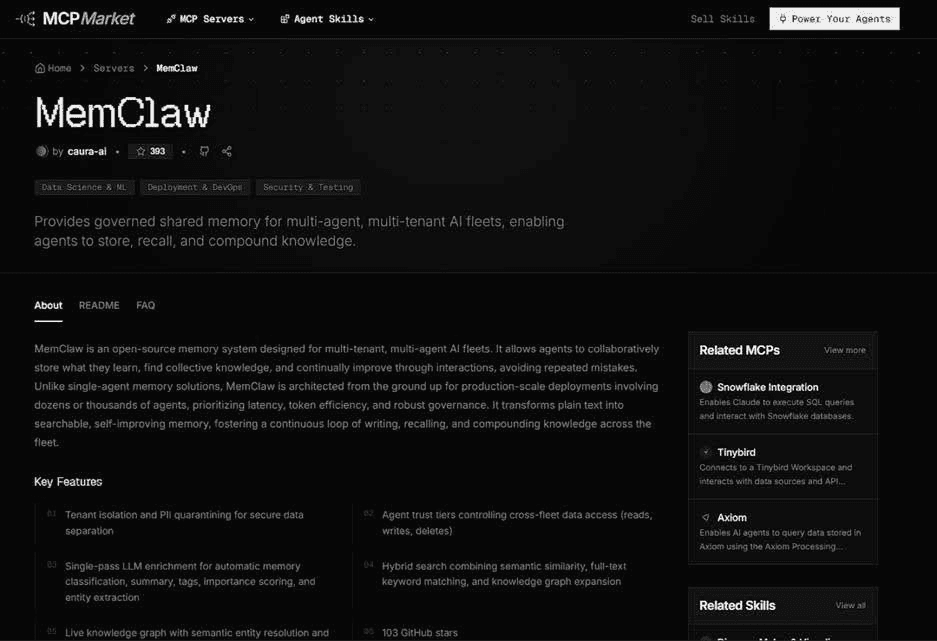
The listing itself is not the point. The Related MCPs panel on the right is. It puts the repo alongside the tools a developer is already weighing it against, on a page built to answer "what else is there", which is exactly the page a model reads when someone asks the same question.
Two details from that data are more useful than the headline number.
The three demo repos grew faster in percentage terms than the flagship. In one two-week reporting window, the main repo added 10%, while the demo repos added 56%, 31%, and 67%, respectively. Satellite repos built around a single verbatim complaint convert attention that a general-purpose README cannot, which is the practical argument for building more than one.
The second is the publishing ratio. Of 54 comments produced, 30 went live, with the rest queued, pending review, or rejected outright on technical accuracy by the client's own engineers. Plan for roughly half of drafted distribution to ship, and treat engineering review as part of the process rather than a bottleneck.
If your repo is technically strong and invisible, that gap is a distribution problem, and it is the one our GitHub marketing service is built to close: demo repos, multi-channel waves, and presence in the threads where your category gets decided.
Where Does This Break?
Four failure modes account for most of it, and three are avoidable in an afternoon.
Distribution runs ahead of the build
The most expensive version of this is a launch wave pointed at a repo with no install command above the fold. Traffic arrives once and does not return. Fix the destination first, always.
Every channel gets the same asset
A Show HN submission, a Dev.to tutorial, and a Reddit comment answering a specific failure are three different jobs. Pasting one text into all three reads as broadcast, and the platforms with voting punish it fastest.
Placement gets mistaken for consideration
Appearing in a model's answer or a directory listing is necessary and not sufficient. A Refine Labs episode on distribution puts it sharply: "Making the list doesn't make you part of a consideration set." The speaker's own example is a buyer who saw an unfamiliar brand recommended, went to Reddit threads to check whether real people mentioned it, and formed a view there. Corroboration across surfaces is what converts a listing into a shortlist, which is the argument for running listings and threads together.
Nobody owns distribution
Distribution decays into an afterthought without a named owner and a written process. Simmonds is direct about this: if it needs to get done, "it needs to be like a process that is defined somewhere, and somebody's like owning that."
Still Confused Where To Start?
You now have the surface list, the canonical settings per platform, and the sequence that keeps distribution from outrunning the build.
The first step is small: open your repo, count your topics, and check whether the install command is visible without scrolling. If either fails, fix them before publishing anything else, because every channel you run points here.
When you want the whole motion run against your category rather than assembled in-house, that is what we do, or compare us against other GitHub marketing agencies first.
Frequently Asked Questions
Does cross-posting to Dev.to hurt my SEO?
Not if you set the canonical URL and publish on your own domain first. Dev.to supports canonical_url in front matter, which tells search engines your site holds the original. The residual risk is crawl order, so allow a few days between publishing and syndicating.
Can I submit my company blog as a daily.dev source?
No. daily.dev's documentation states that corporate and personal blogs are not eligible as sources and points companies to Squads instead. Direct posting is also open to all users, having replaced Community Picks in 2025.
How many GitHub topics should I add?
GitHub permits up to 20, and the useful range is closer to six to eight covering language, category, and use case. Topics must be lowercase with hyphens and 50 characters or less. A repo with zero topics appears on no topic pages at all.
Is Medium still worth it for a devtool?
Only as a secondary surface, and only through the importer, since you cannot add a canonical tag after publishing. Developer intent sits higher on Dev.to and Hashnode, so run those first and treat Medium as reach.
How long before distribution shows up in AI answers?
Longer than star growth. Thread presence and listings register first as engagement and clones, while citation changes follow weeks later once models re-crawl the sources. Track both, and expect the leading indicator to move before the answer does.
Should we pay for placements and directory listings?
Submit the free, high-authority surfaces first and see what converts. In the MemClaw engagement, seven listings went live at zero placement spend, with paid options identified and deliberately deferred.