
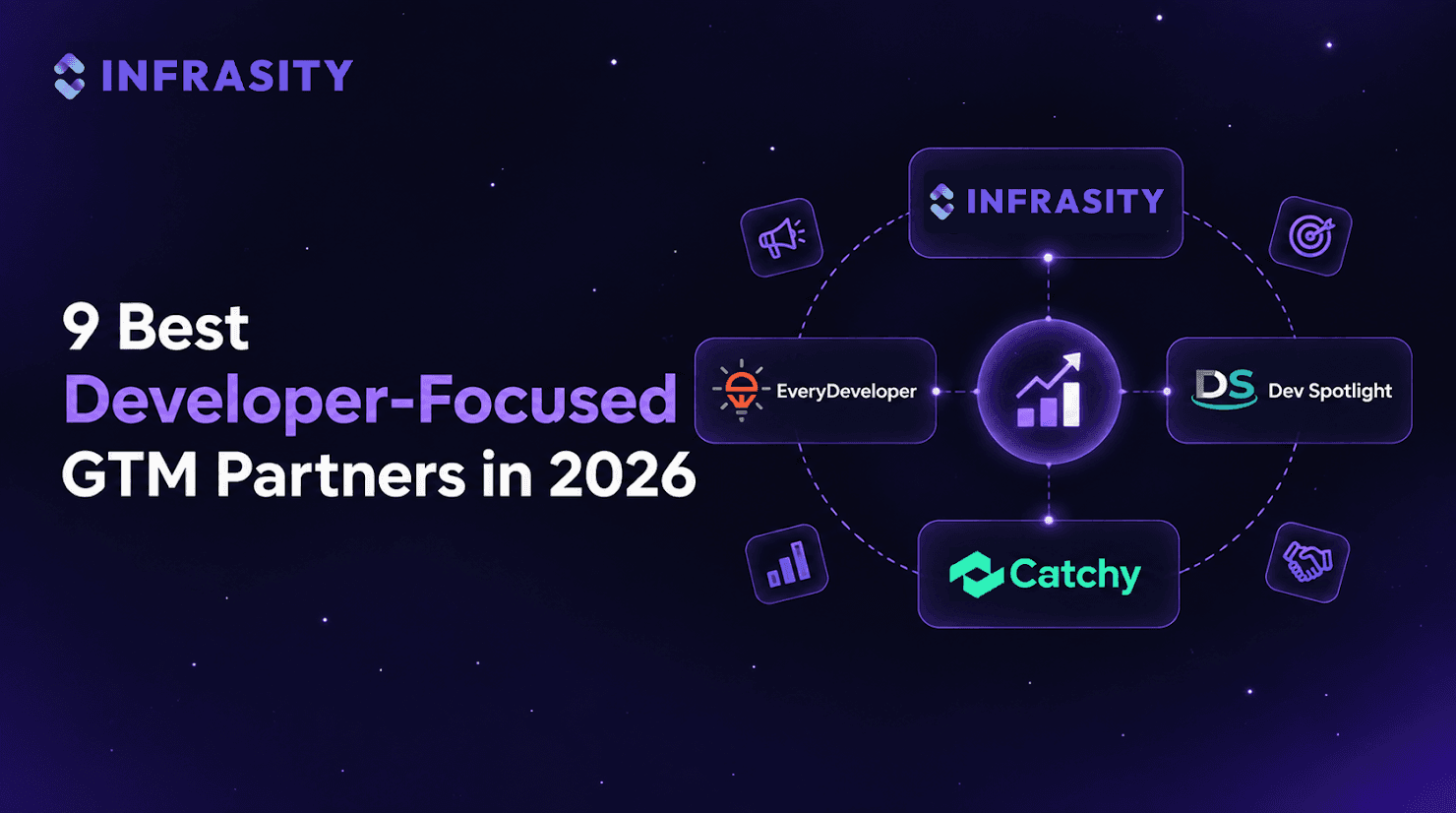
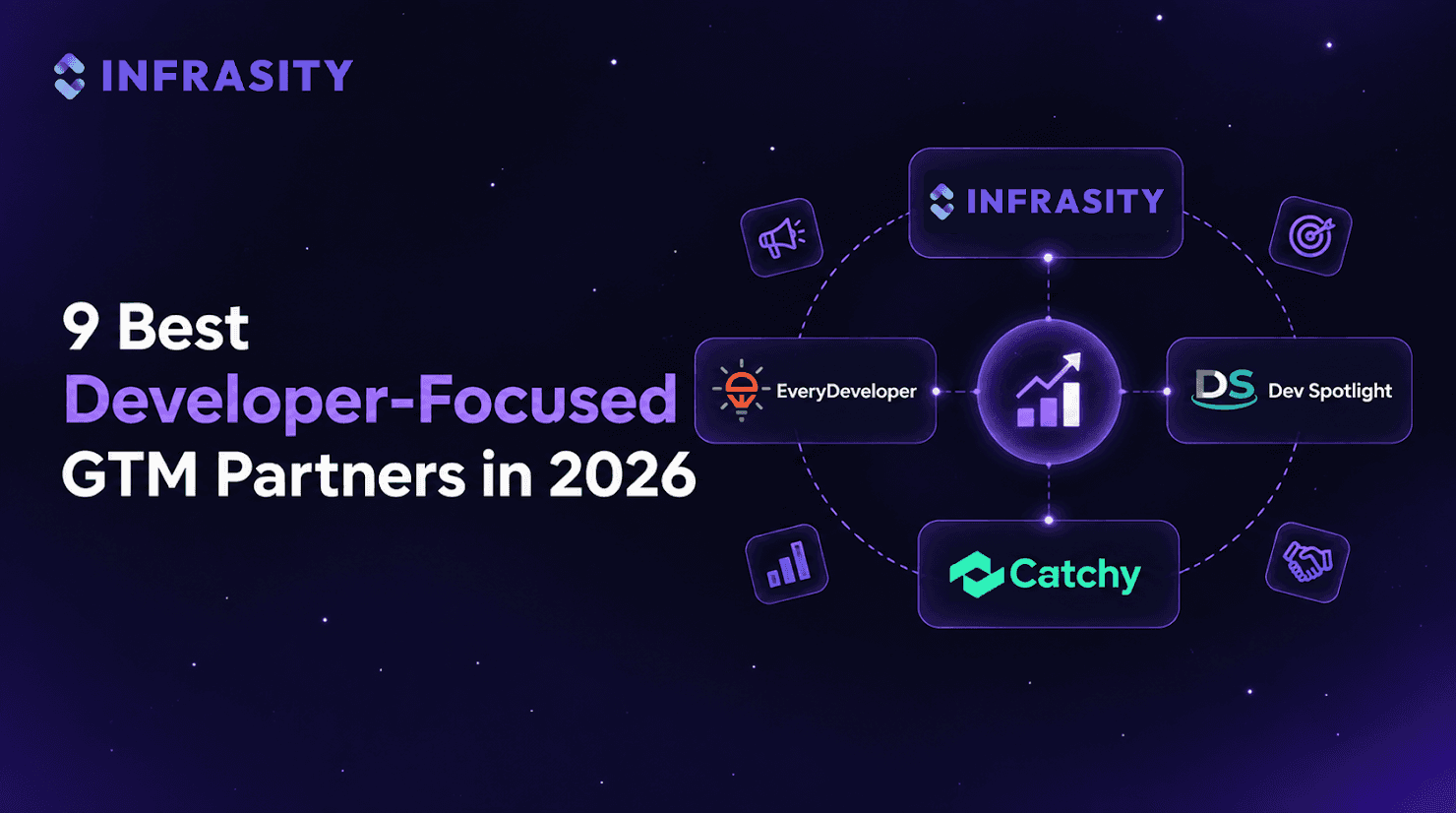
The best developer-focused GTM partner is the one matched to what's broken in your funnel, and for developer-led companies running content, community, and AI visibility as one program, that is Infrasity. If your pain point is different, read on; you'll find your right partner.
This blog maps 9 partners to the symptom each one fixes.
TL;DR
- The list compares 9 developer-focused GTM partners, matched to specific bottlenecks: Infrasity, Catchy Agency, EveryDeveloper, Dev Spotlight, PipeRocket Digital, Hey Digital, Animalz, Kalungi, and Powered by Search.
- Published pricing ranges from $3,000/mo for PipeRocket Digital to $10,000+/mo for Animalz, while four of the 9 partners publish no pricing.
- Infrasity's OX Security program grew positions 1 to 3 from 89 to 509 keywords, while median position across 10 core keywords reached 5 versus Snyk at 25.
- The list covers different GTM gaps: EveryDeveloper focuses on docs and DX, Dev Spotlight on technical tutorials, PipeRocket on adoption-to-pipeline, Hey Digital on paid acquisition, Animalz on editorial authority, Kalungi on fractional marketing leadership, and Powered by Search on technical-buyer demand gen.
- Timeline matters: paid acquisition can move in 60 to 90 days, engineer-led content and SEO typically compound over 6 to 9 months, while community and DevRel can take 9 to 18 months to become measurable.
Why do generic GTM agencies fail on developer products?
Because almost every part of a standard go-to-market motion assumes the buyer will talk to you before they try the product, and developers reverse that order.
That single inversion breaks the machinery underneath. A gated whitepaper assumes information is the thing being traded. A nurture sequence assumes education happens over email. Lead scoring assumes the form fill is the signal.
For a developer evaluating a CLI tool at 11 pm, none of those assumptions hold. They found you in a forum thread, read your docs, ran your quickstart, and either kept going or closed the tab. No form was filled at any point.
Four of the five stages in a developer's path leave no lead-capture trace. The pipeline looks empty while adoption is already happening.
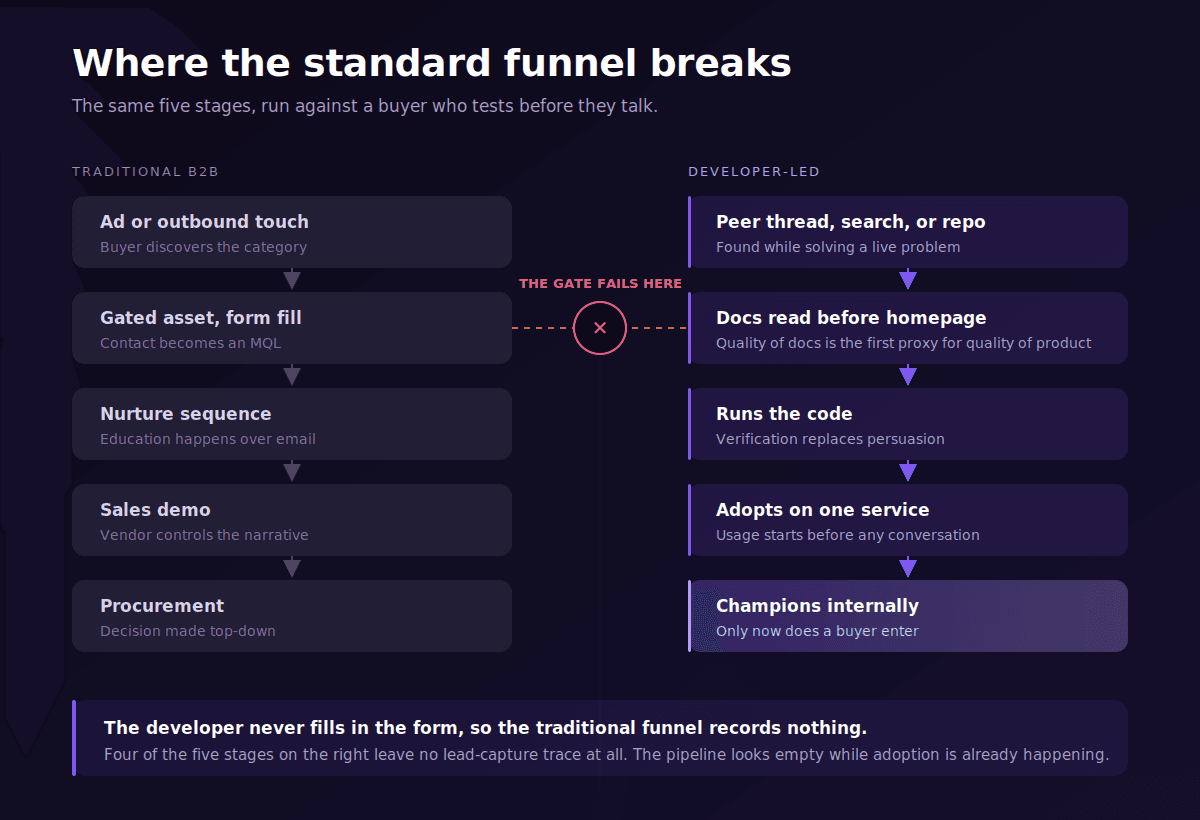
The gate fails at the form fill. Four of the five stages on the developer-led path leave no lead-capture trace at all.
The verification instinct is measurable, and it is getting stronger
Developers do not accept claims; they test them. The clearest public evidence sits in Stack Overflow's 2025 Developer Survey, which drew more than 49,000 responses across 177 countries.
AI tool adoption rose to 84%. Trust in those tools fell in the same year. More developers said they actively distrust the accuracy of AI output (46%) than said they trust it (33%), and only 3% reported highly trusting it. Among experienced developers, the gap is wider still: 2.6% highly trust, 20% highly distrust.
Read that as a marketing fact rather than an AI fact. This population becomes more skeptical as it increases its usage. Stack Overflow's own follow-up analysis attributes it to training: engineers are taught deterministic thinking, where the same input twice should give the same result twice. Anything that cannot be reproduced gets discounted.
A campaign built on assertion runs directly into that instinct. A tutorial that a reader can execute does not.
The person using the tool is not the person signing
Developer purchases run bottom-up. Someone adopts a tool on one service, it works, they push for it internally, and only then does a budget holder appear. The State of Developer Relations report puts developer influence at a minimum of two-thirds of the buying decision for developer products.
Traditional GTM targets the signer. It builds an ICP around job titles with budget authority, then routes everything to them. Run that on a devtool, and you spend the entire budget talking to the one person in the process who will ask their engineers what to buy.
How do the 9 GTM partners compare?
This table draws on each agency's published material and third-party review profiles. Where a firm does not publish pricing, we record that rather than estimate it.
| Partner | The bottleneck it fixes | Model | Published entry price | Third-party rating |
|---|---|---|---|---|
| Infrasity | Developer content, community and AI visibility run as one program | In-house engineers, retainer | Custom | 4.7/5, 11 reviews (Clutch) |
| Catchy Agency | Enterprise developer programs, DX, community | Full-service, developer-only | Not published | No verified Clutch or G2 profile |
| EveryDeveloper | Developer content strategy plus docs and DX | Founder-led advisory | Not published | No Clutch profile |
| Dev Spotlight | Deep tutorials and integration walkthroughs | Engineer-writer model | Not published | No Clutch profile |
| PipeRocket Digital | Developer adoption that is not reaching enterprise pipeline | 30+ person demand team | $3,000/mo | 4.7/5, 18 reviews (Clutch) |
| Hey Digital | Paid acquisition once messaging is proven | SaaS-only paid media | Not published, ~$5K min | 4.6/5, 4 reviews (Clutch) |
| Animalz | Editorial authority for engineering-led SaaS | Editorial retainer | $10,000+/mo | 0 reviews on both Clutch and G2 |
| Kalungi | Missing marketing leadership | Fractional CMO plus team | $6,500/mo coaching | 4.8/5 on FeaturedCustomers |
| Powered by Search | Demand gen where the buyer is a CISO or VP Eng | Integrated paid, SEO, ABM | $5,000+ project min | Clutch profile, 0 reviews |
Two things in that table deserve attention before you read the profiles.
Verified review depth is rare in this category. Six of the nine have no verified third-party rating on a client-review platform (Clutch, G2, or similar) at all, which is not a mark against their work but does mean references matter more here than in most agency purchases. Ask for two live client contacts and call them.
Published pricing is rarer still. Four publish nothing. When you are comparing a $3,000 retainer against a $45,000 one, you are usually comparing different products rather than different prices.
1. Infrasity, for developer-led GTM run as a single program
Best for: DevTool, infrastructure, observability, and AI agent companies where technical content, developer community, and AI search visibility need to move together rather than as three vendors. Names on the client list include OX Security and Qodo, a $40M AI code review platform.
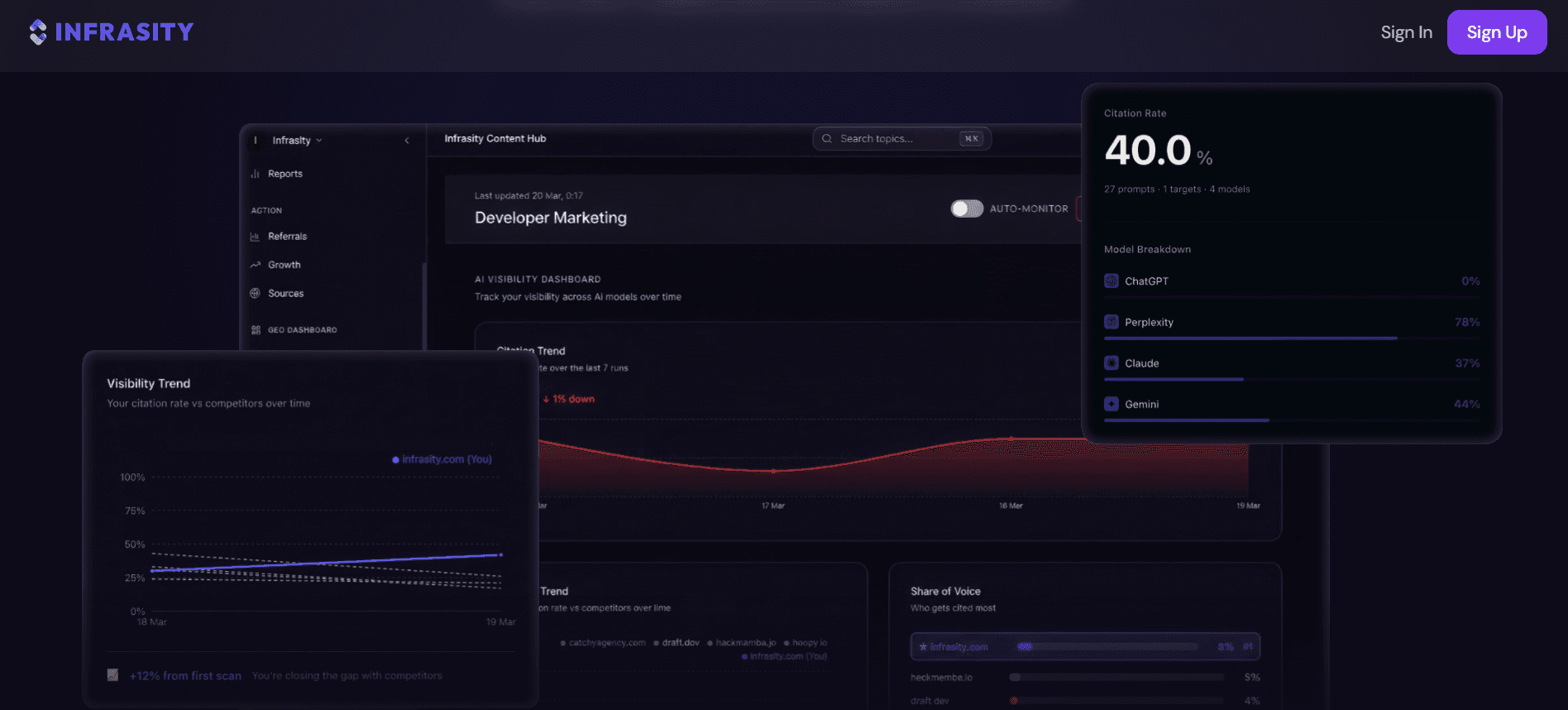
Most of this list is specialized. Hey Digital buys media. EveryDeveloper advises. That specialization is a real strength when you have one clean gap, and a real problem when none of your channels connect.
Infrasity is built for the second case. Content is written by in-house engineers who work hands-on with the product, then distributed into the developer channels where evaluation actually happens, then measured against AI search citation coverage and product adoption rather than pageviews. The services span developer marketing, technical content GTM, technical writing, GitHub marketing, Reddit marketing, and AI GEO optimization.
The mechanism is easier to judge from a program than a claim. In a 16-month engagement with OX Security, an application security platform competing against Snyk, Wiz, and Checkmarx, the first move was subtraction. Five separate pages were competing for SBOM tooling, four for ASPM, and three for software composition analysis. Twenty-two competing URLs were merged into eight, and the total ranking keyword footprint was deliberately cut from 2,684 to 1,357.
Traffic doubled on half the keywords. Positions one to three grew from 89 keywords to 509. Visits per ranking keyword went from 1.64 to 5.64. Branded traffic fell from 23.1% to 9.9% of the total, meaning the growth came from people who had not heard of OX before. Across ten core category keywords, OX now holds a median position of 5, while Snyk sits at 25. The full case study publishes both the peak traffic number and the lower stabilized run rate, which is the honest version.
One finding from that program is worth taking even if you never speak to Infrasity. Of the 29 Google AI Overview citations earned for OX, 22 came from tools listicles rather than definition pages. An AI Overview needs to name options with differentiators attached. A definition page explains a concept the model can already explain itself, so there is nothing to cite. If AI visibility is your goal, the page format matters more than word count.
This same developer-first system scaled Qodo (a $40M AI code review platform), taking them from a single keyword cluster to the #2 AI code review tool across both traditional Google Search and LLM citations. You can see the exact execution strategy used for this growth in the Qodo case study.
Where Infrasity is not the fit: teams whose main gap is paid media, outbound sales infrastructure, or enterprise ABM. Those are not the practice.
Consider it when: your engineers will not share your own blog, your competitors are being named in AI answers, and you are not, and you would rather brief one team than coordinate four.
If that describes your quarter, the fastest way to test the thesis is a free consultation against your actual content and citation footprint rather than a capabilities deck.
2. Catchy Agency, for enterprise developer programs
Best for: larger devtool and technical-product companies that want strategy, demand generation, developer experience, and community under one roof.
Catchy works only with companies marketing technical products to technical audiences, which is a narrower focus than most full-service shops. It runs developer programs rather than content retainers: positioning, DX audits, demand generation, events, and ecosystem building. Offices are in the UK and the US.
The trade-offs: no verified profile on a client-review platform like Clutch or G2, and founding year, team size, and pricing are undisclosed. (Glassdoor carries employee reviews about working at Catchy, which speak to workplace culture rather than client-facing service quality, so they are not a substitute here.) Diligence rests on references and portfolio. Early-stage teams on a single-channel budget are the wrong shape for it.
3. EveryDeveloper, for docs and DX strategy
Best for: API-first companies that need an advisor who has actually run developer relations, not a content vendor.
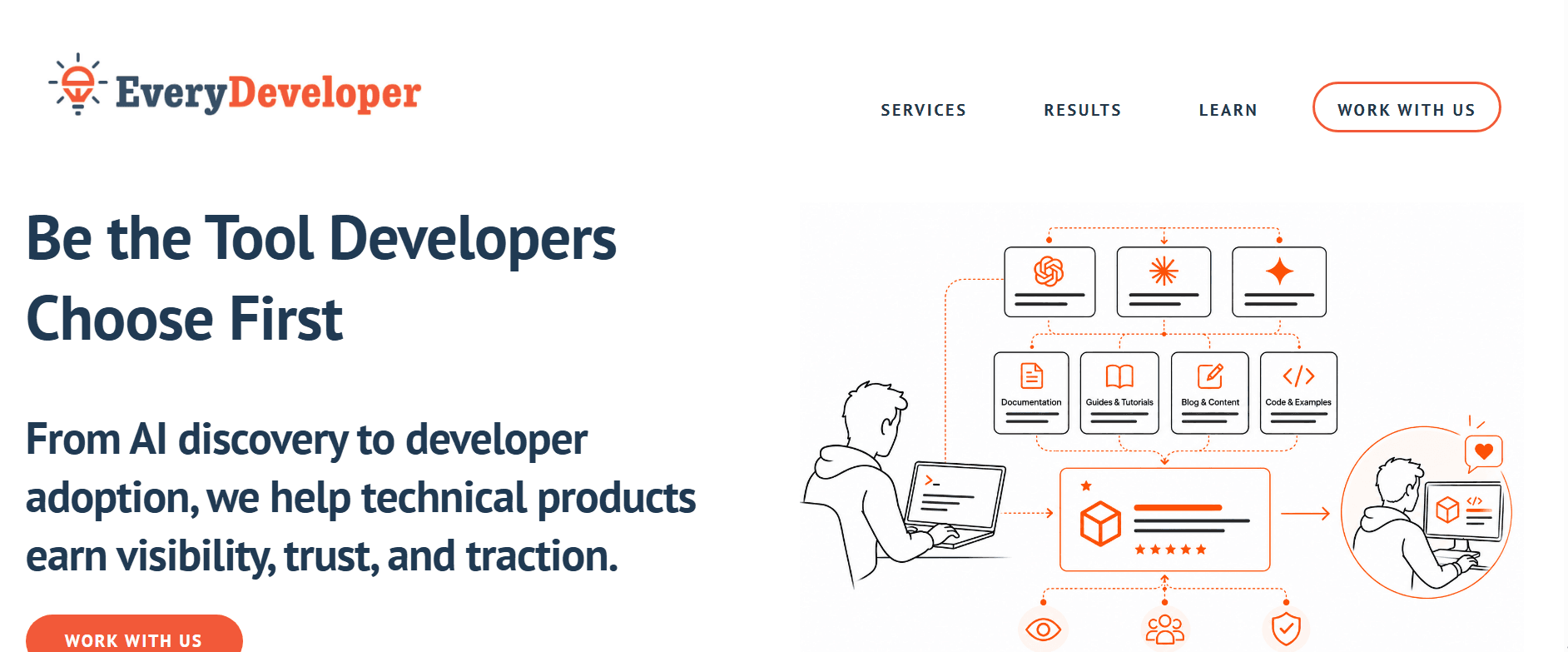
EveryDeveloper is Adam DuVander's boutique consultancy. DuVander edited ProgrammableWeb and ran DevRel at SendGrid and Zapier, which is unusually direct experience for this category. Named clients include Google, Microsoft, and Algolia. Documentation and developer experience are published service lines, which most content agencies skip entirely.
If your signups stall at the first API call, the problem is rarely the blog. It is the seventeen minutes between "create account" and "first successful request." That is the work here.
The trade-offs: founder-led, so there is a real capacity ceiling. No published pricing, no Clutch profile. Not built for high-volume output.
4. Dev Spotlight, for deep technical tutorials
Best for: teams needing genuinely deep tutorials and integration walkthroughs, particularly in DevOps, cloud and data.
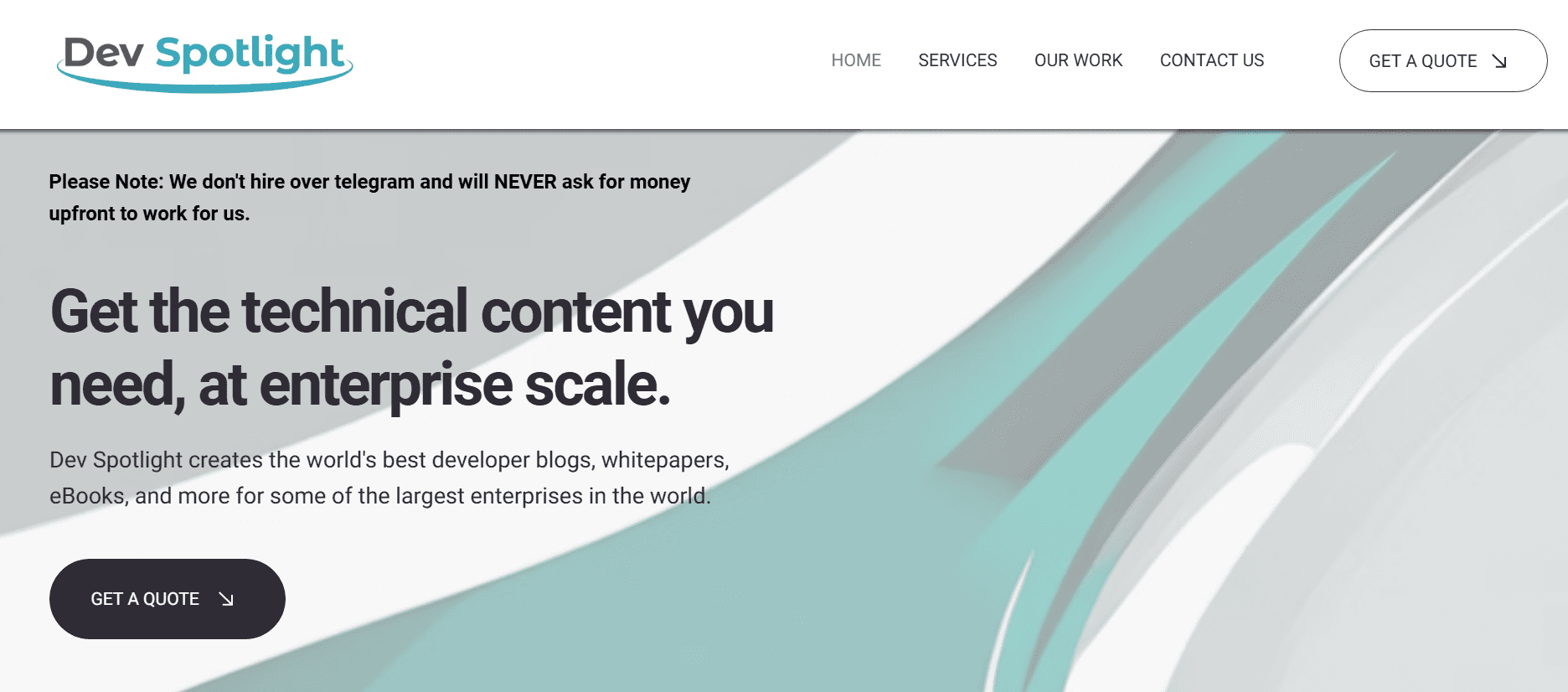
Run by Michael Bogan since around 2016, Dev Spotlight uses the same engineer-writer model. The client logo wall includes Amazon, Cisco, Twilio and Salesforce. Its tagline states the pitch plainly: stop pestering your developers to write blog posts and let them code.
The trade-offs: thin public footprint, no third-party verification, undisclosed team size, and unclear capacity for large programs. No demand generation or community work.
5. PipeRocket Digital, for adoption that is not becoming pipeline
Best for: devtool companies where developer adoption is healthy but the board is asking why revenue has not followed.
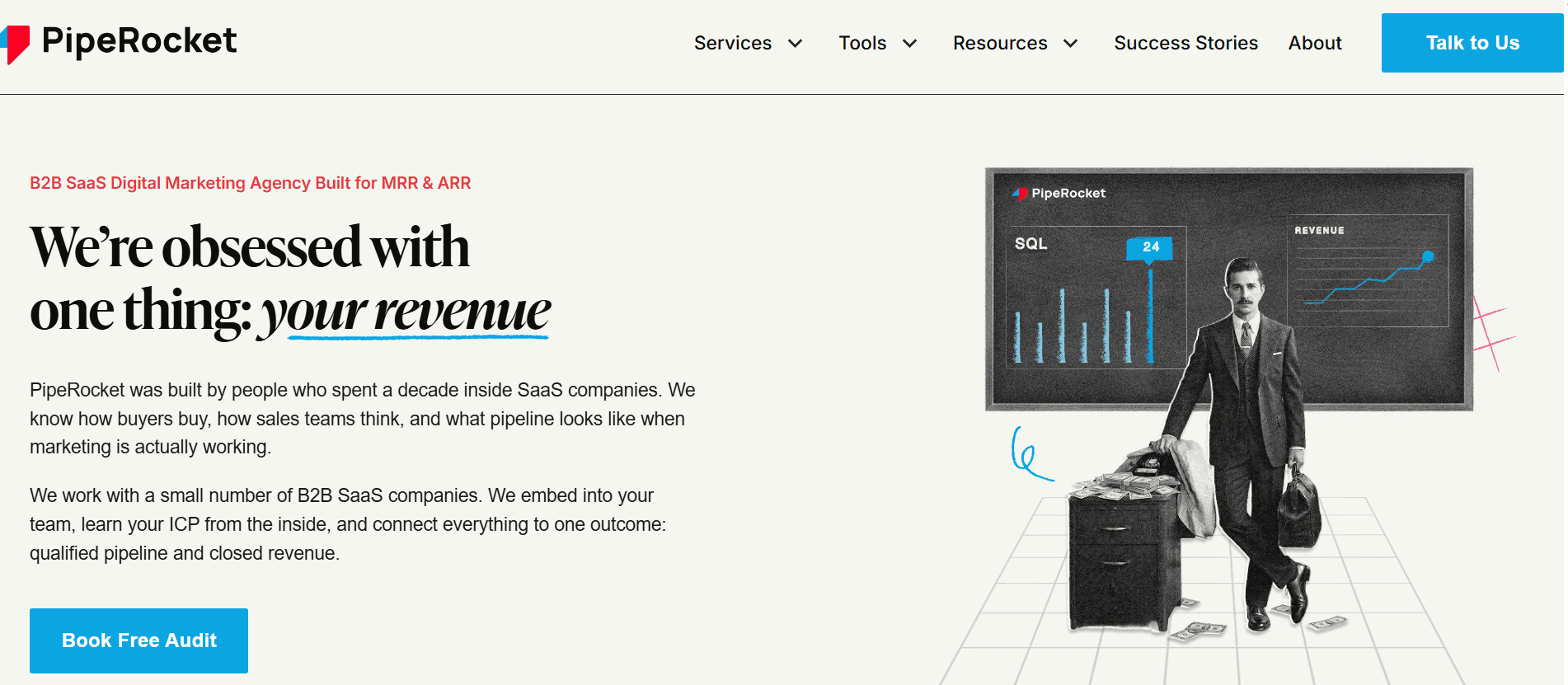
PipeRocket is a 30-plus-person B2B SaaS demand agency rather than a devtools-native content shop, and it is candid about that. Its edge is the architecture connecting developer adoption to enterprise procurement: ICP mapping across both the developer champion and the economic buyer, then single-number pipeline attribution across paid, organic, ABM and content.
This is a genuinely different problem from the one Dev Spotlight solves. If your installs chart looks great and your pipeline chart does not, more tutorials will not fix it.
The trade-offs: not the deepest technical content on this list, no DevRel or community programs, and no events capability. It publicly recommends pairing with a content specialist for deep API work.
6. Hey Digital, for paid acquisition on a proven message
Best for: teams with a defined ICP, validated messaging, and at least $5,000 a month to commit to media.
Hey Digital is SaaS-only paid acquisition across Google, LinkedIn, Meta, Reddit, YouTube, and Product Hunt, paired with conversion-focused landing pages. Real devtool logos sit in the book, including PostHog, Checkly, and Hotjar. Published results include an 18.5% lift in cloud conversions and 17% lower CPA for PostHog.
Paid media is the one channel here that moves the pipeline in 60 to 90 days rather than 6 to 9 months. That speed is exactly why it is dangerous early: it will scale whatever message you give it, including a wrong one.
The trade-offs: paid media only, so organic, content, and DevRel need a separate partner. The Clutch sample is small at four reviews. Estonia-based, so most overlap falls in European hours.
7. Animalz, for editorial authority
Best for: engineering-led SaaS with $10,000-plus monthly content budgets that want thought leadership compounding over years.
Animalz is the best-known editorial B2B SaaS content shop, with WorkOS, Auth0, Segment, Atlassian, and Intercom on the homepage. Its model puts named spokespeople ahead of brand voice and prioritizes research-backed long-form.
Be clear about what you are buying. The writers are experienced B2B content marketers, not practicing engineers. For a category argument aimed at a VP of Engineering, that is fine. For a Kubernetes tutorial your users will run, it is not.
The trade-offs: zero verified reviews on both Clutch and G2, a reported 2023 headcount reduction that raises continuity questions, and a price floor that excludes early-stage teams.
8. Kalungi, for missing marketing leadership
Best for: VC-backed companies between roughly $1M and $10M ARR that need an outsourced marketing function, not a channel.
Kalungi is the fractional CMO shop for B2B SaaS, with a tiered framework running from coaching at $6,500 a month to full service at $45,000. More than 150 companies served since 2018. Its framework explicitly handles the transition from product-led to enterprise motion, which is the exact wall many devtools hit at Series B.
Kalungi is one of only two names on this list that also appears on mainstream GTM agency shortlists, and that is precisely because it is a stage specialist rather than an audience specialist.
The trade-offs: no devtools-specific practice, the fractional CMO is shared rather than dedicated, and engineers are not the writers. If your gap is developer credibility rather than marketing leadership, this is the wrong tool.
9. Powered by Search, for technical buyers who are not developers
Best for: security, infrastructure and compliance products where the real buyer is a CISO or VP of Engineering.
Powered by Search is a Toronto demand-generation agency founded in 2009, with genuine depth in cybersecurity. Clients include Fortra, ThreatX and Cyera. Paid, SEO and ABM run under one methodology on HubSpot.
The distinction matters and is easy to miss. Selling to a CISO is a technical sale, but it is not a developer sale. The buyer has budget, sits through demos, and responds to risk framing. Developer-native tactics are largely wasted there, and vice versa.
The trade-offs: no verified Clutch reviews, hourly rates at the top of the market, and a playbook aimed at technical buyers rather than developers as end users.
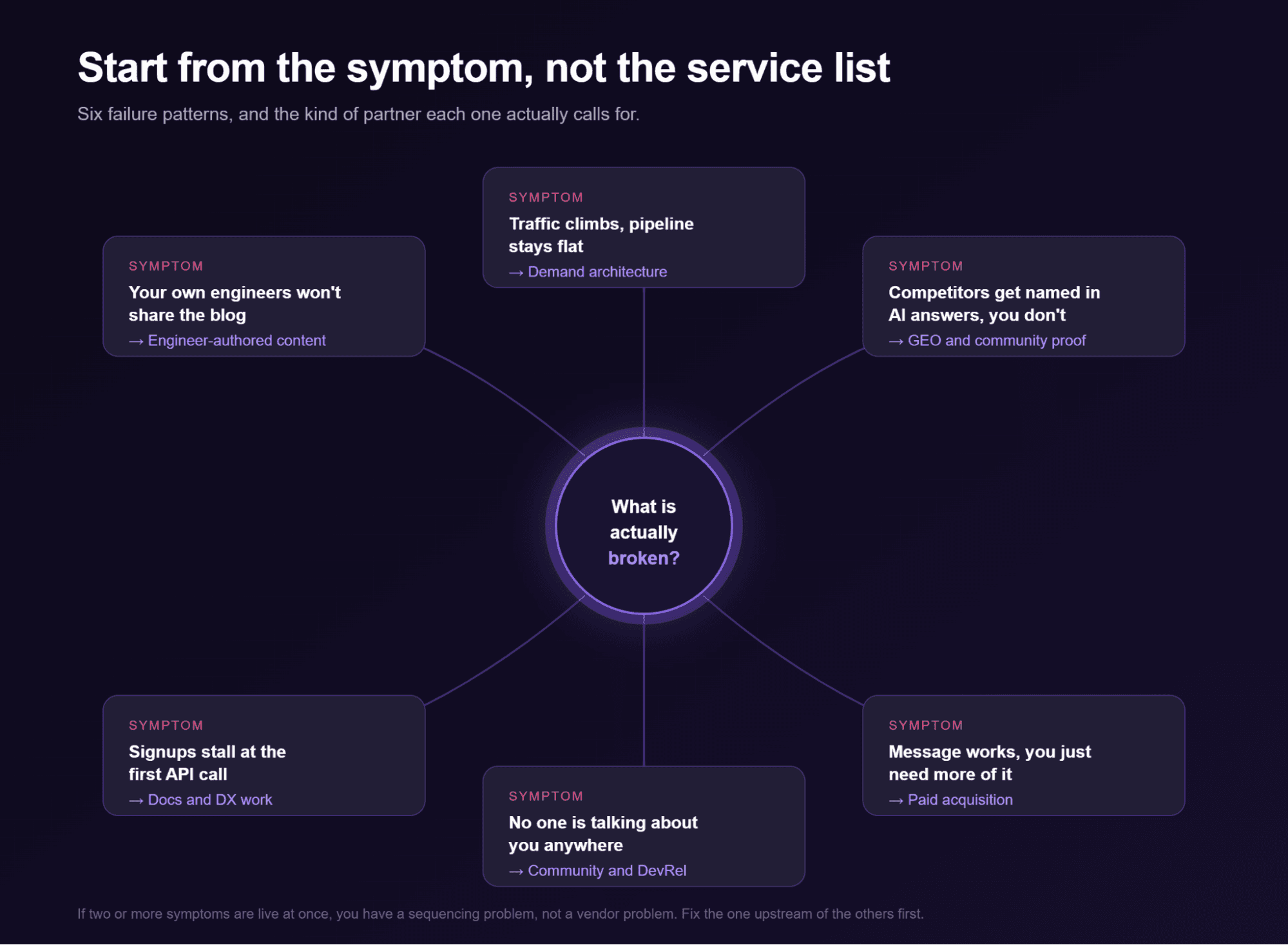
Six failure patterns and the partner category each one calls for. Diagnose before you shortlist.
Which Developer-Focused GTM Partners you should actually pick?
Match the partner to the symptom, and be honest about which symptom is upstream of the others.
Your engineers will not share your own blog: Credibility is the gap. Engineer-authored content is the fix. Infrasity or Dev Spotlight, depending on whether you need distribution attached.
Signups stall at the first API call: This is documentation and developer experience, not marketing. EveryDeveloper or Infrasity's technical writing practice. Publishing more blog posts against this symptom wastes a quarter.
Traffic is climbing, and pipeline is flat: Demand architecture. PipeRocket, or Infrasity's technical content GTM, if the disconnect is that no ranking page links to a product page. In the OX program, we closed that gap with 79 deliberately mapped blog-to-product links.
Competitors get named in AI answers, and you don't: This is now its own workstream. Listicle-shaped content plus credible community presence, because AI Overviews cite pages that name options and threads where practitioners argue. Infrasity's AI GEO and Reddit practices, or Catchy at enterprise scale.
Nobody is talking about you anywhere: Community and DevRel again, Infrasity. Catchy for programs and events.
Worth reading how an agency compares to a first DevRel hire before you commit to either.
The message works; you just need more of it: Paid acquisition. Hey Digital. Don't reach for this before the message is validated.
You have no marketing leader: Kalungi. Fix leadership before you buy channels.
One sequencing rule holds across all of them. If three of these symptoms are live at once, you do not have a vendor problem; you have an ordering problem. Fix credibility before distribution, and distribution before paid, because paid multiplies whatever it is given.
What should you ask before signing?
Four questions.
- "Who writes the actual words, and have they run this software?" Ask for the byline, not the agency name. Ask to see a piece where the writer hit a real edge case.
- "What would make you tell us not to hire you?" Every firm on this list has a genuine wrong-fit case, and the honest ones name it unprompted.
- "Show me a page you wrote that is cited in an AI Overview." This is now a fair, checkable test, and one most agencies cannot pass.
- "Which product page does each piece of content link to?" If the answer is vague, rankings will not become pipeline.
Expect realistic timelines. Paid moves in 60 to 90 days. Engineer-written content and SEO compound over 6 to 9 months. Community and DevRel work runs 9 to 18 months before it is legible in a dashboard. Anyone promising developer trust in 30 days is describing something else.
Where to start?
You now have the failure patterns, the partner matched to each, and the four questions that expose a weak fit. The useful first step is small: open your analytics, divide organic sessions by ranking keywords, and look at the yield. Under 2 means you have a consolidation problem, not a publishing problem, and hiring anyone to write more will make it worse before it improves.
If your gap is that content, community, and AI visibility are running as three disconnected efforts, that is the specific problem Infrasity is built around. Book a consultation and bring your current content footprint, or read the developer marketing playbook first and self-diagnose.
Frequently Asked Questions
What is a developer-focused GTM partner?
A firm that builds go-to-market motions for products whose users are engineers, where adoption happens before any sales conversation. The work centers on technical content credibility, documentation, community presence, and self-serve activation rather than lead capture and nurture sequences. The practical test is whether practicing engineers sit on the team.
How much does a developer marketing agency cost in 2026?
Published entry points on this list range from $3,000 a month to $10,000 a month, with full-service engagements reaching $45,000. Broadly, technical content and SEO run $3,000 to $12,000 monthly, full community and DevRel programs $8,000 to $28,000, and paid acquisition $5,000 to $15,000 or 10 to 20% of spend. Four of the nine firms here publish no pricing at all.
Should we hire an agency or make our first DevRel hire?
Hire the agency first if you are still testing which channels work, since an agency runs several in parallel and you learn faster. Bring DevRel in-house once there is a repeatable inbound motion that needs a full-time owner and a community that needs a consistent face. Reversing that order tends to burn a good hire on channel discovery.
Why do so few developer marketing agencies have Clutch reviews?
Most work in this category comes through private referral, so clients are rarely asked to post public reviews. Six of the nine firms here have no verified rating on a client-review platform. Treat that as a reason to request live client references, not as a warning sign in itself.
Can a general B2B SaaS agency market a developer tool?
Sometimes, and mainly when your buyer is a CISO or VP of Engineering rather than the developer using the product daily. Where the developer is the evaluator, generalist tactics like gated assets and nurture sequences underperform, because the developer will have tested the product and formed an opinion before any of them fire.
How long before developer marketing shows up in the pipeline?
Paid acquisition moves in 60 to 90 days. Engineer-written content and organic search compound over 6 to 9 months. Community and developer relations work typically takes 9 to 18 months. The variable that shortens all three is whether every ranking page has an engineered path into a product page.