


Introduction
A devtool UI/UX engagement buys three things: page and system design, a front end built and shipped to production, and the machine-readable layer underneath it. A focused marketing-site rebuild runs two to four weeks. Product UI work runs longer. We pulled every agency page ranking for "ui ux design services" on Google US and read all of them. One of eighteen named developer tools, CLIs, or SDKs as an audience.
That gap is the whole problem. You're buying a service whose sellers have not, by and large, thought about your buyer. This blog piece covers what belongs in scope for a developer tool specifically, which deliverables are worth paying for, what the work costs, how long it takes, and the five places these engagements stall.
TL;DR
There are three layers, most agencies sell one. Design (Figma), build (shipped production code), and machine-readable (server-rendered copy, JSON-LD, llms.txt). Only 12/19 agencies even mention shipping code, most just hand you a Figma file and your engineers eat the build.
46% of developers distrust AI output claims. Design has to survive scrutiny: link benchmarks, show commands, don't say "10x faster" without proof.
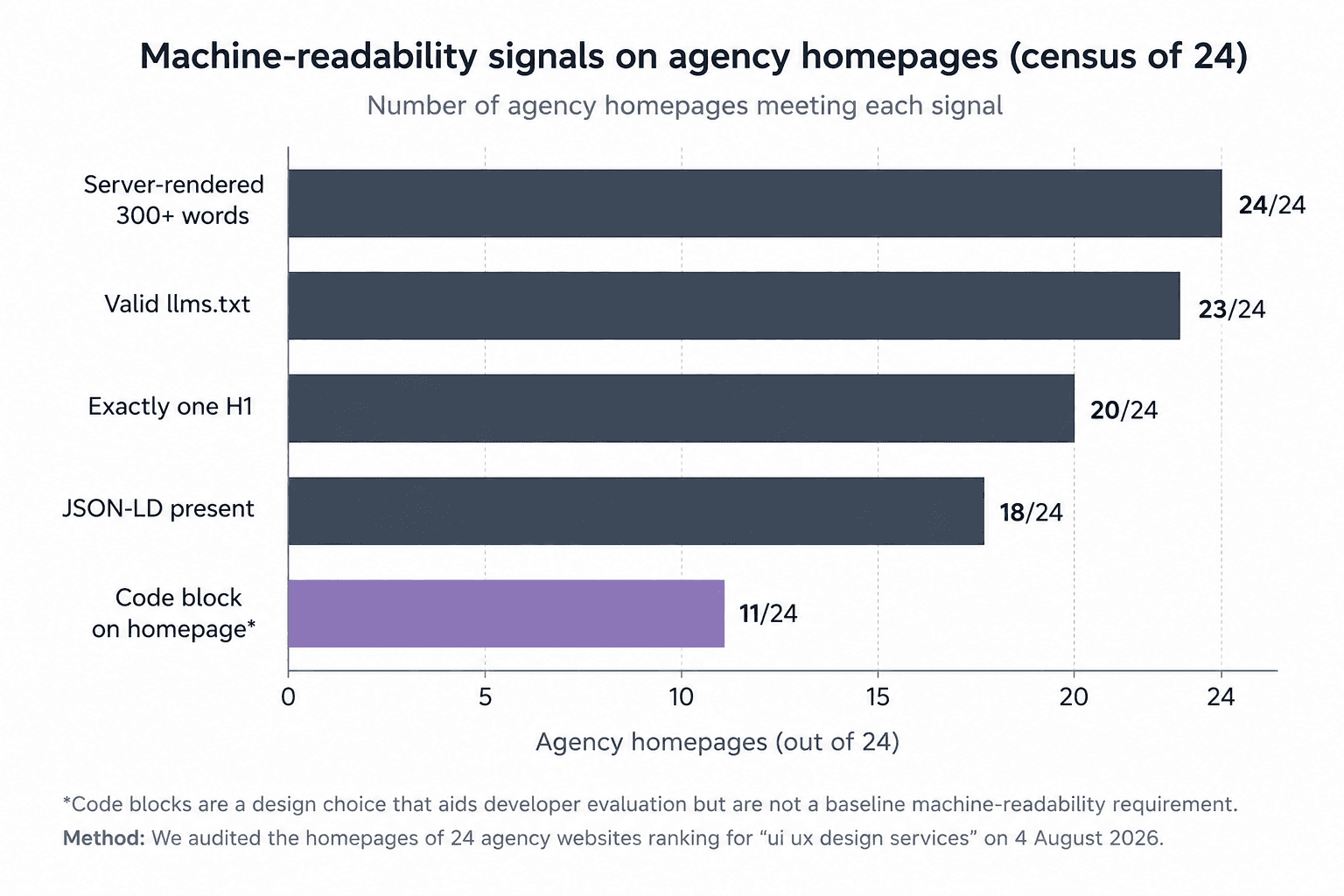
Devtool sites cluster at 800–1,900 words of body copy (not sparse SaaS-style pages). 11 of 24 top devtool homepages ship a server-rendered code snippet, worth it if a user's first action is a command/API call.
A short doc on how terminal output, logs, and errors render in your design system. Almost nobody sells this, but it prevents inconsistent engineering decisions later.
llms.txt is cheap but oversold. It just takes an afternoon and 23/24 top devtools have one, but Google explicitly says Search doesn't use it. Publish it, don't pay a premium for it.
Numbers you should care for: 2-4 weeks for a marketing-site rebuild (5–8 pages); $8K-$25K for agency design+build, median $3,199 on freelance marketplaces. Citation/SEO movement takes 60-90 days, capture your baseline before the rebuild or you can't measure impact.
What do UI/UX design services actually include for a developer tool?
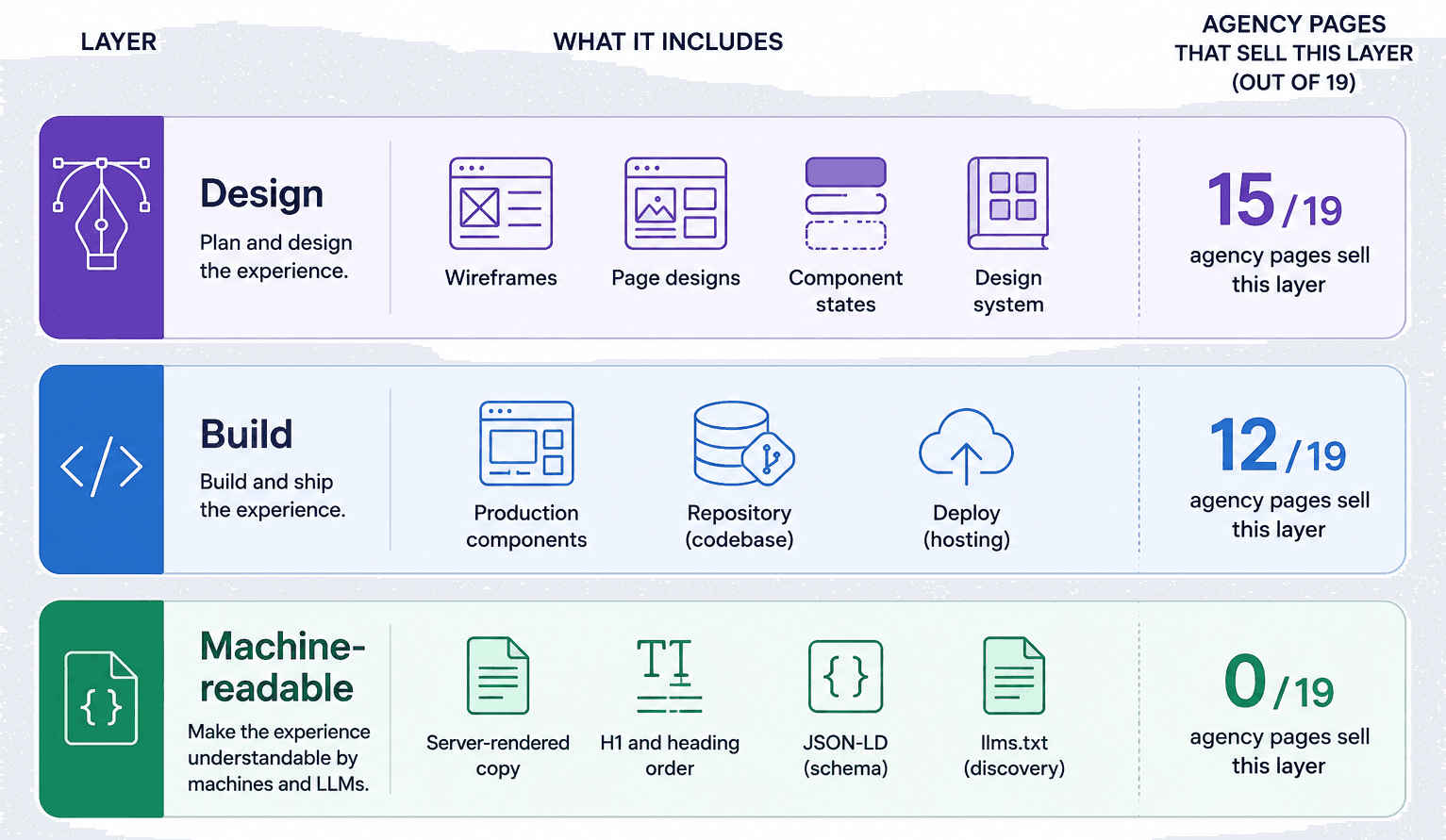
Three layers, and most engagements only sell you one. Read any proposal against these, and you will immediately see what is missing.
The design layer
Wireframes, page designs, a type and colour system, component states, and a Figma file with the whole thing organised. Every agency in the census sells this. Fifteen of nineteen pages named concrete deliverables like wireframes, prototypes, and design systems, so this part is table stakes, and you should not pay a premium for it.
For a devtool, the design layer has one unusual requirement: it has to accommodate real product surfaces. Terminal output, log lines, config files, API responses, error states. These are ugly, monospaced, variable-width, and they break grid systems designed around marketing photography. A design system that has no opinion about how a 400-character stack trace renders on mobile is not finished.
The build layer
Someone turns the Figma file into a running site. Twelve of nineteen pages in the census mention front-end implementation or shipping code, which sounds encouraging until you read what they mean, which is usually a page builder or a handoff document.
The build layer is where devtool engagements most often go wrong, and it is worth being specific about why. Your engineering team didn't join a database company to fix hero section padding. If design hands over a Figma file and a Loom walkthrough, the build lands in your engineers' backlog behind everything that ships product value, and the redesign you paid for goes live in month five instead of week three. Ask who writes the components and who owns the repo. When the answer is "your team," you have bought half a service.
The machine-readable layer
Server-rendered copy, one clean H1 with a sensible heading order beneath it, JSON-LD describing the product and pricing, and, if you want it, an llms.txt file. None of the nineteen agency pages we read sells this as part of a design engagement. It is the layer that decides whether a language model can quote your positioning back to a developer who asked it which tool to use.
The three layers are sequential and the order matters. Design without a build is a PDF. A build without the machine-readable layer is a site that looks right to humans and reads as ambiguous to everything else. Section four covers exactly how much that last layer is worth, including the parts of it that are oversold.
Why does a devtool need a different UI/UX design from a generic SaaS product?
Because your visitor is going to verify everything you tell them, and they have the skills to do it. That single behavioural difference cascades into every design decision on the page.
Your reader is going to check
The 2025 Stack Overflow Developer Survey collected 49,000 responses across 177 countries. It found that 46% of developers actively distrust the accuracy of AI tool output while 33% trust it, with 3% reporting high trust. Among experienced developers the high-trust figure drops to 2.6%. Trust in AI accuracy fell to 29% from 40% the year before, even as adoption climbed to 84%.
That is a measurement of how this audience treats a confident claim from a machine, and the same instinct applies to your landing page. A developer reading "10x faster deployments" does not feel persuaded, they feel prompted to go find out. So the page has to survive the checking. Name the benchmark. Link the repo. Show the command. A claim with a method attached converts a skeptic; a claim without one activates them.
Density beats whitespace, up to a point
Consumer design principles push toward one idea per screen and generous negative space. Developer tools invert this because the reader is scanning for a specific technical fact and every scroll is a cost. Compare the raw body copy on live devtool homepages and you can see where the category has landed: across 24 sites we fetched, the shortest served 520 words and the longest 2,947, with most clustering between 800 and 1,900.
The position worth taking here is that density is not permission for clutter. Dense means high information per pixel, not many elements per pixel. A pricing table with real numbers is dense. A bento grid of six cards saying "Fast," "Secure," and "Scalable" is empty at high resolution.
The code block is a demo, and less than half of them use it
Out of those same 24 homepages we analyzed, 11 render a code or pre block in the HTML that arrives on first request. Supabase, Linear, Resend, Clerk, Sentry, Netlify, Upstash, Pinecone, Replicate, PostHog, and Twilio do. Vercel, Stripe, Fly.io, Render, Modal, Temporal, Railway, Grafana, and Datadog do not, at least not in server-rendered markup.
We would put a snippet on the page for any product where a developer's first real action is a command or an API call. It compresses the entire value proposition into something the reader can evaluate in two seconds and, if they like it, copy. For products where first value comes from connecting an account or importing data, a snippet is decoration and a short product video does more work.
Which deliverables should you expect, and which ones actually matter?
Ask for a written deliverables list before you sign anything. Here is what a devtool UI/UX design should produce, and our read on what each item is worth.
| Deliverable | What it is | Worth paying for? |
|---|---|---|
| Wireframes | Layout and hierarchy before visual design | Yes, but they should take days, not weeks |
| Page designs | Final visual comps for each page, desktop and mobile | Yes |
| Design system | Type scale, colour tokens, spacing, component states | Yes, if you will add pages later |
| Code-surface specs | How terminal output, logs, config, and errors render | Yes, and almost nobody offers it |
| Production components | Built, tested, deployed front end | Yes, this is the difference between a design and a site |
| Server-rendered markup | Copy present in the HTML on first request | Yes, non-negotiable |
| JSON-LD | Product, pricing, and FAQ as structured facts | Yes, cheap to add |
| llms.txt | Plain-text map of your citable pages | Optional, see below |
| Competitor UX audit | Screenshot deck of rival sites | Rarely, this is usually filler |
| Persona documents | Slides describing "Backend Ben" | No |
| Brand guidelines PDF | 40 pages on logo clear space | No, not at this stage |
The two rows worth expanding are the ones the market underserves.
Code-surface specs
A short document, usually four to six pages, saying how your product's actual output renders inside the design system. Line height for monospace. Truncation behaviour for long paths. Colour treatment for error, warning, and success in log output. Horizontal scroll versus wrap for wide tables. Whether a code block is copyable and what the copy affordance looks like.
It sounds small. It is the single most useful artefact a devtool gets out of a design engagement, because it is the piece your engineers would otherwise invent inconsistently across fifteen surfaces over the following year.
Persona documents
We would cut these. For a devtool with a defined technical buyer, a persona deck restates what the founders already know in slide form, and the time is better spent reading 30 support tickets and 10 sales-call recordings. If an agency's proposed timeline allocates a week to personas, that week is available for something else.
What does the machine see when it reads your product?
A second reader now sits between your product and your buyer. Few teams have run their own site through a plain HTTP fetch to see what that reader actually gets, which is the fifteen-minute check the numbers below make the case for.
Postman's 2025 State of the API report, based on 5,700+ developers, architects, and executives, found that 89% of developers now use generative AI in daily work, while only 24% design their APIs with AI agents in mind. Sixty percent still design for human consumption only, and 16% have not considered agents as consumers at all.
That gap has a direct UX consequence. Your buyer asks an assistant which tool to use. The assistant reads whatever your site returns to a plain HTTP request. If your content is assembled by JavaScript after the fact, there is nothing there to read.
CSR and SSR
There are two ways to get words onto a screen. Server-side rendering (SSR) means your server assembles the finished HTML and sends it down, so the text is already inside the file that arrives.
Client-side rendering (CSR) means the server sends a near-empty shell plus a JavaScript bundle, and the browser builds the page afterwards. To a person on a modern browser the two are indistinguishable. To anything reading the raw response without executing JavaScript, CSR returns an empty container and SSR returns your actual copy.
That distinction used to be an SEO footnote. It now decides whether an AI assistant quotes your positioning or describes a competitor's instead.
One in five YC startups is invisible to AI
We fetched the raw HTML of 820 Y Combinator companies across the four 2025 batches and Winter 2026, using a single HTTP GET with no JavaScript execution, which is the view a non-rendering crawler gets.
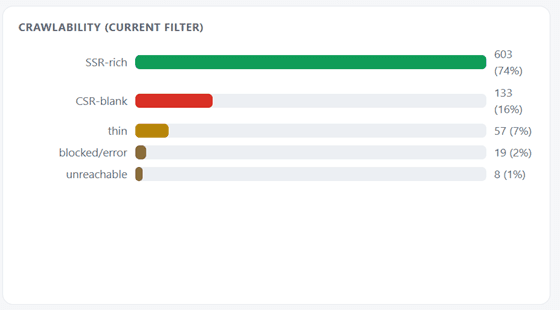
- 603 (74%) are SSR-rich. A real copy arrives in the first response.
- 133 (16%) are CSR-blank. The page returns nothing readable without JavaScript.
- 57 (7%) are thin, 19 return an error or a bot block, and 8 were unreachable.
Add the blanks, the blocked, and the unreachable together and 160 of 820 companies, one in five, are effectively invisible to AI. These are funded, technically capable teams. The failure is not incompetence, it is an inherited default that nobody revisited.
The default comes from the framework you picked
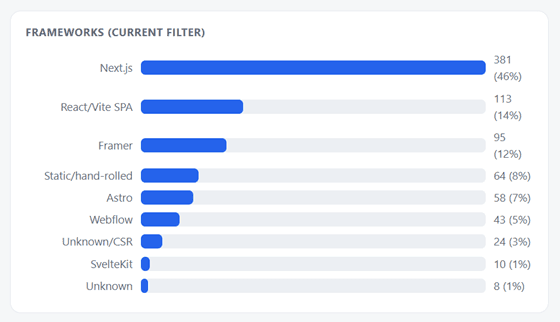
Next.js accounts for 381 of the 820, or 46%. Framer is 95 (12%), Astro 58 (7%), Webflow 43 (5%). Next.js and Astro server-render by default. Framer and Webflow are hosted builders that publish static HTML. All four hand you readable output without anyone on the team having to think about it.
React/Vite SPA sits at 113 companies, 14%, and that is where most of the CSR-blank group lives. A plain Vite single-page app ships an empty <div id="root"> and a bundle. That is the right architecture for an application behind a login. It is the wrong one for the marketing page that a buyer and a model both read before signup.
The practical rule: choose a framework that server-renders by default and this problem never reaches your backlog. Choose one that does not, and somebody has to remember, on every page, forever.
This is checkable in about ten seconds, so here are three live examples. Infrasity's own site runs on Next.js and serves 2,236 words to a plain fetch. DevZero, whose rebuild appears in the case study below, is also on Next.js at 828 words. SoftwareForge runs on Framer, a builder that has pushed hard toward machine-readable output, and serves roughly 3,460 words. Three different stacks, one shared result: the copy is in the file before any script runs.
The irony in this article's own search results is instructive. Of the ten pages ranking for this topic, two return under 130 words of body text to a straight fetch. Both are UX agencies, and both are CSR-blank. Their pages about user experience are, to a machine, close to empty.
We ran the same check across fifteen major devtool documentation sites, including Stripe, Vercel, Supabase, Cloudflare, Datadog, and Sentry. Two results stood out:
- 13 of 15 link to a quickstart or getting-started guide directly from the docs landing page. The leaders treat "where do I start" as a navigation decision, not a menu item.
- Only 4 of 15 ship an actual code block in the raw HTML of that landing page. The rest render it client-side or push it a click deeper.
That second number is the gap. A developer with JavaScript sees code. An AI assistant summarising your product for a buyer often does not.
Stack Overflow's 2025 data explains why this matters more than it used to. Adoption of AI tools is near-universal at 84%, but only 29% of developers trust the output, 46% actively distrust it, and 66% cite answers that are "almost right, but not quite" as their top frustration. So developers arrive at your docs already suspicious, carrying a half-correct answer they need to verify. Your documentation is now the tiebreaker in an argument they are having with a chatbot. If it is thin, stale, or invisible to the crawler, you lose that argument twice.
What does the machine-readable layer add, and what does it not?
It decides whether a system that never runs your JavaScript can still read your positioning. That matters more every quarter, and it is also the area where the most confident advice is the least supported.
We fetched and analyzed 25 developer-tool homepages, with a single HTTP GET and a browser user agent, no JavaScript execution, which is the view a non-rendering crawler gets. One (hashicorp.com) returned a bot-challenge page and is excluded, leaving 24.
- 24 of 24 serve at least 300 words of body copy in the raw HTML. The category has settled this question. If your site does not, you are the outlier.
- 18 of 24 ship JSON-LD structured data. The six without: Supabase, Linear, Fly.io, Replicate, PostHog, and Doppler.
- 20 of 24 have exactly one H1. Clerk has six. MongoDB has three. Stripe and PostHog have two each.
- 23 of 24 serve a valid llms.txt at the root. Doppler is the only miss.
The part that is load-bearing
Server-rendered copy. If your hero headline and product explanation arrive only after a JavaScript bundle executes, a large class of crawlers and retrieval systems sees an empty page. That is not a new or exotic requirement; it is the same reason your pages should render fast for a human on hotel wifi, and it is worth insisting on in a contract.
The heading structure matters for the same practical reason. One H1 stating what the product is, H2s that answer questions a buyer would actually type, and self-contained sections beneath them. This is how to structure content so models can read it, and it is also just good page design for a human who is skimming.
The part that is oversold
llms.txt. Google states plainly in its AI features and your website guide that Google Search does not use llms.txt files, along with several other popular tactics: chunking content into small pieces for AI, rewriting text specifically for AI systems, and over-focusing on structured data are all listed as unnecessary for Google's generative features, because those features run on the same ranking systems as Search.
So the honest position is this: twenty-three of twenty-four leading devtools publish one, it costs an afternoon, and non-Google retrieval systems may use it.
Publish it.
Don't let anyone charge you meaningfully for it, and don't accept it as evidence that an agency understands answer engine optimization. If you want the fuller argument for and against, we wrote up what llms.txt actually is separately.
What does have peer-reviewed support is more ordinary. The Princeton GEO study, presented at ACM KDD 2024 across roughly 10,000 queries, found that adding statistics, quotations, and authoritative citations raised visibility in generative engines by roughly 30% to 40%, while keyword stuffing produced no benefit and slightly hurt. Those are writing decisions, not schema decisions.
If you want to see what a model currently gets from your site before you commission anything, our free AEO audit will crawl your URL and show you. It takes a few minutes, and it will tell you whether the machine-readable layer is a real gap for you or a line item you can decline.
How long does a devtool UI/UX design engagement take?
Two to four weeks for a marketing-site rebuild of five to eight pages, including the build. Add time for product UI, docs restructuring, or anything requiring user research. Six of the nineteen agency pages we audited publish a timeline at all; the stated ranges across those six run from two to four weeks at the fast end to three to nine months at the slow end, which tells you the label "UI/UX design services" covers wildly different amounts of work.
Infrasity publishes two to four weeks for the design-and-build sprint on our devtools design service page, with measurement starting the day the site ships and citation movement typically appearing in 60 to 90 days. Those are two different clocks, and you should hold a vendor to both.
| Scope | Realistic elapsed time | Where the time goes |
|---|---|---|
| Homepage only, design and build | 1 to 2 weeks | Positioning, one round of copy, build, QA |
| Marketing site, 5 to 8 pages | 2 to 4 weeks | Above, plus system, comparison and pricing pages |
| Marketing site plus docs entry points | 4 to 6 weeks | Above, plus docs IA and quickstart redesign |
| Product UI, single workflow | 6 to 10 weeks | Research, flows, states, engineering handoff and review |
| Full product redesign | 3 to 6 months | Above, across every surface, with migration |
Where the calendar actually goes
Not design. In a two-to-four-week engagement, visual design is usually five to seven working days. The time goes to positioning arguments, waiting on your approvals, and QA on real content.
Positioning is the biggest variable and the one you control. If your team has not agreed on what the product is in one sentence, no agency can start the homepage, and the two-week estimate becomes six while you argue in Slack. Write that sentence before the kickoff call. It is the cheapest thing a buyer can do to protect a timeline.
What does UI/UX design cost for a devtool?
The honest answer is that the market hides it, so here is the closest thing to real data.
On the agency side: out of the eighteen ranking pages that served readable text, three publish an actual price for the work. Two more display a budget dropdown in a contact form, which is asking for your number, not stating theirs. The most transparent page in the set quotes $20,000 to $25,000 per month for a full design-and-build engagement with a dedicated team; the other two published figures start at $6,000 and $500 respectively, which tells you those two are selling very different things under the same words.
On the marketplace side, where sellers are required to post a number, we pulled the 27 published prices on Dribbble's SaaS website design services listings. The median is $3,199. The range runs from $500 to $65,000, and 19 of the 27 sit under $5,000.
Read those two datasets together, and the shape of the market is clear. Under $5,000 buys you Figma files from a freelancer, which is a real and sometimes correct purchase. Roughly $8,000 to $25,000 buys a designed and built marketing site from a small studio. Above that, you are buying a team on a retainer, and the monthly figure keeps running whether or not you have work for it.
How to accurately predict your UI/UX budget?
Four things, in order of impact. Page count, because each additional page is real design and build time. Whether the build is included or handed to your engineers. Whether product UI is in scope, which roughly triples the research burden. And how many approvers you have, which nobody prices explicitly but everyone pays for.
Notice what is not on that list: your industry, your funding stage, and how urgently you need it. Agencies that price on those signals are pricing your budget, not the work.
What does a rebuild actually change? Two before-and-afters
Numbers on a slide are easy. Here is what changed on two real sites, measured the same way as the census above.
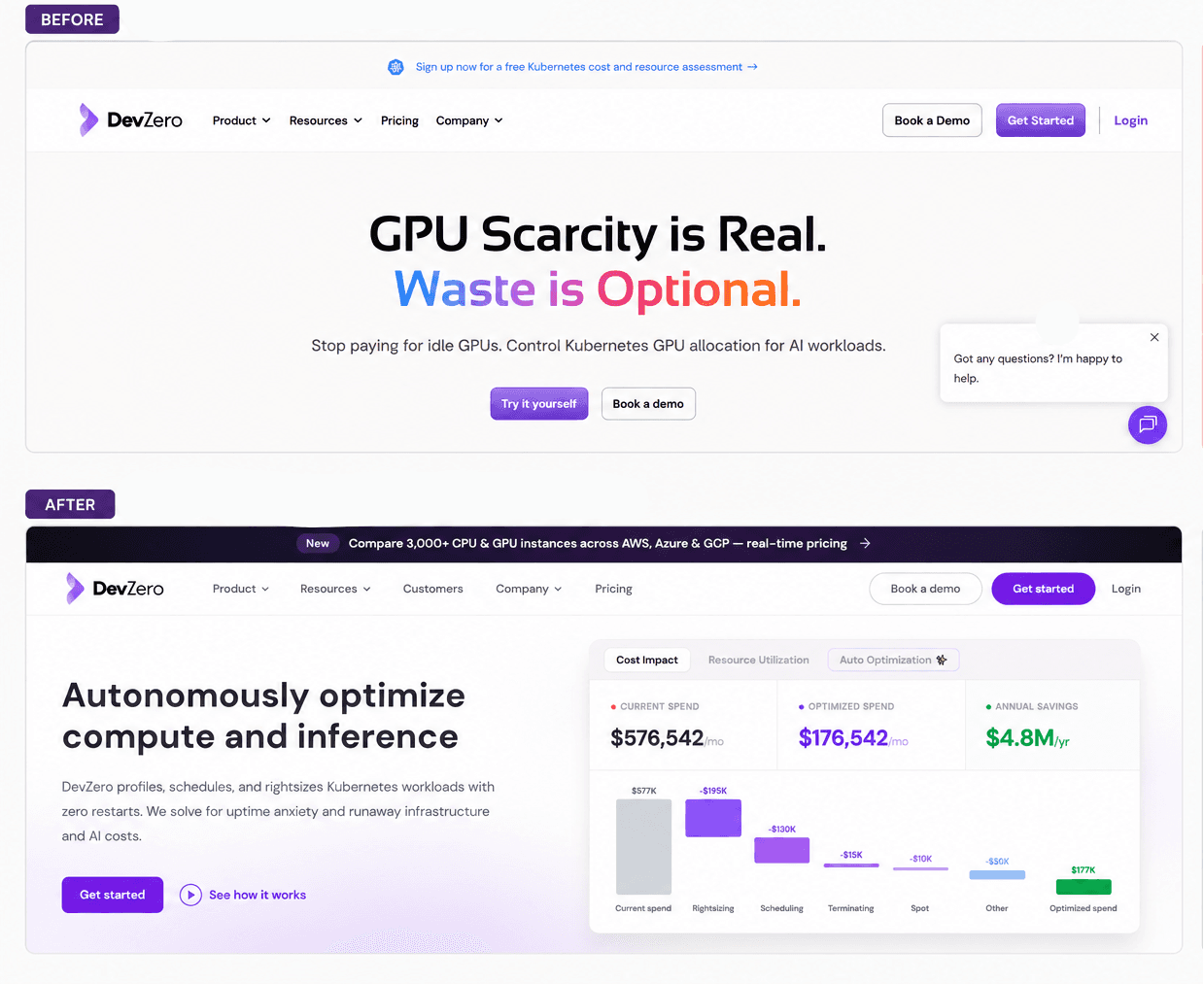
DevZero: shorter copy, more structure
DevZero runs compute and inference optimisation for engineering teams. Comparing the pre-launch preview build of its GPU optimisation page against the live version today.
| Measure | Preview build | Live page |
|---|---|---|
| Server-rendered body words | 1,157 | 651 |
| JSON-LD blocks | 0 | 2 |
| H1 | 1 | 1 |
| H2 sections | 6 | 4 |
The copy got 44% shorter, and the machine-readable layer went from absent to present. That direction surprises people who expect a redesign to add. It should not. The preview page carried six H2s including two that made overlapping claims about GPU tracking; the live page consolidates to four, leads with a single positioning line, and spends its remaining words on the mechanism and the FAQ rather than on restating the value proposition three ways.
The homepage went the other way, to ten H2s and four JSON-LD blocks, because a homepage has to serve more entry points than a feature page does. That asymmetry is deliberate, and it is the kind of decision a devtool-specific engagement should be making explicitly rather than applying one template across every page. DevZero's founder Debosmit Ray has described the wider content engagement as covering technical content, product documentation, and recipe libraries for integrating DevZero with different stacks.
SoftwareForge: WordPress to a positioning-first build
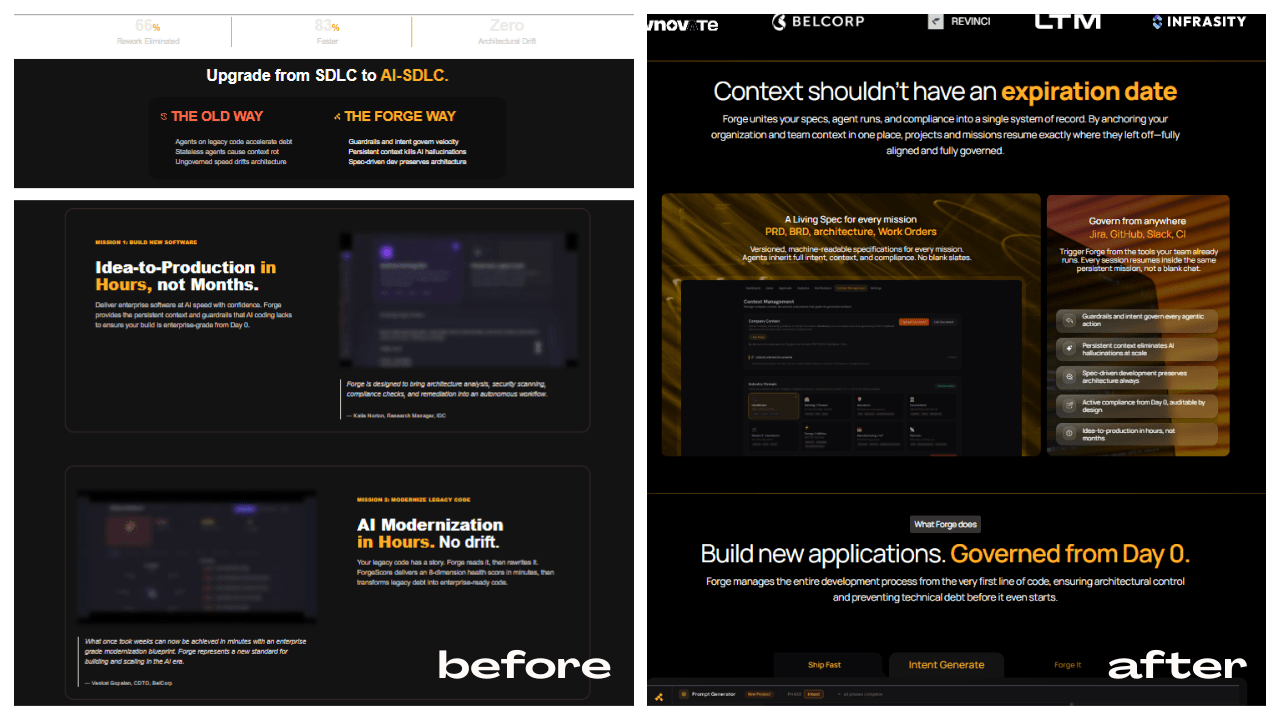
SoftwareForge was on WordPress. The rebuilt site leads with a single positioning line, "The Enterprise Software Factory, governed from spec to production," followed immediately by a stats bar carrying three claimed outcomes and an explicit old-way versus new-way comparison block naming the failure modes of the alternative.
That comparison block is the piece worth copying. Technical buyers arrive already using something, and a page that names the current approach and says precisely where it breaks does more persuasion than a feature grid, because it demonstrates you understand the job before you ask for the meeting. The live site serves roughly 3,500 words of body copy in the raw HTML, which puts it well above the median in our census.
If the layer you are missing is the one under the design, that is the specific gap our UI/UX design work for devtools is built around: a page engineers respect, a build that ships server-rendered and structured, and before-and-after citation numbers across ChatGPT, Claude, Gemini, and Perplexity rather than a screenshot of the design.
Where these UI/UX design engagements go wrong
Five failure modes, in rough order of how often we see them. Each one has an early symptom you can catch in week one.
The handoff cliff
Symptom: The contract ends with "developer-ready Figma files."
Cause: Design and engineering were scoped as separate purchases.
Fix: Make the deliverable a deployed URL, not a file. If the agency cannot build, hire the build in the same contract from someone who can, and put both under one deadline.
The design system nobody uses
Symptom: A beautiful component library and a production site that doesn't match it.
Cause: The system was designed against imagined content rather than your real strings, log output, and error states.
Fix: Ask for the code-surface spec described earlier, and have your engineers review the system before visual design signoff, not after.
Positioning laundering
Symptom: Four weeks in, the homepage headline is still "The modern platform for X."
Cause: The agency is waiting for you to decide what the product is, and filling the silence with generic copy.
Fix: Decide before kickoff. One sentence, agreed by the founders, written down.
The invisible rebuild
Symptom: The new site looks better and organic traffic drops.
Cause: Copy moved into client-rendered components, URLs changed without redirects, or the H1 became an image.
Fix: Put server-rendered copy, one H1, and a redirect map in the acceptance criteria. Re-run a plain HTTP fetch against staging before launch and read what comes back.
Measuring the wrong clock
Symptom: Six weeks after launch, nobody can say whether it worked.
Cause: No baseline was captured before the rebuild.
Fix: Record signups, activation rate, and share-of-answer across the AI systems your buyers use, in the week before the build starts. A baseline captured after launch is not a baseline.
How do you choose an agency for this?
Ask six questions and the field narrows fast. These are ordered so that a no on an early one saves you the rest of the call.
Show me a developer tool you shipped, and the live URL. Not a Dribbble shot. A URL you can fetch and check against the census tests above.
Who writes the production components? If the answer is your team, adjust the price and the timeline accordingly.
How does your design system handle a 400-character stack trace on a 375-pixel screen? A studio that has designed for developers has an answer. One that has not will describe their process instead.
What is in the HTML before JavaScript runs? Ask them to run the test on their own last three launches while you are on the call.
What did the previous client's numbers do, and what was the baseline? A result without a baseline is a screenshot.
What happens in week five? Sites need iteration. Find out whether you are buying a project or a relationship, and price it as whichever it actually is.
If you would rather pressure-test your current site before you brief anyone, the UI UX Pro Max skill is free and open source, runs inside Claude Code, and will audit a page against design and accessibility criteria without a sales call attached.
What should be your next step?
You now have the three layers to check a proposal against, a deliverables list with our honest take on which rows are filler, real price and timeline distributions instead of "it depends," and the four gates that catch most stalled engagements.
Start with the ten-second version: fetch your own homepage with curl, strip the tags, and count the words that come back. If the number is low, the gap is in the build layer, and no amount of visual design will close it.
When you want that gap closed by people who ship devtool sites specifically, Infrasity's UI/UX design work for devtools covers design, the production build, and the machine-readable layer in one two-to-four-week sprint, with the before-and-after citation numbers to show whether it moved.
Frequently Asked Questions
How much do UI/UX design services cost for a developer tool?
Across the 27 published prices for SaaS website design on Dribbble, the median is $3,199 and 19 of 27 sit under $5,000, though that marketplace skews toward freelancers delivering Figma files. Agency engagements that include the build typically run $8,000 to $25,000 for a marketing site, and dedicated-team retainers start around $20,000 per month. Page count and whether the build is included move the number more than anything else.
Do I need a design agency, or can my engineers do it?
Your engineers can build it. The question is whether they should spend three weeks on it and whether anyone on the team has designed for a technical buyer before. Where the site is your primary evaluation surface, that is usually a hire or an agency. Where it is a placeholder while you talk to design partners, it is not.
Does client-side rendering hurt developer adoption?
Indirectly, and increasingly. CSR does not slow down a developer who has already landed on your page with a browser open. It removes you from the answers that decide whether they land at all, because assistants and crawlers read the raw response. Of 820 YC companies we fetched, 133 returned nothing readable without JavaScript. Frameworks that server-render by default, including Next.js, Astro, Framer, and Webflow, avoid the problem without any ongoing effort.
What is the difference between UI/UX design for a devtool and for SaaS?
The buyer verifies claims instead of accepting them, prefers information density over whitespace, and often evaluates your docs before your homepage. In practice that means benchmarks with methods attached, code or product surfaces on the page rather than stock illustration, and a docs entry point treated as a first-class design surface.
Should my devtool homepage have a code snippet?
If a developer's first real action is a command or an API call, yes. Of 24 leading devtool homepages we fetched on 4 August 2026, 11 render a code block in server-side HTML, so it is a deliberate choice rather than a rule. For products where the first value comes from connecting an account, a short product video does more.
Is llms.txt worth paying for?
It costs an afternoon, and 23 of the 24 devtool homepages we checked publish one, so add it. But Google states directly that Google Search does not use llms.txt, so treat it as cheap insurance for other retrieval systems, not as a growth lever, and be skeptical of anyone pricing it as a deliverable.
How long before a redesign shows results?
Signup and activation changes show within days because they are downstream of the page itself. Search and AI-citation movement takes longer, typically 60 to 90 days, because it depends on recrawling and re-ranking. Capture your baseline before the build starts or you will not be able to tell either way.