
An AEO tracker earns its price when it shows whether ChatGPT, Claude, and Gemini cite your devtool, and which pages they cite instead. Buyers ask AI which tool to use before they open Google. Stack Overflow’s April 2026 pulse survey shows AI agent use nearly doubled to 59%. A devtool missing from those answers loses its best-qualified traffic.
This blog ranks the 9 AEO trackers worth testing in 2026, covering what each does best, how they monitor citations across ChatGPT and Perplexity, and how to pick the right one for your category.
TL;DR
- An AEO tracker shows whether ChatGPT, Claude, and Gemini cite your devtool or recommend competitors.
- Track 30 to 50 buyer prompts across AI engines. Repeat checks because answers change between runs.
- Compare nine AEO trackers by pricing, engine coverage, and developer fit. Infrasity adds a prioritized action plan to citation tracking.
- Identify missing citations across docs, Reddit, and third-party comparisons to find content gaps.
- Measure visibility percentage, citation sources, and AI-referred traffic to track progress and prioritize fixes.
What Is an AEO Tracker and Why Do You Need One?
An AEO tracker measures how often AI platforms such as ChatGPT, Claude, Gemini, Perplexity, and Google AI Overviews mention your brand, cite your content, and recommend competitors. Unlike traditional rank trackers that measure keyword positions, AEO trackers monitor AI visibility, citation share, brand sentiment, and the sources influencing answers.

What an AEO tracker looks like in practice: citations per engine across a tracked prompt set.
For example, an observability startup may rank on Google’s first page but remain absent when buyers ask AI tools for product recommendations. Tracking these prompts reveals visibility gaps and opportunities to improve documentation, third-party mentions, and listicle placements. Ahrefs reported that AI search drove 0.5% of its traffic but 12.1% of signups in a 30-day window, highlighting why monitoring AI visibility matters.
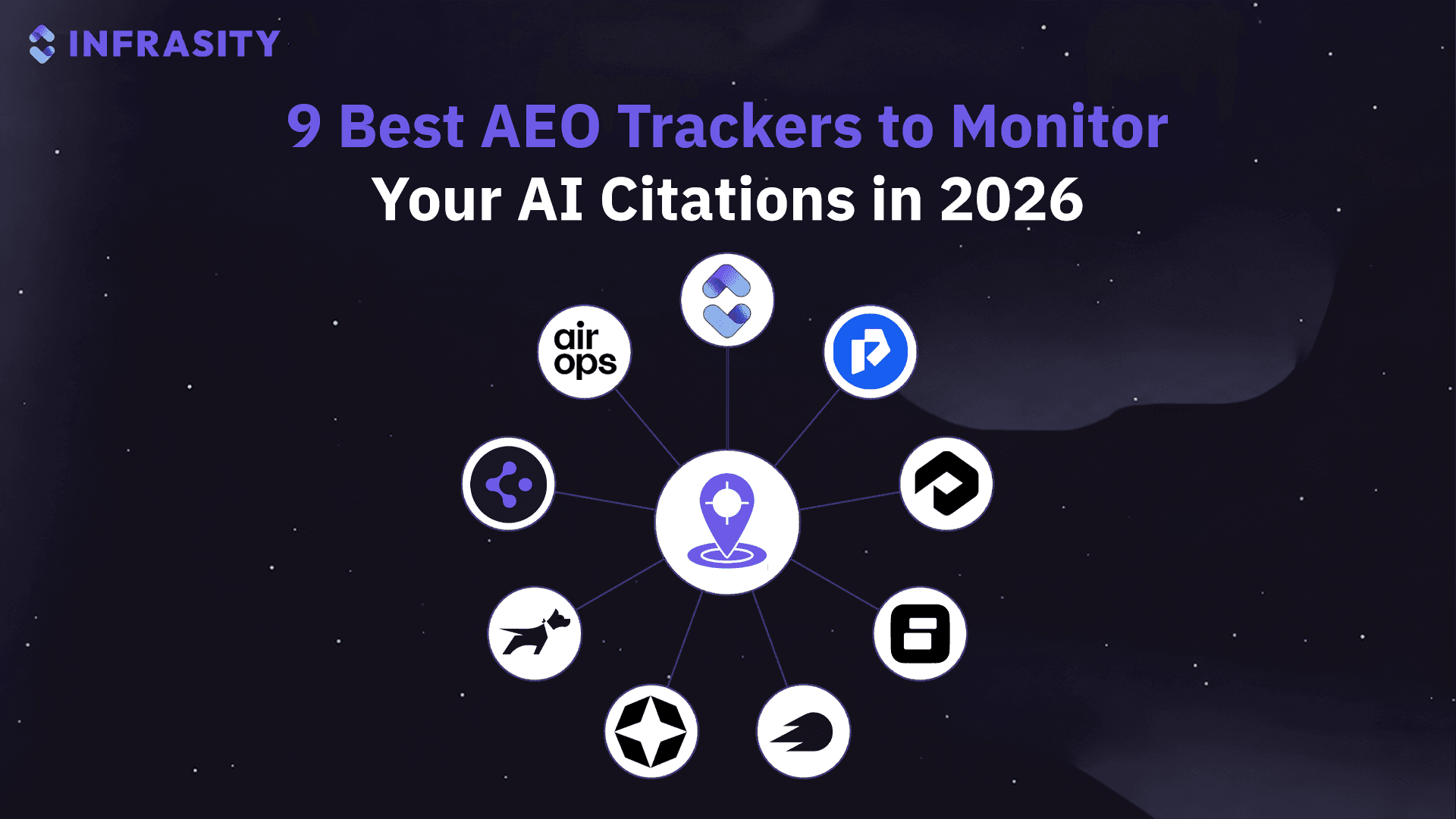
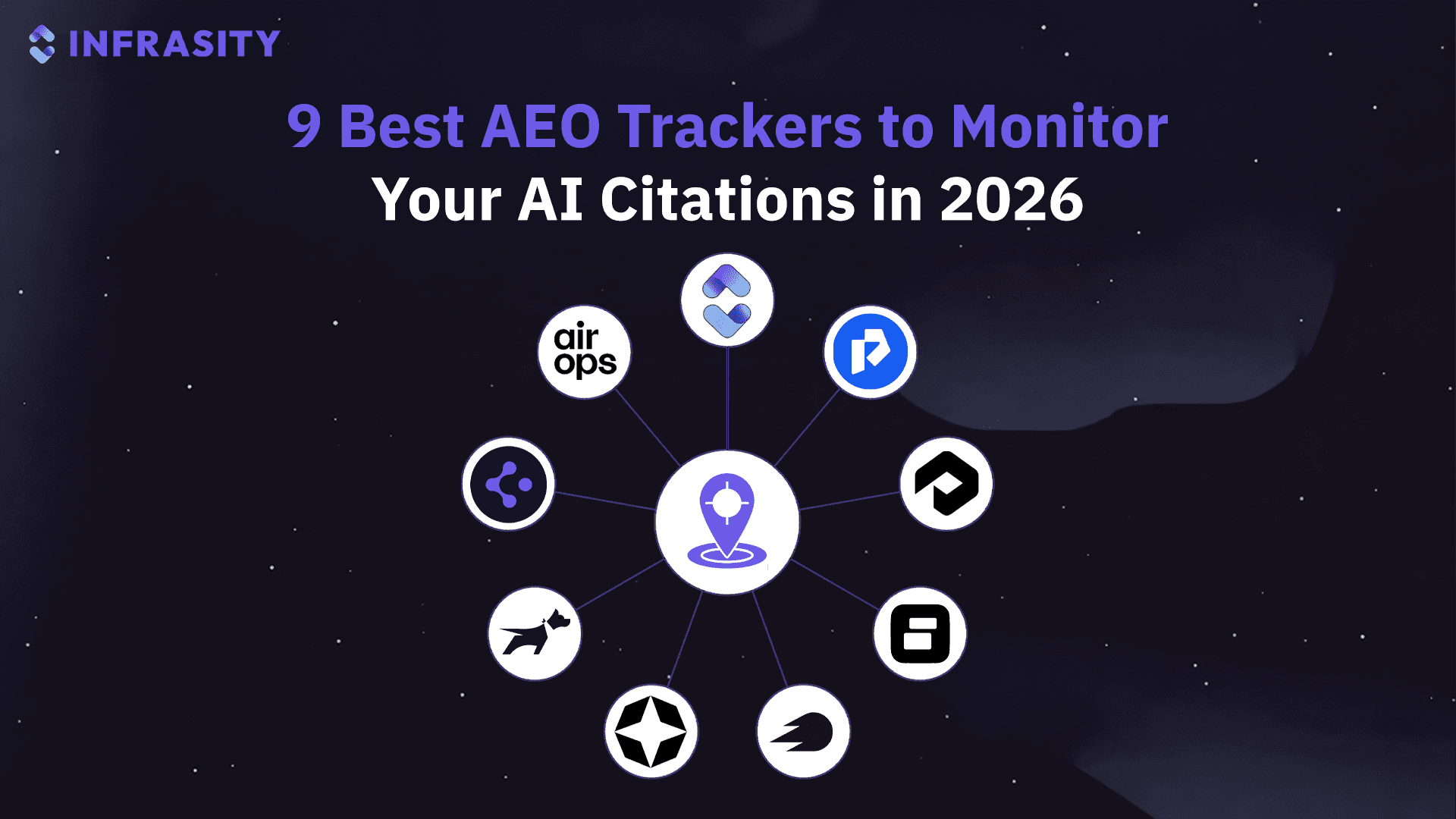
9 Best AEO Trackers to Monitor Your AI Citations
We compared nine options on pricing, engine coverage, refresh rate, and devtool fit. Pricing comes from vendor pages and third-party trackers, so verify it before you buy, because this category reprices every few months.
1. Infrasity
Infrasity is built with devtool teams in mind, though B2B SaaS and other non-devtool teams use it too. Connect your site and it scans it and generates buyer prompts automatically. As an AEO tracker tool, it reports citation rate, visibility score, and share of voice across ChatGPT, Claude, Gemini, and Perplexity in one dashboard. It then turns each gap into a prioritized action.

Infrasity: AI visibility tracking with a ranked action list.
What Sets Infrasity Apart from Other AEO Trackers:
Most trackers tell you where you stand and stop there. These points come from Infrasity’s AEO service page and its product listing, and they cover what happens after you spot a gap.
- Prompt research with difficulty scores. It surfaces prompts where competitors are cited and you are not, then scores how hard each is to win.
- A built-in action plan. Sprints, Topics, a freshness audit, and a ranked Actions list turn tracking data into a content plan.
- Reddit and community tracking. It groups the Reddit and community URLs AI cites by domain and flags missed opportunities. The agency side also seeds Reddit, Quora, and editorial coverage.
- Docs-aware tracking. It understands docs, APIs, and SDKs, and shows which AI coding agents visit your documentation.
- Listicles and distribution. It gets your product into the “best of” listicles AI cites, and distributes content across Reddit, Quora, and editorial sites.
- MCP server with 60 tools. Claude, Cursor, or Claude Code can query your visibility data directly from your IDE.
- Traffic beside visibility. GA4 and Search Console integrations show AI-referred traffic next to citation metrics.
- Engineers write the fixes. Developers with five to ten years of experience write the comparisons, docs, and tutorials that earn citations.
Successful clients:
- Proton Pass went from 0 to 90% LLM citation coverage across five buying prompts.
- Brevo reached 80% coverage across six prompts.
- Inframail lifted its LLM mention rate from 12% to 33% and ranked first in Google AI Overviews for cold email infrastructure.
Best For: B2B SaaS, devtool, and AI companies that want to track AI visibility and get a clear plan for winning citations.
Engine Coverage: ChatGPT, Claude, Gemini, Perplexity
Pricing: Free trial for the tracking app. Agency engagements are custom, start with a free AEO audit, and carry a three- to six-month minimum.
2. AirOps
AirOps began as an AI workflow and content automation platform, then added AI visibility tracking. Its Page360 view puts AI signals beside SEO and web analytics.

AirOps: AI visibility tracking built into a content workflow platform.
Key Strengths:
- Tracking and production in one system: Tasks, brand kits, and knowledge bases sit next to the visibility data, so a gap can become a draft without leaving the platform.
- Wide engine coverage on Pro: It reads 7+ answer engines, and Enterprise adds social and community sources.
- Strong integrations: CMS and SEO connections include Webflow, WordPress, Sanity, Semrush, and Ahrefs, plus an MCP server and API.
Pros:
- Proven at scale: Customers shown on its site include Ramp, Webflow, HubSpot, and Gong.
- Views beyond citations: It lists sentiment, competitor, and conversion-tracking views alongside visibility.
Cons:
- Solo tracks ChatGPT only: Multi-engine tracking starts on Pro.
- Content-first design: A team that only wants a tracker may not use much of the workflow tooling.
Best For: Content-heavy marketing teams that want visibility data and publishing workflows in one system.
Pricing: Solo is free to start. Pro and Enterprise pricing depends on task volume (35,000 tasks on Solo, 100,000 on Pro) and needs, so expect a quote.
3. Promptwatch
Promptwatch combines AI search visibility tracking with crawler logs and article generation. This gives teams a way to monitor brand mentions while investigating whether AI systems access their website content.

Promptwatch: citation tracking plus AI crawler logs.
Key Strengths:
- All models on every plan: It tracks ChatGPT, Claude, Gemini, Perplexity, and Google AI Overviews by scraping the interfaces people actually use.
- Crawler proof: Crawler logs and Agent Analytics show which pages AI bots read, which gives docs teams hard evidence.
- Developer access: MCP and API access come on every plan, with Cursor, Claude, and ChatGPT integrations.
Pros:
- Coding-agent tracking: Beyond chatbots, it lists Codex, OpenCode, and Claude Code, which suits devtool teams.
- Market-level detail: Country-level tracking helps teams selling across several regions.
Cons:
- Consumer-leaning extras: Shopping Insights and Ads Radar serve retail brands more than devtools.
- AI-written articles need review: Content built from citation data still needs an engineer’s check for technical accuracy.
Best For: Teams that want citation tracking plus proof that AI bots read their docs.
Pricing: Essential is $95 a month, Professional is $245, and Business is $579, with custom Enterprise pricing.
4. Cognizo
Cognizo is a young startup that monitors brand visibility across major AI platforms through UI scraping, so you see what users see.

Cognizo: UI-scraped visibility tracking across up to 10 engines.
Key Strengths:
- Broad engine menu: It supports up to 10 engines, including Google AI Overviews and Copilot, with daily tracking.
- Autopilot on every plan: Agents run prompt research, content, publishing, and lead attribution.
- No seat or market limits: Seats, regions, and languages are unlimited on every plan.
Pros:
- Paid AI visibility: A ChatGPT Ads module sits beside organic tracking.
- Crawler controls: AI traffic analytics plus crawler access and protection show and manage bot visits.
Cons:
- Claude coverage is gated: Growth and Pro track five engines you choose, and Claude is reportedly Enterprise only, which matters for devtool buyers.
- Early-stage risk: Ask about roadmap and data retention before you commit.
- Machine-written content: Autopilot articles need human review before publishing.
Best For: Teams that want an AEO tracker with real-time position updates and plan to automate content, so confirm the refresh interval in a demo, since there is no free trial.
Pricing: Growth is $499 a month, Pro is $999, and Enterprise is custom.
5. Profound
Profound is the enterprise option, with autonomous agents for AEO, content, and PR work. Reviewers call it the deepest platform in the category.

Profound: the enterprise option with the widest engine reach.
Key Strengths:
- Widest engine reach: Enterprise tracks up to 9 engines, including Claude, Gemini, Copilot, Grok, and DeepSeek.
- Crawler visibility: Its Agent Analytics module shows which AI crawlers visit which pages.
- Enterprise controls: SSO/SAML, SOC 2, API and MCP access, and dedicated Slack support come with the top tier.
Pros:
- Demand data: Prompt Volumes estimates how often buyers ask about a topic.
- Built for agencies too: Agency Mode adds pitch and client workspaces for multi-client teams.
Cons:
- Heavy for lean teams: The platform is shaped around large, multi-market rollouts.
- Uneven prompt-volume data: Reviewers describe it as unique but still inconsistent.
Best For: Large infrastructure and developer-platform companies that track many markets and can sign a sales-led contract.
Pricing: A free 7-day trial, then custom Enterprise pricing sold through a demo.
6. Gauge
Gauge is a Y Combinator-backed platform that runs daily prompt checks across major engines by scraping logged-out sessions.

Gauge: daily prompt checks with an agent-led publishing workflow.
Key Strengths:
- Agent-led workflow: Its Ask Gauge agent analyzes performance, manages prompts, and drafts content through plain-language chat.
- Publishing built in: The content engine publishes to Webflow, Framer, Sanity, and GitHub.
- Query fan-out analysis: It shows the sub-queries AI models generate behind the scenes when answering a prompt.
Pros:
- Devtool proof: Customers include Supabase, Resend, PostHog, and Braintrust.
- Traffic tie-in: GA4, Search Console, and DataForSEO integrations connect visibility to site performance.
Cons:
- Gated engines: Claude and Grok need Enterprise or a paid add-on.
- Unclear engine count: Sources disagree on whether Growth tracks three or six engines, so confirm coverage before buying.
Best For: Devtool teams ready to act on gaps and publish fixes quickly.
Pricing: Growth is $599 a month for 600 daily prompts and 18 articles a month, and Enterprise is custom.
7. Peec AI
Peec AI is a focused analytics tool with daily tracking of visibility, position, sentiment, and share of voice.

Peec AI: daily visibility, position and sentiment tracking.
Key Strengths:
- Explains lost citations: Source analytics, a gap analysis, and a crawlability audit that checks 40+ AI bots show why a competitor wins.
- Prompt demand signals: Volume scores from 1 to 5 and prompt suggestions help you decide what to track.
- Reporting hooks: A Looker Studio connector and CDN or log integrations (Cloudflare, Vercel, AWS) bring bot traffic into your own dashboards.
Pros:
- Brand perception views: Objection tracking and fact-checks surface what AI says against your brand.
- Ad visibility: An ads library shows prompts where AI answers carry sponsored placements.
Cons:
- Three models per plan: You choose from ChatGPT, AI Mode, AI Overviews, Copilot, Gemini, and Naver AI; Claude is Enterprise only.
- Analysis over execution: Its pricing page lists no content-publishing workflow, so fixes happen in other tools.
Best For: Lean devtool marketing teams that want daily tracking and unlimited seats at a low price.
Pricing: Starter costs $95/month, Pro costs $245/month, and Advanced costs $495/month. Enterprise has custom pricing.
8. Scrunch AI
Scrunch AI adds citation tracking, personas, and page audits to brand monitoring.

Scrunch AI: citation tracking, personas and agent-traffic reporting.
Key Strengths:
- Agent traffic monitoring: AI bot traffic reporting is included on the entry plan.
- Page-level fixes: Monthly site audits and page optimizations point to the pages AI struggles to read.
- AXP layer: The Agent Experience Platform serves an AI-friendly version of your site to visiting agents.
Pros:
- Journey-aware tracking: Personas and funnel stages segment prompts by buyer type and stage.
- Large-brand proof: Akamai’s case study reports a 364% increase in brand presence for non-branded prompts.
Cons:
- Core tracks four engines: ChatGPT, Perplexity, Google AI Overviews, and Copilot are covered; Claude, Gemini, and Google AI Mode need Enterprise.
- AXP is still maturing: Reviewers note that serving parallel content to agents can carry SEO risk.
Best For: SaaS and devtool teams that want citations, agent traffic, and page fixes in one dashboard.
Pricing: Core is $250 a month for 125 prompts and 5,000 responses a month, and Enterprise is custom.
9. Semrush AI Visibility Toolkit
Semrush sells its AI Visibility Toolkit as a standalone add-on to its SEO suite, and also bundles it into Semrush One. It tracks prompts across ChatGPT, Google AI, Gemini, and Perplexity.

Semrush AI Visibility Toolkit: AI tracking beside existing SEO reports.
Key Strengths:
- Organic and AI in one place: The data sits beside your keyword and backlink reports, so you compare both channels without switching tools.
- Prompt research with volume data: It helps you pick prompts by demand rather than guesswork.
- AI-readiness site audit: It flags on-site issues that can hold back AI citations.
Pros:
- No new vendor for Semrush teams: Existing users keep one login and a familiar interface.
- Established platform: A long-standing SEO vendor carries less vendor risk than a young startup.
Cons:
- No Claude tracking: Coverage is limited to ChatGPT, Google AI, Gemini, and Perplexity.
- Keyword-style reporting: It is reportedly less prompt-level than dedicated trackers.
- No documented API: No public API for the toolkit’s data is documented.
Best For: Teams already on Semrush that want AI visibility next to existing SEO reports.
Pricing: The Base plan costs $99/month per domain when billed annually and includes tracking for 25 custom prompts.
How AEO Trackers Monitor AI Citations
Every AEO tracker follows a similar pipeline, whatever its dashboard looks like. This section walks through five steps, so you can spot weak methods and inflated claims.
Step 1: Build a prompt set from buyer questions
The tracker starts with prompts that mirror how buyers evaluate tools. Aim for 30 to 50 across three stages: “best X for Y,” “X vs Y,” and “how to migrate from X.”
Some tools help you seed this list. Scrunch bundles 1,000 industry prompts on its entry plan. Peec scores prompt volume from 1 to 5. A Kubernetes cost tool would track “reduce EKS spend” and “alternatives to [competitor],” not just its category name.

A tracked prompt set in practice: citation rate, share of voice and status for each buyer prompt.
Step 2: Sample every engine repeatedly
AI answers vary from run to run, so one query proves nothing. Trackers repeat each prompt on a schedule, across engines, and aggregate the results.
The scale of variance is large. A SparkToro and Gumshoe study ran 2,961 prompts and found less than a one-in-100 chance of getting the same brand list twice. Rand Fishkin called treating AI output as consistent truth “provably nonsensical”. Collection method matters too. Gauge and Cognizo scrape the live interface, which reflects what users see better than API output.
Step 3: Parse mentions, citations, and sources
The tracker reads each answer and extracts brand names, cited URLs, and sentiment. Citations show which pages the engine trusts. For devtools, those pages are usually docs, GitHub READMEs, and Reddit threads.
Source classification turns this into action. Peec.ai tags each source as competitor, editorial, reference, or user-generated. Your own docs need a different fix than a third-party listicle that omits you.
Step 4: Score visibility, position, and share of voice
Scores roll up by prompt, engine, and competitor. Visibility percentage stays stable across runs. Position does not.
SparkToro’s researchers reached the same conclusion: measure how often a brand appears across many runs, not where it ranks in one.
Step 5: Turn citation gaps into tasks
A score changes nothing until someone ships a fix. The useful trackers rank gaps by source, so you know what to publish.
Picture a CI/CD tool whose tracker shows two Reddit threads and a rival’s migration guide dominating answers. The fix list is clear. Publish your own migration guide, then answer those threads with real configuration steps. Rerun the same prompts after two weeks and compare visibility percentage.
How to Choose the Right AEO Tracker for Your Business
Choose a tracker by what happens after the data arrives, not by how the dashboard looks. Use the checks below, and note how Infrasity handles each one.
- Prompt list: Writing 50 buyer prompts by hand takes days. Infrasity scans your sitemap and generates them for you, so you skip the manual list.
- Reasons you lose: It groups the Reddit and community URLs that AI cites by domain and flags the ones you missed.
- Gap-to-fix plan: Sprints, Topics, a freshness audit, and a ranked Actions list become your content plan. Engineers with five to ten years of experience write the fixes.
- Developer fit: It reads docs, APIs, and SDKs, and shows which AI coding agents visit your documentation.
- Revenue link: GA4 and Search Console integrations put AI-referred traffic beside citation metrics.
The brands that win this cycle aren't the ones who wait for a clean dashboard. They're the ones who found the gap first and shipped a fix before the next model update.
Conclusion
Citations now decide which devtool a buyer shortlists. This guide showed how nine tools track them and how to match one to your team.
Start with 30 to 50 buyer prompts and a daily refresh. Judge by visibility percentage across many runs, and ignore single position scores. Pick the AEO tracker tool your team will act on, not the one with the longest feature list.
If you run a devtool, AI agent, or observability startup and want to see where ChatGPT, Claude, and Gemini name you, book a call with Infrasity’s AEO team. We will map your buyer prompts, show the citation gaps, and ship the docs and content that close them.
FAQs
What is the difference between AI citations and brand mentions?
AI citations occur when an AI-generated answer links to your website as a source. Brand mentions happen when an AI response names your company or product, even without linking to your website.
How much do AEO tracking tools typically cost?
AEO tracking tools typically cost $50 to $1,000+ per month, depending on AI engine coverage, prompt volume, reporting features, and competitor tracking. Enterprise platforms may charge more for custom analytics and larger tracking requirements.
How long does it take to see results from AEO optimization?
AEO optimization results may appear within four to twelve weeks, although timelines vary by website authority, content quality, and competition. Track citation frequency, brand mentions, and referral traffic regularly to identify early improvements.
What red flags should I look for when evaluating an AEO tracking platform?
Watch for unclear data sources, limited AI engine coverage, infrequent updates, inflated accuracy claims, and no historical reporting. Avoid platforms that cannot distinguish brand mentions from citations or explain how they collect and validate results.
How do I prioritize fixes when multiple AI engines cite different competitors?
Identify competitor pages cited most frequently across relevant buyer prompts. Compare their content depth, technical accuracy, freshness, and source authority against yours. Fix factual gaps first, then improve relevant pages and monitor citation changes across AI engines.