
If DevOps engineers, SREs, and platform teams are your ICP, they make the decision before anyone talks to your sales team. Roughly 60% of a B2B buying journey is over before a seller is contacted, and 94% of buying groups already have a preferred vendor. They buy that preferred vendor 77% of the time, according to 6sense's 2025 Buyer Experience Report of nearly 4,000 buyers. For a DevOps tool, the gap is wider still. The practitioner has usually already run your product in a spike branch before your CRM has a name for them.
This blog is for teams selling to DevOps. Not for marketing teams adopting DevOps practices. You will get the buying sequence, the five distinct people hiding inside the word "DevOps", what each channel is actually good for, an original count of every DevOps story that reached the Hacker News front page over the last twelve months, and the specific reason most launch posts die at two points.
TL;DR
- 90% of organisations now use at least one internal platform, while 76% have a dedicated platform team.
- 67.8% of developers rely on technical documentation, compared with 34.8% for blogs, making docs a core part of the buying journey.
- In our Hacker News analysis, 1,805 DevOps Show HN launches had a median score of 2, with only 1.3% crossing 100 points.
- Our Reddit programme logged 699 engagements across 138 subreddits, with 98.1% still live and only 2.6% containing links.
- DevOps content focused on real problems delivered results: Terrateam gained 81% traffic growth and 6,530 additional clicks in three months.
- AI assistants sent 731 monthly visitors versus about 260 from direct Reddit clicks, showing how community content can generate roughly 3x more measurable traffic through AI discovery.
Is this about marketing to DevOps, or doing DevOps in marketing?
Marketing to DevOps. The distinction matters, because the search term is contested.
We ran the query "devops marketing" and read every page returned on the first page of results. Of the eight pages, six are about applying DevOps methodology to marketing operations: CI/CD for campaigns, infrastructure as code for landing pages, automating the martech stack. Two treat DevOps engineers as an audience to sell to. The most-searched term in this category mostly returns content for a completely different reader.
That tells you something useful before you write a word. If you sell to DevOps, the head term is not where your buyers are. They search for the problem, not the category: "terraform state locking", "argocd vs flux", "prometheus cardinality explosion", "why is my EKS bill". Search volume is a poor guide for this audience, because the queries that convert have volumes in the low hundreds, and the queries with volume belong to somebody else's reader.
How does a DevOps team actually buy a tool?
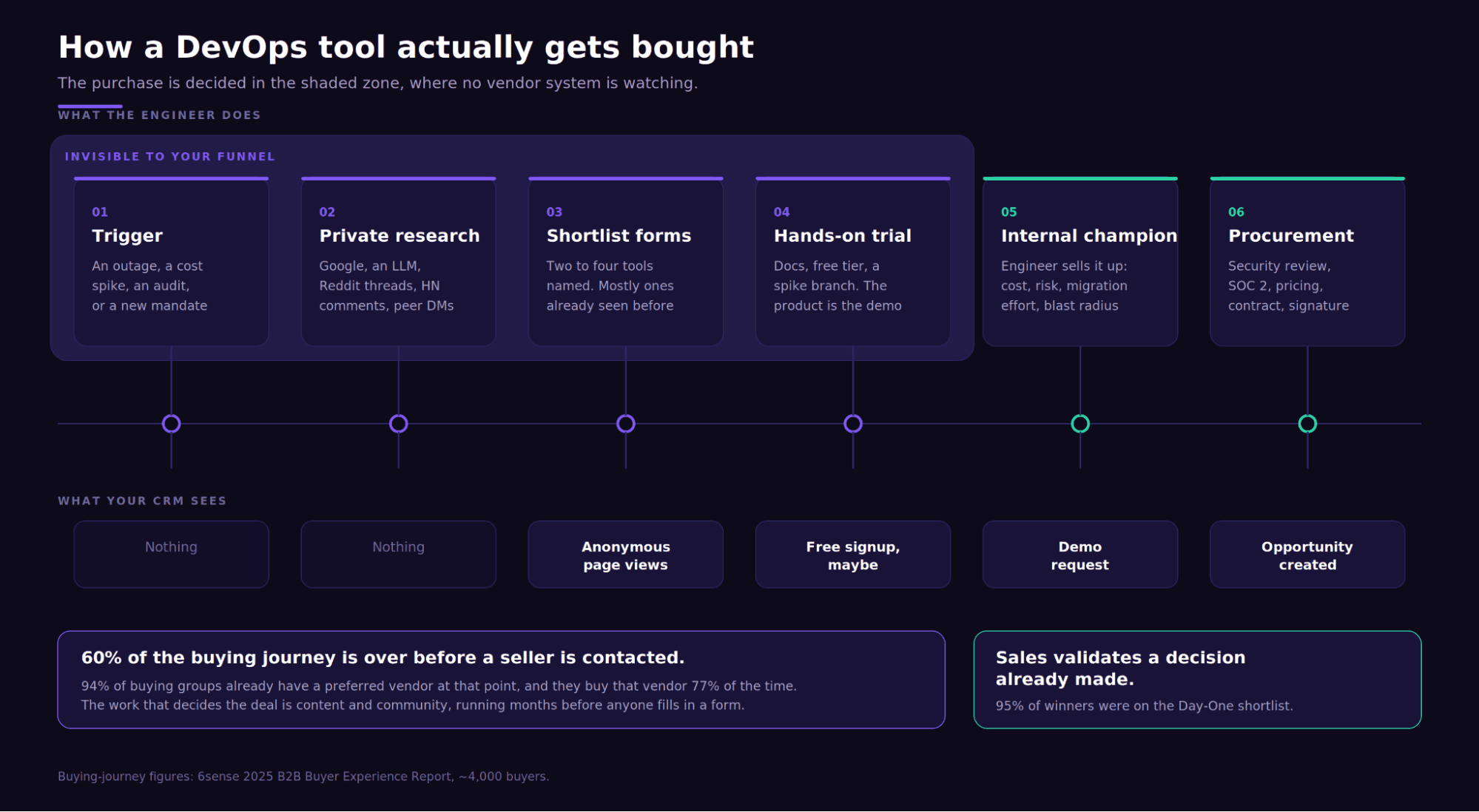
In six stages, four of which are invisible to you. The buying group forms in private, tries the product without telling you, and contacts you only to validate a choice it has already made.
The four stages you never see
A trigger fires: an outage, a cloud bill that grew 40% in a quarter, a compliance mandate, a migration off a tool that just changed its licence.
The engineer then researches in places you cannot instrument. Google, an LLM, three Reddit threads, a Hacker News comment section from 2023, and a direct message to a former colleague.
By stage three, a shortlist of two to four tools exists, and it is heavily weighted toward tools the team has already encountered. 6sense found that 85% of buyers had prior experience with the vendor that eventually won. In DevOps, that prior experience is usually the open-source project, the free tier, or a blog post that solved an unrelated problem two years ago.
Stage four is where DevOps diverges sharply from other B2B categories. The engineer does not book a demo. They read your docs, spin up the free tier, and run your product against a real workload on a Thursday afternoon. Your documentation is your demo. If the quickstart fails on the first run, the evaluation ends there, and you never learn it happened.
The two stages you do see, and why they mislead you
Stage five is the champion selling upward. Your product now has to survive being explained by someone who does not work for you, to a director who cares about cost, risk, and migration effort. Stage six is procurement: security review, SOC 2, pricing, contract.
Both stages appear in your CRM, which is why teams mistake them for the funnel. They are the validation phase. 6sense found the winning vendor was already on the buyer's Day One shortlist 95% of the time. If your marketing only starts working at stage five, you are competing for the 5% of genuinely open deals.
The practical consequence: your pipeline metrics are a lagging indicator of content you shipped six to ten months ago. Average cycle length in the 6sense data was 10.1 months. Judging a DevOps content programme on this quarter's MQLs measures the wrong quarter.
Who is actually in the room when "DevOps" buys?
Five people, with five different definitions of success. Treating them as one persona is the most common and most expensive mistake in this category.
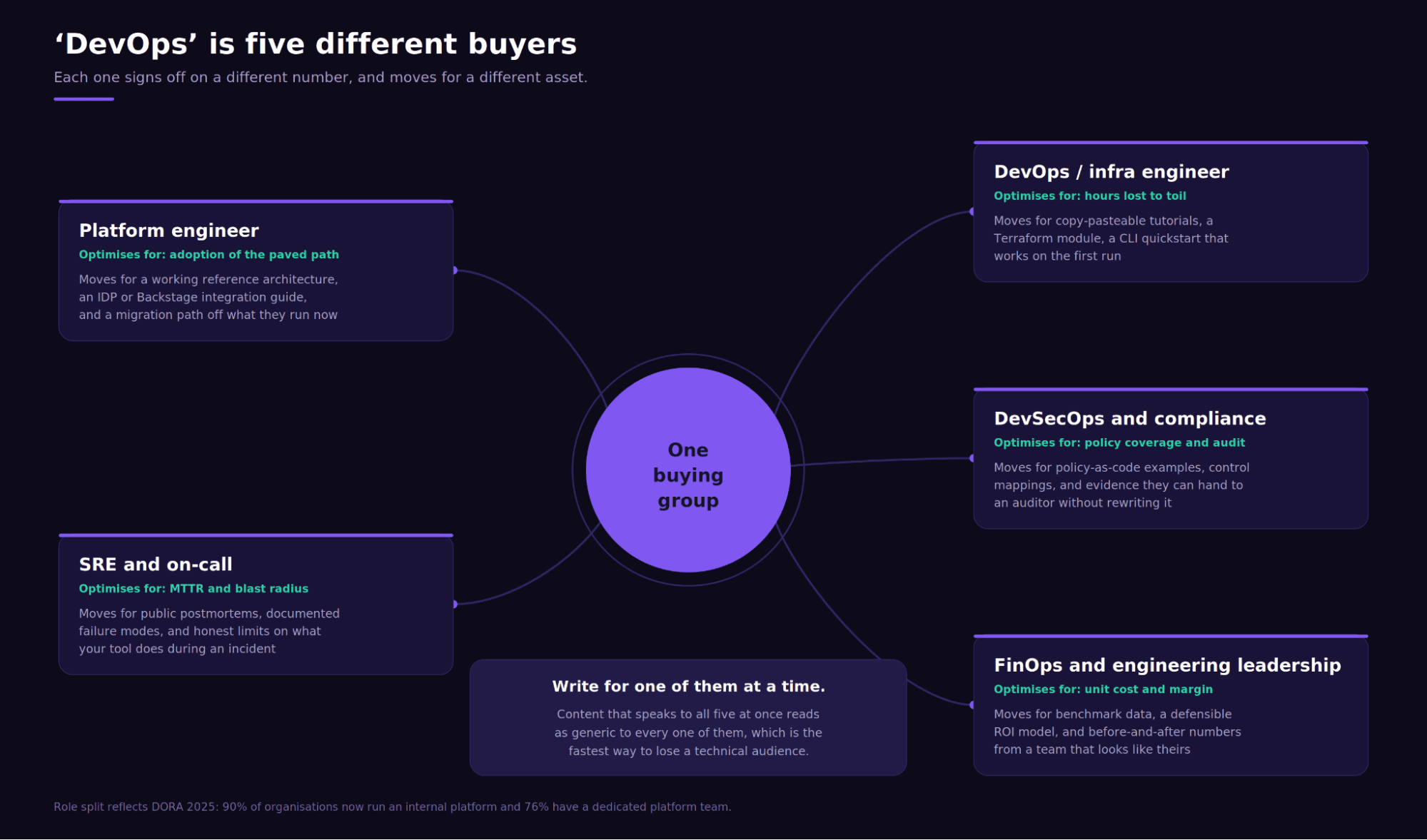
Platform teams are now the default structure. DORA's 2025 report found 90% of organizations run at least one internal platform and 76% have a dedicated platform team.
The platform engineer is the newest and now the most important of the five. DORA's 2025 State of DevOps report, based on nearly 5,000 responses, found that 90% of organizations have adopted at least one internal platform and 76% have established dedicated platform teams. That team owns the paved path. If your tool does not fit the paved path, it does not get adopted regardless of how good it is, which is why a Backstage integration guide or a reference architecture often outperforms a feature page.
The SRE reads differently from everyone else. They are looking for failure modes, not features. A page that documents what your tool does badly during an incident earns more trust from this reader than three pages of capability claims. That preference explains why Honeycomb publicly tells buyers not to take vendor observability claims at face value and to interrogate the technical merits instead. Writing that argues against your own category's marketing is disproportionately credible to an SRE.
The DevOps or infrastructure engineer is measured on toil removed. They want a tutorial they can paste. The DevSecOps reader wants policy-as-code examples and control mappings they can hand to an auditor. The FinOps owner or engineering director wants unit cost, and will not act on a percentage without a model underneath it.
Write for one at a time. Content aimed at all five reads as generic to each of them, and generic is fatal here. Charity Majors, Honeycomb's co-founder, put the test plainly: if you are saying something that any of your competitors could also say, it is not a good message. Our own guidance on defining an ideal customer profile starts from the same place, because in infrastructure the persona split is a technical split, not a demographic one.
One more thing worth knowing about the size of this audience. In Stack Overflow's 2025 Developer Survey, of 49,019 respondents, 2.3% identified as DevOps engineers, 1% as cloud infrastructure engineers, and 0.1% as site reliability engineers. This is a small, concentrated, highly networked audience. Broad-reach tactics waste most of their spend on people who will never buy, and the same people keep showing up in the same twenty places.
What do DevOps buyers read, and where?
Documentation, before anything you would call marketing. It is the single most-used learning resource among developers, and it outranks blogs by roughly two to one.
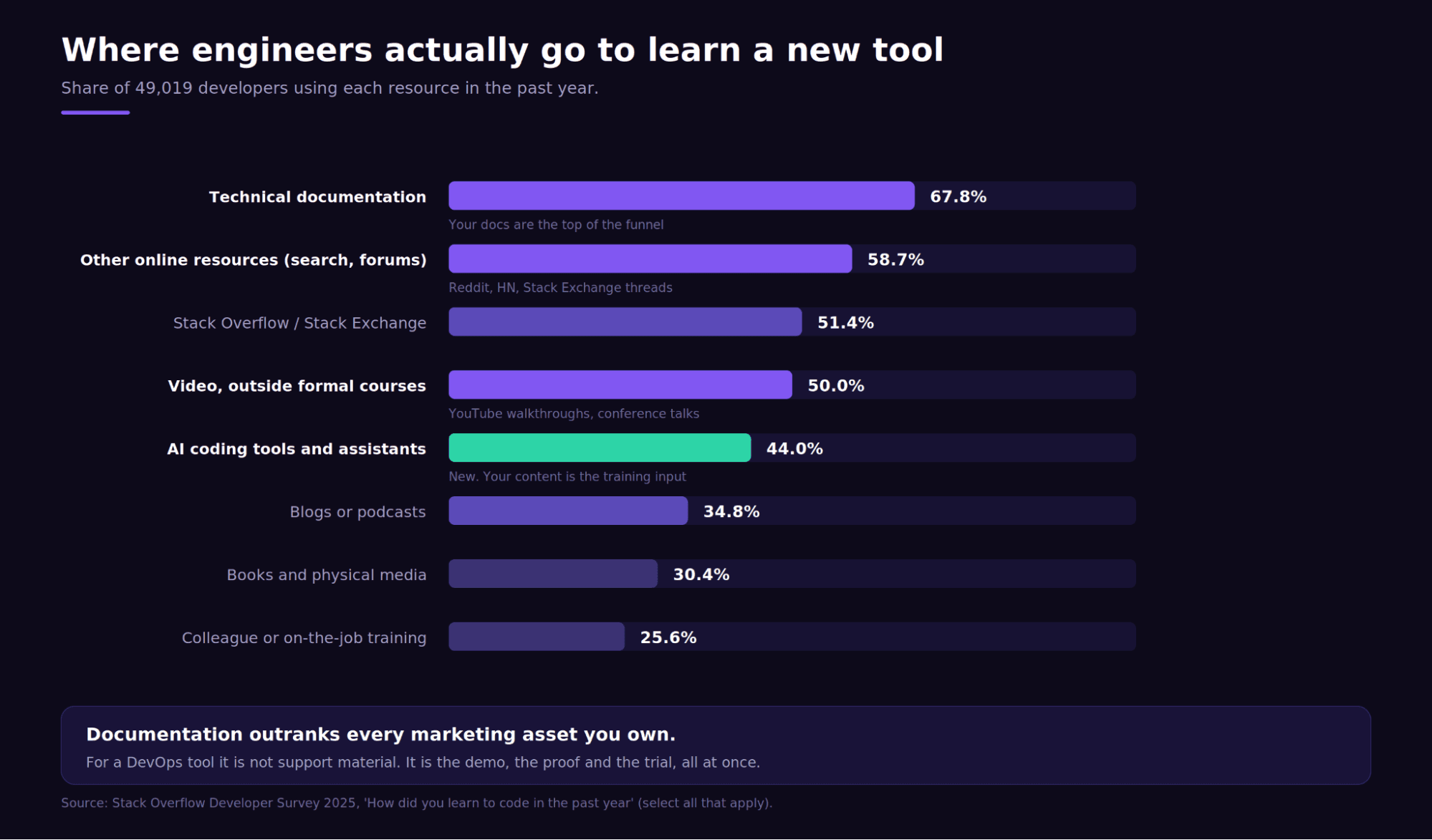
Stack Overflow Developer Survey 2025, 49,019 respondents, select all that apply.
Why docs are a marketing asset, not a support cost
67.8% of developers used technical documentation in the past year. Blogs and podcasts came in at 34.8%. Video sat at 50%, and AI coding tools at 44%.
For a DevOps product, this ranking is not a curiosity, it is the funnel. The buyer's evaluation is a hands-on trial, and the trial runs on your docs. Three things decide whether that trial survives: whether the quickstart works on a clean environment, whether the page answers the "what happens when this fails" question, and whether it says plainly what the tool does not do.
We saw the mechanism directly in an engagement with a cost-optimization platform, where restructuring product documentation as a growth surface rather than a reference manual moved developer engagement, not just support deflection. The docs are also the asset most likely to be retrieved and quoted by an AI assistant during someone else's evaluation, which is a second reason to write them as if a stranger is reading them cold.
The search behavior is problem-shaped
DevOps readers search in error strings and architecture decisions. That means your content map should be built from failure modes and comparisons, not from feature names.
When we worked with Terrateam, a Terraform automation product whose audience was explicitly DevOps and infrastructure engineers, the winning topics were operational problems: managing Terraform state, setting up RBAC, migrating state between backends, caching. That program produced 6,530 additional clicks and 81% traffic growth in three months, with 80% of target keywords landing on page one. None of the top performers were product pages.
The same pattern held at a $23M Series A cloud governance company, where organic traffic grew 781%, from 3,700 to 32,600 monthly visits, and comparison content specifically drove a 182% increase in visibility against better-funded incumbents.
Which channel does which job in DevOps marketing?
Each channel is good at exactly one stage of the decision, and most are misused because they are pointed at the wrong one. Hacker News creates a spike of awareness. Reddit shapes the shortlist. Docs run the trial. Conferences build champions.
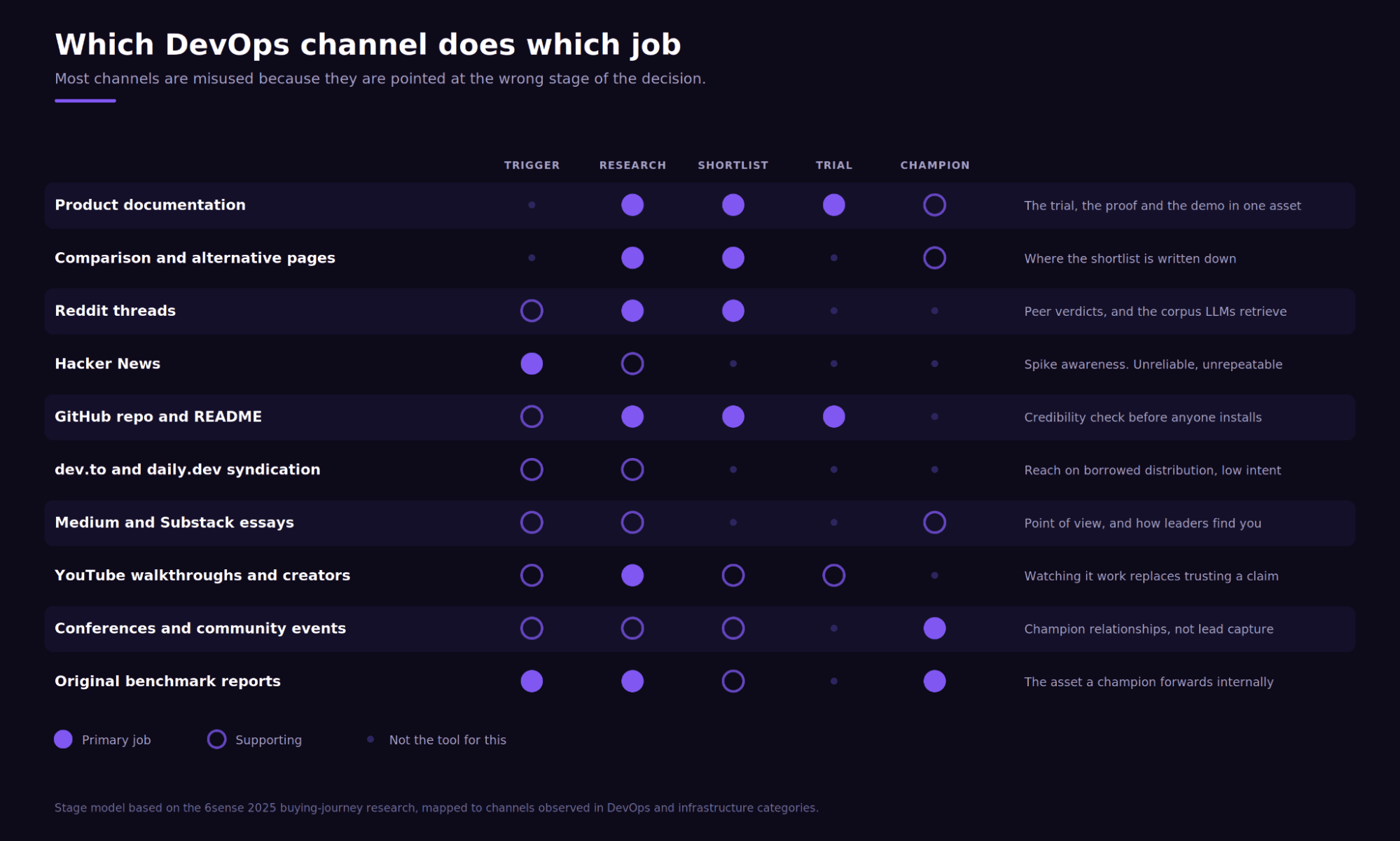
Channels mapped against the stage they actually influence.
Reddit: where the shortlist gets argued out
Reddit is the highest-value and most-misplayed channel in DevOps. It sits at research and shortlist, and it has a second life as the corpus that AI assistants retrieve when your buyer asks a model to compare tools.
The rules that decide whether this works are unforgiving. On a live program in an adjacent developer-tool category, we logged 699 engagements across 138 subreddits over six months. 98.1% are still live. Four constraints produced that survival rate. Answer the question before mentioning any product. Don't link: only 18 of the 699 engagements (2.6%) contained one. Mention the brand only where it genuinely fits, which meant half the comments never mentioned it at all. Name competitors honestly, including where they are better.
Average comment length was 480 characters, because these are real answers rather than one-liners.
Teams running Reddit without aged accounts and thread qualification routinely lose 30% to 60% of comments to removal, and lose the accounts with them. The difference between a 98% survival rate and a 50% one is the difference between an asset that compounds and paying twice for work that gets deleted. When choosing subreddits, our breakdown of the subreddits worth engaging in and the mechanics of running Reddit as a B2B channel cover the qualification step in more detail.
Hacker News: real, but not a channel you can plan around
Here's the data. We pulled every Hacker News story that crossed 100 points between 1 September 2025 and 1 September 2026, then filtered to DevOps and infrastructure topics by keyword in the title or URL.
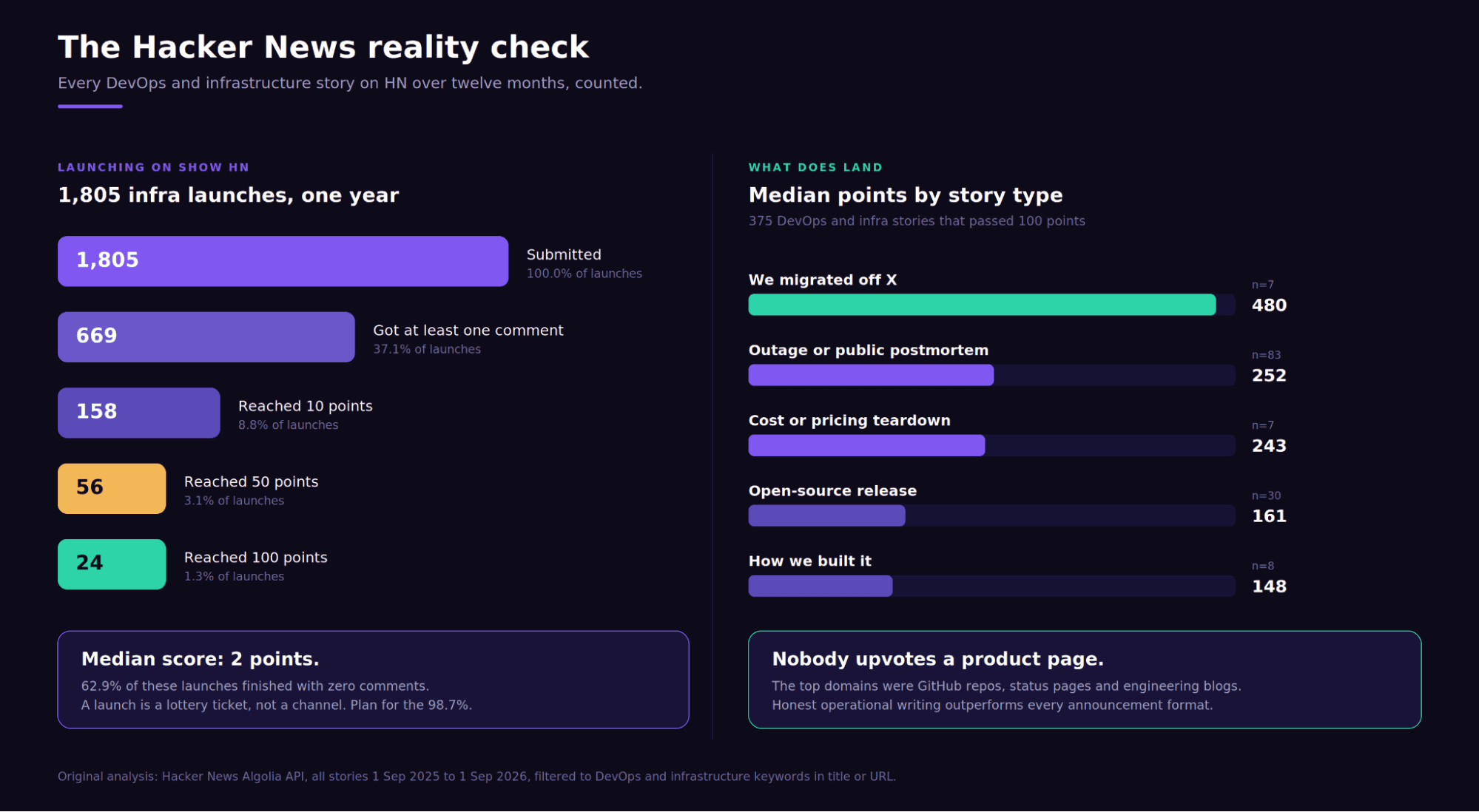
Original analysis of 12 months of Hacker News data. Method in the caption below the chart.
Of 15,659 stories that passed 100 points, 375 were DevOps or infrastructure related, about 2.4% of the front-page-class corpus. Then we looked at launches specifically. Of 1,805 DevOps and infrastructure "Show HN" submissions in the same twelve months, the median score was 2 points, 62.9% finished with zero comments, and only 24 of them, 1.3%, crossed 100 points.
Treat a launch as a lottery ticket rather than a plan. The related channels are more dependable: our notes on launching a developer tool on Product Hunt apply the same discipline to a venue with more predictable mechanics.
What lands on Hacker News is instructive. Ranked by median points, migration stories came top at 480 (only 7 of them, so treat that as directional), outages and public postmortems at 252 across 83 stories, cost and pricing teardowns at 243, open-source releases at 161, and "how we built it" architecture posts at 148. The three most common sources across the whole set were GitHub repositories, vendor status pages and engineering blogs. Nobody upvotes a product page.
The lesson for a DevOps company is specific: your incident write-ups and your migration guides are your Hacker News strategy. The announcement is not.
dev.to, daily.dev, Medium and Substack: reach on borrowed distribution
These four get grouped together and they should not be, because they do different jobs.
dev.to has more than 3 million registered developers and roughly 7 million monthly visits, which makes it the largest free developer publishing surface available. The catch is documented by the community itself: an analysis of a million dev.to articles found article volume rising while engagement per article falls, to the point where January 2026's output alone would take 38 days of nonstop reading. Post consistently, tag precisely, and set canonical_url back to your own domain so the SEO value accrues to you.
daily.dev serves over a million active developers through a feed extension that sits in a new browser tab. It rewards headline clarity and punishes marketing language faster than any other surface here.
Medium is where a point of view travels, and where non-practitioner readers, including the director your champion reports to, are likely to encounter you. Substack is the channel with the strongest compounding effect for a founder or a principal engineer with an opinion, because it is subscription-based rather than algorithmic, and it reaches engineering leadership directly.
Use all four as syndication, not as home. Our guide to content distribution for developer tools covers the canonical setup, and the wider map of developer marketing channels covers the ones not listed here.
GitHub: the credibility check nobody talks about
Before an engineer installs anything, they open your repository. Commit recency, open issue response times, README quality, and star count all get read as proxies for whether your company will still exist in two years.
Repository work is measurable rather than decorative. On one recent program, a client's main repository got over 31,000 package downloads, driven by treating the repo as a marketing surface rather than a code dump. For an open-source-adjacent DevOps product, GitHub SEO and README structure is often the most valuable page you own after the docs.
YouTube and conferences
50% of developers used video to learn last year. For infrastructure products, watching the tool run against a real cluster replaces trusting a claim, which is why technical walkthrough video converts at a stage where written content stalls.
Conferences work at the champion stage, not the awareness stage. KubeCon + CloudNativeCon North America 2025 drew more than 9,300 attendees. The value is not the badge scans, it is the twenty conversations with people who will later be asked internally which tool to use. For budgeting, our KubeCon primer sets expectations on cost and format.
How does influencer marketing actually work in DevOps?
Unlike every other category, because the audiences are small, the trust is earned through demonstrated competence, and a bad sponsorship damages the creator more than it damages you.
DevOps creators concentrate in a handful of channels.
- TechWorld with Nana sits around 1.5 million subscribers and is the default entry point for people learning Kubernetes and CI/CD.
- Jeff Geerling is around 830,000 and owns the homelab and bare-metal audience.
- Viktor Farcic's DevOps Toolkit is around 210,000 and reaches senior platform engineers specifically, with a format built on live coding against real tools.
- That DevOps Guy is around 190,000.
- The CNCF's own channel is around 130,000.
Note the shape of that list. A 210,000-subscriber channel reaching platform engineers is worth more to a GitOps vendor than a 1.5-million-subscriber channel reaching people studying for their first certification. Audience composition beats audience size by a wide margin in this category, which is the opposite of how influencer budgets are usually allocated.
Three rules govern whether these placements work:
- The creator has to run the product. The format that converts is a build, not a read. A sponsored segment where the creator has clearly never opened the tool is visible to this audience within thirty seconds and gets called out in the comments.
- Give them the failure modes. Creators who are allowed to say what the tool does badly produce placements that convert better, because the audience calibrates on the criticism.
- Independent benchmarks are the highest-trust format, and you cannot control them. Channels built on performance comparison carry weight precisely because they are unsponsored. The correct move is to make your tool easy to benchmark, publish your own methodology, and accept the result.
We go deeper on selection, pricing, and briefing in our writeups on developer influencer marketing and influencer marketing for devtools.
What content actually converts a DevOps buyer?
Five asset types do most of the work. Each one exists because it answers a question the buyer cannot answer from your product page.
The original benchmark, built from your own telemetry
The strongest asset in this category is data only you have. Cast AI publishes an annual Kubernetes Cost Benchmark Report built from analysis of more than 2,100 organizations' clusters across AWS, GCP and Azure, with the methodology stated openly, including the fact that the data is collected before those organizations used the product.
The headline finding does the selling on its own. Average CPU utilization across Kubernetes clusters sat at 10% in the 2025 edition, down from 13% the year before, with memory at 23%. That number gets quoted by people who have never visited the site, cited in other companies' decks, and used by champions to justify budget internally. Cast AI has since extended the same motion into its own event format, with KubeAuto Day Amsterdam drawing more than 800 practitioners.
If you run infrastructure software, you are sitting on telemetry that answers a question the whole category argues about. Publishing it once a year, with the method attached, is the single highest-return content decision available to a DevOps company.
The migration guide
The highest median score on Hacker News in our dataset was the migration story. It also maps exactly to a purchase trigger, because most DevOps tools are bought to replace something, not to fill an empty slot. Write the honest version: what breaks, how long it took, what you would not do again.
Comparison and alternative pages
Comparison pages are where the shortlist gets written down, and it is the content most likely to be retrieved when a buyer asks an assistant to compare options. It worked measurably in the Series A cloud program above, where comparison content, FAQs and solution pages drove a 182% visibility increase against incumbents with years of head start.
The rule that makes them credible is counterintuitive: name the cases where the competitor is the better choice. A page that recommends one tool reads as an advertisement. A page that recommends three, with conditions, reads as experience, and gets cited as a source.
Public postmortems and failure documentation
83 outage and postmortem stories crossed 100 points on Hacker News in twelve months, at a median of 252 points. That is the highest-volume category in the whole dataset. Publishing your own incident write-ups is the cheapest trust you will ever buy from an SRE audience.
Practitioner-grade tutorials
The kind an engineer completes without hitting a wall. This is where the technical review step matters more than the writing step, and it is why our own technical content is written and reviewed by engineers rather than briefed to generalists.
Why does a DevTool site need to be designed differently?
Because the visitor's next action is to read or to run something, not to book a call, and standard SaaS site architecture makes both harder.
Four differences matter:
- The docs are a top-level destination, not a footer link. If documentation is the most-used research resource at 67.8%, burying it three clicks down inverts your own funnel. Docs, pricing, and the repository belong in the primary navigation.
- Pricing has to be legible without a call. Engineers evaluating a tool need to know whether it fits the budget they can approve without escalating. A "contact sales" wall at the pricing page removes you from the shortlist at stage three, before anyone has spoken to you.
- Code has to be first-class on the page. Real, copy-pasteable snippets with correct syntax highlighting, not a screenshot of a terminal. The hero of an infrastructure landing page is often a config file.
- The claim has to be falsifiable. "Reduce cloud costs" is unreadable to this audience. "Average CPU utilization across 2,100 clusters is 10%; here is the method" is readable. Specificity is the entire aesthetic.
Grafana Labs states the underlying principle better than any framework: co-founder and CEO Raj Dutt has said, "We don't build technology for the buyer. We build technology for the practitioner." The same company is comfortable saying out loud that "90% of our users will never pay us, and that's by design", which is exactly the posture that produced 20 million users and the commercial business underneath them.
What goes wrong, and how do you catch it early?
Five failure modes account for most wasted DevOps marketing budget. Each has a symptom you can look for this week.
- Gating the technical content. Symptom: your best-performing asset has a form in front of it. An engineer will not fill in a form to read a benchmark, they will read the summary someone else posted on Reddit instead. Gate the ROI model if you must. Never gate the technical proof.
- Marketing language in engineering venues. Symptom: your Reddit comments get removed, your dev.to posts get no engagement, your Show HN dies at 2 points. The venue is not the problem. Leading with the product is.
- Measuring the wrong quarter. Symptom: leadership wants to kill content at month four. The cycle is around ten months, and most of it is invisible. Agree the leading indicators before you start, not after.
- One persona for five readers. Symptom: engagement is flat everywhere and nobody can say who the piece was for. Split it.
- Chasing volume in community channels. In our own monitoring of 186 threads that AI assistants retrieve when answering questions in a developer-tool category, the top 10 threads, 5.4% of them, carried 43.4% of all citations. More than half returned one citation or none. Posting more comments in more places produces less than owning the ten threads that matter.
How do you measure this when the funnel cannot see it?
By tracking shortlist presence rather than lead volume, and by instrumenting the surfaces that the funnel misses.
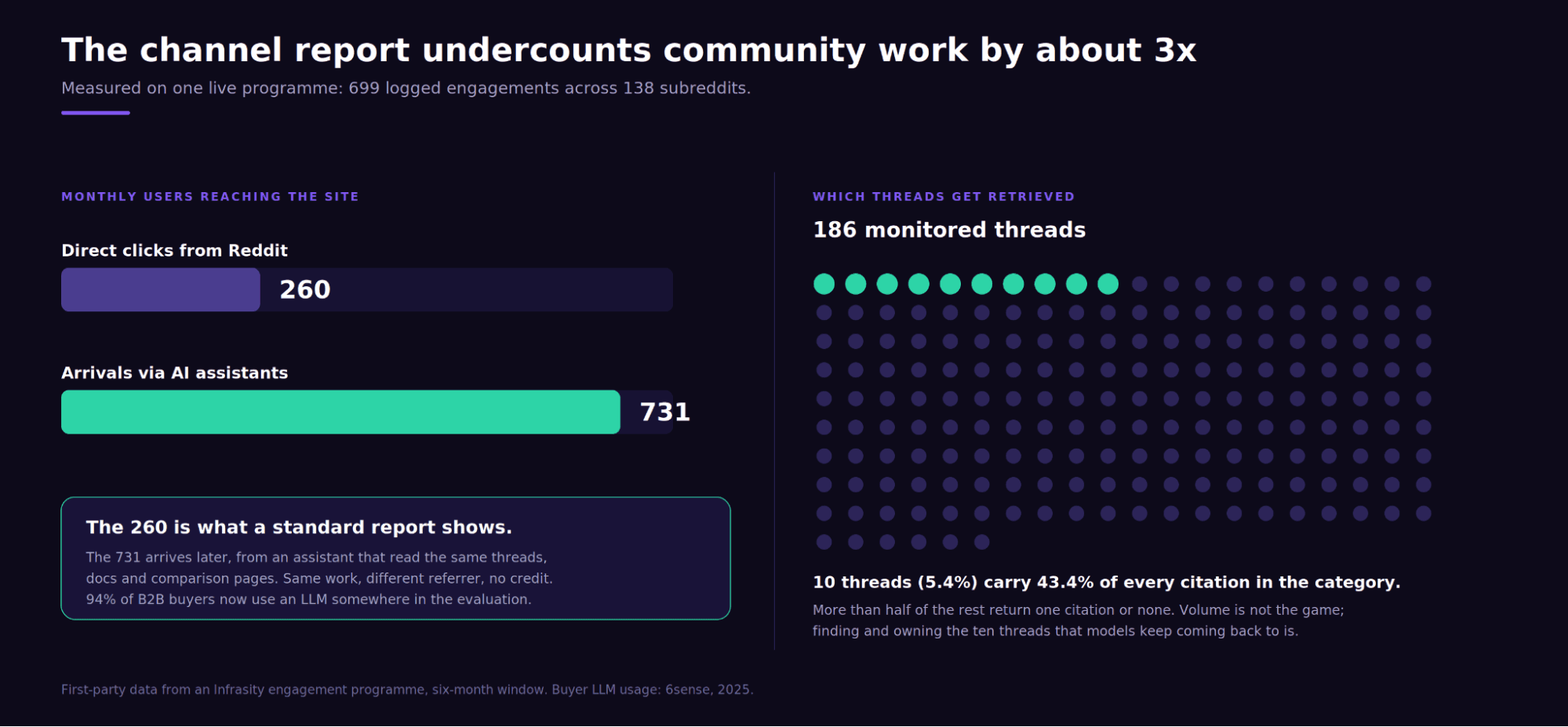
First-party data from a six-month engagement programme.
The attribution gap is now large enough to change decisions. On the programme above, direct Reddit clicks delivered around 260 users a month. Arrivals from AI assistants delivered 731. The 260 is what a standard channel report shows. The 731 came from assistants that had read the same threads, docs and comparison pages, and it carries no referrer that credits the work that produced it. Undercounting by roughly 3x is enough to get a working programme cancelled.
This matters more every quarter, because 94% of B2B buyers now use an LLM somewhere in the evaluation. In the Series A cloud programme, AI assistants were already sending measurable traffic, and we treat AI visibility for platform engineering and infrastructure products as a tracked channel rather than a side effect.
Four metrics worth running instead of MQLs:
| Metric | What it tells you | How to get it |
|---|---|---|
| Shortlist presence | Whether you are in the consideration set at all | Ask every inbound lead which vendors they considered and who they contacted first |
| Assistant citation rate | Whether models retrieve you for category questions | Track a fixed prompt set weekly, measure appearance and position |
| Docs-to-activation | Whether the trial survives the quickstart | Instrument the first-run path, not just the signup |
| Thread ownership | Whether your community work compounds | Count the high-retrieval threads where a credible answer exists |
We wrote up the tracking method for the second of those in our AI visibility audit, and the wider measurement argument in content marketing metrics.
Conclusion
You now have the sequence a DevOps buyer actually follows, the five readers hiding inside the persona, what each channel is good for, and hard numbers on what lands and what does not. The first move is small: run your own quickstart on a clean machine, time it, and count the steps. That single test tells you whether the rest of this applies to you yet.
If you want the whole motion run by people who write infrastructure content because they have shipped infrastructure, that is what Infrasity's developer marketing for DevOps tools does: docs, technical content, community engagement and AI visibility, measured on adoption rather than impressions. Talk to our team about your DevOps content programme.
Frequently Asked Questions
What is DevOps marketing?
DevOps marketing is the practice of marketing software products to DevOps engineers, SREs, platform engineers, and the infrastructure teams around them. It differs from general B2B SaaS marketing because the buyer evaluates hands-on before contacting sales, treats documentation as the trial, and verifies vendor claims through peer communities rather than sales conversations.
How long does a DevOps tool sales cycle take?
Around ten months on average for B2B purchases in the 6sense 2025 data, down from 11.3 months the previous year. Roughly 60% of that time passes before the buyer contacts any vendor, so most of the cycle is invisible in your CRM and your content is doing the work unattributed.
Should we launch our DevOps tool on Hacker News?
Submit it, but do not build a plan around it. Of 1,805 DevOps and infrastructure Show HN submissions between September 2025 and September 2026, the median score was 2 points, and only 1.3% crossed 100 points. Migration stories, public postmortems and cost teardowns perform far more reliably on Hacker News than launch announcements do.
Is Reddit worth it for DevOps products?
Yes, at the research and shortlist stages, provided you participate rather than promote. On a logged programme of 699 engagements, 98.1% survived because comments answered the question first, only 2.6% contained a link, and half never mentioned the brand at all. Reddit threads are also heavily retrieved by AI assistants during vendor comparisons, which extends their value well past the direct click.
How much should we spend on DevOps influencer marketing?
Weight your budget by audience composition rather than subscriber count. A 200,000-subscriber channel that reaches senior platform engineers is usually worth more to an infrastructure vendor than a 1.5-million-subscriber channel that reaches people learning their first certification, and placements only work when the creator has genuinely run the product.
What is the single highest-return asset for a DevOps company?
A benchmark report built from your own telemetry, published annually with the methodology attached. It answers a question the whole category argues about, it gets quoted by people who never visit your site, and no competitor can copy it because they do not have your data.
Do we still need SEO if buyers use ChatGPT?
Yes, and the two are now the same job. Assistants retrieve from indexed content, so the docs, comparison pages, and community threads that rank are also what gets cited. Track a fixed set of category prompts weekly to see whether you appear, because assistant traffic will not show up cleanly in a referrer report.