
A good Product Hunt launch for a developer tool comes down to four things, done in order: start posting in your product's Product Hunt forum thread weeks before launch day, write a listing that people can scan in five seconds, have a real person answer every comment for a full 24 hours, and plan what happens in the six weeks after.
Skip any one of these, and the numbers below show exactly what it costs you. In the first half of 2026, 3,869 products launched on Product Hunt, and the average one collected only 144 upvotes. Most of those products were never seen by anyone outside their own team.
This blog walks through the whole thing, from picking a launch date to writing a maker comment that actually gets read.
We are also two weeks out from a real launch as we write this. Statewave, an open-source memory tool for AI agents, is going live on Product Hunt by the end of July, 2026, and we're building the plan alongside you.
Every recommendation here either comes from that plan, from our experience doing that for our already-launched customer, or from data pulled straight from Product Hunt itself.
What Is Product Hunt, And Does It Still Matter For a Developer Tool In 2026?
Product Hunt is a website where new products get posted every day, and the community votes on the ones they like. It started in 2013 as a simple newsletter and has grown into a place with a 91 domain rating on Ahrefs and about 4.2 million monthly visitors as of April 2026.
A domain rating that high means one link from a Product Hunt page carries real weight with Google, which is one reason the launch still matters even for a team that never touches the homepage.
Plenty of well-known developer tools got their early traction there. Stripe, Resend, Vercel, and Supabase all launched on the platform, and Anthropic, ElevenLabs, and Supabase are among its most-followed pages today.
None of them treated the launch as a one-time stunt. The site has also grown past being just a launch page. Early in 2025, Product Hunt added Product Forums, a community space where teams keep posting updates, open roles, and discussions long after launch day.
The people who show up matter more than the platform's age. Darko Gjorgjievski, a Developer Relations Engineer at Kilo Code, put it simply after two Top 5 launches in 2025:

That is the audience a developer tool actually wants in front of it on day one.
Is Product Hunt "Dead" For Developer Tools, or Is That Just a Myth?
You'll hear this from someone in almost every founder group: Product Hunt doesn't work anymore; everyone launches AI wrappers, and nobody sees anything unless they're featured.
Some of that is true.
Only about 10% of daily launches receive editorial Featured placement as of late 2024 data, down from 60 to 98% between 2020 and 2023. Getting on the homepage really is harder now.
But "harder" is not the same as "not worth it."
Look at one real comparison from a founder who launched the same developer tool on both Hacker News and Product Hunt.
Esteban Vargas, CEO of Watermelon, an open-source coding copilot, got #2 on Hacker News with 107 points, 61 visitors to his GitHub page, and 100+ installs.
On Product Hunt, he landed #14 of the day with 193 votes, 243 visitors over a day and a half, and 30 installs.
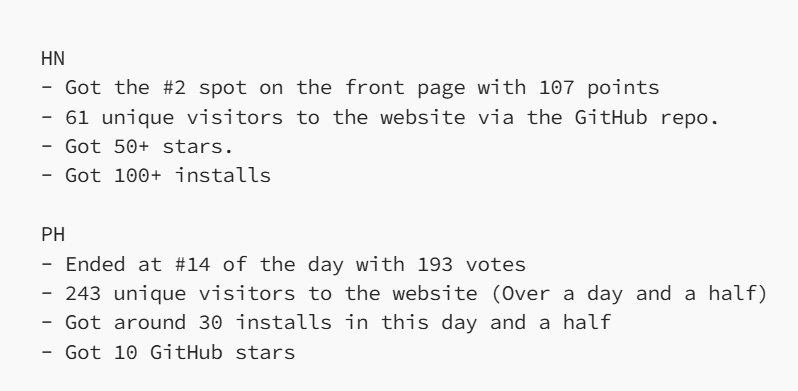
He concluded that Hacker News drove more active installs for his specific tool, but Product Hunt still brought in real, trackable traffic and ten new GitHub stars from a single day, at #14, without ever hitting the front page.
Origin is a newer example of the same pattern, and it's another developer tool team we've worked closely with.
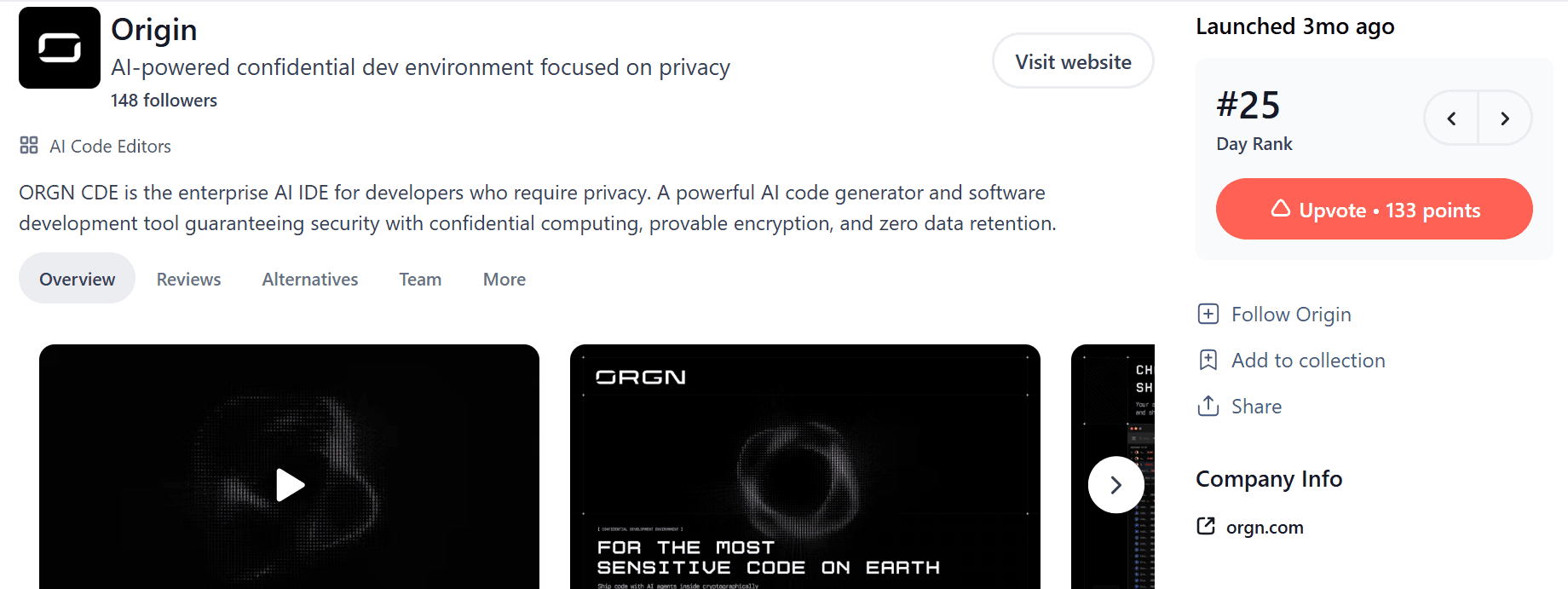
Origin is a privacy-focused AI coding tool that runs code within a Trusted Execution Environment rather than routing it through vendor servers, with zero data retention. It launched on Product Hunt in 2026 and finished #25 of the day with 133 upvotes and 148 followers. That's a modest, honest result, not a front-page win.
What's worth noticing is the comment thread, not the rank. A visitor asked a real technical question about how the tool protects data during a system crash, and the maker answered with the actual encryption mechanics rather than a marketing line. That kind of exchange builds trust for a security product in a way a higher rank alone never could. The Hunter on that launch was fmerian, the same person behind the developer tools guide cited earlier in this piece, a reminder that credibility on Product Hunt tends to come from a small group of people showing up again and again, not from one big launch day.
That's the honest picture. You don't need Product of the Day to get value. You need a plan that turns launch-day attention into signups, stars, and backlinks, whether you land at #1, #14, or #25.
What Happened When We Started Building Statewave's Launch Plan?
Statewave is one of the memory agent customers we're working closely with, and it's launching soon. We're launching right now, so it's worth walking through the actual thinking rather than some made-up example. Statewave is an open-source, self-hosted memory tool for AI agents.
Most AI agents today store memory in a vector database that hands back "relevant" text with no record of where it came from, who's allowed to see it, or whether someone changed it.
That's fine for a demo.
It becomes a real problem the moment an agent handles anything sensitive in production. Statewave's answer is access controls, sensitivity labels, and tamper-evident audit trails built directly into the memory layer, positioned as a self-hosted alternative to hosted services like Mem0 and Zep. That governance story is also core to the wider open source marketing strategy behind the launch, developers need to trust the security model before they'll self-host anything.
The first main decision is our story. With 49% of all Product Hunt launches now carrying some AI component (61% in March 2026 alone) and AI products earning 29% more upvotes on average, "another AI memory tool" would drown instantly. "The governance layer nobody built for AI agent memory" is a different, sharper claim.
Every piece of copy in the plan, from the tagline to the maker comment, repeats that same specific angle instead of general AI hype.
That's the same lesson OpenAI learned the hard way: Sora only reached #3 on Product Hunt with 524 votes despite massive traction on X and LinkedIn, because raw brand recognition doesn't automatically win over the Product Hunt community's own taste. A sharp, specific story beats a famous name on this particular platform.
If your product is buried under "AI-powered X for Y" language right now, that's the first thing worth fixing before touching any of the steps below.
Should You Launch On a Weekday Or a Weekend?
This is the first real strategy decision, and the data on it is more precise than most people expect.
Tuesday is Product Hunt's busiest day, averaging 875 launches with an average upvote count of just 142.
Sunday is the quietest, with only 189 launches averaging 250 upvotes each, the best reception of any day of the week.
A separate 2026 benchmark puts the net upvotes needed to hit #1 at roughly 550 on Saturday versus around 1,050 on Tuesday, once Product Hunt's vote-verification passes are applied.
Sunday's top-3-of-day rate is 39.7%, against just 8.6% on Tuesday.
So a quieter day is genuinely easier to fit in well. The trade-off is total traffic. Weekdays, especially Tuesday through Thursday, still draw the most visitors to the platform, and weekends see about 40% lower traffic across the board.
If your goal is "Product of the Week" or "Product of the Month," those are won on weekdays, not weekends, because weekly rankings pool the whole week's competition together.
Here's how this plays out in practice: Jaume Ros, building an SEO tool called Clicks, deliberately picked a Sunday launch specifically because it was the platform's weakest traffic day.
He landed #3 of the day with 339 upvotes, and in his own words, that badge was "the main goal of my launch." He was clear that if he'd had a bigger audience, he'd have picked a weekday instead, because the raw business impact from a bigger, more competitive day would have been larger.
For Statewave, the team picked Tuesday, July 28, 2026, choosing a date with no US holiday clashing and no obvious major competing launch.
That's the tradeoff: Tuesday means competing against roughly six times more products than on Sunday, but it also means a real shot at Product of the Week if the early hours go well, and it puts the critical first few hours in the European morning rather than the middle of the US night, which matters when your team is spread across time zones.
There's no universal right answer here. There's a right answer for your goal, and you have to pick the goal first.
What Replaced Product Hunt's Old "Coming Soon" Page?
Product Hunt actually removed the old Coming Soon teaser pages on August 28, 2025. If you've read an older guide telling you to build one, that advice is out of date. In its place, every new product now gets its own permanent forum thread the moment you start a draft, at a URL like producthunt.com/p/your-product-name. People can follow that thread the same way they used to follow a Coming Soon page, and they still get notified the moment you go live.
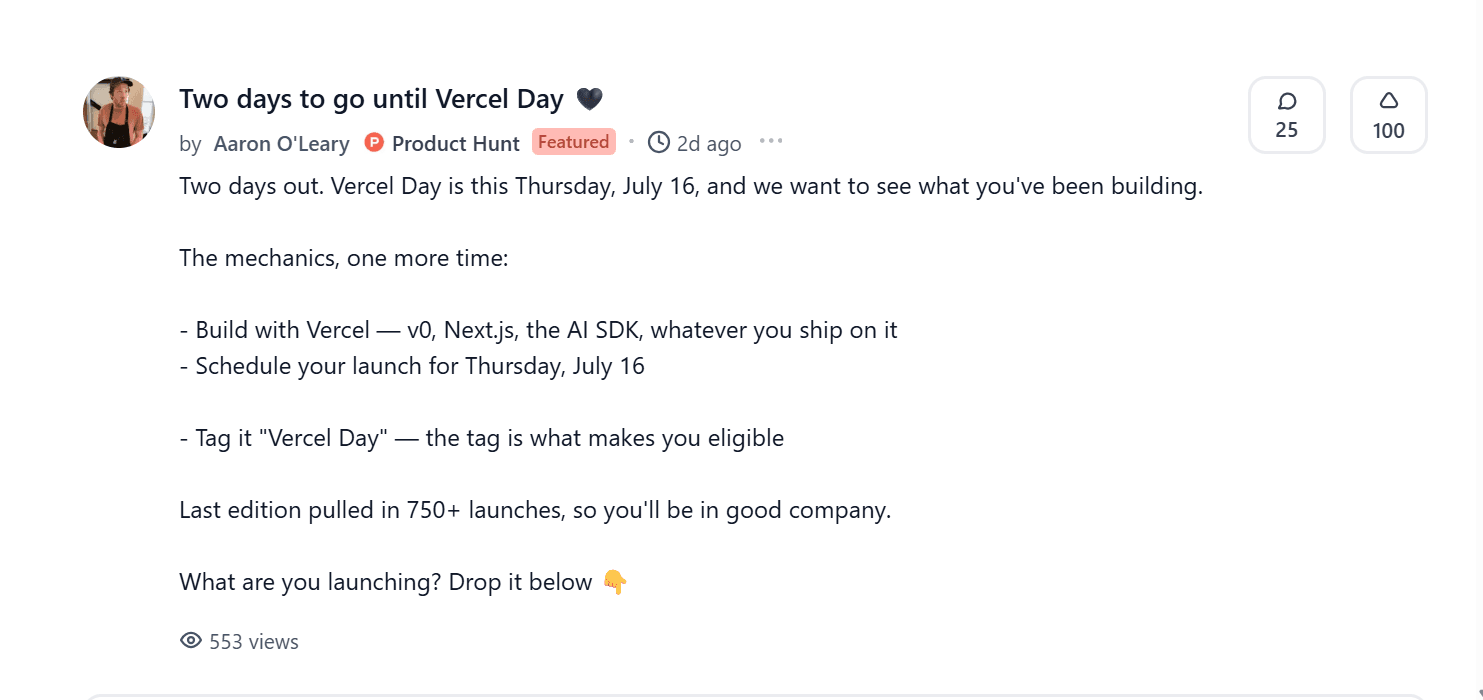
The reason this still matters comes straight from how ranking works. The first two to three hours after your product goes live are still the most important window of the entire 24-hour launch, because early velocity sets the tone for the rest of the day's ranking.
A forum thread you've been posting to for weeks does the same job a Coming Soon page used to. It turns quiet, early audience-building into a group of people who already know you're launching and come back the second you go live.
Product Hunt's own team has data on this too. When Product Forums launched as a feature in its own right, on February 6, 2025, it finished #3 of the day with 63 upvotes and 686 comments, more than ten comments for every upvote. That is a strong sign of how much real discussion a forum thread can generate on its own.
In our plan for Statewave, we start posting in its forum thread in the very first week of prep: short build updates, a note introducing the team, and eventually a preview of the launch date. It costs nothing to set up, and it directly attacks the hardest part of the whole process: getting real traction in those first two to three hours.
Should You Get a Hunter To Post Your Product For You?
A Hunter is an established Product Hunt user, often with a large following on the platform, who submits your product on your behalf instead of you posting it yourself. It's an old debate on Product Hunt, and the honest answer is that a Hunter matters less than most people assume, and more than most people assume, depending on what you're trying to get from them.
What a well-known Hunter actually gives you is speed and borrowed trust, not votes by themselves.
Gold-badge Hunters get their launches placed into the featured queue faster, and their name attached to your listing signals to the community that someone with taste already vetted it.
When n8n, the open-source workflow tool, launched its 1.0 version in July 2023, it partnered with veteran Hunter Chris Messina and landed the #1 Product of the Day spot.
Their Head of Marketing, Luis Guzmán, said:

Even so, this doesn't replace a maker's own presence. Product Hunt requires the actual founder or a core team member to be present in the comments all day, answering questions, and that a maker profile be a real, complete personal account with a photo and bio, not a company logo.
This is why almost every plan we’ve come across, including our own plan for Statewave, insists the launch is posted by the maker or by a maker jointly credited alongside a Hunter, and never by a faceless brand account.
The community can tell the difference between a real person defending their work and a marketing team running a campaign, and it reacts to that difference in the comments section within minutes.
What Actually Goes Into The Product Hunt Listing Itself?
This is the part people either rush through the night before or spend weeks polishing, and the data says the second group wins consistently. Every listing needs six pieces:
- A logo, sized 240 by 240 pixels, that still reads clearly at thumbnail size.
- A tagline of 60 characters or fewer that says exactly what the product does.
- A short description, capped at around 260 characters, that expands on the tagline without repeating it.
- Between five and eight gallery images, sized 1270 by 760 pixels, because that's what shows up in the feed where most people are just scrolling and scanning, never clicking through.
- Two to four relevant topic tags so the product surfaces in the right category pages.
- And the maker's first comment, written and ready before the clock strikes midnight Pacific time.
Statewave's actual tagline is a working example of the 60-character limit in practice: "Open-source memory runtime for production AI agents," which lands at exactly 50 characters and states the category and the differentiator (open-source, production-grade) in one breath, with no filler.
The description that follows names the specific governance features, access policies, sensitivity labels, tamper-evident audit receipts, and source traceability, instead of a vaguer line like "the smartest way to give your agents memory."
Keep your gallery text large and high-contrast, because most people never open your page.
They see your first image on the homepage feed and decide in about two seconds whether to click. That first image is doing more work than your entire product description.
Do You Actually Need a Demo Video, And What Makes One Worth Watching?
Yes, and here's exactly why. Most visitors are scanning a fast-moving feed, not reading. A 30-to 60-second video breaks that scan pattern because it's the one thing on the page that moves.
It also does something screenshots can't: it proves the product actually works, live, in real time, which matters enormously for a developer tool where the whole pitch is "does this actually do the thing?"
For Statewave, the demo is scripted around one flow: a single command deploys the tool locally, the demo writes a memory to it, and the screen then shows the resulting audit receipt along with the memory's source trace.
That's roughly 30 to 45 seconds of screen recording with no narration needed beyond a few on-screen captions. Nothing about it is scripted like a commercial. It's a working developer watching their own tool do exactly what it claims to do.
You upload the video as a YouTube link directly in the gallery section of the listing, right alongside your static images, and Product Hunt displays it as a playable card in the feed. If you're short on time, prioritize the video over a sixth or seventh screenshot.
Motion earns attention that a static image simply can't compete with on a feed where people are speed-scrolling.
What Should The Maker's First Comment Actually Say?
This single comment carries more weight than almost anything else on the page. There's a specific number behind that claim: maker first comments have been shown to average 166% more upvotes on the products that post them, compared to launches without one, and 89% of top-5 makers reply to every single comment they receive on launch day.
The comment that works is a founder telling a personal story about the problem, not a bullet list of features restated from the tagline.
Statewave's first comment opens with the actual failure mode the team kept running into: agents whose memory was a black box, with no way to know where a fact came from, who could see it, or whether it had been changed.
Only after establishing that does it introduce the product and its four capabilities, closing with a direct, specific question to the reader: "What's your biggest memory or governance pain right now?"
That question matters as much as the story. It gives commenters something concrete to reply to, and every reply from a stranger is another signal to the algorithm that real people are engaging, not just clicking a button.
Write this comment 48 hours before launch, not the night before. You want it edited, re-read, and ready to post the second the clock hits 12:01 AM Pacific.
How Many Upvotes Do You Actually Need To Place Well?
This is the number everyone wants, and almost nobody gives it precisely, so here it is. In 2026, the #1 Product of the Day typically needs between 800 and 1,500 upvotes, though on a low-competition day, 500 to 700 can be enough to win. A separate benchmark breaks this down by day: roughly 550 net upvotes win #1 on a Saturday, climbing to around 1,050 on a Tuesday.
The count on your product's page will typically run 10 to 30% higher than the net number that actually decides your rank, because Product Hunt periodically clears fraudulent or bot votes from the total behind the scenes. And the algorithm no longer rewards a single midnight spike followed by silence.
It weighs your average upvotes per hour across roughly a 20-hour window, targeting something in the range of 45 to 55 upvotes per hour on weekdays and 30 to 35 per hour on weekends. One analysis of 50 separate 2026 launches found that products crossing 100 upvotes before 4 AM Pacific had an 82% chance of finishing in the top 10 for the day.
That last stat is the one to build your morning around. It means you need real momentum in the first four hours, not just a plan to "share it a lot throughout the day."
Why Do The First Four Hours On Launch Day Matter More Than Any Other Stretch?
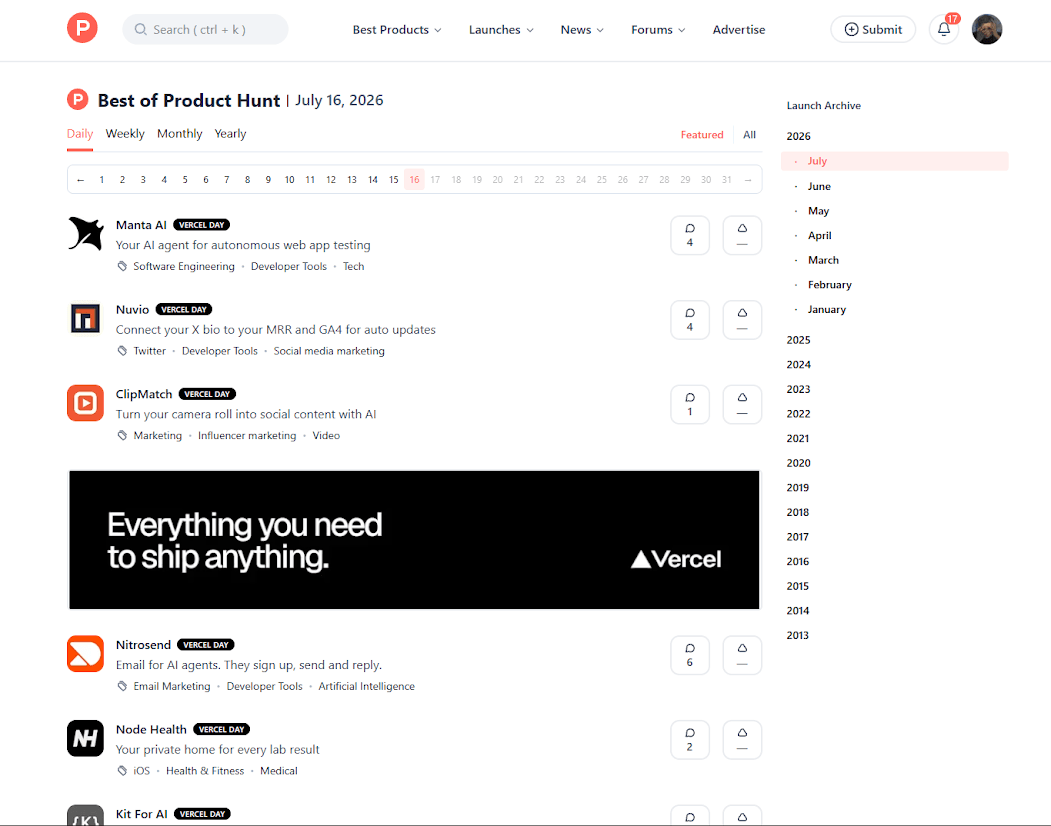
Because Product Hunt hides the upvote count for the first four hours of every day's launches. Every product looks the same during that window, no matter what your total actually is. What is visible instead is the comment count.
That changes the entire early strategy: during those first four hours, the products getting attention are the ones with active, interesting comment threads, not the ones with the biggest vote total, because nobody can see the vote total yet.
This is exactly what happened during Jaume Ros's Sunday launch of Clicks: 74 comments came in alongside those 339 upvotes, and Jaume specifically called out replying to every comment as one of his three top recommendations for anyone launching again.
It's also confirmed at a larger scale: launches with 500 upvotes and 200 genuinely thoughtful comments regularly outrank launches with 800 upvotes and only 30 generic ones, because Product Hunt's ranking system has gotten noticeably better at telling real engagement apart from mobilized, low-effort voting.
Put one person, and only one person, at a time, on comment duty for the entire day. Not a rotating group that each checks in occasionally. Silence in the comments during a busy hour reads as abandonment, both to the algorithm and to the people considering whether to leave a comment of their own.
Where Do The Actual Upvotes Come From, And What Actually Converts?
This is where most teams are clueless, so it's worth being precise about what's been measured.
Reddit and Product Hunt are not the same audience, wearing different hats, even though they overlap. When the open-source tool AFFiNE launched on Product Hunt, Reddit traffic to the launch drove 3,000 to 4,000 impressions with roughly a 1% upvote conversion rate. When that same team ran an open-source-focused push on Reddit for the same product, it drove 80,000 to 100,000 impressions with a 5 to 8% conversion rate to GitHub stars.
The gap was in the pitch. A Product Hunt upvote ask reads as promotional the moment it hits a subreddit, because the Product Hunt audience is already tired of exactly that kind of post.
The version that works is posted by someone who already shows up in that community regularly, leading with the actual problem they solved, not the ask.
This is one of the gaps our Reddit marketing work is built to close for developer tools, one piece of the wider content distribution system for an open-source repo. Getting a launch-day post to land on Reddit takes weeks of aged, credible presence in the right subreddits before launch day, not a single post the morning you go live.
If your team doesn't already have that presence in the communities your users live in, that's worth fixing well before your product's Product Hunt forum thread ever goes live.
LinkedIn behaves differently again, and it's arguably the highest-return channel per hour.
Three people direct-messaging warm contacts full-time on launch day can generate 200 to 300 quality upvotes on their own, but only if every message is personalized. Copy-pasted openers get ignored or, worse, reported.
Email works too, but the conversion rate is lower than most people expect going in: as Jaume emailed just over 1,000 subscribers on his list and saw a 40% open rate with only 6.7% clicking through to the launch page.
That's a healthy open rate and a completely normal click rate for a cold-ish list, which tells you email should be one channel among several, not your entire plan.
What Should Your GitHub README Say On Launch Day, Specifically?
For a developer tool, this is the piece almost every other guide skips, and it's arguably as important as the Product Hunt page itself, because a real percentage of your launch-day traffic is going to click straight through to your repository, not stop at the listing.
Your README needs to open with your one-line pitch and a three-sentence explanation of what it does and why it exists, with a screenshot or a short GIF placed near the very top, before anyone has to scroll.
It needs a one-command install that you have personally tested on a completely clean machine, not just your own laptop with six months of leftover configuration on it.
Your license needs to be visible at a glance, and the LICENSE file itself needs to actually be present in the repo, not just mentioned.
Your repository topics and tags need to be set so people searching GitHub directly can find you. If your product has grown past a single README into a full docs site, the same debate covered in our Mintlify vs GitBook comparison is worth settling before launch, since a docs platform that can't keep pace with fast-shipping code will fall behind within weeks. And on launch morning itself, add a single line near the top of the README, something like "We're live on Product Hunt," linking straight to your listing.
Statewave's repo prep followed this exact list in the two weeks before launch, treating the README the same way the team treated the Product Hunt gallery images: as a first-impression asset that gets one shot to earn a star or an install, not as documentation to be perfected later.
This is precisely the kind of asset Infrasity's product and API documentation work is built around, written by engineers who have actually run the install command themselves, not a marketing writer working from a feature list handed to them secondhand.
What Happens After The 24-hour Launch Window Closes?
This is the stage where the compounding value is actually built or left on the table.
Product Hunt gives you a genuine, permanent do-follow backlink from a domain rated 91 on Ahrefs, which is one of the highest-authority links you can earn for free anywhere on the internet. That backlink is part of a wider distribution game too, since whether your product actually shows up when someone asks ChatGPT or Perplexity for the best tool in your category is now worth tracking the same way you'd track SEO rankings.
Jaume Ros tracked this directly after his own launch and found the Product Hunt backlink itself took a few days to fully register, but two additional backlinks showed up almost immediately from sites that cover new launches, including a mention from tldr.tech, a large newsletter in the tech space. None of that shows up if nobody's watching for it in the days after launch.
Product Hunt also explicitly allows repeat launches. Their own rule requires waiting at least six months between posts for the same product or from the same company, and there has to be a real, significant update to justify the relaunch.
The teams with the biggest wins on the platform average two to four launches over a product's lifetime, timing each one to a real milestone like a 1.0 release or a major new platform integration, not launching the same thing twice out of habit.
There's also the Product Forums feature Product Hunt added in early 2025, essentially a Reddit-style space attached to your product page where you can keep posting updates, starting discussions, and sharing open roles long after the 24-hour ranking window ends.
It's the platform's own answer to the fact that a single launch day was never going to be enough on its own.
None of this happens by accident. It needs a content plan sitting behind it: technical posts published in the weeks around launch to catch the backlink and search traffic while it's fresh, a recap post summarizing what actually happened and what you learned, and a steady publishing habit afterward so the traffic bump from launch day turns into an actual, lasting search presence instead of a one-week spike that fades.
This is the exact gap Infrasity's technical content work is designed to fill, written by engineers who work with your product directly, so the content that follows your launch reads as if it came from the same team that built the thing, because it did.
What Does a Realistic Result Actually Look Like, By Rank?
Here are the real ranges, so you can set expectations before launch day instead of during it. Landing in the top 3 for the day typically brings in 5,000 to 15,000 visitors and 100 to 400 signups over the 24-hour window. Fall outside the top 10, and you're more commonly looking at under 500 visitors for the whole day.
And here's how that traffic actually turns into revenue, and this is what Jaume Ros shared: "You'll get customers." The Sunday launch we've referenced throughout this guide brought in 10 new signups within the first 24 hours, and every one of them signed up for the $25-a-month starter plan, which is $250 in new monthly recurring revenue added in a single day, from a launch that only finished #3 of the day on the platform's quietest day of the week.
That's not a top-3-of-the-year outcome. It's a solid, honest result from a well-run, modest launch, and it's a far more useful number to plan around than "you'll get a ton of traffic."
What Actually Goes Wrong, And How Do You Avoid It?
Almost every failed launch we've seen traces back to one of three mistakes, and none of them are about the product itself.
- ### Asking directly for upvotes
Product Hunt's own rules explicitly prohibit this, and a launch can be penalized or flagged entirely. Every message you send, whether it's a LinkedIn DM, an email, or a Reddit post, needs to ask people to "take a look," "check it out," or "share feedback," and never to "upvote us."
- ### Going quiet in the comments for even an hour during the busy stretch
Given that 89% of top-5 makers reply to every single comment they get, silence during your own launch day is one of the most avoidable mistakes on this entire list.
- ### Treating the listing itself as an afterthought, written the night before
Every stat in this guide traces back to teams that planned their tagline, galleries, and maker comment days or weeks in advance, not hours.
None of these three things requires a bigger budget or a better product. They require someone owning the plan early enough to actually execute it.
How Does Infrasity Fits Into All Of This?
Most developer tool teams are strong on the product and thin on the marketing muscle needed to run a launch like this properly, and that's exactly the gap we work in. We're an engineering-led team that has worked with more than 40 developer-first, AI agent, and infrastructure startups, including companies like Kubiya.ai and Firefly.ai, on exactly the assets this guide covers: technical blog posts, product and API documentation, GitHub marketing, and a strong Reddit presence, the same ten-play system covered in our GitHub marketing strategies guide.
What separates this from a typical developer marketing agency is who writes it, see how we compare in our roundup of GitHub marketing agencies. Our service is tailored to your specific situation. For example, if you want to promote your open source project, we can help you with that. Just like how we helped Memclaw.
If you're two, four, or eight weeks out from your own launch and staring at an empty Product Hunt forum thread, that's exactly the point where an outside team can save you the weeks of setup this blog walks through. Our launch plan, the one referenced throughout this blog, came together the same way: research, real data, and a team that had already run this playbook before.
FAQs
What is a Product Hunt launch?
A Product Hunt launch is when a team submits its product to Product Hunt for a single 24-hour period, starting at 12:01 AM Pacific Time, during which the community can upvote, comment, and discover it. Ranking is based on upvotes and comment activity gathered during that window.
How many upvotes do you need to hit #1 on Product Hunt in 2026?
Most #1 products need 800 to 1,500 upvotes, though 500 to 700 can win on a low-competition day. In 2026, the benchmark puts the exact number at roughly 550 on a Saturday versus 1,050 on a Tuesday.
What is the best day to launch on Product Hunt?
Tuesday gets the most total traffic but the most competition, averaging 875 launches a day. Sunday gets the least competition and the best average reception, at 250 upvotes per launch. Pick Tuesday for reach, Sunday for an easier badge.
What time should you launch on Product Hunt?
Launch at exactly 12:01 AM Pacific Time. That's the moment the daily ranking window opens, and launching then gives your product the full 24 hours to collect votes instead of starting partway through the day.
Do you need a Hunter to launch on Product Hunt?
No, anyone can submit their own product. A well-known Hunter can speed up featured placement and lend early credibility, but the maker still has to be present in the comments all day; a Hunter doesn't replace that.
How long does a Product Hunt launch last?
The ranking window runs 24 hours, but the first two to three hours decide most of your early momentum, and the first four hours hide upvote counts, so only comment activity is visible to visitors during that stretch.
Can you launch the same product on Product Hunt twice?
Yes. Product Hunt requires at least 6 months between launches for the same product or company, and the second launch must include a real, significant update to qualify, not a cosmetic change.
Is Product Hunt worth it for developer tools?
Yes, developer tools regularly perform well there; Stripe, Resend, Vercel, and Supabase all launched on the platform. A single Product Hunt link also carries real SEO weight, since the site has an Ahrefs domain rating of 91.
What replaced Product Hunt's Coming Soon page?
Product Hunt retired Coming Soon pages on August 28, 2025. Every new product now gets its own permanent forum thread, and people who follow that thread are still automatically notified the moment the product goes live.
Why are Product Hunt upvotes hidden for the first four hours?
Product Hunt hides the vote count on every launch for the first four hours of the day, so early ranking isn't decided by raw numbers alone. Only comment counts are visible during that window, which is why replying fast matters more than chasing votes early.
Can you ask people to upvote your Product Hunt launch?
No. Product Hunt's rules prohibit directly asking for upvotes, and doing so can get a launch flagged or penalized. Ask people to "check it out" or "share feedback" instead.
Does a Product Hunt launch help SEO?
Yes. Product Hunt has a domain rating of 91, and a launch earns a genuine do-follow backlink from that domain, plus secondary backlinks from sites and newsletters that cover new launches.