


On July 2, 2026, Zoom announced a definitive agreement to acquire Common Room, the buyer-intelligence platform used by GTM teams at Atlassian, Anthropic, Autodesk, Notion, Okta, and Snowflake. Terms are undisclosed, and the deal is expected to close within weeks.
If your buyers are developers and Common Room is part of how you find them, this is worth more than a passing scroll.
It's also the third time in about a year that a standalone GTM signal company has ended up folded into something bigger, after Clari-Salesloft and Apollo-Pocus, and each time, what happened next to the acquired product came down to one thing: how closely its buyer overlapped with the acquirer's own.
We're not going to tell you the sky is falling, and we're also not going to tell you to ignore it.
We're going to walk through what actually happened, why it's the third deal like this in about a year, what it changes (and doesn't) for teams whose buyers are developers specifically, and what a realistic next step looks like whether you're a Common Room customer or just watching from the sidelines.
We will also provide a non-sponsored comparison of some Common Room alternatives that are worth evaluating: Reo.Dev, 6sense, Clay, Sumble, Unify GTM, and Apollo.io.
Here's the map, in case you'd rather jump than scroll:
- The two-minute recap: what Zoom actually bought, and what it says about Common Room
- Déjà vu, but make it enterprise: the third GTM signal acquisition in a year, and the pattern running under all three
- The blind spot most coverage skips: what changes if your buyer types code for a living
- Your homework, if you're on Common Room: a five-minute audit
- Why the window to act is now, even without a deadline
- The lineup: Reo.Dev, 6sense, Clay, Pocus, Sumble, Apollo.io, and ZoomInfo compared without anyone's sales deck
- Frequently asked questions
What actually happened
Common Room started as a way for community teams to track who was talking about their product across GitHub, Discord, Slack, and social.
Over time it grew into something broader: a platform that stitches product usage, community activity, and engagement data into one person-level and account-level record of who's actually paying attention to you.
Zoom's own announcement frames the acquisition as "a natural extension of Zoom Revenue Accelerator," its conversation-intelligence product. The logic, in Zoom's words: Revenue Accelerator already scores sales conversations once a meeting is booked. Common Room is meant to tell reps who's worth calling before that meeting exists.
That's a sensible-sounding thesis on paper. Whether it plays out that way is a separate question, and Zoom has a mixed track record on that front.
- Workvivo, acquired in 2023, kept its name and team and later became Meta's preferred migration partner when Workplace shut down.
- Solvvy, acquired a year earlier, got folded into Zoom Contact Center as a feature, and the standalone product quietly stopped existing.
- Both outcomes are on the table here, and it's genuinely too early to know which one Common Room gets.
If there's a pattern worth watching, it's this:
- Workvivo's buyer (HR, internal comms) barely overlapped with Zoom's core buyer.
- Solvvy's buyer (a support leader) already was Zoom's core buyer, and it got absorbed.
- Common Room's buyer, whoever owns the buyer-intelligence budget, overlaps closely with Revenue Accelerator's. Worth watching, not a verdict.
The third deal in GTM signal intelligence's consolidation wave
Zoom buying Common Room is the third time in roughly a year that a standalone GTM signal company has been folded into a bigger revenue platform:
- Clari + Salesloft merged in December 2025, combining forecasting and sales-engagement into what they called a unified Predictive Revenue System
- Apollo + Pocus, announced March 2026, brought a revenue-intelligence platform used by Canva, Asana, and Monday.com into Apollo's broader GTM operating system
- HubSpot + Warmly, announced June 2026, folded person-level website de-anonymization and autonomous outbound agents into HubSpot
- Zoom + Common Room, announced July 2026, the deal this post is about
Aimdoc, a company with no stake in any of these deals, summarized the underlying pattern well: "the system of record is buying the system of action." The platforms that store your customer data are now buying the tools that engage the buyer in real time, so they own more of the pipeline motion end to end.
It's not just anecdotal. Bain's 2026 M&A report puts global M&A up 40% in value to $4.9 trillion in 2025, with technology leading deal volume and momentum continuing into 2026. Consolidation in GTM software specifically isn't a blip. It's the direction the whole category is moving.
If you're a Common Room customer, here's what to actually do this week
Deals like this take longer to actually reshape a product than either side lets on at signing. There's no countdown clock forcing a decision this week. But "no urgency" isn't the same as "nothing to do," and the teams that come out ahead of a transition like this tend to do one simple thing early: they get honest about what they're actually using.
A useful exercise to do:
- List every Common Room capability your team touches weekly: Not the full feature set, just what you actually use.
- Sort each one into a bucket: community signal (GitHub, Discord, Slack, social monitoring), account context (firmographic and market data), or developer-native technical intent (installs, CLI activity, docs engagement, OSS telemetry).
- Be honest about which bucket carries the most weight for your specific motion: Most teams find it isn't evenly split, which is exactly why a single blanket decision, stay or switch, is usually the wrong instinct.
- Watch the roadmap, not the press release, over the next two or three quarters: Whether developer-specific signal depth stays a stated priority inside Zoom's broader Revenue Accelerator roadmap is a real open question, and it's one worth tracking rather than assuming either way.
If most of what you rely on is community signal and general account context, there's a legitimate case for staying put and seeing how the roadmap shakes out.
If developer-native intent is doing most of the work in your funnel, that's the piece worth stress-testing against alternatives now, while you have the time to compare properly.
Common Room alternatives worth actually considering
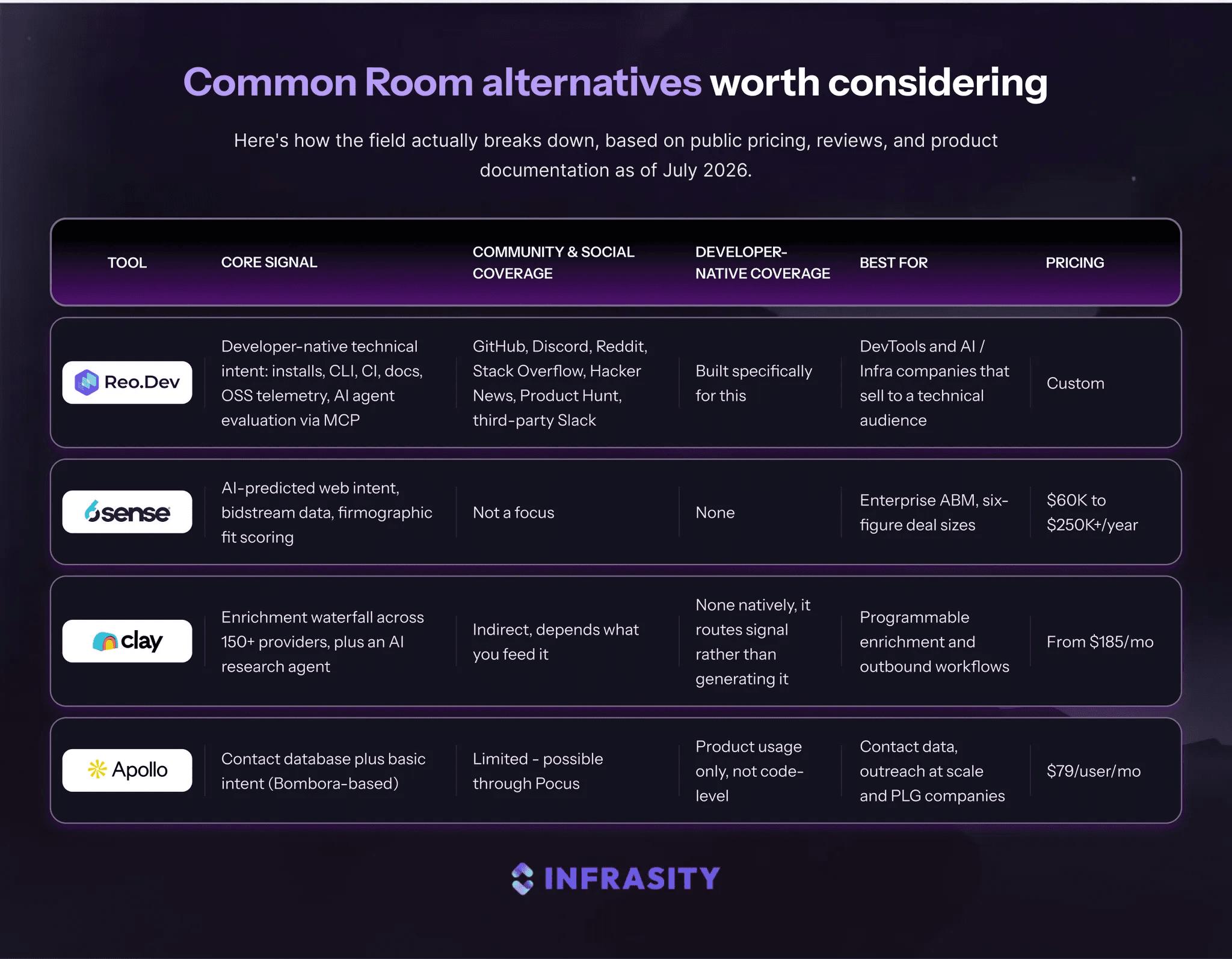
The table covers what each tool does, and for most readers, that's as far as this kind of comparison needs to go.
But most of what Infrasity builds sits downstream of whichever signal tool a team picks, the docs, blog posts, and comparison content an engineer actually reads before trusting a product, which puts us inside enough DevTool GTM stacks to notice a pattern worth naming.
Whichever of the 4 you land on, one follow-up question applies regardless: once you actually know who's engaged, is the content and documentation they land on built to hold that attention, or lose it. If your buyer-intelligence stack is shifting this quarter, there's a good chance that side of things needs a look too. That's a conversation we're glad to have, no pitch attached: book a free consultation.
Picture two accounts side by side in a community dashboard: one starred your repo once, the other has had your SDK running in production CI for six months.
Both show up as "engaged," and nothing in the dashboard says which one deserves a same-day call versus a nurture sequence.
That's the streetlight effect: measuring what's visible rather than what's actually happening.
Worth looking past it for a simple reason: the second account is the one closer to an actual purchase decision.
Knowing that early is what lets a rep have the right conversation at the right time, instead of a nurture sequence aimed at the wrong account.
Reo.Dev is a Common Room alternative built for developer-focused companies specifically, and out of the six above, it's the one built to catch that blind spot. It's worth a spot on your shortlist if your use case looks like any of these:
- You use Common Room to spot activity on GitHub, Discord, or Slack
- Reo.Dev covers the same channels, plus Reddit, Stack Overflow, Hacker News, and Product Hunt, and reaches third-party Slack communities, not just your own branded one.
- Underneath that, it also picks up package installs, CLI activity, and documentation engagement, the layer where most real adoption happens before anyone ever posts in a community.
- You're trying to identify the actual person behind a sign-up or a GitHub handle
- This one's worth noting: on a shared 35,000-contact sample, a general-purpose identity engine resolved GitHub profiles for about 15% of contacts.
- Reo.Dev's developer-specific identity graph, built around GitHub handles, package registries, and cloud sign-ups, resolved roughly 4x more on the same list.
- You're relying on job title to figure out who the real buyer is
- That's a real risk on a technical purchase.
- Reo.Dev layers in domain expertise and location alongside title, because the person actually deciding is sometimes a staff engineer with nothing resembling "VP" anywhere in their profile.
- You want support that isn't gated behind your top pricing tier
- Every Reo.Dev plan includes dedicated support and a direct line to a dedicated account manager and strategist.
- AI agents evaluating your product haven't entered the conversation yet (worth adding now)
- AI coding assistant querying your docs or testing your SDK through MCP, on a developer's behalf, is a real and growing intent signal in 2026.
- Most GTM platforms, Common Room included, don't have a dedicated way to catch it yet.
Said plainly, if your community lives mostly in general social channels rather than GitHub or Discord, the broader lens you're already using will keep serving you better.
Frequently asked questions
Does this acquisition mean Common Room is going away?
Not necessarily, and not immediately. Zoom's release frames the deal as extending Revenue Accelerator, and the company hasn't said Common Room will lose its standalone identity. Zoom's own history includes both outcomes (Workvivo stayed independent, Solvvy didn't), so it's genuinely too early to call this one either way.
Should every Common Room customer switch to an alternative?
No. If your GTM motion runs mostly on community signal and general product usage rather than anything developer-specific, Common Room (or its future inside Zoom) may still be the right tool. The honest answer depends on which capabilities your team actually leans on, not on the fact that an acquisition happened.
What is the best Common Room alternative overall?
There isn't a single best answer, it depends on your GTM motion. For enterprise ABM with a big budget, 6sense. For programmable enrichment workflows, Clay. For developer-led and open-source companies specifically, Reo.Dev. For PLG companies scoring product usage, Pocus (now part of Apollo). For org-chart and tech-stack mapping, Sumble.
Is developer-native technical intent really different from the signals Common Room already tracks?
Yes, meaningfully. Community and general product-usage signals capture that someone clicked or engaged. Package installs, CLI activity, CI pipeline behavior, and documentation engagement capture that an engineer is actually building with your product, often weeks before that same person ever shows up in a form or a community post.
What's the best Common Room alternative for developer-led or open-source companies?
Reo.Dev, because it's the only platform on this list built specifically around developer-native technical intent: package installs, CLI and CI activity, documentation engagement, open-source telemetry, and AI agent/MCP evaluation intent, signals that community or general-B2B intent platforms don't capture natively.
Where does content and documentation strategy fit into all of this?
Directly. The whole reason DevTool teams invest in technical content, docs, and community is to reach engineers while they're evaluating. If the signal layer behind your GTM motion can't see that early technical activity, your best content ends up measured by the wrong metrics, clicks and page views instead of installs and API calls. Getting your buyer-intelligence stack right and getting your content strategy right are two sides of the same problem, which is a big part of why we cover both on this blog.
Two things make that content actually discoverable and worth measuring in the first place: docs that meet our own CLI docs checklist standard, and a technical SEO foundation that gets that content crawled and indexed. And however you end up communicating the product changes behind all this GTM tooling shuffle, keeping a clear changelog vs release notes practice matters just as much for your own users as it does for the vendors you're evaluating here.
This piece is an independent read on a fast-moving acquisition, not sponsored by any of the companies named above. If your GTM stack is shifting this quarter, it's worth revisiting how your content and documentation strategy lines up with it too. That's the kind of work we help DevTool and AI infra teams with at Infrasity, happy to talk through it if useful: book a free consultation.