


One open-source memory tool we worked with saw a 1,512% jump.
Reason?
Because the project showed up on Reddit threads, awesome lists, AI answers, and a README that reads like a landing page.
This blog gives you the ten plays behind that curve, in the order you should run them.
If you own growth, product marketing, or DevRel for a developer tool, this is written for you. You will get the exact moves, the numbers that make them work, and the places to copy them. No fluff, no vanity metrics, and these plays slot directly into the wider GTM enablement motion that ties product, sales, and marketing together.
Key Takeaways
- Discovery moved to AI answers. When a developer asks ChatGPT or Perplexity "best open source X," you are either in the cited threads or you are invisible.
- Your README is your real landing page. 85% of developers check a project's star count and repo page before deciding to use it.
- Reddit is now an answer-engine channel. Pick threads by whether LLMs cite them, not by subscriber count.
- Demo repos out-convert landing pages. The click path from a comment should end in a terminal, not a signup form.
- Compounding beats spiking. A front-page launch decays in about 72 hours; a distribution system posted its fastest growth in week six.
Why Do Good GitHub Projects Stay Invisible?
Because building and marketing the tool are two different jobs, most teams staff only the first. There are more than 200 million repositories on GitHub, and several libraries usually solve the same problem.
If you don't actively tell developers what your project does and who it is for, they will not find you. As Nithya Ruff, who led the Open Source Practice at Comcast, put it:
"If you don't actively communicate what your project is doing and what you're looking for, people are not going to join you. People are not even going to discover you"
This is the quiet money leak. Your engineers spend months on a genuinely better tool, it ships, gets a small launch bump, then goes flat, while a weaker competitor with a marketing motion keeps compounding. Understanding how GitHub stars actually get earned is the first step to closing that gap. The gap is not talent. One team treats GitHub marketing as an event, and the other treats it as a system.
For example: a dev-tools startup ships a faster JSON parser, hits the Hacker News front page once, then plateaus at 500 stars, while a slower competitor posting weekly release notes and Show HN threads grows to 10x that audience in three months.
Here is the reframe that trips up most marketing leaders: even with free code, you are still selling. You're just not asking for money. You are asking for a developer's time and attention, which they guard far more closely than a budget line. Every play below is built around that single truth.
Working on an open-source launch this quarter? Infrasity runs this exact motion for AI infrastructure and developer-tool teams. See our GitHub Marketing service.
Let's cut to the chase and get to the top 10 strategies that can help you.
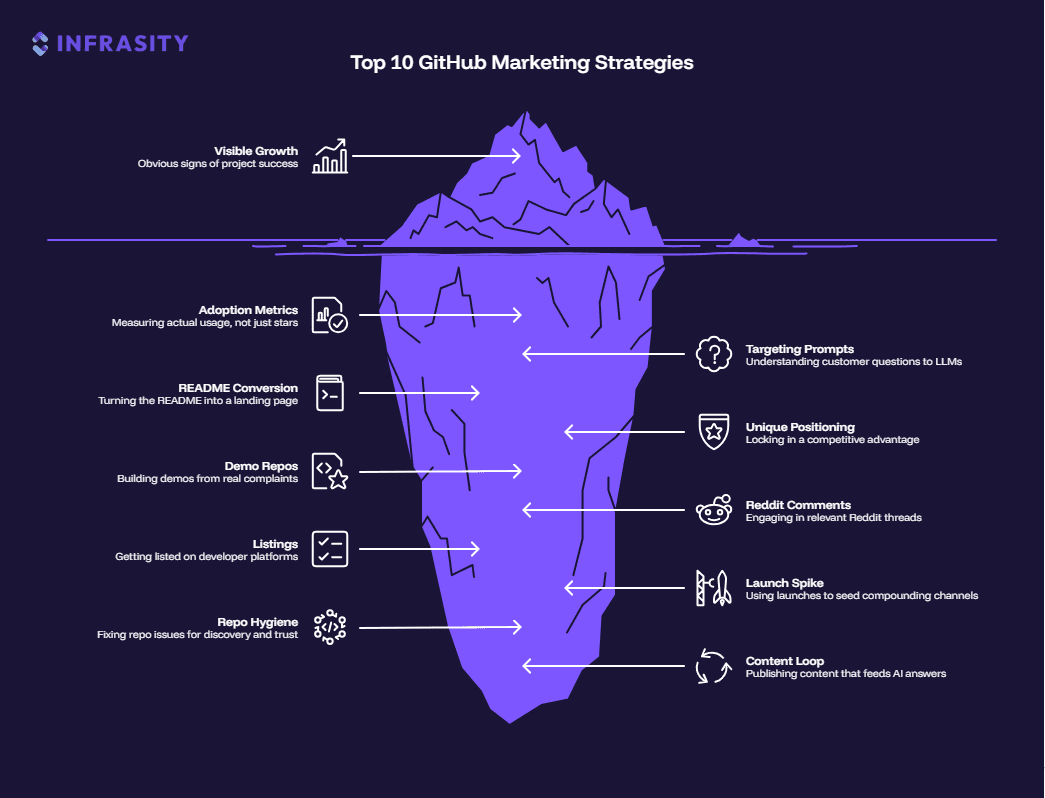
Strategy 1: Measure adoption before you do anything else
Start here, or every later number will be a guess. A star costs a developer one click and commits them to nothing. You can have 10,000 stars and a dead project. Stars are a bookmark; adoption is the business.
The numbers that actually predict pipeline are installs that complete, weekly active usage, package downloads, contributors, and time from first to pull request. Our founder learned this the hard way: when he finally tracked downloads instead of stars, he found that about half the downloads never finished installing. Stars said "winning." The install funnel said "leaking."
What this gets you: a baseline you can defend. A growth number without a baseline is a marketing claim. A growth number with one is an attribution. In the MemClaw engagement, every figure in the final report traced back to a single week-one tracking sheet with five tabs. That is the difference between "stars went up" and "here is exactly what drove it."
Do this next: pick three real metrics (completed installs, weekly active, contributors), write down today's number, and set a weekly check. That is your scoreboard for everything that follows.
Strategy 2: Run the five buying prompts your customer asks an LLM
This is the newest play and the one most teams miss entirely. Developers no longer start every search on Google. A large share now asks an AI assistant "best open source memory layer for agent fleets" or "best Mem0 alternatives," and they trust the answer. If your tool is not named, you were never in the room.
Here is the exact method, and it takes an afternoon. Write down the five questions a buyer types before choosing your category. Not brand terms, the real questions. Run each one across ChatGPT, Claude, Gemini, and Perplexity.
For every answer, log which products get named, in what order, and whether they are cited. You now have a 5-by-4 visibility grid that becomes your scoreboard.
Then do the part that pays off for months: open every source the models cite and record the URL. When we ran this for MemClaw, most of the cited sources were Reddit threads. That single step produced a map of 78 specific Reddit threads that ChatGPT, Perplexity, and Google AI cite in response to those five prompts.
For example, if you maintain an open-source vector database, your five buyer prompts might be: "best open-source vector database for RAG," "self-hosted Pinecone alternative," "vector DB with hybrid search support," "how to store embeddings for a production LLM app," and "Weaviate vs Qdrant vs Milvus."
Those threads, not the biggest subreddits, became the target list for distribution. A comment placed in a cited thread works twice: once for the human reading it, and again every time a model pulls that thread to answer a query.
Want to see where you rank in AI answers right now? This is the first thing we audit. Book a free AI visibility audit for your top 5 buying prompts, or explore AI GEO Optimization.
Strategy 3: Turn your README into a landing page that converts
The README is the first thing a visitor sees, and most projects lose people right there. Treat it like a conversion page, because it is one. The developer decides in the first few minutes whether to try your tool or close the tab.
A README that converts does five things: states what the project does in one plain sentence, shows it working with a GIF, screenshot, or short demo clip (knowing how to choose a video production company helps if you want that clip to look polished rather than homemade), makes installation take under two minutes, links to a real quickstart, and includes a CONTRIBUTING.md so first-time contributors feel welcome.
One more detail almost nobody uses: set a custom social preview image in your repo settings, so the link looks polished everywhere it is shared.
What pain this removes: the silent drop-off. If your quickstart does not run cleanly the first time, you don't get a second chance with that developer. Documentation is not a chore that sits next to marketing.
For a developer tool, the docs are the marketing because time-to-value is the whole game. Linkerd's task-oriented "Getting Started" guide is a good public model to study, and it's the kind of quality that usually means a team chose to hire a technical writer instead of leaving docs to whoever has spare cycles that sprint.
Writing docs that pass engineer scrutiny is its own skill. Engineers handle Infrasity's Technical Writing and Documentation services, not marketers.
Strategy 4: Lock one positioning line competitors cannot copy
Amplifying weak positioning just spreads weak positioning faster. Before a single comment or pull request goes out, decide the one thing you are, in a sentence, a competitor cannot repeat without rebuilding their product.
The trick is to pull differentiation from the architecture, not the roadmap. For MemClaw, the unique parts lived at the fleet level: fleet isolation, trust tiers, cross-agent access control, and write-time contradiction detection.
Competitors could not claim those without re-architecting their core. That produced one line: the only agent memory system built fleet-first, not adapted for fleets after the fact.
Then validate the demand side with outside proof. In that case, the "AI agent memory" category was growing 191% year over year, and a 2026 arXiv survey named multi-agent memory governance as an open problem.
Third-party evidence like that becomes a citation you reuse in every piece of content.
The payoff: one frame runs through the README, every listing, every comment, and the demo repos. Consistency is what makes positioning legible to both a developer skimming and an LLM parsing. Scattered messaging reads as noise to both.
Strategy 5: Build demo repos reverse-engineered from real complaints
Developers don't trust claims. They clone repos. A working demo that reproduces a real failure out-converts any landing page, because the proof runs in their own terminal.
The method is repeatable. Find a high-engagement thread where a developer describes a production failure in their own words.
For MemClaw, that was an r/AI_Agents thread.
Then quote that pain verbatim in the repo README, so the person who wrote it recognizes it instantly.
Two rules make or break it. Script three "screenshot moments," the specific outputs a developer will grab and share, and constrain the whole thing to run locally in under ten minutes on a cheap model. If the proof needs a cloud account or half a day of setup, it is not proof; it is homework.
Ladder the repos so each converts a different reader: a solo dev running long-lived agents, a security-conscious enterprise team, and someone building a multi-step pipeline.
Outcome you can point to: don't tell; show them; add screenshots of things and then say things like the demo repos grew alongside the main one. In a single two-week window, the build-fleet demo grew 67%, and the long-run demo grew 56%.
Strategy 6: Comment in the Reddit threads LLMs already cite
This is where GitHub marketing and AI answer optimization become the same job, and it is the part most teams get wrong by treating Reddit as a place to announce things. Reddit is a place to be useful in public.
Select threads with two filters.
First, topical fit: the thread must be about a problem your tool genuinely solves.
Second, citation value: prioritize the threads from your Strategy 2 map that LLMs already cite. Then write experience-first, answer-first comments.
Open with a shared experience, answer the poster's actual question with technical specifics, and mention your tool only where it truly fits. In the MemClaw run, about a third of live comments did not push the product at all.
That restraint is what keeps a moderator from flagging you and what makes the other two-thirds land.
Run everything through technical review before publishing. The MemClaw funnel: 54 comments were produced, 30 went live, and the client's engineers rejected 2 for accuracy or tone.
Those two rejections are a feature of the process.
On Reddit, a wrong technical claim gets called out in the replies and instantly destroys credibility. Publish in weekly waves of 8 to 10, synced to what you are shipping, so every comment has something concrete to point to.
What this replaces: the bare link drop that gets you banned. A MemClaw comment earned this reply from the original poster: "Appreciate you for taking the time. I'll check out MemClaw".
That is what earned attention looks like.
Getting Reddit right without getting removed is a craft. Infrasity's Reddit Marketing service places engineers in the threads that convert. See the deeper method in our B2B marketing playbook on Reddit.
Strategy 7: Get listed where developers, LLMs, and verification tools look
Listings do two jobs at once.
- Developers browse them to find tools, and LLMs cite them as evidence that a tool is real.
- Run this as a pipeline with statuses and follow-ups, not a one-time submission spree.
Build the target list by surface type, in priority order: awesome lists (permanent, GitHub-native placements via pull request), MCP directories like Glama and Smithery if you ship an MCP server, OSS discovery platforms like LibHunt and StackShare that power "alternatives to X" pages, and developer newsletters. Submit the free, high-authority surfaces first.
The detail that gets PRs merged: make every awesome-list submission mergeable at a glance. Match the list's exact entry format, keep alphabetical order, and write a one-line description that carries your positioning. Maintainers merge PRs that cost them nothing to review. They are volunteers, so a polite follow-up on stale PRs is the difference between "PR open" and "Live." Those open PRs are compounding inventory; they convert into placements over the following weeks at no additional production cost.
Strategy 8: Launch on Hacker News and Reddit as a spike, not a strategy
A big launch, whether Hacker News, Reddit, or a Product Hunt launch, still has a place. Just understand what it is: a spike, not a system. ToolJet posted to Hacker News around 6 PM, hit #1 within an hour, and, within 8 hours, more than 1,000 developers had starred the repo. That trend held for three days and reached 2,400 stars, which was enough traction to raise $1.55 million within two weeks.
That is the upside. The catch is that launch-driven growth decays fast, usually within about 72 hours.
So treat the launch as a way to seed the compounding channels, not as the destination. Post to Hacker News with the problem you solved and why you built it, not a product announcement.
Coordinate the same week across Dev.to, the right subreddit, and a newsletter or two, so the momentum has somewhere to land. The great advantage of a free, open-source project is that you can talk about it on Reddit without it reading as spam, as long as you lead with the problem.
The trap to avoid: treating #1 on launch day as the win. The point is not the badge. The point is to get the project off the ground and into the channels that keep working after the front page forgets you.
Strategy 9: Fix repo hygiene so discovery and trust compound
Distribution brings developers to the repo. Hygiene decides whether they stay, trust it, and star it. Getting the bare tool name, topics, and metadata right is the foundation of GitHub SEO, these are small, cheap fixes with outsized returns.
Use the bare tool name for the repo. Every strong competitor does (mem0ai/mem0, letta-ai/letta, getzep/zep); a prefix adds friction and breaks recall in lists.
Set your GitHub topics, all of them. A repo with zero topics gets zero topic-page discovery; you can add up to 20, so use the relevant ones.
Add a COMPARISONS.md that lays out, factually, how you stack up against the two or three tools buyers compare you to, on the dimensions you win.
Competitors rarely publish that table because they cannot, and it gives LLMs a clean, structured source to quote.
Finally, curate good first-issue labels so that incoming traffic has a path from user to contributor.
Why contributors matter most: contributors are the strongest retention signal an open-source project has. ToolJet holds a healthy 1-to-10 fork-to-star ratio, a sign of real usage rather than passive bookmarking. Stars are attention. Contributors are committed.
Strategy 10: Build a content loop that feeds the AI answers
The last play ties the rest together. Publish content that targets the real queries in your category and lives where developers already read, so each piece keeps pulling in the next wave.
Two moves. First, retitle and rewrite around high-intent terms buyers actually search for, like "Mem0 alternative" or "agent memory for multi-agent systems." The MemClaw audit found 18 blog posts with effectively zero search demand because every title read like product marketing copy, so Google had no query to map them to: same effort, wrong targets.
Second, publish where competitors dominate and you are absent, like DEV.to and Hashnode, with a self-disclosed comparison, an architecture post, and a "failure modes" piece. Technical tutorials get indexed, attract developers searching for solutions, and those developers write about what they built, which creates more content that attracts more developers. That is a loop that runs without your team producing every piece.
Content that passes engineer scrutiny and targets the right queries is what Infrasity does. Explore our Developer Marketing services.
How The Ten Plays Become One Self-Reinforcing Loop
None of these strategies works alone. Run together, they form a loop.
A developer describes a real pain in a thread.
A technical comment answers it and points to a demo repo that proves the fix in a five-minute local run.
The developer clones, stars, and often downloads.
Awesome lists, MCP directories, and topics validate the tool when they go to verify it.
That same thread and those listings become citable sources the next time someone asks ChatGPT "best memory layer for agent fleets." The next developer lands on the repo, and the loop runs again.
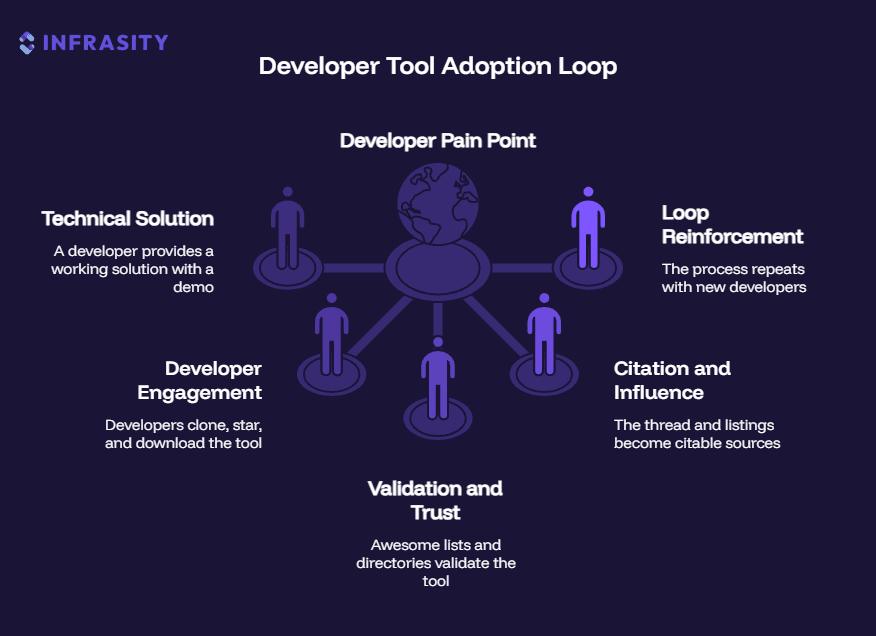
This is also why sequence matters. Baselines before positioning, positioning before repos, repos before amplification. Amplification multiplies whatever exists, so what exists has to be worth multiplying.
The MemClaw curve made the point cleanly: it did not spike and fade. It posted its fastest stretch of growth in week six, crossing 200 stars, which is the signature of a system compounding rather than a launch wearing off.
What You Stop Losing Once This System Runs
Reddit and awesome-list placements cost nothing but attention and keep working for months. You stop guessing at attribution, because a week-one baseline turns "stars went up" into a defensible number your CEO or board will accept.
You stop losing developers at the README because a two-minute quickstart and a working demo remove the silent drop-off. And you stop being invisible in AI answers, because your comments today become the citations models read next quarter.
The pain that goes away is the worst one in developer marketing: shipping a genuinely better tool and watching a weaker competitor win on distribution. Stars follow distribution, not code quality. Once the system runs, the same product that sat flat starts compounding.
How Infrasity Turns This Playbook Into Your Growth Curve
Reading a playbook and running one are different jobs. Infrasity runs this exact motion for AI infrastructure and developer-tool teams: the audits, the positioning, the demo repos, the Reddit engagement, the listing pipeline, and the AI answer visibility work. The difference is who does it. The work is done by engineers who can pass a developer's scrutiny, measured against real baselines, and reported in numbers like the ones in this guide, not clicks and impressions.
If you'd rather not run all ten plays in-house, it's worth knowing what to look for in a GitHub marketing agency before you hand this off, most "developer marketing" shops don't actually own the repo surface.
That is how a stalled repo went from 17 to 274 stars in six weeks, past 31,000 package downloads, with 30 live Reddit engagements across 20 subreddits, on $0 of paid spend.
If you are launching or relaunching an open-source repo this quarter, we will start the same way we did there: by auditing the visibility of your AI answers for your top five buying prompts.
Book a free consultation, and we will show you exactly where your repo is invisible and the first three plays to fix it. Prefer to read first? Go deeper in our Open Source Marketing Strategy guide or the full MemClaw case study.
Frequently asked questions
What are the best GitHub marketing strategies for a new repo?
Start with measurement, not promotion. Set a real baseline (completed installs, weekly active users, contributors), map the five buying prompts your customer asks an LLM, and fix your README so a developer reaches value in under two minutes. Only then amplify through Reddit threads, awesome-list placements, and a content loop. Distribution, run as a system, moves stars more than code changes do.
How do I get my first 1,000 GitHub stars?
Combine a seeded launch with compounding channels. A strong Hacker News post can drive over 1,000 stars in a day, as ToolJet saw, but that spike decays in about 72 hours. Pair the launch with Reddit engagement, awesome-list PRs, and technical content so the momentum lands somewhere durable. First direct outreach for credibility, then organic distribution, is a proven order.
Are GitHub stars a vanity metric?
Partly. A star is a bookmark that commits a developer to nothing, so you can have 10,000 stars and a dead project. But 85% of developers still check star count before trying a tool, so stars are useful social proof. Track them, but decide based on adoption metrics: completed installs, weekly active usage, and contributors.
How does AI search change GitHub marketing in 2026?
Discovery now runs partly through AI answers. When a developer asks ChatGPT or Perplexity "best open source X," the model names a few tools and cites its sources, often Reddit threads. If you are not in those cited threads, you are invisible to that buyer. The play is to find the threads LLMs cite for your buying prompts and be genuinely useful in them.
Why is my open-source project not getting adoption despite good code?
Almost always distribution, not quality. With over 200 million repos on GitHub and several libraries per problem, code that nobody can find dies in the dark. If you are not showing up where developers decide what to use (GitHub discovery, Reddit, Hacker News, AI answers), better code will not save you. Fix visibility first.
How much should I budget for GitHub marketing?
You can go a long way on $0 of placement spend. The MemClaw engagement shipped 7 live listings, 30 Reddit engagements, and a 1,512% star jump without paying for placement. Paid channels can scale a stable, well-documented project later, but they amplify whatever exists, so earn organic traction first.
What should a developer-tool README include to convert?
One plain sentence on what it does, a GIF or screenshot of it working, an install that takes under two minutes, a link to a real quickstart, a CONTRIBUTING.md, and a custom social preview image. Treat it as a landing page, because for a developer evaluating you with a terminal open, it is the only one that matters.