
You built a product that developers should love. The code is pretty solid. The demo works fine. But signups stall, the docs get complaints, and your usual marketing slides right off technical buyers.
Someone on your team says the fix is to hire a DevRel. Then you see the price. A senior one costs $150,000 to $200,000 a year, plus equity, and the search can take months.
This blog is for the person deciding whether that spend is worth it, not for someone chasing a DevRel job. By the end, you will know what DevRel really is, what it costs, how to measure it, and when to build the function or buy the output.
TL;DR
- DevRel means developer relations. It is a two-way bridge. You help developers succeed with your product, and you carry their feedback back to your team.
- It is not a marketing channel. Good DevRel sits across marketing, engineering, product, and community work.
- It pays off through adoption, like API calls and SDK downloads, not through clicks or impressions.
- Whether you hire or outsource depends on your stage and the centrality of developers to your business.
- In 2026, much of developer discovery will happen within AI assistants. So DevRel now also decides whether tools like ChatGPT and Claude recommend you.
What is DevRel, in Simple Words?
DevRel is short for developer relations. The simplest working definition: it is the practice of building useful, two-way relationships with the developers who use, or could use, your product. You help them get value from your tool. In return, you bring their real problems back to your product and engineering teams.
Ask ten people for a better definition, and you will get ten different answers. Marc Backes, who leads DevRel at WeAreDevelopers, says he asked around 100 advocates for a definition and got 100 different ones. That is not a flaw in the field. It just means the work bends to fit what each company needs at the time.
Here is the part that matters for a growth leader. Developers are now buyers. They try a tool on their own, like it, and then push their company to pay for it.
This is how products like Cursor and Clerk spread, bottom-up, one engineer at a time, until the bill lands on a manager's desk. So the relationship you build with a single developer can later turn into a company-wide contract.
Want to see what this looks like when a team runs it end-to-end? Here is how an engineering-led developer marketing team operates.
Is DevRel Just Marketing For Developers?
This is the most common pushback, and it is worth answering head-on. On Hacker News, a widely read thread on the topic argues exactly this: that DevRel is "marketing that targets developers," and that docs and tutorials already belong to other roles.
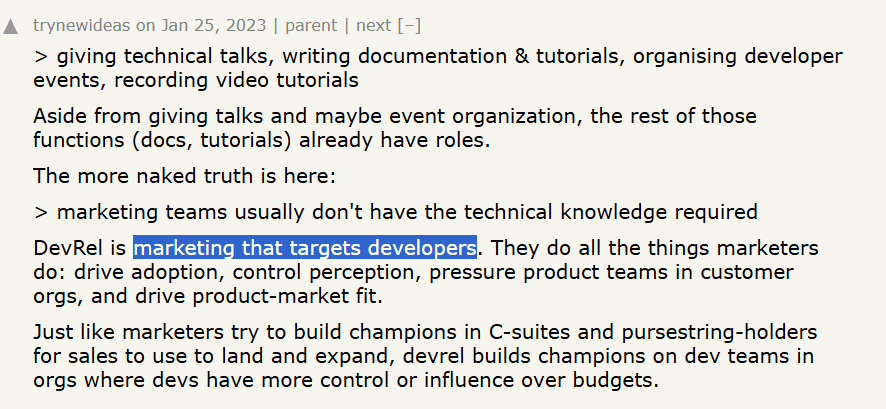
The skeptics have a point. DevRel can collapse into marketing if you let it. But that is the failure mode, not the definition. Tejas Kumar, who has worked in DevRel since around 2017, puts it bluntly in his own DevRel Deep Dive on YouTube video. The job is the relationship. If your sales numbers are low, hire salespeople. If your branding is off, hire marketers. DevRel feeds both teams the truth about what developers actually think.
Good DevRel sits across four kinds of work at once: marketing, engineering, product, and community.
It goes wrong when it leans too far one way. Lean too far toward marketing, and the team becomes a lead-generation machine that developers stop trusting. Lean too far toward engineering, and the person disappears into the codebase, looking like just another developer.
Developer advocates used to be called "outbound product managers." Their original job was to sit with developers in the field and carry that feedback straight back into the roadmap. That feedback loop, not the conference talks, is the real value.
What Does a DevRel Actually Do All Day?
In practice, the work produces things developers can use. A short list:
- Documentation, quickstarts, and setup guides
- Code samples, SDKs, and starter templates
- Technical blog posts and tutorials
- Talks, videos, and answers inside developer communities
- A steady feedback loop into the product team
A simple way to remember the shape of the role comes from a KubeCon talk often shared as the 5 Cs of DevRel: community, content, code, collaboration, and a fair amount of coffee.
The point is that the role is part technical and part human.
At its center, a developer advocate is a translator. They turn what engineers need into what the product team builds, and they turn what the product does into something developers can follow.
Vercel does this well through people like Lee Robinson. Companies like Tailscale and Freshworks lean on the same bridge between their builders and their users.
Here is an example from our own work. DevZero is a developer platform, and its developers needed quick wins. So our team built a ready-to-run Python devcontainer starter template, wrote integration docs where none existed, recorded hands-on video tutorials, and even fixed bugs inside their existing docs. The same instinct applies to infrastructure-as-code products, where documenting Terraform modules clearly is often the difference between a developer finishing setup or abandoning it.
None of that is "marketing." It is product-adjacent work that makes adoption easier. That is DevRel doing its real job.
If you want a step-by-step version of this, our free Developer Marketing Playbook lays out the full plan.
Why Should a Growth Leader Care About DevRel?
Because adoption is the growth engine for any product developer's touch, when more developers succeed with your tool, more of them stick with it, recommend it, and pull their companies behind them. That is product-led growth in one sentence.
The pattern shows up again and again. Stripe grew from roughly $5 billion to $95 billion in valuation, largely by winning over developers with clean APIs and good docs.
MongoDB displaced older databases through developer advocacy, not golf-course sales. Twilio built its whole brand by marketing to developers, with developers. And Supabase reached more than 4 million developers with no paid ads, using GitHub, Discord, and Reddit instead.
The common thing you’d see in this thread is trust. Developers distrust polished advertising and reward people who help them get work done.
Earn that trust, and they become your most effective sales channel, for free. There are about 28.7 million developers worldwide as of 2024, so this is a large audience to win or lose.
Do You Actually Need DevRel Yet?
Not every company needs a full DevRel hire on day one. What you need depends on your stage.
A simple stage model we use:
- Early stage: focus on content loops and starter templates that deliver fast wins for developers.
- Growth stage: add scalable docs, video, and SEO so more people can find and adopt the product on their own.
- Mature stage: layer in community, advocacy, and events, with a real feedback loop back into the product.
There is also a gating question: How central are developers to your business? The answer depends on the line of business you’re in, for example. DevRel matters far more to GitHub than to Apple because almost everyone who uses GitHub is a developer. If developers directly pick or reject your product, you need this function. If they do not, you may not.
A short readiness check. You probably need DevRel work now if two or more of these are true:
- Developers are the people who decide whether to adopt your product.
- Your signups stall right after the first step, or your docs get complaints.
- Your current marketing does not speak to a technical buyer.
- Competitors keep being mentioned in developer communities, but you are not.
Not sure where your docs stand? Run a free documentation audit and see what is blocking adoption today.
What Does DevRel Cost, and Should You Hire or Outsource It?
Start with the sticker price. A senior developer relations hire in the US runs about $150,000 to $200,000 a year in base salary, plus equity and benefits. For reference, the average DevRel salary sits near $185,000, while a GTM engineer averages closer to $107,000.
But salary is not the real cost. The hidden cost is time. Finding the right DevRel often takes two to three months. After they sign, it takes another month to a month and a half for them to understand the product well enough to ship with authority.
So before a single blog post goes out, you may be four or more months in, with your go-to-market motion stalled the whole time.
That is the choice in plain terms.
| First DevRel hire | Engineering-led team (Infrasity) | |
|---|---|---|
| Cost | $150,000 to $200,000 a year, plus equity | Flat monthly fee, a fraction of one hire |
| Time to first output | 4+ months (search plus ramp) | Developer Content shipping in week 1 |
| Output range | One person's bandwidth | Docs, content, video, and distribution at once |
| Scale | Capped at one person | A team working in parallel |
We saw this play out with Cycloid, a Series A developer-platform company in Europe. They planned to hire a DevRel to own content, community, and videos. The search dragged on for nearly three months while their content sat still. Instead of waiting longer, they separated the work from the hire and brought us in as an extended DevRel arm.
Here is how, because the numbers only matter if you know how they happened. Our team produced search-driven, deep-dive blog posts and use-case walkthroughs aimed at the exact questions their buyers were typing.
Then we distributed each piece across Medium, Dev.to, and Daily.dev, which helped build both Google rankings and citations within AI answers.
Over three months, organic clicks went from 60 to more than 1,000, month-over-month growth held at 20%, and traffic from AI tools rose from zero to more than 200 visitors.
See the full side-by-side. Here is the honest hire-versus-outsource comparison.
How Do You Measure DevRel ROI?
When the budget review comes, and DevRel can only show conference photos and webinar signups, it gets cut. Those are marketing vanity numbers. They say nothing about whether developers are actually building with your product.
Measure adoption instead. A clean set of numbers to track:
- Documentation engagement: who reads your getting-started pages, and do they finish?
- Developer activation: what share of signups create an API key and make a first call?
- Community signal: activity and sentiment in your forums, Discord, or Slack.
- Content-driven adoption: signups and usage that trace back to a specific guide or video.
Then there is one number almost nobody tracks, and it may be the best of all: the time between a developer giving feedback and your team shipping a fix. We believe this single metric better demonstrates DevRel's value than any attendance count, because it shows the feedback loop at work.
A short feedback-to-fix time means your developers feel heard, and that is what keeps them.
This matters more than ever in 2026. Teams that cannot draw a straight line from their DevRel work to activation, retention, or revenue are getting cut or folded into content marketing.
So pick one or two adoption metrics as your headline numbers and report them every month for a closer look at how these roles are measured.
How Is AI Changing DevRel?
A lot, and fast. Developers no longer start every search on Google. Many start by asking an AI assistant like ChatGPT or Claude which tool to use. In June 2025 alone, AI platforms sent about 1.13 billion referrals to the top 1,000 sites, up 357% from the year before.
If those assistants do not mention you, you’re invisible at the exact moment a developer is making a choice.
Two changes follow from this.
First, your documentation is now reference material for AI coding tools like Cursor, Copilot, and Claude.
When your docs are clear and well structured, those tools recommend your product correctly.
When they are thin, the AI gives wrong answers about you.
One study found that 65% of developers say their AI coding assistant misses relevant information about their code, and that missing piece often comes straight from gaps in your docs. Some teams are now closing that gap by pairing their docs with a local, RAG-based assistant developers can query directly, which also happens to be excellent training data for the AI tools reading your site.
Second, if AI tools are not citing you, that is usually a citation gap. Your product may be great. It isn't written in the structured, quotable format these systems pull from.
Closing that gap is now part of DevRel. This is why the Cycloid work above lifted AI-driven traffic from zero to more than 200 visitors by publishing in the formats and places these systems read.
If AI assistants are skipping your product, our AI visibility service helps you get cited where developers now look.
What Does Great DevRel Look Like In Practice?
A few patterns worth copying:
- Twilio: turned a strong developer community into a category-leading business by treating developers as the main audience rather than an afterthought.
- Spotify: open-sourced its internal developer portal, Backstage. A single conference talk planted the seed, and adoption grew for years afterward. That slow burn is normal for DevRel. The payoff often arrives long after the work is done.
- Supabase: grew to millions of developers with no paid ad budget, leaning on GitHub, Discord, and Reddit.
- Cycloid and DevZero: show the version most companies actually need. You do not have to build the whole function in-house to get these outcomes. You can plug in a team and start shipping now.
This same distribution gap showed up again and again in conversations with developer tool founders on the ground at KubeCon India 2026.
See our community-led growth case study for another example.
The lesson across all of them is patience plus consistency. DevRel is closer to angel investing than to paid ads. Most single efforts return little, but the occasional one returns enormously, and you cannot always predict which.
How Do You Get DevRel Output Without a 6-Month Ramp?
You separate the work from the hire. That is the whole idea. Instead of waiting months for one person to ramp, you bring in a team that already knows how developer go-to-market works and start producing right away.
The model we run looks like this:
- Week 1: strategy and setup. We learn about the product, identify its technical value, and map it to the right developer channels.
- Week 2: content production. The first blogs, docs, code samples, and videos go out.
- Weeks 3 and 4: distribution and community. Each piece is published where developers actually look, and we seed real discussions.
- Ongoing: scale and optimize. We double down on what drives adoption and cut what does not.
So the real question is not whether you can build a DevRel function. It’s how fast you need the output. Suppose you have a year, hire, and ramp. If you need momentum this quarter, plug in a team.
Want output in week one instead of month five? Talk to our team, or browse the case studies first.
Conclusion
Here is where this lands. DevRel is the work of turning developer relationships into adoption, and adoption into revenue.
It is not a marketing gimmick, and it is not measured by impressions.
You start it at the stage that fits your business, measure it by adoption, and, in 2026, make sure AI assistants can find and recommend you.
If developers decide whether your product wins, you cannot afford months of silence while a hire ramps up. That is the gap Infrasity fills.
We act as your extended DevRel team, engineers who ship technical content, docs, video, and distribution from week one, so your go-to-market keeps moving while you decide on a long-term hire.
Cycloid went from 60 to over 1,000 organic clicks in three months this way. You can aim for the same kind of result without the four-month wait.
Frequently asked questions
What is DevRel short for?
DevRel is short for developer relations. It is the practice of building two-way relationships with developers, helping them succeed with your product while carrying their feedback back to your team.
Is DevRel marketing or engineering?
Both, and neither on its own. Good DevRel sits across marketing, engineering, product, and community work. It uses marketing skills but is measured by adoption rather than leads or impressions.
Do startups need a DevRel?
Only if developers decide whether your product gets adopted early on, you may not need a full-time hire. You may just need steady content, docs, and community presence, which you can build in-house or outsource.
How much does a DevRel engineer cost?
A senior DevRel hire in the US costs about $150,000 to $200,000 a year in base salary, plus equity. The average sits near $185,000. On top of that, expect two to three months to hire and another month or more to ramp.
What is the difference between a developer advocate and a developer evangelist?
The titles overlap. Both build relationships with developers. "Advocate" leans toward two-way work, carrying developer feedback back into the product. "Evangelist" leans toward outward promotion, like talks and demos. Many companies use the terms interchangeably.
DevRel vs GTM engineer, which do we need?
DevRel fits seed and Series A products that grow through developer adoption. A GTM engineer fits later-stage, sales-assisted SaaS, automating pipeline and outreach. Some teams eventually use both.
How do you measure DevRel ROI?
Track adoption, not vanity numbers. Watch documentation engagement, developer activation from signup to first API call, community sentiment, and content-driven signups. One strong metric is the time between developer feedback and a shipped fix.
Can you outsource DevRel?
Yes. An engineering-led team can produce the content, docs, video, and community work of a DevRel function, often starting in week one instead of after a multi-month hire. This is how companies like Cycloid kept their go-to-market moving. See how it works.