

KubeCon + CloudNativeCon India 2026 just wrapped in Mumbai, and the short version is this: the Indian cloud native ecosystem is no longer a smaller version of Europe or North America.
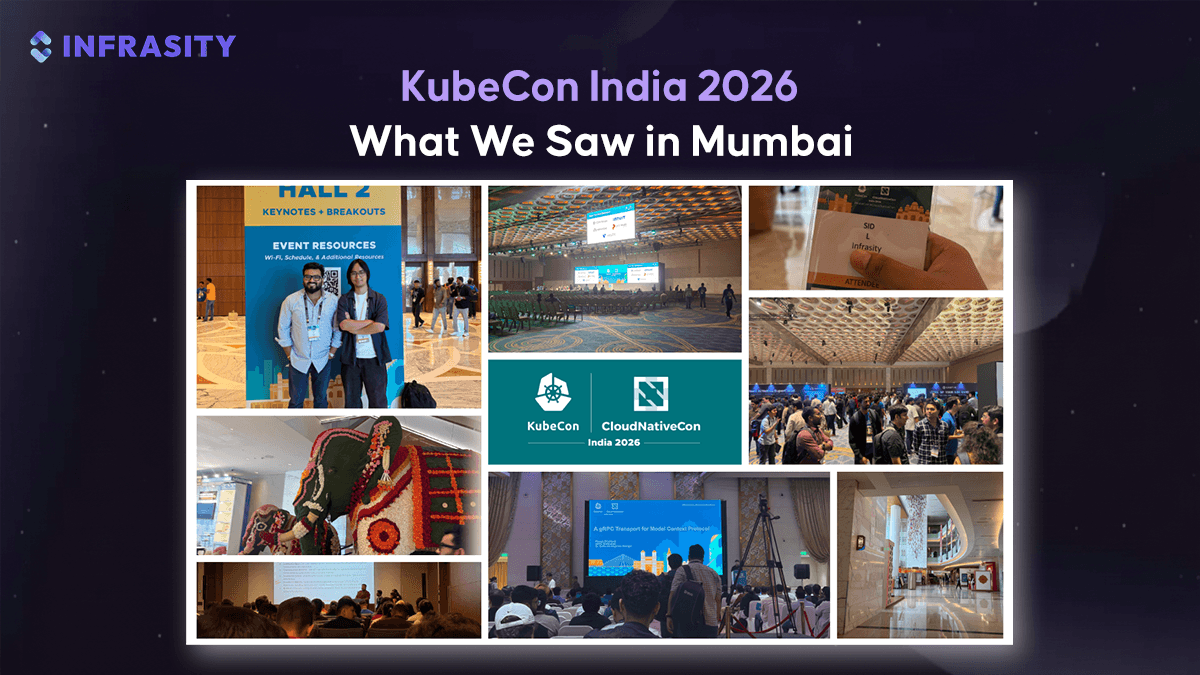
It has its own momentum, its own builders, and its own problems worth solving. We sent a team to the Jio World Convention Centre in BKC for the two days (June 18 and 19), walked the floor, sat in sessions, and ran voxpops with founders and engineers between talks.
This is our recap on what the room was actually buzzing about, the technical shifts that matter, and the one pattern we kept hearing at almost every booth. If you lead marketing, growth, product, or DevRel at a developer tool or cloud company, that pattern is the most important thing in this blog.
A quick heads up on what this is. It is a first-person field report with a point of view, written for the people who have to turn all this energy into actual developer adoption.
Key takeaways
- AI workloads on Kubernetes are the new center of gravity. GPU orchestration, model routing, and running thousands of AI jobs cheaply have replaced basic cost tuning as the hard problem.
- MCP and agent infrastructure were everywhere. Security layers, private registries, and new transports for the Model Context Protocol came up in talks and hallway chats alike.
- FinOps grew up. Teams now track model and token costs, not just compute, because AI spend is the new line item nobody fully controls.
- The distribution is the challenge. Many companies we met are still working on how to get more developers to adopt their tool and explore new use cases.
- Developer marketing is no longer just content. It is use case positioning, community presence, search visibility, and showing up when developers ask an AI assistant for tool recommendations.
Why KubeCon India 2026 Mattered More Than The Schedule Suggests?
On paper, this was two days, a set of keynotes, 55 sessions, and a few lightning talks. In the room, it felt bigger than that. You could feel years of community work landing at once.
Local groups like Cloud Native Thane and the KCD Mumbai meetups have spent years building this audience, and Mumbai was the moment it came home.

The backdrop helps explain the energy. According to CNCF, India ranked fourth globally for newly funded AI companies in 2024, and roughly 76% of Indian startups build on open source AI to move fast and keep costs low. So, a cloud native conference here is not a regional side event. It is one of the most active corners of the industry right now, during monsoon season, in a city that does nothing quietly.
If you want the primer on the event itself, we wrote a full KubeCon India 2026 attendee guide, a breakdown of what KubeCon and CloudNativeCon actually are, and a recap of KubeCon 2025 for context on how fast things are moving year over year.
Who Was In The Room: Global Giants Meet Indian Builders
The floor had an interesting split, and that split is the story. On one side, the established infrastructure players. Platinum sponsors included CAST AI, Chainguard, Microsoft Azure, and VMware by Broadcom, with Grafana Labs and Red Hat also out in force.
On the other side, a wave of early stage Indian and global startups are building in the open: Nudgebee, Archestra, Coredge, Doctor Droid, OpenObserve, DragonflyDB, Kloudfuse, and more.
We had conversations across various booths with our clients, DevZero and Middleware, as well as through hallway-track discussions with teams from Archestra, Coredge, Nudgebee, DragonflyDB, Kloudfuse, OpenObserve, CAST AI, and Azul.
The takeaway from the mix is simple. The big companies came to defend and expand their place in the AI shift. The startups came to prove they belong in it. Both, as you will see, are fighting the same uphill battle once they leave the booth.

What Everyone Was Actually Building: 5 Themes From The Floor
Strip away the logos and the same handful of themes came up again and again. Here is what the cloud native world is really working on in 2026.
1. AI workloads on Kubernetes are the new frontier
Basic Kubernetes cost work has matured. Pod resizing, live migration, bin packing, and spot management are table stakes now. The hard problem has moved to GPU orchestration and running thousands of AI jobs at once without the bill exploding.
Sessions like "Beyond vLLM: Distributed LLM Inferencing with llm-d on Kubernetes" from Red Hat and "Run Your Own AI Cluster" our team captured where the energy went.
One engineer we had a word with summed up the shift well: teams are moving from microservice deployments to GPU-heavy AI workloads, and that changes everything about how you run a cluster.
2. MCP and agent infrastructure were everywhere
The Model Context Protocol came up constantly: new gRPC transports for MCP, security layers around agent infrastructure, and private MCP registries.
This was not a theory. In one of our hallway discussions, we got to know that the CNCF policy project now standardizes Common Expression Language.
3. Reliability for AI got real
When your AI agent or MCP server can fail mid-task, you need a crash proof system. We saw real interest in durable execution platforms that keep long-running AI workflows alive through failures. As agents move into production, "what happens when it crashes halfway" stops being a thought experiment.
4. FinOps grew up and now counts tokens
Cost talk has moved past infrastructure. Teams want token-level cost tracking and FinOps for AI workloads, because model usage is the new spend that finance cannot see and engineering cannot fully predict. This is where AI cost optimization and platform engineering meet.
5. Sovereign cloud, data residency, and security
Sovereign AI and data residency came up strongly, especially for Indian enterprises and regulated sectors. A keynote on "Sovereign AI at Population Scale" set the tone, and security sessions ran deep, from "Zero Trust for Fintech" with Cilium to a walkthrough of how a team stopped a crypto-mining attack triggered by a Next.js vulnerability. Observability, meanwhile, keeps fragmenting.
The debate between one unified platform and best of breed tools is still unresolved, which is exactly why so many observability startups were in the room.
If you only skim one theme, make it the first. The center of gravity in cloud native has moved to AI, and every other theme orbits it.
The Pattern We Could Not Unhear: Strong Tech, Weak Distribution
Here is the part that matters most, and it is the reason we wrote this post the way we did.
We talked to companies of every size, from well-funded infrastructure leaders to two-person startups. Almost all of them, regardless of stage or geography, are still trying to figure out developer adoption. Technology was rarely the problem. The distribution was.
Most teams have strong engineering and a real product. What they don't have is a reliable way to talk to developers in a way that lands.
The playbook keeps shifting under them: hackathons one quarter, a Discord server the next, a free tier, a booth at KubeCon, a flurry of blog posts.
And the hardest part is not what you would expect. For most of these tools, the real challenge is not visibility. It is getting developers to recognize that the problem exists before they ever start looking for a solution.
You can rank for a keyword all day, but if a developer doesn't yet know they have the pain your tool solves, they are not searching for it. That is a positioning and education problem, not a traffic problem.
This is the same gap we see in client conversations every week, and KubeCon India confirmed it at scale. For the deeper version of this argument, see our state of developer marketing and our guide to what developer marketing actually is.
Developer Marketing Is No Longer Just Content
A second, newer concern showed up in these conversations, and it is rising fast. Founders are starting to ask whether their tool shows up when a developer asks an AI assistant for recommendations. When someone types "best Kubernetes cost tool" or "open source observability for AI workloads" into ChatGPT, Claude, or Perplexity, does your product get named, or does a competitor?
That question reframes the whole job. Developer marketing in 2026 is not one channel. It is four things working together:
- Use case positioning: Naming the problem clearly so developers recognize it as theirs.
- Community presence: Being genuinely useful where developers already gather, from subreddits to Slack groups to KubeCon hallways.
- Search visibility: Still real, still worth doing, especially for the developers who already know what they want.
- LLM discoverability: Being the answer when developers ask an AI assistant. This is the new frontier, and most teams have no plan for it.
Check our guides on ranking in ChatGPT, ranking in Perplexity, and answer engine optimization break down how.
There is a GitHub layer to this too. Many of the projects at KubeCon live or die on GitHub: stars as a first signal, contributors as proof of life, and recommendations in threads and AI answers as the real growth engine.
Strong code is not enough. The projects that win pair it with a README that converts, docs that remove friction, and a presence in the places developers evaluate tools. That is the heart of GitHub SEO and the open source distribution work we do.
We have proof this can be engineered. For one client, Brevo, we reached 80% citation coverage across AI answers and a top-4 spot in Google's AI Overview and ChatGPT for high-intent queries, through authentic community participation and zero paid placements.
The same motion applies to a Kubernetes tool that wants to be the name developers hear first.
What We Did at KubeCon India?
We did not go to hand out flyers. We went to listen. Our team worked the hallway track, sat in sessions across the AI, platform engineering, and observability tracks, and ran voxpops asking founders and engineers real questions: where is your developer traction stuck, what is working, what is not.
The honesty was striking. The developer marketing gap came up so consistently that it stopped feeling like a coincidence and started looking like the defining challenge of this stage of the market.
That work is exactly what we do for a living. Infrasity helps developer tools and cloud companies with search visibility, LLM discoverability, use case positioning, and developer community growth, with content written by engineers who actually understand the product.
If you want to see how we turn an event like this into a content engine, our technical video production and developer marketing services are built for it.
What This Means For Your 2026 GTM?
If you are a VP of Marketing, a Head of Growth, a CMO, a DevRel lead, or a Fractional CMO trying to turn cloud native momentum into a pipeline, here is what we would take away from Mumbai.
First, audit whether developers even recognize the problem you solve. If they don't, lead with use case positioning before you spend another rupee on traffic.
Second, treat AI discoverability as a real channel with an owner, not a curiosity. Run a check on whether you show up when developers ask AI assistants in your category, and our AI search visibility tool is a fast way to start.
Third, do not let strong engineering hide weak distribution. The companies that win the next two years will not be the ones with the best tech alone. They will be the ones that make developers recognize the problem first, then meet them in the community, the search bar, and the AI answer.
For the channel-by-channel version of this, see our rundown of the top developer marketing channels.
The most important point you must keep in mind: The companies that figure out how to get developers to recognize the problem first, and then show up everywhere developers look, including AI answers, are the ones that will win.
If that is the work in front of you, let's talk. We were in the room, and we know what it takes.
Frequently asked questions
When and where was KubeCon + CloudNativeCon India 2026 held?
June 18-19, 2026, Jio World Convention Centre, BKC, Mumbai; CNCF flagship, first at this scale in India.
What were the biggest themes at KubeCon India 2026?
AI on Kubernetes (GPU orchestration, model routing), MCP/agent infrastructure, FinOps for AI with token-level cost tracking, sovereign cloud, observability, and security.
Who sponsored and attended KubeCon India 2026?
Platinum sponsors CAST AI, Chainguard, Microsoft Azure, VMware by Broadcom, plus Grafana and Red Hat; global leaders mixed with Indian/global startups (OpenObserve, DragonflyDB, Coredge, Nudgebee, Doctor Droid, Archestra).
Were the sessions recorded?
Yes, on CNCF's YouTube channel within about two weeks; links to the LF schedule.
What's the biggest takeaway for developer-tool companies?
Strong tech, weak distribution; the real challenge is making developers recognize the problem before they search (your dev-marketing angle).
How do I get my tool recommended when developers ask AI assistants?
Be useful where developers gather, name the problem clearly, and make docs/GitHub/community reflect real expertise.