

TL;DR
- Most developer tools are losing discovery battles they don't even know they're fighting. Traffic metrics hide the real problem: low visibility across AI search, Reddit, GitHub, and comparison content.
- Documentation is now a growth channel as it ranks in search, gets cited in AI answers, and is where developers actually decide to adopt your tool.
- GitHub is a distribution infrastructure. Some examples are repos, starter kits, and clean READMEs, which reduce friction to trial and signal engineering credibility better than any landing page.
- AI systems retrieve structured, frequently cited content. If your tool isn't appearing in answers from ChatGPT, Perplexity, or Claude, you have a citation gap, not a quality gap.
- Community presence compounds, tools like Supabase, scaled to 4M+ developers with no paid ads, using GitHub, Discord, and Reddit as their primary distribution channels.
- The next 12 months will reward structural discoverability; B2B SaaS teams with a real developer marketing plan across SEO, docs, community, GitHub, and AI visibility will pull ahead of teams optimizing a single channel.
Developer marketing in 2025 was already shifting away from traditional playbooks. In 2026, those shifts are permanent. In June of 2025 alone, AI platforms like ChatGPT, Gemini, and Perplexity generated 1.13 billion referrals to the top 1,000 websites globally.
AI platforms generated a 357% increase in June 2024. Developer tools that are optimized only for Google traffic are now invisible to a large and growing share of the audience they're trying to reach.
Discovery, trust, and authority now operate across five distinct layers simultaneously, and the tools and behaviours developers use to evaluate products have structurally changed. This blog breaks down exactly what changed in the developer marketing plan, what’s working, and what most B2B SaaS teams are still getting wrong.
How Developers Found Tools in 2025 & Why That Model Broke?
Till the year 2025, the dominant playbook was:
- Publish SEO content targeting product-adjacent keywords
- Run paid acquisition to bottom-of-funnel landing pages
- Rely on GitHub stars and word-of-mouth for community signal
- Hope for Reddit mentions
But the problem is that this approach is optimised for a single discovery channel in a world that has already fragmented. Stack Overflow, GitHub (67%), and YouTube (61%) led the pack as one of the few platforms developers relied on the most. So, yes, SEO alone was never enough. Soon after that, AI search accelerated the fragmentation.
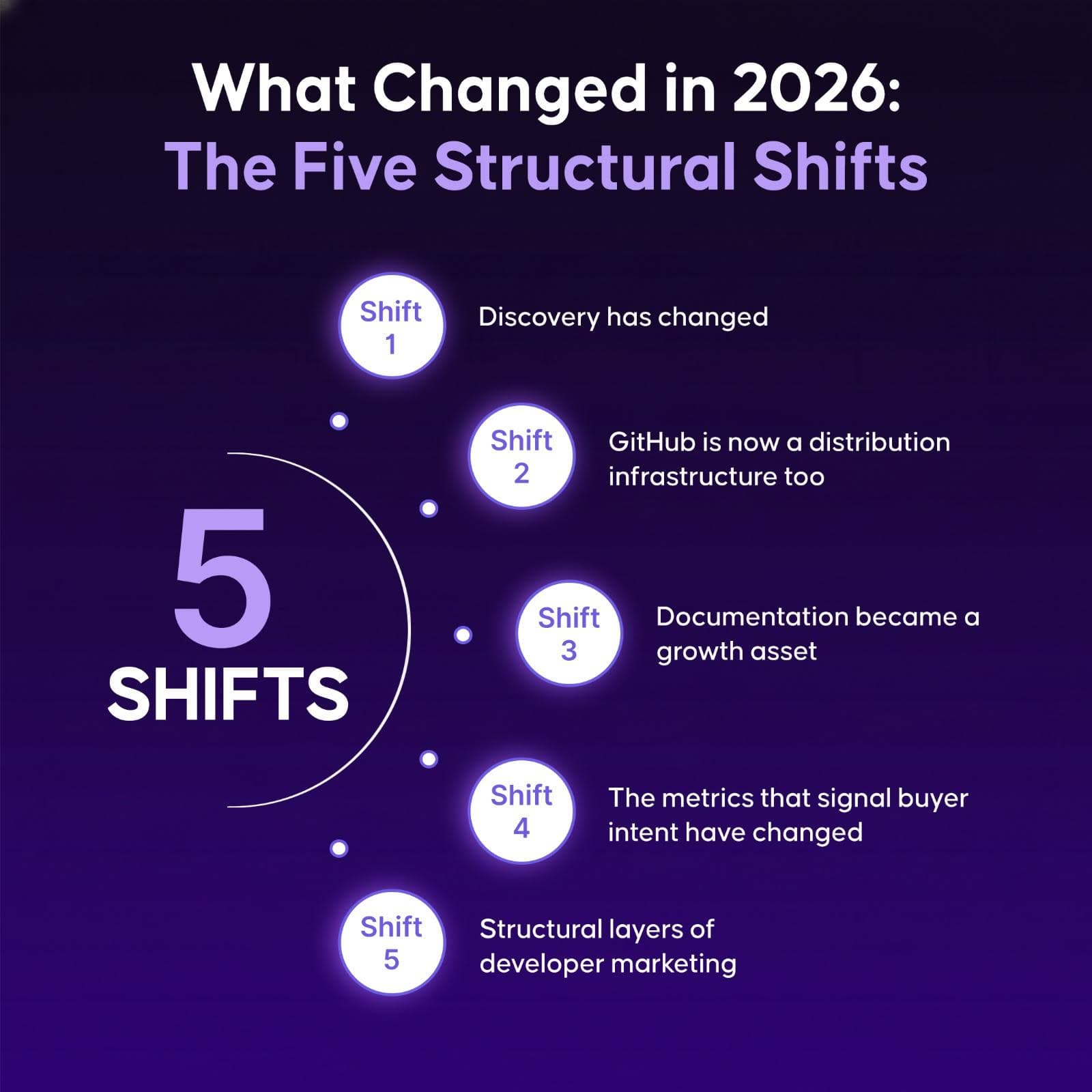
What Changed in 2026: The 5 Structural Shifts A Developer Marketing Plan Must Address
Shift 1: Discovery Has Changed
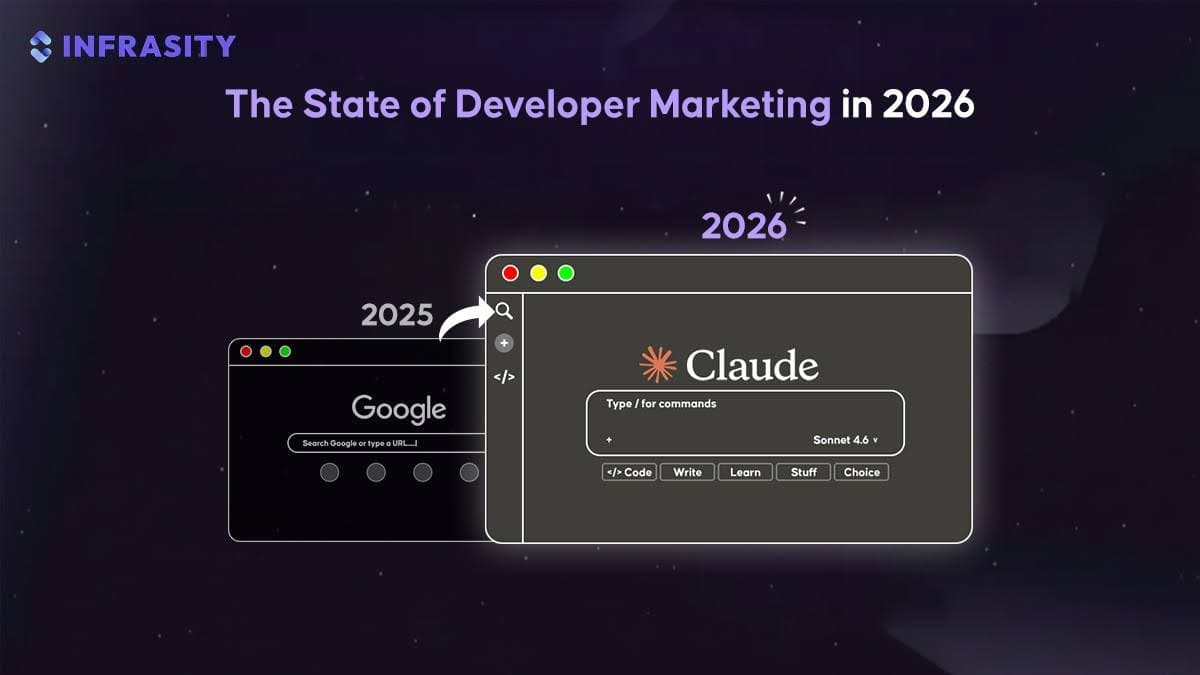
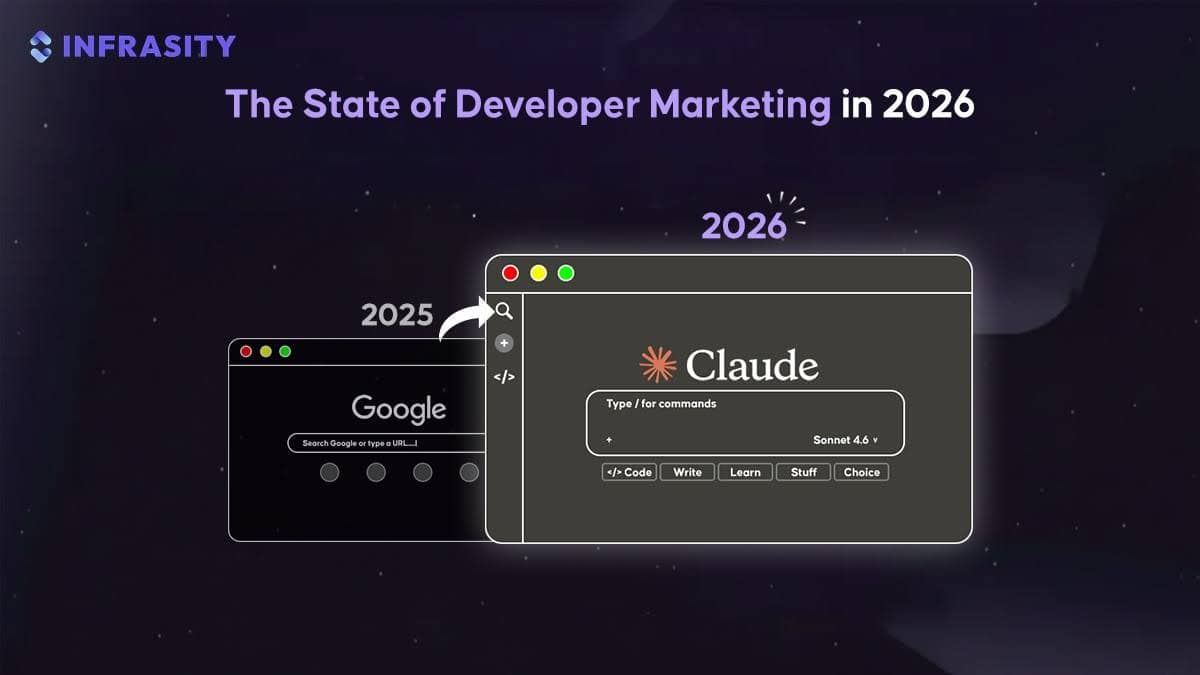
In 2025, developers still started with a Google query, but in 2026, that isn’t the default first step. Search quickly changed from SERP to LLMs.
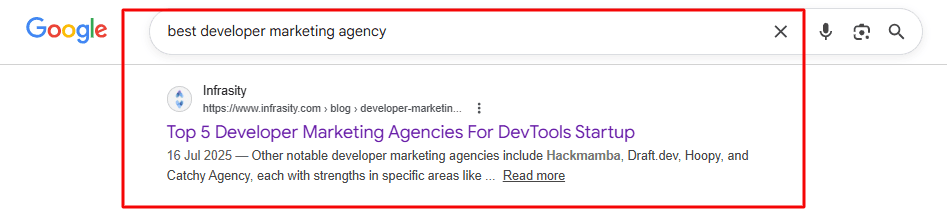
Developers now discover tools across AI search tools like ChatGPT, Claude, Gemini, etc., AI-native answer engines like Perplexity, Reddit threads ranking on page one, GitHub repositories and documentation, and technical comparison content.
A developer evaluating a Kubernetes automation tool in 2026 might ask Perplexity for a comparison, check a Reddit thread for community validation, read your docs to assess technical depth, and look at your GitHub stars to verify traction, all before they ever visit your homepage.
We soon realised how discovery is now fragmented across:
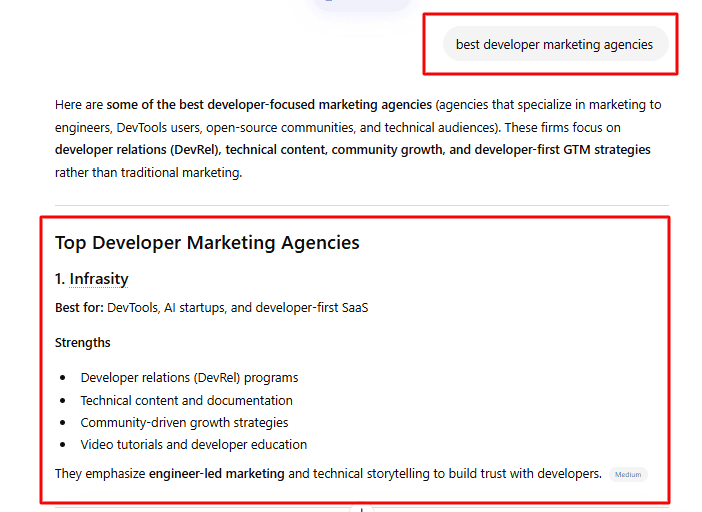
- AI search tools like Claude, ChatGPT, etc. As shown in the image below, when the query is searched for the top developer marketing agencies for tech and software startups, Infrasity takes the first position in LLM visibility.
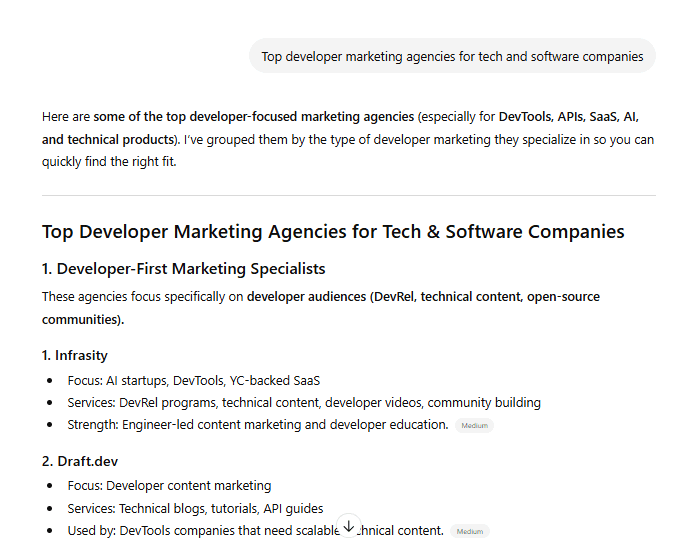
- AI assistants and answer engines such as ChatGPT, Claude, and Perplexity that generate direct recommendations instead of traditional lists of links on SERP.
- Reddit threads increasingly rank on the first page of search results for developer queries such as tool comparisons, debugging questions, and infrastructure recommendations. These discussions often surface real user experiences, benchmarks, and trade-offs, which makes them a trusted source during tool evaluation.

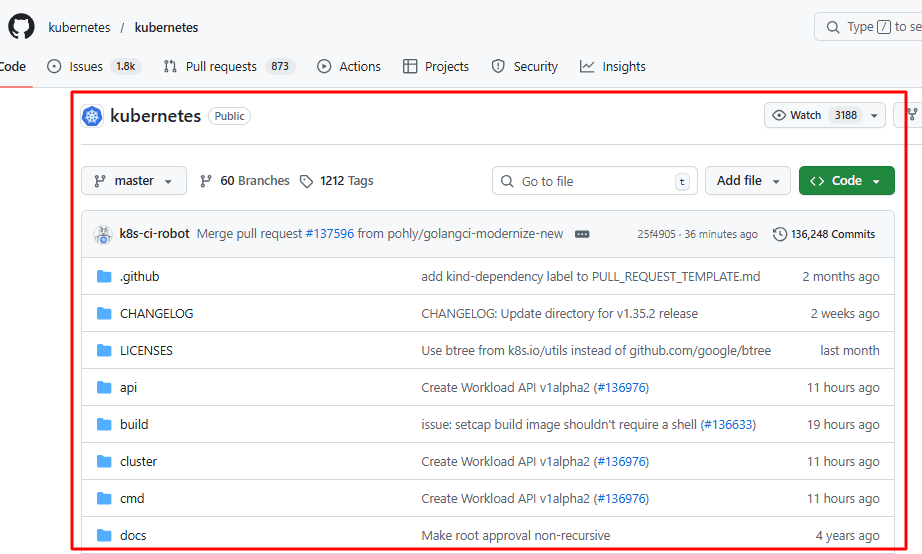
- GitHub repositories and open-source projects, where developers evaluate real usage, community activity, and integration examples. Popular infrastructure projects like Kubernetes demonstrate how repositories function not only as codebases but also as living documentation and credibility signals for the tools built around them.
- Comparison blog posts like “AEO vs GEO”, “ Deterministic AI vs Non-Deterministic AI: Understanding the Core Difference”, etc
- Technical documentation, like API references, integration guides, and deployment walkthroughs, that developers review to evaluate how easily a tool fits into their existing stack.
Did you know that ChatGPT processes 2 billion queries daily and is the 4th most visited website globally as of September 2025? More importantly, AI Search traffic converts at 14.2% compared to Google's 2.8%; the visitors arriving via AI citations are high-intent. Missing this channel is not just a visibility problem, but a pipeline problem.
This simply means that your developer content structure and content volume now determine whether you're cited. 44.2% of all LLM citations come from the first 30% of text, the intro. Structuring content for answer extraction is now as important as keyword targeting.
What this means for your team: Every article needs a direct answer in the first 150 words, clear H2s that match how developers phrase questions to AI, and all six major AI crawlers (GPTBot, ClaudeBot, PerplexityBot, Google-Extended, Meta-ExternalAgent, Bytespider) allowed in your robots.txt.
Shift 2: GitHub is Now a Distribution Infrastructure Too
GitHub’s presence in 2025 meant open-sourcing something and hoping for stars. In 2026, the framing has shifted: Stack Overflow survey data shows 67% of developers use GitHub as a primary resource, placing it alongside Stack Overflow itself as a trust verification layer, not just a code host.
Repositories, starter kits, and working templates reduce trial friction in a way that landing pages cannot. Developers trust working code and a repository with clear documentation and real-world use cases is now a credibility asset in the buying process.
This is exactly the kind of signal, GitHub engagement, repo activity, doc page visits, that provides leading indicators of buying intent before a startup ever fills out a form.
Example: Vercel's documentation is served as static HTML, making it fully readable by every major AI crawler. Their thousands of pages on Next.js deployment concepts, combined with active community participation in GitHub discussions and developer forums, led ChatGPT to recommend Vercel.
As a result, ChatGPT grew from referring less than 1% of Vercel's signups to 10% in six months, with the platform crossing $200M in ARR driven entirely by a freemium, self-serve, developer-first model.
What this means for your team: Ship example repositories with working integrations. Ensure your GitHub README is structured like a landing page and answers “what it does, who it's for, how to get started in under 3 minutes”. Every doc page and README is now crawled by AI systems and surfaced in answers to developer evaluation questions.
Shift 3: Documentation Became a Growth Asset
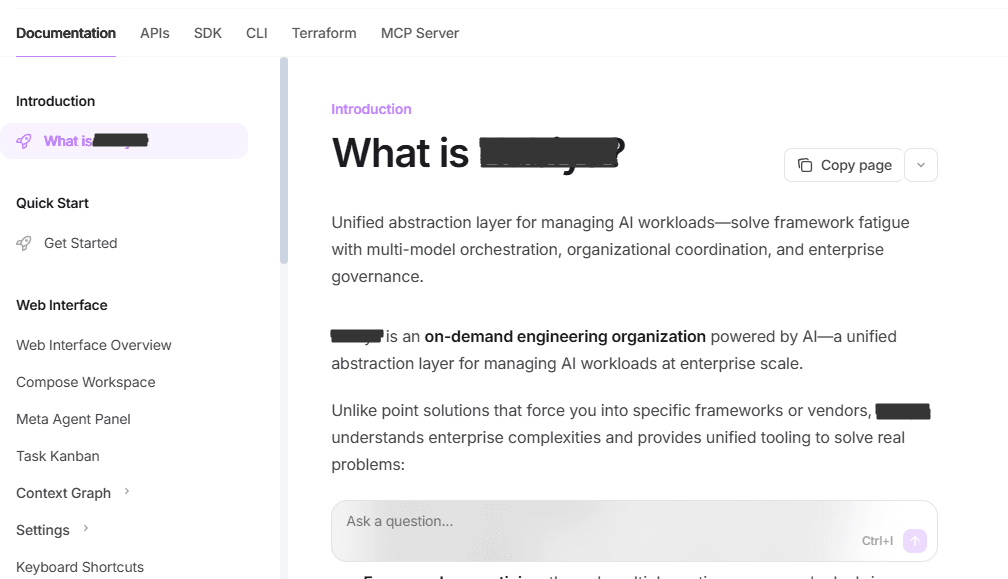
In 2025, documentation was a support infrastructure, a cost center written reactively to reduce ticket volume. In 2026, however, technical product documentation is the primary channel through which AI systems retrieve and cite your product when answering technical evaluation questions.
AI crawlers retrieve documentation pages as source material when developers ask buying questions. If your docs are structured as JavaScript-rendered single-page applications, AI bots cannot read them. If they bury key integration information in nested menus or lack FAQ sections, AI systems skip them.
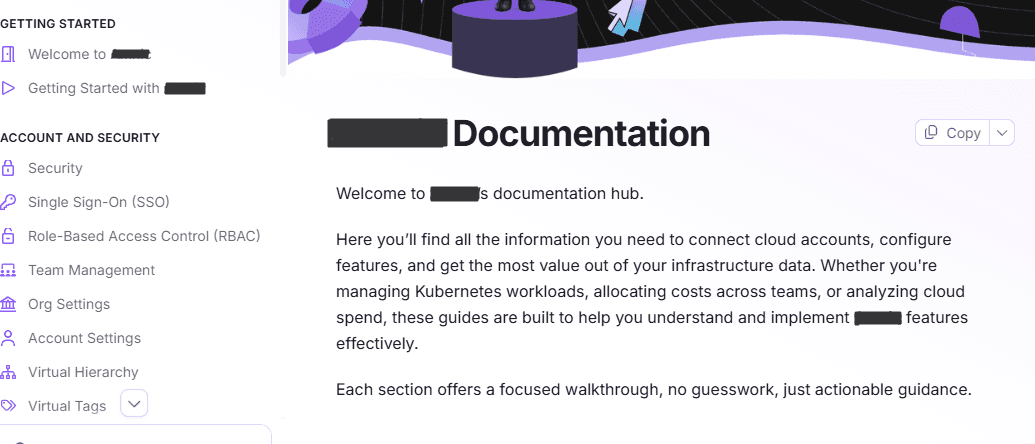
If they are not written to answer the specific questions a developer has at each stage of the buying journey, like "how does this integrate with my stack," "how long does onboarding take," "what does it cost at scale", they generate no pipeline.
Documentation now needs to be written for two audiences simultaneously: the developer reading it, and the AI system that will surface it in an answer. Getting there usually takes a dedicated technical editing pass that turns concept-heavy engineering notes into scannable, answer-first pages.
Example: One DevTool startup using Reo.Dev reported: "We now know who's looking at our documentation or who's reviewing our GitHub. That's a much easier and frictionless path to building a pipeline versus your traditional approach on outbound.", achieving a 30% month-over-month increase in signups by combining documentation quality with intent signal tracking
What this means for your team: Audit every doc page for AI crawlability (no JS-gating, clear H2 structure, FAQ blocks, timestamped data). Treat documentation updates as content marketing sprints, not maintenance tasks. Every new integration guide is a new AI citation candidate.
Shift 4: The Metrics that Signal Buyer Intent Have Changed
In 2025, the dominant proxy for buyer intent was inbound form fill or demo request. However, things have changed in 2026; those are late-stage signals that follow a long, mostly invisible evaluation journey.
The actual buying process for a developer evaluating a B2B SaaS tool or product in 2026 looks like this: discovery via AI recommendation, next is Reddit validation, then documentation review, then GitHub star or fork, then trial sign-up to package install to return visits to advanced doc pages, to internal Slack discussion, to finally procurement conversation.
A startup relying only on form fills is acting on the last 10% of that journey and missing the preceding 90%.
Reo.Dev's GTM research shows there is a 3x chance of an account with developer activity being at the bottom of the sales funnel compared to the top, and the more intense the developer activity, the further along the buying journey the account tends to be.
The new leading indicators of real buying intent are: GitHub stars and forks from engineers at target accounts, documentation page depth (which pages, how many, how often), npm or pip install volume from startups’ IP ranges, trial sign-ups from developer email domains, and return visits to pricing and enterprise feature pages.
What this means for your team: Stop treating marketing as the function that generates form fills and sales as the function that closes them. In a developer-led GTM motion, the handoff between marketing and sales happens at a GitHub star, a documentation deep-dive, or an npm install. The teams that build instrumentation around those early signals will have a structural pipeline advantage over those still waiting for demos to arrive.
Shift 5: Structural Layers of Developer Marketing
Unfortunate enough, there are still a number of B2B developer-focused startups that are executing marketing using outdated assumptions. The most common pattern we see is teams publishing blog posts or running SEO campaigns without building the underlying visibility infrastructure that determines whether developer tools are actually discovered.
Some typical gaps you will notice are:
- Publishing blog content without a structured AI visibility layer, for example, no schema, no FAQ sections, and no answer-first formatting.
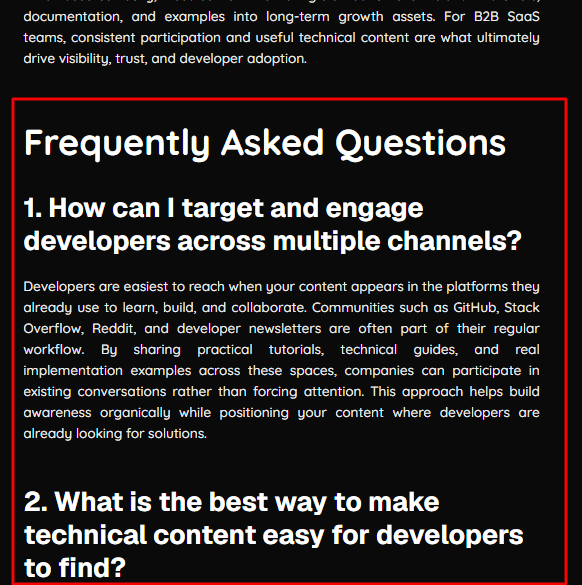
- No Reddit participation strategy and treating the community as a megaphone rather than a trust-building channel.
- GitHub repos with poor READMEs and no example code, documentation as an afterthought
- Measuring success by traffic rather than reference visibility (AI citations, Reddit mentions, doc engagement)
Through audits and growth engagements, we have identified five layers that determine whether a developer tool becomes discoverable or invisible.
Let’s take a look at it.
5.1 Technical Content Depth
Developer-focused content is extremely important to reach the right audience. For instance, Infrasity offers technical content created by developers for developers as the first step of the developer marketing plan. This allows your content to address the pain points of your target audience and provide solutions.
The teams that consistently build visibility into content approach it differently. They develop structured topical authority around the problems their product solves.
- Core educational guides around their technology category
- Comparison pages evaluating competing solutions
- Tutorials showing real implementation workflows
- Problem-solution articles answering developer pain points
This approach allows them to dominate problem-driven search queries, which are often the first entry point for developers evaluating tools. The topical depth increases ranking consistency and AI visibility probability. Always start with creating a content roadmap, creating clusters, and assigning topics according to your content clusters, the same way a strategic marketing plan ties niche, content types, and distribution together before a single post goes live.
Examples: Some of the topics we created for our customers include “Integrating Terraform MCP Server into Platform Engineering Workflows”, “Enterprise-Grade Security in 2026: The New Rules of Defense”, etc.
5.2 Community Authority
Developer communities have become one of the most powerful credibility signals in the current discovery landscape.
Platforms like Reddit, Hacker News, and GitHub Discussions frequently appear on the first page of search results for developer queries such as:
- “Best observability tools for Kubernetes”
- “Alternatives to Datadog”
- “How to manage secrets in production.”
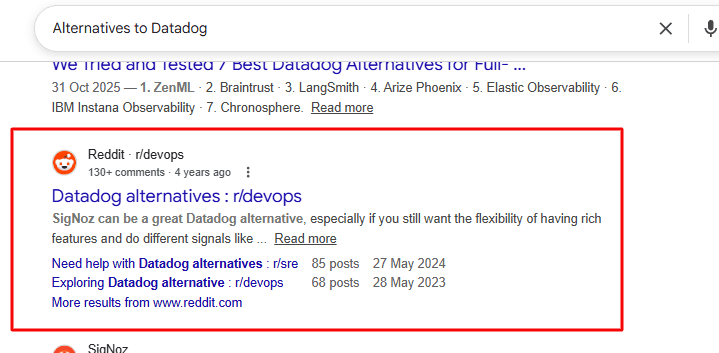
These discussions matter because developers trust peer validation far more than any type of promotional messaging. Reddit threads, especially, now rank aggressively for developer queries. When someone searches for tools, comparisons, or technical problems, Reddit frequently appears on the first page.
Example: Supabase actively interacts with developers in GitHub discussions, Discord communities, and Reddit threads, answering implementation questions and gathering product feedback.
This kind of participation builds brand familiarity over time. When developers later ask AI systems for recommendations, tools that appear frequently in community discussions are more likely to be surfaced. Consistent, high-quality participation builds brand recall and increases the likelihood of being surfaced in AI answers.
5.3 Documentation as a Growth Engine
Documentation was written reactively to reduce support tickets. Today, it has become one of the most powerful acquisition channels for developer tools.
When developers evaluate a tool, they don't read your marketing copy. They open your docs. They look for a quick start and search for how you handle the edge case that they're already thinking about. If they find a clear answer fast, trust goes up. If they hit a wall, they leave.
This is why well-structured documentation functions as four things simultaneously:
- A search engine asset that ranks for technical queries
- A knowledge base for AI systems, retrieving implementation answers
- A conversion environment where developers evaluate product usability
- A credibility signal demonstrating engineering maturity
What well-structured documentation actually does:
- Ranks for technical queries that marketing pages never will. "How to implement webhook verification in Node.js" lands on the docs.
- Gets cited by LLM platforms. When a developer asks Perplexity or ChatGPT how to integrate your tool, the answer is pulled from structured content on the web. Thin or poorly organized docs = invisible in AI answers.
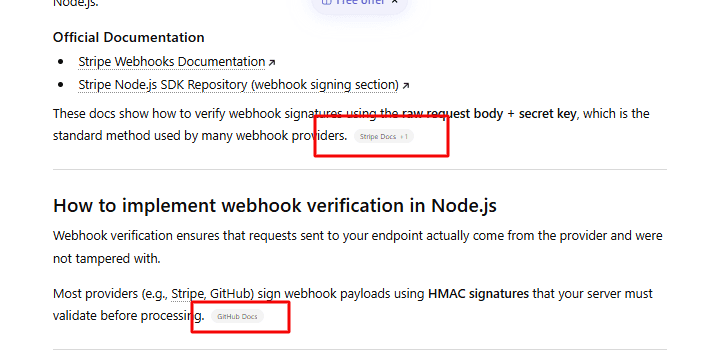
- Converts inside the product. Developers decide to adopt tools in the docs, and not on landing pages. The moment they map a working example to their own stack, intent converts to trial.
- Signals engineering quality. Sparse, outdated docs suggest a rough product. Well-maintained docs suggest a team that ships thoughtfully.
We saw this directly when partnering with one of our customers, an auth platform, by building example repos with working Supabase integrations, developers could test authentication flows in minutes. That first successful run is when adoption begins.
The data reflects this. For example, GitHub's research on Copilot found that developers using it completed tasks 55% faster. Harness reported a 10.6% increase in pull requests and a 3.5-hour reduction in cycle time. Developers move fast. Whichever resource answers their question first wins; that needs to be your docs.
What to fix structurally: Write answer-first instead of concept-first, add FAQs that mirror real developer queries, include working copy-paste examples, and keep information hierarchy clean.
5.4 GitHub as a Trust Layer
A landing page tells developers what your tool does, and a GitHub repo shows them. That gap is where adoption decisions actually get made.
What working code on GitHub does that marketing can't:
- Reduces friction to trial. No configuration from scratch, or guesswork about fit. The first successful run is when adoption starts.
- Signals developer standards. Clean, idiomatic examples tell developers the team writes code the way they do. No examples, or bad ones, raise doubt before they've even tried the product.
- Appears where marketing doesn't. Repos surface in search results, AI-generated answers, and dependency graphs. A well-structured example repo gets referenced in places no ad budget can reach.
- Trains AI coding tools. When a developer uses Copilot or Claude to write code that integrates with your tool, the model draws from existing implementation examples. Clean public repos increase the probability that AI-generated suggestions for your tool actually work.
The README is a product page, the example repo is a demo environment. The issue tracker is a public support log that new developers read before opening a ticket.
5.5 AI and Search Visibility
The real question in 2026 is no longer just "does Google rank us?" It's "Does an AI system cite us when a developer asks about this problem?"
When a developer asks Perplexity which rate-limiting library to use, or asks Claude which auth SDK handles enterprise SSO, the answer is retrieved from structured, authoritative, frequently cited content. The tools that appear aren't necessarily the most popular. They're the most parseable and consistently referenced.
What AI retrieval rewards:
- Citation tracking. Run prompt tests across ChatGPT, Perplexity, and Claude. Track where you appear vs. where competitors appear in app.infrasity. Gaps in citation coverage are gaps in discoverability.
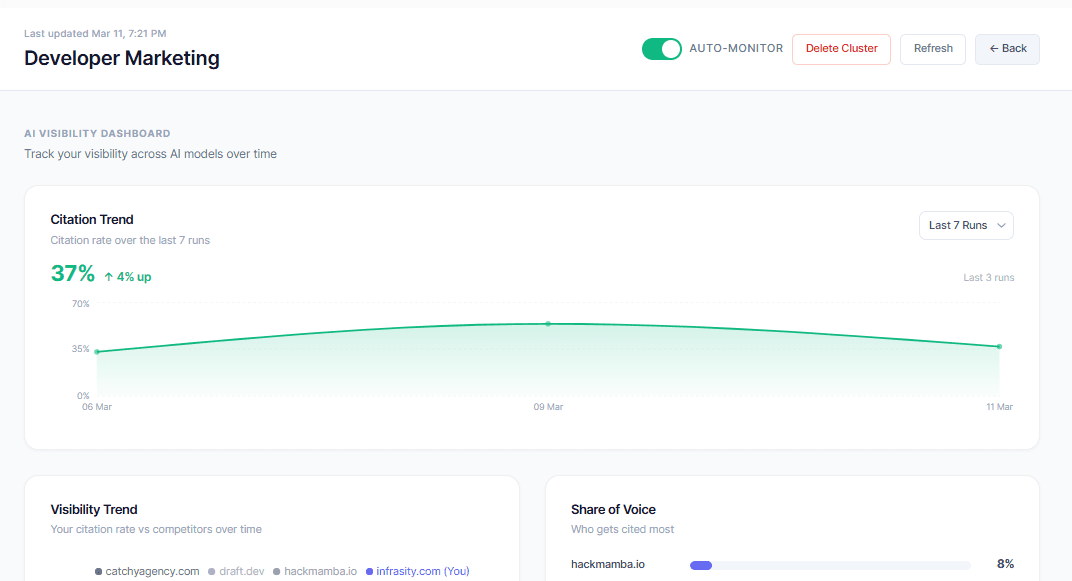
- FAQ sections that mirror real queries. "Does X support multi-region?" "How does X handle token refresh?" Explicit questions in your content get extracted directly into AI answers.
- Comparison content. "X vs Y" and "alternatives to Z" are high-intent research queries. If you don't have content addressing them, you're absent from that part of the funnel, in both search and AI answers.
- Prompt-aligned writing. Write the way developers search. "How to implement webhook signature verification" outranks "Our webhook security architecture" in both SEO and AI retrieval.
- Schema markup. The FAQ Page and HowTo schemas help LLMs to understand the type and context of your content.
Search is shifting from ranking to retrieval. Teams that adapt now build structural advantages that compound.
What Most Developer Startups Still Get Wrong in Their Developer Marketing Plan?
After running audits across developer-first startups, we have seen this repeatedly.
| Gaps | Why It Costs You |
|---|---|
| No comparison landing pages | You're absent from the highest-intent research queries |
| No structured positioning statement | AI systems can't accurately describe what you do |
| Blog content disconnected from product | Content drives no adoption signal |
| No Reddit participation strategy | Competitors get recommended in threads you're not in |
| No GitHub distribution plan | Your highest-trust channel sits unused |
| No AI visibility monitoring | You don't know if you're being cited or ignored |
Most teams are optimizing for Google traffic while the actual discovery conversation is happening in Reddit threads, AI answers, and GitHub searches that they're not tracking.
What Will Define Developer Marketing Over the Next 12 Months
As discovery fragments across AI search, communities, documentation, and GitHub, the signals that matter for your DevTool are changing too. You can no longer rely on traffic alone. What matters more is how developers are actually finding you in open-source ecosystems, what technologies your users already run, and how engineers engage with your docs and product pages. These signals give you a clearer view of how your tool is being discovered, trusted, and shortlisted in practice.
Layer on top of that, which startups are showing early signs of evaluation, how their engineering teams are structured, and where hiring is trending, and you start to see real buying motion. This is the kind of developer intent platforms like Reo.Dev is built to observe and aggregate, helping you understand what’s really driving adoption beyond surface-level metrics.
The structural shift is already underway. Here's where it goes next:
- AI citation visibility becomes a KPI. B2B SaaS teams will start tracking which AI systems cite them, for which queries, and how that changes over time, the same way they track keyword rankings today.
- Comparison SEO gets more competitive. "X vs Y" content will become a priority category. The teams that own these pages early will be hard to displace.
- Reddit influence keeps growing. Community threads already rank on page one for developer queries.
- Docs replace landing pages as the primary conversion driver. Developers are already making adoption decisions in documentation. Marketing teams will start treating docs with the same investment they currently reserve for paid acquisition.
- GitHub signals matter more in trust evaluation. Stars, forks, example repo quality, and README clarity will become explicit factors in how developers shortlist tools.
- The winners won't be the loudest startups. They'll be the ones that are structurally discoverable, across AI answers, community threads, search results, and GitHub, while most teams are still optimizing a single channel.
Developer marketing has permanently shifted. The developer tools that win in the next two years won't be the ones with the biggest ad budgets, strongest documentation, the most visible community presence, the cleanest GitHub footprint, and the structural content that AI systems actually retrieve and cite.
Building a developer marketing plan today means treating each of these layers, SEO, community, docs, GitHub, and AI visibility, as an interconnected system. The teams that understand this are already compounding. The teams still measuring success by pageviews alone are falling behind without realizing it. Discovery is not one funnel, but it’s everywhere developers look, and the tools that show up consistently are the ones that get adopted.
Frequently Asked Questions
1. How to do developer marketing?
Developer marketing in 2026 requires building visibility across the channels where developers actually research tools, not just driving traffic. A good developer marketing plan includes technical content, optimized documentation, GitHub examples, community participation, and AI search visibility. Most teams fail because they treat it as content production instead of a structured system. Infrasity helps DevTools startups design and execute a developer marketing plan that ensures their product is consistently discovered, trusted, and adopted across AI, GitHub, and developer communities.
2. What are the most effective developer marketing strategies?
The most effective developer marketing strategies focus on how developers evaluate tools. This includes creating problem-first technical content, publishing comparison pages, optimizing documentation for AI and SEO, building GitHub repositories with real use cases, and engaging in developer communities. These strategies work together to build authority and trust. B2B SaaS agencies like Infrasity execute these as part of a unified developer marketing plan, helping startups move beyond traffic and build consistent visibility across the environments where developers make decisions.
3. Which are the best channels for marketing to software engineers?
The best channels today include AI assistants, Reddit, GitHub, technical documentation, and comparison content. Developers use these platforms to discover, validate, and evaluate tools before making decisions. Most teams treat them separately, which weakens results. Infrasity helps early-stage startups build a developer marketing plan that integrates all these channels, ensuring their product appears consistently throughout the developer decision-making journey.
4. How do developer tools actually get adopted today?
Developer tools are adopted through a multi-step journey that starts with discovery via AI or search, followed by validation in communities like Reddit, technical evaluation through documentation, and trust-building via GitHub. By the time a developer signs up, most of the decision is already made. If a product is missing from any of these stages, adoption drops. Developer agencies like Infrasity helps DevTools startups build a developer marketing plan that covers this entire journey, ensuring consistent visibility from discovery to decision.