



The seven agencies worth talking to about GitHub marketing are Infrasity, Gitroom, Evil Martians, Draft.dev, Markepear, Emily Omier Consulting, and Hoopy. Only one of them sells GitHub marketing as a named service with its own page. The other six do the work, well, in some cases, as a line item inside a developer marketing or technical content retainer.
We checked the public sitemaps and homepage navigation of the eight firms most often named in "best developer marketing agency" roundups. One of eight publishes a dedicated GitHub or open-source marketing service page. The rest have blog posts about GitHub, example galleries about GitHub, podcast episodes about open source, and no page you can point your CFO at.
This blog covers what each of the seven actually ships on GitHub, what their clients say on the record, where each one stops, what to ask on the first call, and how to tell a real GitHub program from a launch tweet with an invoice attached.
TL;DR
- Only 1 of 8 top developer marketing agencies sells GitHub marketing as a real service. The rest bury it in a content retainer, so nobody owns your README, listings, or launch.
- Search "GitHub marketing agency," and you get repos, not agencies. The category has almost no supply-side content.
- It's a different job from developer marketing: the repo page, metadata, placement, the launch moment, and the threads where developers (and LLMs) decide.
- The repo is a funding metric. Median 2,850 stars at seed, 4,980 at Series A, and most of those companies had no revenue.
- The seven: Infrasity, Gitroom, Evil Martians, Draft.dev, Markepear, Emily Omier, Hoopy.
- One question sorts them: name the last repo you grew, give me the URL. Then check Insights yourself.
Why does searching "GitHub marketing agency" return almost nothing useful?
Because the category has no supply-side content. Search the exact phrase, and you don't get agencies. You get repositories.
We ran the query. All seven results returned were GitHub.com URLs. Zero were service pages from firms selling GitHub marketing.
Search engines read the keyword as "a marketing agency website hosted on GitHub," not "an agency that markets your GitHub repo." Nobody has published enough on the second meaning to move it.
What the service-page audit found
We took the eight firms that appear repeatedly across current roundups and checked every URL in their public sitemaps plus their homepage navigation for a service page about GitHub or open source.
| Agency | GitHub/OSS URLs in sitemap | Dedicated service page |
|---|---|---|
| Infrasity | 10 | Yes: /services/github-marketing |
| Emily Omier | 131 | No, all podcast episodes and blog posts |
| Gitroom | 21 | No, links to client repos from the homepage |
| Markepear | 10 | No, blog posts and example-gallery entries |
| Literally.dev | 2 | No, two resource articles |
| Hoopy | 0 | No |
| Draft.dev | 0 in exposed nav | No, service pages are /content-marketing-engine and /drive-awareness |
| Evil Martians | /opensource present | No, that page lists Martians' own projects, not a service |
Emily Omier has the most open-source URLs of anyone in the set by a wide margin, and every one of them is an episode of her podcast or an essay. That is not a criticism of her work. It tells you what shape the offer takes: advisory, sold in conversation, not productized.
Why this is so important when you are the buyer
An unnamed service is an unspecified service. When GitHub work lives inside a content retainer, three things happen that you will not see on the SOW.
Scope drifts toward whatever the agency is already good at, which is usually blog posts. Nobody owns the README, the topics, the awesome-list pull requests, or the Show HN timing, because none of those were written down. And there is no baseline, so at month three the reporting is traffic and impressions rather than stars, clones, package installs, and contributors.
Ask for the service. If it doesn't exist, ask for the deliverable list in writing before you sign.
What is GitHub marketing, and where does it stop being developer marketing?
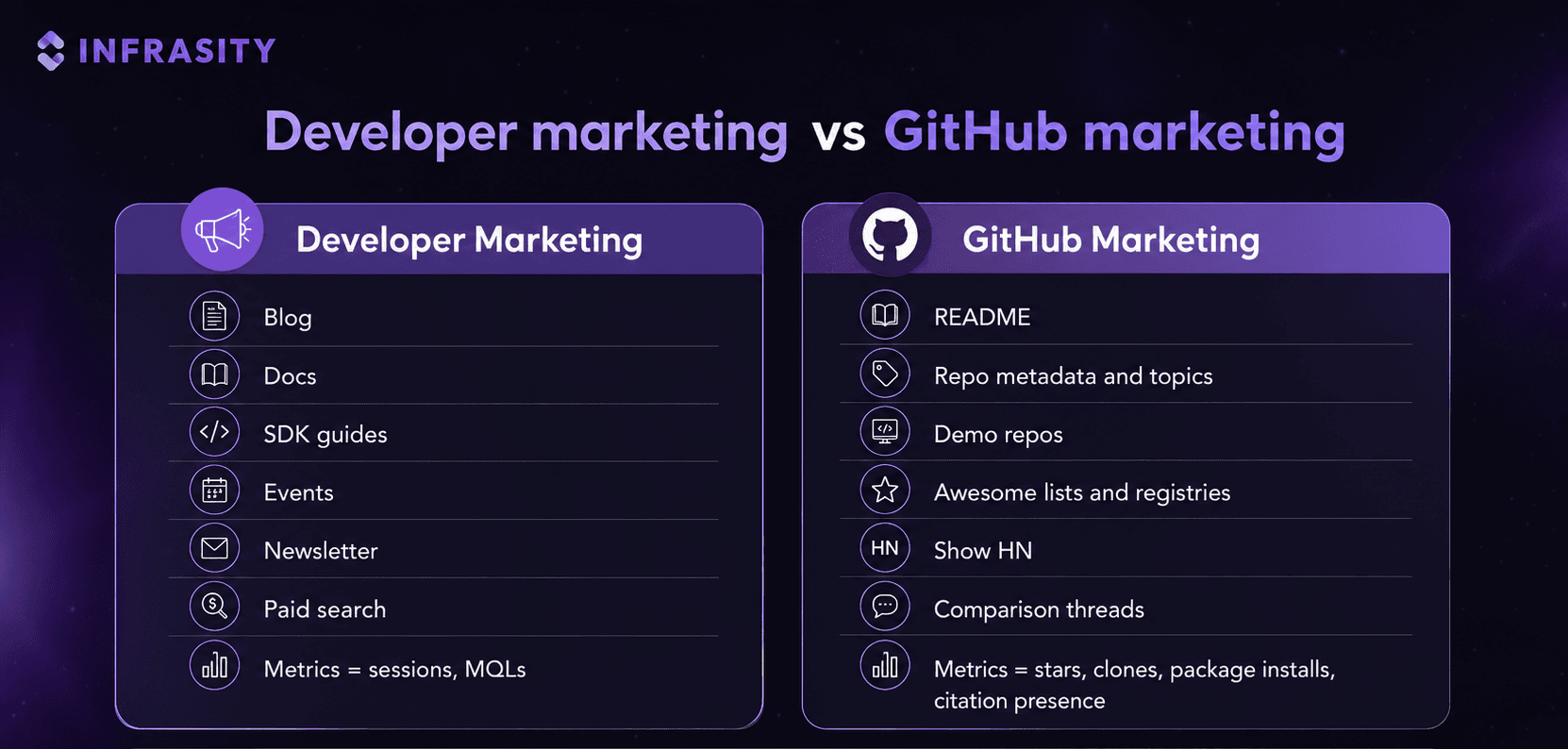
Developer marketing is the parent category: everything aimed at engineers, from conference booths to SDK docs to paid search. GitHub marketing is the subset that runs on and around the repository, with its own surfaces, metrics, and failure modes.
The dividing line is concrete. Developer marketing owns the blog, the docs, the events, the newsletter. GitHub marketing owns five things a content team almost never touches:
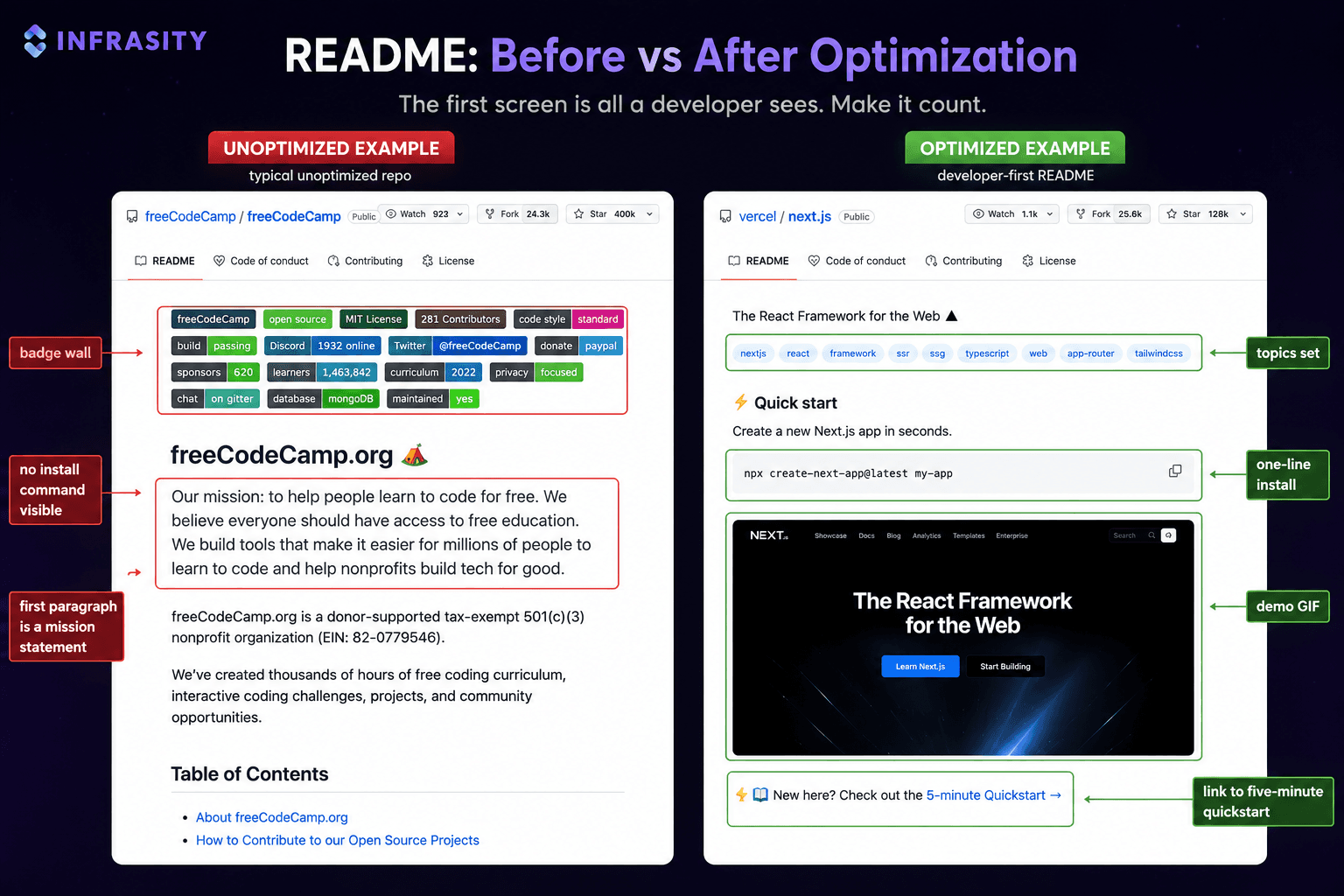
The README as a conversion page. Install command above the fold, a demo GIF, a five-minute path from clone to working output.
Repo metadata and topics. The bare tool name, social preview card, COMPARISONS.md, good-first-issue labels.
Placement. Awesome-list pull requests, package registries, MCP directories, OSS discovery platforms.
The launch moment. Show HN title and timing, the founder's first comment, the fallback plan when it does not land, and where a Product Hunt launch for a developer tool fits alongside it.
Thread presence. The comparison threads on Reddit and Hacker News where developers decide what to use, which is now also where language models get their answers.
The data behind separating the two
Three numbers explain why this is a different job rather than a subsection of the same one.
Scale. GitHub crossed 180 million developers and 630 million repositories in the year to August 2025, adding 121 million new repositories and more than 230 new repositories every minute. Publishing four blog posts a month does nothing against that denominator. Placement does.
Funding. Redpoint's Jordan Segall pulled traction data from 80 open-source companies at the time of their seed and Series A rounds. Median star count at seed was 2,850. At Series A it was 4,980, with a median of 50 contributors and 1,274 Slack or Discord members. Of the 69 seed companies, at least 49 had no revenue at the time of financing. The repo was the traction. That makes repo growth a finance function, not a brand function, and finance functions get their own line item.
Discovery. 84% of developers now use or plan to use AI tools, while 46% actively distrust the accuracy of the output and 75% say they would still ask a person when they don't trust the answer.
So the buying path runs: ask the model, get a shortlist, verify it against a human thread and a repo. Every step of that verification loop happens on surfaces GitHub marketing owns and a content calendar does not.
Infrasity separated GitHub marketing out of its developer marketing agency offer for exactly this reason.
The work is sequenced differently (baseline, then positioning, then repos, then amplification), measured differently (stars, clones, package downloads, citation presence), and staffed differently, because someone has to write code that runs.
The 7 best GitHub marketing agencies in 2026
Ranked by how much of the GitHub surface each one owns end to end, and how much public, checkable proof exists that they have done it.
1. Infrasity
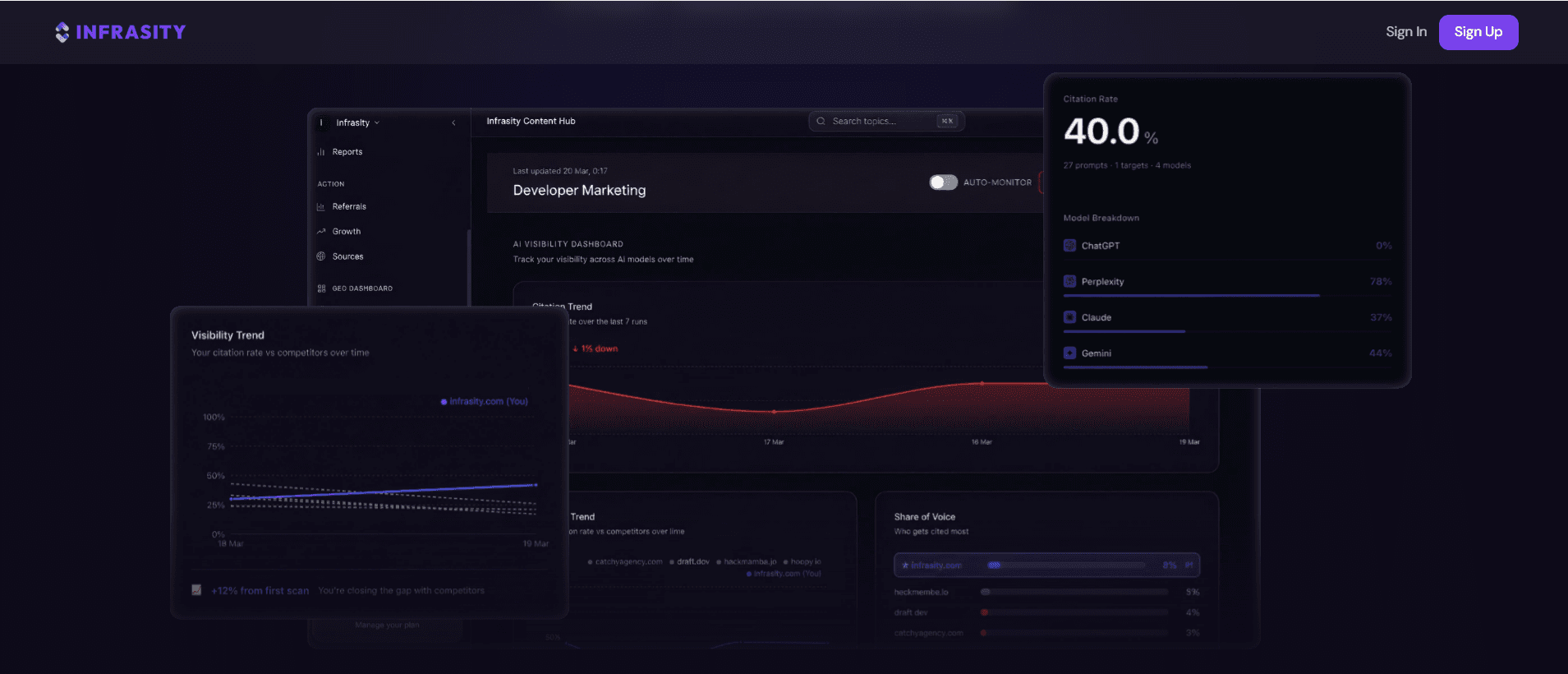
What they own on GitHub: the full surface. Production demo repos, README and metadata work, awesome-list and directory placement, multi-channel syndication, Reddit and Hacker News thread insertion, and a Show HN attempt, run as one sequenced sprint rather than parallel workstreams.
The GitHub-specific proof: the only published case study in this set that reports repo-level numbers with a stated method. MemClaw, an open-source memory layer for multi-agent AI fleets. They've shown a 1,512% increase in stars in just a couple of weeks, alongside 31,000+ package downloads, 30 live Reddit engagements across 20 subreddits, and 7 directory placements, at $0 paid spend.
The mechanism is documented step by step, which is the part worth reading if you are evaluating anyone.
Week one produced no content at all. Five buying prompts were run across ChatGPT, Claude, Gemini, and Perplexity, and every source cited in every answer was opened and logged. That produced a map of 78 specific Reddit threads the models cite for those prompts. Those threads, not the largest subreddits, became the distribution targets. Three demo repos were then reverse-engineered from verbatim complaints in real threads. Each runs locally in under ten minutes, and each is built around a specific output a developer would screenshot.
The number that matters most. It is the shape of the curve: the fastest growth came in week six. A front-page launch decays in roughly 72 hours. A distribution system accelerates.
What clients say: On the record on Infrasity's site, Cindy Blake, VP Marketing at Firefly, notes the team was quick to onboard and understand how to show off the product's capabilities. Josh, co-founder of Terrateam, cites attention to detail and accuracy. Shaked Askayo, CTO at Kubiya.ai, credits the content with lifting product visibility in a crowded market. Client roster includes Teleport, Lovable, Endor Labs, Cerbos, ZenML, Daytona, Qodo, and Travis CI.
Pricing posture: the only firm in this set with a live pricing page showing tiered deliverable scopes. No dollar figure is published, which is normal in this category, but the scope is written down before the call.
Best for: AI infrastructure and DevTool teams launching or relaunching an open-source repo in the next 90 days who want stars, installs, and LLM citation presence measured against a week-one baseline.
Where it stops: Conference programs, community management, and long-run advocacy belong to a hire.
If you want the raw playbook before you talk to anyone, the OSS Launch Visibility Checklist is the free version of the week-one audit described above. Run it yourself, and you will know within an afternoon whether your repo has a distribution problem or a product problem.
2. Gitroom

What they own on GitHub: star growth as the headline deliverable. Nevo David's practice is unusually literal about it, publishing tactics on Dev.to and Reddit, promoting Hacktoberfest timing, and positioning repos aimed squarely at stargazers and contributors.
The GitHub-specific proof: the homepage links directly to client repositories rather than describing them, which is the most verifiable format anyone in this set uses. Named repos include Novu, Medusa, ToolJet, Amplication, and Preevy. ToolJet has separately published how it reached 20,000 stars and 400 contributors, naming r/selfhosted and staged Product Hunt launches as the drivers. David also grew his own product, Postiz, from 3,000 to 14,000 stars in three months.
What clients say: Tomer Barnea, CEO of Novu, credits growth "in a remarkably short time." Nicklas Gellner, COO of Medusa, calls him a growth engineer who understands traction around developer products. Teja Kummarikuntla, Developer Advocate at ToolJet, describes strategies experimented with and improved toward stargazer and contributor growth. Zevi Reinitz at Livecycle recommends it specifically for anyone growing a GitHub library.
Pricing posture: no service page, no pricing, no scope document. The public surface is a newsletter and a WhatsApp founder group.
Best for: OSS founders who want a star curve and are comfortable with an operator-led, tactic-first engagement rather than a documented program. If the plan leans on named creators rather than threads, read how developer influencer marketing actually converts before you budget for it.
Where it stops: enterprise pipeline attribution, positioning work, and anything an enterprise procurement team needs to sign off on. There is no published baseline-to-outcome methodology.
3. Evil Martians
What they own on GitHub: they are the only firm here that has run the entire commercial open-source motion on their own products, at scale, for two decades. Founded in 2006, creators of PostCSS, imgproxy, AnyCable, and 100+ open source projects with 25 billion downloads.
The GitHub-specific proof: their own P&L. Evil Martians have written publicly that AnyCable generates leads worth over a million dollars a year in consulting revenue, and imgproxy became a standalone company with a commercial Pro tier. Their essay on open-core, single-user-free, and hosted models is the clearest published account of how each business model changes what the repo has to do. Client work includes Teleport, NATS, Lago, Tines, and Wallarm.
What clients say: the strongest signal is not a testimonial; it is that Martians ship the product and the open-source strategy together. Victoria Melnikova, their head of new business, has spoken repeatedly on commercializing OSS and notes their engineering blog reaches around half a million technical readers a year.
Pricing posture: consultancy engagement, scoped per project. No published service page for open-source marketing, because open source is an operating philosophy across the firm rather than a SKU.
Best for: teams who need the product and the open-source business model designed at the same time, especially when choosing between open-core, hosted, and dual licensing.
Where it stops: they are a product consultancy first. If your repo is built and you need distribution, thread presence, and placement this quarter, you are buying a different service than the one they lead with.
4. Draft.dev

What they own on GitHub: the content layer around the repo. Tutorials with real code samples and companion GitHub repos, comparison pages, and the technical articles that make a repo findable and credible once someone arrives.
The GitHub-specific proof: volume and consistency rather than star curves. Founded in 2020 by former CTO Karl Hughes, Draft.dev runs a network of 300+ engineer-writers and reports 346% traffic increases and 20 to 45% click-through on client work. On Karl's own description of the model in TechCrunch, the writers are practicing software developers working nights and weekends, which is why the tutorials survive engineer scrutiny.
What clients say: the testimonial wall is the deepest in this set and names real operators. Randall Degges at Snyk describes them as instrumental in scaling developer security education. Rich Burroughs at Loft Labs calls the steady flow of posts a competitive advantage. Robert Gibb at fabric reports referral traffic and organic rankings up 3x in weeks, with one post hitting Hacker News and producing five demo requests in a single day. Dawn Parzych at Shorebird notes conversion held at 10 to 15% even as traffic grew.
Pricing posture: no published rates. Service pages are /content-marketing-engine and /drive-awareness, neither of which mentions GitHub.
Best for: Series A to C DevTool companies that need four to twenty technically accurate articles a month without pulling engineers off the roadmap.
Where it stops: the repo itself. Nobody here is opening awesome-list pull requests, rewriting your README above the fold, or timing a Show HN. That HN hit at fabric was a byproduct of a good article, not an engineered launch.
5. Markepear

What they own on GitHub: the design and messaging layer of the repo page. Jakub Czakon's work is teardown-driven, and his public library includes specific examples on GitHub README design from Prisma, the sticky "Star us on GitHub" pattern from PostHog, the pull-request growth loop at Snyk, and repository search optimization.
The GitHub-specific proof: ten GitHub-related URLs in his sitemap, all examples and guides. His credential is operating, not agency work: he was CMO of neptune.ai, an ML experiment-tracking DevTool later acquired by OpenAI, and took it from zero through Series A to exit.
What clients say: Arjun Iyer, co-founder and CEO of Signadot, says a strategy session clarified where they were on track and where they needed to adjust. Maria Hayat at ApyHub credits him with getting to the heart of the unique problem of content strategy for developer audiences. Matthew Henderson at Sentry and Megan Bruce at Stacklok are on the record about the newsletter.
Pricing posture: 1:1 strategy sessions, teardowns, and longer-term advising. Sold as time, not as a program.
Best for: a marketing lead who already has a team and needs the repo page, positioning, and messaging critiqued by someone who has shipped a DevTool to exit.
Where it stops: execution. You leave with a plan and an opinion. Somebody on your side has to build the demo repos and write the pull requests.
6. Emily Omier Consulting
What they own on GitHub: the question that comes before any of it. What business outcome is the open-source project supposed to produce, which metrics prove it, and how do the project roadmap and product roadmap relate.
The GitHub-specific proof: depth of exposure rather than growth numbers. She has interviewed hundreds of founders on The Business of Open Source, and her site carries 131 open-source URLs, almost all of them episodes with COSS operators.
What clients say: Mike McNeil, CEO of Fleet, reports that a shift in positioning language produced more calls from customers speaking the same language and an improved demo-booking conversion rate. Michael Tanenbaum, CEO of Mycelial, describes the positioning workshop as producing a battle plan and notes she is versed in the specific nuances of OSS and cloud native. Jonathan Beri, CEO of Golioth, frames the core problem plainly: not being able to communicate what you do is what hurts the business.
Pricing posture: positioning workshops and advisory, scoped per engagement.
Best for: open-source founders who have adoption and no revenue path, or a project and product that have quietly drifted into competing with each other.
Where it stops: she doesn't run distribution. Positioning is the input to a GitHub program, not the program.
7. Hoopy
What they own on GitHub: almost nothing directly, and that is the honest answer. Hoopy's work is DevRel strategy, developer experience audits, research, training, and content placement. The repo shows up as one input to a developer experience audit.
The GitHub-specific proof: none published. What is published is enterprise credibility. Dan Young, GM of the Xero Developer Platform, says the audit was widely understood across stakeholder levels and moved their developer experience forward. Jennifer Hooper, Senior Director of Technical Product Marketing at Heroku, calls Hoopy a rare strategic, developer-centric vendor.
One thing to check before you sign. Hoopy was acquired by Orbit in May 2022; Orbit was then acquired by Postman in April 2024 and its product was shut down. The hoopy.io site is live and current, and founder Matthew Revell now leads the DevRel strategy and consulting practice at Major League Hacking, describing Hoopy in the past tense on his personal site. Several 2026 roundups still recommend Hoopy without mentioning any of this. Ask directly who will staff your account.
Pricing posture: consultation-led. No pricing page (/pricing resolves to the homepage).
Best for: enterprise platform teams who need an independent, defensible audit of their developer program that a VP can circulate internally.
Where it stops: star growth, launches, and repo execution.
How do the seven compare on the things you are actually buying?
Read the table as a shopping list. Draft.dev scoring "no" on demo repos is not a weakness; it is a boundary, and a Series B company with a strong repo and a thin blog should hire them, and the same can be said for all in this list. You just need to pick the solution you're looking for.
| Agency | Dedicated GitHub service page | Published repo-level results | Demo repos built | Awesome-list / directory placement | Thread insertion at scale | Positioning work | Best fit |
|---|---|---|---|---|---|---|---|
| Infrasity | Yes | Yes | Yes | Yes | Yes | Yes | Launch or relaunch in 90 days |
| Gitroom | No | Client repos linked, no methodology | No | Partial | Yes, Reddit and Dev.to led | Light | Star curve, operator-led |
| Evil Martians | No | Own products: 25B downloads, AnyCable $1M+/yr in leads | Builds the product itself | No | No | Yes, business-model level | Product plus OSS model design |
| Draft.dev | No | Yes, 346% traffic, 20 to 45% CTR (content metrics) | Code samples and companion repos | No | No | No | Technical content at volume |
| Markepear | No | Advisory, no growth numbers published | No | No | No | Yes | Repo page and messaging teardown |
| Emily Omier | No | Positioning outcomes, no repo metrics | No | No | No | Yes, core offer | OSS business outcome clarity |
| Hoopy | No | None published | No | No | No | Partial | Enterprise DevRel audit |
What should you ask on the first call?
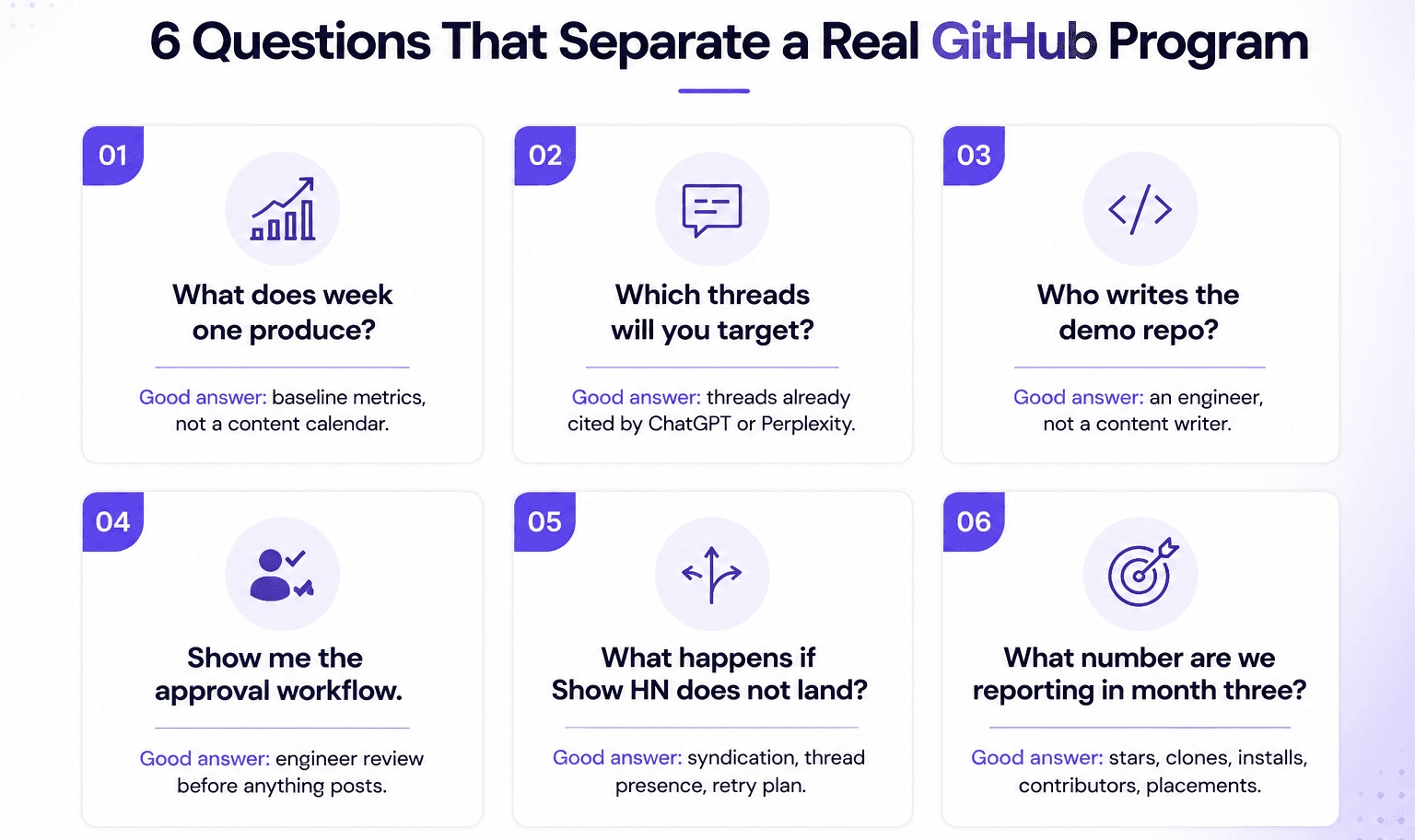
Six questions separate a real GitHub program from a repackaged content retainer. Ask all six, and write down the answers.
"What does week one produce?" The correct answer is a baseline, not content. Star count and velocity, clone and traffic data from repo insights, package download counts, current placements, and a ranking of where you appear when a buyer asks a model for a shortlist. If week one produces a content calendar, you bought content.
"Which specific threads will you target, and how did you choose them?" Subscriber count is the wrong filter. The right filter is whether the thread already gets cited when someone asks ChatGPT or Perplexity to recommend a tool in your category. That list is built by opening every citation on every answer, and it takes hours, so ask whether they have done it or not.
"Who writes the demo repo, and does it run in under ten minutes?" If the answer is a content writer, the repo will be a tutorial in a trench coat. It needs an engineer, a deliberately reproduced failure scenario, and an output a developer would screenshot.
"Show me the approval workflow for community comments." One rejected comment in the wrong subreddit does more damage than ten good ones repair. You want every comment reviewed by your engineers before it posts, and you want the rejection count reported.
"What happens if Show HN doesn't land?" Most first attempts don't reach the front page. The best answer describes a baseline that works without it: syndication, awesome lists, thread presence running independently, and a retry with a sharper angle. The generic agency will just answer promises the front page.
"What number are we reporting in month three, and against what?" Stars, clones, package installs, contributors, and placements, all measured against week one.
Don't settle for impressions and reach because they're not answers which the best in the business would give you.
The one question that ends bad conversations fast
Ask them to name the last open-source repo they grew, and give you the URL.
Not a client logo. The repo. Then open it, click Insights, and look at the star history and the contributor graph yourself. Six of the seven agencies above can point you at something. If a firm cannot, the GitHub line on the proposal is a hope, not a service.
Which agency should you actually pick?
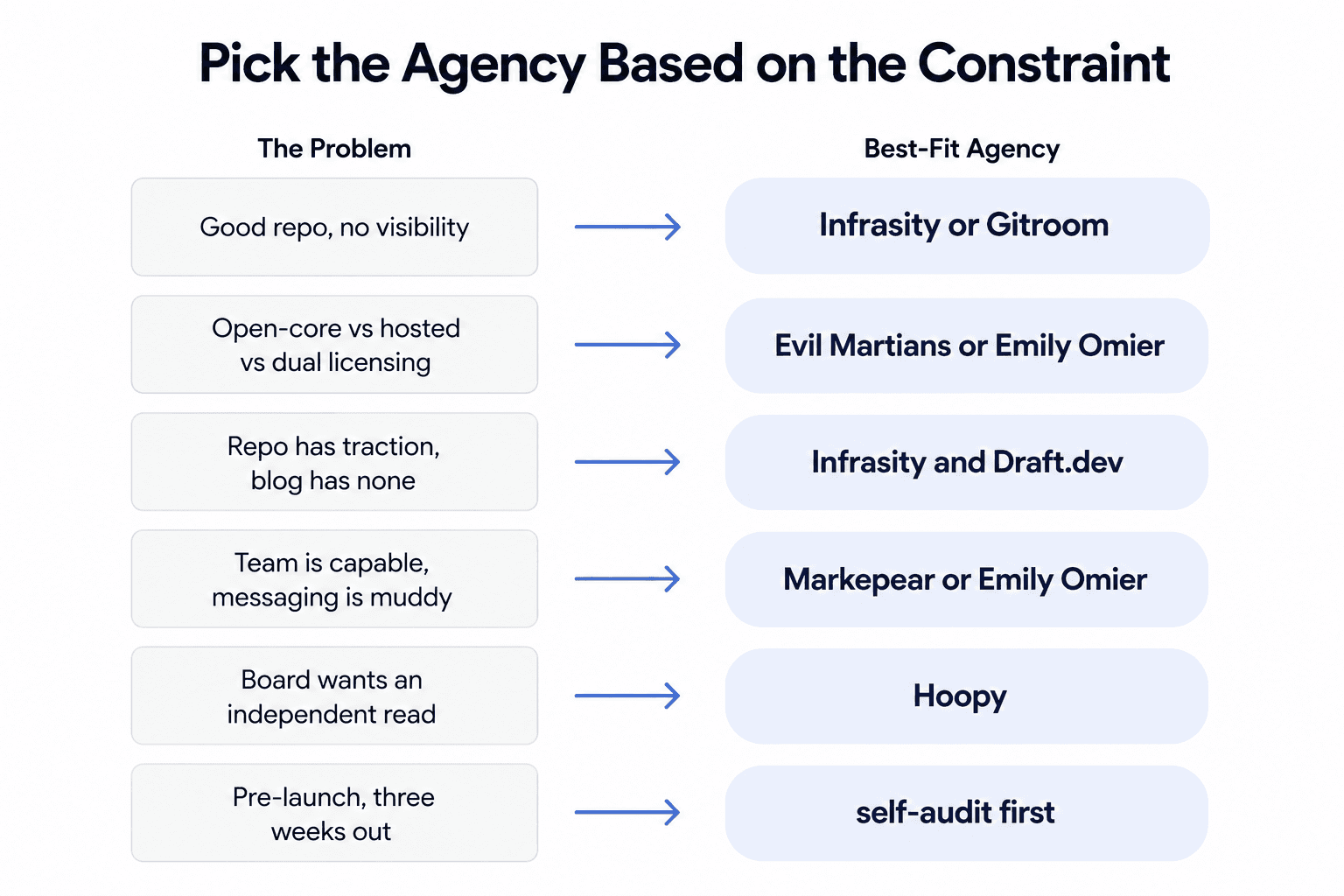
Match the agency to the constraint that is currently blocking you, not to the one with the best homepage.
You have a good repo, and nobody knows it exists: this is a distribution problem. You need demo repos, placement, and thread presence running as one sequence. If you'd rather run the distribution plays yourself before hiring anyone, start there, it's the same sequence Infrasity or Gitroom would run for you.
You are choosing between open-core, hosted, and dual licensing: This is a business-model problem, and getting it wrong costs a year. Evil Martians or Emily Omier.
The repo has traction and the blog has none: Infrasity and Draft.dev, and don't ask them to touch the repo.
The team is capable, and the messaging is muddy: Markepear for the teardown, Emily Omier if the confusion runs deeper than the words.
Your board wants an independent read on your developer program: Hoopy, with the staffing question asked up front.
You're pre-launch with three weeks to go: Do the audit yourself before you hire anyone. Run your five buying prompts across ChatGPT, Claude, Gemini, and Perplexity, open every source they cite, and see whether you appear anywhere. That result tells you which of the five problems above you actually have.
Who else gets recommended, and why they are not on this list
Catchy Agency, Kalungi, Column Five, Devada (DZone Media), and Literally.dev appear across current roundups. They are left out for specific reasons, not as a judgment on quality.
Kalungi is a B2B SaaS CMO-as-a-service model without an open-source practice. Column Five is a design and content studio. Devada is a media property. Literally.dev publishes strong open-source resources, but its four service pages cover technical documentation, technical content, audits, and AI knowledge management, with no repo work. These are the things we thought were worth considering before including them.
Before you email any of them
You now know which seven firms are worth a conversation, which part of the GitHub surface each one owns, and the six questions that separate a real program from a content retainer with a GitHub bullet on the SOW.
Start with the audit, not the outreach. Write down the five questions a buyer in your category would type into ChatGPT before choosing a tool. Run them across ChatGPT, Claude, Gemini, and Perplexity. Open every source cited in every answer and log the URL. It takes an afternoon, and it tells you whether you are invisible, mispositioned, or simply undistributed. Every agency on this list will do better work with that document in hand, and you will be able to tell which of them understands what it means.
If you would rather have that audit run for you, that is where Infrasity's GitHub marketing service starts: five buying prompts across four models, every citation traced, and a thread map you keep whether or not the engagement continues. It is the same week-one work that we follow with our customers.
Book a free consultation, and we will show you exactly where your repo is invisible and which of these seven, if any, is the right fit.
Frequently asked questions
Is it worth hiring an agency to grow GitHub stars?
It depends on whether your repo is unfound or unwanted. If developers who see the repo do not clone it, an agency will spend your money faster. If almost nobody sees it, distribution is the constraint and an agency can compress six months of learning into a few weeks. The test is cheap: check clones and unique visitors in your repo Insights tab against your star count. High traffic and low stars is a product or README problem. Low traffic is a distribution problem.
How much does a GitHub marketing agency cost?
None of the seven publishes a rate, so any figure you read is someone's estimate. Control the deal by buying countable units instead: demo repos shipped, thread engagements per month, directory submissions, and one Show HN attempt with preparation. Then ask what stays yours if you stop, because placements and repos persist and retainer activity does not.
What happens if you buy GitHub stars?
You get roughly two months of lift and a permanent problem. The ICSE 2026 fake-stars study found the promotion effect lasts under two months and then becomes a liability, and that repositories in fake-star campaigns show deletion rates up to sixteen times higher than normal. Investors and platform moderators both run detection over star curves, so the anomaly outlives the benefit.
What is the difference between a DevRel agency and a GitHub marketing agency?
A DevRel agency builds long-term developer trust: community, advocacy, education, events, developer experience. A GitHub marketing agency runs the repository as a distribution and conversion surface: README, metadata, demo repos, placement, launch, and thread presence. DevRel is a standing function measured over quarters. GitHub marketing is closer to an activation sprint measured in weeks. The two are sequential more often than simultaneous: the sprint creates something for the standing function to sustain.
How many GitHub stars do you need to raise a seed round?
Redpoint's dataset of 80 open-source companies put the median at 2,850 stars at seed and 4,980 at Series A, with median contributor counts of 25 and 50. Growth rate mattered more than the absolute number: best-in-class was around 10% month over month, and the observed average between seed and Series A was 7.9%. Note that at least 49 of the 69 seed companies had no revenue at the time, so the repo was carrying the traction argument.
How long does it take to see results from GitHub marketing?
Star velocity is the first thing to move, typically within one to two weeks of distribution going live. Package downloads follow as people actually run the software. Presence in AI-generated answers lags the longest, because models need to re-crawl the threads and listings where you now appear, which is why the prompt audit should be re-run monthly rather than once.
Should I hire a GitHub marketing agency or a DevRel person?
Hire the agency for the launch window and the person for everything after it. An in-house DevRel hire will get there, but they spend three to six months rediscovering thread selection, README conversion patterns, awesome-list etiquette, and Show HN timing. An outside team that has run it repeatedly finishes that curve in weeks. Once the program exists, an internal owner runs it better than any agency will, because they can talk to your engineers daily.
Do GitHub stars actually matter, or are they a vanity metric?
Both, which is why the metric needs a companion. A star costs one click and commits nobody to anything, so 10,000 stars can sit on a dead project. What stars do is buy attention from investors, from developers scanning a comparison thread, and from ranking systems. Pair that with installs completed, weekly active usage, package downloads, and contributor count, and it stops being vanity and starts being a leading indicator.