
If the CTO is your buyer, your website is your sales team. Every technology leader surveyed in Wynter's study of 300 senior B2B buyers visits a vendor's site before any sales conversation; 84% arrive at the first call with an opinion already formed, and 83% expect to explore the product before they will speak to a human. By the time you know a CTO is evaluating you, the evaluation is mostly finished.
Read this if your customer is a CTO, VP of Engineering, or CIO. You will get the exact sequence a technology leader runs, what they check and in what order, an original audit of what 24 infrastructure vendors expose publicly, the channels that reach this buyer and the two you cannot buy, and three teardowns of companies that did this well.
TL;DR
- 84% of senior B2B buyers arrive at the first sales call with an opinion already formed, while 83% want to explore the product before speaking to sales.
- 73% of technology leaders start vendor research with search, while 24% now use AI assistants, up from 0% in 2024.
- Our audit of 24 infrastructure vendors found 21 publish pricing, 21 have status pages, 20 have security or trust pages, but only 14 publish a changelog.
- Buyers typically start with 5 to 7 vendors and narrow to 3 finalists, while the eventual winner was already on the Day One shortlist 95% of the time.
- 58% of CFOs do not trust vendor ROI calculations, and 40%+ of B2B deals can stall because internal stakeholders are misaligned on value.
- In our cloud-governance programme, organic traffic grew 781% from 3,700 to 32,600 monthly visits, while comparison content drove a 182% increase in visibility against incumbents.
Is this about marketing to CTOs, or teaching CTOs about marketing?
Marketing to CTOs. The clarification is necessary because the search term returns almost nothing on the subject.
We ran the query "CTO marketing" and read the first page of results. Of the eight pages returned, none were about how to market to a chief technology officer. Three define an unrelated acronym or role, two cover the CMO and CTO working relationship, one teaches marketing metrics to technology leaders, one describes hiring a "marketing CTO", and one belongs to a company whose name happens to be CTO Marketing.
That is a useful thing to know before you build a content plan. The head term carries no buyer intent for this audience, which means keyword volume is a bad guide here. The queries that matter are the ones a CTO actually types, and those look like problems and comparisons: "postgres vs dynamodb at scale", "SOC 2 evidence collection cost", "how to reduce datadog bill", "build vs buy feature flags". Our argument for why search volume misleads B2B SaaS teams applies with more force at executive level, because executive queries are rarer and higher value.
What makes CTO marketing different from developer marketing?
The developer decides whether a tool works. The CTO decides whether the company standardises on it, and those are different questions with different evidence.
A developer asks whether the quickstart runs, whether the API is sane, whether it solves today's problem. A CTO asks what happens in year three: what the migration costs, whether the vendor survives, what the blast radius is when it fails, how many other tools it lets them retire, and whether they can defend the decision to a CFO and a board.
Bottom-up gets you in. Top-down decides the contract
Most technical products enter through an engineer and stall at the executive layer. The free tier spreads, three teams adopt it, and then the renewal hits a threshold where someone has to sign. At that moment the criteria change completely, and content written for the practitioner has nothing to say to the person holding the pen.
That gap is the most common structural failure in developer-led companies. The marketing works right up to the point where it needs to work differently. If your motion is bottom-up today, developer marketing is the entry, and CTO-facing material is what converts adoption into a contract.
The CTO is not one behaviour
Wynter's data splits technology leaders into four research styles: delegators who trust their teams and validate the recommendation (25%), a hybrid group who research first then hand off (22%), solo researchers who run the whole evaluation themselves (13%), and a group who split the work by expertise area (12%).
Aim accordingly. With a delegating CTO, your job is to make the senior engineer's internal recommendation easy to write and hard to argue with. For a solo researcher, your job is to answer everything on the site. Build for only one of these and you lose the other half of the market.
How does a CTO actually evaluate a vendor?
Alongside two other people, on a separate track, using criteria that partly conflict with theirs. Understanding that structure explains most stalled deals.
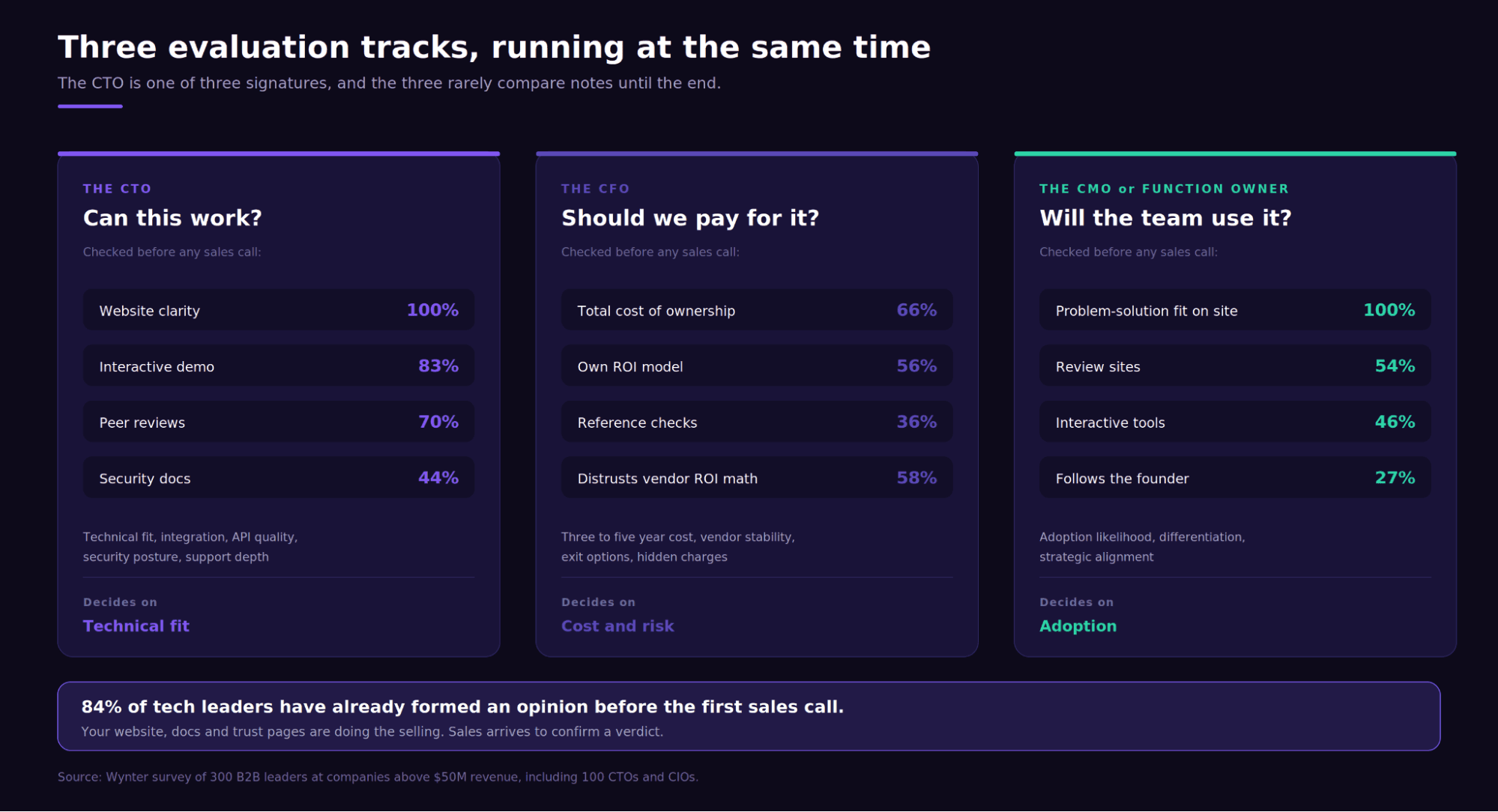
The three tracks rarely coordinate until late. Figures from Wynter's survey of 300 senior B2B buyers, including 100 CTOs and CIOs.
Three tracks, three definitions of a good decision
The CFO is asking whether to pay for it. Two thirds model total cost of ownership across three to five years, 56% build their own ROI framework, and 58% do not trust vendor-supplied ROI calculations. The function owner is asking whether their team will use it. The CTO is asking whether it works: technical fit, integration with the existing stack, API quality, security posture, support depth.
These priorities collide by design. The cheapest option often creates integration problems. The best technical option often fails the ROI test. Deals stall at the end because nobody reconciled the three value systems, and Edelman and LinkedIn's 2025 B2B Thought Leadership Impact Report found that more than 40% of B2B deals stall on exactly this kind of internal misalignment.
The shortlist is short, and formed early
One CIO in the Wynter research described the process plainly: start with a long list, cut it to two or three, then run a side-by-side comparison on functionality, technical fit, vendor strength and stability, cost and support.
Buyers typically start with five to seven vendors and narrow to three finalists. 6sense's 2025 Buyer Experience Report, covering nearly 4,000 buyers, found the eventual winner was already on the buyer's Day One shortlist 95% of the time, and the pre-contact favourite won 77% of the time. Getting onto that first list is worth more than anything you do after it.
Brand helps a CFO more than it helps a CTO
79% of CMOs say brand fame matters when they build a shortlist. Among CTOs, 39% explicitly prioritise problem-solving capability over brand recognition. One CTO at a 1,001 to 5,000 employee software company put the reasoning bluntly: the point of paying a vendor is to solve a problem, and the only reason to pick one for its brand alone is if the relationship itself generates revenue.
Challengers should read that as an opening. Brand recognition still signals proven technical capability, established integration patterns and available community support, so you have to substitute for those signals with evidence rather than hope the buyer overlooks them.
Where does a CTO look first?
A search box. Technology leaders are the only one of the three executive buyers who still begin with direct search rather than a peer network.
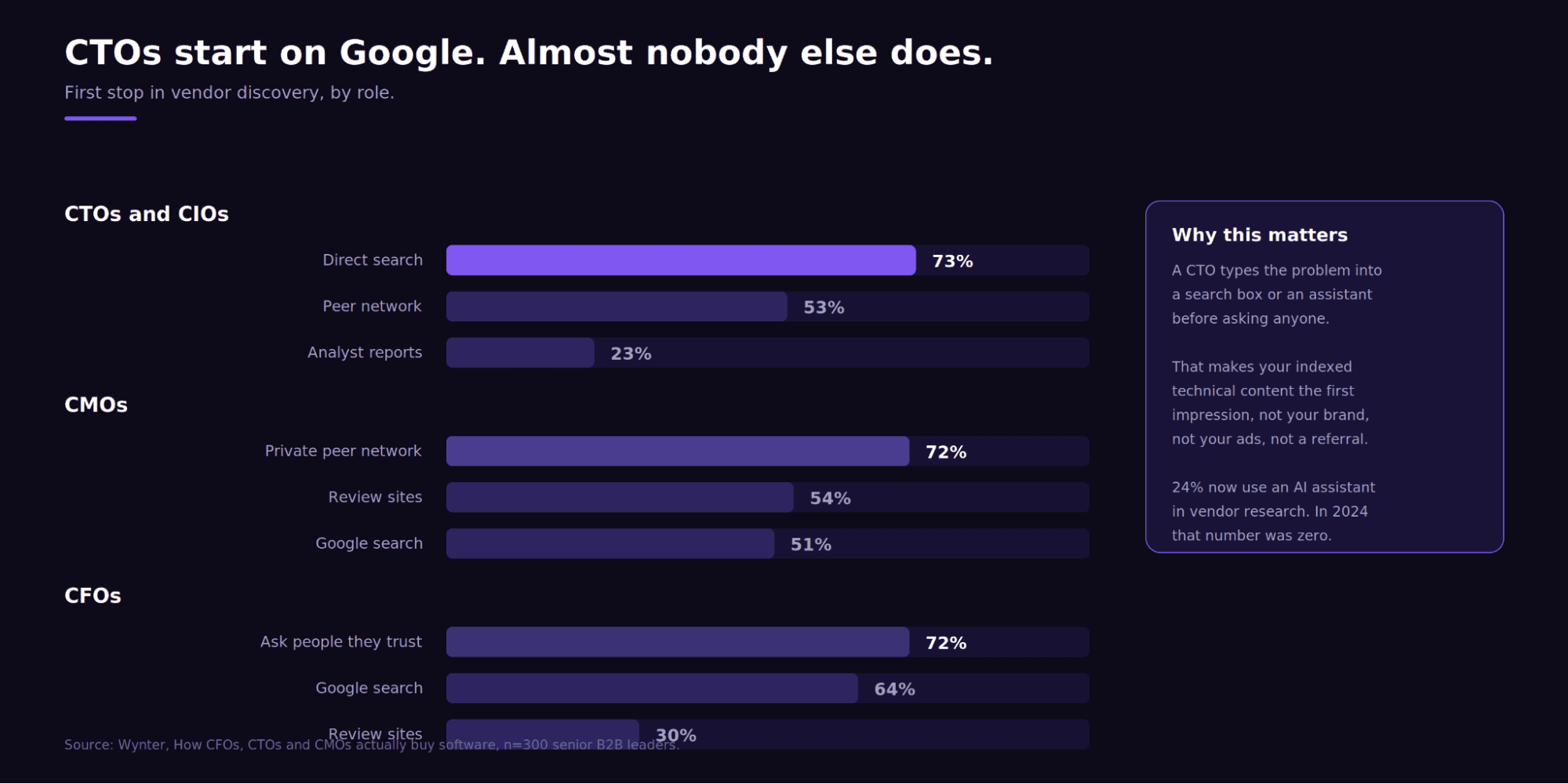
Discovery order by role. CTOs research first and ask peers second.
73% of technology leaders begin with direct searches. 53% consult their network, usually after that initial research rather than before it. 23% check analyst reports from Gartner, Forrester or IDC. Compare that with CMOs, 72% of whom start inside private communities, and CFOs, 72% of whom ask someone they trust before any formal research.
The practical consequence is that a CTO's first impression of you is whatever your indexed technical content looks like. Not a referral, not an ad, not a conference booth. The page that answers their architecture question is the page that introduces your company.
The assistant is now in the loop
24% of buyers now use tools like ChatGPT and Perplexity for vendor research. In 2024 that figure was zero. Buyers use them to summarise options, map a category quickly, and cross-check what a peer told them.
They are not replacing people: 76% still prefer advice from a human. What has changed is the compression. A CTO who would have spent an afternoon building a category map now has one in ninety seconds, assembled from whatever the model retrieved, which may or may not include you. That makes AI discoverability for technical products a discovery channel rather than a side project, and it is why we track assistant citations as a channel in its own right.
What does a CTO check on your site before contacting you?
Four things, in a predictable order, and most of them are now table stakes. We went and measured which ones vendors actually publish.
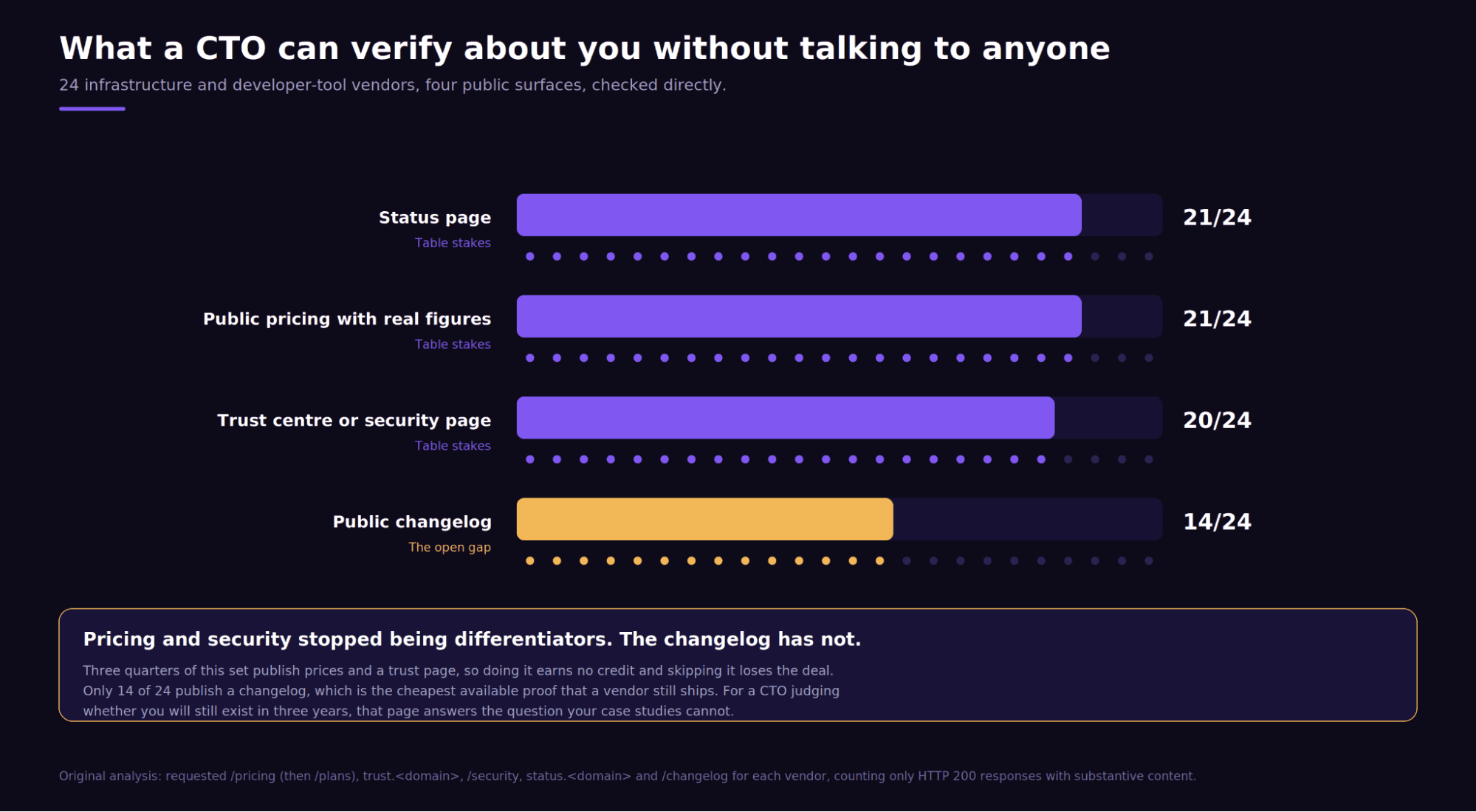
Original audit. Method: we requested /pricing (falling back to /plans), trust.<domain>, /security, status.<domain>, and /changelog for each of 24 infrastructure and developer-tool vendors, counting a surface as present only when it returned a live page with substantive content.
The surfaces that are now expected
21 of the 24 vendors publish a pricing page carrying at least two distinct dollar figures. 21 run a dedicated status subdomain. 20 publish a trust centre or a security page.
Read that as a floor, not an achievement. When roughly six in seven of your category publish prices, doing it earns you nothing and skipping it removes you from consideration before a human is involved. The three vendors in our set without public prices at a predictable URL are all enterprise-first, which is a deliberate trade: they accept losing the self-directed evaluator in exchange for controlling the conversation.
Hiding pricing from a CTO is a choice, so be honest with yourself about which side of that trade you are on. 83% of technology leaders want to explore before speaking to sales, and a contact-sales wall is a decision to be absent from that exploration.
The surface most vendors still skip
Only 14 of 24 publish a changelog. That is the widest gap in the audit and the most useful one, because a changelog answers a question a CTO cannot get anywhere else: are you still shipping?
A case study reports what happened once. Testimonials report that somebody was happy. Twelve months of dated changelog entries show velocity, direction and whether the roadmap you described in the demo is real. It is the cheapest available evidence of vendor viability, and it costs a paragraph a week. If you are deciding what shape yours should take, we have written on the difference between a changelog and release notes and on release notes as a marketing surface.
Documentation carries more weight here than anywhere else
Technical documentation is the most-used learning resource among developers, at 67.8% in Stack Overflow's 2025 survey of 49,019 respondents. For a CTO evaluation the docs do a second job: they are the artifact the CTO forwards to the architect who will actually judge the integration.
Three things get read closely. Whether the architecture is described honestly, whether the limits and failure modes are documented, and whether the integration story matches the stack they already run. Documentation built as a growth surface rather than a reference manual is the highest-return asset in this category, and it is the one place where 100% of technology leaders will land.
Who else is in the room, and what does the CTO need to hand them?
Between five and thirteen people, depending on deal size. The CTO's real problem is not evaluating you; it is defending you to the rest of them.
Forrester's research on enterprise buying groups puts an average of 13 internal stakeholders on an AI tooling decision, each with a different priority and the ability to say no. The 6sense data shows the middle of the range for most purchases sits nearer five. Either way, your champion is going to explain your product to finance, to security, and to the team that will own it, without you in the room.
Build the internal case, not just the external one
The CFO does not trust your ROI calculator. 58% of them build their own model, which means the useful thing you can supply is not a polished number but the raw inputs: unit costs, implementation hours, what the first year looks like versus year three, and what the migration actually requires.
Security review is the other predictable choke point. Certifications, data handling, incident response and subprocessor lists belong on a public page, not behind an NDA and a two-week email thread, because every week that takes is a week your competitor's evaluation is still moving.
The champion enablement asset almost nobody builds
Write the document your champion would have to write themselves. A one-page internal brief: the problem in their language, the options considered including doing nothing, the cost model, the risks and how each is mitigated, and the rollout plan with a date.
That artifact converts an interested CTO into an advocate with ammunition. It is also what go-to-market enablement means at this level, and it is a better use of a quarter than three more top-of-funnel posts.
Which channels reach a CTO, and which can you actually buy?
Two of the highest-value channels cannot be bought at any price. That constraint should shape the budget more than it usually does.
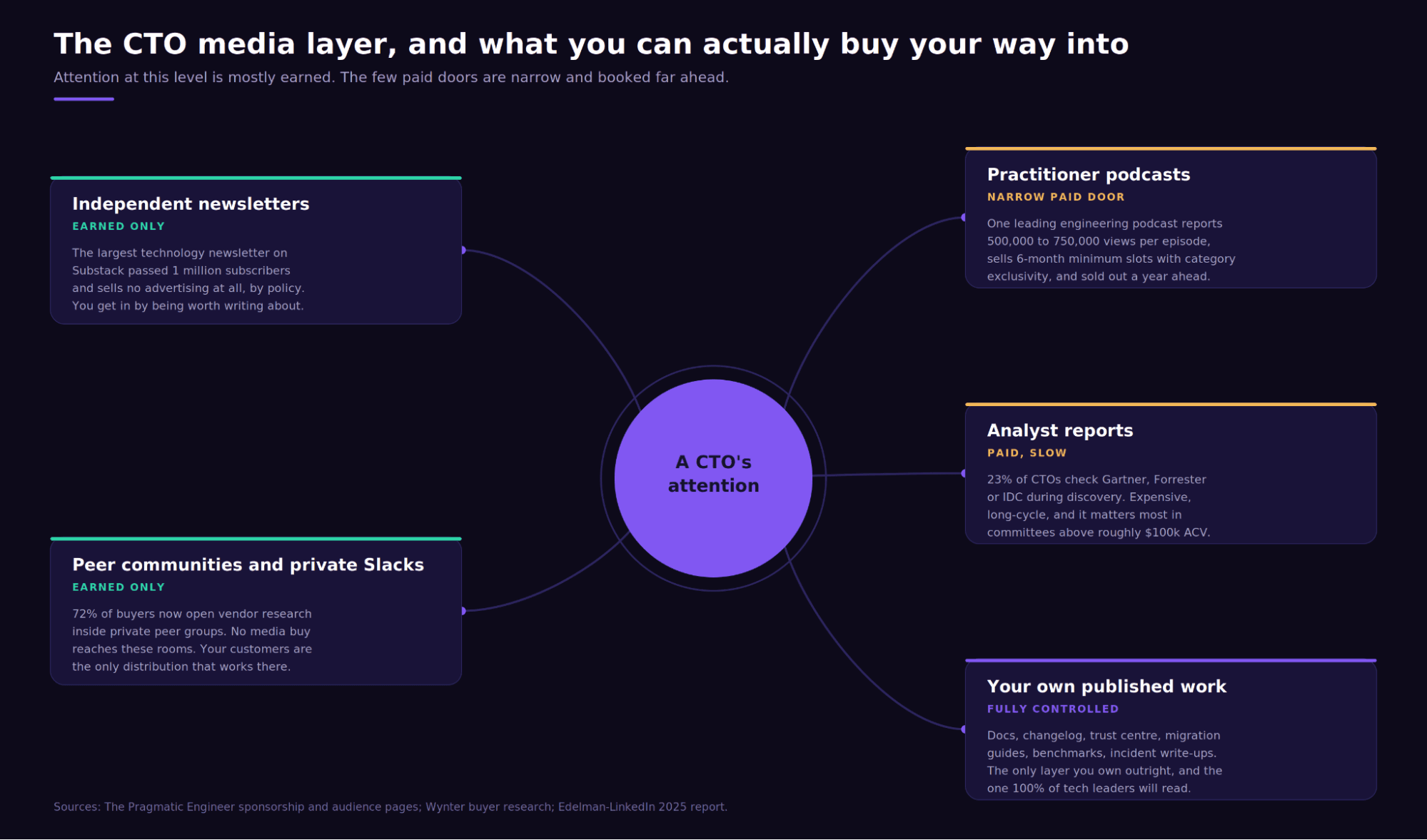
The channels that reach engineering leaders, sorted by whether money opens the door.
The newsletter you cannot sponsor
The largest technology newsletter on Substack passed one million subscribers and does not sell sponsorships of any kind, by stated policy, in order to stay independent. Its author reports the growth came from word of mouth and platform recommendations rather than advertising.
The lesson generalises. In this audience, the publications with the most trust are usually the ones that refuse money, which means the only route in is to do something worth writing about. That is a product and evidence problem before it is a marketing problem.
The podcast door is narrow and books a year out
The same publication's podcast reports 500,000 to 750,000 combined views per episode within thirty days of release, with an audience that is 25% engineering leaders holding titles like CTO, VP of Engineering or Director of Engineering, 60% software engineers, and 62% working at venture-funded scaleups or larger technology companies.
Its sponsorship terms are instructive: long-term partnerships of six months or more, category exclusivity, and slots for the year sold out in advance. If podcast placement is part of your plan for reaching engineering leaders, treat it as an annual commitment negotiated early, not a campaign you can spin up next quarter. Our roundup of B2B SaaS podcasts worth a technical audience's time is a reasonable starting map.
Private peer rooms, where you have no account
72% of buyers now open vendor research inside private communities. There is no media buy that reaches a private Slack, a CTO dinner or a peer group thread. The only thing that travels into those rooms is what your existing customers say when you are not present.
That makes customer advocacy a distribution strategy rather than a testimonial exercise. The reference a CTO trusts is a peer at a comparable company who will speak candidly about what went wrong during implementation as well as what went right.
Analyst reports, LinkedIn and the founder's own voice
23% of CTOs check analyst reports during discovery. Analyst relations is slow and expensive, and it matters most in committees deciding above roughly six figures of annual contract value. Below that threshold it is rarely the best marginal spend.
LinkedIn is where a technical founder's argument reaches an executive audience directly, which is why founder-led publishing on LinkedIn outperforms company-page posting for this buyer. When paid amplification through practitioners is on the table, we cover the mechanics in B2B influencer marketing for technical buyers.
How does an unknown vendor get onto a CTO's shortlist?
By satisfying six specific conditions. 38% of buyers say they will consider a vendor they have never heard of, and they are precise about what it takes.
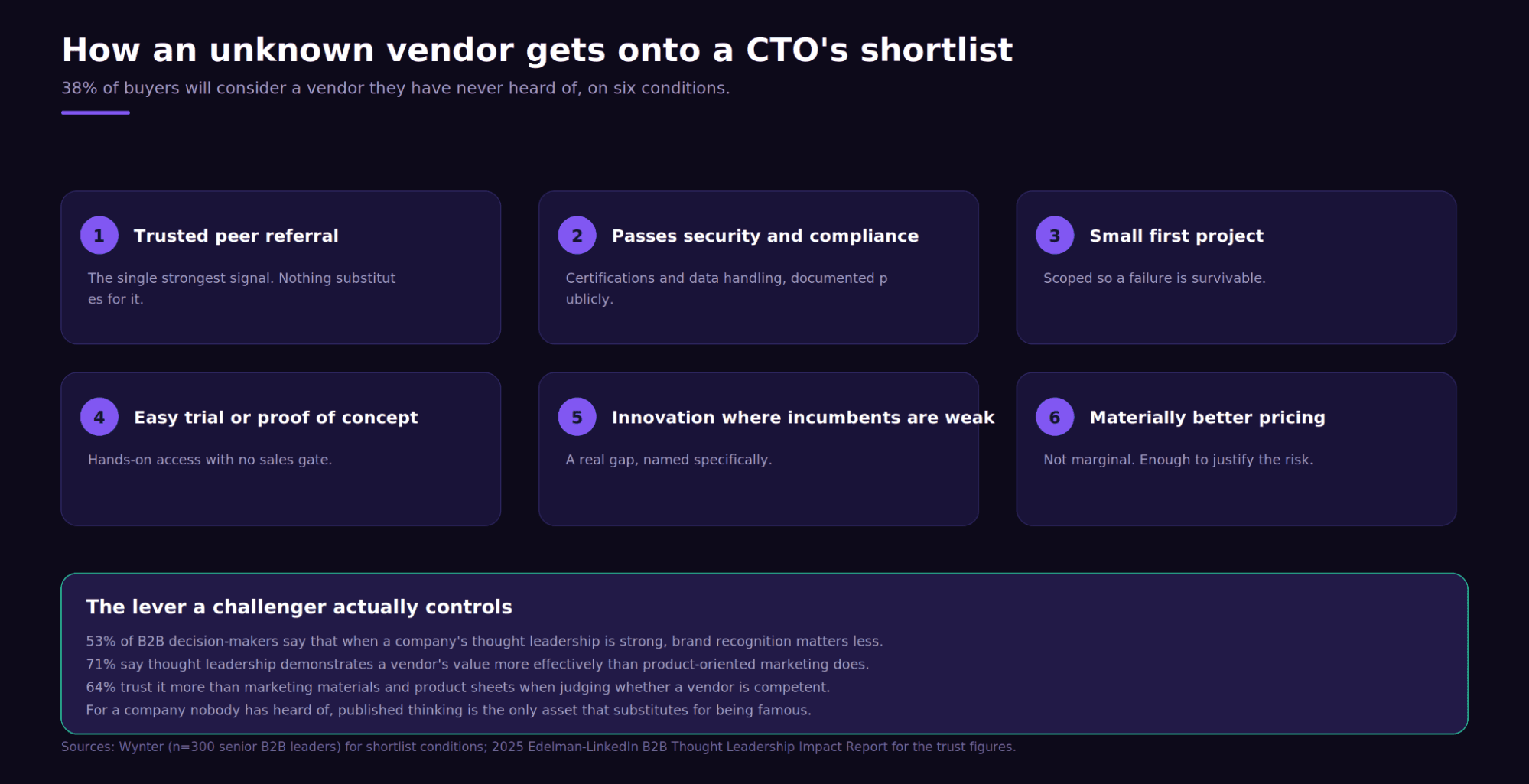
The six conditions, and the lever a challenger controls.
The conditions run in rough order of importance: a trusted peer referral, passing security and compliance checks, a scope small enough that failure is survivable, an easy trial or proof of concept, genuine innovation where incumbents are weak, and pricing materially better than the established option. Company size shifts the risk tolerance. Organisations above 500 employees strongly favour brand safety for business-critical systems and purchases over roughly $30,000 a year.
Notice which of those six you control directly. You cannot manufacture a peer referral, but you can publish the security documentation, design a genuinely small first project, remove every gate on the trial, and name the specific gap where the incumbent is weak.
The sixth lever is the one most challengers underuse. 53% of decision-makers told Edelman and LinkedIn that when a company's thought leadership is strong, brand recognition matters less. 71% say it demonstrates a vendor's value more effectively than product-oriented marketing does, and 64% trust it more than marketing materials and product sheets when judging competence. Published thinking is the closest available substitute for being famous.
What content actually earns a CTO's attention?
Six asset types, each answering a question the buyer cannot answer from a product page. Ranked roughly by how hard they are to fake.
The benchmark built from your own telemetry: The strongest asset available to an infrastructure company is data only you hold. Cast AI publishes an annual Kubernetes Cost Benchmark built from analysis of more than 2,100 organisations' clusters across AWS, GCP and Azure, with the method stated openly, including that the data is collected before those organisations use the product. The headline finding, average CPU utilisation around 10%, travels on its own into decks and board conversations written by people who have never visited the site.
The migration and total cost model: CTOs buy to replace something. Document what breaks, how long it took, what the cutover required and what you would not repeat. It doubles as the artifact a CFO can build a model on top of.
The architecture explainer: Not a feature page. How the system works, where the data sits, what the failure modes are, what it costs at scale. This is what gets forwarded to the architect.
The public postmortem: Publishing your own incident write-ups is the cheapest trust available in this market. A vendor that documents its worst day is a vendor a CTO believes about its ordinary ones.
The comparison that names where you lose: A page recommending only your product reads as an advertisement. A page that recommends three options with conditions reads as experience and gets cited as a source, including by assistants summarising the category.
The case study with a mechanism: A result without a how is a brag. The version that works for this reader names the situation, the change, the number and the mechanism that produced it. We have written separately on using case studies and whitepapers as durable SEO assets.
What can you learn from companies that did this well?
Three teardowns. Each solved a different part of the CTO problem, and each approach is copyable.
Grafana Labs: win the practitioner, and the CTO inherits the decision
Grafana Labs built for the person using the software rather than the person signing for it. Co-founder and CEO Raj Dutt has stated the strategy directly: "We don't build technology for the buyer. We build technology for the practitioner." He is equally direct that "90% of our users will never pay us, and that's by design".
The commercial logic is what matters here. By the time a Grafana purchase reaches a CTO, the tool is already running in the organisation, the team has an opinion, and the decision is about support, scale and governance rather than whether the software is any good. The company reached 20 million users on that model.
What to learn: make the free path genuinely useful and count on internal adoption to pre-qualify the executive conversation.
What to watch: this only works if you also build the executive-facing material for the moment adoption hits a contract, which is precisely the gap most open-core companies leave open.
Cast AI: turn your telemetry into the number a CTO forwards
Cast AI's benchmark converts operational data into a category-level statistic with a stated method. That does three jobs at once. It gets cited by people who never visit the site, it gives a champion a defensible figure for an internal business case, and it positions the company as the party that measures the problem rather than one of several parties selling a fix.
The company has since extended the same motion into its own event format, with KubeAuto Day drawing more than 800 practitioners in Amsterdam.
What to copy: publish once a year, state the method, report the real number even when it is unflattering. What to watch: a benchmark without a method is a press release, and a CTO will notice.
Honeycomb: say the thing your competitors cannot say
Honeycomb built its reputation on writing that argues against its own category's marketing. Its engineering blog tells prospective buyers not to take vendor observability claims at face value and to interrogate the technical merits instead.
That posture is disproportionately effective on an audience with, as the company's own writing implies, a finely tuned detector for vendor language. It also demonstrates the harder discipline underneath: a message that any competitor could also make is not a message.
What to copy: publish the evaluation criteria you would want a buyer to use, including the ones where you lose. What to watch: this requires a product that survives the criteria you publish.
And one from our own work
For a $23M Series A cloud governance company selling into platform and engineering leadership, we ran technical content, problem-solution storytelling, and community-driven developer marketing together. Organic traffic grew 781%, from 3,700 to 32,600 monthly visits, and comparison content specifically drove a 182% increase in visibility against two better-funded incumbents. The mechanism was not volume. It was mapping the product's governance capabilities against the specific problems the buyer's team was already searching for, then covering the comparison queries the incumbents had left thin.
Why does a site selling to CTOs need to be built differently?
Because the visitor is auditing you, not browsing. Four differences decide whether the audit passes.
Pricing has to be legible. A technology leader needs to know whether the tool fits a budget they can approve. Six in seven of the vendors we audited publish real figures, so the absence of them now reads as a signal rather than a strategy.
The trust surfaces belong in the navigation. Docs, status, security and changelog are not footer links for this reader. They are the evidence.
Architecture has to be visible without a demo. Diagrams, data flow, deployment models, limits. If a CTO cannot work out how it fits their stack from the site, they will assume it does not.
Claims have to be falsifiable. "Reduce cloud spend" is invisible to this audience. "Average CPU utilisation across 2,100 organisations is 10%, and here is the method" is legible. Specificity is the entire register. Our notes on design for developer tools go through the page-level patterns.
What can go wrong in the CTO marketing?
Five failure modes account for most of the waste in CTO-facing programmes.
Selling business outcomes to a technical buyer: "Increase revenue 30%" is a message for a CRO. A CTO wants the mechanism first and the outcome second, in that order.
Gating the evidence: Putting the architecture doc, the security page or the benchmark behind a form removes you from the 83% of evaluations that happen before contact.
One asset for a five-person committee: The CTO, the CFO and the function owner need different documents. Sending all three the same PDF guarantees that two of them find it irrelevant.
Treating a launch as a plan: Executive attention does not arrive on a schedule you control. Compounding assets do.
Measuring the wrong thing: Buying cycles in the 6sense data average 10.1 months and most of the decision happens before you can see it. Judging this quarter's leads against this quarter's content measures the wrong quarter.
How do you measure CTO marketing?
By shortlist presence and by the surfaces the funnel cannot see, because lead volume is a lagging and misleading proxy at this level.
| Metric | What it tells you | How to get it |
|---|---|---|
| Shortlist presence | Whether you were in the consideration set at all | Ask every inbound lead which vendors they considered and who they contacted first |
| Assistant citation rate | Whether models surface you for category questions | Track a fixed prompt set weekly, log appearance and position |
| Champion enablement usage | Whether your internal-case material is being forwarded | Instrument downloads and shares of the business-case assets, separate from top-of-funnel |
| Docs and trust-page depth | Whether the technical audit is passing | Session depth on architecture, security and changelog pages, not just the homepage |
| Time to security answer | Whether you stall at the predictable choke point | Median days from first security question to complete answer |
The AI channel deserves separate instrumentation, because it is systematically undercounted. On one of our own engagement programmes, direct community clicks delivered around 260 users a month while arrivals via AI assistants delivered 731, roughly a threefold gap between the number a standard channel report shows and the number the work actually produced. We treat AI visibility as a tracked channel for exactly this reason.
Conclusion
You now have the sequence a technology leader runs, the four surfaces they check before contacting you, the six conditions that get an unknown vendor shortlisted, and the two channels no budget can open. The first step costs nothing: request your own pricing, security, status and changelog pages as a stranger would, and write down what a CTO would conclude from what they find.
If you want the whole motion built by people who write technical content because they have shipped technical products, that is what Infrasity's services cover: documentation, technical content, executive-facing evidence and AI visibility, measured against shortlist presence rather than impressions.
Frequently Asked Questions
What is CTO marketing?
CTO marketing is the practice of marketing technical products to chief technology officers, VPs of Engineering and CIOs. It differs from developer marketing because the developer decides whether a tool works while the CTO decides whether the organisation standardises on it, which requires evidence about cost, risk, vendor viability and migration rather than evidence about usability.
How is marketing to a CTO different from marketing to a developer?
The developer evaluates the product; the CTO evaluates the commitment. Developers want a working quickstart and a sane API. CTOs want the architecture, the security posture, the total cost across three to five years, and proof you will still be shipping when the contract renews.
Where do CTOs look for vendors?
Direct search first. In Wynter's survey, 73% of technology leaders begin with a search, 53% consult their peer network afterwards, and 23% check analyst reports from Gartner, Forrester or IDC. A further 24% of buyers now use AI assistants during vendor research, up from zero in 2024.
How long is a CTO sales cycle?
Around ten months on average across B2B purchases in the 6sense 2025 data, with roughly 60% of the journey completed before any seller is contacted. Enterprise deals with formal security review and procurement run longer, and the security review is the most common late-stage delay.
Should we publish pricing if we sell to CTOs?
In most cases yes. Of 24 infrastructure and developer-tool vendors we audited, 21 publish a pricing page with real figures, so hiding prices now reads as a deliberate signal rather than a neutral default. The exception is genuinely enterprise-only products where every deal is custom, and even then a published range and a model beats nothing.
Do analyst relations still matter for reaching CTOs?
They matter for a specific slice. 23% of CTOs check analyst reports during discovery, and that share concentrates in committees deciding on contracts above roughly six figures annually. For products below that threshold, the same budget usually returns more in documentation, benchmarks and community.
What is the highest-return asset for reaching CTOs?
A benchmark or dataset built from your own telemetry, published annually with the method attached. It gives a champion a defensible number for the internal business case, it gets cited by people who never visit your site, and no competitor can reproduce it because they do not hold your data.