
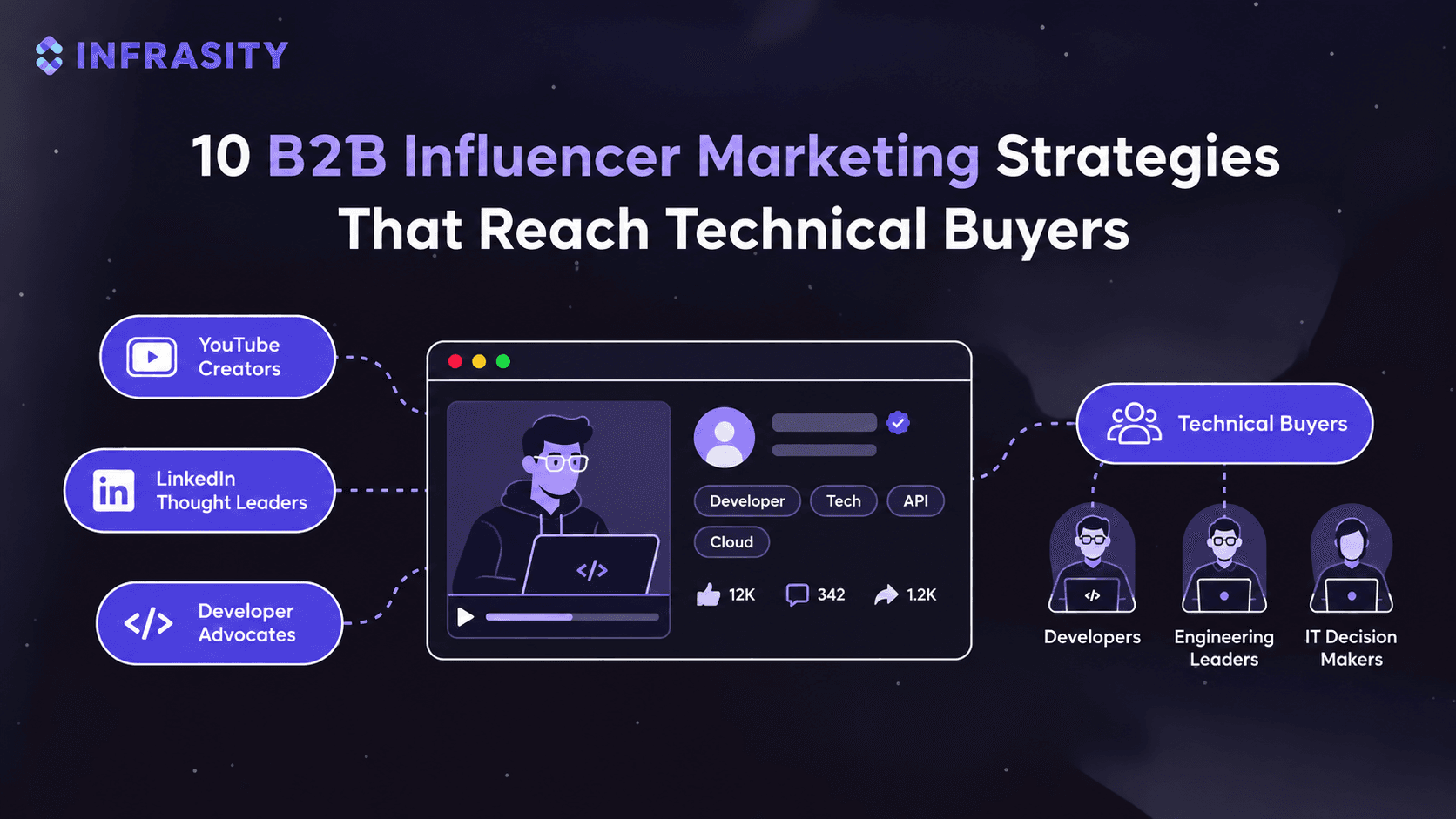
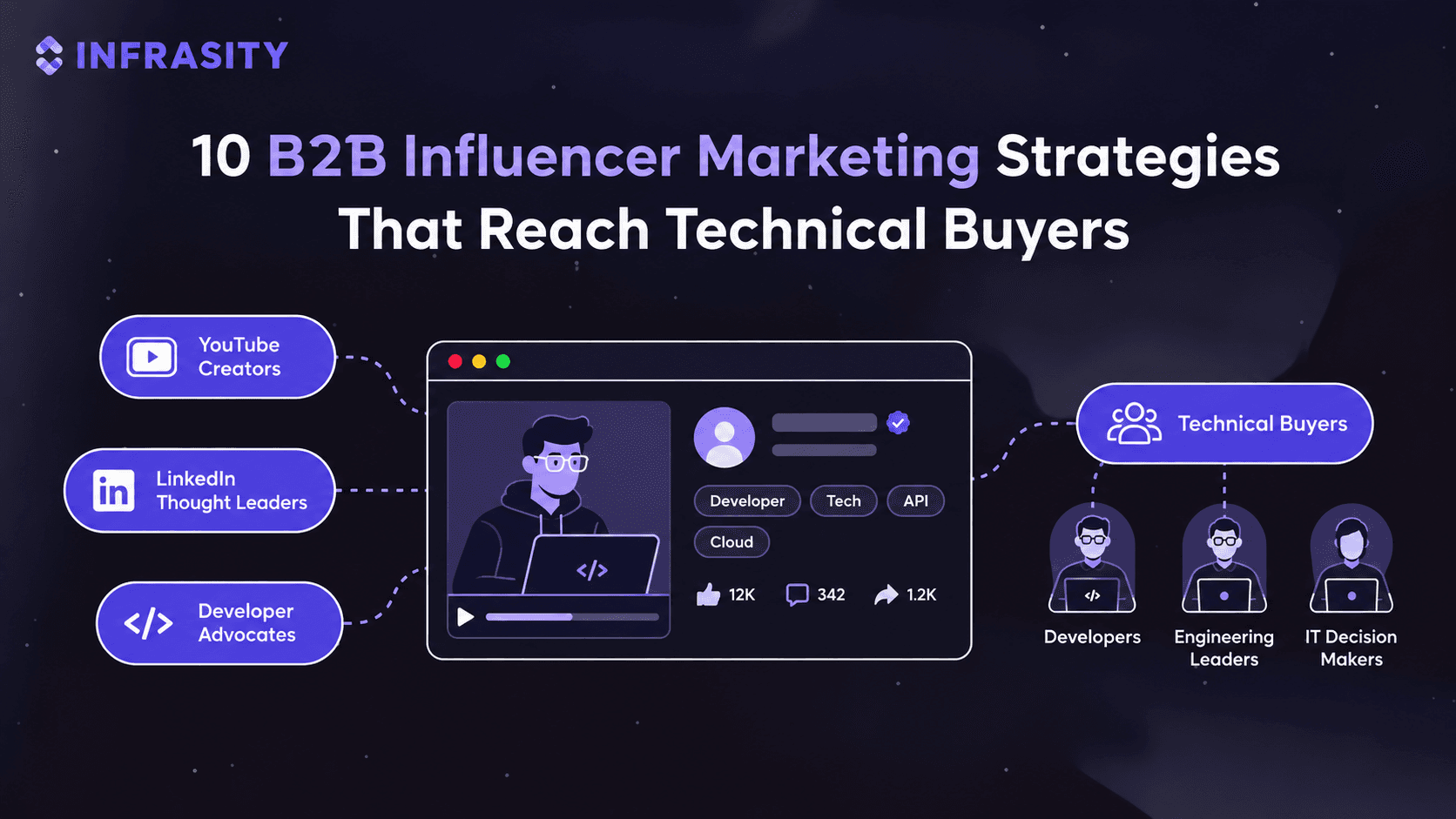
A B2B influencer marketing strategy reaches technical buyers when the creator demonstrates the product in action rather than describing it, publishes a written artifact alongside the video, and is measured against a baseline established before any money moves. Everything else is a media buy.
That distinction matters more than most budget owners realize. In the 2025 Stack Overflow Developer Survey, 48% of developers said they endorsed or influenced a new technology purchase at their organization in the past year. For 19.8%, that purchase was a major addition to the company's tech stack. The person running your trial is the one signing off on it, or the one standing next to whoever does.
This blog covers the ten strategies that hold up when the buyer opens your repo instead.
TL;DR
- Technical buyers verify; they don't accept: the creator post is the entry point. The docs, the repo, and the forum thread are where the decision is made.
- Cast on proof, not reach: the creator has to run your code in front of people who can tell whether it works.
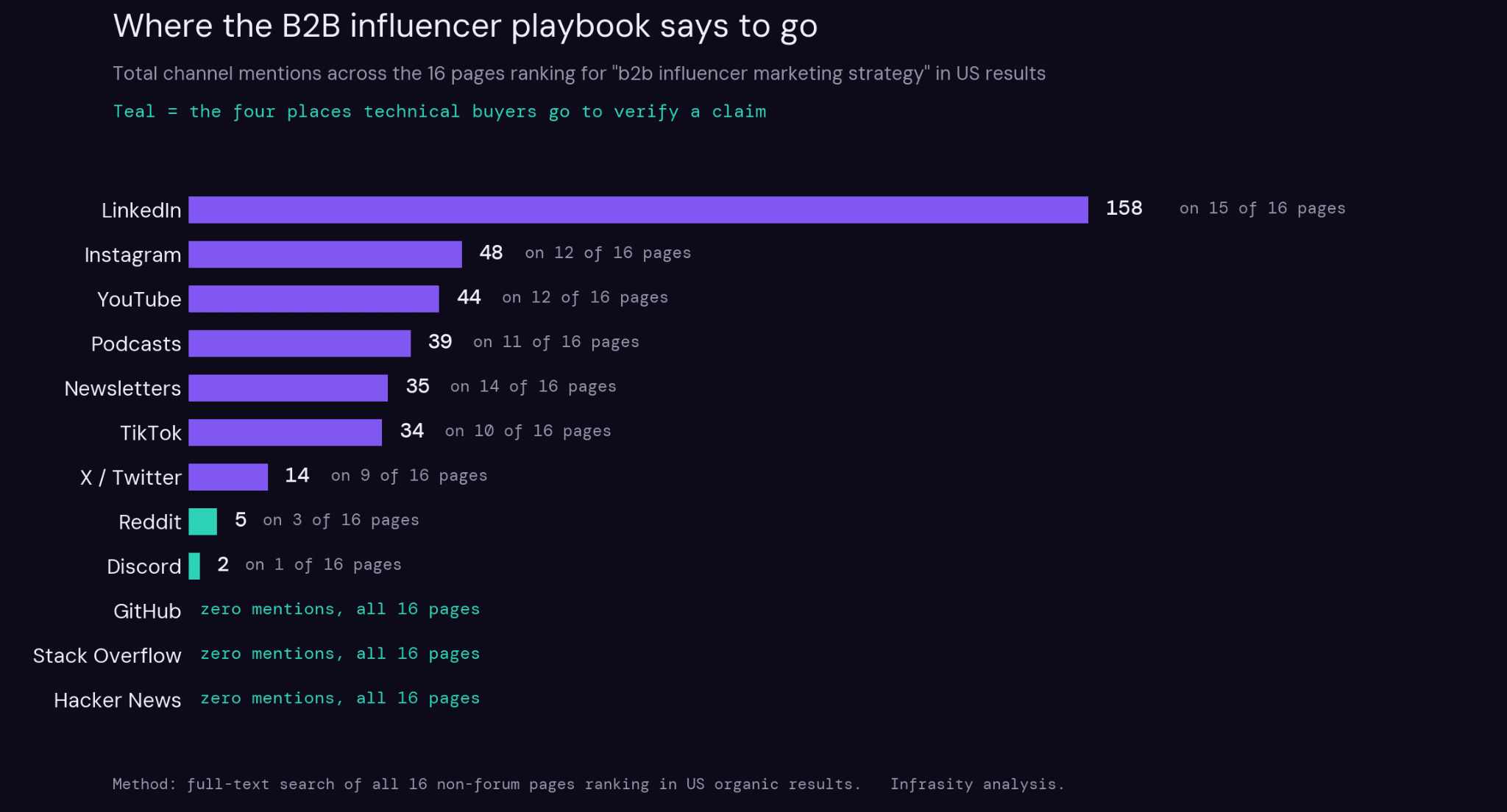
- The market's channel advice is inverted: across 16 ranking pages, Instagram gets 48 mentions and TikTok 34. GitHub, Stack Overflow, and Hacker News get zero.
- Buy the written artifact, not just the video: language models cite text. That is the part you should also be asking for.
- Give up message control: a Google Cloud director says he goes looking for five negative opinions before three positive ones. Scripted praise fails that search.
- Baseline before you spend: only 29% of thought-leadership producers can link a sales lead back to a specific piece of content.
What actually changes when the buyer is technical?
The unit of persuasion changes. Consumer influence sells taste. General B2B influence sells credibility, an industry figure lends authority to a claim, and the audience nods. Influence aimed at technical buyers has to sell proof, because the audience can check.
It is a sequence that starts the moment the creator's post ends.
Verification loop
A developer watches a creator install your SDK. If the demo lands, they open your documentation to see whether they can self-serve. Next comes the repository, for the open issues and the date of the last commit. After that, they search for the failure mode to find who says it broke. Finally, they run it locally.
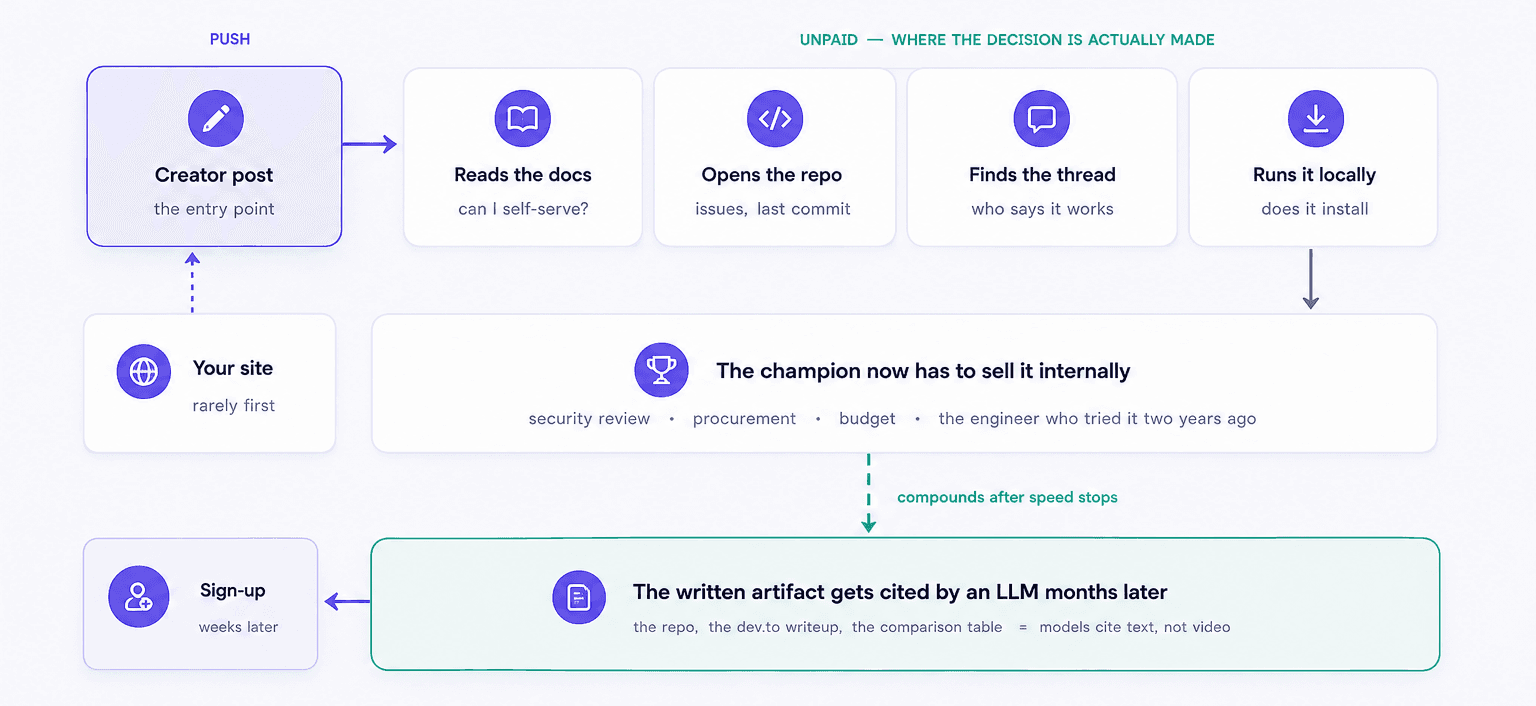
Only the first step in that chain is something you can buy. The other four are the ones that decide the deal, and every one of them will contradict a creator who oversold you.
Why the technical evaluation is slow, and why that is not a problem to solve
Technical evaluations run long because the decision is structural. Swapping a component changes architecture, hiring, and workflows, so it gets weighed accordingly. Security review, procurement, and a proof-of-concept environment all sit between interest and signature.
Two consequences follow. First, a creator touch may precede a signup by six weeks or more, so judging a program on 30-day last-click attribution kills the channel that works. Second, your most common competitor is not another vendor. It is a senior engineer saying the team could build this internally, which is the one objection a paid ad has never once overcome and a credible practitioner sometimes can.
1. Cast someone who knows how to code
Pick the creator who will write the code, not the one who will describe it. This is the single decision that determines whether the other nine strategies have anything to work with.
The reason is mechanical. A developer cannot run your product during a video, so they use the creator's terminal as a proxy for their own. They are reading output faster than the creator is talking, and they are watching for the parts a marketing video would cut. When someone hits an authentication error and fixes it on camera, those thirty seconds are the most persuasive segment of the piece, precisely because a paid ad would never include it.
PostHog, which publishes its entire creator operation in its public handbook, states its casting preference plainly: they would rather work with a creator who genuinely uses the product than one with a much larger audience but no connection to it. The same handbook is about why the copy has to be concrete: "Developers can smell marketing fluff instantly." Their rule is that a plain statement of what the product does beats any sentence built on benefit language.
What casting looks like in a shortlist
Score three things before follower count enters the conversation: whether the creator publishes consistently in your specific niche, whether their audience is the technical professionals you actually sell to, and whether they maintain real engagement rather than posting into a void.
Then hard-check each row for conflicts. We publish the full sheet, including the flags column and three real conflicts we caught on one roster, in our DevTool influencer marketing playbook.
A creator with genuine reach and no hands-on depth will produce content that reads fine to your marketing team but comes across as hollow to your buyer. Your marketing team is not the quality gate. The comment section is.
2. Price against median views, not subscriber count
Subscriber counts are cumulative and never decay. View counts are current demand. Paying against the first number while converting on the second is the most expensive routine error in this channel.
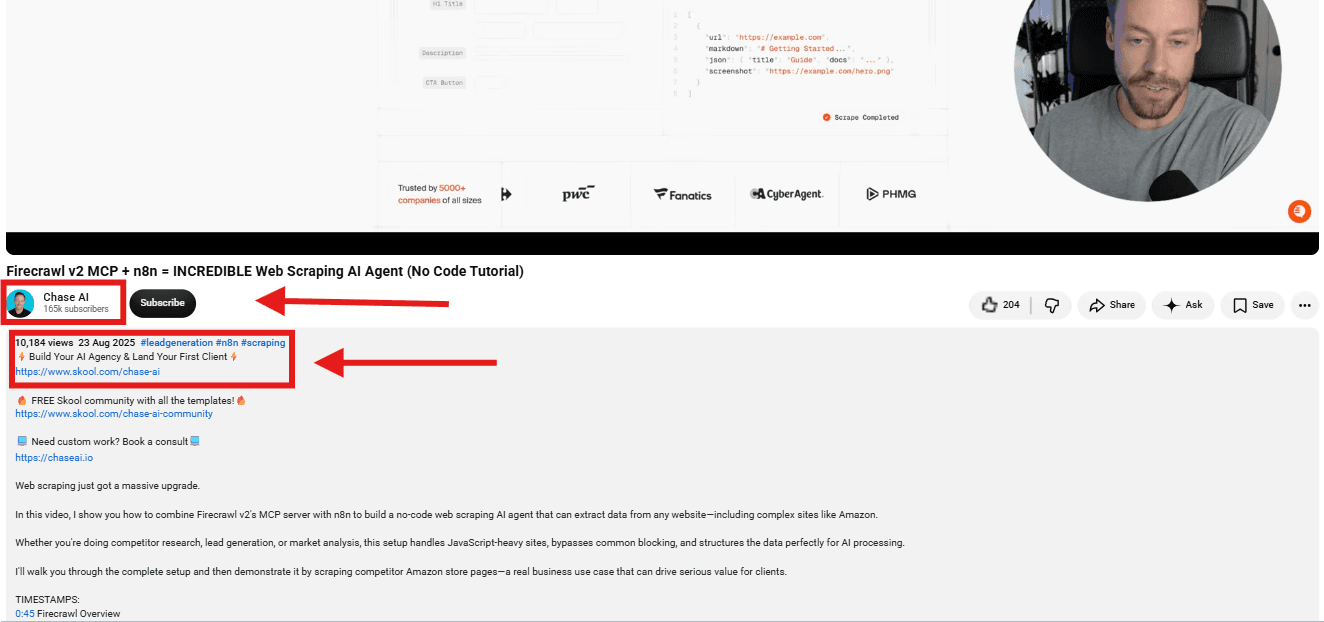
As the screenshot above shows, the subscriber count is over 160,000, but the views are only 10,000, which clearly indicates you shouldn't rely solely on the subscriber count.
Do the math yourself: a channel with 160,000 subscribers pulling 10,000 views per video, quoted at $2,000, costs roughly $222 per thousand views. A 30,000-subscriber channel pulling 40,000 views at the same price costs $50. Same invoice, four times the delivery. Ask for the median view count of the creator's last ten videos, never the best one.
Also try usable engagement thresholds, measured as ratios rather than raw counts:
| Engagement quality | Comments per view | Likes per view |
|---|---|---|
| Weak | 0.001 | 0.02 |
| Average | 0.001 to 0.002 | 0.02 to 0.03 |
| Good | 0.002 to 0.005 | 0.03 to 0.05 |
| Excellent | 0.005+ | 0.05+ |
PostHog's own guidance sets a floor of 5,000 views per video and deliberately avoids naming developer categories, including interview preparation and career-growth channels, because that audience is job-hunting rather than tool-buying. There is no upper size limit in their guidance: larger creators charge more and are often more efficient per view.
For the full method of converting a quote into effective CPM before you approve it, see our breakdown of how to check a YouTube creator quote with arithmetic.
3. Route budget to the surfaces where technical buyers verify
Spend where the claim gets checked, not only where it gets seen. The market's default advice points almost exactly the wrong way for a technical audience.
Across 16 ranking pages, we counted every channel mention. LinkedIn appears 158 times across 15 pages. Instagram gets 48, YouTube 44, TikTok 34. Reddit gets 5 mentions across 3 pages. Discord gets 2. GitHub, Stack Overflow, and Hacker News get zero mentions across all sixteen pages.
The pattern holds outside our own search. Ogilvy's Influencing Business report, a survey of 550+ senior B2B decision-makers across 11 markets run with Opinium, asked marketing teams which platform is the next significant one for B2B influencer marketing. Half named YouTube. Facebook came next at 48% and Instagram at 46%. Reddit registered 7%.
For a buyer evaluating a developer tool, that ranking is inverted. The Stack Overflow data shows where technical learning actually happens: technical documentation reaches 67.8% of developers, search and forums reach 58.7%, Stack Overflow itself reaches 51.4%, and videos not attached to any course reach 50%.
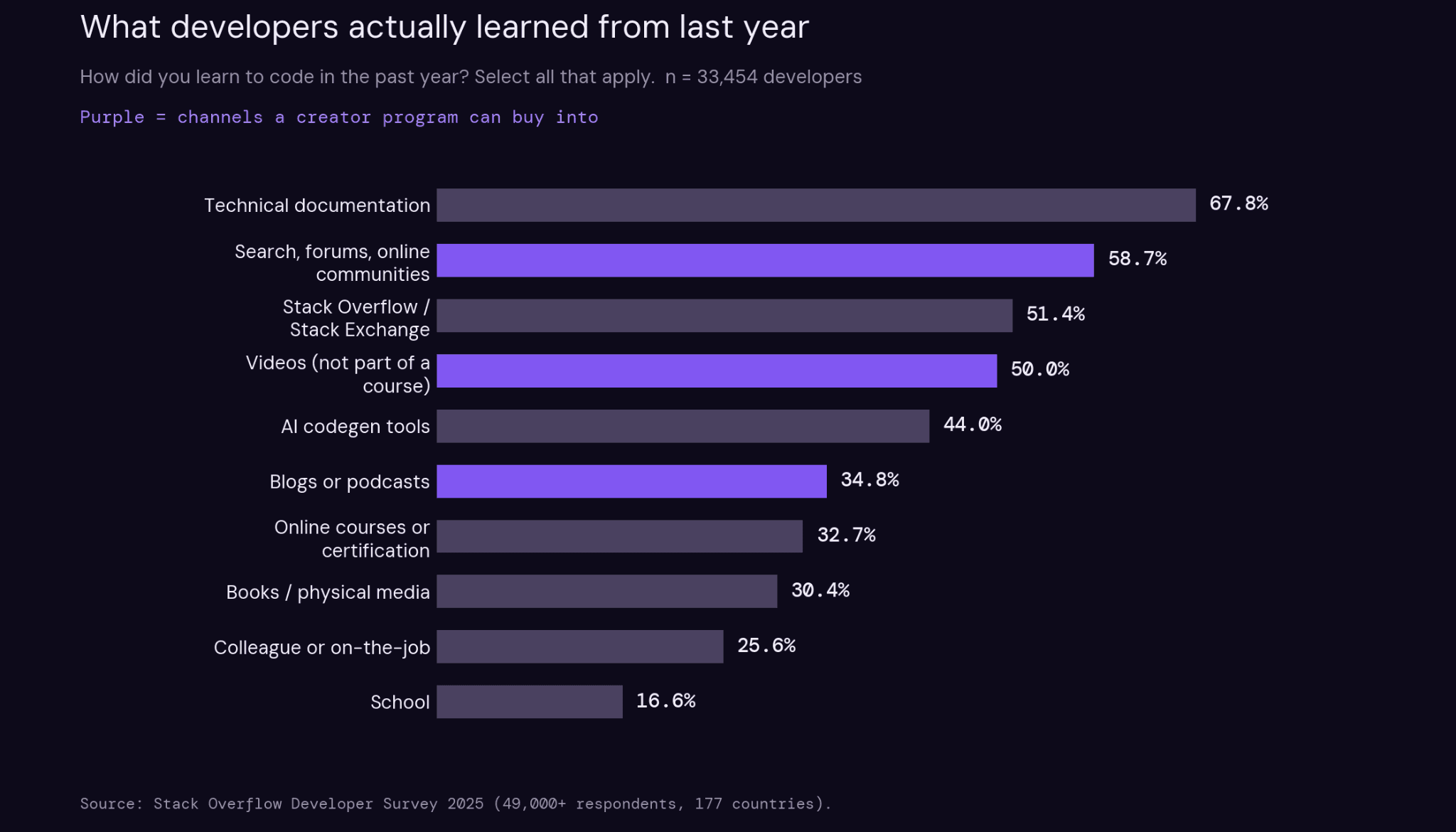
Half of all developers learned something from video last year. That is your case for creator video, and it is a stronger one than any engagement-rate argument. The practical move is to fund the channels where verification actually happens and treat Instagram and TikTok as awareness experiments with their own separate, smaller budget line.
If you want the roster mapped to those surfaces before you commit budget, Infrasity's B2B influencer marketing team builds and shares the full creator shortlist and channel split for your niche, with verified follower counts and conflict flags, before you spend anything.
4. Give up control of the message, including the criticism
Buy attention, not opinion. A brief that dictates wording converts a credible practitioner into an expensive spokesperson, and the audience detects the swap immediately.
Emily Freeman, co-founder of the influencer marketing firm Freeman & Forest and previously head of community at AWS, draws the line cleanly: "If you want to control the actual messaging from a word-to-word perspective from an influencer, influencer marketing is not what you need. You need traditional advertising." On the same point, she cites a rule her firm adheres to: "You're buying attention, you're not buying an opinion."
There is a harder version of this argument, and it comes from the buying side.
Buyers actively search for the negative case
Matt Thompson, Director of Developer Adoption at Google Cloud, described his own evaluation habit on camera: "Once I get into a topic, then I'm going to go look for five people saying really negative things about it and then probably three or four people saying some really positive and then try to balance that and figure out where I think I sit on this."
Read that as a media-buying instruction. A senior technical decision-maker at a hyperscaler weights negative coverage more heavily than positive coverage and deliberately looks for it. If every piece of content carrying your name is uniformly enthusiastic, you have not saturated the search. You have failed it, and the buyer concludes the positive coverage was bought.
What to put in the brief instead
Specify what must be technically correct, not how it should sound. Give demo access, a named engineer who answers questions within the day, and a review pass for accuracy only. Ask the creator to leave the errors in. Then let them decide what the ad read sounds like.
One discipline does belong to you: message consistency across the roster. If four creators describe your product four different ways, you have paid several people to confuse the same audience.
5. Commission the written artifact alongside the video
Ask for a repository, a Dev.to post, or a comparison table in every brief, and price it into the deal. Video converts the viewer. Text is what gets quoted back to the next buyer six months later.
The mechanism is retrieval. When a developer asks a model what to use for a given job, the model answers by citing pages its ranking systems retrieved, then links to the sources it drew on.
Google's own AI features guidance calls this retrieval-augmented generation, running on the same systems as Search. Its stated route to eligibility is a unique, first-hand point of view rather than recycled commodity content. A creator who genuinely built something with your tool produces exactly that, on a third-party domain, which is the kind of source these systems favor over your own marketing pages.
So a single tutorial now does three jobs: it converts the viewer, it ranks for the query it teaches, and it becomes a citable source shaping what a model says about your category next quarter.
Deals are still priced for the first job alone. That gap is a temporary arbitrage, and it closes as soon as creators start charging for the third.
Two practical notes. Upgrade candidates who already cross-post to Medium, Substack, or Dev.to, because they can be co-authors rather than just amplifiers. And ask for the comparison table specifically, since comparison content is disproportionately what gets pulled into answers when a buyer asks which of two tools to pick.
Contested category? Our AI GEO optimization service runs answer-engine visibility as its own measured track, so you can see whether creator artifacts are actually landing in model answers. The related reading is answer engine optimization for developer tools.
6. Sponsor the small, dense list before the large, loose one
Buy audience density, not audience size. A 1,500-subscriber newsletter read by platform engineers is worth more than a 400,000-follower generalist tech account, and it costs a fraction as much.
Freeman reports this as the finding that surprised her most. Asked which platforms actually perform, she answered: "The platforms that perform the best by far are newsletters, and second place is LinkedIn." She explicitly added the reversal: "Whereas two years ago I would have said TikTok, Instagram, short-form video was the winner, right now I would say not as valuable to companies as they were."
The entry price is low. Her firm sponsors lists in the 1,000 to 5,000 subscriber range. At that size, you are buying a named, self-selected professional audience with a direct click path, which is why the conversion holds up even when the raw reach looks unimpressive next to a video.
The same logic extends to community placements. A live AMA in a creator's Discord before a launch reaches fewer people than a YouTube video, but it reaches them in a conversation, which is a different and often better purchase. Our guide to developer community engagement covers how those placements are structured.
7. Build creators internally, because the external supply is constrained
Fund your own engineers as creators in parallel with the external roster. The external market runs out before the demand does, and you are competing for the same forty people as everyone else in your category.
Emily Freeman, who sits between brands and creators, states the shortage directly: "We are absolutely supply-side constrained. I'm going to run out of influencers way faster than I run out of clients who want this." Once your competitors have partnered with the obvious names, prices rise, and exclusivity windows become harder to negotiate.
Your engineers already hold the expertise. What they lack is the audience, and that can be built. The internal version also solves a problem the external version never does: your staff can speak to the roadmap, the known limitations, and the migration path with an authority no sponsored creator can borrow.
Matt Thompson frames the strategic reason to do both at once: "Not all the smart people are going to work for you... you have to have a strategy for innovation happening elsewhere." The internal program covers what you know. The external roster covers everything happening beyond your walls, which is most of it.
Practically, this means giving named engineers time, editing support, and explicit permission to publish opinions that are not pure marketing. It is slower than buying a placement, and it does not decay when the budget stops. For the boundary between this and a formal advocacy function, see what DevRel is and where it stops.
8. Brief for the buying committee, not just the developer
Write the campaign for two readers: the engineer who evaluates, and the internal champion who has to get the purchase approved. Most creator programs serve only the first, then lose the deal in the second.
A technical buyer who is fully sold still has to convince a security team checking compliance, a procurement function negotiating contracts, IT leadership assessing long-term scalability, and often a colleague who used your product two years ago at a different company and did not like it. Deals stall here far more often than they stall on product fit.
Creator content can carry part of that load if you brief for it. Ask for the piece to name the integration constraints honestly, to show the security-relevant configuration, and to state what the product does not do. That content becomes the champion's evidence, and it disarms the objection before the security review raises it.
The rest is on your own properties. Publish pricing, security documentation, and architecture diagrams without a form in front of them. If a buyer has to book a call to get a compliance answer, they will take the competitor who published it. This is not a creator strategy on its own, but it determines whether creator spend converts.
9. Run the roster as a portfolio, and rotate it
Book four to six creators across at least two channels rather than one creator repeatedly. A single voice is a single point of failure, and repetition on the same audience decays fast.
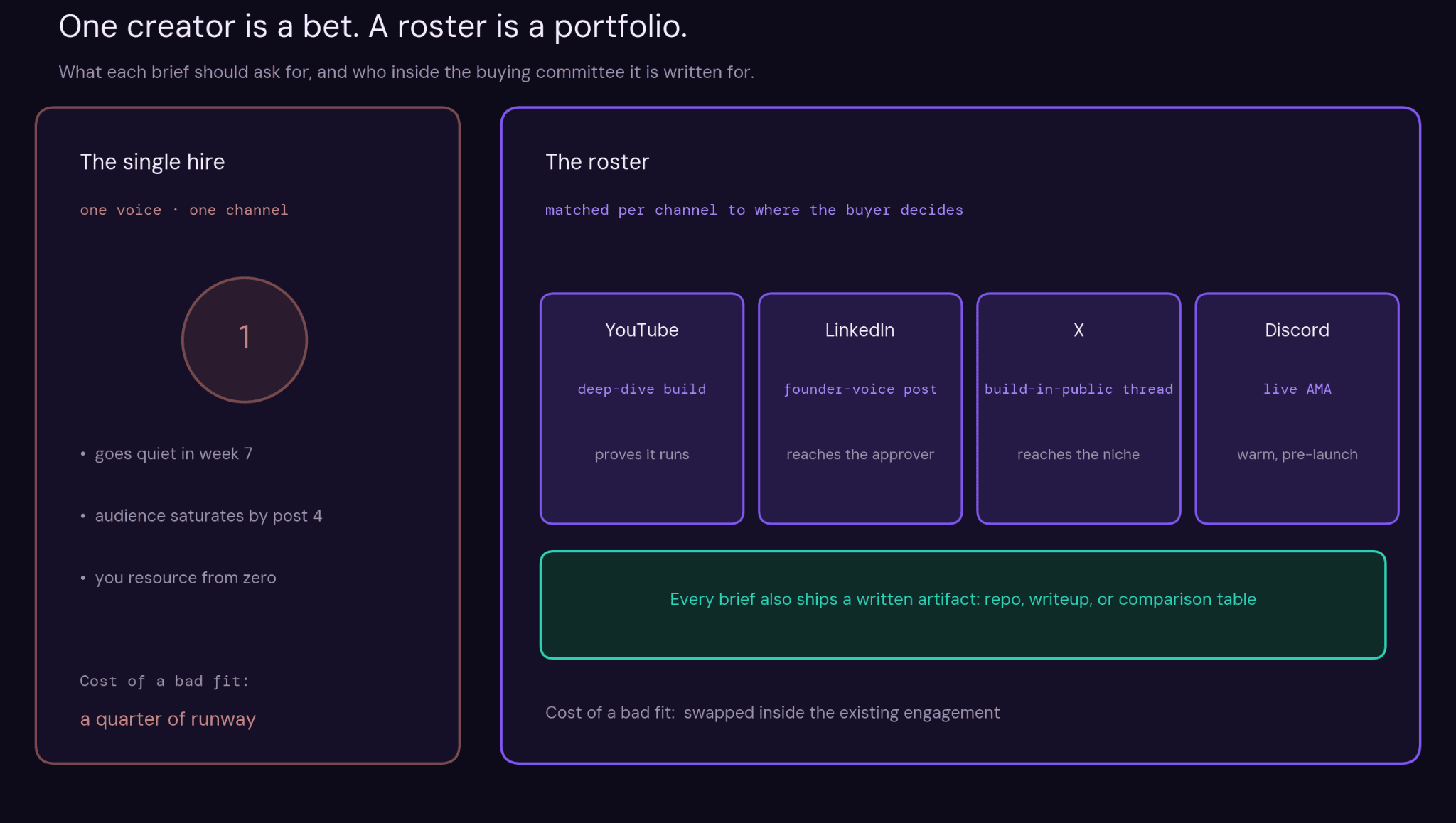
Three failure modes are worth naming. A solo creator can go quiet mid-campaign, and you resource from zero. Repeat promotions to the same audience produce diminishing returns within a few posts, so the fourth placement with the same person rarely matches the first. And a creator who quietly advises a competing product will not volunteer that fact, which is what the conflicts column on a vetting sheet is there to catch.
Match the format to what you are asking someone to do next. YouTube works when the product needs to be seen in action. LinkedIn reaches the person who signs off, not the person who installs, and our nine rules for LinkedIn creator placements cover the changes on that platform. X delivers fast reach inside a tight technical niche. Discord suits warm conversations immediately before a launch.
One legal note that belongs to you rather than to the creator. Under the FTC's endorsement guides, disclosure is the advertiser's problem: "Your company is ultimately responsible for what others do on your behalf," and delegating to an agency "doesn't relieve you of responsibility under the FTC Act." The same guidance notes that a single non-compliant creator is unlikely to trigger enforcement if you have a reasonable training and monitoring program in place. Build the program. It costs a checklist.
10. Take the baseline before you spend, then judge on a 90-day window
Measure your position before the first placement goes live, because a lift you never baselined is a lift you cannot prove. Teams skip this step more than any other, and it decides whether the program survives its first budget review.
The measurement gap in B2B content is well documented. In the 2024 Edelman-LinkedIn B2B Thought Leadership Impact Report, a survey of 3,484 business executives, 19% of producers had no process at all for measuring effectiveness, 42% still measured by watching for traffic increases, and only 29% could link a sales lead back to a specific piece of content.
The same report shows what that costs. 86% of decision-makers said they were likely to invite a company that consistently produces high-quality thought leadership into an RFP. Only 38% of producers expected their content to do that. The channel gets undersold internally because no one has measured it.
The three layers that actually work
Unique links per creator, with UTM source and campaign set to the creator name. PostHog supports both patterns: per-video links via a short-link service and per-creator redirects such as posthog.com/theo.
Self-reported attribution, which means asking the creator to tell their audience to mention them at signup. This catches the developer who watched on a phone and signed up from a laptop three weeks later, which no UTM will ever see.
A pre-measured baseline, taken before any money moves: your branded search volume, your citation share across the buying prompts that matter in your category, and your current signup rate from organic. Run it, write it down, then spend.
Then hold the read for 90 days. A creator touch commonly precedes a signup by four to six weeks. Compute cost per attributed signup per creator at day 60, cut the bottom half without sentiment, and note which format won rather than only which creator won.
What should influencer marketing cost, and how long before it works?
A useful pilot for a pre-seed-to-Series B company runs $3,000 to $15,000 and buys three to five creators across two channels over about three months. A four-creator, two-channel engagement typically lands near $4,200.
It is nothing compared to the ROI it usually delivers. According to Amra & Elma's 2025 B2B influencer marketing research, which surveyed marketers running active programs, the average ROI reported was 647%.
Timelines are the part worth setting expectations on internally. Some signups appear within days of a post going live. The larger return arrives over months, as the content keeps being found and referenced. Six weeks buys you a signal about which creators and formats work. Twelve months buys you a channel.
The compounding is real, and it is the argument for programs over one-offs. One of Infrasity's creator posts was still linked in an r/devops thread as the answer to a question eight months after publication. The paid campaign it sat inside stopped delivering the day the spend stopped.
What can go wrong in B2B influencer marketing, and how do you fix it?
Here are a few things we've often seen go wrong, so make sure not to repeat them.
| Failure | Symptom | Fix |
|---|---|---|
| Over-briefing | Comments call the video an ad; engagement is half the creator's norm | Specify accuracy requirements only; let the creator write the read |
| Paid on subscribers | High invoice, low sessions, CPM above $150 | Reprice on median views of the last ten videos |
| No baseline | Cannot answer "what did this do" at the budget review | Record branded search, citation share, and organic signup rate before spending |
| Weak positioning amplified | Four creators describe the product four ways | Fix the one-line positioning before booking anyone |
| Same creator, repeated | Post four underperforms post one by a wide margin | Rotate the roster or change the format |
| Undisclosed conflict | Creator advises a competing product | Conflicts column in the vetting sheet, checked before payment |
| Judged at 30 days | Best channel gets cut, worst channel survives | Hold the read to 90 days, attribute across three layers |
The pattern underneath most of these: amplification multiplies whatever already exists. If the positioning is fuzzy, a creator program distributes a fuzzy message faster and more expensively. Sequence it as positioning, then proof, then amplification.
Where this leaves your next campaign
You now have the casting rule, the pricing arithmetic, the channel split that matches how technical buyers actually verify, and the three-layer measurement that survives a budget review. The gap in this channel has never been belief. It is that 99% of the online resources you'd see only don't talk about technical buyers, so the advice on offer doesn't describe your buyer, and the programs built on it cannot tell a good creator from an expensive one or prove what happened afterward.
Start with the baseline in step one. It takes only a couple of hours, and it tells you whether the rest of this applies to your situation.
If you would rather have that run with you, Infrasity builds vetted creator rosters for DevTool, AI infrastructure, and observability teams, with verified follower counts, conflict flags, price bands, and an attribution dashboard that ties reach back to signups. We share the roster and the full budget before anything is briefed.
Frequently Asked Questions
Does B2B influencer marketing actually work, or is it a consumer tactic?
It works differently. There is no impulse purchase in B2B, so a creator post doesn't produce a sale on its own. What it does is compress evaluation: a practitioner the buyer already follows says, "I used this; here is what happened," which replaces weeks of quiet solo research. Ogilvy's survey of 550+ senior B2B decision-makers found 75% of B2B businesses already use influencer marketing and 93% of those plan to increase it.
How many followers does a B2B creator actually need?
Fewer than the rate card implies. Density beats size: a creator with 15,000 genuinely engaged developers in your exact niche typically outperforms one with 400,000 generic followers because overlap with your buyer converts. PostHog's practical floor is 5,000 views per video with no upper limit on size.
How is this different from DevRel?
DevRel is your own people building relationships that outlast any campaign. Creator marketing is borrowed reach from people who already hold an audience. They are complements, not substitutes, and both fail if the product experience is poor. Budget them separately.
Should we disclose paid placements, and who is liable if we don't?
Yes, and the liability is yours. The FTC's endorsement guides place responsibility on the advertiser, and hiring an agency does not transfer that responsibility. Require clear disclosure in every contract and keep a written training and monitoring process, which the FTC treats as a mitigating factor if an individual creator slips.
What is a realistic budget for a first test?
Three to five placements, in the $3,000 to $15,000 range for an early-stage company, run over roughly three months. Treat it as an amount you can afford to lose entirely, judge it on cost per attributed signup rather than reach, and scale only the creators and formats that clear your bar.
Can this improve how AI assistants describe our product?
Indirectly, and it is one of the stronger reasons to run the program. Models answer from retrieved sources, and creator-authored text on third-party domains is exactly the kind of independent source they draw on. Video alone contributes far less, which is why the written artifact belongs in every brief.