
TL;DR
- The seven worth a call are Infrasity and Plug.Dev, The Outloud Group, NeoReach, The Goat Agency, Famesters, and Viral Nation. Only the first two are built for products a developer has to install.
- Pick a specialist if your product requires an install, API key, or CLI: Infrasity is the strongest fit because they focus on developer audiences and technical creator programs.
- Judge creators by actual views, not subscribers: use the median views from recent videos and check engagement quality before approving a creator.
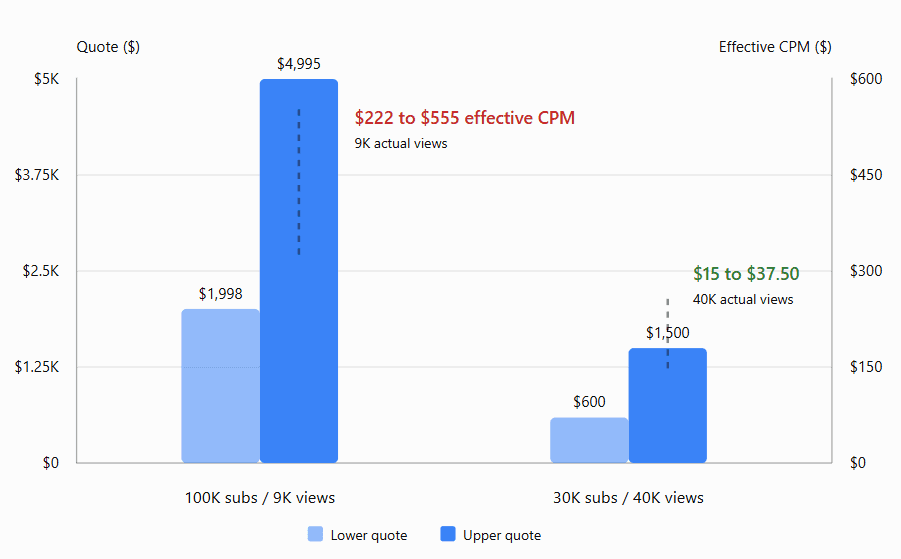
- Always convert quotes into effective CPM: a 100K-subscriber channel getting 9K views can cost $222 to $555 CPM, while a 30K-subscriber channel getting 40K views can cost only $15 to $37.50 CPM.
- Developer videos need proof. The product should be shown working, including the install and even failed runs, because technical audiences judge credibility through the actual workflow.
- Before choosing an agency, ask one question: "Name the last developer tool you cast for and send me the video." Then inspect the video and comments yourself.
Here is the number that should shape this shortlist. We pulled the live US desktop results for "youtube influencer marketing agency" and opened every agency site Google ranks or cites on page one, including the five named inside Google's AI Overview. Twelve agency domains. Eleven served us their pages.
Across every YouTube service page and every reachable case-study index on those eleven, not one names a developer tool, an API, a CLI, an SDK, or an infrastructure product as a client.
This blog covers what each of the seven actually ships on YouTube, what a developer video has to do differently at the casting, briefing, and editing level, what a placement should cost and how to check a quote with arithmetic, and the ten questions that separate a real YouTube program from a media buy.
What does a YouTube influencer marketing agency actually own, and where does it stop?
A real YouTube agency owns six things end to end: sourcing, vetting, rate negotiation and contracting, the creative brief, disclosure compliance, and attribution back to a signup. Anything less than six is a subcontractor, and you will be filling the gaps with your own team's time.
The six deliverables, defined
Sourcing is building a candidate list from something other than a search bar. Ask what tool they use. PostHog names Kuli for discovery and Social Blade for checking whether a channel's view curve is still growing. The Goat Agency built its own, called IBEX, on ten years of campaign data. NeoReach indexes over 250 million creators.
Vetting is the part almost nobody productizes. It means verified view medians rather than subscriber counts, an audience-overlap verdict against your ICP, and a written conflicts column recording whether the creator advises a competitor. Our own DevTool influencer playbook publishes the exact sheet, including three real flags we caught on one roster.
Negotiation and contracting cover slot type (pre-roll, mid-roll, end-roll, full integration), usage rights if you plan to run the footage as a paid ad, exclusivity windows relative to competitors, and payment terms. PostHog pays net 30 and says the first quote from a new creator is usually negotiable.
Brief is guidance on what must be technically correct, not a script. More on why in the next section.
Disclosure compliance is a legal function, not a checkbox. The liability sits with you rather than the creator, and the FAQ at the end of this piece covers what the FTC and YouTube each require.
Attribution is three layers, not one: a unique link per creator, a "mention them on signup" field, and a pre-measured baseline taken before any money moves.
What doesn't a YouTube influencer marketing agency do?
An agency is not a substitute for DevRel: DevRel is your own people building relationships that outlast a campaign, a creator program is borrowed reach, and the two fail together if the product experience is bad.
It is also not a video production studio, because product footage for your own channel and your docs is a different purchase with a different crew, which is why we run tech video production as a separate service from creator campaigns.
And it is not talent management, which matters because an agency that also represents creators is negotiating against itself when it sets your rate. Ask directly which side of the table they sit on.
Why does a developer video need a different casting and production model than a consumer one?
Because the unit of proof is different: a consumer video needs the viewer to want the thing, while a developer video needs the viewer to believe the thing works, and the only evidence that clears that bar is watching it run.
This is the section most agencies cannot execute even when they understand it, so it is worth going through mechanism by mechanism.
The screen is the product, so the edit has different rules
In a consumer integration, the creator holds the product and the camera stays on their face. A developer integration is mostly the creator sharing their screen and explaining what is happening, so the viewer is reading terminal or IDE output faster than the creator is talking.
That changes concrete production decisions. Font size has to survive a phone screen, because a meaningful share of dev viewing is mobile, and a 12-point terminal is unreadable at 6 inches. Cuts cannot skip the install. If the creator jumps from npm install to a working dashboard, the audience assumes the middle was painful and hidden.
And the failed run stays in. When someone hits an auth error and fixes it on camera, that thirty seconds is the single most persuasive part of the video, because it is the part a paid ad would never include.
Ask any agency you are evaluating how they brief the edit. If the answer is about pacing and hooks and nothing about the terminal, they have made consumer videos.
Casting on views, not on subscribers
The single most expensive mistake in this channel is buying a subscriber number. Subscriber counts are cumulative and never decay. View counts are current demand.
PostHog publishes the cleanest public thresholds anyone has, in its company handbook, and they are worth holding an agency to:
| Engagement quality | Comments per view | Likes per view |
|---|---|---|
| Weak | 0.001 | 0.02 |
| Average | 0.001 to 0.002 | 0.02 to 0.03 |
| Good | 0.002 to 0.005 | 0.03 to 0.05 |
| Excellent | 0.005+ | 0.05+ |
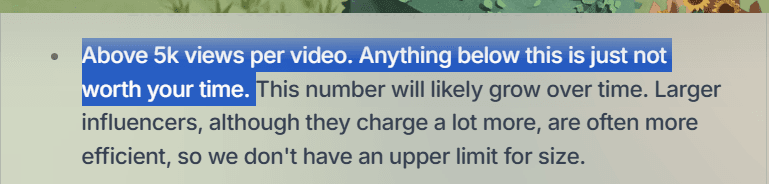
They also set a hard floor of above 5,000 views per video, with no upper limit on channel size, and note that larger creators are often more efficient despite higher fees. Comments per view matter more than likes per view for technical products, because a comment is someone stopping to argue about the implementation. That is the behavior you are buying.
Categories to exclude even inside developer content
This is where technical casting stops being a vibe and starts being a filter. PostHog names the developer sub-categories it avoids: job interview prep, career growth, low-level engineering, and heavy computer science content.
The stated preference runs to web and mobile developers, product engineers, startup founders, and indie hackers.
The logic is simple once you see it. An audience watching interview prep is optimizing for getting hired. They have no budget, no stack authority, and no reason to adopt your tool this quarter. A 200,000-subscriber interview-prep channel will produce decent reach and close to zero pipeline.
Any agency selling you a devtool campaign should be able to name three developer sub-categories they would refuse to cast from and say why. If they cannot, they are casting on reach.
The comment section is a permanent peer review
On a consumer video, the comments are sentiment. On a developer video, the comments are a technical audit that outranks the video in search for years, and increasingly they are the text a language model reads when someone asks it what to use for your category.
Stack Overflow's 2025 Developer Survey explains why that matters more now than it did two years ago. 84% of developers use or plan to use AI tools, and 51% of professionals use them daily. But 46% actively distrust the accuracy of the output against 33% who trust it, and only 3% say they highly trust it. Among developers with ten or more years of experience, 20% highly distrust it.
Asked what would still make them ask a human in a future where AI does most coding, the top answer, at 75%, is "when I don't trust AI's answers."
So the buying path is: ask the model, get a shortlist, then go verify it against a human. A creator video with a live comment thread is exactly that verification surface. Which means the comment section is not campaign exhaust. It is the asset.
Ask for the written artifact, every time
Models cite text far more readily than they cite video. A tutorial that exists only as a YouTube upload converts the viewer and then goes quiet in every AI answer about your category.
Put a written companion in the brief: a Dev.to or Medium writeup, a public demo repo, or a comparison table. It costs the creator an hour, and it doubles the half-life of the placement.
We treat this as its own measured track alongside AEO work for developer tools, because a creator video and an AI citation are now the same budget line.
One more mechanical detail worth insisting on: the link goes in the top three lines of the description. Below the fold is money burned.
The 7 best YouTube influencer marketing agencies in 2026
Ordered by how much technical casting judgment each one holds in-house, and how much public, checkable proof exists that they have done this for a product developers install. Every claim below came off the agency's own live site.
1. Infrasity
What Infrasity owns on YouTube: the full sequence for technical products. Sourcing and vetting across YouTube, LinkedIn, X, and Discord, rate negotiation with the budget shown to you before anything is briefed, creative direction in the creator's own voice, and an attribution dashboard reporting reach, engagement, and attributed signups per creator and per channel. The YouTube format they run is an 8 to 12 minute sponsored deep-dive or build video, used when the product has to be seen working rather than described.
YouTube-specific proof: the service page publishes the operating numbers rather than describing them. 200+ creators screened per engagement. 218K+ monthly reach. A worked example budget of $4,200 for four creators across two channels, approved by the client before briefing, with no hidden markups. 641 attributed signups and 16 threads spawned across Reddit, X, and community channels from one program.
The engagement comparison they publish is the sharpest: 61% click-through on a practitioner's LinkedIn post next to 3% on a sponsored post in the same feed, 312 likes against 6, and 48 comments against zero. On compounding, they report a creator tutorial being linked as the answer in an r/devops thread eight months after publication, against a sponsored campaign that stopped the day the spend stopped.
The roster is named and checkable. It includes: Piyush Garg (400K), Astro K Joseph (82.4K, AI agents), Eric Tech (68K), Rohit Ghumare (53.4K, DevRel and agent memory), Vivek Mishra (35.4K), Yashica Jain (30.4K, AI automation), down to Md Waqar Tabish (1.32K, DevOps, CI/CD, Kubernetes). The presence of a 1.32K DevOps creator on a public roster is itself the signal.
What clients say: on the record, Cindy Blake, VP Marketing at Firefly.ai, credits the team with being quick to onboard and understand how to show off cloud asset management. Debosmit Ray, founder at DevZero, cites product videos that made it easier to engage users across different tech stacks. Abhilash, Head of Marketing at Amnic, says the engagement bore fruition within the first three months.
Pricing: Published entry band of $3K to $15K to test creator distribution, aimed at DevTool and AI infra teams. The roster and the full budget are approved by you before a single brief goes out.
Best for: DevTool, AI infrastructure, and observability companies that need the creator vetted by someone who can read the code, and need signups attributed rather than impressions reported.
Where it stops: This is not a consumer or DTC operation, and it is not built for enterprise brand campaigns measured in reach. If your target is a 40-market product launch with a media budget in the millions, look at entries 5 and 7.
Want the roster before you spend anything? We will build the vetted shortlist for your niche with verified view medians, an ICP verdict per creator, a conflicts column, and price bands, and show you what a campaign looks like on your channels. Book a free consultation, and we will review your current shortlist first.
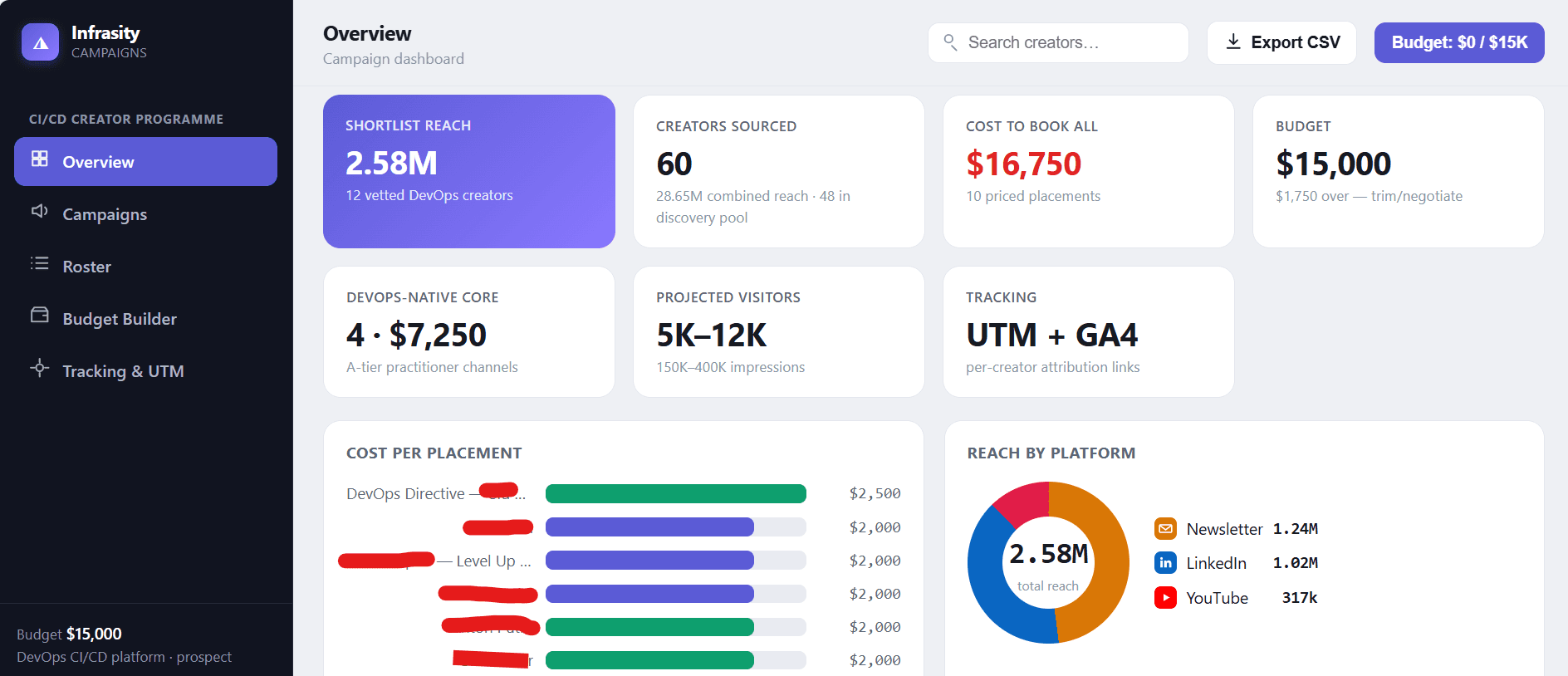
The platform you get access to: every engagement runs inside Infrasity's own campaign workspace rather than a shared spreadsheet, so you see the same sourcing pool, the same price per placement, and the same per-creator attribution the team works from. It is built for devtool programs specifically: creators are graded on ICP fit, budgets are approved before anything is briefed, and every number below is either a quote or an attributed result.
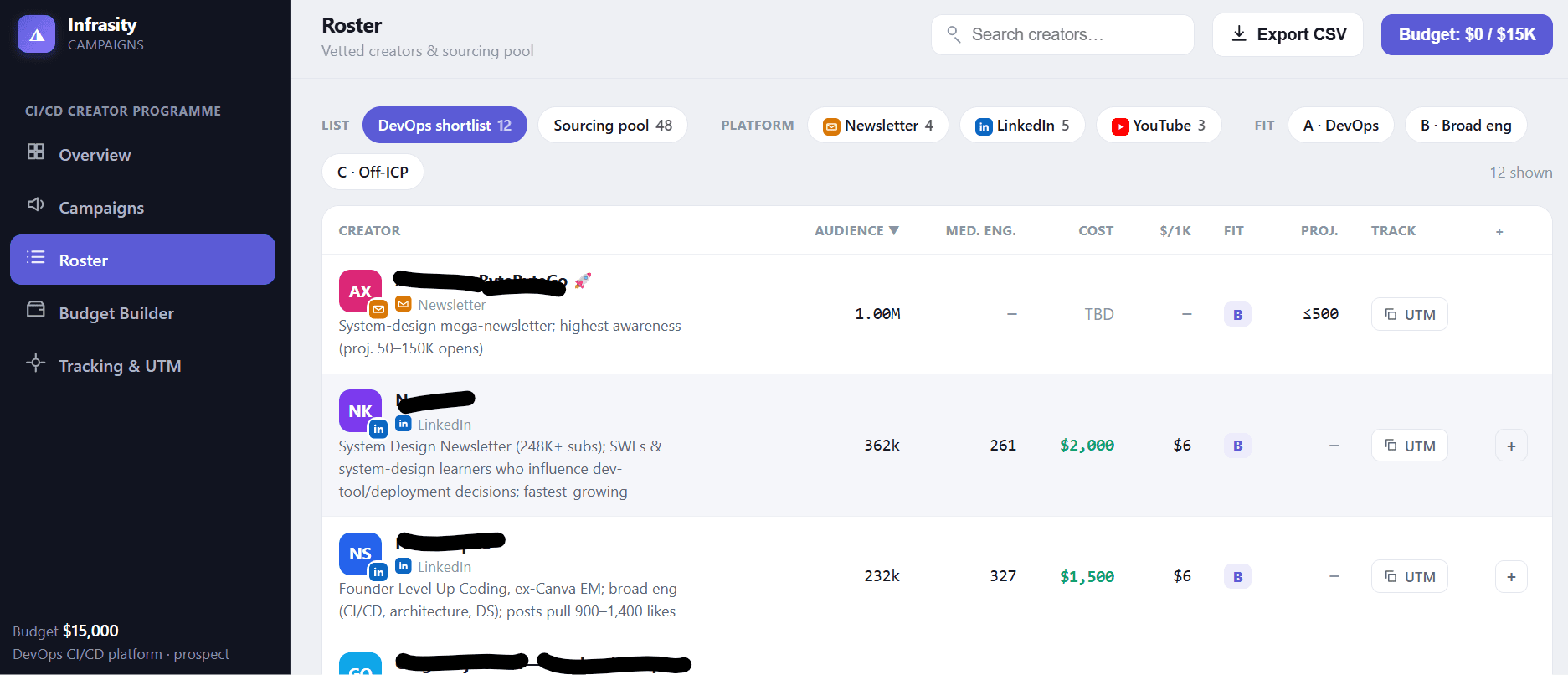
Roster and ICP fit. Each creator carries platform, audience, median engagement, quoted cost, cost per 1K reach, and a fit grade: A for DevOps-native, B for broad engineering, C for off-ICP. Filter chips separate the vetted shortlist from the wider sourcing pool. The fit column is what stops a million-subscriber generalist from outranking a 232K platform-engineering channel whose audience is entirely your buyer.
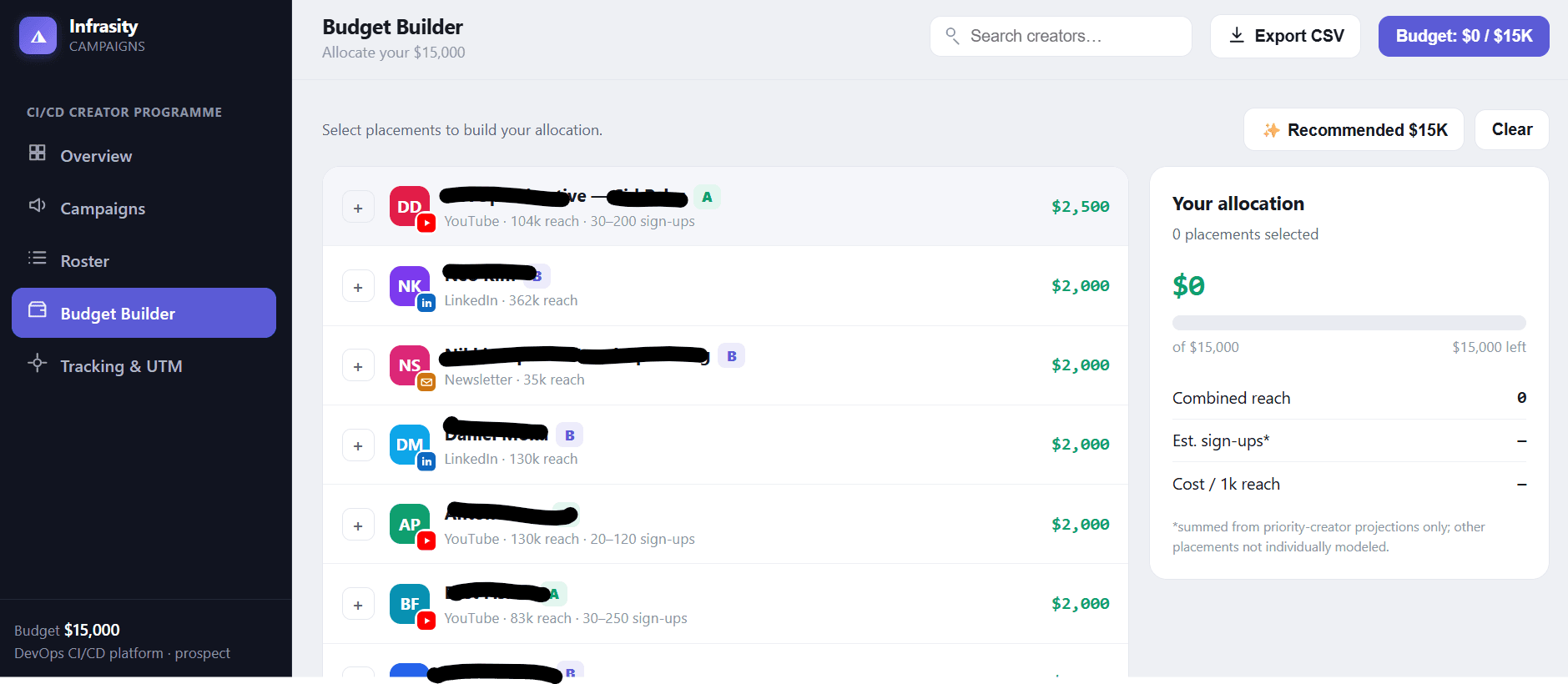
Budget builder. You allocate a fixed budget across named placements and watch combined reach, estimated sign-ups, and cost per 1K reach recalculate as creators go in and out. Nothing is booked until you approve the allocation, which is the roster-and-budget-approved-before-briefing rule enforced in software rather than promised on a call.
Campaign reporting. Live and planned campaigns each report impressions, clicks, sign-ups, and CPA against spend, and every forecast stays a range rather than a single confident number. A projection of 120 to 300 sign-ups can be judged after the fact; one of 220 cannot.
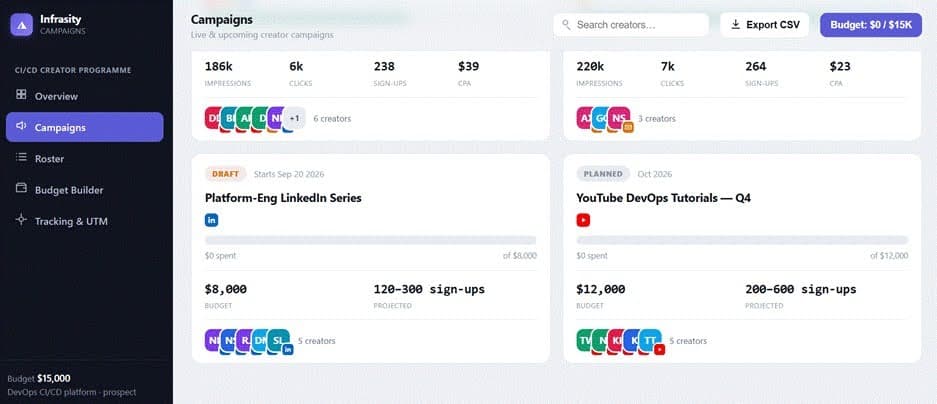
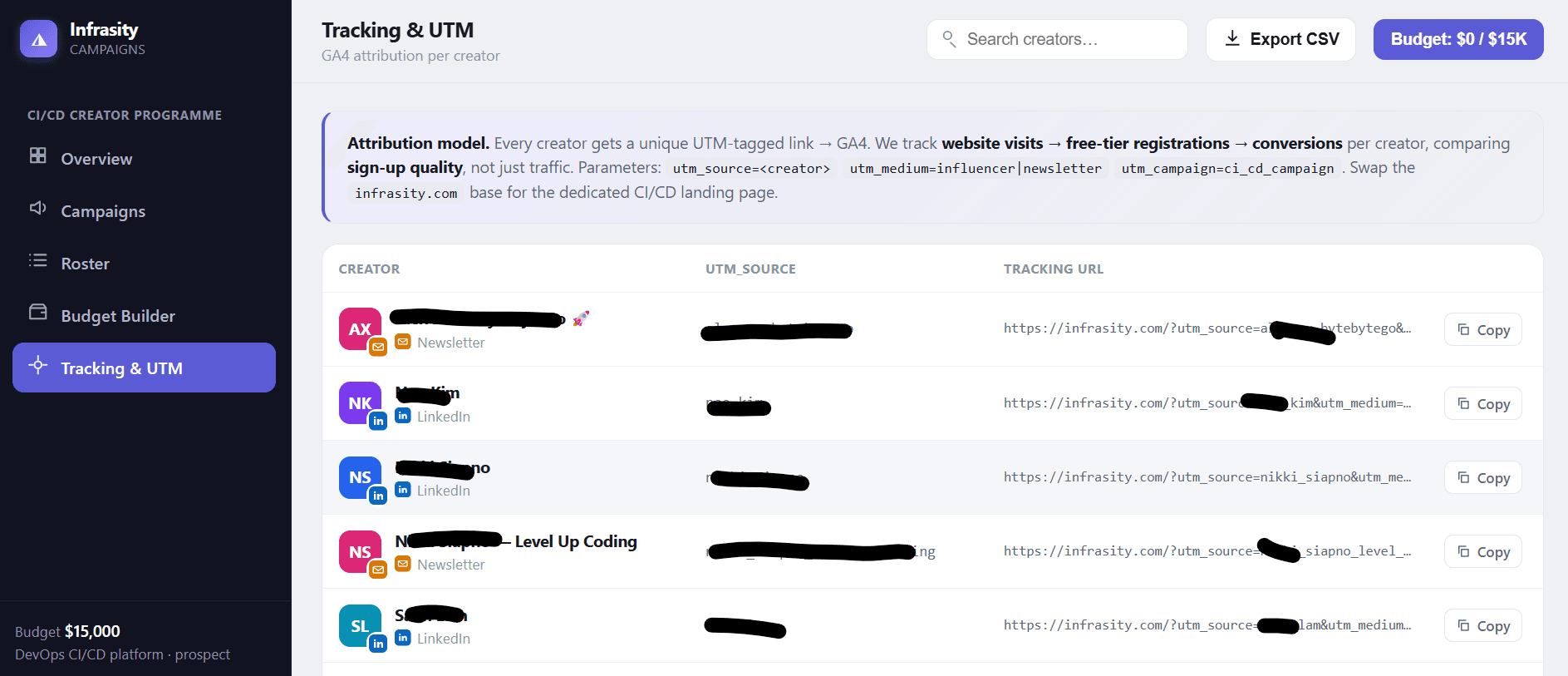
Per-creator attribution. Every creator gets a unique UTM-tagged link into GA4, so website visits, free-tier registrations, and conversions are attributed to the individual creator rather than to the campaign as a whole. That is the three-layer attribution described earlier in this piece, with the links generated for you and copyable per row.
2. Plug.Dev
What Plug.Dev owns on YouTube: Dev influencer marketing as a productized program, built on a dedicated network the founder calls Creators That Code, meaning engineers, educators, and community builders rather than tech commentators. The offer spans YouTube partner programs, launch campaigns, and video production at scale, plus cross-channel distribution into Reddit and daily.dev and a beta for community-generated content. They also convert creator video into AEO-ready written content, which is the same insight covered above about models citing text.
The YouTube-specific proof: The creator side of the business is public and verifiable, which is rare. Testimonials on the creator page come from Web Dev Simplified (1.7M subscribers), Santiago (1.7M), Kevin Powell (980K), Coding with Lewis (690K), DevOps Toolbox (690K), and Connor Ardman (124K). The brand-side testimonials name Anthropic, Neon, Descope, Dub, and Cassidy Williams at GitHub.
Their dev influencer playbook publishes a funnel-to-format map that is the clearest public breakdown of the category: ad integrations and dedicated videos for awareness, drop-in integrations and commentary for evaluation, example apps and tutorials for adoption, and open-source projects plus micro-courses for retention.
What clients say: Coding with Lewis, writing on behalf of an Anthropic partnership, calls them the best at YouTube partnerships specifically. Steven Tay at Dub describes them as essential for nailing influencer marketing to developers.
Pricing: No published rates. Platform plus agency plus network hybrid, sold on a demo call.
Best for: DevTool companies that want scale on YouTube specifically, with access to creators in the 500K to 1.7M subscriber range who already run sponsorships professionally.
Where it stops: The model leans toward the creator network as the primary asset. If your problem is that your positioning is unclear or your category story is not yet sharp, amplification will distribute the fuzziness faster. Sequence positioning first.
3. The Outloud Group
What The Outloud Group owns on YouTube: long-form YouTube integration as a core discipline, not a platform on a list. They define the product precisely: a 30 to 90 second branded segment inside creator content, with a verbal and on-screen call to action and a clickable link in the description. They also sell dedicated full-length videos, Shorts, paid amplification of creator content, and podcast advertising, which is often the right adjacent buy for a technical audience.
The YouTube-specific proof: They are an officially designated YouTube preferred agency partner, and they are one of only two agencies in our audit that publish any YouTube numbers at all. Their campaigns page states a $30 to $100 CPM range, a 0.3% to 0.7% click-through range, and a $30 to $300 cost-per-acquisition range, all varying by vertical and creator. Publishing a CPA band in public is a level of specificity nobody else in the set matches.
What clients say: The named work is consumer. Fiverr with The Old Gays produced 3.3M+ views and 182K likes and comments. Other named campaigns cover Grubhub, McDonald's, and Olympic and NCAA athlete activations.
Pricing: No retainer figure published, but the performance bands above give you more to negotiate against than any other agency here.
Best for: B2B SaaS with a broad, non-specialist buyer, where the creator does not need to write code to make the placement land, and where you want a partner who will argue about CPA rather than impressions.
Where it stops: There is no developer casting layer. Fiverr is the closest thing to a technical client in their public work, and it is a marketplace, not a tool with an install step. Budget internal engineering review time.
4. NeoReach
What NeoReach owns on YouTube: full-service influencer marketing plus paid amplification, UGC production, and an API for programmatic reporting, run through a proprietary index of over 250 million creators. Twelve verticals are each staffed with a senior team, and the technology vertical is described specifically as LinkedIn and YouTube creators with technical authority.
The YouTube-specific proof: they are the only agency in the research whose technology vertical page frames the problem correctly, naming long, evidence-driven purchase cycles, teardown videos, and benchmark reviews as the mechanism. On scale: $350M+ in influencer spend managed since 2013, and 90% of clients renewing for additional activations. The named tech case is NVIDIA, a paid social program across TikTok and YouTube reporting 3.3M impressions, $266K in influencer media value, and 46.7K engagements.
What clients say: the client list is the argument. NVIDIA, Netflix, Walmart, FanDuel, Airbnb, Robinhood, FIFA, and The New York Times since 2013.
Pricing: enterprise scoping, no published rates. The API product suggests they will integrate reporting into your own stack, which matters if your team lives in a warehouse rather than a dashboard.
Best for: Later-stage B2B SaaS with a real media budget that needs measurement rigor and wants creator data flowing into existing BI, and companies whose technical buyer overlaps with a consumer-tech audience.
Where it stops: NVIDIA is a hardware brand with a consumer audience, and the reported metrics are impressions, media value, and engagements. No signup or activation number appears in the public work. If your success metric is API calls, you will be building that measurement layer yourself.
5. The Goat Agency
What The Goat Agency owns on YouTube: end-to-end campaigns across long-form YouTube and Shorts, including strategy, creator discovery, content production, paid media behind creator content, and multi-market execution. Discovery and pricing run through IBEX, their own tool built on ten years of campaign data.
The YouTube-specific proof: the strongest genuinely B2B case study in the whole audit belongs to them. IBM briefed Goat to promote Granite, its purpose-built large language model, to developers and C-suite decision-makers. IBEX identified seven creators, all developers or tech and AI experts, and the campaign ran short-form across LinkedIn, TikTok, Instagram, and YouTube Shorts with paid amplification behind it. Reported results: 43M impressions, 9M engagements, and 68K link clicks.
Their stated creative rule is that they never script creators and instead supply the messages that must land. Elsewhere: Dell, plus 50K campaigns and 10BN views claimed across the agency's history since 2015.
What clients say: the public work names IBM, Dell, CarGurus, NIVEA, Heineken, Arla, Arm & Hammer, and World of Warcraft, where 10 influencers produced 631K engagements.
Pricing: enterprise, no published rates. Offices in London and New York, with campaign delivery across 37 markets.
Best for: Established B2B technology brands running a category-level awareness play in multiple markets, especially where the audience includes both engineers and the executive who signs.
Where it stops: The IBM work was short-form and measured in impressions, engagements, and clicks. That is a brand campaign, executed well. It is a different purchase from a long-form integration meant to produce trials, and the agency's own thought leadership currently centers on FMCG.
6. Famesters
What Famesters owns on YouTube: a YouTube-first agency with an unusual amount of operational plumbing sold as named services: competitor analysis, influencer search, media planning, fraud protection, payment and transaction services, and legal and compliance. That last cluster is the reason they belong on this list.
The YouTube-specific proof: scale and roster control. 8+ years, 65 countries covered, 7,500+ campaigns launched, 1,000+ exclusive YouTubers under contract, and 50,000+ influencers activated. An exclusive roster means faster negotiation and enforceable terms, which matters when you are running many placements at once.
What clients say: Céline Combelles at Konami credits them with immediately understanding the influencer type needed for the right audience. Named clients also include 1XBET, FxPro, and Yager.
Pricing: No published rates. The published industry list runs iGaming, financial services and crypto, apps and digital products, PC and console gaming, mobile games, e-commerce, education, beauty, fashion, sports, and food.
Best for: Developer-adjacent products with a global or non-English footprint, particularly APIs and platforms with a crypto, fintech, or gaming user base, where fraud screening on view counts is a real concern.
Where it stops: B2B software is absent from the published vertical list, and so is any developer tool in the named work. Treat them as a distribution and compliance engine and bring your own technical casting brief.
7. Viral Nation
What Viral Nation owns on YouTube: The full enterprise social mandate under one accountable model, with creator marketing as one of eight disciplines alongside paid social, social commerce, community, and governance. Three named layers: SocialAI for decisions, CreatorOS for campaign management and measurement, and VN Secure for brand safety.
The YouTube-specific proof: The data asset is the pitch, and the specificity is checkable. Viral Nation reports 85B+ views driven by their creators in 2025, 421+ years of video processed, 110M+ posts analyzed, and 50K+ creator payment records feeding their pricing model. That last number is the interesting one: pricing intelligence built from actual paid deals rather than rate cards is exactly what you lack when you negotiate alone.
What clients say: Positioned around enterprise brands, with the differentiator framed as connecting strategy, creators, paid, commerce, and measurement in one accountable system rather than selling any single piece.
Pricing: Enterprise only. No published rates and no small-pilot motion.
Best for: Large B2B SaaS and technology companies where creator marketing has to survive procurement, legal, and a brand-safety review, and where the program spans many markets and both consumer and business audiences.
Where it stops: there is no developer specialization, no published devtool work, and no pilot-sized entry point. If you are pre-Series B, this is not your first call.
How do the seven compare in terms of what you are actually buying?
All seven agencies, compared on what each one publishes.
| Agency | Technical casting in-house | YouTube format led with | Published numbers | Entry point | Best-fit stage |
|---|---|---|---|---|---|
| Infrasity | Yes, engineers vet creators | 8 to 12 min integration or build video | $3K to $15K band, $4,200 example budget, 200+ screened, 61% vs 3% CTR | Pilot, roster approved before spend | DevTool, AI infra, observability |
| Plug.Dev | Yes, Creators That Code network | YouTube partner programs, dedicated videos | Creator roster sizes public (17K to 1.7M) | Demo call | Seed to Series C DevTool |
| The Outloud Group | No | 30 to 90 sec integration, dedicated video | $30 to $100 CPM, 0.3 to 0.7% CTR, $30 to $300 CPA | Strategy call | B2B SaaS with a generalist buyer |
| NeoReach | Partial, named tech vertical | Full-service plus paid amplification | $350M+ managed, 250M+ creators indexed, 90% renewal | Enterprise scoping | Series C and later |
| The Goat Agency | Partial, IBEX creator matching | Long-form plus Shorts, multi-market | 50K campaigns, 10BN views, IBM 43M impressions | Enterprise scoping | Established tech brands |
| Famesters | No | YouTube-first campaigns at volume | 7,500+ campaigns, 1,000+ exclusive creators, 65 countries | Inquiry form | Global or non-English products |
| Viral Nation | No | Enterprise social system | 85B+ views in 2025, 50K+ payment records | Enterprise scoping | Enterprise |
The pattern is worth highlighting: Technical casting and enterprise scale currently sit at opposite ends of this table, and no agency has both. Choose the end that matches your actual constraint.
What should a YouTube creator placement cost, and how do you check a quote?
Price against median views, never against subscribers. Every other pricing conversation follows from that one rule, and getting it wrong is the most common way a devtool overpays by a factor of ten.
The two published rate bands, and why they disagree
There are only two public reference points worth using. The Outloud Group publishes a $30 to $100 CPM for YouTube integrations, priced per thousand views. daily.dev's developer influencer resource reports developer creator rates of $20 to $50 per thousand subscribers.
Those are not the same unit, and the gap between them is where budgets disappear.
The arithmetic that should be in every quote review
Take a creator's last ten videos, find the median view count, and convert whatever they quoted into an effective cost per thousand views. Two worked examples using the daily.dev subscriber rate:
| Channel | Subscribers | Median views | Quote at $20 to $50 / 1K subs | Effective CPM |
|---|---|---|---|---|
| Channel A | 100,000 | 9,000 | $2,000 to $5,000 | $222 to $555 |
| Channel B | 30,000 | 40,000 | $600 to $1,500 | $15 to $37.50 |
Channel B is cheaper in absolute dollars and delivers over four times the views. Against Outloud's published $30 to $100 consumer band, Channel A is between two and eighteen times the market rate and Channel B is at or below the floor.
The bigger channel is the worse buy on every axis, and the only thing that revealed it was dividing by the median.
This is also why Infrasity's published example of $4,200 for four creators across two channels is a useful sanity anchor. It works out to roughly $1,050 per creator, which lands squarely inside the Channel B band rather than the Channel A one.
What else changes the number
Slot type moves price more than anything except views. A dedicated video runs several times the cost of a mid-roll integration. Usage rights, if you intend to run the footage as a paid ad, are negotiated up front or repurchased later at a premium. An exclusivity window against named competitors costs extra and is usually worth it in a crowded category.
Two things to insist on regardless of price: The link sits in the top three lines of the description, and payment terms are written down. The creator economy is small, and reputations travel. Late invoices cost you access to good creators later.
For the full breakdown of formats, funnel stages, and the 90-day pilot structure, our DevTool influencer marketing playbook goes deeper than this section can.
What should you ask on the first call?
Here are the ten questions you must ask on your first call.
- Name the last developer tool you cast for, and send me the video. Then go read the comments yourself. This one question sorts the field faster than the other nine combined.
- What is your view floor, and what engagement thresholds do you cast against? A real answer sounds like a number. Compare it to the comments-per-view excellent band.
- Do you price on views or subscribers? If the answer is subscribers, ask them to convert their last three quotes to effective CPM on the median.
- Which developer sub-categories do you refuse to cast from? Silence here means casting on reach.
- Do you represent creators as well as brands? If yes, ask how they handle negotiating your rate against their own talent's interests.
- Who owns disclosure compliance, and do you pre-approve the cut? Reference the FTC's monitoring requirements covered in the FAQ below.
- What baseline do you take before the first placement goes live? Without one, the lift is unprovable at month three. Ours includes the buying prompts your category is losing across the major models.
- Show me your attribution model. Three layers is the correct answer: unique per-creator links, a self-reported "mention them on signup" field, and the pre-measured baseline.
- Do you brief a written artifact alongside the video? A repo or a Dev.to post is what an AI answer can cite three months later.
- What happens if a creator underperforms in month two? "We rotate the roster" is a program. "We will look at optimizing" is a campaign.
If you want a version of this you can run yourself before spending a dollar, our B2B influencer marketing service page shows the same five-stage process we use internally, including the point at which you approve the roster and the total budget.
What should be your next action?
Your job is now simple: shortlist filtered by whether the agency can cast a creator for a product engineers install, a way to convert any quote into a real cost per thousand views, the disclosure obligations that sit with you rather than the creator, and ten questions that expose an agency's actual method in about fifteen minutes.
Start with question one. Ask your two strongest candidates to name the last developer tool they cast for and send the video, then go read the comments. You will know before the call ends.
If you would rather see the roster before you commit to anything, that is what we do first. Infrasity builds vetted creator rosters for DevTool, AI infrastructure, and observability companies with verified view medians, an ICP verdict per creator, a conflicts column, and price bands, and you approve the roster and the full budget before a single brief goes out.
Book a free consultation, and we will review your current shortlist and show you what a campaign looks like on your channels.
Frequently Asked Questions
How much does a YouTube influencer marketing agency cost for a B2B SaaS company?
Agency fees are almost never published, but media costs are checkable. The Outloud Group publishes a $30 to $100 CPM for YouTube integrations, and daily.dev reports developer creator rates of $20 to $50 per thousand subscribers. Infrasity publishes a $3K to $15K band for a first creator test. Convert every quote to cost per thousand median views before comparing anything.
Is YouTube or LinkedIn better for reaching developers?
They do different jobs. Long-form YouTube is the strongest acquisition channel in PostHog's public reporting, because a developer can watch the tool work. LinkedIn reaches the person who signs the purchase order rather than the person who runs the trial. Most technical companies end up running both rather than choosing.
Do I need a specialist agency, or can a generalist run a developer campaign?
A generalist can handle sourcing, contracting, payments, and reporting well. What they cannot do is tell whether a creator's Kubernetes tutorial is technically wrong, and that judgment is what determines whether the video builds trust or destroys it. If you use a generalist, budget internal engineering review time into the brief and the approval step.
How long before a YouTube creator campaign produces pipeline?
Slower than paid ads, faster than SEO. Some signups appear within days of publication, but the larger return builds over months as the video keeps getting found through search and shared in threads. Six weeks buys you a signal. Twelve months buys you a channel.
Should the creator follow a script?
No. Give them the points that must be technically correct, demo access, and a named engineer who can answer questions, then let them decide how it sounds. PostHog's brand guidance puts the reason plainly: developers can smell marketing fluff instantly, so "it does X" beats "it empowers you to unlock X."
Who is responsible if a creator forgets to disclose the sponsorship?
The advertiser carries most of the risk. The FTC states that its enforcement focus is usually on advertisers or their agencies, and that advertisers need reasonable programs to train and monitor their creator networks. YouTube separately requires the creator to check the paid promotion box, and its help documentation says the brand shares responsibility for meeting local disclosure obligations.
What is a realistic number of creators for a first test?
Three to five, run over about three months, with a mix of formats rather than five of the same thing. Compute cost per signup per creator at day 60, cut the bottom half without sentiment, then rebook the winners for multiple placements.