
Thought leadership marketing works better when part of the voice sits outside your company, because buyers grade content on who said it before they grade what it says. In Edelman and LinkedIn's survey of 3,484 executives, 62% named content produced or written by a prominent, well-respected expert as a characteristic of average or above-average thought leadership, while only 15% of them rated the thought leadership they actually read as very good or excellent.
The same study found the reason for the gap sitting inside the companies producing it: 26% of producers admit they are not engaging their most senior and talented people, and 50% say the function is under-resourced.
You cannot fix a talent shortage by asking the same three executives to post more often.
This blog covers the part almost nobody writes down: which outside voices do which job, how to score them when follower count is close to meaningless, what they cost, which rules bite when money changes hands, and how to measure a program built on people you don't employ.
TL;DR
- Data shows the correlation between a creator's subscriber count and their quoted price is effectively zero (r² = 0.001). You should evaluate creators based on their "view-through rate" (views as a share of their total audience) instead.
- 62% of executives trust content from independent experts, yet brands rely on internal ghostwriting; AI can be a "ghostwriter," but it cannot be the "ghost thinker" your audience actually wants.
- B2B DevTool buyers demand proof, not praise. Placements only work when creators actually build with your product and are explicitly given permission to criticize it, proving authenticity.
- Recommissioning the same creator yields a massive 41% uplift in performance on the second placement, yet most B2B programs waste this by constantly re-sourcing new creators every quarter.
- Gifting a free software license or having your own employees answer Reddit threads without explicit disclosures are direct FTC violations. Furthermore, verify engagement early, as fake followers account for 56.5% of creator fraud.
- Never launch without distinct tracking URLs for every individual creator. Stop measuring 30-day pipeline and start measuring your "branded search result share" to see if independent voices are dominating your brand's search terms.
What counts as an external voice in thought leadership marketing?
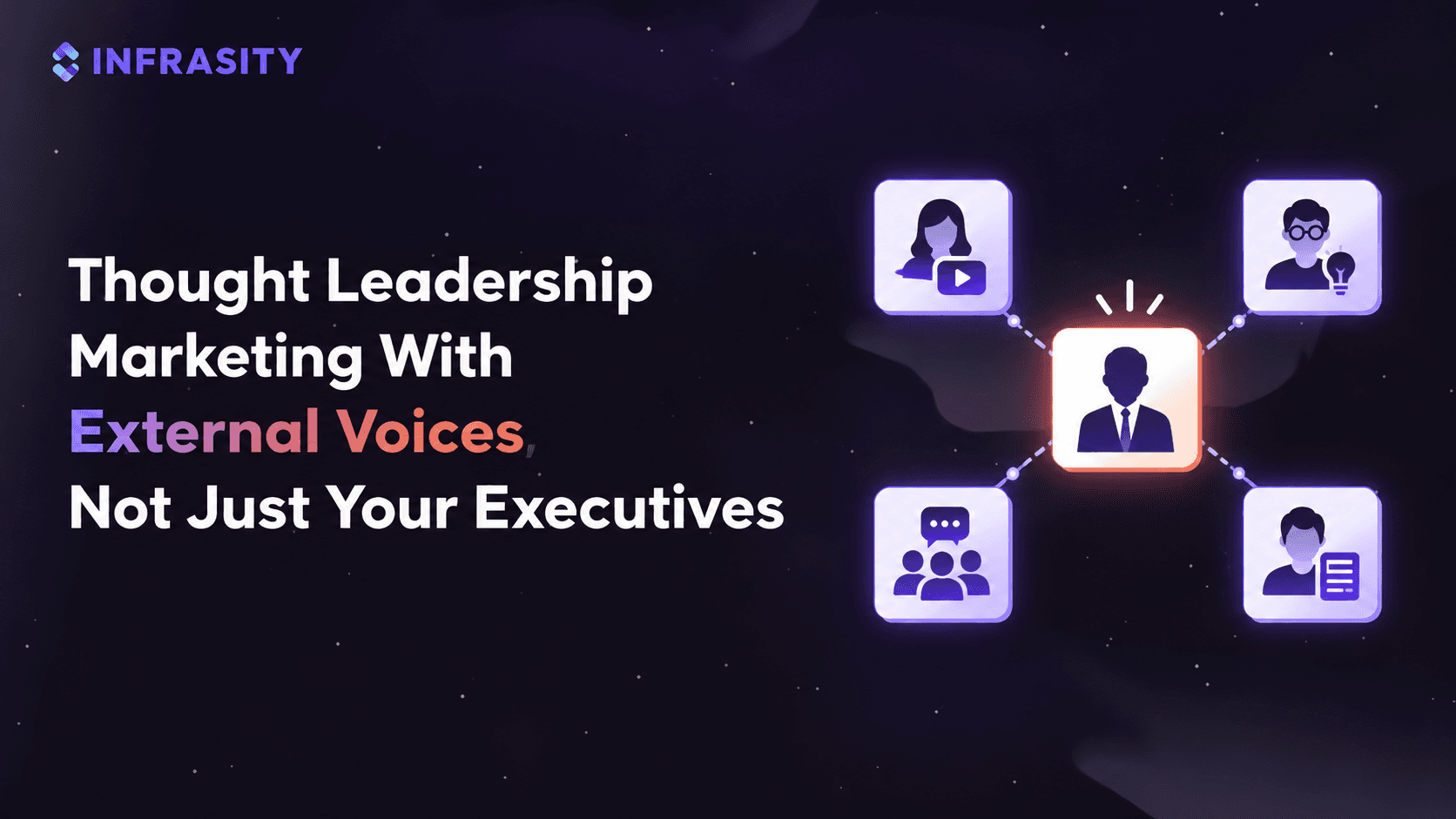
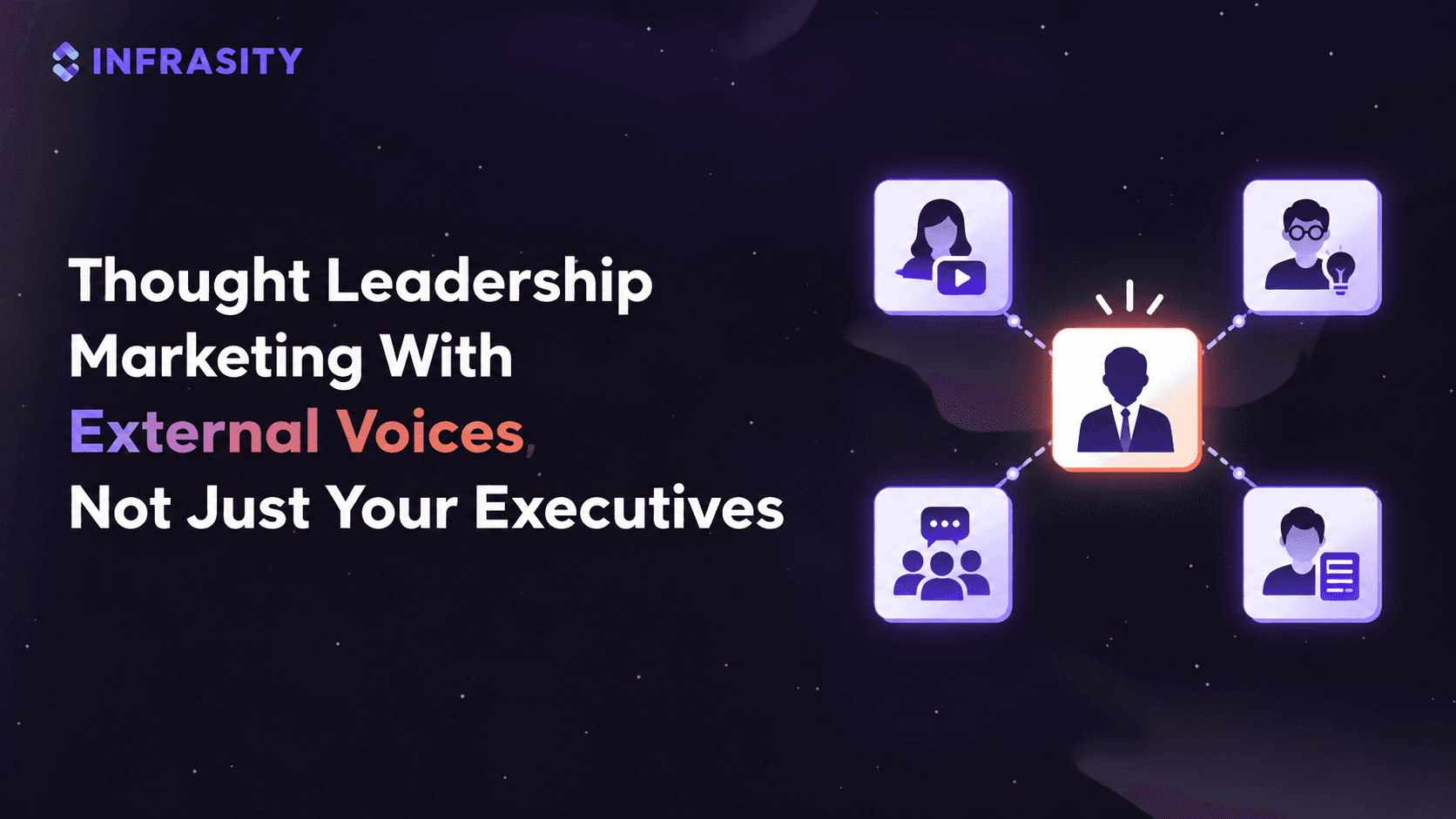
Four different kinds of people can carry a message for you, and they buy four different things. Treating them as interchangeable is the first error, because a program stacked entirely with one type has a predictable hole in it.
Ashley Faus, Head of Lifecycle Marketing at Atlassian and author of Human-Centered Marketing, splits B2B creators into subject matter experts, influencers, and thought leaders, and scores each against four pillars: credibility, profile, being prolific, and depth of ideas. In a session on working with B2B creators, she makes the distinction that matters most here. Internal influencers have expertise aligned to your product and become the face of your brand. External influencers have expertise aligned to the audience and the industry, work with several companies, and publish almost entirely craft-related content.
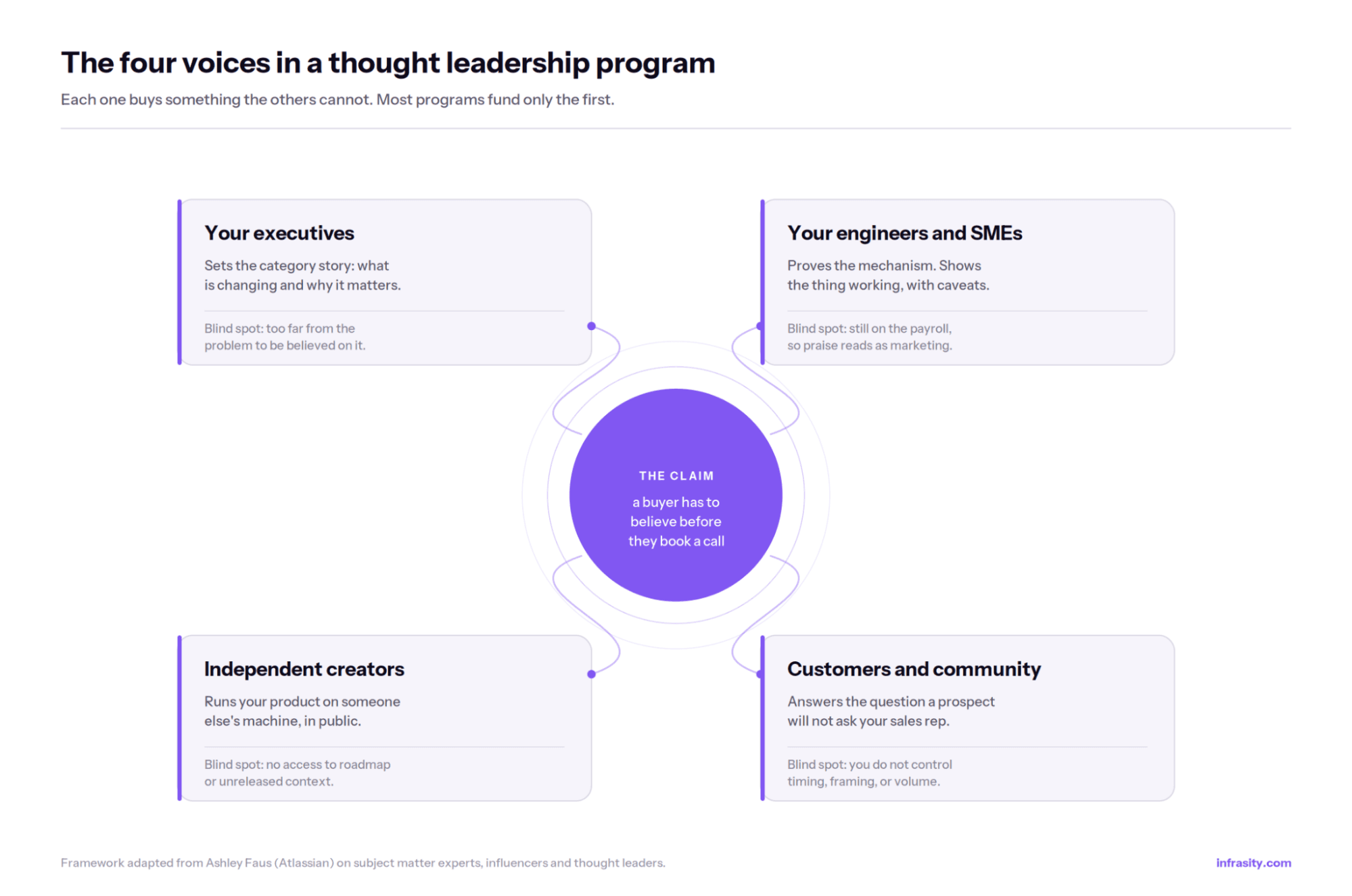
Your executives set the category story
An executive is the right voice for the argument about where the market is going and why a buyer's current approach expires. This is the voice a program usually starts with, and the mechanics of building an individual profile are well covered elsewhere on this blog.
What they cannot cover is distance from the work. Faus puts it bluntly: founders and executives "might be so far from the problem that they lack credibility with the audience." A CTO who has not written a migration script in four years will get caught the moment a technical audience asks a follow-up question.
Your engineers and support staff prove the mechanism
Internal subject matter experts hold the detail nobody else has. They know which configuration breaks at scale, which error message means what, and which part of the docs is wrong. Faus notes that most of that knowledge stays locked inside internal dashboards and one-to-one customer conversations, because these people are not writing or speaking externally.
Their limit is the payroll. However accurate the content, praise from an employee reads as marketing. It also carries a legal consequence that none of the ranking pages on this topic mention, covered in the rules section below.
Independent creators run your product on someone else's machine
This is the voice that answers the only question a buyer actually has, which is whether somebody who does not work for you would recommend the thing. A creator can compare you against three alternatives, publish the comparison, and keep the result up for years. They can also say a critical thing, which is precisely what makes the positive parts land.
The trade is access. They do not know your roadmap and will not defend you when something breaks.
Customers and community members answer what sales cannot
A practitioner answering a question in a subreddit or a Slack group is operating in the layer where most real evaluation happens. Tom Augenthaler, CEO of 551 Media, describes this as the part no marketing software can see: private message groups, roundtables, and invite-only communities where buyers compare notes. His route in is through people who already participate in those spaces, sometimes the people who run them.
The cost is control. You do not get to pick the timing, the framing, or the volume.
The practical test for your own program: write down the last ten pieces of thought leadership you published, and mark who spoke in each. If all ten are internal, you are funding one column of a four-column table.
Why does an executive-only program stall?
It stalls for four reasons, and only one of them is about content quality. The other three are structural, which is why publishing more does not fix them.
The bench is thinner than the calendar
The Edelman and LinkedIn data names the bottleneck precisely. Among companies producing thought leadership, 50% cite being under-resourced as the main barrier, 27% say they lack the skills to produce high-quality content, and 26% say they are not engaging their most senior and talented people. Those three numbers describe a program running on two or three willing participants who also have day jobs.
Faus's version of this, from years of doing it at Atlassian: "I am no longer in the business of convincing people to do anything." Forcing a reluctant engineer onto LinkedIn to repost marketing copy produces content that reads exactly like what it is.
Ghostwriting cannot manufacture a point of view
The standard workaround is to have marketing write it and put an executive's name on top. Faus's line on this is the sharpest formulation we have heard: AI "can be used as a ghost writer. It cannot be used as a ghost thinker. And the problem is whether it's a human or a robot, a lot of people want a ghost thinker."
The failure surfaces the first time the executive is on a podcast or a panel and has to defend an argument they did not build. That is a reputational cost, not a content cost.
The buying group is bigger than the person you are writing for
Edelman's 2025 report opens on the finding that more than 40% of B2B deals stall on internal misalignment inside the buying group, and focuses the whole study on "hidden buyers" in finance, legal, compliance and procurement who never appear in your CRM but consume and evaluate thought leadership the same way your target buyer does.
Your CEO's post reaches people who follow your CEO. It does not reach the security architect who will veto the purchase in week six. Somebody that architect already follows might.
The content has no voice left by the time it publishes
Augenthaler describes the mechanism in corporate content: "it's all sort of been watered down by the legal department and the PR department." He is also unsparing about where most of it lands. "YouTube is a graveyard of corporate video content," he says, describing companies that produce decent video, post it to their own channel, and leave it to accumulate five views.
An outside voice is not subject to your approval workflow, which is the entire reason it survives contact with a skeptical reader.
What actually changes when the voice is not on your payroll?
Three things change, and all three are measurable. We can show the mechanism on our own client work rather than describe it in the abstract.
The brand search result stops being yours alone
In Rocket's creator program, which we ran across YouTube, X, and Instagram, 90 placements went out from more than 80 creators. Eleven months in, we checked the top twenty YouTube results for the query "rocket.new" on September 2026. Fourteen of the twenty are creator placements. Four belong to Rocket's own channel. Two are earned podcast interviews. The ratio of independent voices to owned content on the brand query is 3.5 to 1.
That was not a search objective when the program started, and we would not have promised it. It is what happens when 28 pieces of durable video content about one product accumulate over eleven months. A buyer who types your product name into YouTube, which is what technical buyers do before they read a pricing page, now meets practitioners first.
The result stops depending on one lucky draw
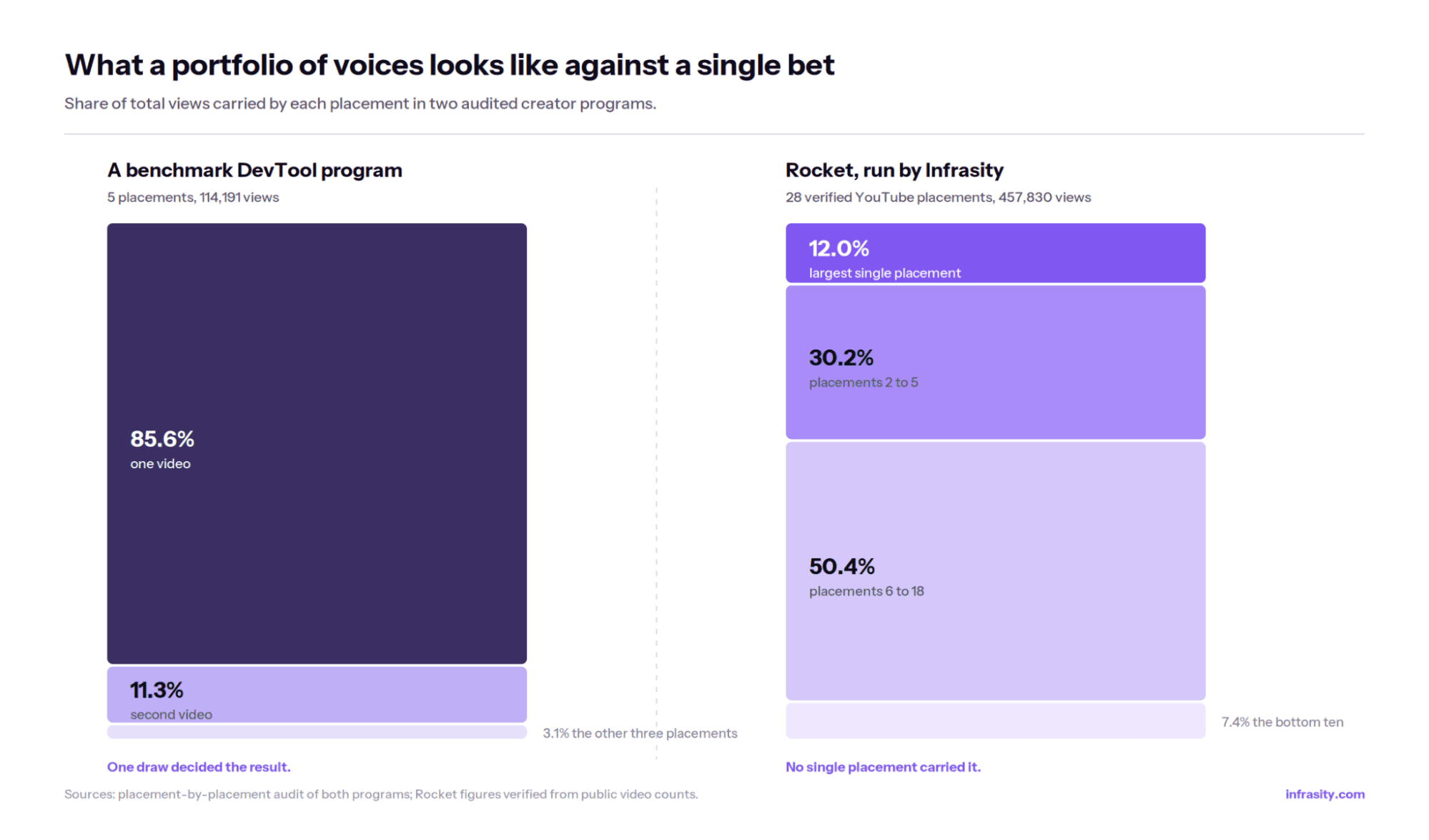
The most common way a first creator budget gets spent is on a small number of large placements. We audited a competing DevTool's creator program as a benchmark. Five placements, 114,191 views, and one video delivered 85.6% of them. Three of the five delivered 3.1% between them. In aggregate, that program reads as a success. It was one video and four write-offs.
Rocket's largest placement carries 12.0%. The top five carry 42.2%. The bottom ten carry 7.4%, which is fine, because they cost proportionally little and two of them are creators worth recommissioning.
You cannot predict which placement is the good one. You can buy enough draws that being wrong is survivable.
The content becomes a source other systems read
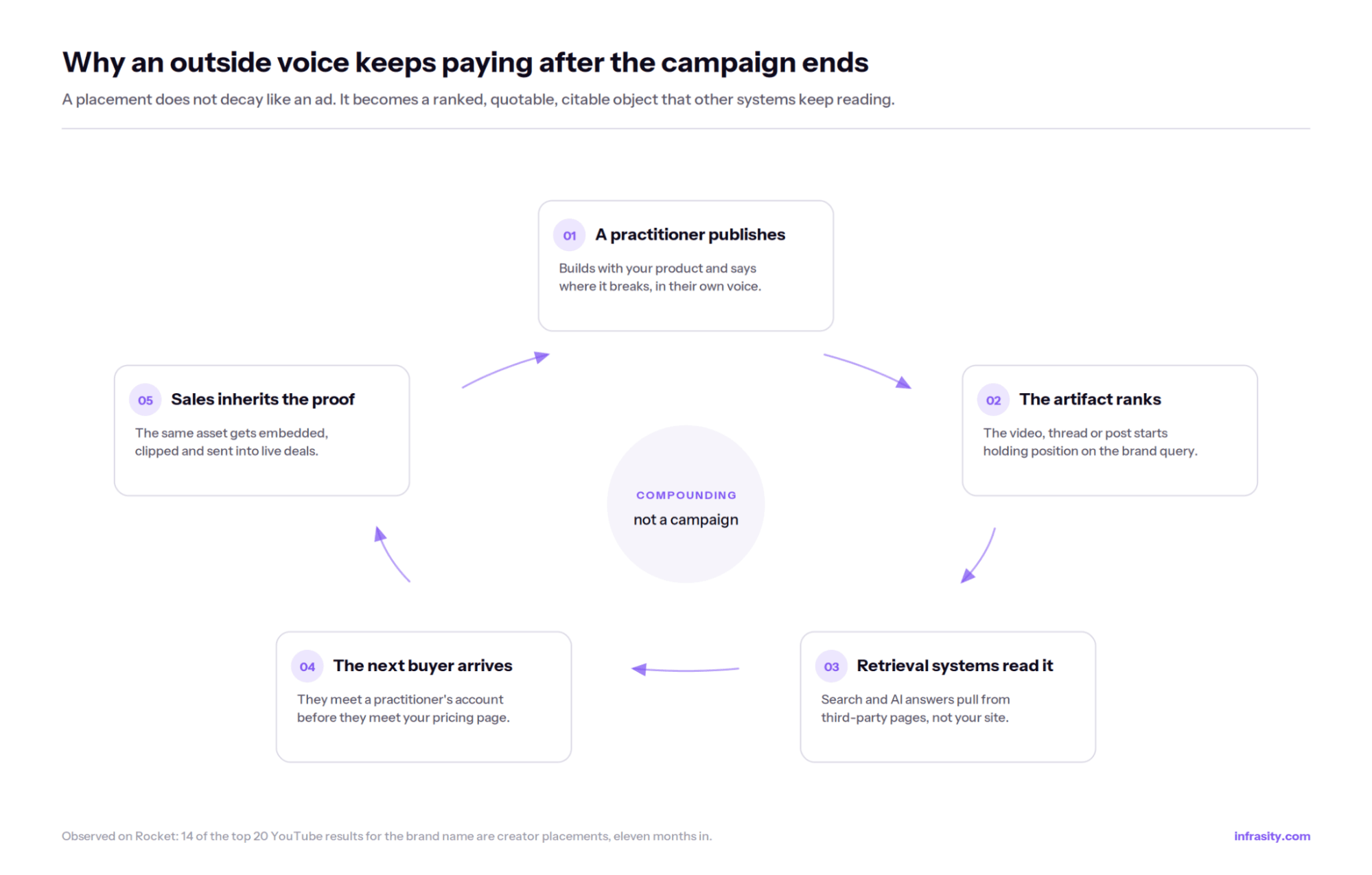
A creator placement does not decay the way an ad does. It becomes a ranked object that search engines and AI answer engines keep reading.
We saw this most clearly on Proton Pass, where the work was community engagement rather than paid creators. Across 30 postable threads tracked against five core buying prompts, 27 now mention the product, which is 90% coverage. Of the 42 Reddit threads ranking for those prompts, 30 mention it, so a buyer landing on a Reddit result from Google has a better than 7-in-10 chance of finding the product already named in the thread. Across 284 days the product accumulated 92 mentions in 68 active communities at 98% positive sentiment.
The Google AI Overview for "best password manager for privacy" now names it, and the sources panel shows reddit.com appearing 6 times across 17 total sources. The community layer is feeding the AI answer directly.
One caution on this point, because the category is full of people overstating it. Citation share for community sources moves violently between engines and between months, so treat any single published figure as a snapshot rather than a constant. The durable claim is narrower and safer: third-party pages get read, your homepage mostly does not, and that is not going back.
Where this fits with paid: If you are already running LinkedIn influencer marketing or paid social, an external-voice program is the thing that gives those campaigns creative worth amplifying. We build both sides through our B2B influencer marketing service, and the sourcing work below is the half that decides whether the paid half is worth funding.
How do you pick the right outside voice?
Score on fit, sort on fit, and record audience size in a column you never sort by. That sounds like a slogan until you look at what the numbers do.
Follower count explains almost nothing
On the Rocket roster, subscriber count explained 29% of the variation in the views a placement returned (r² = 0.288). Seventy-one percent of the outcome came from something else. Two placements published within a fortnight of each other landed within 150 views of one another, at 30,450 and 30,314. One came from a 918,000-subscriber channel, the other from a 607,000-subscriber channel. A 51% difference in audience size produced a 0.4% difference in delivered views.
Price behaves even worse. Across rate-confirmed quotes, cost per 1,000 subscribers ranged from $2.57 to $233.10, and the correlation between subscriber count and quoted price was r² = 0.001. Price is effectively random with respect to reach.
David Walsh, founder of the B2B creator marketplace Limelight, reached the same conclusion from the supply side. Asked for the most reliable predictor of a good partnership, he said: "Everyone looks at follower count. I say disregard it completely. Follower count does not mean anything on LinkedIn." What he substitutes is what he calls creator market fit: does this person publish about this problem, do they know it deeply, and is your product well positioned as the solution.
His team screened roughly 30,000 LinkedIn profiles over three months and scored, ranked and tagged every one, ending with 3,500 to 4,000 creators they considered strong. That is a roughly 12% hit rate on a platform where anyone can call themselves a creator.
What to score instead
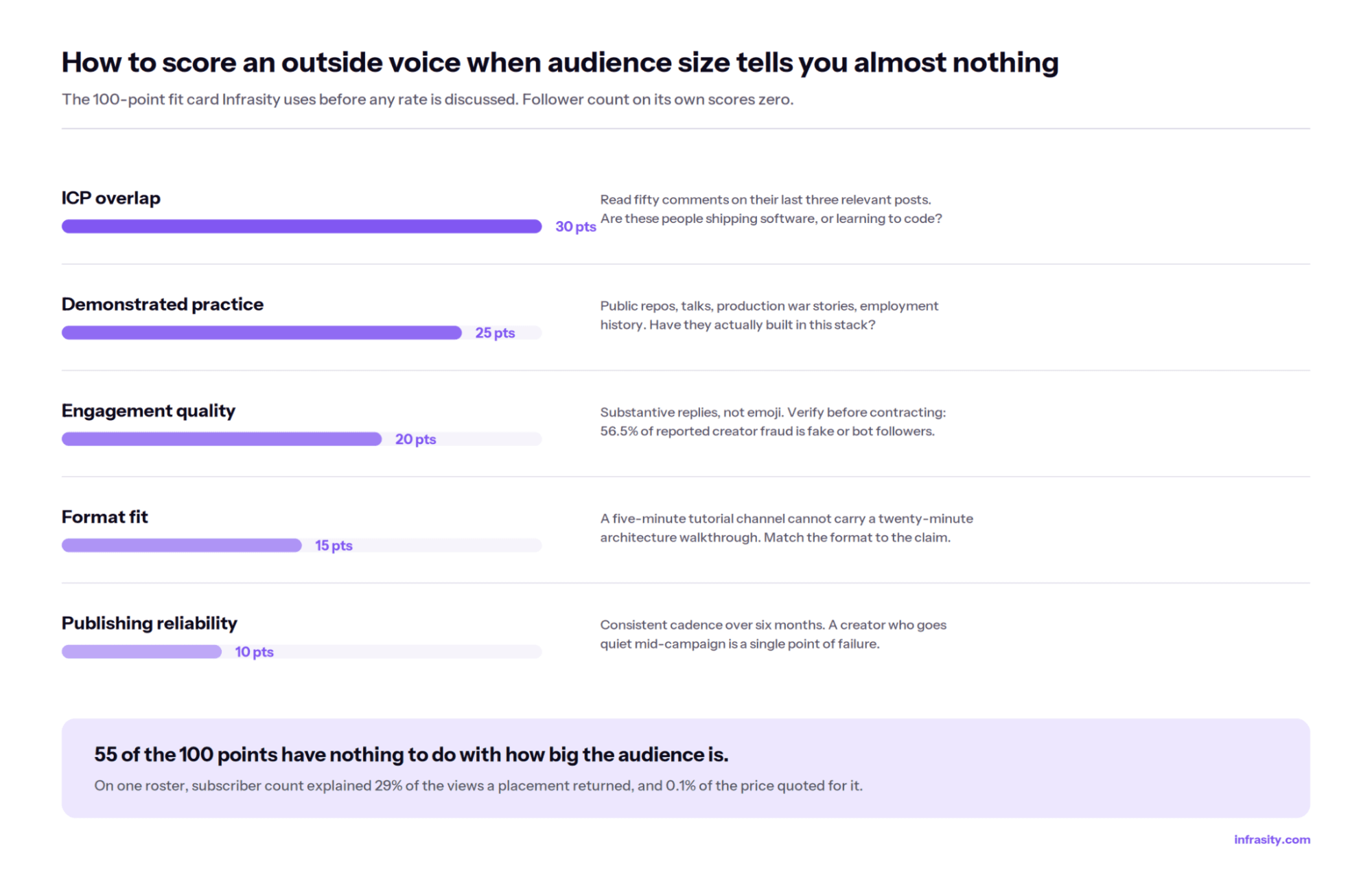
The card above is what we run before any rate is discussed. Two of the five criteria deserve expansion because they are where programs actually go wrong.
Engagement quality, not engagement rate: A 6% engagement rate made of emoji replies is worth less than a 1.5% rate made of people arguing about the implementation. Verify before contracting rather than after: fake and bot followers account for 56.5% of all reported creator fraud, and the FTC treats buying indicators of influence to misrepresent that influence as a deceptive practice in its own right.
Demonstrated practice: For technical categories this is the single highest-weighted signal after ICP overlap. Public repos, conference talks, production war stories, employment history. If a creator has never shipped in your stack, the audience will know inside the first minute.
How many, and for how long
Augenthaler's answer is refreshingly small: B2B does not need the 150 or 300 creators a consumer program runs. "Maybe it's five or six," he says, chosen based on where your buying audience actually goes for information, then worked programmatically rather than as one-off buys.
Walsh recommends going wider at the start for a different reason, which is surface area to learn from. His pattern is 20 creators in the 15,000 to 40,000 follower range on a rotation, one posting per working day, so that the brand holds a floor of presence and you can attribute traffic to a specific day and a specific person. Both are defensible. The choice turns on whether you are optimizing for depth of relationship or speed of learning, and smaller creators make the second option affordable.
Why does a DevTool program need a different design?
Because the audience verifies. A CRM buyer can accept a claim about time saved. A platform engineer will open the repo, check the last commit date, and read the issues before they finish your headline.
Faus, who spent most of her career in developer marketing, states the constraint directly: "this particular audience is very interested in dealing with their peers. They don't want to hear from a marketer."
The placement has to contain a build, not an opinion
In a category where every landing page promises the same thing, the only format that separates products is somebody building the same thing in each tool and showing what came out. That is expensive to commission and impossible to script, which is exactly why it works.
For Rocket, competing against Lovable, Bolt, Replit, v0, and Cursor, this was the whole strategy. The placements that performed were builds: a full-stack app with Supabase, a head-to-head against four named competitors, a clone of a real product. The placements that did not perform were overviews.
The creator needs permission to be critical
Anyone evaluating a developer tool in 2026 has already tried two and abandoned one. They are not looking for a feature list. They want a credible person to tell them where it breaks. A creator who cannot say a critical thing is worth nothing in this category, which rules out scripted placements entirely.
Walsh describes what happens when brands ignore this: "if you start to tell the creators what to do and what content to write, we don't even want to work with you, because it just doesn't work." On his platform, when the brief carries the campaign goal, the audience, the key claim and the constraints but not the script, nine times out of ten the content comes back with no edits required.
Put the limitation in the brief explicitly. Name the thing the creator is free to criticize. It reads as confidence and it is the only version a technical audience believes.
The distribution map is different
LinkedIn-first playbooks fail here because the buying conversation is somewhere else. For a developer tool, the surfaces that matter are long-form YouTube where someone will watch a twenty-minute build, GitHub where the proof lives, technical subreddits and Hacker News where the arguments happen, Discord and Slack communities where the evaluation happens quietly, and conference talks that turn into permanent video.
Rocket's channel logic reflects this, and it is worth copying. YouTube bought proof, because it is the only channel where a viewer gives you eight to twenty minutes. X bought credibility inside a tight niche, fast and cheap. Instagram bought volume and a comment-gated capture mechanic. The sequencing mattered as much as the mix: X and Instagram published first because they cost hundreds rather than thousands and told us whether the positioning survived contact with a real audience. The five-figure YouTube slots went out afterwards, with a message already tested.
Teams that invert this order commit their largest cheque to their least-tested message.
Trust in tooling is falling, and people are the fallback
Stack Overflow's 2025 Developer Survey of more than 49,000 developers found 84% using or planning to use AI tools, while 46% actively distrust the accuracy of the output and only 3% report highly trusting it. The follow-on behaviour is the part that matters for marketing: 75% said they would still ask another person for help when they do not trust an AI answer.
When verification gets harder, people fall back on people they already trust. That is the market condition an external-voice program is built for. If you want the fuller treatment of this audience, we have written separately on B2B influencer marketing for technical buyers and on influencer marketing for DevTools.
What does it cost, and how long before it works?
Public rate data in this category is thin, so here is what is actually observable, with its source attached.
| Item | Observed range | Source |
|---|---|---|
| LinkedIn creator, 15K to 30K followers | $500 to $1,000 per post | Walsh, on the Executive Brand podcast |
| LinkedIn creator, ~150K followers | up to $8,000 per post, while some 500K-follower creators were paid less | Walsh, same source |
| Sensible monthly floor | $10,000 per month to get enough surface area | Walsh, same source |
| Three-month LinkedIn pilot, 20 creators, 60 posts | $30,000 to $60,000 | Walsh, same source |
| YouTube, cost per 1,000 subscribers | $2.57 to $233.10 across rate-confirmed quotes | Rocket roster |
| YouTube, modelled cost per 1,000 views | $409 to $4,245 inside a single roster | Rocket roster |
Two things follow from that last row. The 10.4x spread inside one roster is the argument for measuring per placement, because a blended program CPM hides it and most reporting shows only the blended number. And the spread is not a story about good and bad creators, since several of the expensive placements were correct reach buys.
On timing. Walsh sets the floor at three months and product-market fit before you start, which usually means Series A or later. "You can't just assume let's get three creators to create three LinkedIn posts and it's going to drive 100k in new revenue. That's not realistic." He also estimates that roughly 3% of B2B companies that could be running this are running it today, which is either a warning or an opening depending on your appetite.
On the compounding. The second placement with the same creator beat the first by 41% on the Rocket roster. Four creators ran more than once. Those nine placements were 32.1% of the total and delivered 40.0% of all views, averaging 20,355 views against 14,454 for a one-off. By the third video, the creator was not explaining what the product is. They were reporting on how it had changed.
That uplift is free, and most programs throw it away by re-sourcing from scratch every quarter.
What are the rules you have to get right?
This is the section the ranking pages skip entirely, and it is the one that carries real exposure. The governing text in the US is the FTC's Guides Concerning the Use of Endorsements and Testimonials in Advertising, revised effective July 2023. It is readable in an afternoon and worth the afternoon.
Disclosure applies to more relationships than you think
A material connection must be disclosed clearly and conspicuously whenever it might affect how much weight the audience gives the endorsement, and the audience would not reasonably expect it. The Guides are explicit that this covers monetary payment, free or discounted products, early access, the possibility of being paid, and the possibility of winning a prize. Sending a creator a free annual licence and no cash is still a material connection.
Three edges catch B2B programs regularly:
- Your own employees posting in communities: The Guides include a worked example of an employee of a robot manufacturer promoting its product on a discussion board without disclosing their employment. The Guides say the poster should disclose the relationship and the employer should train, monitor, and act. If you are running community engagement on Reddit or in Discord, this applies to you on day one.
- Commissioned research: If you determine the subject of a study and pay for a share of its cost, the payment should be disclosed even when an independent organization designed and ran the work.
- Paid placement in rankings: A review site that takes money for higher positions is deceptive, and the brand paying for the position may be liable too. Disclosure does not cure it, because the payment determined the ranking.
You are liable even when the creator is not
The Guides state directly that an advertiser may be liable for a deceptive endorsement even when the endorser is not. They set out three obligations: give your endorsers guidance on avoiding misleading statements and disclosing connections, monitor compliance, and act to fix and prevent non-compliance. Agencies and other intermediaries can be liable for their own role in hiring and directing endorsers who fail to disclose.
Practically, that means the brief carries the disclosure requirement in writing, someone checks the published post within 24 hours, and you keep the record.
An expert endorsement has a higher bar
If your creator is presented as an expert, their evaluation has to be real, and at least as extensive as someone with that expertise would normally need to support the conclusion. Where the endorsement implies a comparison against other products, the expert must actually have made the comparison. That "we beat Competitor X" video needs the competitor to have genuinely been tested.
Two more that bite quietly
Reusing an old endorsement after the product materially changes requires confirming the endorser still holds that view. A two-year-old glowing video about a feature you have since rebuilt is not a safe asset to keep sponsoring.
And on platform mechanics: LinkedIn opened Thought Leader Ads to posts from any member, not just employees, in March 2025, and added the format for events the following August. LinkedIn's own early-pilot data put Thought Leader Ads at 1.7x the click-through rate and 1.6x the engagement rate of other single-image campaigns, a figure LinkedIn itself flags as directional and subject to early-adopter bias. If the creator is compensated, the partnership label goes on before the post is promoted.
Worth noting for anyone still arguing about disclosure internally: on the Rocket program, X placements carrying the paid-partnership label still cleared a 0.4% to 0.6% engagement rate against views. Disclosure cost nothing.
How do you measure a program built on other people's voices?
Measurement is where this channel earns or loses its budget, and the industry is currently failing at it. Among the companies producing thought leadership in the Edelman and LinkedIn study, nearly one in five have no process for measuring effectiveness at all, 42% still measure by looking for a traffic bump, and only 29% can link a sales lead back to a specific piece.
Meanwhile the gap between ambition and instrumentation is widening: 72.22% of marketers plan to increase creator budgets by 50% or more, but that same group accounts for only 64.23% of measurement-tool adoption. The teams scaling fastest are instrumenting least.
The four things to instrument before the first brief goes out
One tracked URL per creator, not per campaign: A campaign without per-creator tags produces exactly one fact, which is total traffic. You cannot tell which placement earned it, so you cannot rotate the roster, so your second campaign starts as blind as your first. On Rocket, every paid YouTube placement carried a distinct medium value inside a named campaign, visible in the public video description, which is why the YouTube half of that case study is independently auditable.
View-through rate, not views: Views as a share of the creator's own audience is the most useful number in creator reporting and almost nobody calculates it. It normalizes a 24,000-subscriber channel against a 918,000-subscriber one. On the Rocket roster it ranged from 2.89% to 17.53%, a 6.1x spread that ran against size rather than with it. Anything above 8% is a creator to go back to.
Share of the branded result: Count how many of the top twenty results for your product name are independent voices, and re-count quarterly. It is the cleanest proxy for whether the work is compounding.
Thread and citation coverage, for community work: The Proton Pass model is countable: number of high-intent threads ranking for your buying prompts, and the share of those that name you. Ninety percent coverage across tracked threads is a measurable position, not a feeling.
Say what this channel does not prove
Sales impact here is real and indirect, and it is worth saying so before the first invoice rather than after. During the window when Rocket's creator program was running, Rocket's registered users went from 400,000 to 1.5 million. We will not claim the program caused that. What we will claim is what the instrumentation supports: 90 placements, between 1.16M and 1.90M impressions of independent practitioners using the product, and a branded search result now dominated by voices that do not work there.
A report that only shows wins is an advertisement. Two things we would change on that program: we should have collected post-insights from every creator rather than most, since two-thirds of the reach is modelled rather than verified, and we under-used repeat commissioning given that the 41% uplift on second placements was the clearest finding in the dataset.
Where to start this week
You now have the four voice types and what each one buys, a scoring card that works when follower count does not, the observed rate ranges, the FTC obligations that apply the moment money or free product changes hands, and the four numbers worth instrumenting before the first brief goes out.
Start with the audit in step one. List the last twenty pieces you published and mark who spoke in each. It takes a couple of hours, and the imbalance it exposes will tell you whether the rest of this applies to you.
If it does and you would rather run it with people who have done it before, our B2B influencer marketing team sources, vets, briefs and reports on external-voice programs for DevTools and technical B2B. Every number in this piece came from running them.
Frequently Asked Questions
Is thought leadership marketing the same as B2B influencer marketing?
No. Thought leadership marketing is the practice of publishing expertise and a point of view to build credibility. B2B influencer marketing is one way to distribute and co-create it, using people outside your company. Most programs need both, because thought leadership without external distribution reaches only the people who already follow you.
Can you do thought leadership marketing without paying anyone?
Yes, and community engagement is the clearest example. The Proton Pass work that reached 90% citation coverage across tracked threads was earned participation in conversations that were already ranking, not paid placements. It costs time rather than media budget, and it moves more slowly. Paid creators buy speed and a guaranteed publication date.
How many external voices does a B2B program need?
Fewer than a consumer program. Tom Augenthaler's answer is five or six worked programmatically over a year. David Walsh's is around 20 smaller creators on a rotation for the learning surface area. Both beat the common failure mode, which is two or three large placements bought once.
Do executives still matter in a thought leadership program?
Yes, for the category argument and for anything requiring commitment on behalf of the company. What changes is that they stop being the only voice, and that they are selected on whether they actually have a point of view rather than on their title. Ashley Faus's framing is worth borrowing: have thoughts, be a leader.
Does disclosing a paid partnership hurt performance?
Not on the data we have. X placements on the Rocket program carried the paid-partnership label and still cleared a 0.4% to 0.6% engagement rate against views. Disclosure is also required under the FTC's Endorsement Guides when a material connection exists, so the question is largely academic.
How long before a creator program shows results?
Three months is the minimum useful window, and the compounding effects appear later than that. The branded search result on the Rocket program took roughly eleven months and 28 placements to shift. Anything promising pipeline in the first six weeks is selling you a single-placement bet.
What should we pay a B2B creator?
At 15,000 to 30,000 LinkedIn followers, $500 to $1,000 per post is the observed range. Above that, price decouples from reach almost entirely: on one YouTube roster, the correlation between subscriber count and quoted price was r² = 0.001. Negotiate on format, duration and usage rights rather than on audience size.