
AI influencer marketing for a company that sells an AI product means paying practitioners to build something real with your model, agent, or tool publicly. Twelve of the 24 AI companies we checked run a named program for exactly this. Cursor publishes its rate: $500 per month, per creator, against four to five posts.
That number is on Cursor's own website. So is Anthropic's ambassador stipend structure, ElevenLabs' hackathon credit tiers, and n8n's 30% revenue share. The category has a public rate card. Almost nobody has read it.
One clarification before anything else, because the search results for this term are a mess. Two other topics have taken over the phrase: software that automates creator discovery, and synthetic AI-generated personas. Neither is the subject here.
If you sell an AI product and you want real humans with real audiences to teach it, everything below is drawn from what AI companies publish about their own programs, plus campaign data from our own work.
TL;DR
- 12 of 24 AI companies verified have dedicated creator/ambassador programs; only 4 run more than two program layers.
- Cursor offers $500/month for 4–5 Stories, with a 6-month commitment, about $100–$125 per Story.
- Affiliate commissions range from 22%–35%, with programs capped between 3–12 months.
- HeyGen requires creators to have 5,000+ followers; PostHog uses 5,000+ views/video as its sponsorship threshold.
- ElevenLabs offers hackathon winners up to 600K credits ($297 value), while top-tier projects receive $897 in credits.
- A practical pilot starts with 40 creators, 15 shortlisted, 3–5 pilots over a 90-day testing period.
What makes an AI product different from a normal SaaS product here?
Three things, and here are those.
Demo is the entire sale
For most B2B software, a creator can describe the value, and the viewer takes it on faith. For an AI product, the viewer wants to see the output. They want to watch the agent fail on step four and recover on step five. A description of what a model can do is worth close to nothing, because every competitor's landing page makes the same claim in the same words.
That pushes the format hard toward long-form video, live builds, and published repos, and it makes the creator's own skill part of the deliverable. Someone who cannot code cannot credibly demo Claude Code.
For instance, during a live stream on the One Shot Show, developer Mark Miller opened a completely blank directory and typed a single sentence into Claude Code. Over the next 45 minutes, viewers watched the AI build a fully functional RSS reader from scratch. The audience didn't just see a polished, perfect end product; they watched the real-time back-and-forth, saw the moments where the human creator had to slow the AI down, and witnessed the model debug its own errors live on screen.
Capability changes monthly, so one-off content decays fast
A sponsored post about a CI tool is roughly as true in six months as it was on the day it was published. A sponsored post about a model released in March may be describing behavior that no longer exists by June. Anyone running one-off placements against an AI roadmap is buying a depreciating asset.
This is the mechanical reason the leading programs are structured as cohorts and retainers rather than campaigns. It is not a preference. It follows from the release cadence.
The audience is pre-loaded with suspicion
Developers already distrust ads. Audiences for AI products carry a second layer on top: a live argument about training data, job displacement, and whether the tool is genuinely good or just well-funded. A creator promoting a Kubernetes tool risks looking lazy. A creator promoting an AI video tool risks appearing to be a traitor to their craft, which is precisely what happened in August 2026, and we cover it in strategy 9.
Put together: your creator has to be technical enough to build, committed enough to keep building as the product changes, and brave enough to absorb an audience reaction that has nothing to do with your product's quality. You cannot buy that with a media rate. You buy it with access, status, and continuity, in that order.
What do AI companies actually publish about their creator programs?
We checked 24 AI product companies for live, distinctly titled creator, ambassador, campus, or affiliate program pages, then verified every hit by page title and H1 to strip out single-page-app shells that return the homepage for any URL. That verification step removed four apparent hits, including two well-known names whose /ambassadors path returns a 404 body under a 200 status.
Twelve companies came back with verified, live programs. Only four of them run more than two layers.
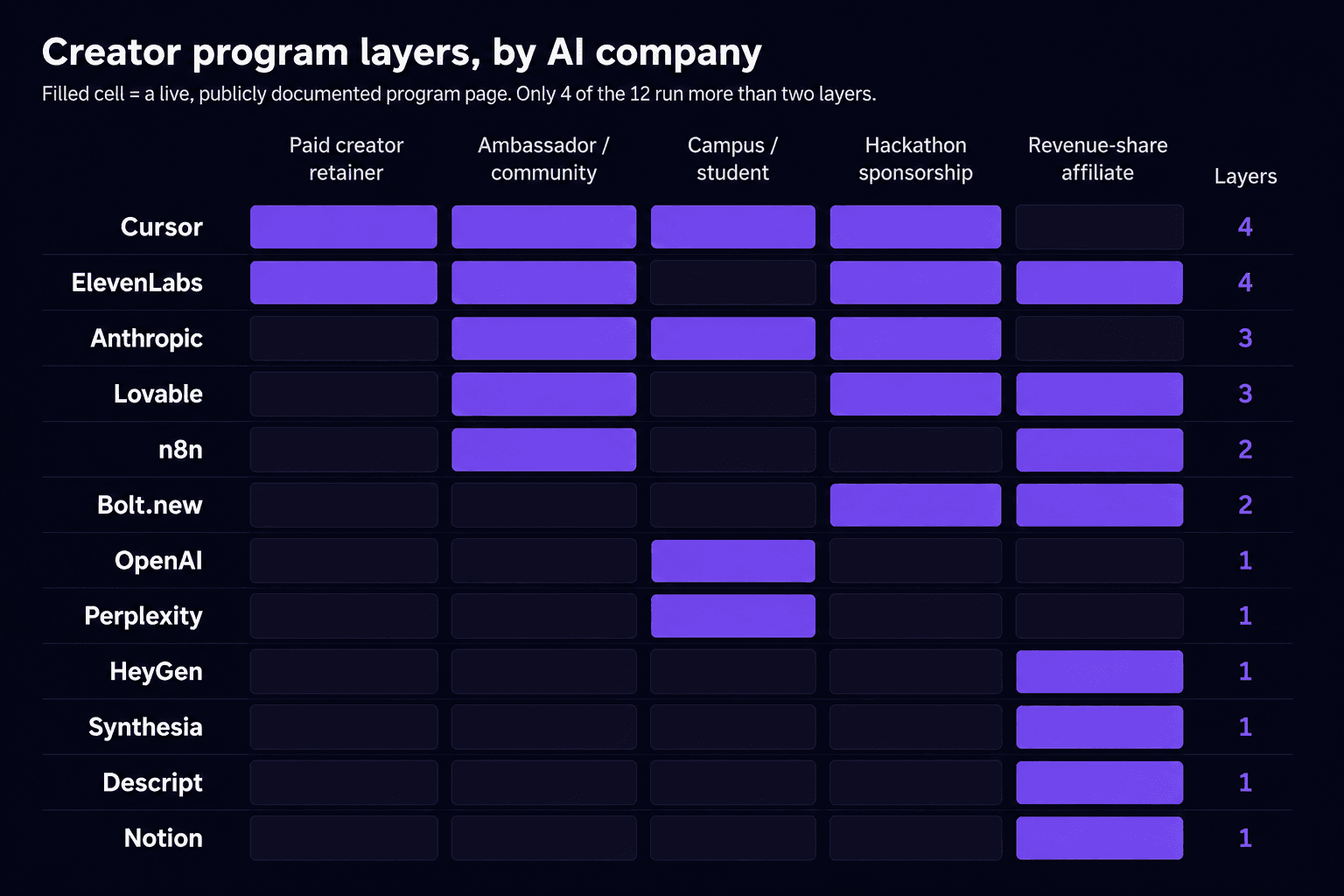
Read the empty cells rather than the filled ones. Seven of these twelve companies run a single affiliate link and nothing else. A single affiliate link is a payout mechanism, not a creator program. The four companies stacking layers are also the four with the fastest observable adoption curves in their categories, which is suggestive rather than causal, but worth sitting with.
The nine strategies below are drawn from what the top of that chart does.
1: Pay in credits before you pay in cash
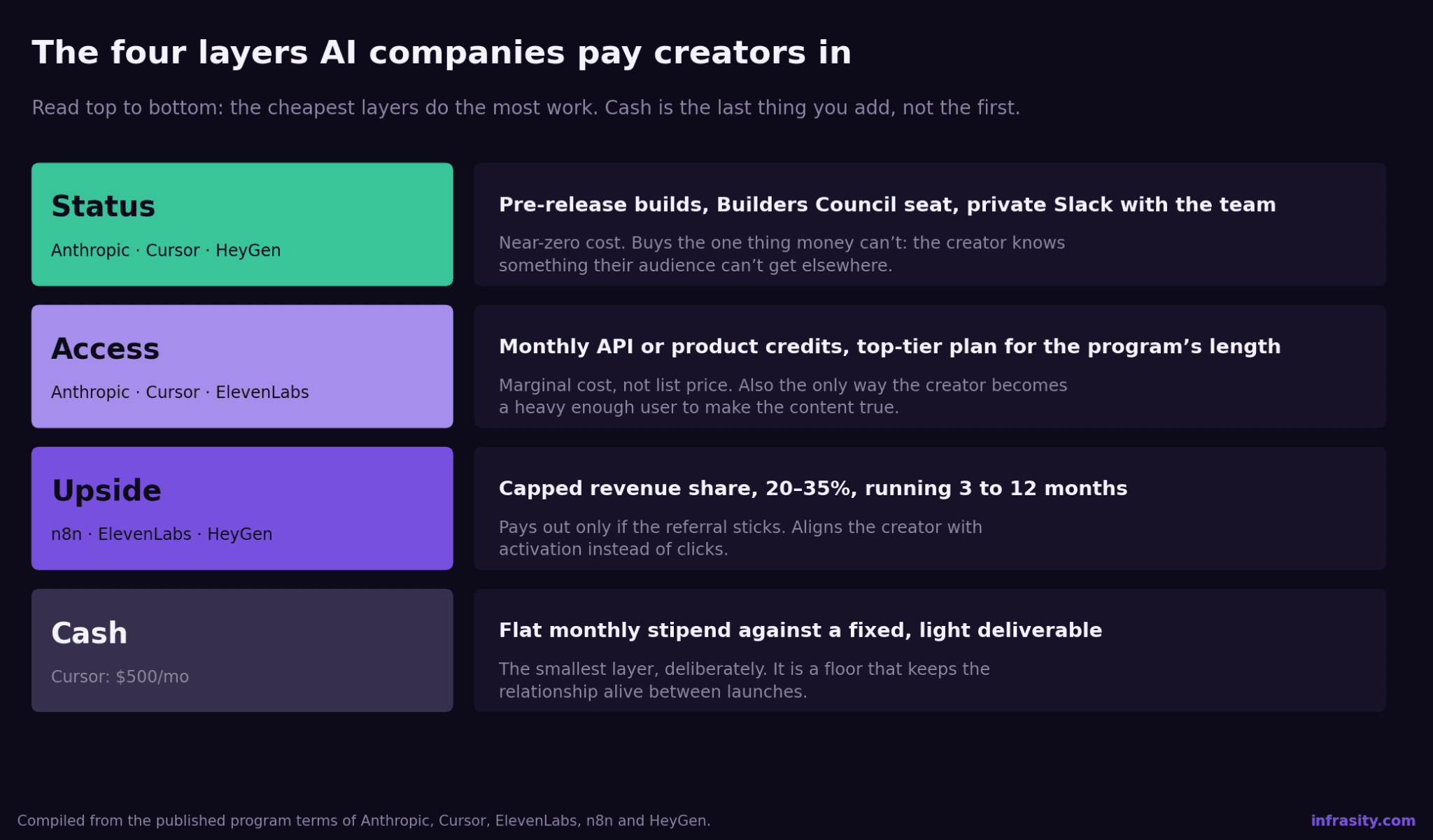
Every serious AI creator program leads with product access, and there is a hard commercial reason.
Anthropic gives Claude Community Ambassadors monthly API credits specifically to power demos. Cursor gives Monthly Creator Program members a fresh credit allotment every month, and gives Campus Leads six months of Cursor Ultra. ElevenLabs structures its entire hackathon sponsorship as credit tiers. Even Higgsfield, in the campaign that went badly, compensated creators through "a combination of monetary payment and platform credits," per The Verge's reporting.
Two mechanisms are running at once.
The first is margin: credits cost you inference, not list price. A creator burning 600,000 ElevenLabs credits costs the company a fraction of the $297 sticker value. You are paying in the currency you manufacture.
The second matters more: credits are the only compensation structure that forces creators to become heavy users. A cash fee buys you an hour of their attention. A large monthly credit allotment, with no obligation to spend it on your campaign, buys you a person who has genuinely pushed your product to its limits and knows where it breaks. Their video is the one worth watching.
Here's a practical version: size the credit grant to be uncomfortably generous, well beyond what the deliverable requires. If a creator can complete your brief without noticing the credit limit, the grant is too small to change their behavior.
2: Sell status, because it costs nothing and it is the thing they actually want
Look at what Anthropic offers ambassadors beyond credits: access to pre-release features and Builders Council sessions to influence what gets built, plus a private Slack with the Anthropic team. Cursor offers ambassadors nightly builds, forum moderation powers, a badge, and a Slack channel with the Cursor team. Cursor Campus Leads get an all-expenses-paid trip to the San Francisco office for kickoff.
None of that is a media buy. All of it is inventory the company already has.
The mechanism: a creator's business is differentiation. A creator who can post something their competitors physically cannot post, because they saw the build two weeks early, has just been handed a content moat by your program. For a working creator, that beats a four-figure fee, and it costs you a seat on a call.
There is a tell in Cursor's ambassador FAQ that shows how valuable both sides consider this: "Our preference is that you not participate in other advocacy programs while you're in Cursor's Ambassador program." That is a soft exclusivity clause attached to a program with no published cash component. Access alone is priced high enough to demand exclusivity.
If you are a CTO or Head of DevRel reading this and wondering what you can offer without a marketing budget, that paragraph is your answer. Pre-release access, a real feedback channel into the roadmap, and a private room with your engineers is a complete program.
3: Buy a retainer, not a sponsorship
Cursor publishes the clearest content rate in the category, and its shape is the interesting part.
The Cursor Monthly Creator Program is a six-month commitment. Creators join a cohort of roughly 50, with a new cohort starting about every two months. In return for a proposed $500 per month, plus monthly credits and cohort-only merch, the ask is four to five Instagram Stories per month featuring Cursor, with monthly submissions of proof of completed deliverables.
Run the math: it comes to roughly $100-$125 per Story, which is well below what a comparable creator would charge for a one-off placement. Cursor is not buying cheap posts. It is buying six months of continuity at a price a creator accepts because the relationship is worth more than the fee.
Three things that structure gets you that a sponsorship does not:
- Your product can change, and the content follows: When you ship a new model or agent mode, you have 50 people already under contract who have been using it for weeks. No re-negotiation, no new brief, no lead time.
- You learn who is actually good: One placement gives you one data point contaminated by luck. Six months of monthly deliverables from 50 creators gives you a ranked list, which is what you need before you spend real money on the top decile.
- The creator stops performing: Month one reads like an ad. By month four, the product is genuinely in their workflow, and the content changes character. That shift is the entire point, and it is unavailable on a single placement at any price.
Cursor's deliverable is also deliberately light. Four to five Stories is a low bar, and the program page says the "core ask will remain light and recurring." Heavy monthly deliverables kill retainers, because the creator starts treating them as work rather than as a relationship.
If your creator spend currently looks like a list of one-off invoices, you do not have a program. We build vetted creator rosters and run them as multi-month engagements for AI and DevTool teams, with the roster and full budget approved by you before anything publishes. See how our creator marketing for AI models and APIs works.
4: Cap the revenue share, and say so on the page
Every published affiliate program in this set has a time limit. Not one pays lifetime revenue share.
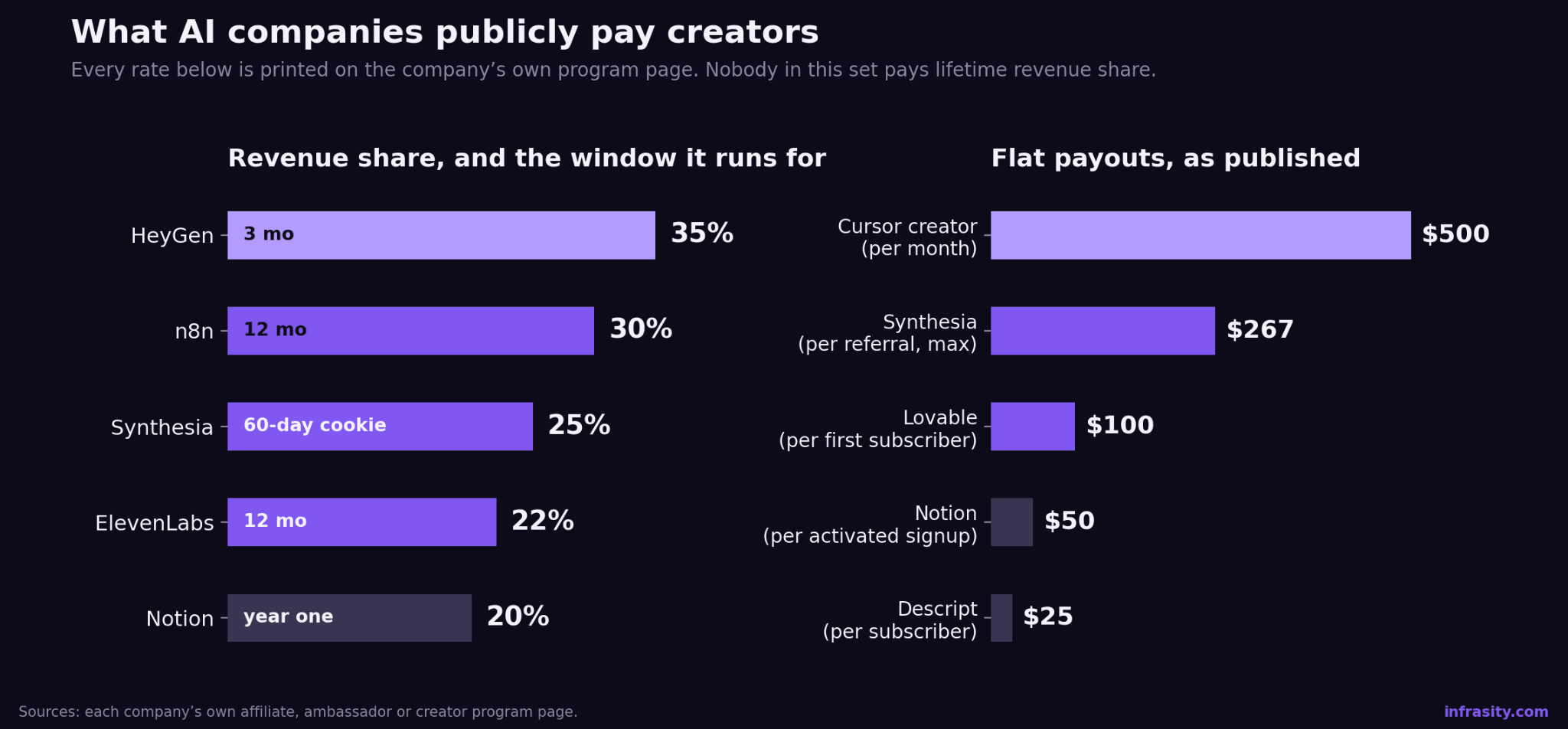
The numbers, each taken from the company's own page:
| Company | Program | Published terms |
|---|---|---|
| HeyGen | Social Creator Program | 35% recurring, 3 months, 30-day cookie, 60-day verification hold, $100 minimum payout |
| n8n | Affiliate partner | 30%, 12 months, Starter and Pro plans |
| Synthesia | Affiliate partner | 25%, up to $267 per referral, 60-day cookie, free avatar after 15 sales |
| ElevenLabs | Affiliate program | 22%, 12 months, run through PartnerStack |
| Notion | Affiliate program | Up to $50 per activated signup plus 20% of year one revenue |
| Lovable | Affiliate partners | Up to $100 per first-time subscriber |
| Descript | Affiliate program | $25 per new subscriber |
The reason for the cap is specific to AI economics. Inference cost means gross margin on an AI subscription is lower and less predictable than on traditional software, so a perpetual 30% is a liability you cannot model. A 12-month window lets you pay generously during the period where creator-driven referrals actually influence retention, then stop.
HeyGen's three-month window is the aggressive end, paired with the highest rate at 35%. That combination is a deliberate trade: pay more, pay briefly, and push creators to keep referring rather than to coast on a back catalog. For a product with monthly churn risk, that pairing is the one to copy.
One more detail worth noting: HeyGen publishes a 60-day verification hold to account for refunds, chargebacks, and subscription validation. AI products attract trial-and-cancel behavior at higher rates than most software. Building the hold into your published terms, rather than clawing back after the fact, prevents the single most common source of creator resentment.
5: Set a hard floor on who qualifies, and a format rule on what counts
The most useful line on HeyGen's creator page is not the commission rate. It is the eligibility rule.
HeyGen looks for creators with 5,000+ followers on at least one platform, and restricts qualifying promotion to original video content across social and course-based platforms. Explicitly excluded: SEO and blog-only promotion, paid search, and self-referrals.
That second rule is the sharp one, and it is easy to misread as a company undervaluing written content. It is doing something more specific. Blog-only affiliates in AI categories frequently run programmatic review sites that rank for "best AI video generator" and convert on the intent the company already paid to create. Excluding them is a decision about attribution honesty, not about content format. Any affiliate program operating in a category with heavy review-site farming should copy this rule verbatim.
For the follower floor, note that 5,000 is low. Deliberately. PostHog's public handbook sets its threshold on views rather than subscribers, refusing to sponsor videos with fewer than 5,000 views, which is the better metric and the one we use in our own vetting. Subscriber counts are a stock. Views are a flow. A 400,000-subscriber channel getting 9,000 views per video is worse value than a 30,000-subscriber channel getting 40,000 views per video, and creators price based on the number that flatters them.
We wrote up the full vetting sheet, including the conflict-flag column that catches creators who quietly advise a competitor, in our DevTool creator marketing playbook. The logic transfers directly to AI products, with one addition: check whether the creator has publicly taken a position on AI ethics or training data that your partnership would put them in conflict with. That check did not exist two years ago. It is now the highest-value row on the sheet.
6: Buy the written artifact, because the model that recommends you cannot watch video
Your buyer increasingly doesn't start at Google. They ask Claude or ChatGPT what to use for a given job, and the model answers by drawing on sources it can read.
That changes what a creator partnership is worth. A tutorial video does three jobs now: it converts the viewer, it ranks in YouTube and Google search for the query it teaches, and it becomes a source that shapes what a model says about your category next quarter. The third job only happens if there is text.
So write the artifact into the brief. Alongside the video, ask for one of: a Dev.to or Medium write-up, a public GitHub repo with a working example, or a comparison table with real numbers in it. Retrieval systems index and cite text far more readily than they cite a video, and a repo with a clear README is among the most reliably surfaced artifacts in technical categories.
This is the least-priced element of any creator deal right now. Creators do not charge much extra for a written companion piece because nobody asks for one, which makes it the cheapest durable asset in the whole engagement. That arbitrage will close. Use it while it is open.
If your category is contested and you want the before-and-after measured rather than assumed, that is what our AEO and answer-engine work for developer tools exists to track.
7: Run a campus layer, because habit forms years before procurement does
Four of the biggest names in AI run a student program, and they aren't doing it for the immediate signups.
Anthropic runs Claude Builder Clubs, where student leads organize workshops with Anthropic guest speakers, run hackathons and demo nights, distribute API credits to members, and receive a paid program stipend.
OpenAI runs the Student Collective, giving undergraduate Campus Leads tools, training, funding, and support.
Cursor runs Campus Leads: two cohorts a year, a 5-hour-per-week commitment, an all-expenses trip to the SF office, reimbursed travel to one hackathon, and six months of Cursor Ultra.
Perplexity runs a Campus Partners program with published terms and conditions.
The mechanism is straightforward and slow. Developer tool preferences are sticky in a way that most software preferences are not, because they are bound up with muscle memory and workflow. A student who learns to build with your agent framework in their final year carries that default into their first job, where they are the person the team asks, "what should we use for this?"
Anthropic has taken the same logic to its extreme with Claude Corps, announced in June 2026: a $150 million commitment to train 1,000 fellows, pay them $85,000 salaries plus benefits and an expansive token budget, and place them full-time inside at least 400 nonprofits for 12 months. Whatever else that program is, structurally it puts a thousand trained, credentialed advocates inside a thousand organizations that were not previously customers.
Almost nobody else can write that cheque. The transferable part is the shape: fund the person, place them where the tool is not yet used, and let competence do the selling. A single funded student club at one strong engineering school costs a rounding error against a paid social budget and produces a cohort of people who can actually run your product.
8: Sponsor hackathons against a written SOP, not an ad-hoc cheque
ElevenLabs publishes its entire hackathon sponsorship playbook, and it is the most operationally useful document any AI company has put online about creator marketing. Anyone can read it on the affiliates page FAQ.
The published package:
| Tier | What they give |
|---|---|
| All participants | 1 month free Creator tier, 100k credits, normally $22/month |
| Overall event winners | 3 months Pro tier, 600k credits, $297 value per team member |
| Best project built with ElevenLabs | 3 months Scale tier, $897 value per team member |
And the operating rules, which are the part worth copying:
- In-person events only: Stated simply as a fraud prevention measure, because online-only events make it impossible to verify that credits reach real attending participants rather than being bulk-claimed.
- Hybrid events get in-person support only: scoped to verified physical check-ins rather than total registrations.
- Credits distributed through an automated Discord bot, with organizers submitting a participant CSV at least 72 hours before the event.
- No workshops, no API demos, and generally no in-person judge: stated directly, the team is small and spread across time zones. Instead, they supply a Hacker Guide.
What they require in return: logo placement per brand guidelines, the Hacker Guide distributed to all participants, a post-event organizer feedback form, and a link to the best project built with the product.
Judging criteria published in advance, so organizers can select winners without a company representative present. The criteria prioritize agentic depth and voice as a necessity rather than a bolt-on feature.
That document solves the real problem with hackathon sponsorship, which is that it does not scale with headcount. ElevenLabs has made the sponsorship self-serve for organizers and near-zero-touch for the company, and turned the credit grant itself into the distribution mechanism.
For scale on the other end, Bolt.new's World's Largest Hackathon drew over 130,000 participants and 9,500+ submitted projects against a $1M+ prize pool, a number confirmed publicly by Addy Osmani, who judged it. Every one of those projects is a person who has now built something with the product and posted a meaningful share about it.
Hackathons work for AI products specifically because the barrier to a finished demo is now hours rather than weeks. Traditional developer tools do not enjoy that advantage, and AI companies underuse it.
9: Disclose more than the law requires, because the blast radius lands on your creator
This is the strategy that separates AI creator marketing from every other kind, and it is the one that will cost you the most if you get it wrong.
In August 2026, filmmakers Matti Haapoja and Sam Kolder published videos showcasing Higgsfield's generative video platform without clear sponsorship disclosure. Viewers connected the videos to partnership screenshots from Higgsfield's PR agencies. Marques Brownlee publicly pushed back on Haapoja's framing. Higgsfield later confirmed to press that the arrangements were formal paid partnerships involving cash and platform credits. The Verge covered it on 21 August 2026 under the headline "Major YouTube creators are facing backlash for accepting AI money."
Read the asymmetry carefully, because it is the operative lesson. Higgsfield absorbed a news cycle. The creators absorbed a credibility hit inside the exact community their careers depend on. For filmmaking channels whose standing rests on craft, aligning with a generative video company is a strategic decision about their own positioning, not a media placement.
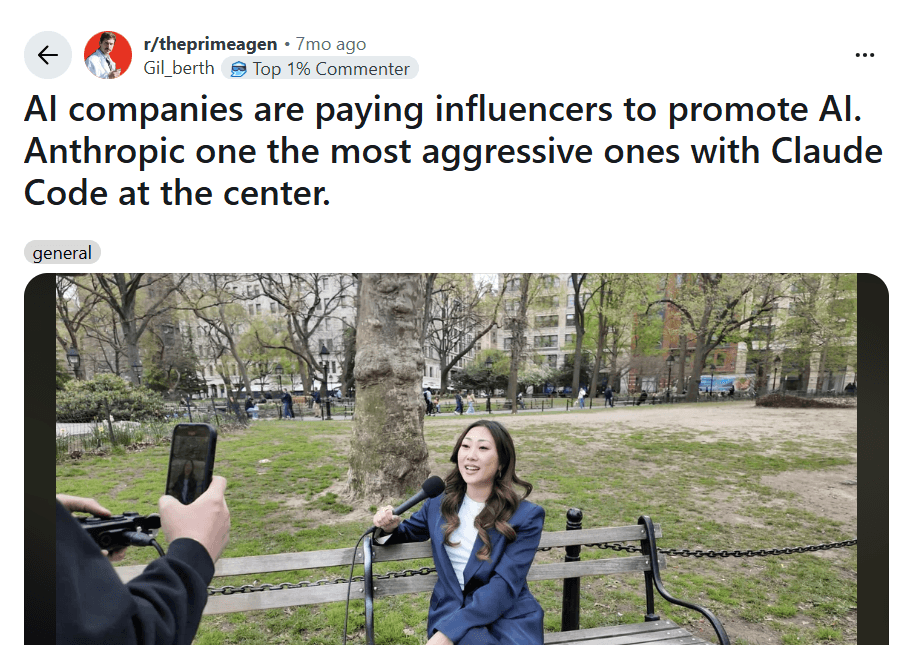
The same reporting connects the incident to earlier backlash over OpenAI influencer retreats. And a thread in r/theprimeagen titled "AI companies are paying influencers to promote AI. Anthropic one of the most aggressive ones with Claude Code at the center" ran to more than 50 comments. Developers are actively tracking which AI companies are buying creator coverage and discussing it in public.
Four rules follow, and they are stricter than FTC guidance:
- Disclose in the video, not just the description: a spoken disclosure in the first 30 seconds. Description-only disclosure is what triggered the Higgsfield reaction.
- Require the creator to state the terms, including credits: "This video is sponsored" is insufficient when part of the payment is product access. The audience treats undisclosed credit grants as a hidden interest, correctly.
- Give the creator explicit written permission to criticize the product: put it in the agreement. Then, when they publish the rough edges, don't ask for an edit. It is the clause that does the most work in the whole agreement, because it converts your brief from an ad into a review.
- Brief them on the reaction, not just the product: tell the creator what the objection to your category sounds like and let them decide whether they want to answer it on camera. A creator who is ambushed by their own comment section will not work with you again, and will tell other creators why.
The cost of getting this right is a paragraph in a contract. The cost of getting it wrong is that the creators who matter in your category stop taking your calls.
What does the first 90 days of AI influencer marketing look like?
Four phases. Two of them publish nothing, and those two are the ones teams skip.
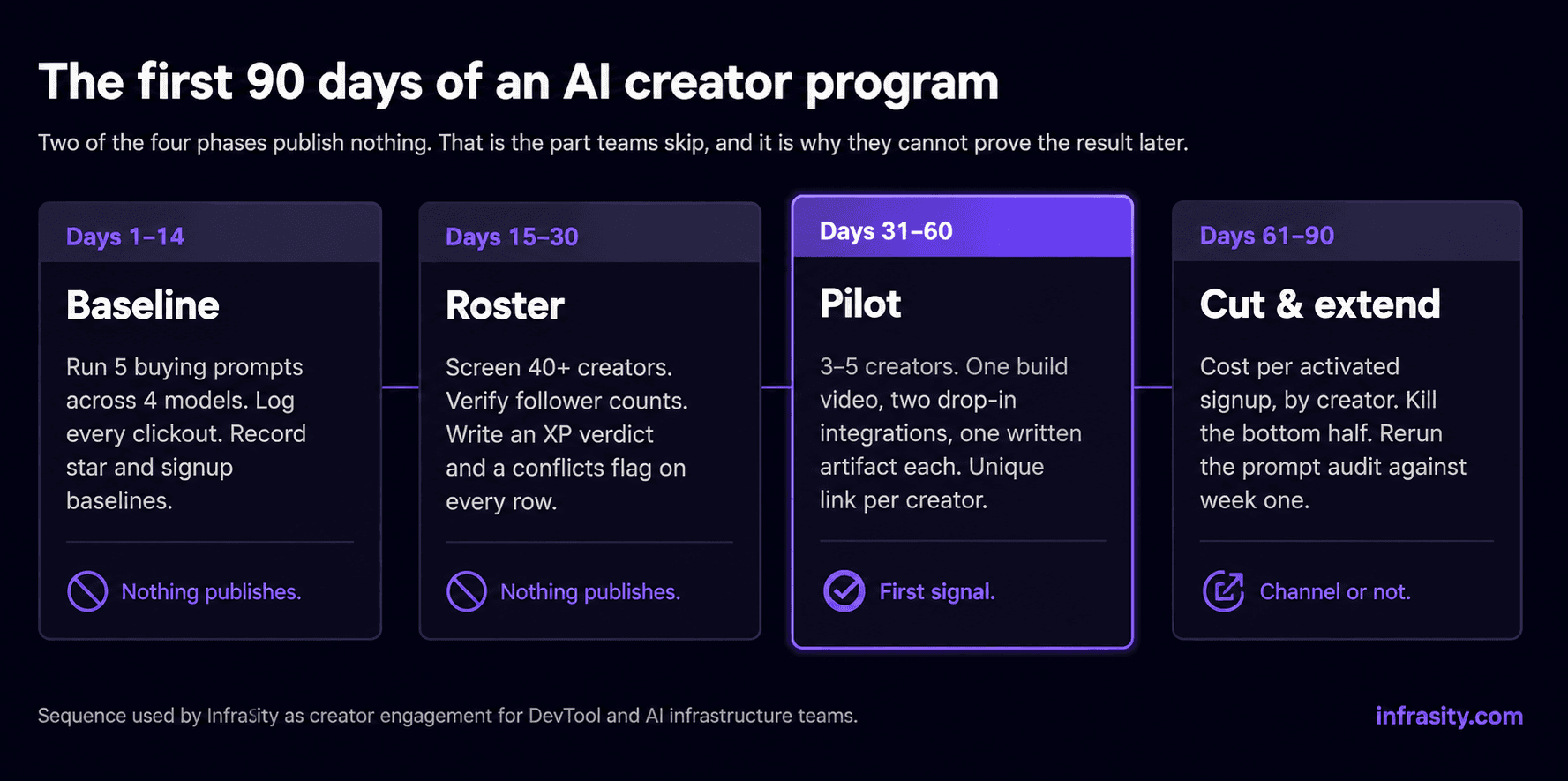
Days 1 to 14, baseline: Define the five prompts a buyer would actually type into a model when evaluating your category. Run them across four models. Log every citation. Record your GitHub stars, package downloads, and organic signups as of today. Nothing publishes in this phase. You are creating the counterfactual that makes every later number defensible.
Days 15 to 30, roster: Screen at least 40 creators to land 15 viable ones. Verify follower counts independently against stated counts. For every row, write a plain-language ICP verdict rather than a score, and a conflicts flag covering competing advisory roles, ghostwriting arrangements, and public positions on AI that your partnership would compromise. Still nothing publishes.
Days 31 to 60, pilot: Three to five creators. Mix formats deliberately: one dedicated build video, two drop-in integrations where your tool appears naturally inside a tutorial about something else, and one written artifact from each creator. Unique tracked link per creator, plus a "mention this creator on signup" line in every brief to catch the developer who watched on a phone and signed up on a laptop three weeks later.
Days 61 to 90, cut and extend: Compute cost per activated signup by creator, not cost per click. Kill the bottom half without sentiment. Re-run the five-prompt audit and compare it to your week-one matrix. Rebook the winners for multi-piece deals.
The past 90 days are in program mode, and that's where the compounding lives. Our own campaign data shows why patience is required: one creator post kept producing organic references eight months after it was published, when someone in r/devops linked it as the answer to an unrelated question. Sponsored reach ended the day the budget did.
Where does this leave your AI company?
You have a product whose value only becomes obvious when someone competent uses it in public, in a category where the audience is primed to suspect that any praise was bought. That combination makes creator marketing the strongest channel available to you and the easiest one to detonate.
The twelve companies with published programs have already answered the hard questions in public. Lead with credits, because they cost you inference and turn the creator into a real user. Sell status, because it is free and it is what creators want most.
Then the mechanics. Buy six months rather than one post. Cap the revenue share. Set your floor on views. Ask for the written artifact. Fund a campus club. Publish your hackathon SOP so it scales without headcount. And disclose harder than the law requires, because the reputational cost lands on the person doing you the favor.
Start with the baseline in the 90-day sequence above. It takes an afternoon, it publishes nothing, and it tells you whether the rest of this applies to your situation.
Or let us make your job easier: check out our B2B influencer marketing agency service.
Frequently Asked Questions
How much should an AI startup budget for a creator marketing pilot?
Enough for three to five placements you could afford to lose entirely, which for pre-seed to Series B AI teams typically lands between $3,000 and $15,000 for a first test. Judge that pilot on cost per activated signup rather than reach, then scale only the creators who cleared your bar. Cursor's published $500 per month per creator is a useful anchor for what a recurring relationship costs versus a one-off placement.
Do AI credits actually work as creator compensation, or do creators want cash?
Both, in a specific order. Credits do the heavy lifting because they turn the creator into a genuine power user, which is the only thing that makes the content credible. Cash is the floor that keeps the relationship alive between launches. Anthropic, Cursor, and ElevenLabs lead with credits and treat cash as a smaller layer, and Cursor's ambassador program asks for soft exclusivity while publishing no cash component at all.
Should an AI company run an affiliate program or an ambassador program?
Run both, because they solve different problems. An affiliate program pays for conversions you can attribute and scales without management overhead. An ambassador program buys advocacy, event coverage, and product feedback that no affiliate link will ever capture. Only four of the twelve companies we verified run more than two program types, which is why the layered approach is still a competitive advantage rather than table stakes.
How long before creator marketing produces pipeline for an AI product?
Some signups appear within days of a post going live, but the meaningful return builds over months as the content keeps getting found. Six weeks buys you a signal about which creators work. Twelve months buys you a channel. One of our own campaign posts was still generating organic references eight months after publication, long after the campaign budget had stopped.
What is the biggest mistake AI companies make with influencer marketing?
Buying one-off placements against a product whose capabilities change monthly, so the content is describing a version that no longer exists by the time it gets discovered. The second-biggest is thin disclosure, which, in AI categories, transfers reputational damage onto the creator and burns the relationship along with the campaign.
Does this apply to AI companies selling to non-technical buyers?
Partly. The disclosure discipline, the capped revenue share, and the retainer structure all transfer directly. The demo-heavy content requirement softens, because a non-technical buyer will accept a described benefit where a developer demands to see the terminal. Format shifts toward LinkedIn and long-form written work, which is also where B2B influencer marketing for technical buyers and LinkedIn creator programs do most of their work.
How do you find creators who can credibly demo an AI product?
Filter on evidence of building rather than evidence of talking. Look for a public repo, a shipped side project, or a video where something breaks on camera and gets fixed. Then check median views across their last ten videos rather than subscriber count, and run a conflicts check covering competing advisory roles and any public position on AI that your partnership would compromise. We break the full scorecard down in our guide to choosing YouTube influencer marketing agencies.