
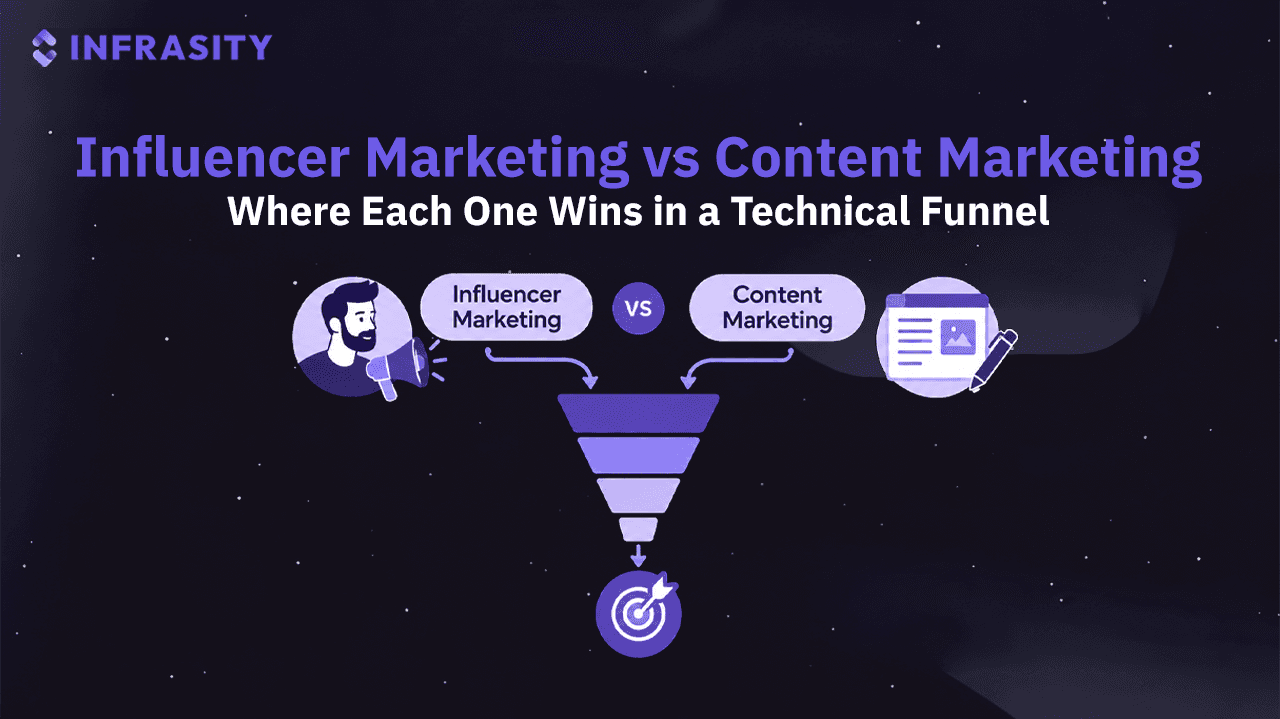
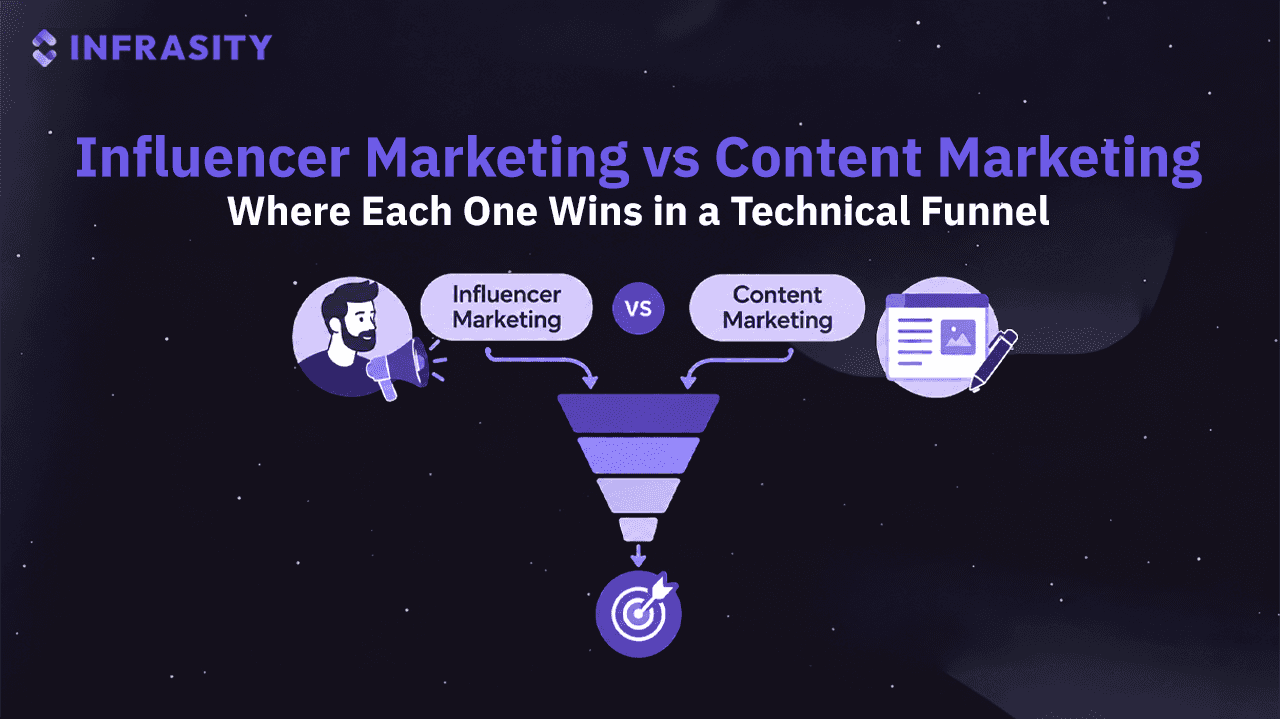
In the influencer marketing vs content marketing decision, creators win the stage where a technical buyer builds a shortlist without you, and owned content wins every stage where that buyer checks whether you belong on it. The 6sense Buyer Experience Report 2025 found the winning vendor was already on the Day One shortlist 95% of the time, and buyers make first contact only 61% of the way through their journey. So the real question for a B2B SaaS or devtool team is which stage is leaking deals today, and which channel fixes that stage.
This blog is for the people who sign off on that spend and the advisors and investors who review their plans. It covers how each channel works inside a technical funnel, where each one breaks, what similar B2B companies did with each, and a simple model for deciding where the next dollar goes.
TL;DR
- Influencer marketing rents trust and reach. It works best at awareness and shortlist stages, where most B2B buyers are not yet talking to vendors.
- Content marketing builds owned assets. It wins evaluation, activation, and expansion because developers verify claims in docs, tutorials, and working code.
- Developers learn from technical documentation more than any other source (67.8%, per the Stack Overflow Developer Survey 2025), almost double the share who learn from blogs or podcasts (34.8%).
- Creator campaigns for devtools perform when the product sits inside a real build. Clerk's sponsor-only videos did not move its metrics; workflow integrations lifted YouTube-attributed signups 30%.
- Fund content first if a new developer cannot reach first success from your docs. Fund creators first if your docs work but nobody names you on a shortlist.
What Is the Difference Between Influencer Marketing and Content Marketing in B2B?
Both channels produce content, which is why the line gets blurry in budget meetings. The difference sits in who owns the audience, who owns the asset, and how long the asset keeps working.
Influencer marketing borrows an audience that already trusts someone else
B2B influencer marketing pays or partners with a person whose audience already trusts their judgment: a YouTube engineer, a LinkedIn operator, a newsletter writer, a podcast host. You get reach and credibility on day one. The audience, the channel, and usually the asset stay with the creator.
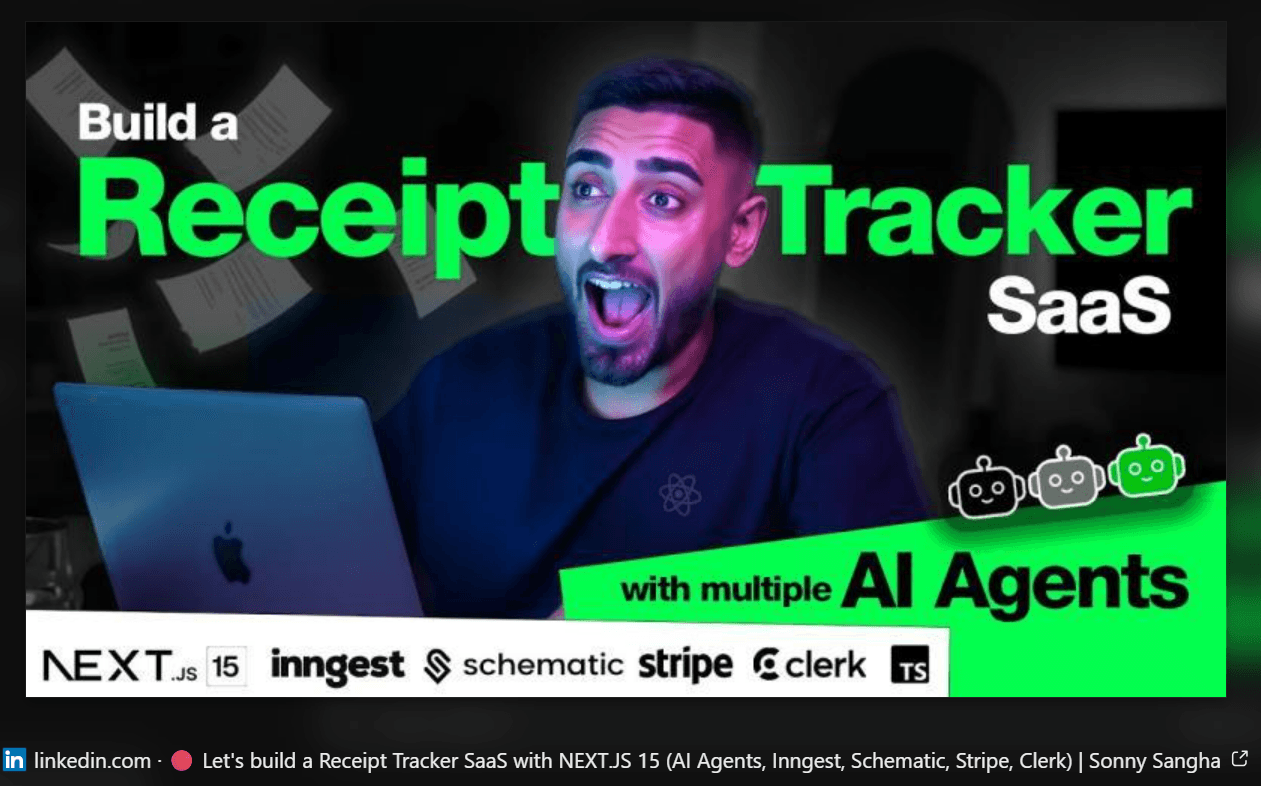
A creator build video in practice: the tools appear inside one working app rather than in a scripted ad read.
Research on B2B programs describes this differently from consumer influencer work. A study of senior B2B marketers in Industrial Marketing Management found practitioners prefer the term "influential marketing", built on expertise, professionalism, and long-term, industry-specific relationships. In B2B, the creator's value is their judgment, and judgment doesn’t survive a one-off scripted ad read.
Content marketing builds assets you own and keep compounding
Content marketing means publishing material on channels you control: blog posts, documentation, tutorials, benchmarks, comparison pages, newsletters, and your own video. Reach starts slow. But a strong tutorial or comparison page keeps capturing demand for years, and in 2026 it also feeds the answers that ChatGPT, Perplexity, and Google AI Overviews give to buyers.
How the two channels compare on the variables a budget owner tracks
| Variable | Influencer marketing | Content marketing |
|---|---|---|
| Who owns the audience | The creator | You |
| Speed to first result | Days to weeks | Months |
| Shelf life of one asset | Spike, then decay | Compounds if maintained |
| Strongest funnel stages | Awareness, shortlist | Evaluation, activation, expansion |
| Main proof signal | Reach, engagement, signup lift on publish dates | Organic signups, docs-assisted activation, AI citations |
| Biggest failure mode | Wrong audience, ad-read format | Thin content, no distribution |
| Attribution | Directional (date matching, codes, branded search) | Trackable, slower to show |
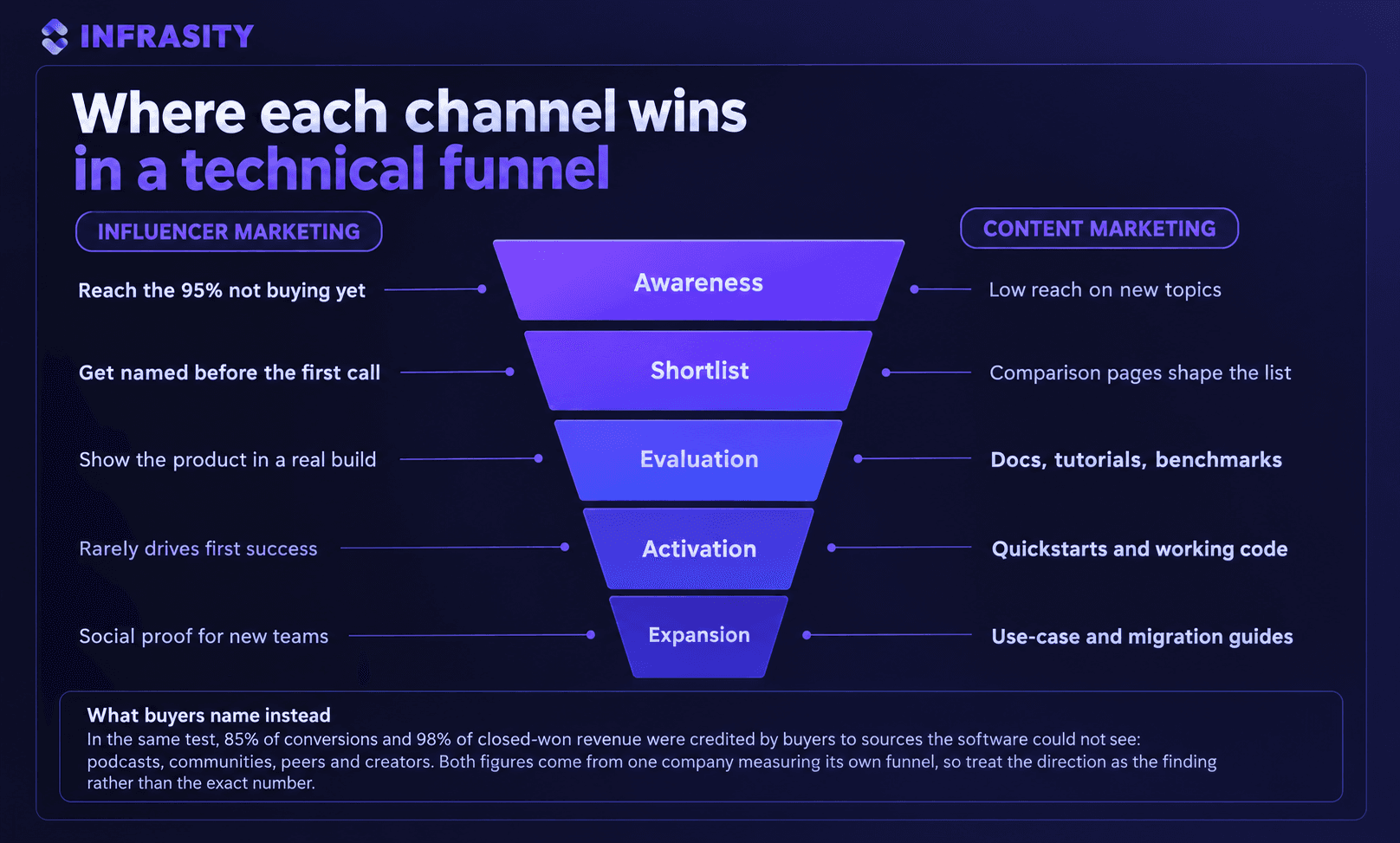
Influencer marketing is strongest in the early stages of the funnel, content marketing in the later ones.
How Does a Technical Buyer Move Through the B2B Funnel in 2026?
Before deciding between influencer marketing vs. content marketing, map how your buyer gets to a decision. The current data shows most of that decision happens out of your sight.
Buyers pick the shortlist before they talk to anyone
According to 6sense, buyers now make first contact with sellers about 61% of the way through the journey, and 79% start that contact themselves. Gartner reported that 61% of B2B buyers prefer a rep-free buying experience. If you are not on the Day One list, a better demo later rarely saves the deal.
Hidden decision-makers never meet your sales team
The Edelman and LinkedIn 2025 B2B Thought Leadership Report found that 71% of hidden buyers (the finance leads, security reviewers, and senior engineers behind the main champion) have little or no contact with sales. They still vote. They form their view from what they read, watch, and hear from peers.
Only a small slice of the market is buying right now
Research from the LinkedIn B2B Institute with Professor John Dawes, known as the 95:5 rule, estimates only about 5% of B2B buyers are in market at any given time. The other 95% will buy later, and they will buy from the names they already know.

Most of the decision happens before a seller hears about it. Sources: 6sense Buyer Experience Report 2025 (95% and 61%), Edelman and LinkedIn 2025 (71%), LinkedIn B2B Institute (5%).
Read those numbers together, and the funnel splits cleanly. Early on, the job is memory: get your name into the heads of people who are not buying yet. Later, the job is proof: give the people who are buying everything they need to defend the choice internally.
Where Does Influencer Marketing Win in a Technical Funnel?
Influencer marketing earns its budget when the buyer isn't searching yet and doesn't trust you yet. It loses money when it is asked to do conversion work it was never built for.
Getting your product named before the first sales call
A trusted creator saying "this is what I use for auth" puts you on a list you could not reach through ads. The Ogilvy B2B influencer research, a survey of 550 senior marketers across 11 countries reported by Campaign Middle East, found 49% say influencers give their brand more credibility and trust than it could earn alone, and about 75% already run B2B influencer programs.
Reaching the 95% who are not in market
Creators reach people who would never search for your category this quarter. A platform engineer watching a Kubernetes cost video is not shopping, but the tool that shows up inside that video becomes the default name when budget opens. This is the brand-building job the 95:5 research describes, and creator audiences in devtools are unusually concentrated around a single stack, which keeps waste low.
Showing the product inside a real build
For developer tools, the format decides the result. In a playbook published by HyperGrowth Partners, Clerk's first test of three long-form, Clerk-only sponsored videos did not move its target metrics. The team switched to integrations where Clerk appears inside a larger app build, starting at three to five videos per creator. It scaled from a handful of creators to 20 active partners and grew YouTube-attributed signups by 30%.
The lesson is mechanical. A developer trusts what they see compile. A 60-second ad read asks for belief; a build shows the auth flow working in real code, which is the same evidence a developer would look for in your docs.
Our guide to influencer marketing for devtools covers how to brief creators for this format.
What Limits B2B Influencer Marketing ROI?
- Attribution is directional. Viewers rarely click description links, so Clerk's team matched video publish dates to signup spikes. Plan for date matching, promo codes, branded search lift, and holdout tests from day one. Our breakdown of measuring influencer marketing ROI shows the full stack.
- The traffic lands somewhere you own. If the creator sends 4,000 developers to a quickstart that fails on step three, the creator did their job, and your funnel did not.
- One-off posts decay fast. The TopRank Marketing 2025 B2B influencer report found 82% of the most successful marketers run always-on programs, and teams without always-on are 17 times more likely to report ineffective results.
- Pricing varies widely. HyperGrowth Partners reports developer YouTube deals across its portfolio at roughly $20 to $55 per 1,000 views, often with a make-good clause if a video misses a view floor.
Where Does Content Marketing Win in a Technical Funnel?
Content marketing wins from the moment a buyer starts checking claims. In a technical funnel, that moment arrives early, because the evaluator is often the developer who will use the product.
Developer evaluation runs on documentation first
The Stack Overflow Developer Survey 2025 shows technical documentation is the top learning source for developers at 67.8%. Videos sit at 50.0%, level with Stack Overflow, and blogs or podcasts at 34.8%. Your docs are the most-read marketing asset you have, whether your marketing team owns them or not.
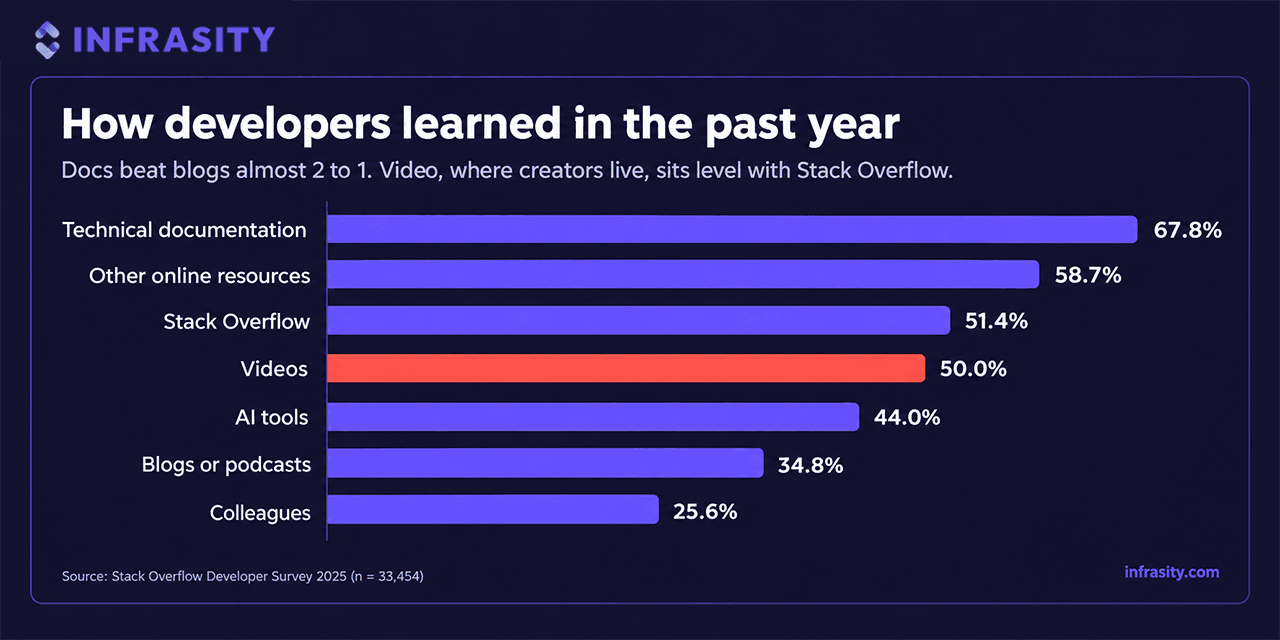
Docs beat blogs almost 2 to 1. Video, where creators live, sits level with Stack Overflow. Source: Stack Overflow Developer Survey 2025.
This is why documentation that drives adoption belongs in the content budget. Quickstarts, API references with copy-paste examples, and migration guides do the conversion work that no sponsored post can.
Proof content convinces the buying committee
The champion has to sell your tool internally. Edelman and LinkedIn found 64% of hidden buyers trust thought leadership more than product sheets when judging a vendor, and 79% are more likely to back a vendor in an RFP if it consistently publishes high-quality thought leadership. Benchmarks, architecture write-ups, security pages, and honest comparison pages give the champion something to forward to the CFO and the security reviewer.
Owned content compounds instead of decaying
Ahrefs is the clearest B2B example. Its CMO Tim Soulo said in a 2024 interview on Latka that the company had no sales team until it passed about $100 million in revenue, and that growth came from word of mouth, blogs, and YouTube. Every Ahrefs article shows the problem being solved inside the product, so the content teaches and sells in the same move. Supabase reports a similar pattern on its launch process page: databases grew 47% month-on-month for 18 months, driven by repeated launch content and community posts.
AI answers now sit between your content and your buyer
Search is changing what "owning content" means. Pew Research found users clicked a result in 8% of visits when an AI summary appeared, against 15% without one. Ahrefs measured a 34.5% lower click-through rate for top-ranking pages on keywords with AI Overviews.
With fewer clicks, the goal shifts: your content has to be the source the AI answer quotes. That favors specific, structured, sourced pages and independent mentions on Reddit, GitHub and creator channels. Our guides on structuring content for LLMs and AEO vs GEO explain the mechanics, and an AI visibility audit shows where you stand today.
Where content marketing breaks
- It is slow. Expect months before organic signups show up in volume, which tests the patience of seed-stage boards.
- It has no reach on day one. A great tutorial on a new domain gets read by almost nobody until something distributes it.
- AI-generated volume does not move results. The CMI B2B research for 2026 found 87% of marketers using AI for content report higher productivity, but only 39% report better content performance.
Why Do DevTools Need a Different Design for Both Channels?
Most influencer marketing vs. content marketing advice is written for consumer brands or generic B2B SaaS. Developer tools break three of its assumptions, and each one changes how you design both channels.
The user and the buyer are different people with different sources
The developer who installs your SDK learns from docs, GitHub and video. The engineering manager or CTO who approves the contract reads newsletters, podcasts and peer recommendations. One channel rarely reaches both. Map content to the user and creators to whichever group your shortlist depends on. Our developer funnel guide breaks down each stage from discovery to expansion.
Creator selection follows the buyer, not the follower count
Clerk and WorkOS both sell authentication and both sponsor developer creators, but they buy very different audiences. Third-party sponsorship tracking from Sponsorradar lists 105 WorkOS-sponsored videos, with Theo (t3.gg) accounting for 52 of them, about half, plus Lenny's Podcast at 28 and The Pragmatic Engineer at 12. Clerk's tracked spend is spread across 26 creators, led by Sonny Sangha's build tutorials at 36 videos.

WorkOS buys senior-engineer and founder audiences; Clerk buys builder and tutorial reach. Third-party sponsorship tracking, directional.
The pattern fits each company's buyer. WorkOS sells enterprise SSO to SaaS companies moving upmarket, so it buys the attention of senior engineers and founders who make that call. Clerk sells to developers building React and Next.js apps, so it buys tutorial reach where those developers learn. Same category, same channel, opposite casting.
The micro-influencers in B2B guide explains why smaller, narrower audiences often convert better for technical products.
Developers punish anything that reads like an ad
A creator who reads a script loses the trust you paid for. A blog post that hides the code behind a demo form loses the developer. In both channels, the content has to run: real repos, real commands, real limits. Video creators should build with the product; written content should ship working examples. Our YouTube best practices for devtools, drawn from 645 videos across 43 channels, cover the formats that hold developer attention.
What Happened When Similar B2B Companies Chose Different Routes?
Clean A/B tests between companies don’t exist; nobody publishes revenue by channel. But a few pairs in the same category, at similar scale, show how each route behaves.
Ahrefs vs Semrush: two routes to the same scale in SEO software
Ahrefs went content-led and bootstrapped: product-led blog posts, a large YouTube channel, free tools that Soulo said drive about half of its traffic, and no sales team until about $100 million. Semrush paired heavy content with a large affiliate and partner engine, paying fixed commissions per sale or trial through a 120-day-cookie affiliate program. Semrush reported $376.8 million in revenue for 2024 and about 117,000 paying customers in its full-year results.
What to take from it: both reached nine-figure revenue, and both built a deep content base first. Partner and creator spend scaled a product that already had strong owned content behind it. Neither company used creators to replace content.
Clerk vs WorkOS: same channel, opposite casting in authentication
Both companies sponsor creators, and Clerk has reported public scale of more than 200 million users and 15,000 apps alongside its Series C. WorkOS publishes no comparable signup data, so outcomes cannot be compared directly. What the pair does show is that the influencer marketing decision in devtools comes down to which creators match the buyer who signs.
Supabase: content and community before any paid reach
Supabase built growth on launch weeks, documentation and community posts. Its own write-up describes a single Hacker News front-page run sending hosted databases up 10x overnight, and its Series B announcement reported databases growing from 50,000 to more than 150,000 between rounds. The team also re-promotes features repeatedly because, in its own words, it tends to overestimate the reach of its online marketing.
Three lessons from these companies
- Owned content came first in every case: Creators and partners amplified products that already had docs and tutorials good enough to convert the traffic.
- Creator programs worked when the format matched how developers evaluate: product inside a build, repeated across several videos, with the same creator.
- Creator choice tracked the buyer: Reach numbers alone did not predict fit.
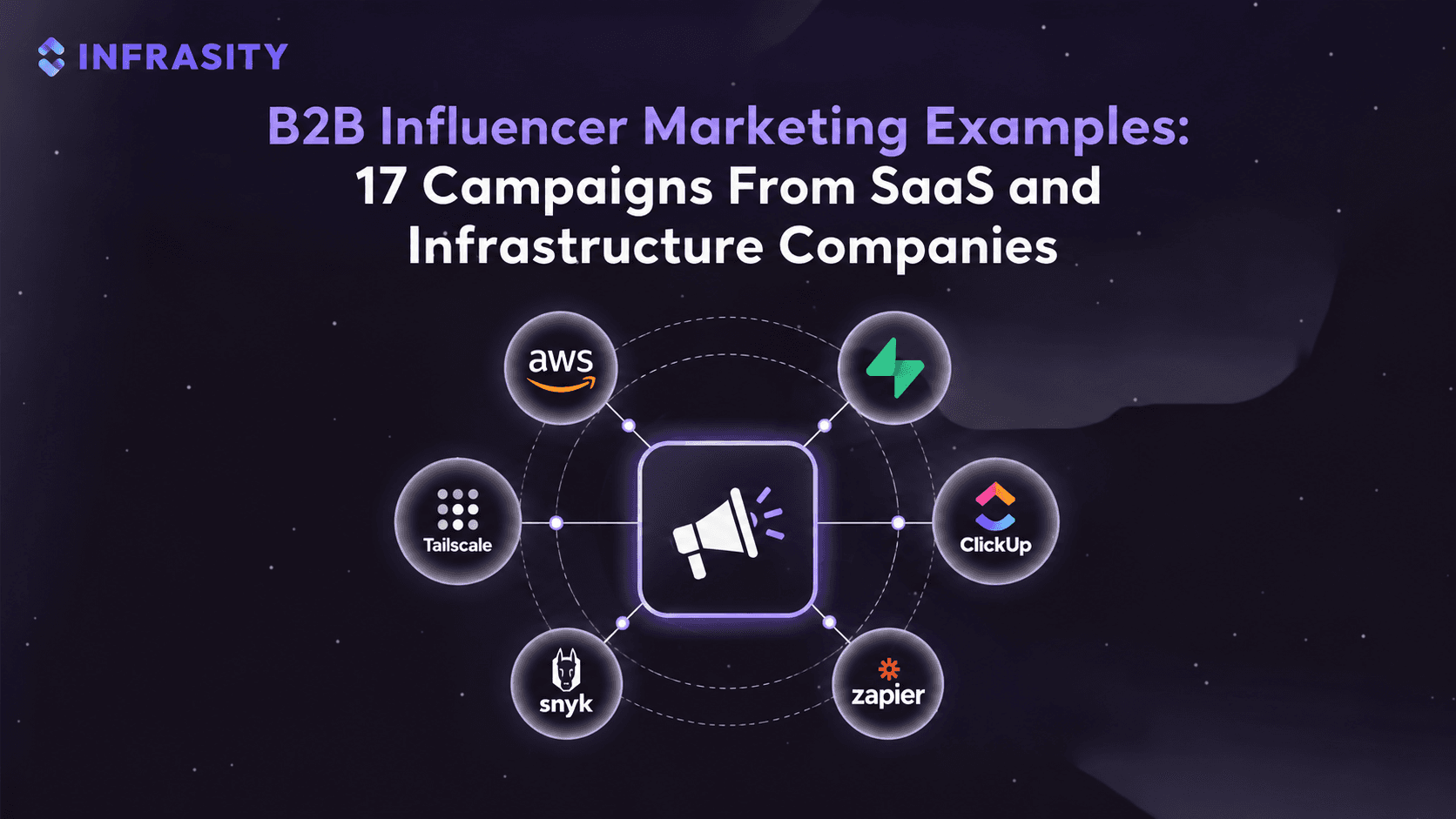
For more campaign-level detail, see our roundup of B2B influencer marketing examples across 17 SaaS and devtool programs.
How Should You Split Budget Between Influencer Marketing and Content Marketing?
The right split depends on where your funnel leaks. A fixed ratio copied from another company will misfire. Use the three questions below in order; each "no" tells you where the next dollar goes.
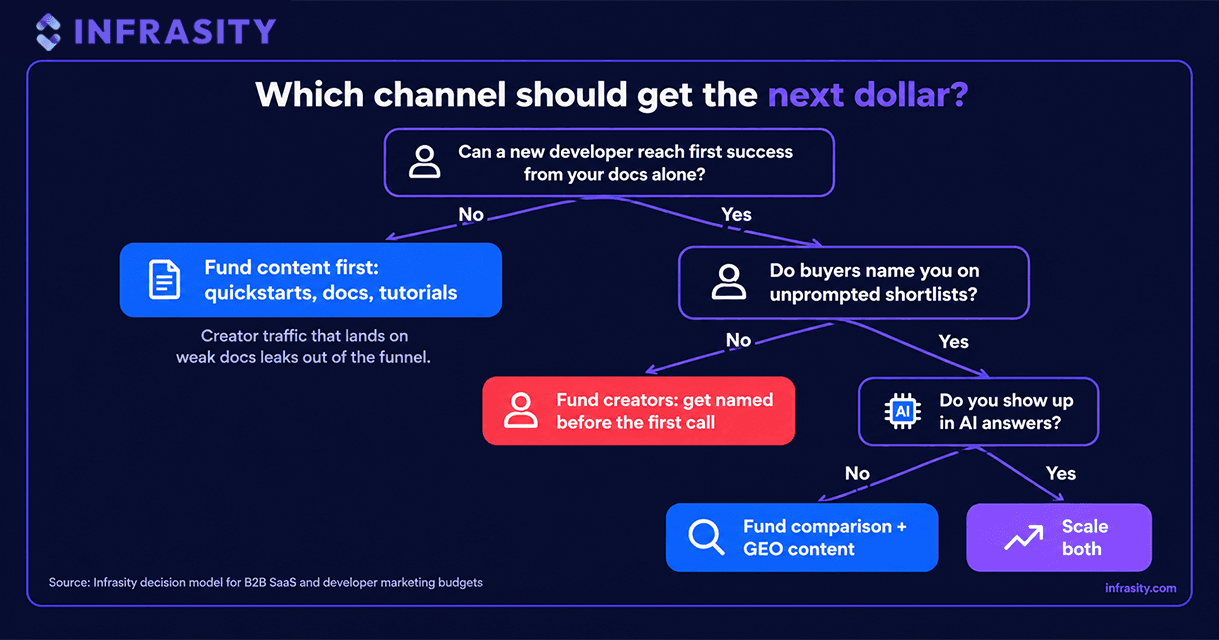
Three questions, asked in order. Each no tells you where the next dollar goes.
Question one: can a new developer reach first success from your docs alone?
If not, fund content first. Every creator campaign will send traffic into a funnel that cannot convert it. Start with a quickstart, three to five task-based tutorials for your top use cases, and an honest comparison page for each main alternative.
Question two: do buyers name you on unprompted shortlists?
Ask your last 20 closed deals and lost deals which tools they considered first. If your name came up late or not at all, your content is converting people who find you, but too few find you. That is the moment to fund creators, ideally an always-on roster of a few creators with several integrated videos each.
Question three: do you show up in AI answers for your category?
Run your top ten buying prompts, such as "best feature flag tool for Kubernetes", through ChatGPT, Perplexity, and Gemini. If competitors appear and you do not, fund comparison content, third-party mentions on Reddit and GitHub, and creator content that can be cited. If you appear, scale both channels together.
How to measure each channel without fooling yourself
- Content: organic signups by landing page, docs-assisted activation (users who read docs before first API call), time to first value, and citations in AI answers for tracked prompts.
- Influencer: signup lift in the 7 to 14 days after each publish date against a baseline, branded search volume, promo code redemptions, and self-reported attribution in your signup form ("Where did you hear about us?").
- Both: pipeline influenced by accounts that touched either channel, checked against a holdout region or segment where possible.
How Do Influencer Marketing and Content Marketing Work Together?
The strongest B2B programs stop treating influencer marketing vs content marketing as an either-or choice. They connect the two so each one feeds the other.
- A creator builds a real project with your product and links to the exact tutorial they followed.
- That tutorial lives on your docs or blog, structured for search and AI citation, with a working repo.
- The creator video gets embedded in the tutorial, so the owned page carries the trust signal.
- Questions from the creator's comments become new FAQ entries, docs fixes and Reddit answers.
- Repeated mentions across creators, Reddit threads and your own pages raise the odds that AI answers cite you.
This loop is where programs usually fall short. Creator campaigns run from one team, content from another, and the two never link. Our developer marketing strategy guide and our list of developer marketing channels show how to plan them as one system.
How Infrasity runs both channels for devtools and B2B SaaS
At Infrasity, we run both sides of this loop for developer tools and B2B SaaS companies. Our technical content marketing and technical writing teams build the tutorials, comparison pages, and guides that convert. Our documentation services fix the quickstarts that creator traffic lands on. Our B2B influencer marketing team casts and briefs creators on YouTube, LinkedIn, and X, and our Reddit marketing and AEO and GEO work makes sure all of it shows up in AI answers.
The results are public. For Rocket, we ran 90 creator placements across YouTube, X, and Instagram with 1.5 million verified reach and per-creator UTM tracking. For OX Security, content work doubled organic traffic and lifted top-3 rankings 5.7x. For Qodo, we combined 32 technical pieces with Reddit engagement to reach the second spot in AI code review across Google and LLMs.
Common Mistakes When Choosing Between Influencer and Content Marketing
- Buying creators before the docs work. The spike arrives, the quickstart fails, and the campaign gets blamed.
- Casting by follower count. A large general tech audience rarely contains your buyer; a narrow channel on your exact stack often does.
- Paying for ad reads instead of builds. Developers skip scripted segments. They watch someone solve a problem.
- Judging creators on last-click attribution. Most of the effect shows up as branded search and direct signups days later.
- Publishing content with no distribution. A tutorial nobody sees cannot compound. Pair new content with Reddit, community, and creator distribution, as covered in our guide to distributing open-source devtools.
- Running both channels in separate silos. The value sits in the links between them.
Conclusion
The influencer marketing vs content marketing choice gets easier once you compare funnel stages instead of channels. Creators get a technical product remembered by the 95% who are not buying yet and named on the shortlists that decide most deals. Owned content proves the product to the developer evaluating it and the hidden stakeholders approving it, and it keeps compounding long after a sponsored video peaks.
If you want help finding which stage is leaking and building the channel that fixes it, talk to the Infrasity team. We run technical content, creator programs, Reddit, and AI visibility for devtools and B2B SaaS under one plan.
Frequently Asked Questions
Is influencer marketing or content marketing better for B2B SaaS?
Neither wins across the whole funnel. Influencer marketing is stronger at awareness and shortlist stages, where most B2B buyers are not yet talking to vendors. Content marketing is stronger at evaluation, activation, and expansion, where buyers verify claims in docs, tutorials, and comparison pages.
Which should a devtool startup fund first?
Fund content first if a new developer cannot reach first success from your docs alone, because creator traffic will leak out of a broken quickstart. Once activation works, add creators to get named on shortlists you cannot reach through search.
How do you measure ROI on B2B influencer marketing?
Track signup lift in the one to two weeks after each publish date against a baseline, branded search volume, promo code use and self-reported attribution in your signup form. Last-click links undercount the effect, because most developers search for the product later instead of clicking the description link.
Does AI search make content marketing less valuable?
Content now has a different job. Pew found users click results far less often when an AI summary appears, so content now has to be the source those summaries cite. Specific, structured and well-sourced pages, plus independent mentions on Reddit, GitHub and creator channels, raise those odds.
Can influencer marketing and content marketing share one budget?
Yes, and the best programs plan them as one system. A creator video links to a tutorial you own, the tutorial embeds the video, and questions from the audience become new docs, FAQs, and community answers. That loop turns a one-time spike into an asset that keeps working.