
TL;DR
- Median B2B/DevTool video gets 508 views; 4% of videos drive 95% of all views, so stop chasing a weekly cadence and focus on the few that matter.
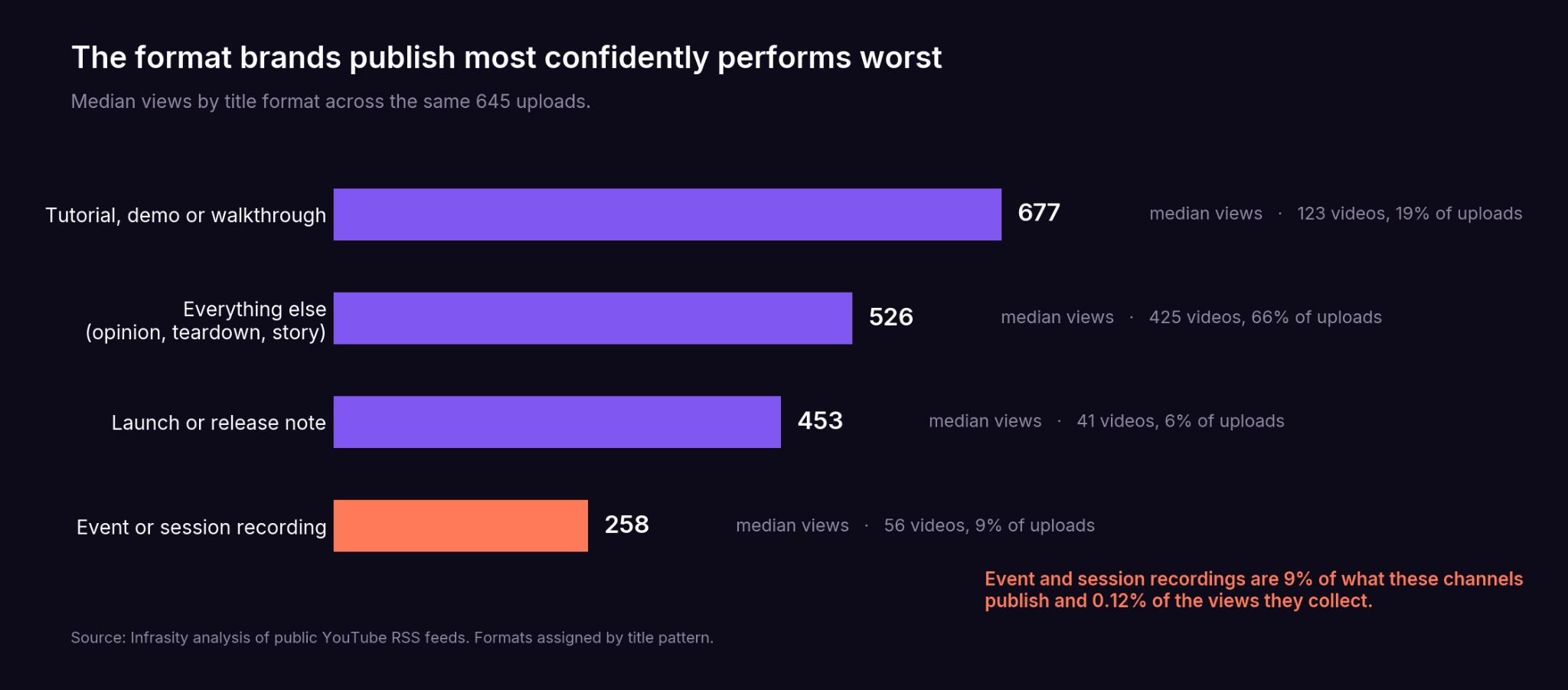
- Conference/session recordings are the worst format: 9% of uploads, 0.12% of views. Archive the full talks; cut only the 2-3 strongest minutes.
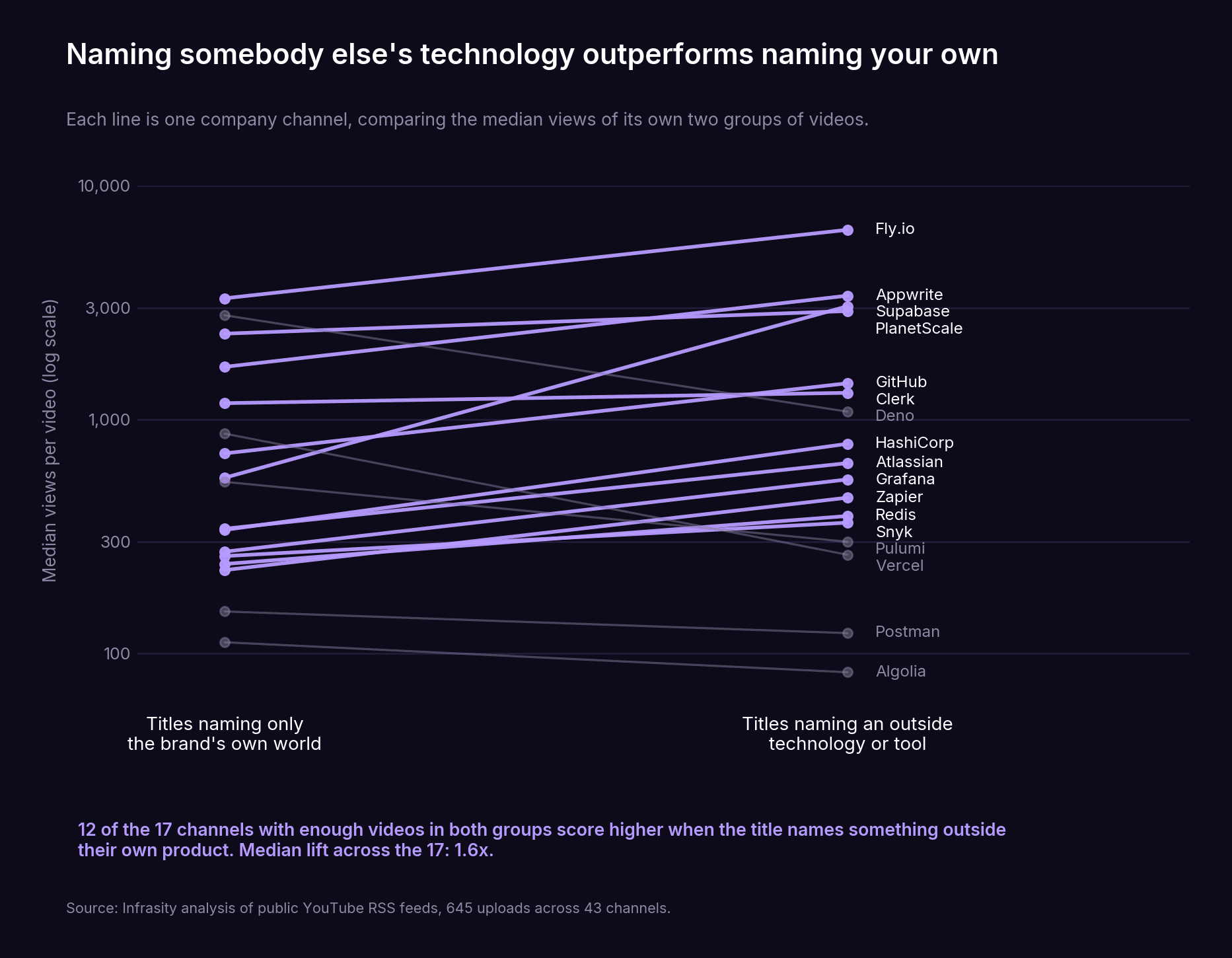
- Title for the ecosystem, not your product: videos naming an outside tool or framework beat own-brand titles by 1.6x median across channels.
- Chapters and a link above the fold are non-negotiable: only about 25% of brand videos do either, and Google prioritizes creator-set chapters for search visibility.
- Don't measure clicks; measure qualified views. Developers rarely click links, so track self-reported attribution ("how'd you hear about us") plus a before and after baseline lift instead.
The single highest-leverage change most B2B devtools can make on YouTube is to stop publishing on their own channels. The median recent upload from a DevTool or B2B SaaS company channel gets 508 views. Not the bad ones. The median. We pulled the public upload feeds of 43 company channels and measured 645 recent videos, and 428 of them landed under 1,000 views, while 25 videos, 4% of the sample, collected 95% of all views.
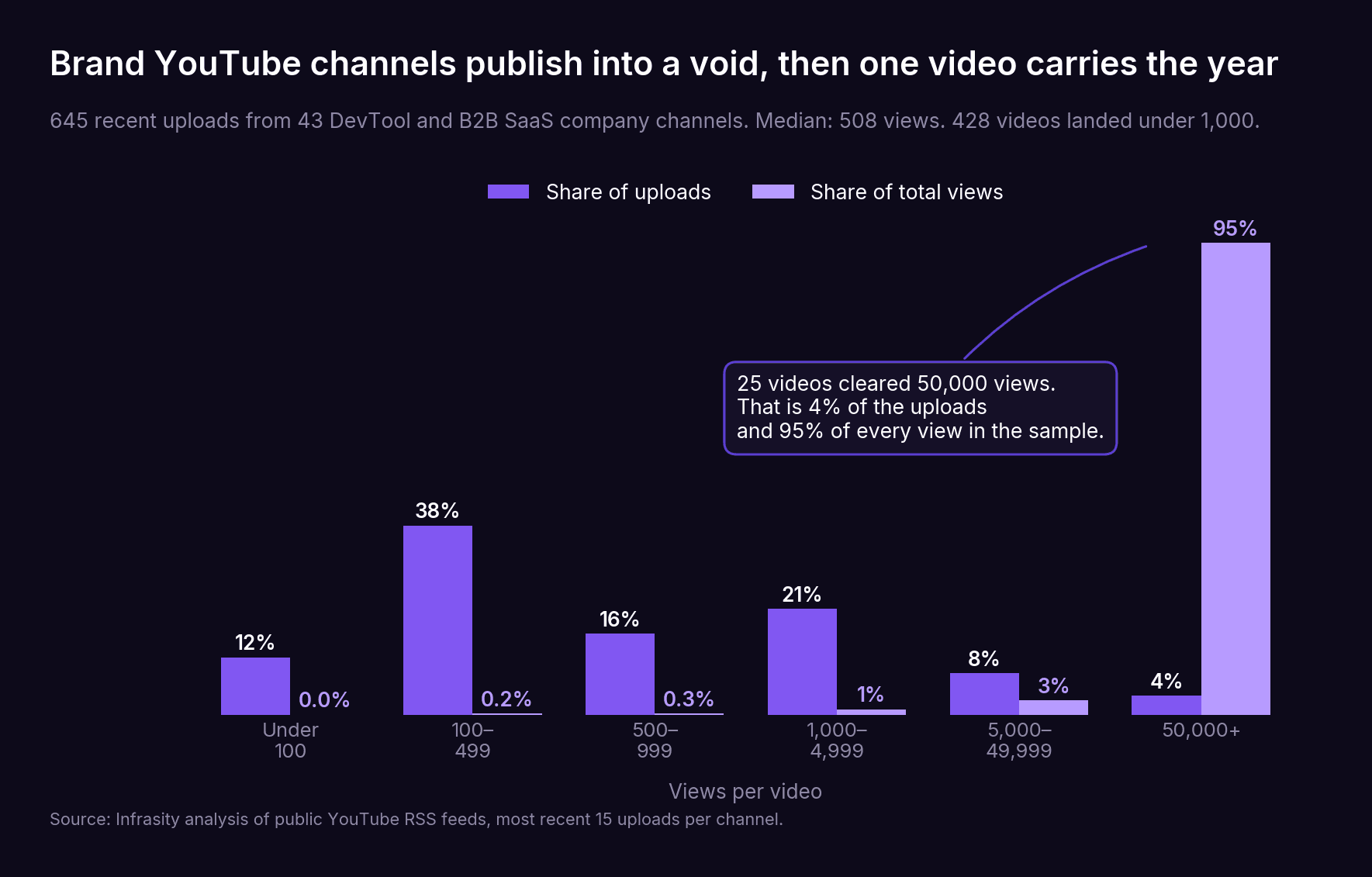
That distribution is the whole strategy problem in one number. YouTube is not a channel where steady output compounds into an audience. It is a channel where a small number of videos answer a question somebody was already asking, and everything else is archive.
This blog covers the 11 practices that separate the 4% from the 96%, along with the data behind each. These production decisions are specific to products a developer has to install, and what to measure when your buyer never clicks the link.
How we got these numbers
Every figure attributed to "our sample" in this article comes from one analysis, so you can check it or repeat it.
We resolved 47 DevTool and B2B SaaS brand YouTube handles to channel IDs, pulled each channel's public RSS feed at youtube.com/feeds/videos.xml, and took the most recent 15 uploads from each. 43 channels returned usable data. That gave 645 videos, 643 of which were published within the previous twelve months. The feed carries the title, publish date, view count, like count, and full description for each video, which is what makes the title and description analyses below possible.
The sample spans infrastructure (Cloudflare, Fly.io, Railway), databases (MongoDB, Redis, ClickHouse, PlanetScale, Neon, CockroachDB), developer platforms (Supabase, Vercel, Appwrite, Deno, Clerk, WorkOS), observability and data (Datadog, Grafana, Elastic, Confluent, dbt Labs), and ten non-developer B2B SaaS channels (Notion, Figma, Asana, monday.com, Zapier, Salesforce, Atlassian and others) as a control group.
1. Publish against the question, not the release calendar
Most B2B channels are organized around what the company did. The videos that work are organized around what the viewer is trying to do.
The clearest illustration in our sample is Stripe Developers, whose median recent upload sits at 35,949 views, roughly seventy times the sample median. Their titles are almost all questions or objections a developer actually holds: "Why NOT roll your own SCA integration?" at 226,415 views, "Why should developers care about 3DS?" at 172,333. None of them announce anything. Each one names a decision the viewer is stuck on.
Why the question format outperforms the announcement format
Two mechanisms, and they stack.
The first is retrieval. YouTube's own documentation on search and discovery states that videos are ranked on "how well the title, description, and video content match the viewer's search" and "what videos drive the most engagement for a search," and adds a line worth pinning above a content calendar: "Search results are not a list of the most-viewed videos for a given search." A title phrased as a question matches a query phrased as a question. A title phrased as "Introducing X" matches nothing anyone types unless they already know X exists.
The second is that developers are genuinely using video as a learning surface. In Stack Overflow's 2025 Developer Survey, 50% of the 33,454 respondents who answered said they had learned to code in the past year using "videos not associated with a specific online course or certification." That puts standalone video ahead of blogs and podcasts at 34.8% and ahead of formal online courses at 32.7%. Only technical documentation (67.8%), general online resources (58.7%), and Stack Overflow itself (51.4%) rank higher.
Read those two facts together, and the implication is specific: developers watch video, but they don't enroll. They arrive with a task, take what they need, and leave. A curriculum is the wrong shape. A standalone answer to one task is the right one.
How to build the question list
Don't brainstorm it. Harvest it from four places that already contain the exact wording:
- Your docs search logs: Every zero-result query is a video title. These are people who wanted something specific enough to type it and got nothing.
- Support tickets and Discord: Filter for questions asked more than three times. Repetition is the signal.
- The "people also ask" and autocomplete for your category, but on YouTube rather than Google, since the phrasing differs.
- Sales-call objection notes: The objection a prospect raises in week three of an evaluation is the highest-intent video you will ever make, and almost nobody makes it.
Rank the resulting list by how close the question sits to a purchase decision, not by search volume. A question with 40 searches a month, asked by platform engineers mid-evaluation, is worth more than one with 4,000 searches, asked by students.
2. Stop making conference recordings your main output
This is the most expensive habit in B2B video, and our sample puts a number on it.
Videos whose titles carry an event marker (keynote, summit, session, workshop, panel, a conference name, a "Ship 26" or "Build Fest" tag) made up 56 of 645 uploads, 9% of everything published, and 0.12% of all views collected. Their median was 258 views, compared with 677 for tutorials and walkthroughs and 526 for opinion and teardown content. Session recordings were the worst-performing format in the set by a clear margin.
Why the footage underperforms so badly
A conference talk is optimized for a room. It opens with three minutes of speaker introduction and agenda, assumes the audience has already self-selected by walking in, and carries no thumbnail, no title written for a stranger, and no first ten seconds designed to hold someone who arrived by accident. Uploaded raw, it inherits none of the conditions that made it work live.
There is a second cost that doesn't show up in the view count. Publishing thirty session recordings in a week trains YouTube's recommendation system on an audience signal that has nothing to do with your evaluators. Google's guidance on Home and Suggested describes ranking based on "how well your video has interested and satisfied similar viewers." Thirty videos that satisfy nobody is not a neutral act.
Three channels in our sample had at least 33% of their recent uploads in this category. Their channel medians were 655, 178, and 99 views. The median across the other forty channels was 476.
What to do with the footage instead
Keep publishing it. Just stop treating it as programming.
Put the full sessions on an unlisted playlist or a separate archive channel and link them from the event recap page, where the people who want them will actually look. Then take the two or three minutes in each talk where the speaker demonstrated something or said something contentious, and cut those into standalone videos with their own titles, thumbnails, and descriptions. One 45-minute keynote usually contains one genuinely good six-minute video. Publishing 45 minutes of content and calling it content is how a channel ends up with a median of 258 views.
3. Title for the ecosystem, not for your product
Here is a piece of advice you have probably been given that our data doesn't support: "stop putting your product name in the title."
We tested it. Across the 32 channels with at least three videos in each group, titles containing the brand's own product name outperformed titles without it in 19 of 32 channels, with a median ratio of 0.86 favoring the branded titles. Naming yourself is not the problem.
What does show a signal is naming something outside yourself. Titles referencing an external technology, framework, or tool (Next.js, Postgres, Kubernetes, Claude, TanStack, VS Code, and so on) beat the same channel's other videos in 12 of the 17 channels with enough videos in both groups, with a median lift of 1.6x. Supabase saw 5.4x. HashiCorp 2.3x. Appwrite and Fly.io both roughly 2x.
Appwrite pattern
Appwrite's recent uploads make the mechanism obvious. Their top performers are "TanStack Start vs Next.js key differences" at 41,096 views, "TanStack Start finally makes sense" at 11,937, and "Why Theo left Next.js for TanStack Start" at 10,559. Their one straightforwardly product-named video in the window, announcing MongoDB support for self-hosting, got 563 views.
That is a 73x gap between the video about somebody else's framework and the video about their own feature, on the same channel, in the same window.
The reason is audience size, not cleverness. The number of people searching for your product name is capped at the number of people who know it exists. The number of people searching for the framework, database or cloud your product plugs into is the entire ecosystem. A video about the ecosystem reaches people who have never heard of you; a video about your feature reaches people who already have.
Version-release exception
Two channels in our sample break this rule profitably, and the reason is instructive. Deno's release videos performed well ("Deno 2.7" at 17,935, "What's new in Deno 2.6" at 14,686). Linear's feature announcements did too ("Introducing coding sessions" at 11,227, "Introducing Linear Diffs" at 7,845).
Both are cases where the product is the category for its audience. A Deno release is news to everyone writing TypeScript on that runtime. A new Linear feature is news to a team that already lives in Linear all day. If your product occupies that position, launch videos work. If it doesn't, and for most tools it does not, a launch video is a memo to people who already subscribed.
4. Design the frame for reading, not for watching
Everything above is about what to publish. This is where DevTool video separates hard from B2B SaaS video, and it is the part most agencies and most in-house video teams get wrong, because the craft rules they learned invert.
In a consumer or general SaaS video, the camera is on a face and the product is shown finished. In a DevTool video, the camera is on a screen and the viewer is reading terminal or IDE output faster than the presenter is talking. That single difference changes six concrete production decisions.
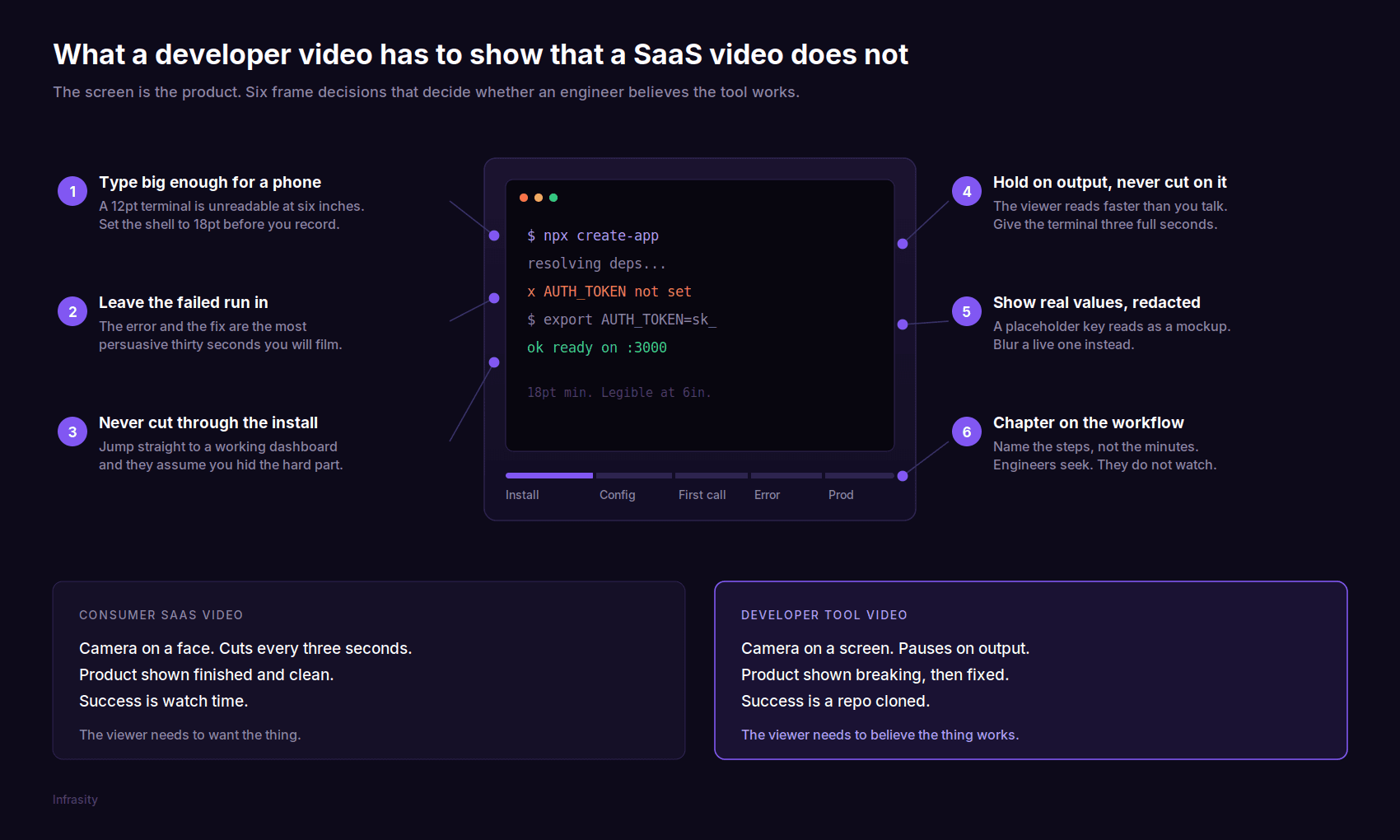
The six decisions
- Set the terminal to 18pt before you record: A meaningful share of developer viewing happens on a phone. A 12pt shell that looks fine on a 27-inch monitor is unreadable at six inches, and a viewer who cannot read the output has no reason to keep watching a video whose entire content is output.
- Hold on the output; don't cut on it: Standard edit pacing cuts the moment the action completes. Here, that removes the evidence. Give the terminal three full seconds after the command returns. The pause feels wrong in the edit and is correct for the viewer.
- Never cut through the install: If the video jumps from
npm installto a working dashboard, the audience assumes the middle was painful and hidden. That assumption is expensive, and it is usually correct, which is why they make it. - Show real values, redacted: A visible
sk_live_xxxxxplaceholder reads as a mockup. Blur a genuine key instead. The blur is proof the thing ran. - Leave the failed run in: Covered in the next section, because it deserves its own.
- Chapter on the workflow, not the clock: Covered in section six.
Why this is not a stylistic preference
The unit of proof is different. A consumer video needs the viewer to want the product. A DevTool video needs the viewer to believe the product works, and the only evidence that clears that bar for an engineer is watching it run, on a real machine, with real output, including the parts that did not go smoothly.
If you are commissioning this work externally, the diagnostic question is simple: ask how they brief the edit. If the answer is about hooks, pacing, and retention curves and says nothing about the terminal, they have made consumer videos. Infrasity runs technical video production, with engineers who use the product before filming it, precisely because the briefing problem is technical rather than creative.
5. Show the failure
The most persuasive thirty seconds you will ever publish is the moment something breaks on camera and gets fixed.
The mechanism is that a paid advertisement would never include it. An engineer watching your video is running a continuous credibility check, and a flawless demo fails that check, because every experienced developer knows a first integration is never flawless. The error is not a blemish on the proof. It is the proof.
Practically: keep the auth error and the fix. Keep the version mismatch. Keep the moment when the presenter reads the stack trace aloud and says which line matters. Cut the ninety seconds of silent confusion in between, but keep the failure and the resolution.
This is also the least expensive form of credibility available to a small team. You cannot outspend a competitor on production quality. You can film something breaking and being fixed, and they won't, because their brand team will not sign it off.
6. Chapter every video, because chapters are navigation and search surface
In our sample, only 163 of 645 videos carried three or more timestamps in the description. The other 482 forfeited two things at once.
The first is navigation. Developers don't watch tutorials. They seek. Someone arriving at a twelve-minute integration video wants minute eight, because minutes one through seven cover setup they have already done. Without chapters, they scrub, fail to find it, and leave, which YouTube reads as dissatisfaction.
The second is Google Search. Google's video structured data documentation states that Google tries to detect video segments automatically, and then adds the operative sentence: "We will prioritize key moments set by you, either through structured data or the YouTube description." For a video hosted on YouTube, Google's stated method is to "specify the exact timestamps and labels in the video description." Chapters are the mechanism by which a single video becomes eligible to surface for several different queries in Google Search rather than one.
Name the chapters after the steps of the workflow, not after the minutes. "05:40 The first query fails, and why" outperforms "05:40 Part 3."
7. Treat the description as a landing page, not a footer
The description numbers in our sample were worse than the chapter numbers.
168 of 645 videos carried no link at all, anywhere in the description. Only 117 of 645 placed a link inside the first 150 characters, which is roughly what YouTube renders before the "...more" fold. Thirty videos shipped with the description field completely empty.
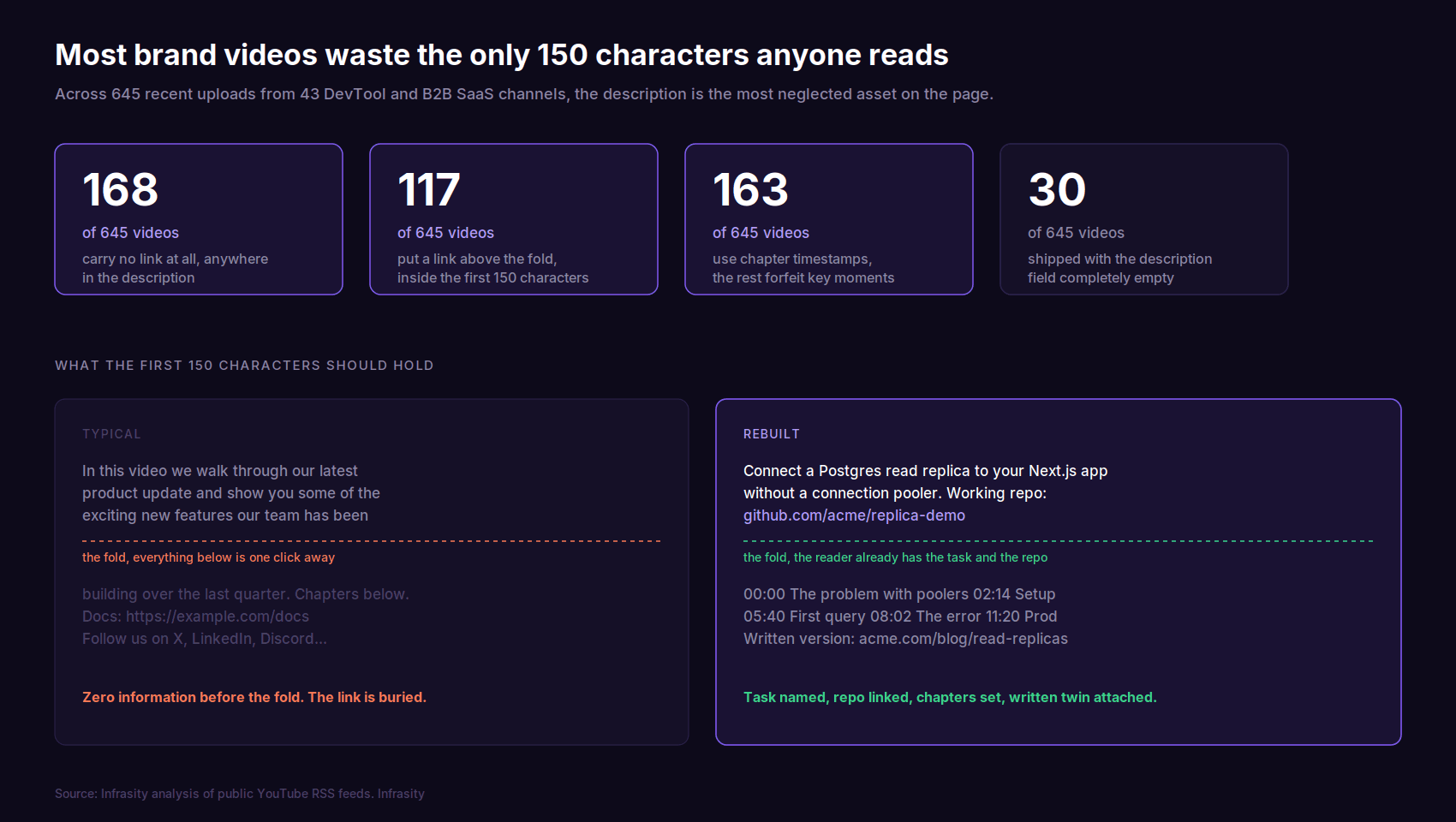
What belongs above the fold
Three things, in this order, inside 150 characters:
- The task in the viewer's language: Not "in this video we walk through." The actual job: "Connect a Postgres read replica to your Next.js app without a connection pooler."
- The working repo link: A repo is a better destination than a marketing page for a developer audience, and a better tracker: stars and clones are timestamped and public, so you get attribution data even from people who never sign up.
- Nothing else: Social links, boilerplate, and the company mission go below the fold, where they belong.
Below the fold, put the chapters, then the link to the written version of the same content, which is the next practice.
8. Ship a written twin of every video
A video converts the person watching it and then goes quiet in every AI answer about your category.
This is not speculative. Language models retrieve and cite text far more readily than they cite video, and buyers now routinely start an evaluation by asking a model for a shortlist before they verify it against a human. If your best explanation of a hard problem exists only as a YouTube upload, it is entirely absent from the shortlist stage.
The fix costs a few minutes per video. Publish the same material as a written post on your own domain: the same sequence, the same commands, the same failure and fix, with the video embedded at the top.
You get three things:
- The written version becomes retrievable by models and by Google's text index.
- The embed gives the video a second surface.
- And the two reinforce each other for the reader who prefers one format.
Do the same when you commission creator content. Put a written companion in the brief, a Dev.to write-up, a public demo repo, or a comparison table. It roughly doubles the half-life of the placement, and it is why we treat AEO work for developer tools and video production as one budget line rather than two.
9. When you buy reach, cast on view medians and never on subscribers
Your own channel is one half of YouTube. The other half is creators whose audience you can borrow, and the math there is unforgiving in a way that is easy to check before you spend anything.
As the screenshot below shows, the subscriber count is over 160k, but the views are only 10k, which clearly indicates you shouldn't rely solely on the subscriber count.
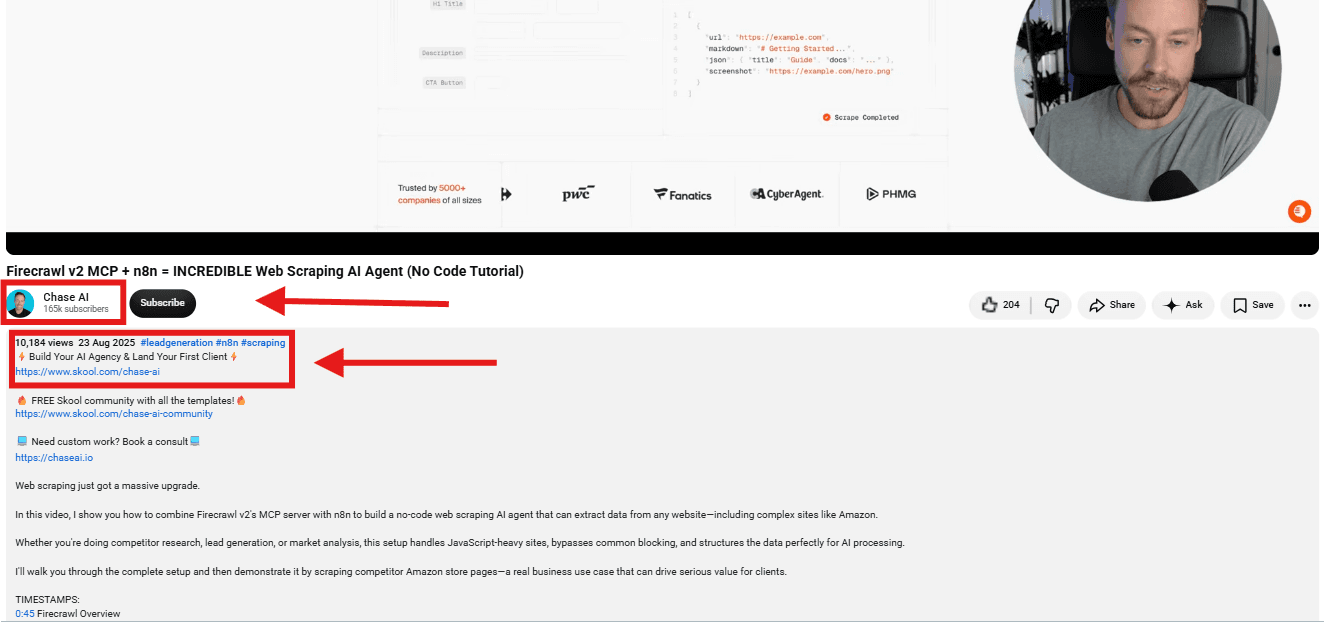
Subscriber counts are cumulative and never decay. View counts are current demand. A 160,000-subscriber channel averaging 10,000 views per video and a 30,000-subscriber channel averaging 40,000 views aren't close to each other, and the first one usually quotes higher.
Convert every quote to an effective CPM before you approve it: the fee divided by the median views of that creator's last ten videos, times 1,000. Our full breakdown of that calculation, the two published rate bands and why they disagree, sits in the YouTube influencer marketing agency guide, and the vetting sheet, including the conflicts column most rosters omit, is in the DevTool creator-led growth playbook.
Two things specific to developer casting are worth repeating here.
Comments per view matter more than likes per view, because a comment on a technical video is usually somebody stopping to argue about the implementation, which is the behavior you're actually buying.
And the developer audience is not one audience: a 200,000-subscriber interview-preparation channel will produce reach and close to zero pipeline, because its viewers are optimizing for getting hired, not for adopting tooling this quarter.
If you would rather not build the roster and the conflicts column yourself, that sourcing, vetting, and negotiation is what our B2B influencer marketing service runs end to end for DevTool and AI infrastructure teams.
10. Measure qualified views and self-reported attribution, not views
Developers do not click tracked links. They read the repo name, open a new tab, and type it. Any measurement model that depends on the click will report that YouTube did nothing, and your finance team will believe it.
Three layers, because the click only catches the minority who used it.

The three layers
- Direct link tracking catches the minority. One UTM per video rather than per campaign, so you can tell which video did the work. Repo links double as trackers.
- Self-reported attribution catches the people who typed it manually. One free-text field at signup: "How did you hear about us?" Free text, not a dropdown, because a dropdown only returns the options you already guessed. This is the highest-value field on a developer signup form, and it takes an hour to add.
- A pre-measured baseline catches everyone else. Record branded search volume, direct traffic, documentation sessions, and package installs for the four weeks before a video or campaign goes out, and compare the four weeks after. Without the "before," a lift is unprovable, which is the single most common reason creator and video spend gets cut.
The metric that replaces views
Report qualified views: views from people who could plausibly adopt the tool. On a 508-view median, a video reaching 400 platform engineers is worth more than one reaching 40,000 people learning to code, and any reporting model that cannot express that will keep recommending the wrong videos.
Then divide spend by qualified views to get a cost per qualified view, and judge every video, every format, and every creator on that one number. Applied correctly, it usually retires the conference back catalog within a quarter.
11. Run a portfolio, not a cadence
Return to the distribution. In our sample, 4% of videos produced 95% of the views. That is not a channel you can manage with a publishing schedule.
Weekly cadence is advice imported from creator YouTube, where the goal is a subscriber base that shows up for the next upload. A B2B brand channel does not have that. Your videos are found by search and recommendation, months after publication, by someone with a problem. Consistency does not compound. Relevance does.
What to run instead
Treat the channel as a portfolio with three tranches:
- Durable answers, roughly 70% of effort: Videos answering the questions from practice one, built to be correct for eighteen months. These are the assets. They start slow and accumulate.
- Ecosystem bets, roughly 20%: Videos about the framework, database or model everyone in your category is arguing about this quarter, per practice three. Most will do nothing. One will be the 4%.
- Product news, roughly 10%: Real releases only, published because customers need to know, not because the channel needs a post this week.
And set the expectation before you start: on a 508-view median, the first six months of a serious channel will look like failure by creator standards and be perfectly healthy by B2B standards. A video that reaches 300 of the right engineers and gets cited in a Reddit thread eight months later has outperformed a launch video that got 5,000 views from nobody who can adopt anything.
What to do first
You now have the distribution, the four format findings, the production rules specific to product developers' installs, and a measurement model that doesn't collapse when the click is missing.
Start with an audit that takes only 2-3 hours max. Pull your last fifteen uploads, write down the view count for each, and sort them. Then mark each one as a durable answer, an ecosystem bet, product news, or event footage. If the bottom half is event footage and launch notes, you have found the problem, already know the fix, and have not spent anything to learn it.
If you would rather have someone run that audit with you and rebuild the roster and the production brief on the other side of it, that is what our B2B influencer and developer video work does for DevTool and AI infrastructure teams.
Frequently Asked Questions
How many views should a B2B SaaS YouTube video get?
Across 645 recent uploads from 43 DevTool and B2B SaaS company channels, the median was 508 views and 428 videos landed under 1,000. Judge a new channel against that, not against creator benchmarks. The more useful target is qualified views, meaning views from people who could actually adopt the product, since 300 platform engineers are worth more than 30,000 students.
Is YouTube worth it for a DevTool with a small audience?
Yes, but not as a broadcast channel. It works as a search and verification surface: 50% of developers in Stack Overflow's 2025 survey said they learned to code in the past year from standalone videos, ahead of blogs, podcasts, and formal courses. The return comes from videos that answer specific tasks and get found months later, not from a subscriber base.
Should we post our conference talks on YouTube?
Post them, but not as your main output. Event and session recordings were 9% of uploads and 0.12% of views in our sample, with a median of 258 views against 677 for tutorials. Archive full sessions on an unlisted playlist and cut the two or three genuinely strong minutes from each talk into standalone videos with their own titles and thumbnails.
How often should a B2B brand publish on YouTube?
Less often than creator advice suggests. With 4% of videos producing 95% of views, cadence is the wrong lever. Publish when you have a question worth answering properly, and put the saved effort into making fewer videos correct enough to stay useful for eighteen months.
Do YouTube chapters actually matter for SEO?
Yes, for Google Search specifically. Google's video structured data documentation states that it prioritizes key moments set by the publisher over those it detects automatically, and for YouTube-hosted videos, the stated method is to include timestamps and labels in the description. Only 163 of the 645 videos we measured used them.
Should the creator we sponsor follow a script?
No. Give them a technical accuracy brief covering what must be correct, and leave the format, pacing, and opinions to them. A scripted developer video reads like an advertisement to the exact audience you are trying to reach, and the credibility loss outweighs the message control gains.
Why do our YouTube videos get views but no signups?
Usually because the link is unreachable or the audience is wrong. In our sample, 168 of 645 videos had no link in the description at all, and only 117 put one above the "...more" fold. If the link is fine, check who is watching: reach from a general programming audience will not convert for an infrastructure product, regardless of volume.