
TL;DR
- You are buying a recommendation, not reach. A credible engineer telling other engineers your tool is worth an afternoon behaves nothing like a consumer impression.
- Build a roster, not a shortlist. Depth across platforms beats the three creators you already follow, because developer attention isn't concentrated in one place.
- Sort by ICP fit before follower count. A 30k-subscriber CI/CD specialist routinely outperforms a 1.4M-subscriber generalist.
- There is no rate card. Comparable creators price up to 4× apart. Work backwards from what a signup is worth, not from CPM.
- Forecast in ranges. "180 to 320 signups" can be evaluated afterwards. "220 signups" is false precision nobody can be held to.
- Measure signups, accounts, and citation lift, not views. Views are the easiest number to report and the furthest from revenue.
Developer audiences are small, skeptical, and allergic to advertising, which is why influencer marketing works better here than almost anywhere else, and why most teams still run it badly. This is the operating model, stage by stage.
What is developer influencer marketing?
Developer influencer marketing is paying technical creators, YouTubers, newsletter authors, and engineers with followings on X, LinkedIn, or Dev.to, to build with your product and tell their audience what they found. Unlike consumer influencer marketing, the deliverable is a credible technical opinion, and success is measured in signups and activated accounts rather than impressions.
The distinction matters because it changes every downstream decision. If you're buying reach, the cheapest CPM wins. If you're buying a recommendation, the creator's standing with a specific audience is the entire asset, and that's not a number you can read off a follower count.
Why is it different from consumer influencer marketing?
Because the audience is technical, small, and unusually good at detecting inauthenticity. Engineers can verify claims in minutes, they punish scripted reads, and the total addressable audience for any given tool is often in the tens of thousands rather than the millions.
That inverts the usual economics. In consumer marketing, scale forgives a weak match, because a large enough audience contains enough buyers. In developer tooling, a large mismatched audience mostly generates bounced traffic and support noise. Precision beats volume, consistently.
It also changes the failure mode. A consumer campaign that lands badly is forgettable. An undisclosed sponsorship spotted by a developer community becomes a thread, and the reputational cost outruns anything the campaign was going to earn.
How do devtool companies find developer influencers?
The reliable method is maintaining a roster, a standing pool of vetted creators tagged by platform, niche, and ICP fit, rather than assembling a shortlist per campaign. A shortlist is biased toward whoever you personally follow and collapses the moment one creator is booked or off-topic.
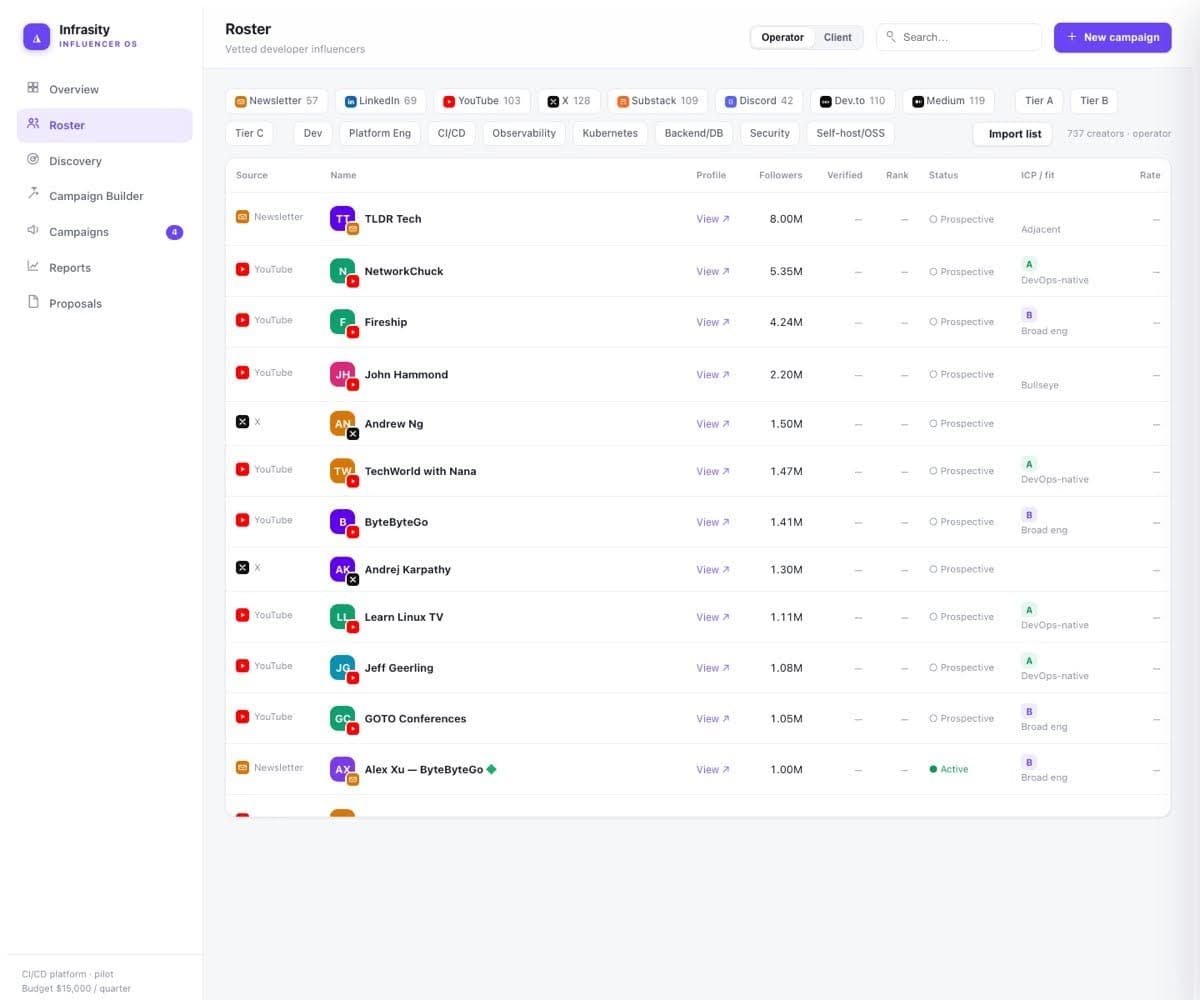
Filter chips are platform, budget tier, and niche. The ICP-fit column does the real work, separating a two-million-subscriber generalist from a twelve-thousand-subscriber platform engineer whose audience is entirely your buyer. Sample data shown.
Sourcing itself is unglamorous: conference speaker lists, the maintainers of tools adjacent to yours, newsletter sponsorship directories, and the creators your existing users already cite in support tickets. The last of those is the highest-signal source most teams never check.
Which platforms do developer influencers use?
Developer attention splits across at least seven meaningful platforms: YouTube, X, LinkedIn, newsletters and Substack, Dev.to, Medium, and Discord communities. No single platform covers a majority of any given tool's audience, which is why single-channel programs underperform.
The engineer watching a 40-minute Kubernetes deep-dive on YouTube is frequently not the one reading a systems-design newsletter on Tuesday morning, and neither is reliably in the Discord where your users actually ask questions. Each platform also has a different unit of work, a video, an issue, a post, a pinned message, and different lead times.
Data quality varies sharply by platform. YouTube and X publish follower counts you can re-pull on a schedule. LinkedIn gates them behind login, and most newsletter operators publish nothing verifiable. Record where every audience number came from and when, because an unlabelled figure becomes indistinguishable from a guess within about two quarters.
How much do developer influencers cost?
There is no published rate card, and comparable creators in the same niche routinely quote up to 4× apart. Price on cost per qualified signup rather than CPM, working backwards from what a signup is worth to your business.
Developer creators are mostly independent operators setting their own rates, so pricing reflects individual circumstance rather than a market standard. Rate cards you find online are aggregated from consumer influencer marketing, where the economics are entirely different.
CPM optimizes for the cheapest reach, precisely the wrong objective when audience quality is the whole point. Cost per signup ties spend directly to the funnel and gives you a defensible ceiling for each placement.
| CPM | Optimizes for cheap reach, the wrong objective |
| CPS | Cost per signup, ties spend to the funnel |
| 4× | Typical spread between comparable creators |
How do you forecast a campaign before spending?
Project in ranges derived from channel benchmarks, never single numbers. A projection of "180 to 320 signups" can be evaluated after the fact, the campaign either landed in range or it didn't. A projection of "220 signups" is false precision that teaches you nothing either way.
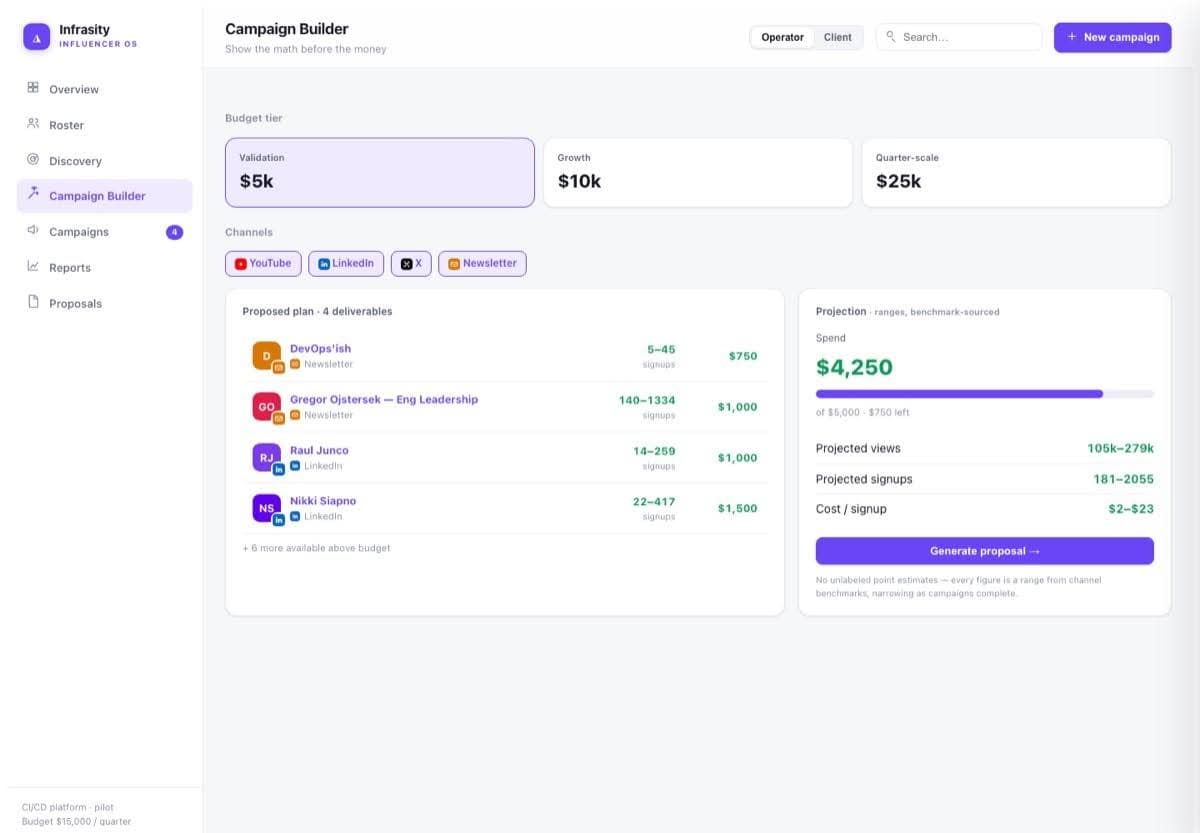
Pick a budget tier and channels, and the plan fills against benchmarks while every projected figure stays a range. The cost-per-signup band decides whether the plan is worth running at all. Sample data shown.
Ranges also change the client conversation. Rather than defending a number you invented, you present a band derived from benchmarks that narrows as you accumulate real campaign history. That's a model that improves, not a promise that ages.
How do you brief a developer influencer?
Give them genuine product access, a clear list of claims that must not be made, and then let them find their own angle. Do not send talking points or scripted copy, because engineers detect it immediately, and it destroys the credibility you're paying for.
The recommendation carries weight precisely because the audience believes the creator means it. A brief should therefore constrain accuracy, not opinion: what the product does, what it doesn't, which comparisons are fair, and what's under embargo. Everything else is theirs.
Two gates are worth enforcing without exception, because both are expensive to fix retroactively:
- Disclosure. Paid placement must be disclosed. It's legally required in most markets and non-negotiable in developer communities.
- Tracked links. A distinct UTM per placement. Five minutes of setup that determines whether measurement is possible at all.
How do you measure a developer influencer campaign?
Measure the chain from views to clicks to signups to activation, and report signups against the projected range. Views are the easiest metric to collect and the furthest from revenue, a campaign reported in views cannot be evaluated or renewed on evidence.
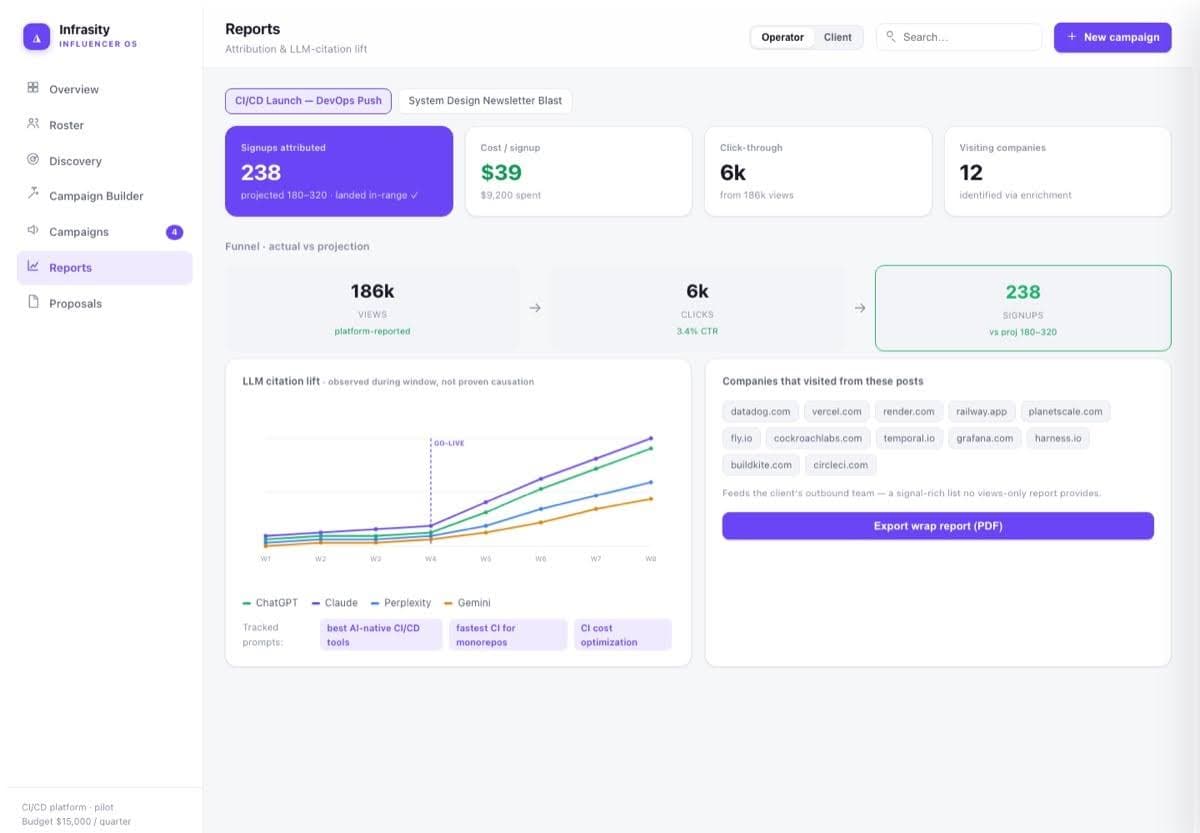
Signups measured against the projected range, the funnel with actual conversion at each step, and company-level identification of who visited. Sample data shown.
Company-level attribution
Enriching visitor traffic tells you which organizations arrived from a placement. For a bottom-up devtool this is often more valuable than the raw signup count, because it hands your sales team a list of accounts that just self-identified as interested, something no views-based report can produce.
LLM citation lift
A growing share of "which CI tool should I use" questions are asked of an assistant rather than a search engine, and those answers are shaped by what has been written about you. Tracking whether your product starts appearing in responses to a fixed set of prompts, before and after a campaign window, is a genuine leading indicator.
Be honest about causation. Citation lift is observed during a campaign window, not proven to be caused by it. Model releases, index refreshes, and unrelated coverage move the same needle. Report it as an observation with the window marked, and resist drawing the arrow.
Conclusion
The first campaign is expensive because everything is a guess: rates, projections, which niches convert. The second is cheaper because you have priors. By the fourth you're negotiating from evidence, forecasting from your own history rather than generic benchmarks, and re-booking the creators who actually delivered.
That compounding is the whole argument for treating this as an operating system rather than a series of one-off buys. The roster, the rate history, the projections-versus-actuals, those are the asset. Any individual campaign is one read from it.
Frequently asked questions
Does influencer marketing work for developer tools?
Yes, and typically better than for consumer products, but only when matched precisely to ICP. Engineers discount advertising and weight peer recommendation heavily, so a credible technical creator carries more influence per impression than almost any other channel. The catch is that mismatched reach converts close to zero, so the same channel performs terribly when run on consumer logic.
How many followers should a developer influencer have?
Follower count is the wrong primary filter. A creator with 20k to 50k subscribers in a single technical niche frequently outperforms one with over a million covering technology broadly, because a far higher share of the audience is your actual buyer. Use ICP fit as the primary sort and treat size as a tiebreak between similarly-fitting creators.
What should a developer influencer campaign budget be?
Start with a validation tier large enough to fund three to five placements across at least two platforms, enough to produce a signal you can read, without betting the year on untested assumptions. Scale only after you have your own cost-per-signup figures. The specific number matters less than resisting the urge to spend it all on one large placement.
How long does a developer influencer campaign take?
Longer than most teams plan for. Between agreement and a live post sit contracting, product access, briefing, a script or outline draft, review, and scheduling, each with a different owner. Video generally has the longest lead time, newsletters the shortest. Build the pipeline explicitly and track which stage each placement is in, or campaigns stall invisibly.
Should you script what a developer influencer says?
No. Scripted reads are obvious to technical audiences and negate the credibility you're paying for. Constrain factual accuracy, what the product does, what it doesn't, which comparisons are fair, what's embargoed, and leave the framing, structure, and opinion entirely to the creator.
Is sponsorship disclosure legally required?
In most markets, yes, and it's enforced by advertising regulators. Beyond the legal position, developer communities treat undisclosed sponsorship as a serious breach, the reputational damage from being caught reliably exceeds whatever the placement earned. Treat disclosure as a hard gate before go-live.
What metrics matter most for developer influencer campaigns?
Attributed signups measured against a pre-committed projected range, cost per signup, and, for bottom-up products, the list of companies that visited from the placement. Views and impressions are useful only as inputs to conversion rates, never as the headline result.
Which platform works best for developer influencer marketing?
It depends on the product's buyer, and no single platform dominates. Infrastructure and DevOps tools tend to do well on YouTube and technical newsletters, developer-experience and framework tools often perform better on X and Dev.to, community-led products see disproportionate returns from Discord. Run at least two platforms in any first campaign so you learn where your audience actually is.
How do you find developer influencers in a specific niche?
Conference speaker lists, maintainers of tools adjacent to yours, newsletter sponsorship directories, and the creators your existing users cite in support tickets and community threads. The last is the highest-signal source and the one most teams never check.
Can influencer marketing improve how AI assistants describe your product?
Plausibly, though it should be reported as correlation rather than proven causation. Assistant answers are shaped by what has been written about a product, so sustained technical coverage is a reasonable input. Track appearance rates against a fixed prompt set before and after campaign windows, and be explicit that model updates and unrelated coverage move the same metric.
Should you work with the same creators repeatedly?
Yes, where performance justifies it. Repeat placements compound, the creator understands the product properly by the second collaboration, the audience has seen it before, and you're negotiating from known results rather than estimates. A roster of proven creators is considerably more valuable than a wider list of untested ones.