
Nano influencers are creators with roughly 1,000 to 10,000 followers, and for DevTools, B2B SaaS, and AI companies, they beat larger creators on the searches that decide deals. We counted. Across 19 buyer-intent queries on YouTube, the median subscriber count of a channel ranking for a specific implementation search is 9,850. For a brand or hype search, it is 433,000.
That gap is the whole argument, and it is not the argument the consumer playbook makes. Nano creators don't win because they are cheap or because their followers are loyal. They win because a 2,000-subscriber engineer who solved one narrow problem on camera occupies the exact result your buyer lands on three weeks before they talk to sales.
This blog will tell you what we found researching, the 11 rules that follow from it, what a placement costs, the failure rate you should budget for, and the categories where nano is the wrong first buy.
TL;DR
50.4% of the videos ranking for specific implementation queries come from channels with fewer than 10,000 subscribers. For brand and hype queries, it is 7.8%. Query type, not category age, decides whether nano works.
You are buying a ranked asset, not an audience. Nano channels pull in a median of 1,094 views per 1,000 subscribers, compared to 117 for mega channels, because views come from search rather than a subscriber list.
It compounds. 61% of the nano videos ranking today were published over a year ago. 22% are more than three years old.
Budget for variance. 40% of nano placements in our census cleared fewer than 500 views. One placement is a coin flip. Eight to twelve is a program.
They are cheap to book and hard to find. Only 40% of nano channels expose an off-platform contact path, compared with 78% of mid-tier channels. Sourcing, not fees, is where the budget goes.
Nano cannot create category demand. It compounds demand that already exists in search. If your buyer does not yet know your category has a name, start elsewhere.
What is a nano influencer, and why is the B2B version different?
A nano influencer is a creator with roughly 1,000 to 10,000 followers on a single platform, focused on one narrow subject.
For a DevTool, nano means specificity
The consumer case for nano rests on parasocial closeness: the creator knows their followers, so the recommendation feels like a friend's. That mechanism is real and almost irrelevant to a Staff Engineer choosing an observability backend.
The technical case rests on something else. A creator with 3,000 subscribers who has published eleven videos on OpenTelemetry collectors is not intimate with their audience. They are the person who documented the thing. Their audience mostly arrived from a search box, not from a subscribe button. The asset you are buying is their standing on one narrow topic and the search position that standing earned.
That distinction changes who you hire, what you pay for, when you measure, and what counts as a failure. The rest of this piece works through each of those.
What we counted, and what it showed
We searched YouTube for 19 buyer-intent queries across the categories DevTool and AI infrastructure companies sell into: infrastructure as code, Kubernetes, observability, AI agents, authentication, application security, FinOps and databases.
We took the top 20 video results for each query, resolved all 266 unique channels, and pulled subscriber counts, view counts, and publication dates. 370 of the 380 results returned complete data.
137 of the 370 ranked videos come from channels with under 10,000 subscribers. 124 of the 266 channels are nano-tier. But the aggregate hides the finding that actually matters.
Across 19 buyer-intent queries, nano channels account for half the results for specific implementation searches and almost none for brand searches.
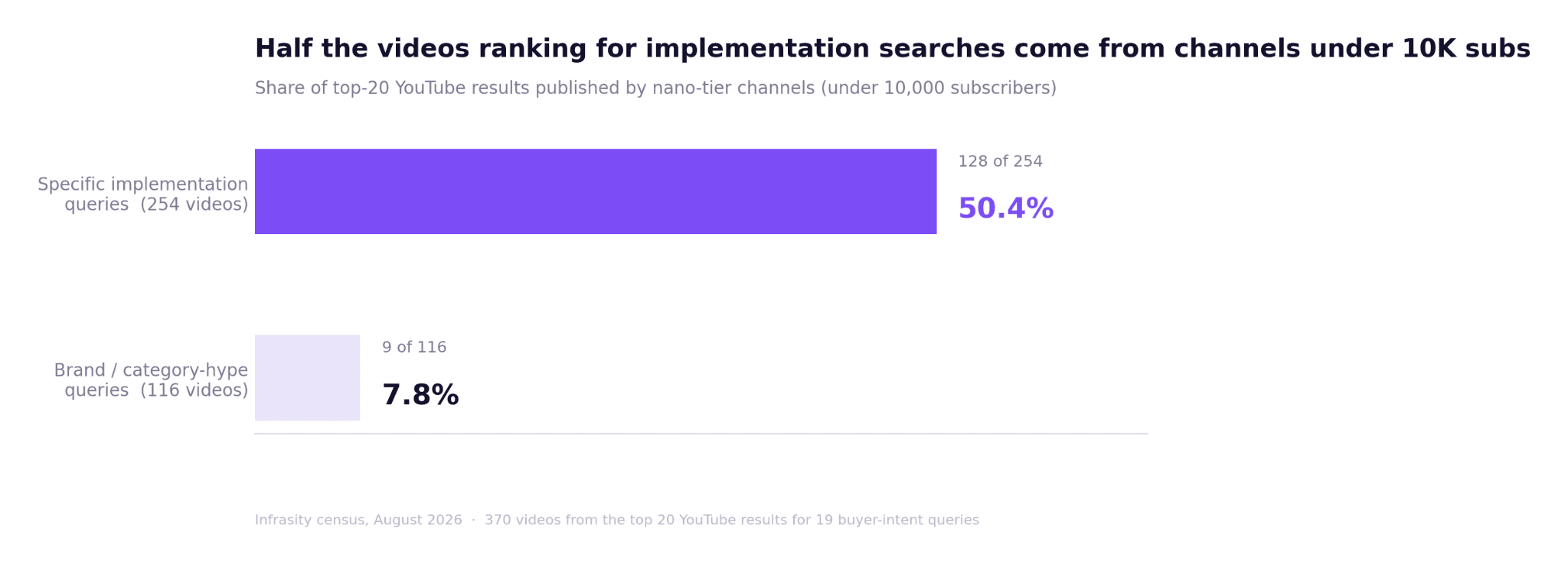
Split the queries into two groups and the picture separates cleanly. On the 13 queries that name a task (terraform drift detection, oauth2 pkce implementation, postgres connection pooling pgbouncer), 128 of 254 ranking videos come from nano channels. On the 6 queries that name a product or a hype category (claude code tutorial, mcp server tutorial, ai code review tool comparison), 9 of 116 do.
This is the single most useful thing in the dataset, because it converts a taste question into a lookup. You don't have to decide whether nano creators "feel right" for your product. You look at what your buyer types and count how many are already there.
1. Sort creators by the query your buyer types, not by follower count
Start by writing down the search your buyer runs the week before they build a shortlist, then find who ranks for it. Follower count is a proxy for reach in a feed. It is a poor proxy for presence in search results, and search is where technical evaluation happens.
Nano share by query. The pattern follows specificity, not category age.
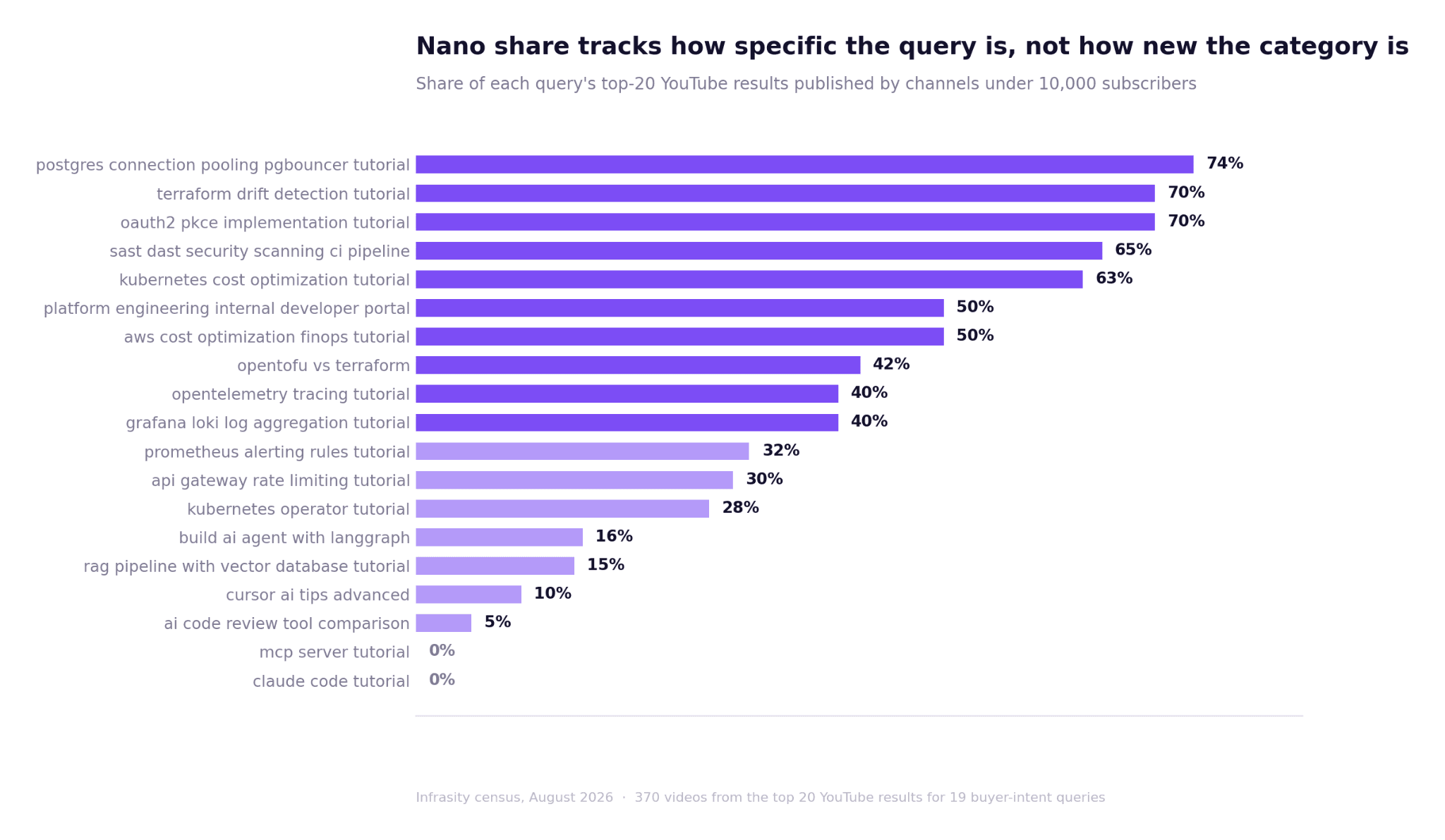
Look at the shape of that chart. Postgres connection pooling pgbouncer tutorial is 74% nano. Terraform drift detection and OAuth2 PKCE implementation are both 70%. sast dast security scanning CI pipeline is 65%. Then it falls off a cliff: Cursor AI tips advanced is 10%, AI code review tool comparison is 5%, and MCP server tutorial and Claude code tutorial are both zero.
The tempting read is that nano works in old categories and fails in new ones. That is wrong. MCP is new, and so is OpenTofu, which sits at 42%. The variable is whether the query names a task or a brand. Task queries fragment into thousands of narrow, unglamorous problems that no large channel can afford to cover. Brand queries concentrate demand onto a handful of names that large channels rush to occupy.
How to run this
Take your top ten support tickets and your top ten sales objections and turn each into the search a person would type to solve it themselves. Run each on YouTube in an incognito window, filtered to video results. Record the channel and the subscriber count for the top ten. If the median lands under about 20,000, nano is your primary motion for that query. If it lands in the hundreds of thousands, read rule 11 before you spend anything.
This is the same exercise our creator sourcing for DevTool teams starts with, and it is worth doing yourself once before delegating it, because the output tells you something about your category that no agency deck will.
2. You are buying a ranked asset, not an audience
The subscriber number is not the distribution mechanism, and pricing against it is the most expensive routine error at this tier. A nano channel's video gets watched because it answers a query, not because 3,000 people were notified.
The census makes this measurable. Median views per 1,000 subscribers, by tier:
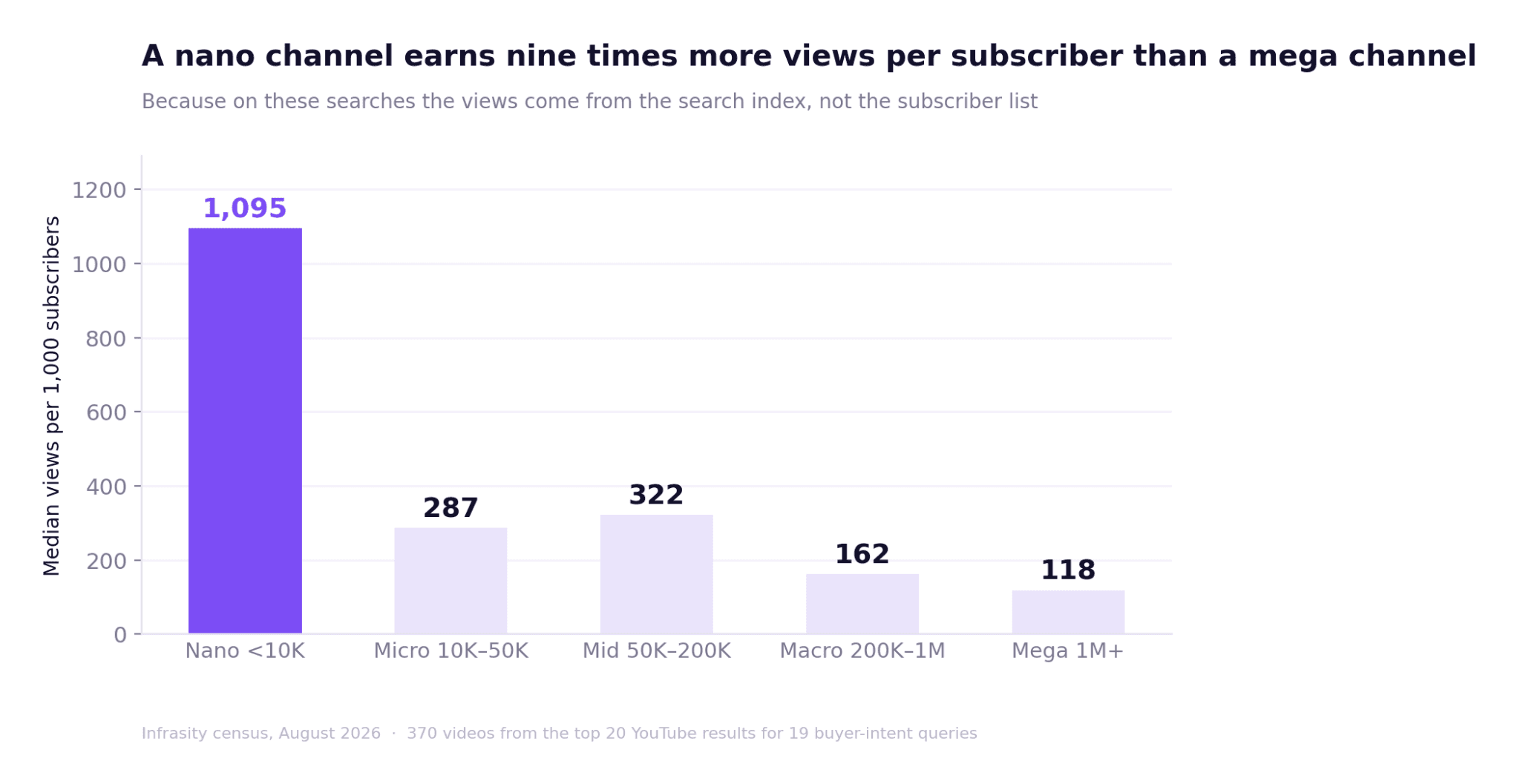
Nano channels return roughly 9 times as many views per subscriber as mega channels on these searches.
A nano channel averages 1,094 views per 1,000 subscribers. A mega channel returns 117. Small channels are not magic. It is a statement about where the traffic comes from. A mega channel's video is watched by a slice of its subscriber base in the first 72 hours, then the viewership decays. A nano channel's video has almost no launch audience and accumulates views from search over years.
Some concrete cases from the census:
| Creator | Subscribers | Video | Views |
|---|---|---|---|
| Laszlo Fogas | 517 | Grafana Loki querying basics | 92,620 |
| Sascha Preibisch | 2,540 | OAuth 2.0 PKCE | 47,089 |
| Software With Shawn | 2,050 | OpenTelemetry in 180 seconds | 37,748 |
| Adam Gardner | 2,980 | OpenTelemetry Collector | 25,564 |
| Ryan Hay | 3,700 | What is a Kubernetes Operator? | 23,938 |
| Soham Kamani | 1,870 | Spring AI RAG Tutorial | 15,177 |
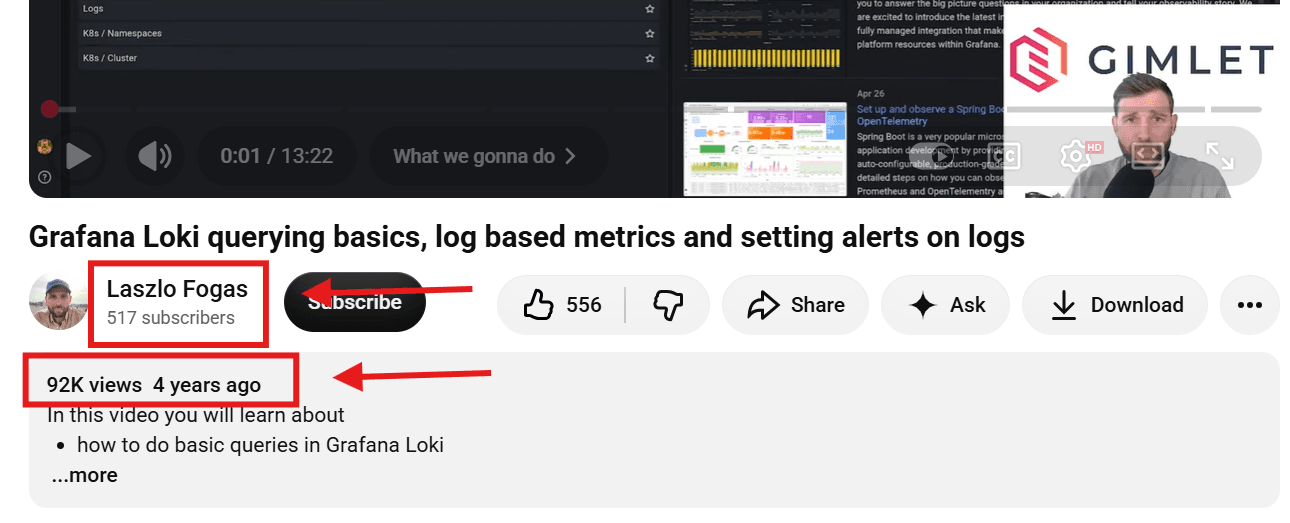
Laszlo Fogas has 517 subscribers and a video with 92,620 views. Any pricing model built on audience size gets that placement wrong by two orders of magnitude.
The payoff arrives late, and keeps arriving
Age of the nano videos currently holding a top-20 position.
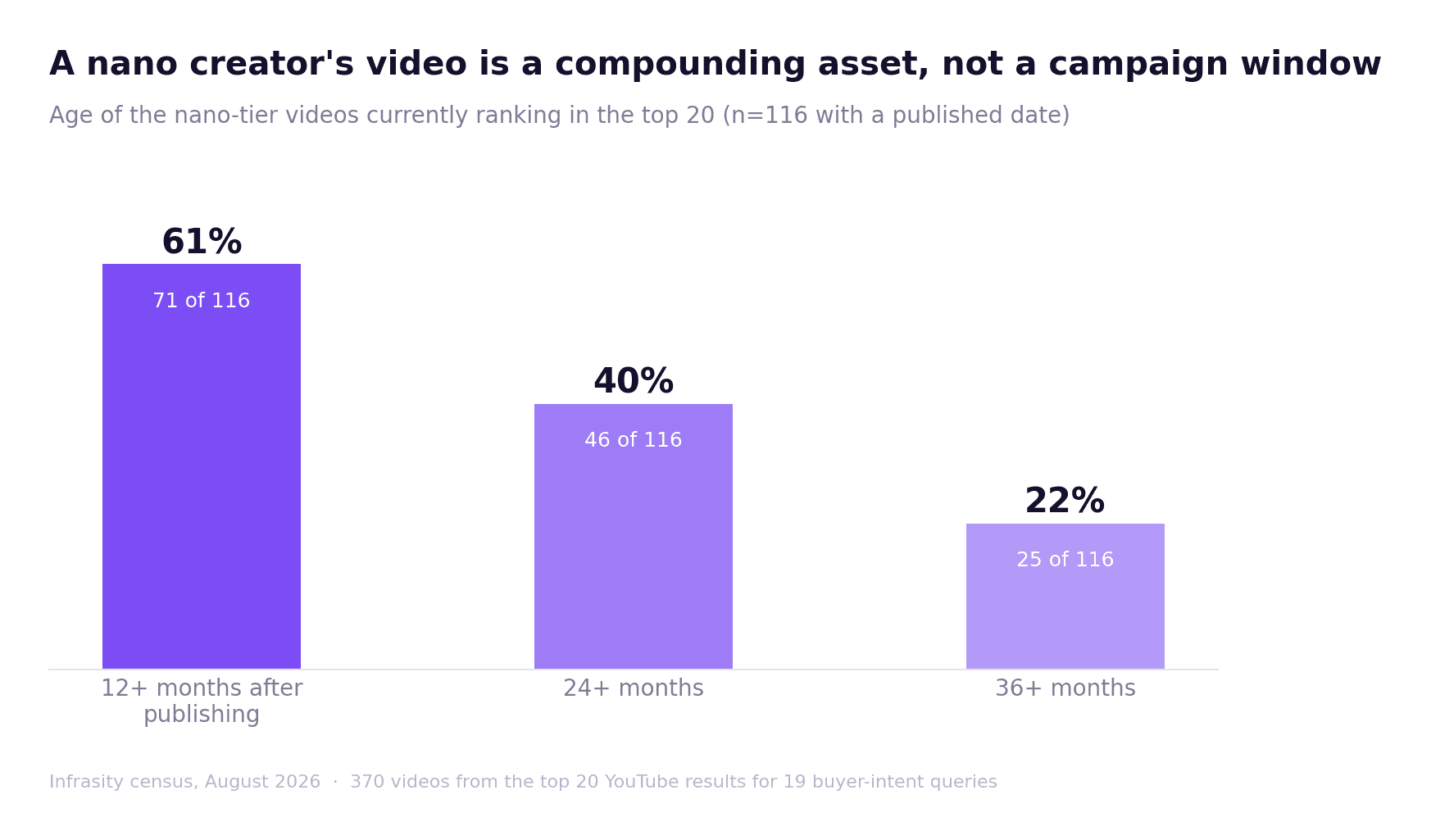
Of the 116 nano videos for which we could read a publication date, 71 were published more than 12 months ago, 46 more than 2 years ago, and 25 more than 3 years ago. Sascha Preibisch's OAuth PKCE video went up six years ago and still ranks.
This matches what we see on other channels. One creator post we ran was linked in r/devops as the answer to someone's question eight months after it was published, while the paid campaign running alongside it produced nothing the day the spend stopped. Same pattern, different surface: content that answers a durable question keeps being retrieved, and content that interrupts a feed does not.
The operational consequence is a measurement one. If you judge a nano program at the end of a 30-day campaign window, you will measure the worst 30 days of its life and cancel it.
3. Assume four in ten placements will underperform, and buy a portfolio
Single nano placements are close to a coin flip, and the correct response is volume, not better selection. In our census, 55 of 137 nano videos ranked had fewer than 500 views. 45% cleared 1,000 views. Only 16% cleared 10,000.
Read those numbers carefully, because they cut both ways. The distribution is skewed: most placements do modest numbers, and a few do very well. That is exactly the shape that rewards a portfolio and punishes a single bet.
The practical translation for a first program: eight to twelve placements, not two or three. At $50 to $500 a placement, that is affordable in a way a single macro sponsorship never is, and it is the only way to learn which niches inside your category convert before you commit real budget.
What to do with the duds
Nothing dramatic. A placement that lands under 500 views is not wasted if the video is accurate, disclosed, and indexed, because rule 2 applies to it too. Some of those videos will pick up search traffic in month nine. Judge the program on the aggregate and the trend, and cut a creator only when the content itself was weak, not when the first-month number was.
The Influencer Marketing Hub 2026 benchmark report, surveying over 600 marketers, shows the market moving the same way. Nano creators have the highest net expansion intent of any tier: 51.43% of respondents plan to grow the tier, compared with 10.00% planning to cut it. Macro is flat, with 20.59% expanding and 20.58% contracting.
4. Sourcing is the real cost, not the fee
Nano creators are the cheapest tier to book and the hardest tier to contact, which is the reverse of how most budgets are built. This is the finding that most surprised us, and it is the one that kills more nano programs than any other.
Nano channels are markedly less likely to publish a way to reach them.
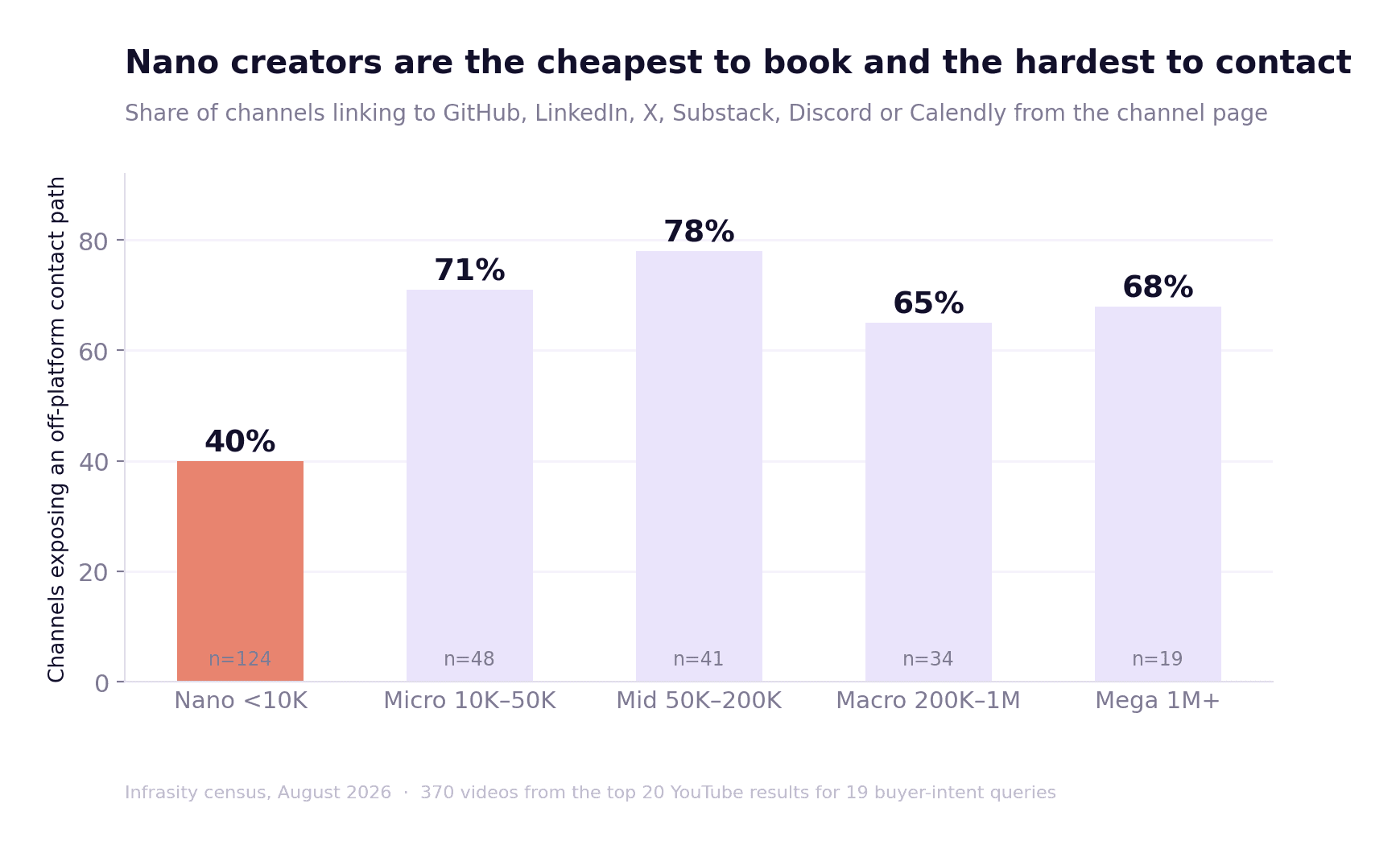
We probed all 266 channel pages in the census for an off-platform contact path: a link to GitHub, LinkedIn, X, Substack, Discord, or Calendly.
Only 40% of nano channels expose one, compared with 71% of micro, 78% of mid-tier, and 65% of macro channels.
Larger creators run their channels as businesses and publish a front door. A 3,000-subscriber engineering channel that publishes OpenTelemetry explainers on weekends often publishes nothing but videos.
So the cost curve inverts. The fee is trivial, and the identification, verification, and outreach are not.
The Influencer Marketing Hub report reaches the same conclusion from the operator side: at this tier, "your limiting factor won't be finding creators. It will be throughput." Intake, vetting, briefing, compliance, usage rights, and performance tagging all have to scale faster than creator volume.
Where nano DevTool creators are actually findable
Ranked in order of how much signal each source carries:
- The search results themselves. Run the queries from rule 1 and the roster assembles itself. Cross-reference the channel name against GitHub and LinkedIn to find a contact path.
- Conference speaker lists. KubeCon, SREcon, Monitorama, PlatformCon and regional DevOpsDays. Speakers publish contact details; their YouTube channels frequently do not. Our census picked up a DevOpsDays Vancouver talk from a 60-subscriber channel still ranking seven years later.
- Maintainers of adjacent tools. The people who wrote the plugin that connects your product to the thing your buyer already runs.
- Creators your own users cite. Search your support tickets and community threads for youtube.com links. This is the highest-signal source and the one almost nobody checks.
That last one deserves emphasis. Your users are already telling you which nano creators taught them your category. Nobody reads the tickets for it.
Screening at this volume is the part teams underestimate. We screened 200-plus creators to build the roster behind a single DevTool engagement, and we share the full roster and budget before anything gets briefed. If you would rather not build the intake pipeline yourself, our B2B influencer marketing service does that for you.
5. Pay for the artifact and the usage rights, not for the reach
Price a nano placement as a piece of content you get to keep using, because that is what it is. The reach on any single placement is too small and too uncertain to justify a fee on its own. The asset and the rights are not.
The clearest public illustration comes from creator Salma Jafri, who documented a YouTube Creator Partnership deal end-to-end. She was paid $2,500. The video had roughly 700 views when the brand began running it as a paid ad. The fee did not buy an audience. It bought a credible practitioner video the brand could put spend behind.
Copy that model. A nano placement should be priced as three things bundled:
| Component | What it covers | Typical range |
|---|---|---|
| Base placement | The video, post or thread itself | $50 to $500 |
| Whitelisting rights | Running the creator's content as a paid ad from their handle | +20% to 50% of base |
| Affiliate or rev-share | Recurring commission tied to actual signups | 15% to 30% recurring |
Those bands come from Launchpoint's 2026 tech and SaaS nano rate guide, which puts tech and SaaS nano creators at a 40% to 60% premium over lifestyle creators at the same follower count, on the reasoning that their audiences are worth more per head. A dedicated YouTube review sits at $200 to $500; a 60-second mid-roll integration at $100 to $250.
The Influencer Marketing Hub survey independently confirms where the market actually lands: nano is the tier respondents priced most often, at 29.54% of all cost selections, and roughly 55% of those responses fall under $500.
The trade that works at this tier
Many nano technical creators will reduce or drop the cash fee in exchange for a genuinely useful license plus recurring affiliate commission. That trade is good for you when it aligns their incentive with activation rather than publication. It is bad for you when the product is not something they would use anyway, because then you have bought a review from someone with no reason to keep the tool open after filming. Offer the trade; do not push it.
6. Give a claims boundary, never a script
Constrain accuracy and leave opinion alone, because the opinion is the entire asset. This is true of all creator work, and it is more true at the nano tier, for a reason worth stating: a nano creator has no brand-safety incentive to protect.
A creator with 800,000 subscribers is managing a business with sponsors, and their honest opinion is filtered through what that business can afford to say.
A creator with 3,000 subscribers has nothing at stake except their standing with a few hundred engineers who would notice immediately if they went soft. You are buying a sharper opinion, and a script destroys the only thing that made it worth buying.
Technical audiences are unusually well-equipped to detect this. The 2025 Stack Overflow Developer Survey found that 46% of developers actively distrust the accuracy of AI tool output against 33% who trust it, with only 3% saying they highly trust it. Experienced developers are the most skeptical of all, at 20% highly distrusting.
The same survey found that in a future where AI handles most coding tasks, the top reason developers would still ask a person is "when I don't trust AI's answers," at 75%.
That last number is the market you are buying into. Verification demand is rising, not falling, and it routes to humans with demonstrated hands-on experience. Salma Jafri's conversation with Izzy, who heads YouTube's brand deal desk, lands on the same point: brands are seeking nano creators because they "talk about specialized topics from real lived experience," which "builds massive audience trust, which is becoming very rare right now because of AI."
A workable brief is short: here is what the product does, here is what it does not do, here are the comparisons that would be unfair, here is what is under embargo, here is your access. Then stop writing.
7. Treat your onboarding as part of the campaign, because it is
A nano creator building with your product on camera is a public QA run, and if your first-run experience is broken, several thousand engineers watch it break. This is where DevTool creator programs diverge most from every other category, and it is the reason a generalist influencer agency will hurt you here.
Consumer creators unbox a finished object. A technical creator installs an SDK, hits an authentication error, reads your docs, finds them wrong, and keeps recording. Everything between npm install and first successful output is campaign surface you do not control.
The pre-flight that prevents most of it
Before any nano creator gets access, have someone outside your team run the quickstart cold, on a clean machine, with no internal credentials, and time it. Note every place they stop. Two questions decide whether you are ready:
Can a competent stranger reach first meaningful output without asking you anything? If not, fix that before you brief anyone. A nano creator will not email you when they get stuck at step four; they will quietly pick a different topic, and you will never learn why.
Does your free tier survive the tutorial? If the thing the creator wants to demonstrate sits behind a sales call, the video cannot exist. This kills more DevTool creator campaigns than bad creative does.
The asymmetry here favors you if you get it right. A creator who hits a rough edge, reports it, and gets a fix shipped inside a week will say so on camera, and that clip is worth more than the tutorial you were paying for. If your product documentation is the thing standing between a creator and a working demo, fix the docs first and run the campaign second.
8. Run nano where there is no follower count at all
On Reddit, GitHub, and Discord, the nano logic holds, and the follower metric disappears entirely, which is why these surfaces are underpriced. Developer attention does not concentrate on the platforms where influence is measured.
Reddit has no meaningful follower economy. Standing is earned per subreddit through comment history, and a person with 400 karma in r/kubernetes who answers architecture questions carefully is the closest thing that community has to a nano influencer. You cannot buy that placement, and that constraint is the point: the only available move is genuine participation, which is also the only move that works. Our own subreddit strategy work starts by mapping where a product's category is actually discussed rather than where its keywords appear.
GitHub works similarly. The maintainer of a 200-star tool that integrates with your product has more influence over your buyer's evaluation than a 500,000-subscriber generalist, and the currency is a working integration rather than a fee.
Discord and Slack communities are where the compounding shows up fastest, because a good answer gets pinned and read for months.
The through-line is the same as rule 2: on all three surfaces you are buying a durable, retrievable artifact rather than a moment of attention. If Reddit is where your category argues, our Reddit marketing service runs that motion without the account-burning tactics that get B2B brands banned.
9. Disclose, and make it a hard gate before go-live
Paid placement gets disclosed, without exception, and this is stricter at the nano tier rather than looser. The FTC's endorsement guides require it in the US, and most other markets have equivalents, but the legal position is only half the argument.
The larger half: nano creators are embedded in the communities they publish into. A macro creator who gets caught in an undisclosed sponsorship absorbs it as a news cycle. A nano creator gets it raised in the Discord they are in every day, and the damage lands on them personally and on you by association. You are asking someone to spend social capital they cannot easily rebuild.
Two things belong in every contract at this tier: explicit disclosure language the creator is required to use, and a named person on your side who checks it is present before the placement is considered delivered. Add a distinct UTM per placement in the same pass. Five minutes of setup determines whether rule 10 is possible at all.
10. Measure position held and attributed signups, not campaign-window views
Views are the input to a nano program, never the result, and the reporting window has to match the asset's life rather than the invoice date. Three numbers are worth tracking, in this order.
Attributed signups against a pre-committed range
Commit to a range before the campaign, not a point estimate. "180 to 320 signups" can be evaluated afterward. "220 signups" is false precision that teaches you nothing either way. Cost per attributed signup is the number that survives a budget review; cost per thousand impressions is the number that gets the channel canceled.
Search position held, per placement, over time
This is the metric specific to nano and the one nobody reports. Record where each placement ranks for its target query at 30, 90, and 180 days. A placement that sits at position four for terraform drift detection after six months is a permanent fixture in your category's evaluation path, and it should be valued as inventory rather than as a spend line that already closed. Given that 61% of the nano videos ranking today are over a year old, this is where most of the return actually shows up.
Citation lift in AI answers, reported
A growing share of "which tool should I use" questions get asked of an assistant instead of a search engine, and those answers are shaped by what has been written and published about you. Track appearance rate against a fixed prompt set before and after a campaign window. Report it as an observation with the window marked, not as a proven effect, because model updates and unrelated coverage move the same number. We cover the mechanics of this in our AI answer visibility work.
One honest note on attribution generally: a developer watches a video in March and signs up in May from a search. Last-click will credit Google every time. Company-level identification of visitors from a placement is usually more useful to a bottom-up DevTool than the raw signup count, because it hands sales a list of accounts that just self-identified as interested.
11. Know when nano is the wrong call
If your buyer's search names a product or a brand-new category rather than a task, nano creators are not there and cannot be sent there. This is the rule that keeps the other ten honest.
The routing decision, made before any sourcing begins.
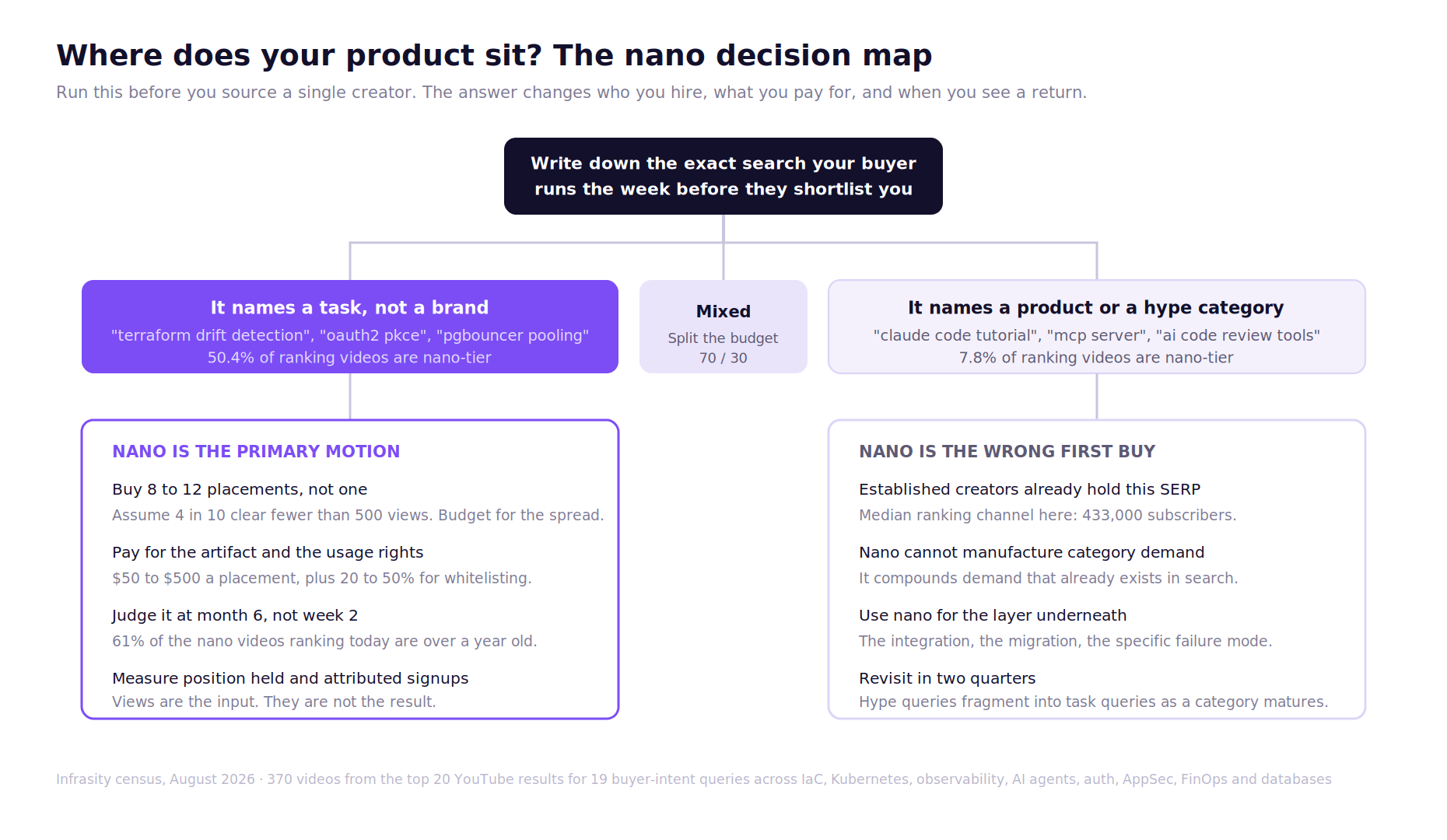
The census is unambiguous on this. Claude code tutorial and MCP server tutorial returned zero nano channels in 38 combined results. AI code review tool comparison returned one in nineteen. Median subscriber count of a channel ranking for these queries: 433,000. Those results are held by established creators who moved into the category early and have the production capacity to keep publishing against it. A nano creator cannot dislodge them, and paying eleven of them to try will produce eleven videos nobody finds.
Three specific situations where nano is the wrong first buy:
- Category creation. If your buyer does not yet know your category has a name, there is no query to rank for. Nano compounds existing search demand; it does not manufacture it. You need the category-defining content and the larger voices first.
- A dated launch moment. Nano placements pay off over quarters. If you need coverage concentrated in a specific week, buy concentration.
- Enterprise-only products with no self-serve path. If a creator cannot get to a working demo without a sales call, the content cannot be made honestly.
Treat this as a timing judgment rather than a permanent one. Hype queries fragment into task queries as categories mature. mcp server tutorial has no nano presence today; in eighteen months, mcp server authentication error and mcp server rate limiting will, and those are the queries a buyer runs when they are already committed. Re-run the count from rule 1 every two quarters.
What a first nano program actually costs
For a pre-seed to Series B DevTool or AI infrastructure company, a first program that produces a readable signal runs $3,000 to $15,000 over roughly three months. Here is where that goes.
| Line | Range | Notes |
|---|---|---|
| 8 to 12 nano placements | $600 to $6,000 | At $50 to $500 each, weighted toward video |
| Whitelisting rights on the best 2 to 3 | +20% to 50% of base | Only worth buying after you see which performed |
| Sourcing and vetting | The largest line | See rule 4. Only 40% publish a contact path |
| Attribution setup | One afternoon | Per-placement UTMs, promo codes, a signup survey field |
| Paid amplification behind winners | Optional | Where the whitelisting rights earn out |
Two things to hold to.
Treat the number as an amount you can afford to lose entirely, because the first program is where you buy priors rather than pipeline.
And judge it on cost per attributed signup at month six, not on reach at week four.
For reference on what the output looks like when it works: a single practitioner-led LinkedIn post in one of our DevOps engagements returned a 61% click-through rate against 3% for the sponsored post running beside it in the same feed, with 312 likes against 6 and 48 comments against zero. Across that engagement, 218,000 monthly reach converted to 641 attributed signups. The mechanism was not the budget. It was that one post was a practitioner saying what he did last week, and the other was an ad.
Conclusion
You now have the routing rule, the pricing model, the failure rate to budget for, and the three numbers worth measuring. The first step is small enough to take today: pick your ten highest-intent buyer queries, run them on YouTube, and write down the subscriber count of every channel in the top ten. If the median lands under 20,000, you have found a distribution channel that is currently underpriced for your category, and rules 3 through 10 tell you how to run it.
If you would rather not build the sourcing pipeline yourself, that is the part we run. Infrasity screens and vets nano and micro creators across YouTube, LinkedIn, X, and Discord for DevTool and AI infrastructure companies, shares the full roster and the budget before anything is briefed, and reports attributed signups per creator rather than impressions. See how the engagement works, or read the case studies first.
Frequently Asked Questions
How many followers does a nano influencer have?
Roughly 1,000 to 10,000 on a single platform. The band is consistent across sources, including Brandwatch and Google's own AI Overview. For B2B technical products, the useful threshold is closer to 10,000 subscribers on YouTube, because that is where our census shows the ranking behavior changes.
Do nano influencers actually work for B2B SaaS?
Yes, on specific implementation searches, and poorly on brand searches. In our census of 370 ranking videos, nano channels held 50.4% of results for task-named queries and 7.8% for product-named queries. Run the count for your own queries before committing budget; the answer is category-specific and takes an afternoon to get.
How much do nano influencers charge in tech and SaaS?
Between $50 and $500 per placement, with dedicated YouTube reviews at the top of that range. Launchpoint's rate guide puts tech and SaaS nano creators at a 40% to 60% premium over lifestyle creators of the same size. Whitelisting rights add 20% to 50%, and many will trade cash for a license plus a 15% to 30% recurring affiliate commission.
Are nano influencers easier to reach than bigger creators?
No, and this is the most common wrong assumption. They are easier to win and harder to find. Only 40% of the nano channels in our census published any off-platform contact path, compared with 78% of mid-tier channels. Budget for sourcing effort rather than for negotiation.
How long before a nano influencer campaign shows results?
Longer than a standard campaign window, which is why most programs get canceled early. 61% of the nano videos currently ranking in our census were published over a year ago and 22% over three years ago. Measure at 30, 90, and 180 days, and expect the majority of the return in the second half of that.
How many nano creators should a first campaign use?
Eight to twelve, across at least two platforms. In our census, 40% of nano placements cleared fewer than 500 views while 16% cleared more than 10,000. That distribution rewards portfolios and punishes single bets, and the low unit cost is what makes the portfolio affordable.
Can nano influencers replace macro creators entirely?
Not in every category. The demand for nano compound searches already exists; it cannot create category awareness. If your buyer does not yet know your category has a name, or if you need coverage concentrated in a launch week, larger voices do a job nano cannot. In mature technical categories with high query specificity, nano can carry the program.
Does nano influencer marketing work on Reddit and GitHub?
The logic holds, and the metric disappears. Neither platform has a follower economy that maps to influencer tiers, so standing is earned through comment history, maintained code, and answered questions. You cannot buy a placement, which is why the surfaces stay underpriced and why participation has to be genuine.