


To launch a SaaS product with creators, build a roster of 20 to 30 people already publishing in your category, give 15 to 25 of them free access three weeks before launch, pay only the ones who ship something unprompted, and put a distinct tracking link on every placement so you can tell which creator produced which signup. The spending comes fourth in that sequence, not first.
Let's know all of that in detail.
This blog covers the sequence, the real rates, the four programmes that published their figures (two worked, two did not), the peer-reviewed finding that should change how you brief creators during a launch, and the attribution setup that decides whether you can re-book anyone.
TL;DR
- Subscriber counts only explain 29% of a video's performance variation. Follow PostHog's strict vetting rule: sort by median views and automatically reject any creator averaging under 5,000 views per video.
- Seed access before spending money: Give 15-25 vetted creators free access three weeks before launch, but only pay the ones who actually build something unprompted. This filters out creators who will just read a script.
- Launch announcements are statistically terrible: A peer-reviewed study of 5,835 creator posts proved that "new product announcements" diminish engagement. Technical buyers want to see a gritty, 40-minute product demonstration, not a polished ad.
- The best SaaS programs combine flat placement fees with affiliate commissions to share the risk. Semrush pays a flat fee plus $300 per sale, while ClickFunnels offers 30% monthly recurring commissions.
- If your product requires a long setup, creator traffic is wasted. Developer backend Convex burned $100,000 (spending over $100 per click) pointing creators to a homepage, resulting in zero conversions because the product lacked an immediate quickstart path.
- Don't reset your roster after launch week. Data from Rocket's 90-placement campaign showed that recommissioning the same creator yielded 41% more views (20,355 vs 14,454) than their first video.
What does launching with creators actually involve?
Launching with creators means paying people who already hold the attention of your buyers to use your product in public during a defined window, and designing the launch so their output is traceable back to revenue.
The creator is not lending you their face. They are lending you a demonstration slot in front of an audience that has already decided to listen to them about this category. Lovable is the clearest recent example of taking that seriously before a product even ships widely. Mindaugas Petrutis, one of the company's first 50 employees, built its creator program on a simple rule: give a creator product access before any brief, deliverable, or payment gets discussed, because their unscripted first reaction tells you more than a media kit does. In one collaboration, a creator built an app live with Lovable on camera; the video reportedly drew around 20,000 comments asking for access, and the beta that followed drew a reported 30,000 signups. Treat the exact figures as self-reported, but the sequence, access before ask, is the part worth copying.
How it differs from influencer marketing as most people picture it
Consumer influencer marketing buys attention and association. A creator holds a product, says it is good, and the audience transfers some of their trust to the brand.
Software buying does not work that way, and it works least like that for technical products. A developer evaluating your tool is going to open a terminal. The useful thing a creator can give you is not an endorsement. It is forty minutes of footage showing your product solving a problem the viewer recognises, with the errors left in.
That distinction decides everything downstream: who you cast, what you pay for, and what you measure. It is also why the B2B influencer campaigns that fail usually fail before anyone publishes, in the casting and the brief rather than in the content.
Where it sits against the other launch channels
Product Hunt, Hacker News, and your own email list are all borrowed-audience moves too. The difference is repeatability. A Product Hunt launch happens once. A creator roster is a standing asset you can activate again at the next release, and a creator-led launch runs on a 90-day rollout rather than a single day.
If you are still deciding on the overall shape of your launch, the five pieces of a SaaS go-to-market plan is the wider frame. This guide is about one channel inside it.
Should creators carry your launch at all?
Four conditions decide it, and the best answer for a lot of products is no, or not yet.
Can someone build something real with your product in 30 minutes?
A creator can only film what they can finish. If the first meaningful result takes an afternoon of configuration, you are buying a video of someone struggling, and no editing fixes that. Supabase's own alpha launch postmortem is instructive here: the thing that carried their launch was a product someone could try immediately, which produced 30,000 new visitors and over 1,400 signups in launch week off a Hacker News front page run.
Shorten time to first result before you spend on placements. It changes more than anything else you can do here, and it costs no media budget.
Is anyone already publishing about your category unpaid?
If creators already cover the space, you are buying a slot in an existing conversation. If nobody does, you are paying creators to learn your category on camera, which is slow and reads as sponsored even when it is sincere. Seed and teach first.
Can you tie a signup to one named creator?
Not a blended total. One creator, one link, one number. Without this, you will re-book on view counts, and view counts do not pay. This is the condition most programmes skip and the reason most of them cannot say afterwards whether they worked.
Is your contract value big enough to absorb a four-figure placement?
A single technical YouTube placement is frequently a four-figure commitment. On a $29-a-month product with no expansion path, the arithmetic rarely closes on one video. Run an affiliate or revenue-share structure instead and pay on the outcome.
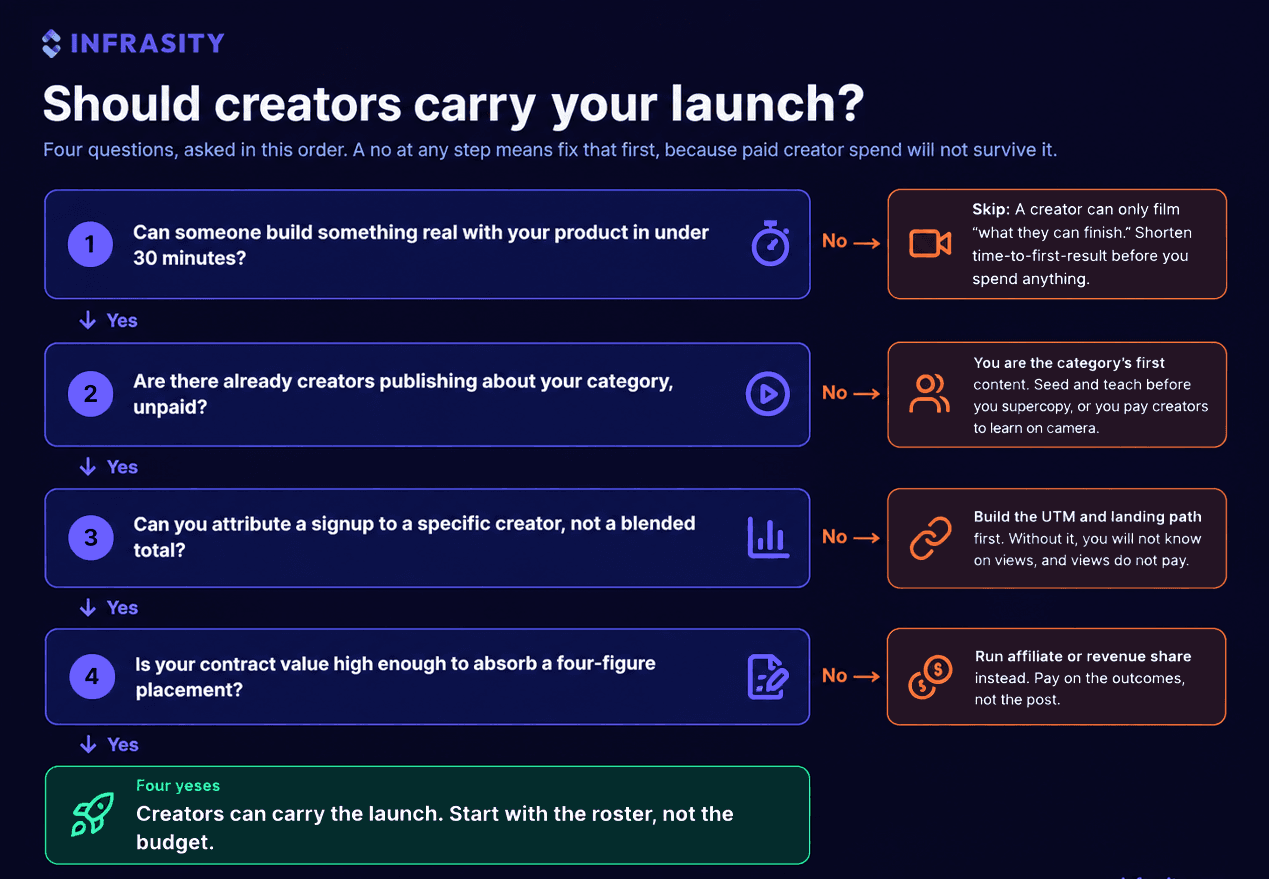
A no at any step means fix that first, because paid creator spend will not survive it.
What does the sequence look like, week by week?
Twelve weeks, five phases, with the paid spend landing in phase four.
Weeks 1 to 2: build the roster
Search your category the way a buyer would and collect every creator already publishing about it. Include YouTube, LinkedIn, X, newsletters, and the Discord and Reddit people who answer questions in your space.
Score for fit, not reach. PostHog publishes its own screening rule in its public handbook and sets a hard floor: "Above 5k views per video. Anything below this is just not worth your time." They also prioritise creators who are users first. Both rules are worth copying verbatim.
Use median views rather than subscriber count. In our own creator programme for Rocket, subscriber count explained only 29% of the variation in how a video performed, which means roster decisions made on follower numbers are mostly noise. The practice of judging a creator on median views instead of subscriber count is the single cheapest upgrade to a shortlist.
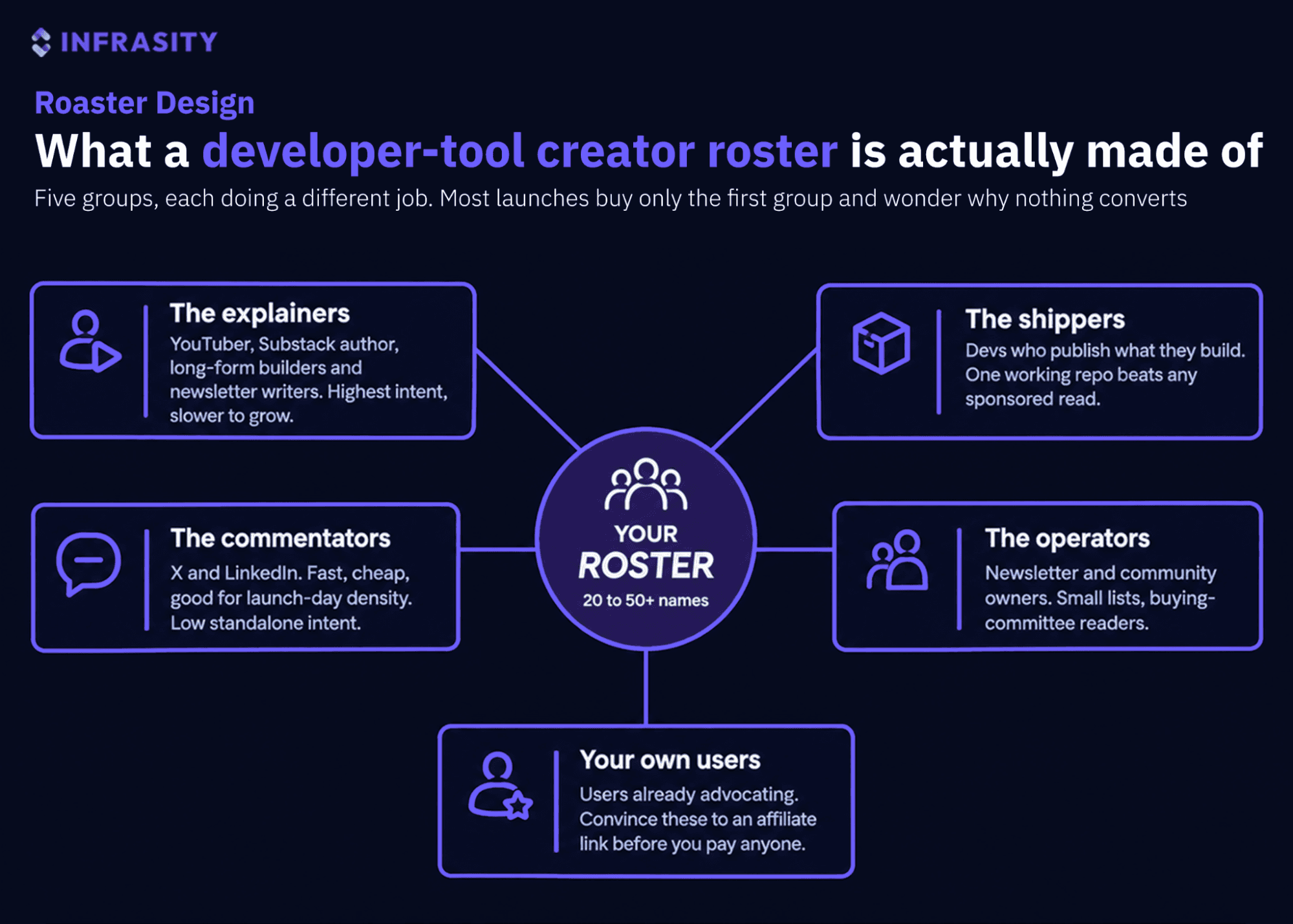
A developer-tool roster isn't one type of creator. Most launches buy only the first group and wonder why nothing converts.
Week 3: seed before you sponsor
Give 15 to 25 creators free access, a working demo repository, and no obligation. Then watch. The ones who build something unprompted are your paid roster. The ones who go quiet have told you something useful at no cost.
This phase is where the campaign is actually decided. A creator who has already run your product can show it working. A creator who has not can only describe it.
Week 4: wire the tracking
Every placement gets a distinct UTM string in the description and a landing path that matches the video. Decide now what counts as a result, whether that is a signup, a deployed project, or a booked call, and instrument it before anything publishes.
In the Rocket programme, per-creator UTMs on every paid YouTube placement are the reason we can say that the largest single video delivered 12.0% of total views rather than guessing at it. Blended reporting would have hidden that entirely.
Weeks 5 to 6: pay the shortlist
Buy the creators who already built with you. Stagger the publishing dates by a few days each so you can read every placement separately. The temptation to land everything in one hour is strong, and it costs you the ability to tell which creator worked.
Weeks 7 to 12: cut, re-book, repeat
Drop the bottom half. Re-book the top. Repeat placements outperform first placements, and in the Rocket data, returning creators averaged 41% more views than first-time ones, 20,355 against 14,454. The second round is where the economics turn, which is why one-off campaigns usually report worse numbers than standing rosters. Running creator campaigns as a standing roster rather than a one-off shortlist is the structural version of this point.
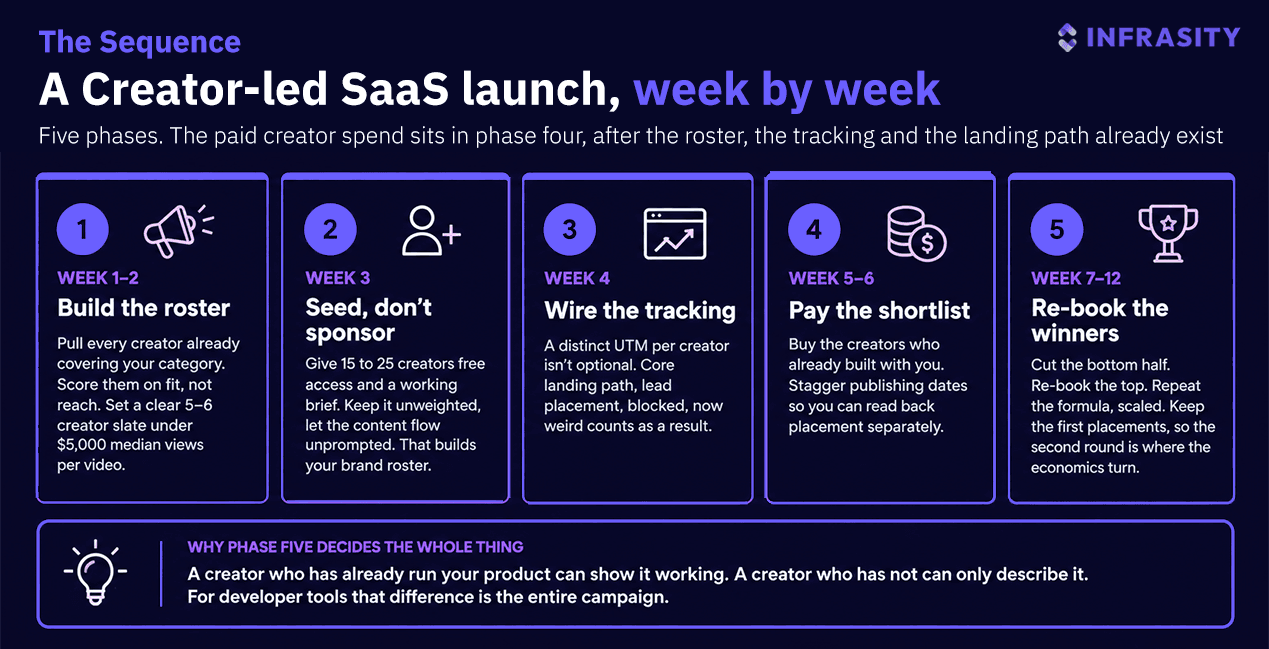
Five phases. The paid creator spend sits in phase four, after the roster, the tracking, and the landing path already exist.
Why do developer tools need a different design?
Because the buyer verifies instead of believing, and almost every assumption in consumer creator marketing inverts.
Developers check the work
In Stack Overflow's 2025 Developer Survey, covering more than 49,000 respondents across 177 countries, more developers actively distrust the accuracy of AI tool output (46%) than trust it (33%). That scepticism is not limited to AI. It is the default posture toward any claim about tooling.
A creator placement survives that posture only if it contains something checkable: a repository, a terminal session, a failure the creator hits and works around. A polished sixty-second spot gives a sceptical viewer nothing to verify and gets read as an ad.
The channels are different, and YouTube is the one that matters
The same survey shows where developers actually go: Stack Overflow at 84.2%, public GitHub at 66.9%, YouTube at 60.5%, and Reddit at 53.7%. YouTube skews higher still among people learning, at 70% versus 60% for working professionals, which is exactly the population adopting a new tool.
There is a measured version of this. In a December 2025 conversation with Greg Isenberg, Rob Hoffman described a local SEO tool that hit $5,000 MRR on day one from a single feature launch, where YouTube drove 80 to 90% of sales from a video that got roughly one tenth the views of the accompanying X post. Reach and revenue pointed in opposite directions.
Production value is not the constraint
Hoffman's advice in the same conversation is blunt: "just rip some Loom videos, put them on YouTube," and "Don't worry about being polished." For technical audiences, this holds up. The constraint is whether the thing works on screen, not whether the colour grade is good.
Small channels convert
Audience density beats audience size when the product is narrow. A 12,000-subscriber channel covering exactly your category is worth more than a 400,000-subscriber generalist, which is the mechanism behind a 13,000-follower creator outconverting a 500,000-follower one.
What do creators actually cost, and how should you pay them?
Here is what we found in our research:
The two payment structures, and the one that works best combined
Flat placement fee: You pay for the content regardless of outcome. Predictable for the creator, risky for you, and the only structure that works when the creator has no reason to believe your conversion rate yet.
Affiliate or revenue share: You pay on the result. Cheaper on day one, and it transfers risk to the creator, which means the creators with real audiences will often decline it unless the payout is large or the brand is proven.
The companies that have made this work at scale run both at once. Semrush's affiliate programme pays $100 to $300 per sale depending on tier, $10 per free trial, and a 120-day last-click cookie. Its FY2024 10-K describes the programme in the company's own words as paying commission for "each new registration, trial, and subscription activated through a referral affiliate's promotion", and lists influencers alongside agencies among its named partner categories.
We can show what that looks like from the receiving end, because Semrush's affiliate team sent it to us.
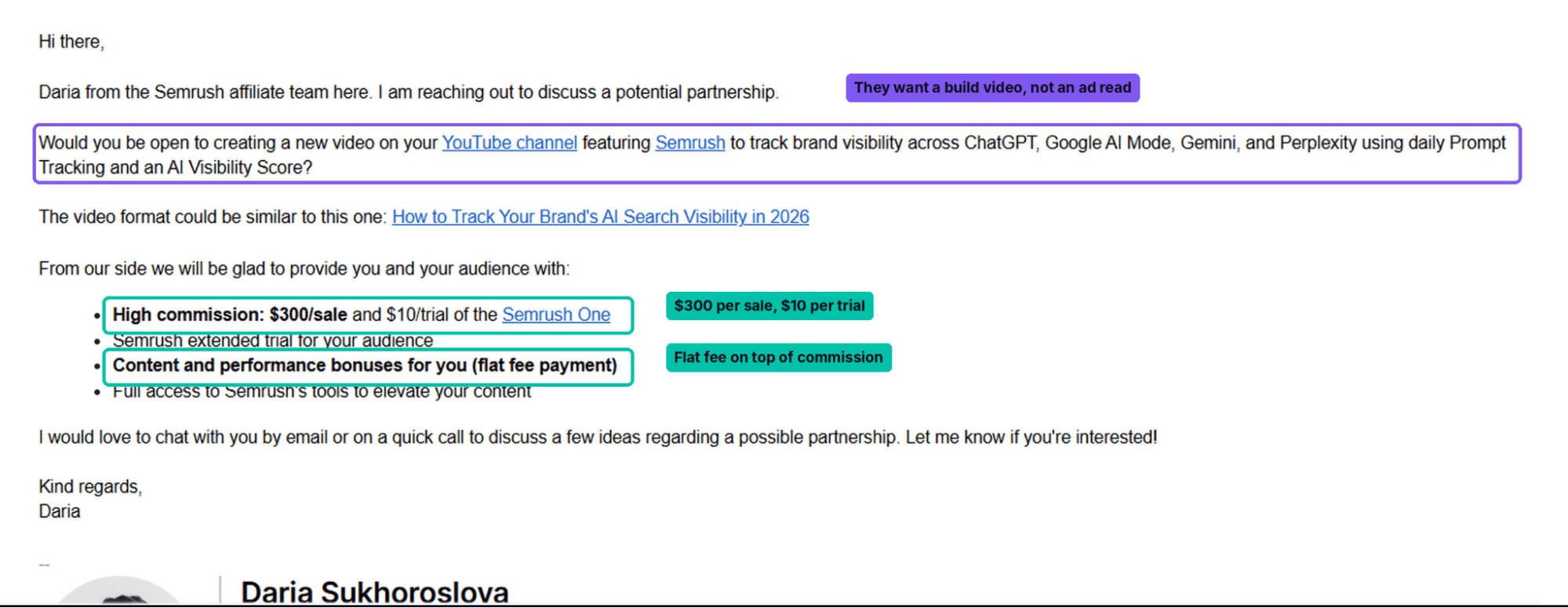
The ask is for a build video, not a mention, and the flat fee runs alongside the commission so the creator is paid for the work and again for the outcome.
Three things in that email are worth learning from. The ask is for a video showing the product doing a specific job, not a mention. The flat fee and the commission run together, so the creator is paid for the work and again for the outcome. And the offer includes full product access, because a creator who cannot use the tool cannot demonstrate it.
What recurring commission actually looks like
ClickFunnels is the most-cited example of affiliate-led SaaS growth, and the number most often quoted for it is wrong. Its published affiliate page states 30% monthly recurring commission, not the 50% that circulates in summaries. The programme layers a bonus on top: "Get and keep 100 or more active ClickFunnels members," and the company reimburses a car lease. ClickFunnels announced passing $100 million in sales with 67,000 customers in 2018.
The 50% figure does appear in the ClickFunnels story, just somewhere else. Steve Larsen, who built funnels there in the early days, describes the joint-venture split as "I'll do the whole thing; just bring your audience, and I'll give you 50% of the take" on webinars run to partner audiences. That is a revenue split on a live event, not a standing affiliate rate. The distinction is worth keeping straight when you are designing your own terms.
Benchmark figures for sizing the budget
US influencer marketing spend reached a projected $10.52 billion in 2025, up from $9.15 billion in 2024, with YouTube passing 50% adoption among US influencer marketers that year. That is a consumer-weighted figure, and your category will price differently, but it tells you the direction of creator rates.
Nobody publishes a credible rate card for technical YouTube channels. We looked. The aggregators that claim to have one disclose no method and no sample. The only first-party cost datapoints that exist are PostHog's 5,000-view screening floor and Convex's report of placements running over $100 per click, which is covered in the next section.
If you want the numbers underneath the rates, Infrasity's free B2B Influencer Marketing Playbook carries the creator roster, the 100-point fit score we run shortlists through, and the attribution ladder we use to decide what counts as a result. It is the working version of what this section summarises.
What goes wrong, and what does the research say about launches specifically?
This is the part the article skips, and it includes a peer-reviewed finding that should change your brief.
Launch announcements are the weakest possible creator brief
The Journal of Marketing study behind the HBR article "Does Influencer Marketing Really Pay Off?" analysed 5,835 posts from 2,412 influencers across 1,256 campaigns and 861 brands. Among its findings: influencer originality, follower size, and sponsor salience raise effectiveness, while new-product-launch announcements diminish it.
Read that again with a launch in mind. The content type you most want creators to produce during a launch window is the type the data says performs worst. The fix is a different brief, not a different channel: ask for the demonstration instead of the announcement, have the creator build the thing, and let the fact that it is new sit as a detail rather than the subject.
Two more results from the same study are worth carrying into a brief. Posting frequency and follower-brand fit both show inverted U-shaped effects, meaning there is an optimum and more is not better past it. And the headline elasticity is modest: a 1% increase in influencer marketing spend raised engagement by 0.457%, with the authors estimating 16.6% more ROI available purely from reallocating spend across the seven variables they measured.
One caveat you should know before quoting it: the dataset is Weibo posts collected in October 2018. It is peer-reviewed, and it is the best-controlled evidence available, and it is consumer social commerce from seven years ago. Treat the direction as reliable and the magnitude as indicative.
Spending without a conversion path burns fast
Convex, a developer backend, published an unusually candid account of this. The company spent roughly $100,000 on newsletter and creator sponsorships in two months, with some placements running over $100 per click, and reported that it "brought a trickle of extremely expensive new visitors who didn't actually build anything." Paid ads performed worse again: sessions 3.3 times shorter, bounce rate 2.5 times higher, zero conversions.
What worked for them was a startup program whose cohort compounded spend 30 times over 24 months. The lesson is not that creators do not work. It is that a creator placement pointed at a homepage, with nothing waiting to convert the visitor, is an expensive way to buy a bounce.
Views are not a result
A $6,000 campaign published in September 2026 by an influencer-marketing platform paid 15 creators on X to quote-retweet a feature announcement inside a 60-minute window, and reported over 225,000 views in 72 hours at roughly a $25 CPM. The writeup contains no signups, no trials, and no revenue. Not low numbers. No numbers.
That is the default failure mode, and it is quiet, because a quarter of a million views looks like success in a deck. The eight metrics that tie creator video spend to revenue exist precisely so that the question gets asked while the campaign is still running.
Running your own channel is a different job with a different timeline
PostHog tried this and wrote it up. Between November 2022 and July 2023, they published videos that did hundreds to thousands of views, one hitting 3,000 in a week, and concluded: "we didn't see an increase in signups, traffic, or mentions from the videos." Only 2.5% of the video traffic came from their own site, with 60% arriving from YouTube search and recommendations, and they judged that the channel would need multiple years and hundreds of videos.
Their own handbook calls long-form YouTube their strongest acquisition channel. The distinction is that the videos working for them are on other people's channels. Borrowing distribution and building it are separate projects on separate timelines, and conflating them is how launch budgets get spent on a channel that will not produce for two years. If you want the owned-audience version, building an audience before you need it is a pre-launch activity, not a launch one.
One concentrated placement is a single point of failure
We benchmarked a competitor creator programme in which one video produced 85.6% of all reach. That looks efficient until the creator changes direction, the video underperforms, or the relationship ends. In the Rocket programme, we deliberately spread 90 placements across 23 YouTube creators plus X and Instagram, and the largest single placement accounted for 12.0% of views. The eight failure modes that decide a campaign before anyone publishes are mostly roster-composition problems like this one.
Who has actually done this, and what happened?
Four programmes with first-party numbers attached, plus two companies that built the structural version of the same idea.
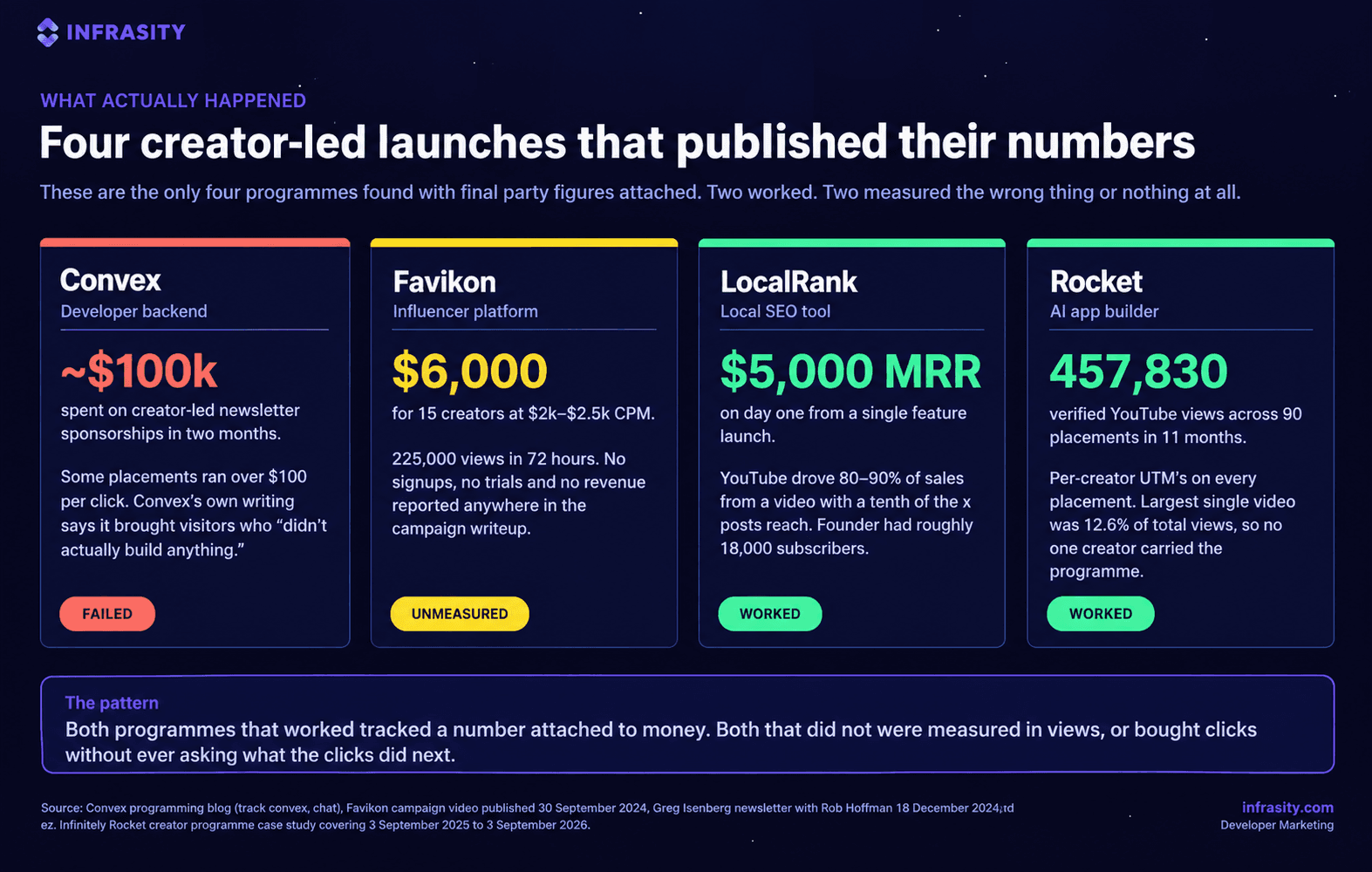
The two programs that worked both tracked a number attached to money. The two that didn't were measured in views, or bought clicks without ever asking what the clicks did next.
Rocket: 90 placements, 457,830 verified views, no single point of failure
Over 11 months from September 2025, Rocket ran 90 creator placements across YouTube, X, and Instagram with more than 80 creators activated, producing 457,830 verified YouTube views and between 1.16 and 1.90 million total reach. Every paid YouTube placement carried a distinct UTM string, so performance was readable per creator rather than blended.
The mechanics are the transferable part. Creators were scored on a 100-point fit card where 55 points have nothing to do with audience size. X and Instagram published first because they are cheap and fast to iterate on, before YouTube budget was committed. Repeat creators averaged 41% higher views. And 14 of the top 20 YouTube results for the brand's own name became creator placements, which turned the campaign into a durable search asset rather than a spike. The full Rocket creator programme writeup has the per-platform breakdown.
Semrush: creator economics running at public-company scale
Semrush is the clearest case of the education-plus-affiliate model compounding. Its FY2024 10-K reports $376.8 million in revenue, roughly 117,000 paying customers, and more than 1,049,000 active free customers, alongside a Semrush Academy with over 1.1 million enrolled students and 500,000 certifications issued as of 31 December 2024.
The shape to notice is the ratio. Nine free users for every paying one, over a million people trained on the product by the company's own curriculum, and an affiliate programme paying technical creators on both trials and sales. The creators are inside the funnel, not pointed at the top of it.
Figma: turning users into the content supply
Figma Community launched in closed beta in October 2019, letting designers publish files that others could inspect and remix. At Config 2020, the company reported 800 files available in the Community. By the time Figma filed its S-1, that had become over 250,000 Community resources, including more than 10,000 plugins and widgets.
The same filing reports 132% net dollar retention as of 31 March 2025, 13 million monthly active users, and $749.0 million in 2024 revenue. It also notes over 200 Friends of Figma chapters running more than 650 events in 2024.
Figma did not rent creator audiences. It gave creators a place to publish inside the product and let the resources become the marketing. That is the most durable version of this strategy and the slowest to build, and it is adjacent to how community-led growth compares against paid acquisition for B2B products generally.
Supabase: the launch-week habit
Supabase's alpha launch drove 30,000 visitors and 1,400+ signups in a week off a Hacker News front-page run. Three years later, the company reported 50,000+ GitHub stars, 80,000 X followers, 17,000 Discord members and 14,000 YouTube subscribers. Running launch week on a cadence turned a one-time event into a recurring one, which is what gives a creator roster something to show up for more than once.
What creators do when they stop renting out their audience
The trend worth watching is creators building the software themselves. beehiiv, founded by former Morning Brew operators, raised a $33 million Series B led by NEA in April 2024 with monthly revenue exceeding $1 million and over a billion emails sent monthly.
The read-across for a SaaS founder is about bargaining position. A creator who can build is also a creator who can evaluate, and increasingly one who wants equity rather than a placement fee. Offering that deliberately, to the two or three creators who genuinely move your category, is a structure worth considering before a competitor offers it first.
One warning on the surrounding commentary: most circulating revenue figures for creator-owned platforms like Skool, Kit, Gumroad, Whop and Stan Store come from third-party estimate services rather than company disclosures. We checked, and beehiiv is the one with a primary source. Treat the rest as unverified.
How do you know whether it worked?
Decide before launch, instrument before launch, and read it per creator.
The measurement setup, in order
- One tracking link per creator, in the video description and in any pinned comment. Not one per campaign, and not one per platform.
- One landing path per placement type, matching what the video actually showed. A video about your CLI should not land on a homepage.
- A defined result, chosen in advance. Sign-up, deployed project, repository cloned, or booked call. Views are a leading indicator, never the result.
- A 90-day window, because technical buying cycles outrun campaign reporting windows. Judging a placement at day seven will make you cut creators who were working.
What to actually compare
Cost per signup per creator, not blended CPM. Median views per creator, not subscriber count. Share of total reach held by the single largest placement, because anything much above 30% means you are running a concentration risk rather than a programme.
Then re-book on those numbers. The fastest improvement available in a second round is usually not a bigger budget. It is dropping the bottom half of the roster and giving that money to the creators whose placements already converted. Seventeen creator campaigns with spend and pipeline attached is a useful reference for what the ranges look like across different product types.
A note on dissent worth taking seriously
Not everyone thinks launching on borrowed audiences is a good idea. TK Kader, who built ToutApp to 100,000+ registered users before selling to Marketo, argues for a three-phase sequence where you sell to your own network first, then your network's network, and only then go public. His view on the borrowed-audience version is unhedged: lifetime deals and big-bang launches bring "a bunch of people that are not even your ICP, a bunch of tire kickers" and you are stuck with them.
He is right about a specific failure, and it is the one Convex documented. The resolution is the qualification test earlier in this blog. If you cannot attribute a signup and your product takes an afternoon to produce a first result, Kader's sequence is the better plan, and creator spend will not rescue you. If you pass those tests, creators give you reach that a personal network cannot, and the difference between the two positions is mostly about which precondition you are standing on.
Conclusion
Build the roster before you build the budget. Open a sheet, list every creator currently publishing about your category across YouTube, LinkedIn, X, and newsletters, and record median views rather than subscriber count for each. Cut anyone under 5,000 median views. That list, which takes about a day, tells you whether you have a creator channel available to you at all, and it costs nothing to find out.
Then seed 15 of them with free access and a working demo, and see who builds something without being asked.
If you would rather have that roster built, scored and attributed by people who run it as a standing programme, that is what our B2B influencer marketing service does for DevTool and AI infrastructure companies: vetted creators across YouTube, LinkedIn, X and Discord, per-creator attribution, and pricing agreed before anything is signed. If creators are one channel inside a wider launch rather than the whole plan, our developer marketing engagement covers the technical content, community presence, and AI search visibility around it.
Frequently Asked Questions
How much does it cost to launch a SaaS product with creators?
There is no published rate card for technical creator placements, and the aggregators claiming to have one disclose no method or sample. The verifiable reference points are Convex reporting some placements running over $100 per click, and one X campaign spending $6,000 across 15 creators at roughly a $25 CPM. Budget for a pilot you can measure rather than a number you read somewhere, and decide your acceptable cost per signup before you spend.
How many creators do you need for a launch?
Fifteen to 25 for the seeding phase, narrowing to the ones who build something unprompted. In the Rocket programme, 80+ creators were activated across 90 placements over 11 months, with no single placement exceeding 12.0% of total views. The number matters less than the spread: a programme where one creator carries most of the reach is one relationship away from failing.
Should you pay creators a flat fee or an affiliate commission?
Both, running together, is what the companies doing this at scale use. Semrush pays a flat content fee alongside $10 per free trial and $100 to $300 per sale with a 120-day cookie. ClickFunnels pays 30% monthly recurring on its standing affiliate programme. A flat fee alone transfers all risk to you; commission alone makes it hard to recruit creators who have not yet seen your conversion rate.
Do creators work for developer tools or only for consumer products?
They work, with a different brief. Developers verify claims by running code, and 60.5% of respondents to Stack Overflow's 2025 survey name YouTube as a place they participate in the developer community. What converts is a creator building something visible with your product, including the parts that break, rather than a scripted endorsement.
What is the biggest mistake in a creator-led SaaS launch?
Measuring in views. A campaign can produce 225,000 views and report nothing about signups, trials, or revenue, which makes it impossible to decide what to repeat. The fix is a distinct tracking link per creator and a defined result chosen before launch.
How long before a creator launch shows results?
Plan on 90 days to read it properly, and expect the second round to outperform the first. In our Rocket data, repeat creators averaged 41% more views than first-time placements, 20,355 against 14,454. Technical buying cycles outrun seven-day reporting windows, and cutting creators at day seven usually means cutting ones who were working.
Is Product Hunt still worth it alongside a creator launch?
It is a different kind of day with a different audience, and it rewards preparation over spend. Some founders argue it attracts non-ICP users who are expensive to support. Treat it as one placement inside the launch rather than the launch itself, and know the hour-by-hour requirements before committing to a date.