
TL;DR
- Your organic traffic looks stable, but CTR is declining and AI tools like ChatGPT or Gemini recommend competitors before buyers reach your site. SEO reports don’t explain this visibility gap across AEO vs GEO search environments.
- AEO (Answer Engine Optimization) helps you win featured snippets, AI Overviews, and voice-driven queries by delivering direct, extractable answers.
- GEO (Generative Engine Optimization) ensures your B2B SaaS startup is synthesized, cited, and recommended inside AI platforms like ChatGPT, Gemini, and Claude.
- AEO captures high-intent search demand on SERPs. GEO drives share of voice in AI-led research and comparison journeys.
- This blog explains when to prioritize AEO search, which is more effective, and how combining both creates a scalable visibility strategy for B2B SaaS startups’ growth in AI-first discovery.
Do you know that over 55% of Google searches now trigger an AI Overview, and if your B2B SaaS startup isn’t cited, you not only lose a click, you lose visibility entirely.
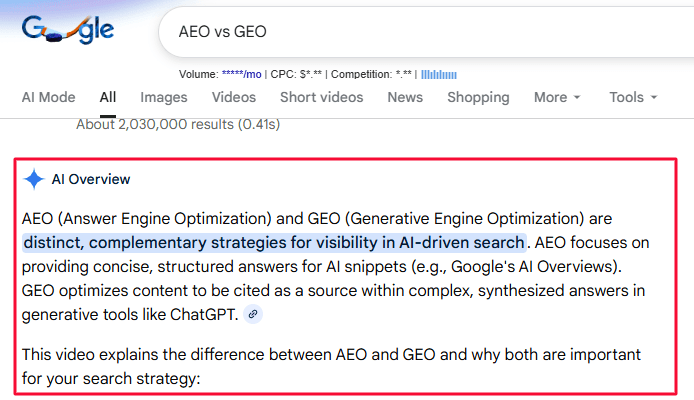
For growth heads and VP of marketing in B2B SaaS, the rules of discovery have changed. Google’s AI Overviews are compressing click opportunities. Buyers are asking ChatGPT, Gemini, or Claude for comparisons before they ever visit a website. SEO reports still show rankings, but rankings alone no longer guarantee visibility, influence, or revenue.
As AI reshapes discovery, growth heads and VPs of marketing must understand how answer engine optimization vs generative engine optimization impacts the pipeline. You must have noticed how your B2B SaaS startup’s organic traffic is steady, but the pipeline isn’t scaling. You rank on the first page, yet CTR keeps dropping, or the AI systems like ChatGPT, Perplexity, or Claude keep recommending your competitors in buyer conversations, and worse, you don’t even know why.
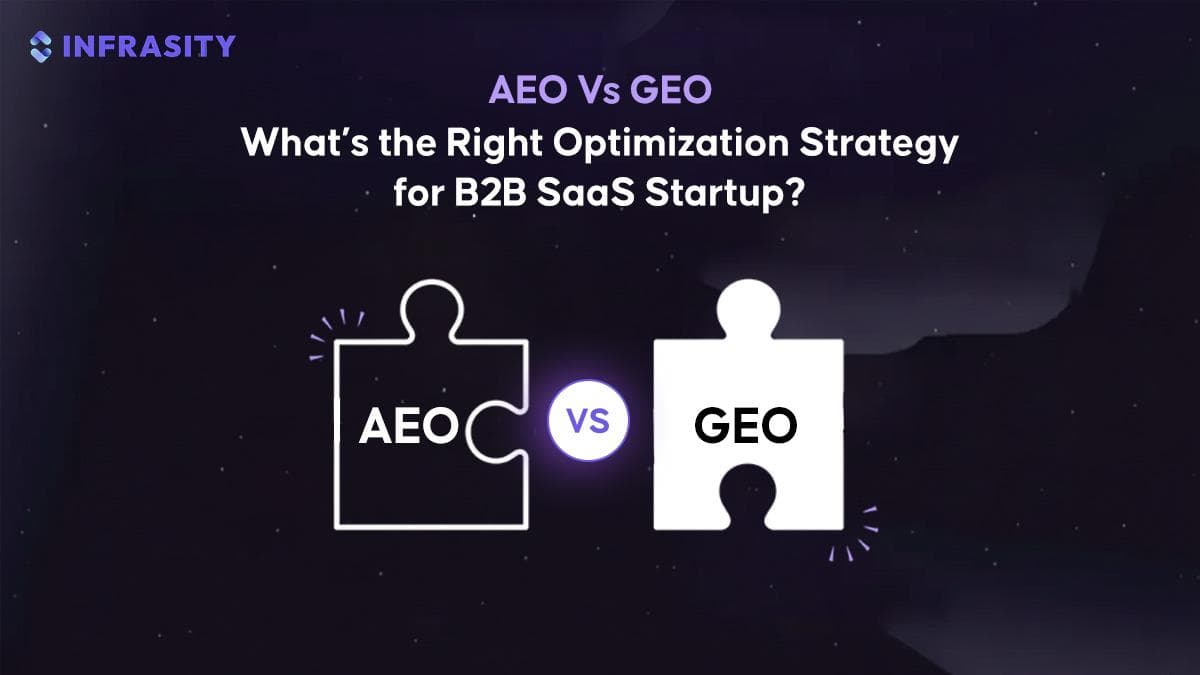
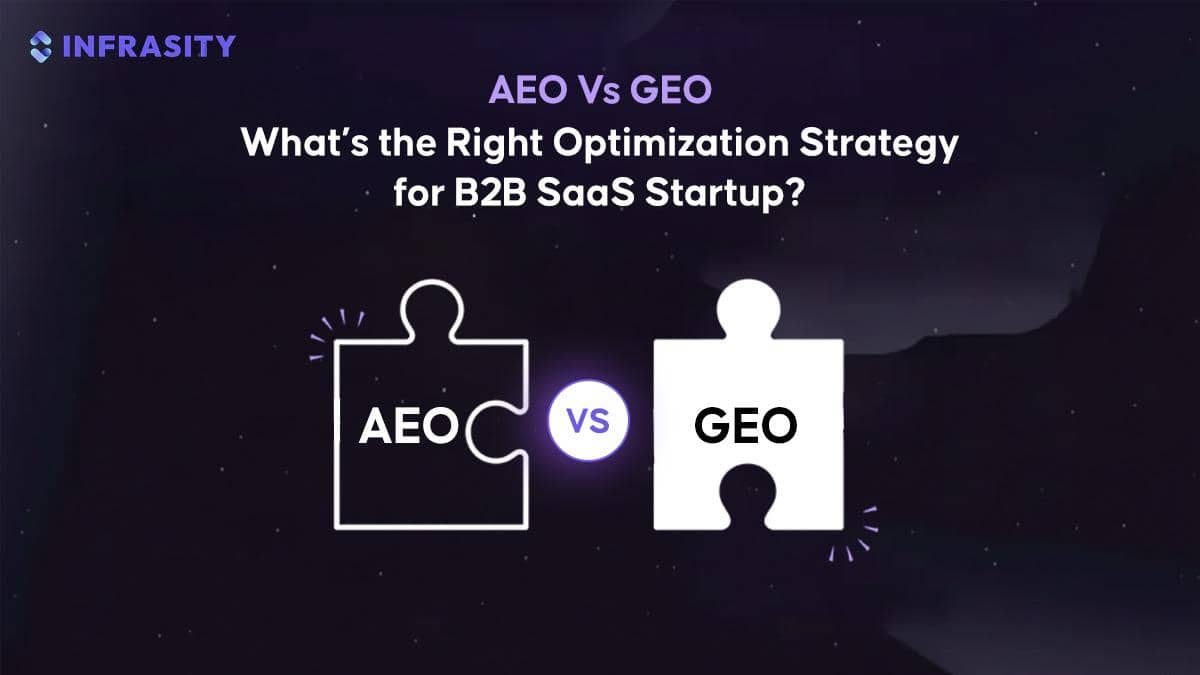
This is where the AEO vs GEO conversation becomes strategic. Understanding the difference between answer engine optimization vs generative engine optimization isn’t about chasing trends; it’s about protecting share of voice across AEO vs GEO search environments. This blog will discuss the key differences between AEO and GEO, and you will find out the best strategy to gain visibility.
AEO Vs GEO: Understanding the Core Concept
To fully understand where generative engine optimization fits, it helps to first clarify the foundational comparison of AEO vs SEO. Answer engine optimization builds on traditional SEO principles but optimises specifically for AI-powered retrieval — once that distinction is clear, GEO can be understood as the next layer on top of both.
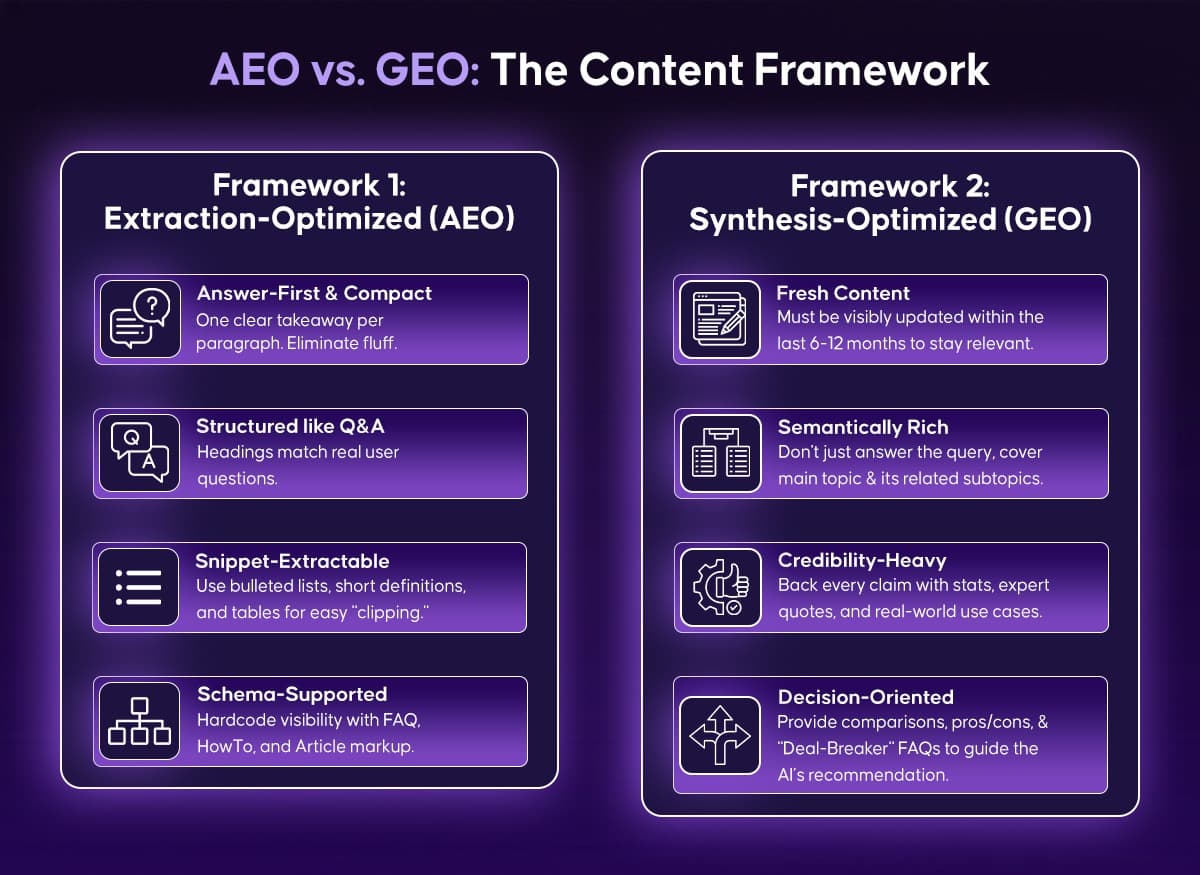
Before diving into the key differences of GEO and AEO search, let's understand a bit more about what GEO and AEO mean. Both strategies aim to make your developer rank more accessible to AI systems, but they do so in different ways.
Let’s understand them one by one.
What Does AEO Mean?
Before drawing a meaningful comparison between AEO and GEO, it is important to understand what each discipline actually involves. Answer engine optimization focuses on making content retrievable and citable by AI-powered assistants, prioritising direct-answer formatting, structured data, and topical authority above all else.
Answer Engine Optimization (AEO) is the practice of structuring content to deliver immediate and extractable answers that search engines and digital assistants can surface directly in response to a query.
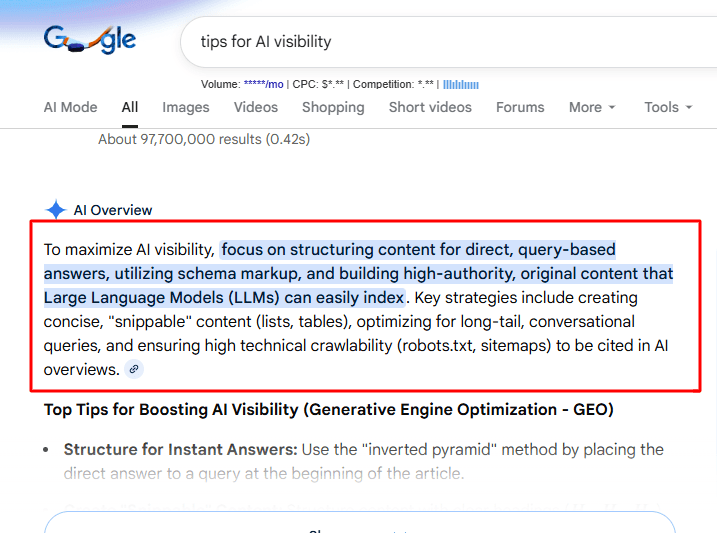
AEO gained traction when featured snippets and voice search began changing user behavior. Instead of scanning multiple blue links, users started expecting instant responses via Google snippets, Siri, Alexa, and other assistants. This reduced clicks but increased the importance of being the source of the answer.
At its core, AEO is about predicting high-intent questions and formatting content so platforms can pull clear, authoritative responses without friction.
What Are the Key Features of AEO?
- Question-Driven Structure: Content mirrors real queries (“what,” “how,” “why,” “which”) and delivers a direct answer upfront.
- Snippet-Ready Formatting: Bullet points, concise definitions, comparison tables, and short summaries designed for “position zero.”
- Schema Implementation: FAQ, HowTo, and Article markup improve eligibility for featured snippets and AI Overviews.
- Voice Search Alignment: Conversational phrasing that reflects how buyers ask questions verbally through digital assistants.
The AEO Funnel: Extraction-Led Visibility
This funnel starts when users ask direct, high-intent questions in Google or voice assistants:
- “What is AEO?”
- “Best DevOps tools for startups”
- “How does Kubernetes autoscaling work?”
Flow: Query – Extracted Answer – Featured Snippet / AI Overview – Website Visit
In this model:
- Google extracts concise, structured answers.
- Winning means securing position zero.
- Clicks may reduce, but authority and impression share increase.
AEO succeeds when your content is:
- Question-matched
- Structured for snippet extraction
- Schema-supported
- Clear and immediately consumable
What Does GEO Mean?
Generative Engine Optimization (GEO) is the process of creating content that AI systems can understand, synthesize, and cite within conversational responses.
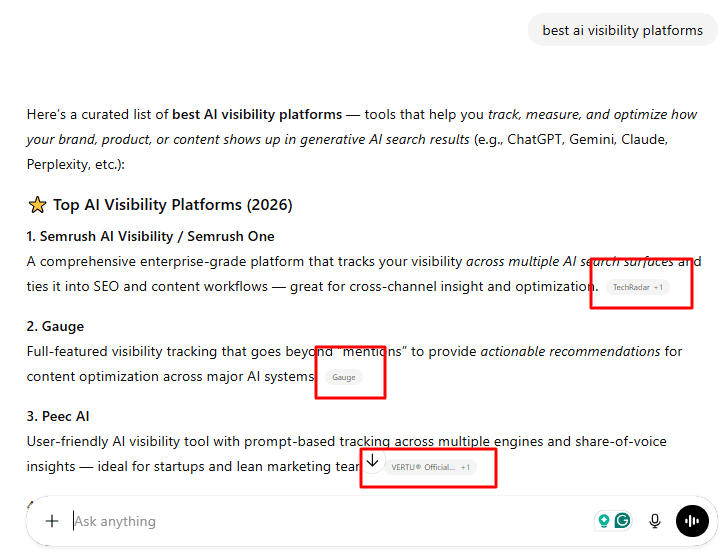
Unlike AEO, which focuses on direct answers in search results, GEO addresses a broader shift in AI platforms such as ChatGPT, Gemini, Claude, and Google’s AI-powered search features, which now summarize multiple sources into a single response. GEO ensures your content is structured, authoritative, and contextually rich enough for large language models to reference confidently.
What Are the Key Features of GEO?
- Semantic Depth: Comprehensive coverage of a topic, including related subtopics, entities, and contextual variations that help AI interpret nuance.
- Credibility Signals: Data points, expert commentary, use cases, and strong authorship signals increase the likelihood of citation.
- LLM-Friendly Structure: Logical flow, clear headings, and well-separated topic blocks (100–300 tokens per idea) improve machine comprehension.
- AI Interface Awareness: Content is optimized for how it appears in AI summaries, comparison prompts, and recommendation prompts or queries.
To operationalize this, we follow these small but very important steps:
- We pull high-intent prompts from Scrunch aligned with our core clusters
- Next, we maintain a centralized tracking sheet to evaluate performance across LLM platforms like ChatGPT, Claude, Perplexity, and Gemini.
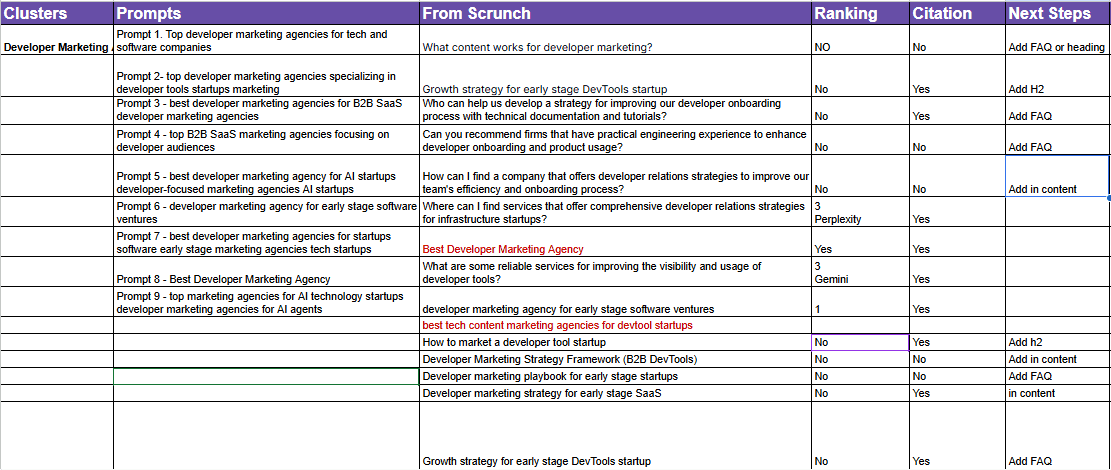
- As you can see in the image above, each prompt is mapped against ranking status, citation presence, cited page, and required next steps.
- If a prompt isn’t performing or generating citations, we plan the “Next Steps” for it. We decide whether to integrate it into existing headings like H2s, H3s, or FAQs, expand the section with deeper context, or build a dedicated page around it.
This structured prompt mapping has helped improve LLM visibility across clusters such as developer marketing, technical content, and product documentation by turning conversational queries into content architecture decisions. Once your team is producing prompt-mapped content at this scale, it's worth reading our breakdown of AI agent content strategy for B2B SaaS, which covers the frameworks for turning this kind of GEO workflow into a repeatable content pipeline.
The tracking sheet serves as a strategic control panel actively guiding content prioritization for GEO impact and most B2B SaaS startups are doing this to gain LLM visibility.
Example: A code review platform incorporated the prompts taken from platforms like Profound or Peec in its content. They replaced their H2s, H3s and FAQs with the prompts and soon saw a boost in their citations and overall AI visibility. Below is a snapshot of their organically boosted citations on the platform.
The GEO Funnel: Synthesis-Led Visibility
This funnel activates when buyers ask generative AI tools for guidance:
- “What’s the best DevOps automation platform for SaaS startups?”
- “What tools do Series A startups use?”
Flow: Prompt – AI Synthesizes Multiple Sources – Brand Mention / Citation – Shortlisting – Visit
In this model:
- AI doesn’t extract a snippet.
- It aggregates and reformulates.
- If your startup isn’t cited, you’re invisible.
GEO succeeds when your developer content is:
- Semantically comprehensive
- Structured in AI-readable blocks
- Authority-backed with data and proof
- Decision-oriented
AEO Vs GEO: Key Differences (2026)
Below is a comparison table that displays the key differences between geo vs voice search optimization.
| Aspect | AEO (Answer Engine Optimization) | GEO (Generative Engine Optimization) |
|---|---|---|
| Primary Goal | Win direct answers in AEO search results, such as featured snippets, People Also Ask, and AI Overviews | Influence AI-generated summaries and become a cited source in generative responses across LLM platforms |
| Best Use Case | Ideal when targeting high-intent, question-based queries that dominate the AEO vs GEO search landscape on Google | Best when buyers are asking AI tools for comparisons, alternatives, recommendations, or category overviews |
| Content Style | Answer-first, compact, snippet-extractable formatting with FAQ schema and structured markup aligned with answer engine optimization vs generative engine optimization principles | Semantically rich, context-driven, credibility-heavy content structured for synthesis and citation by AI models |
| Funnel Focus | Mid-to-bottom funnel users actively searching for specific product capabilities, integrations, or solutions | Mid-to-top funnel buyers are conducting research through AI assistants before visiting websites |
| Core Benefits | Improved SERP visibility, position-zero placements, stronger CTR, and exposure in voice-driven results (often debated in GEO vs voice search optimization) | Increased AI share of voice, higher brand mention frequency in ChatGPT/Gemini/Claude, referral traffic from LLMs, and stronger influence during evaluation |
When is AEO More Effective Than GEO for SaaS Startups?
AEO is more effective than GEO for B2B SaaS startups when your primary growth lever is getting high-intent, question-driven searches on SERP. If your buyers are still discovering and evaluating tools through the SERP, AEO wins the first click.
But how can AEO be more effective than GEO for B2B SaaS startups? It’s simple, if you’re:
- Targeting question-driven, snippet-friendly keywords and prompts: AEO performs best when your core queries start with what, how, why, which, or best and trigger featured snippets or People Also Ask results. Structured answers, concise definitions, and FAQ blocks help you capture these high-visibility SERP placements quickly.
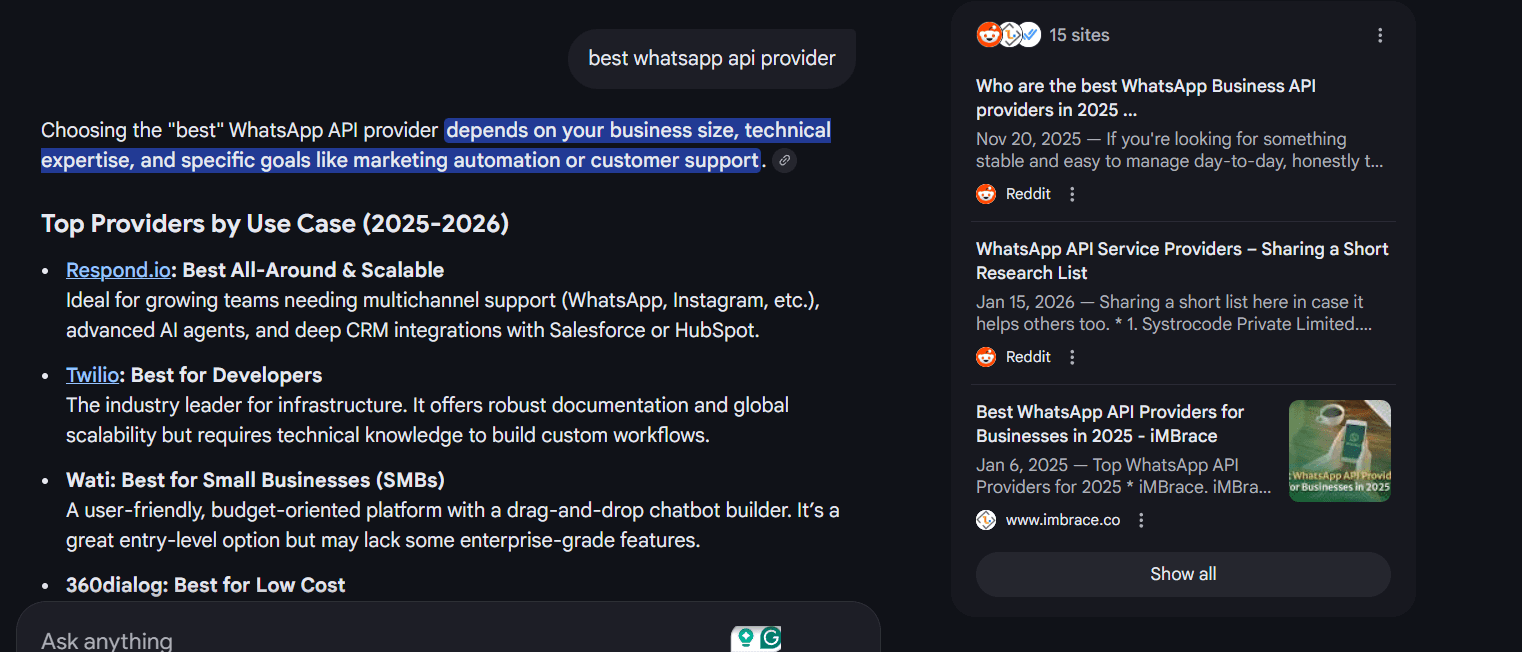
Example: An omnichannel inbox CRM for lead management platform incorporated prompts infused with high-intent keywords from Profound.ai into their threads. Next, they engaged with the cited threads on the prompts and created new engagement posts around the same prompts. This resulted in a spike from 4th to 1st within 1-2 months.
Take a look at the image below, which shows how the platform was ranking in ChatGPT for the prompt “Best whatsapp api provider.”
- Rank on page one, but CTR is underperforming: If you’re sitting in positions 4-10 and clicks are weak, AEO optimizations can unlock traffic fast. Improving titles, rewriting introductions, and adding snippet-ready answers often increase CTR without requiring a full GEO-focused content overhaul.
- Value proposition is clear: SaaS buyers skim search results. When your page delivers a sharp, immediate answer and clear positioning, Google is more likely to reward it with higher visibility.
- AI Visibility & Citation Tracking: AI Search Visibility Scores, mentions in LLM platforms like ChatGPT, Gemini, Claude, Perplextity, etc. AI sentiment analysis. Website and AI visibility audit.
Example: If you use AI visibility audit tools like Infrasity, you can do an audit of your website. Your LLM visibility audit will look like this:
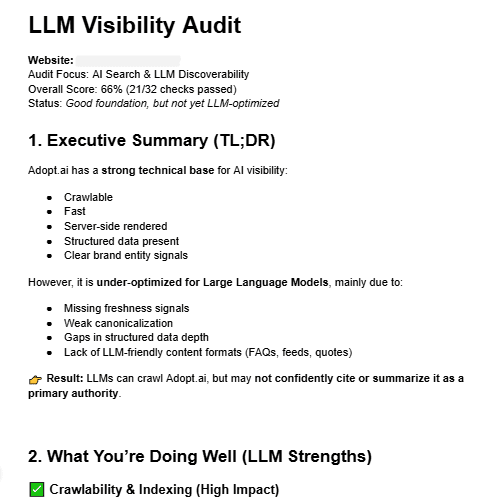
Once your LLM visibility audit is done and you are aware of your startup's gaps, feel free to apply the AEO and GEO practices mentioned in this blog. Finally, with the help of tools like app.infrasity, track the performance of your incorporated prompts and maintain them. If you're still building out your content research and drafting stack to act on these gaps, our roundup of content marketing tools for beginners is a useful starting point.
AEO vs GEO: Content Frameworks Explained
AEO and GEO require fundamentally different content architectures. One is built for extraction in search results, the other for synthesis and citation inside AI-generated responses.
Framework 1: Extraction-Optimized Content (AEO)
- Answer-first and compact: a clear takeaway per paragraph.
- Structured like Q&A: headings match real questions.
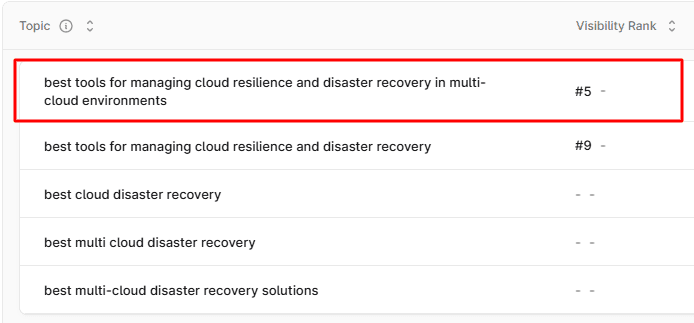
Example: Select any well-performing prompt from Scrunch, Profound, or Peec and incorporate it into the heading of your content. Adding these prompts for better visibility.
- Snippet-extractable: bullets, short lists, definitions.
- Schema-supported: FAQ, HowTo, Article markup
Framework 2: Synthesis-Optimized Content (GEO)
- Fresh: visibly updated within the last 6-12 months.
- Semantically rich: covers the topic and related subtopics.
- Credibility-heavy: stats, expert quotes, use cases.
- Decision-oriented: comparisons, pros/cons, deal-breaker FAQs
Best Strategy to Maximize Visibility Across Search and AI Platforms?
The best strategy to maximize your B2B SaaS startup’s visibility across all platforms is to combine AEO and GEO.
Together, they keep your startup visible across Google search snippets, voice assistants, and AI platforms like ChatGPT, Gemini, Claude, Perplexity, etc. AEO helps you win direct answers and featured placements on Google while GEO helps your developer content get cited, summarized, and recommended inside generative AI responses.
Because many of their tactics overlap, you can optimize once and benefit across multiple discovery channels. To optimize your content for both AEO and GEO, follow these:
How to Optimize for AEO + GEO Together?
Optimizing for AEO and GEO together means structuring content for direct answer extraction while building the semantic depth and credibility needed for AI citation.
Start with shared foundations like schema, answer-first formatting, and topical breadth, then use a dedicated GEO checklist to validate entity coverage, freshness signals, and citation readiness before publishing
1. Start with tactics that support both
- Use structured data (FAQ, HowTo, Article schema) so search engines and AI systems can extract answers cleanly.
- Write answer-first content. Lead with the direct response, then expand. Keep one core idea per paragraph.
- Support claims with credible sources, data points, and clear authorship to increase trust and retrieval likelihood.
2. Tactics that lean more toward AEO (Google snippets + voice search)
- Match natural, question-based queries with a conversational Q&A structure.
- Format key sections for featured snippets using bullets, tables, and concise definitions.
- Add FAQ blocks and FAQ schema targeting “what,” “how,” “why,” and “which” queries that trigger zero-click results.
3. Tactics that lean more toward GEO (AI citations + generative recommendations)
- Build depth and topical breadth so AI systems can synthesize complete answers from your page.
- Use semantic variation (entities, related concepts, synonyms) to strengthen contextual understanding.
- Keep content fresh with visible update dates and current examples.
- Monitor AI citations and refine sections that are frequently referenced
For a deeper, non-comparison-specific walkthrough of these tactics, see our guide on how to optimize content for AI search engines, which covers the same schema, freshness, and structure work in more detail.
Final Thoughts
The debate around AEO vs GEO is no longer theoretical, but it directly impacts how B2B SaaS companies acquire pipeline in 2026. As AI Overviews expand and conversational AI platforms shape buyer journeys, relying solely on traditional SEO leaves visibility gaps. This is why understanding answer engine optimization vs generative engine optimization allows growth teams to protect influence across both SERPs and AI-generated responses.
If AEO search helps you win featured snippets, voice-driven queries, and position-zero answers, GEO ensures your B2B SaaS startup appears inside AI-generated comparisons, recommendations, and evaluations. The real opportunity isn’t choosing between AEO vs GEO search, but integrating both into a unified content strategy. By structuring snippet-ready answers while building semantically rich, credible, and decision-oriented pages, your B2B SaaS early-stage startup can capture attention before competitors enter the conversation.
In 2026, discovery happens across search engines and generative engines alike. The startups that adapt early will own the conversational layer and the pipeline that comes with it.
Frequently Asked Questions
1. Is answer engine optimization and generative engine optimization same?
No. While they’re related, AEO vs GEO serve different discovery mechanisms. AEO focuses on structuring content so search engines can extract direct, concise answers for featured snippets, AI Overviews, and voice assistants. It optimizes for extraction. GEO, on the other hand, ensures content can be understood, synthesized, and cited by large language models (LLMs) such as ChatGPT, Gemini, or Claude. It optimizes for recommendation and citation.
2. How to optimize documentation for AI discovery?
To optimize documentation for AI discovery, structure it with clear headings, concise definitions, and schema markup to support extraction (AEO). Then add semantic depth, contextual examples, and updated references to improve synthesis and citation likelihood (GEO). Clean formatting, logical flow, and entity-rich language make documentation easier for both search engines and LLMs to interpret.
3. How to improve LLM visibility for my B2B SaaS startup?
Improving LLM visibility requires building semantically rich, credibility-heavy content that AI systems can confidently cite. Focus on topical depth, comparisons, use cases, and decision-oriented FAQs. Monitor AI mentions and refine frequently surfaced sections to strengthen your presence across generative search environments.
4. Top GEO optimization techniques for AI search visibility?
Top GEO techniques include expanding topical coverage with related entities and subtopics, adding credible statistics and expert-backed insights, maintaining fresh content with visible updates, and structuring content into digestible thematic blocks. These practices increase the likelihood of being referenced in AI-generated comparisons and summaries.