
TLDR
- Most LLM visibility analysis tools are good at showing what’s working in AI search: prompt coverage, rankings, citations, and competitors. The real challenge starts after the analysis, when teams need to turn insights into content that LLMs actually surface.
- LLM visibility analysis tools measure how often and in what context your B2B SaaS product is cited, recommended, or referenced in AI-generated answers instead of traditional search rankings.
- These tools track prompts across multiple AI models (ChatGPT, Perplexity, Gemini), recording brand mentions, citations, sentiment, and per-prompt ranking shifts.
- Key metrics include visibility score trends, relative share of voice, sentiment distribution, and prompt‐level rank movement, which reveal both strengths and gaps in AI search presence.
- Manual tracking is possible but doesn’t scale; modern tools automate prompt tracking, competitor benchmarking, and AI-specific insights historically unavailable in SEO tools.
- Winning in AI search requires not just visibility tools but also strategic technical content aligned with buyer intent, content that LLMs actually surface and cite in answers. This guide shows how to use both together, rather than stopping at dashboards.
We’re living in the first generation of AI discovery, where large language models or LLMs are the front door to information for millions of engineers, buyers, and decision-makers.
Recent data shows that AI search platforms now account for billions of interactions every month: for example, ChatGPT alone handles over 5.8 billion visits monthly in September 2025 and has 800 million weekly active users.
This is reshaping how products are discovered. Traditional SEO tells you where your web pages rank. But in an era when AI-generated summaries and zero-click answers influence over 13 % of all search queries and referral traffic converts significantly better than organic traffic, visibility requires citations inside AI answers, too.
For Growth Leads, VPs of Marketing, and Founders, the core question has shifted: are AI search engines aware of your product when buyers ask real evaluation-stage questions?
That’s where LLM visibility analysis tools come in. They let you measure and benchmark how your brand shows up in the new discovery layer, across ChatGPT, Perplexity, Gemini, and beyond, and help you bridge the gap between being indexed and being cited. In this blog, we’ll discuss the best LLM visibility tools in 2026 and what metrics you should use to get the best results. Let’s get started!
The Best AI Visibility Analysis Tools List
What is an LLM Visibility?
LLM visibility is how often and in what context your B2B SaaS startup is cited or referenced inside AI-generated answers. Instead of ranking on page one, you’re competing to be:
- Cited as a source
- Recommended as a tool
- Referenced as a category leader
- Included in “best of” AI responses
LLMs don’t crawl the way Google does. They synthesize across training data, live retrieval, and cited sources, which means visibility isn’t about indexing pages. If your product doesn’t appear in those outputs, you’re invisible to AI search.
What are the Metrics to look for in an LLM Visibility Analysis tool?
After running multiple AI visibility audits for B2B DevTools and infrastructure startups, one thing is clear: Most teams track visibility. High-performing teams track movement, sentiment, and prompt dominance. Teams that pair this measurement with a focused DevTools marketing strategy, covering content formats, community channels, and positioning, see their AI visibility gains compound significantly faster.
Here are the metrics we consistently rely on in Infrasity’s LLM visibility practice, explained with real examples:
1. AI Visibility Score
Your AI Visibility Score is a directional metric, so what’s important is the movement. In one of our customers’ LLM visibility increased by 10% after focused AI visibility work. That tells us that positioning, content, and prompt coverage are compounding correctly.
Good LLM visibility analysis tools show:
- Visibility score over time
- Changes tied to prompt clusters
- Correlation with content updates
AI models rarely show ten options. They usually surface two clear leaders and one alternative. In one category we analyzed:
- Leading startup A: 45% relative AI visibility
- Leading startup B: 40%
- All other competitors combined: 15%
This breakdown instantly answers critical questions:
- Are you seen as a category leader or a secondary option?
- Which competitor AI models associate you with most often?
- Who you actually need to beat in AI search
This is why some of the best competitor analysis tools for AI search LLM brand visibility always compare relative presence.
2. Sentiment Distribution Inside AI Mentions
Visibility without sentiment can hurt conversion. In the same analysis, sentiment inside AI-generated answers looked like this:
- 55-60% positive
- 30-35% neutral
- 10-15% negative
What we needed to focus on wasn’t the presence of negative mentions but exactly why they exist. In this case:
- Positive mentions highlighted identity-based access, unified control, and auditability
- Neutral mentions framed the product as powerful but situational
- Negative mentions focused on setup complexity and operational overhead
This tells growth teams exactly:
- Which strengths to reinforce
- Which objections need better onboarding, docs, or positioning
- What AI models repeat when buyers ask comparison questions
A solid LLM visibility analysis tool should clearly separate visibility from perception.
3. Per-Prompt AI Ranking Movement
This is the metric that experienced growth leads to the most trust. Instead of asking “Are we visible?”, we track:
“Did we move closer to #1 for buyer-intent prompts?”
In one anonymized report:
- Average AI ranking improved from 3.8 to 2.0
- That’s a 47% improvement in average position
Even more important were individual prompt wins like:
- “modern bastion host alternative” moved from mid-page to #1
- “alternative to a leading competitor” is now #1
- “secure infrastructure access platform” is now #1
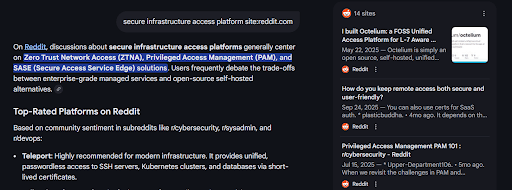
As shown in the image above, the prompts that we used for one of our customers moved to the 1st position as an answer to the query. These gaps are extremely valuable because they tell us:
- Where competitors still influence AI answers
- Which use cases aren’t clearly associated with the Devtool startup yet
- What prompt clusters deserve the next investment
These are not informational prompts but are evaluation and replacement queries. LLM visibility analysis tools must track per-prompt ranking over time.
How to Track LLM Visibility Manually (With Templates)
Before teams adopt an LLM visibility analysis tool, we often recommend manual tracking for one reason: It forces you to understand how AI systems actually respond to buyer intent.
Here’s how to do this:
Step 1: Build a Prompt Tracking Sheet
Start with prompts that map directly to evaluation-stage intent.
Example prompts for an infra or DevTools SaaS:
- “Best zero trust infrastructure access tool”
- “Alternative to [leading competitor]”
- “Modern bastion host alternative”
- “Infrastructure access without VPN”
Create a simple sheet with:
- Prompt
- AI model (ChatGPT, Google AI, Perplexity)
- Brand mentioned? (Yes/No)
- Ranking position
- Sentiment (Positive / Neutral / Negative)
This becomes your baseline.
Step 2: Check Relative Competitor Visibility
Run the same prompt across AI models and note which B2B SaaS startups repeatedly appear. In most categories, you’ll see:
- Two startups are consistently in the top positions
- One or two secondary mentions
- A long tail that never appears
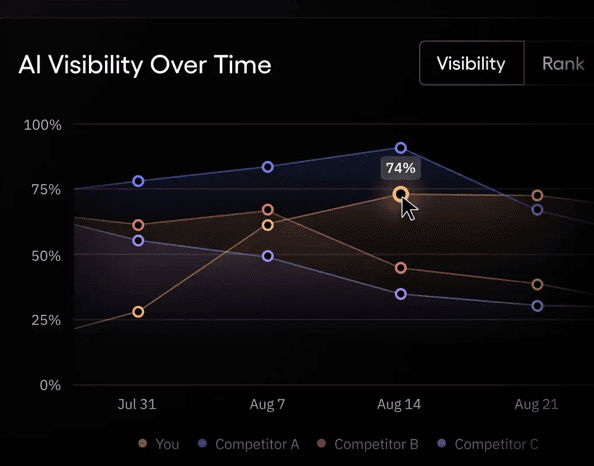
This tells you:
- Whether you’re perceived as a category leader
- Who AI systems compare you against by default
Manual tracking quickly reveals the relative share of voice, even without a tool.
Step 3: Track Sentiment Inside AI Answers
Visibility alone isn’t enough. For each mention, label sentiment:
- Positive (recommended, praised, clearly positioned)
- Neutral (listed, compared, contextual)
- Negative (flagged as complex, heavy, or overkill)
Step 4: Repeat Monthly and Track Movement
Run the same prompts every month. What’s important is the ranking movement:
- Moving from 4th to 2nd
- Moving from 2nd to 1st
Even a 1-2 position gain across high-intent prompts often signals a 30–50% improvement in AI visibility impact.
Step 5: Identify Coverage Gaps
Finally, flag prompts where:
- Competitors dominate
- Your startup doesn’t appear at all
These gaps define:
- What content to create next
- Which use cases does AI not associate with your B2B SaaS startup yet
- Where positioning needs tightening
6 Best LLM Visibility Analysis Tools for B2B SaaS DevTool Startups
Below are the best LLM visibility analysis tools currently used by growth teams.
1. Profound
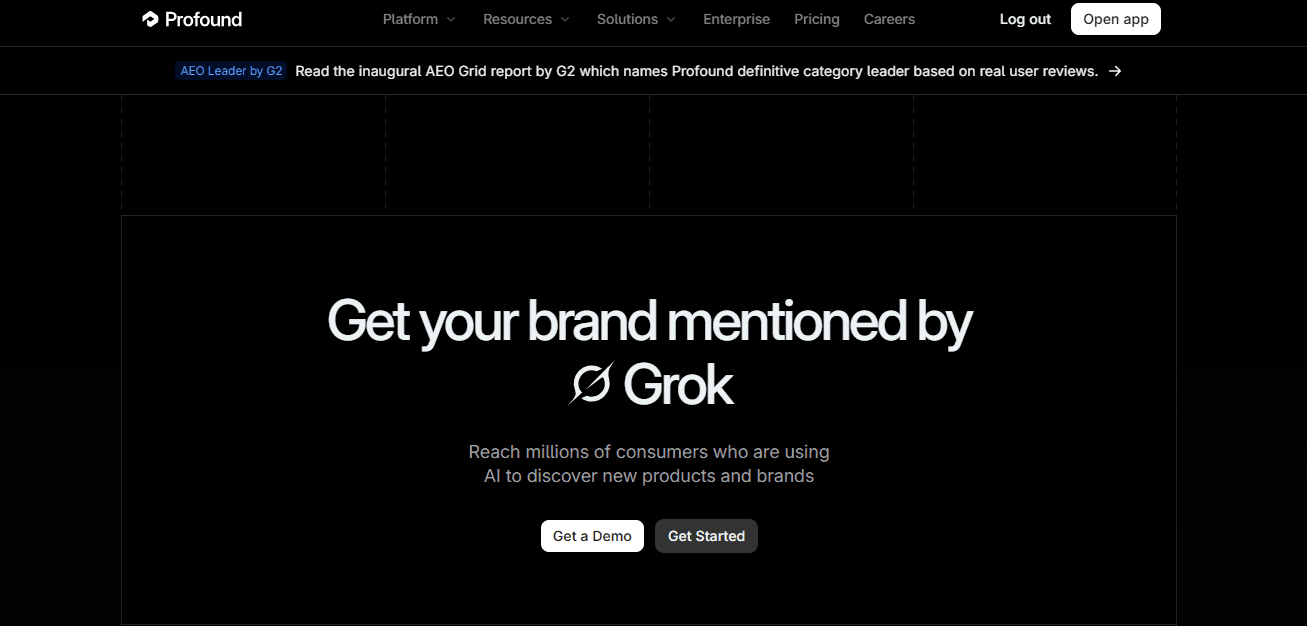
Profound is an AI SEO tracker and visibility platform that focuses heavily on AI search and Generative Engine Optimization (GEO). The platform is built primarily for established tech startups and enterprise scaling GTM efforts. Unlike most platforms that require you to manually define prompts, Profound blends elements of traditional SEO tools like Ahrefs and Semrush with AI visibility tracking.
It uses that data to surface high-intent prompts automatically. From a growth perspective, this is powerful because it expands visibility beyond obvious queries.
When you sign up, Profound runs an initial analysis of your website, but note that it does take time. Once the analysis completes, it walks you through an onboarding flow that suggests topics and AI search queries based on your site’s existing content. The recommendations were accurate and aligned well with how buyers would actually evaluate the product.
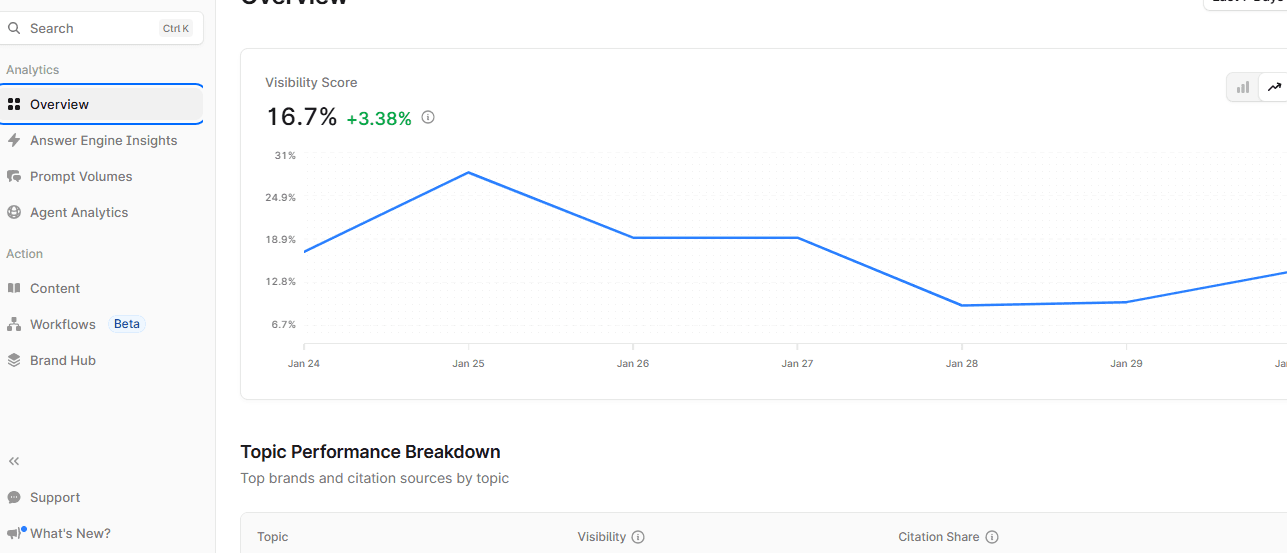
At this stage, the platform does restrict access. You’ll need to upgrade before you can see full data populate across AI models. The full Profound dashboard gives a comprehensive view of:
- AI search visibility
- Prompt-level performance
- Startupand competitor presence across AI-generated answers
Ease of use: Moderate
Best for: Established tech startups and enterprise teams
Features:
- AI prompt discovery via Conversion Explorer
- Startup and competitor AI visibility tracking
- Prompt-level performance analysis
Pricing: Starts at $99/month
2. Wellows
.png&w=3840&q=75)
Wellows is an AI Search Visibility Platform built for agencies, in-house SEO teams, and consultants who need to measure, diagnose, and improve how their brand appears inside AI-generated answers across ChatGPT, Perplexity, Gemini, Google AI Overviews, and Google AI Mode.
Its strongest point is the AI Content Optimization layer, — the industry's first cannibalization-aware decision engine. Before any content work begins, Wellows scans your entire domain, picks the single strongest existing page per prompt, and routes new-content opportunities to a creation workflow when no existing page qualifies. It then pulls 20–50 actually-cited competitor URLs per prompt to produce line-level gap recommendations, section by section. No other platform in this category prevents cannibalization at the decision stage rather than discovering it after the work is done.
.png&w=3840&q=75)
Beyond optimization, the Tracked Prompts dashboard shows you visibility score for each tracked prompt, which competitor URL is appearing, whether that appearance is explicit or implicit, citation sentiment, and which engine produced it, all in one row. The Industry Momentum Report adds a daily written competitive briefing naming specific competitors, topic movements, and priority actions, with no manual chart interpretation required.
.png&w=3840&q=75)
Ease of use: High — Tracked Prompts consolidates what most tools spread across three separate reports into a single filterable view
Best for: Agencies and in-house teams that need citation monitoring, content optimization decisions, and outreach workflow in one platform
Features:
- AI visibility tracking across all five supported engines
- Explicit vs implicit citation separation with different recommended actions per type
- Competitor URL per prompt across all engines in one view
- Citation Sentiment Distribution per prompt
- Performance History with daily citation gain/loss tracking
- Industry Momentum Report — daily written competitive briefing
- AI Content Optimization — cannibalization-aware decision engine with line-level gap analysis
- Outreach Engine with verified contacts, AI-written pitch emails, and full pipeline tracking
- Socials layer — Reddit, YouTube, Medium, Quora, Facebook as implicit citation targets
- Strategy calls on every plan (1 to 5 per month)
- API access and GSC integration on all plans
- Unlimited team seats and unlimited outreach on all plans
Pricing: 7-day free trial with no feature gating, then Lite, Essential, Starter, and Pro tiers — see wellows.com/pricing for current figures
3. Peec AI
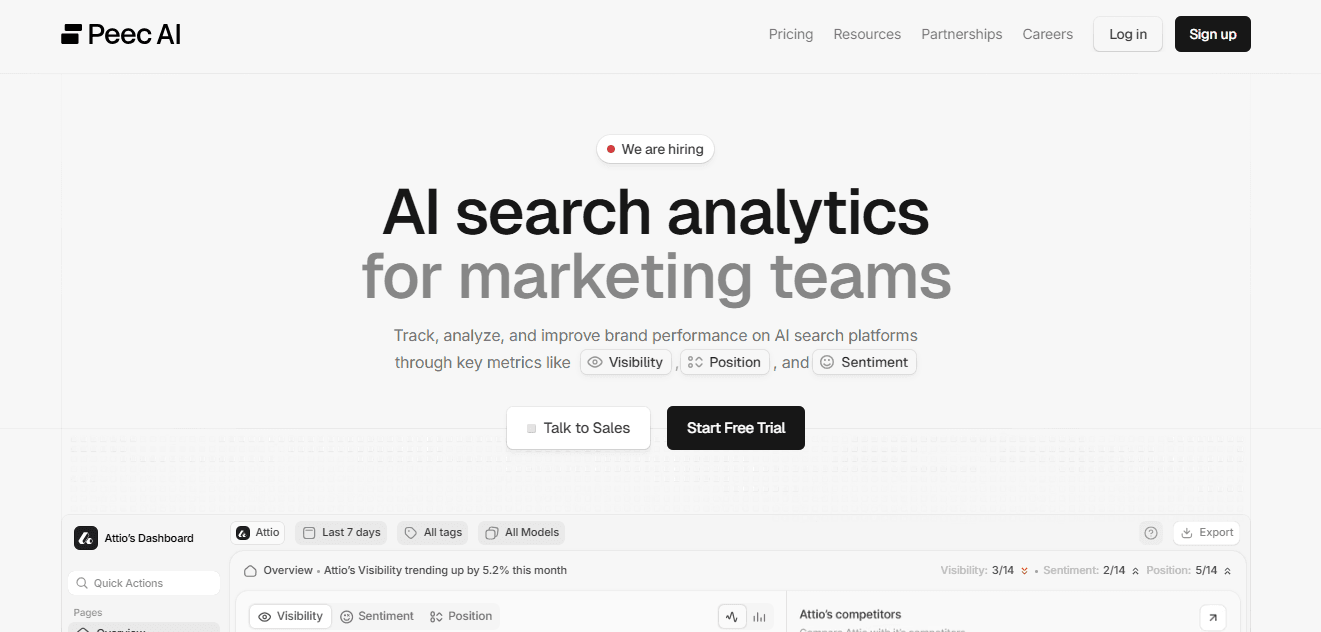
Peec AI is an LLM visibility analysis tool built for teams that want to monitor, benchmark, and improve how their product shows up in AI search. The platform is widely recommended among SEO agencies and in-house growth teams, so we decided to test it ourselves.
If your product is already being searched for, recommended, or compared in your category, Peec AI does a great job of showing where you stand inside LLMs and how competitors compare.
It positions itself as a tool to help teams “start winning in AI search.” and translates to surfacing current AI visibility first, then guiding teams on where improvements are needed.
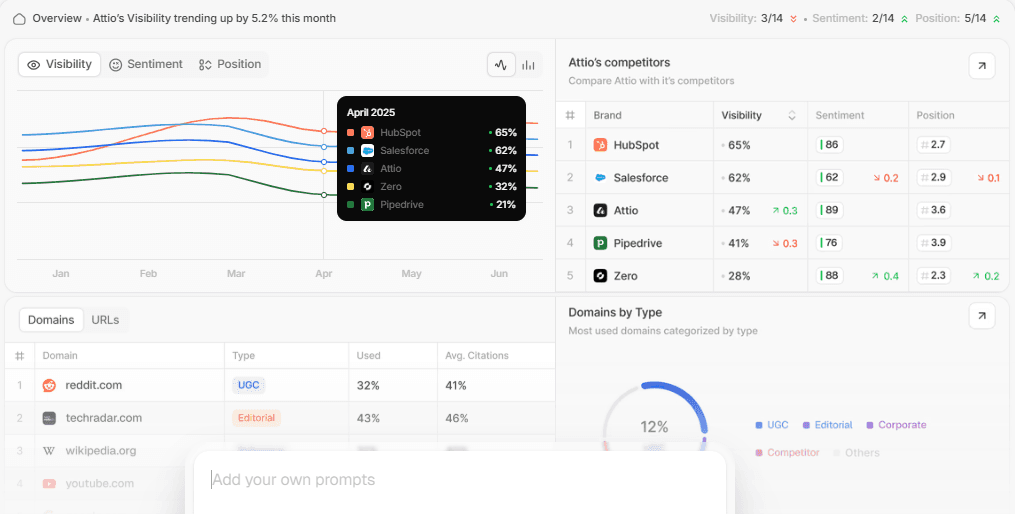
The onboarding experience is one of Peec AI’s strongest points. Once you input your website, Peec AI generates a free report showing your initial AI visibility. From there, starting the free 7-day trial unlocks the full platform experience.
After logging in, you land on a dashboard. In our tests, these were all familiar sites, startups and publishers that already rank for similar topics in traditional search. In the Prompts tab, Peec AI preloads prompt suggestions relevant to your site. Clicking into a prompt opens a detailed breakdown showing:
- Visibility score
- Brand mentions
- Citation sources
- Performance across AI models
This makes it easy to understand why your startup appears, or doesn’t. Where Peec AI really shines is competitor analysis.
When testing with a well-known B2B SaaS product, the data became far more insightful. The platform clearly showed:
- AI visibility score
- Prompts where the competitor appears
- Which sources recommend that product
Ease of use: High
Best for: B2B SaaS products with existing branded search
Features:
- AI prompt tracking and visibility monitoring
- Competitor benchmarking and comparison
AI source and citation analysis
Pricing: Free 7-day trial, then starts at €89/ month
4. Scrunch AI
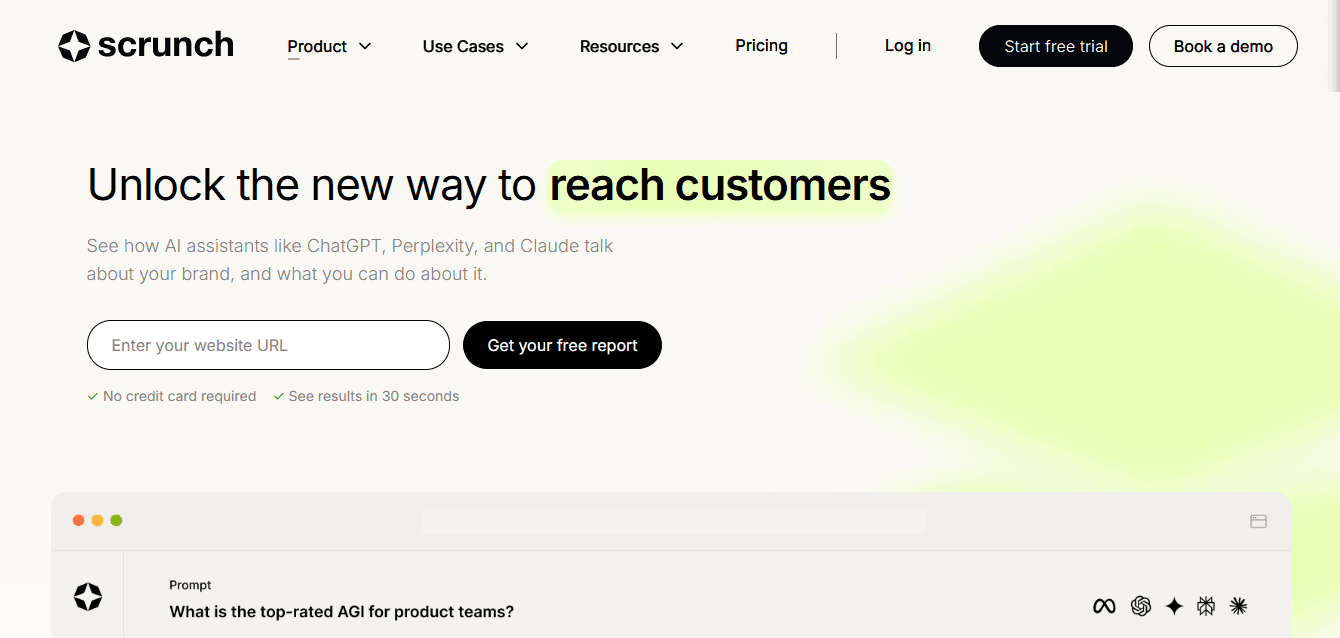
Scrunch AI is a startup monitoring and AI visibility platform designed to help teams understand how their website and content are being recommended across AI search engines like ChatGPT, Perplexity, and Google Gemini.
It’s a tool we’ve heard about repeatedly from people deep in the SEO space, which is usually a strong signal. That said, if you don’t know the reputation behind the product, the site alone might make you hesitate.
Scrunch AI shows how it’s clearly built with enterprise and mature GTM teams in mind. There is no self-serve signup like Peec AI, and the platform has a 7-day free trial. The core of Scrunch AI revolves around three main capabilities:
- Monitoring
- Insights
- AXP or AI Agent Experience Platform
This tool is best suited for teams that want more than dashboards. Many tools show data and stop there. Scrunch goes a step further by suggesting what to do with that data.
Ease of use: Moderate
Best for: Enterprise and mid-market B2B SaaS teams
Features:
- AI citation and visibility monitoring
- AI-driven content optimization insights
- AI Agent Experience Platform (beta)
Pricing: Starts at $100/month
5. Hall
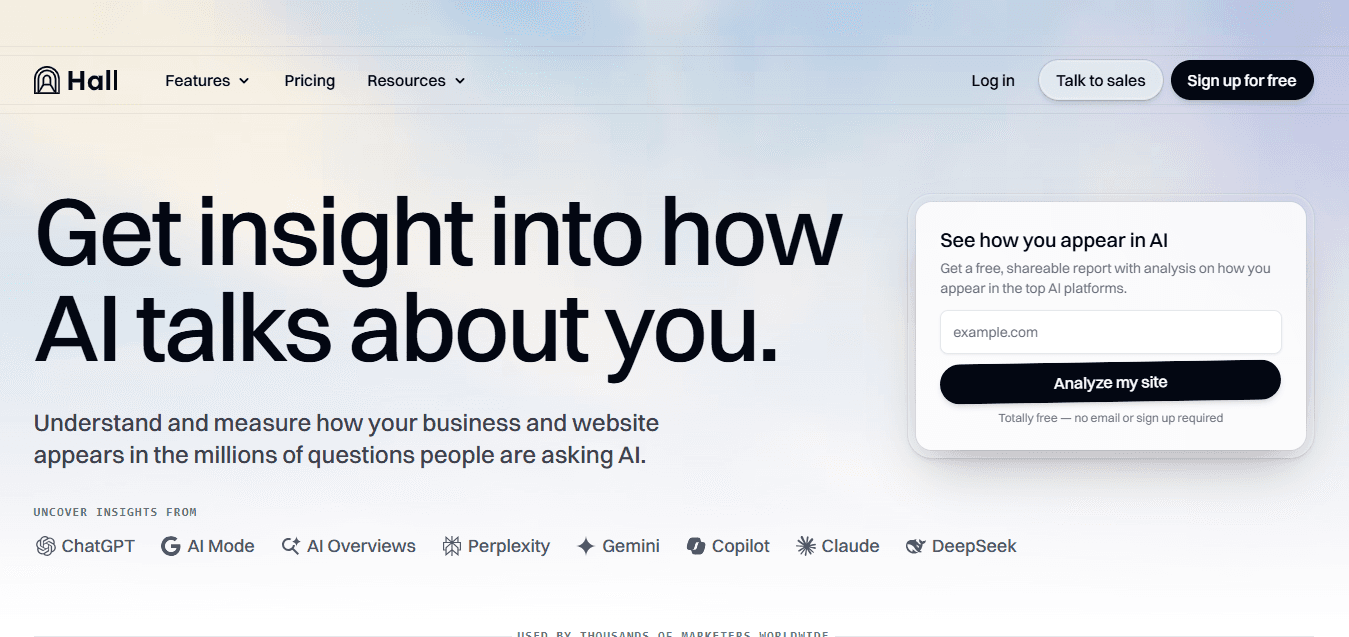
Hall positions itself as a Generative Engine Optimization (GEO) platform built specifically for AI search visibility. Hall is based in Sydney, Australia, and honestly, the first thing that stood out to me was the design. Clean, opinionated, and developer-friendly. Aussies tend to get UX right, so expectations were already high.
Once you enter your startup’s domain, Hall instantly generates a free AI search visibility report. This report is shareable and gives you an immediate snapshot of how your startup shows up in AI results. Along with that, it also surfaced competitors that actually made sense.
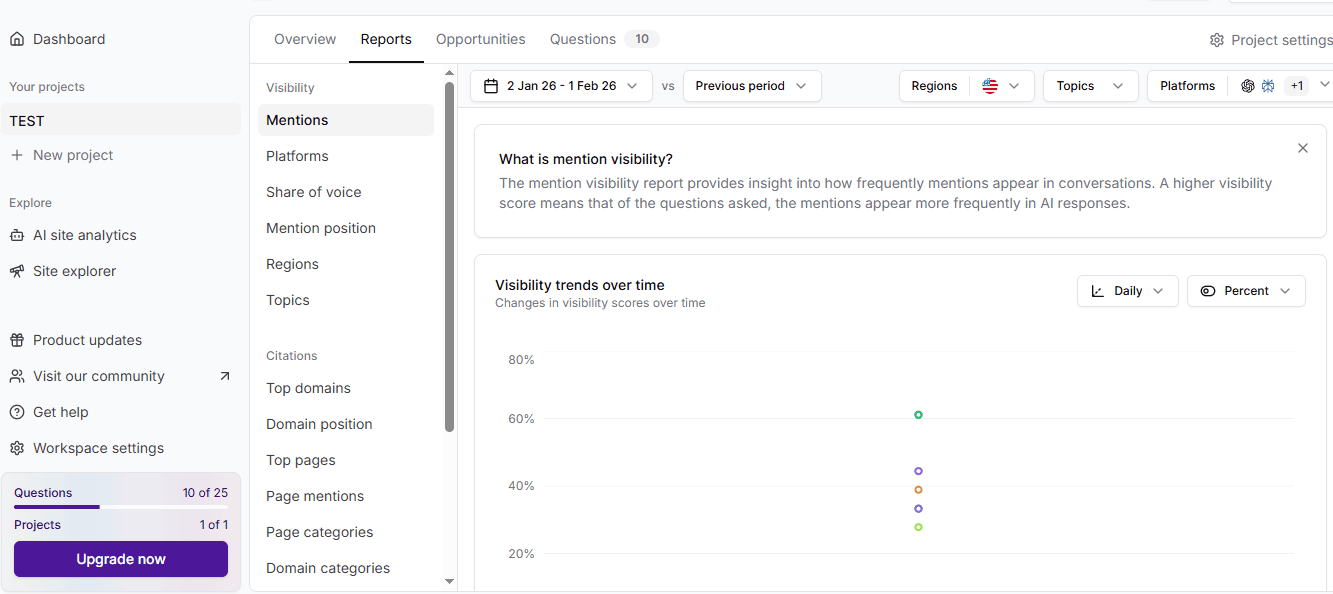
The above image shows, although this is a test project, if you enter your startup as a Project, and add the prompts, you should be able to see the results it's driving.
When you add a topic (essentially a keyword), it automatically generates relevant prompt templates and suggestions for AI tracking.
We tested this by adding just one topic: “AI marketing tools.” and this was the result shown.
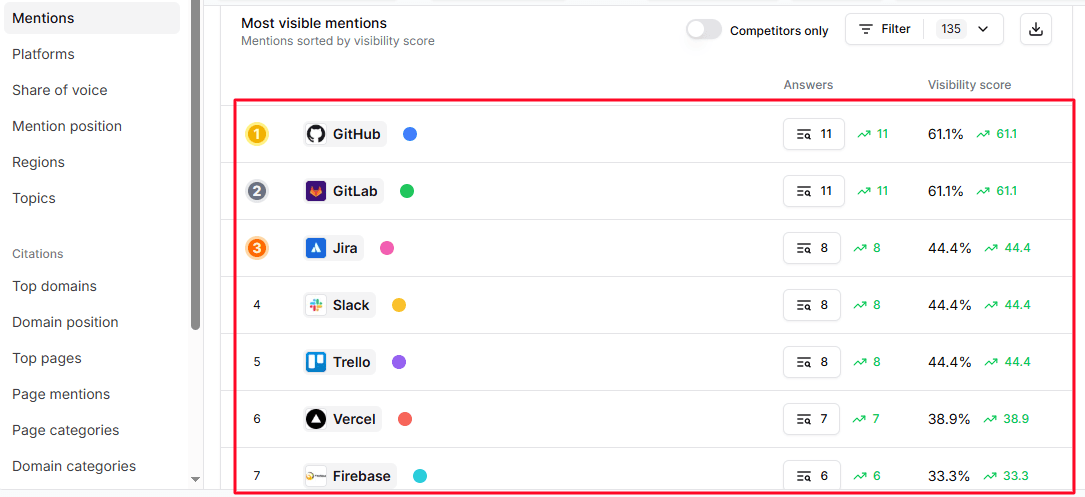
The tool surfaced:
- AI prompts related to that topic
- How those prompts perform across LLMs
- Whether our B2B SaaS startup appears in mentions or citations
All of this was available on the free plan.
Ease of use: High
Best for: B2B SaaS Startups
Features:
- Prompt monitoring
- LLM mention alerts
- Snapshot-based visibility reporting
Pricing: Starts at $239/ month
6. AthenaHQ
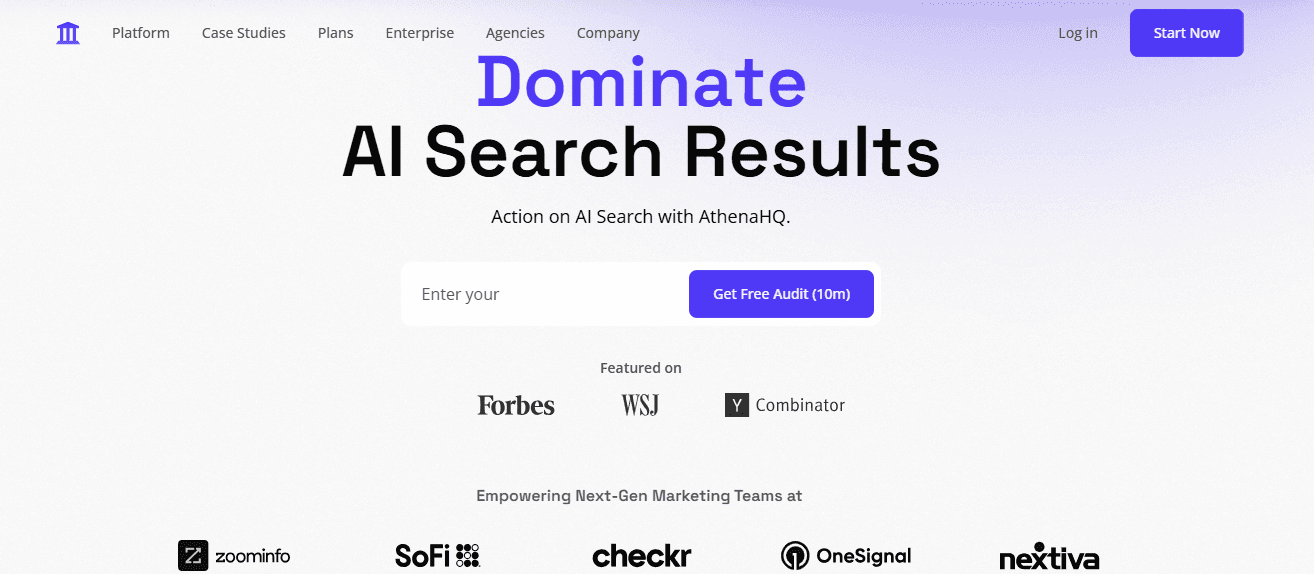
AthenaHQ is an AI-powered GEO and visibility tracking platform built to help teams understand how their startup appears in AI search, and how that visibility translates into real engagement and conversions.
Similar to Hall, the first thing that stood out was the website design. It’s modern, clean, and well thought out. During onboarding, AthenaHQ asks you to input your website details and add competitors. This is a smart move and something we haven’t seen consistently across other LLM visibility analysis tools. The platform even suggests competitors during this step, which helps teams frame their AI visibility in the right competitive context from day one.
Once setup is complete, AthenaHQ generates a free AI visibility report that you can share internally. This makes it easy to communicate early insights with stakeholders before committing further.
After the free report, you can create your full account. During signup, AthenaHQ continues to surface prompt ideas based on your site and competitive landscape, which shortens the time it takes to start meaningful tracking. Once fully loaded, the platform opens up a surprisingly comprehensive analytics suite.
Beyond AI visibility tracking, it includes web analytics features. The depth here genuinely stands out. For teams already running mature SEO or content programs, this makes AthenaHQ feel more like a full analytics layer.
Ease of use: High
Best for: SEO agencies and consultancy teams
Features:
- AI search visibility and GEO tracking
- Prompt discovery and analysis
- Comprehensive web analytics
- Conversion-focused visibility insights
Pricing: Starts at $95/month
What to Do After You Use an LLM Visibility Analysis Tool?
Now this is where most teams get stuck. LLM visibility analysis tools tell you what’s happening but they don’t fix it. So, this is what you do next.
First, you’ll identify prompt clusters where your citation rate is low or zero. They are the AI comprehension gaps.
Second, you’ll realize that existing blog content isn’t enough as LLMs prefer:
- Clear technical explanations
- Structured comparisons
- Authoritative developer-focused content
- Consistent positioning across sources
Third, feel free to use App.infrasity. Infrasity focuses on what happens after visibility analysis. Instead of just tracking prompts, Infrasity helps you:
- Create prompt-aligned technical content
- Structure content for AI retrieval
- Track how that content performs across AI search systems over time
- Monitor visibility changes by cluster, model, and category
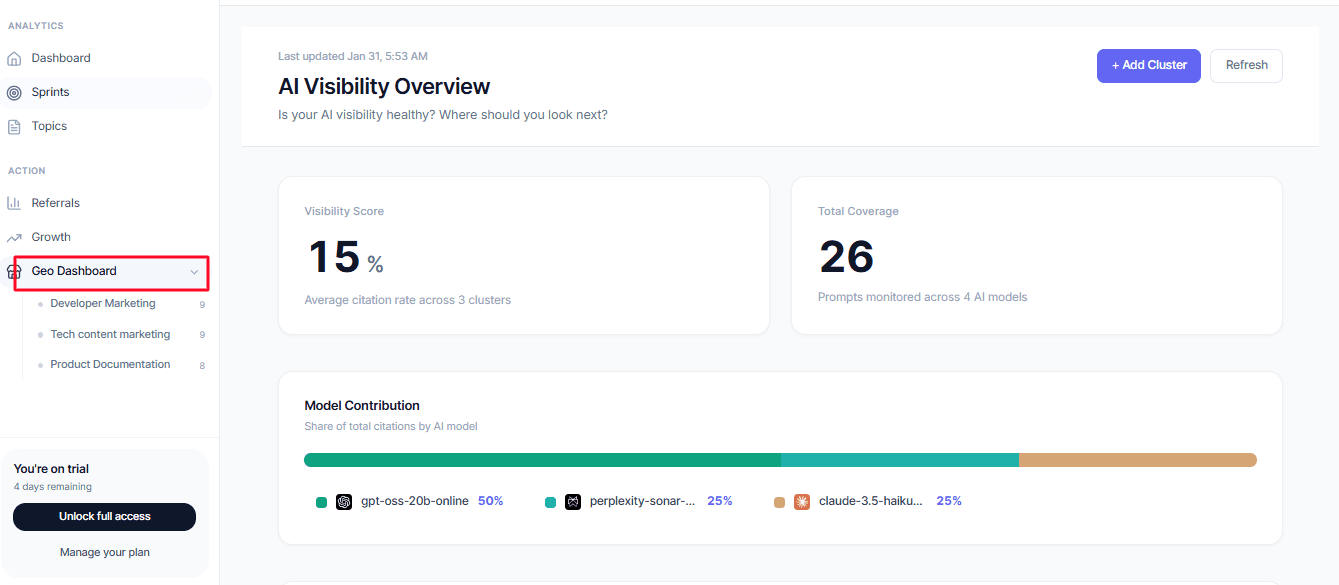
As shown in the image above, inside the app, in the GEO Dashboard, B2B SaaS teams can see:
- AI visibility overview (Visibility score and Total coverage)
- Citation rate by cluster
- Prompt coverage across ChatGPT, Perplexity, or Claude
- What changed week over week
Here’s how teams use Infrasity in practice.
Step 1: Take the prompts from your visibility tool
Start by exporting your priority prompts from tools like Profound, Peec AI, or Hall. These are usually:
- High-intent evaluation prompts
- Comparison and alternative queries
- Category-defining prompts where competitors dominate
Step 2: Upload prompts into Infrasity and group them into clusters
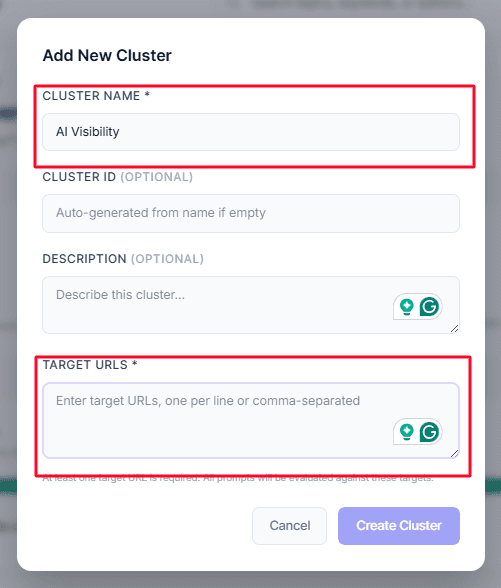
Inside App.infrasity’s GEO Dashboard prompts are organized into clusters based on buyer intent and use case (for example: “Developer Marketing,” “AI Visibility”).
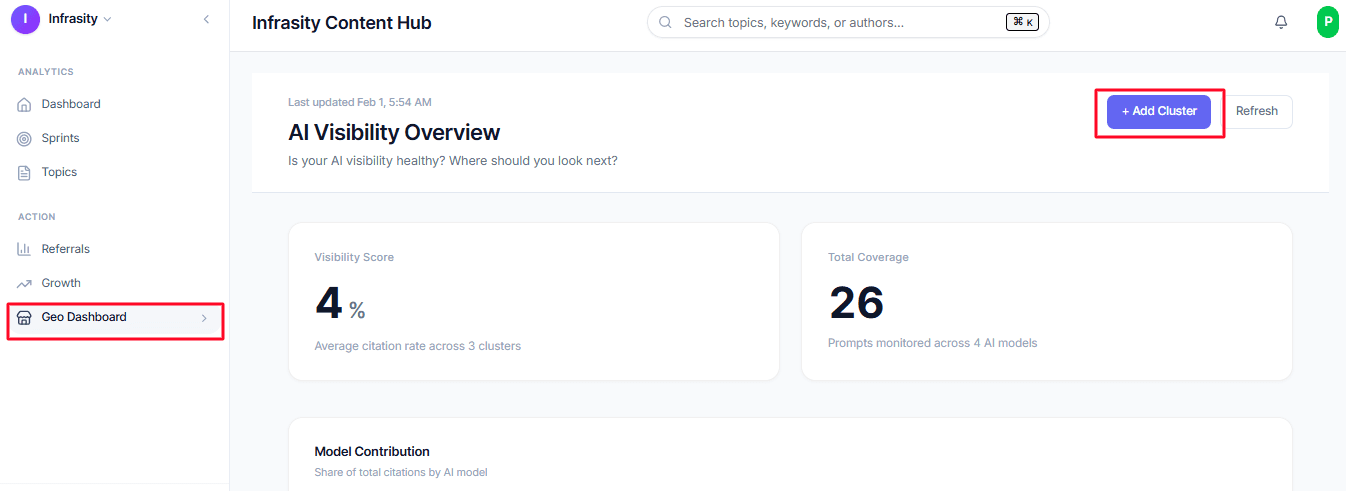
This is crucial because AI systems reason at the topic and concept level. Once your cluster is created, add your target URL(s) as shown in the image below and hit Create Cluster.
Step 3: Create prompt-aligned technical content
Infrasity helps teams produce developer-focused content mapped directly to each cluster. This includes:
- Clear technical explanations
- Structured comparisons
- Use-case-driven documentation
This is the type of content LLMs reliably retrieve and cite.
Step 4: Track visibility by cluster, model, and time
Instead of tracking isolated wins, Infrasity shows:
- Visibility score by cluster
- Citation rate across ChatGPT, Perplexity, and Claude
- Week-over-week changes per AI model
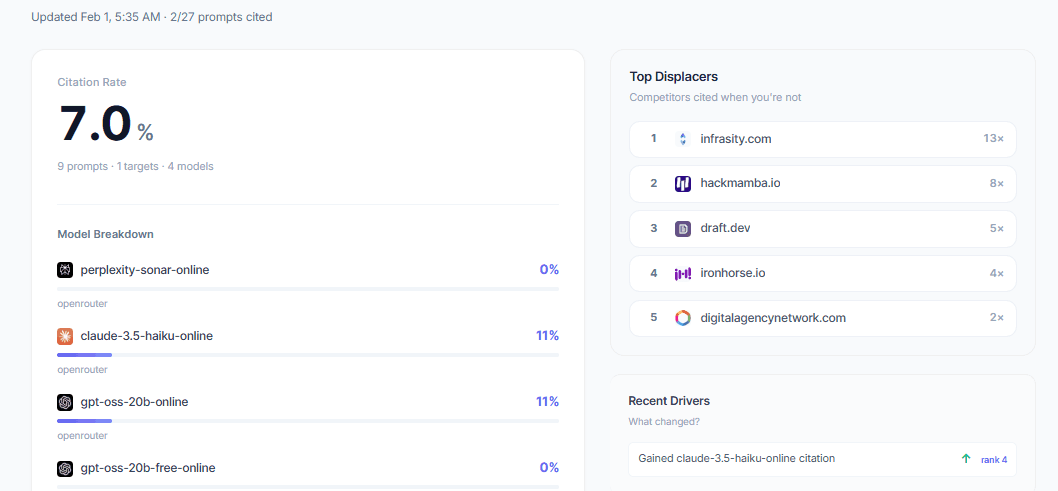
This closes the loop between analysis, content and measurable AI visibility gains. Most importantly, Infrasity is built for developer-focused B2B SaaS. That‘s important because AI models reward technical depth and shallow marketing content doesn’t get cited. LLM visibility tools show you the gap and Infrasity helps you systematically close it. That’s the difference between knowing and growing.
The Best LLM Visibility Analysis Tools at a Glance
| Tool | Best For | Core Strength |
|---|---|---|
| Profound | Enterprise startups | Startup narrative analysis |
| Wellows | Agencies and SEO teams managing AI visibility at scale | End-to-end platform: citation tracking, cannibalization-aware content optimization, and outreach in one workflow |
| Peec AI | B2B SaaS growth teams | Prompt-based citation tracking |
| Scrunch AI | SEO + AI visibility teams | Content performance insights |
| Hall | Startups | Simple visibility monitoring |
| AthenaHQ | Content-led teams | AI content analysis |
Final Thought: How to Show up in AI Search Engines
From everything we’ve seen working with B2B SaaS teams, it comes down to three things:
- Clear positioning AI can understand
- Consistent technical content tied to real buyer prompts
- Ongoing measurement using LLM visibility analysis tools
The tools covered in this guide help you understand where your startup stands today. They show which prompts you appear in, how competitors outrank you, and how AI systems currently describe your product. But visibility alone doesn’t create demand. Publishing that content across the top developer marketing channels, from GitHub and developer communities to Reddit and technical newsletters, is what turns AI citations into actual product discovery. For teams that want structured execution across both content production and distribution, a tech content marketing agency with engineering depth can close the gap between knowing where you stand and systematically improving it.
If your next question is what to actually do to improve those rankings, we’ve broken that down step by step in our guide on how to rank on ChatGPT, covering content structure, citations, prompt alignment, and technical depth that LLMs consistently reward.
AI search visibility compounds over time, just like SEO. The teams that win are the ones that start early, measure correctly, and execute consistently.
Frequently Asked Questions
1. What is the difference between LLM visibility analysis tools and AI SEO tools?
AI SEO tools typically focus on optimizing content for traditional search engines using AI.
LLM visibility analysis tools focus on how your B2B SaaS startup appears inside AI-generated answers themselves. They track prompts, citations, sentiment, and competitor mentions across LLMs like ChatGPT and Perplexity, areas that classic SEO tools don’t measure.
2. Can early-stage startups benefit from LLM visibility analysis tools?
Yes, but the use case is different. Early-stage teams should use LLM visibility analysis tools to identify which prompts they don’t show up in yet and which competitors dominate AI answers. This helps founders prioritize category positioning and content before early-stage startup narratives harden inside AI systems.
3. Are free LLM visibility analysis tools enough to get started?
Free plans can help teams understand baseline visibility, but they’re usually limited in prompt volume, history, and competitor analysis. For serious AI search growth, paid LLM visibility analysis tools are necessary to track trends, sentiment, and prompt clusters at scale.
4. How do LLM visibility analysis tools support the go-to-market strategy?
These tools act as early signal systems. They show how AI models describe your product, who they compare you against, and which use cases you “own” in AI search. Growth and GTM teams use this data to refine messaging, strengthen differentiation, and align content with how buyers actually discover products through AI.
5. What type of prompts should you track with LLM visibility analysis tools?
You should prioritize buyer-intent prompts, not informational ones.
The most valuable prompts usually include:
- “Best [category] tool”
- “[Competitor] alternative”
- “How to solve [problem] without [legacy approach]”
These prompts directly influence evaluation and vendor shortlists. LLM visibility analysis tools help you track where you appear in these conversations and how frequently AI systems associate your startup with the right use cases
6. Is LLM visibility something I need to care about right now?
If your buyers use ChatGPT, Perplexity, or Google AI to evaluate tools, then yes. AI answers are now part of the decision journey. LLM visibility analysis tools help you see whether your product even shows up when those evaluation questions are asked. If you’re not visible there, you’re being skipped early..