
TL;DR
- ChatGPT ranks content based on clarity, trustworthiness and originality.
- AI-first visibility is different from traditional SEO. ChatGPT and other generative platforms don’t index pages but they extract and reference content with clarity, structure, and trust signals.
- To know how to rank on ChatGPT, structured, benefit-driven, user-friendly content always wins. Clean formatting, clear headings, natural language, and outcome-focused value make your content more likely to be used as an answer.
- Build strong site architecture, internal linking, and semantic URLs. This helps AI and users understand the context and relationships between your content pieces, enhancing relevance and authority.
- Engagement, media richness, and reputation matter. Multimedia, interactive elements, correct metadata, and credible citations boost trust and improve chances of being surfaced.
- Technical performance and schema markup make a difference. Fast page speed, FAQ/Q&A markup, optimized images all contribute to better AI visibility and user experience.
ChatGPT has over 800 million weekly active users and sees 5.8 billion monthly visits as of 2026, and the platform is still exploding.
That kind of scale makes ChatGPT a thriving hub of activity, insight-seeking, and decision-making. Every day, users send over 2 billion prompts worldwide, and the AI remains the dominant player in generative AI with an estimated 81% market share.
For B2B SaaS startups, these numbers represent more than raw traffic; they represent a massive opportunity. Learning how to rank in ChatGPT search is essential for capturing early-stage attention, positioning your offering in front of high-intent professionals, and establishing credibility with potential users before they even land on traditional search engines.
But how to rank on ChatGPT? How does it work?
In this blog, we will discuss how to rank on ChatGPT and the best practices for seo enhancing AI visibility. This will ensure your content gets the attention it deserves. Let’s get started.
How Does ChatGPT Rank Websites?
82% of AI-generated answers reference content from a high-authority publisher. ChatGPT doesn’t technically “rank” pages the same way Google’s search algorithm does, but it still needs to select which information to surface. That selection process is influenced by similar content quality signals.
Large Language Models or LLMs like ChatGPT aim to provide the most accurate, clear, and credible answer to a user query in real time. Instead of crawling the web live, LLMs rely on knowledge distilled from training data and retrieval models such as Bing search or other browsing tools to determine what makes the cut.
To make it simple, think of it this way:
- Google evaluates pages with an algorithm
- ChatGPT evaluates information for usefulness and trust
Understanding How ChatGPT Generates Responses
Before trying to rank on ChatGPT, it’s important to understand how the system actually produces answers.
ChatGPT does not crawl the web in real time as Google does. When your user asks a question, the model generates a response based on patterns, facts, and structures it learned during training. That training includes large volumes of publicly available, high-trust content, such as:
- Editorial blogs and long-form articles
- Wikipedia and other encyclopedic resources
- Research papers, documentation, and technical guides
- Product reviews, comparison pages, and FAQs
- Community platforms like Reddit and Stack Overflow
Instead of pulling a “fresh” page every time, ChatGPT recalls how reliable information on a topic is typically written, its structure, clarity, depth, and framing.
This is why some early-stage B2B SaaS startups consistently show up in AI answers while others don’t. Content that mirrors trusted formats and explains concepts clearly is far easier for LLMs to reuse when answering user prompts.
What ChatGPT Tends to Lean On?
When choosing what information to surface, ChatGPT consistently favors content that is easy to extract, validate, and trust.
Based on observed patterns, AI-generated answers rely more heavily on:
- Clear, well-structured writing with logical headings
- Pages that provide strong semantic context through internal linking
- In-depth explanations that fully answer questions, not surface-level summaries
- Sources with established domain authority, visibility, and reputation
If your developer content is vague, fragmented, or lacks contextual signals, it becomes harder for LLMs to confidently reuse it. On the other hand, structured pages that explain the “what,” “why,” and “how” in a single place are far more likely to be referenced verbatim.
Key Benefits of Ranking on ChatGPT
Optimizing for ChatGPT visibility isn’t just about traffic. It’s about where and how buying decisions increasingly start. Here’s why appearing in ChatGPT responses matters, especially for B2B SaaS startups:
- No ads, no pay-to-play: Unlike Google, ChatGPT answers are not dominated by sponsored placements. This gives high-quality content a real opportunity to surface based purely on usefulness.
- Stronger perceived authority: When ChatGPT references your product or content, users interpret it as a trusted recommendation. AI-cited Devtool startups often feel more credible than standard search results.
- Context-aware discovery: ChatGPT builds on previous questions in a conversation. This means your developer content can show up across multiple stages of a buyer’s journey, not just a single query.
- Faster decision-making: Users get direct, condensed answers without navigating multiple tabs. Startups that structure content for clarity become the default reference point.
- Privacy-aligned experience: With fewer tracking and ad-based incentives, AI platforms feel more neutral and user-focused, an environment where trust matters more than aggressive marketing.
- Early-mover advantage: Very few B2B SaaS startups are actively optimizing for AI visibility today. Startups that do so now can establish long-term dominance before competition increases.
B2B SaaS startups that appear in ChatGPT responses often see higher-intent visitors and stronger conversion rates than traditional search traffic, because users arrive with context, trust, and clearer intent.
Best Practices to Rank on ChatGPT
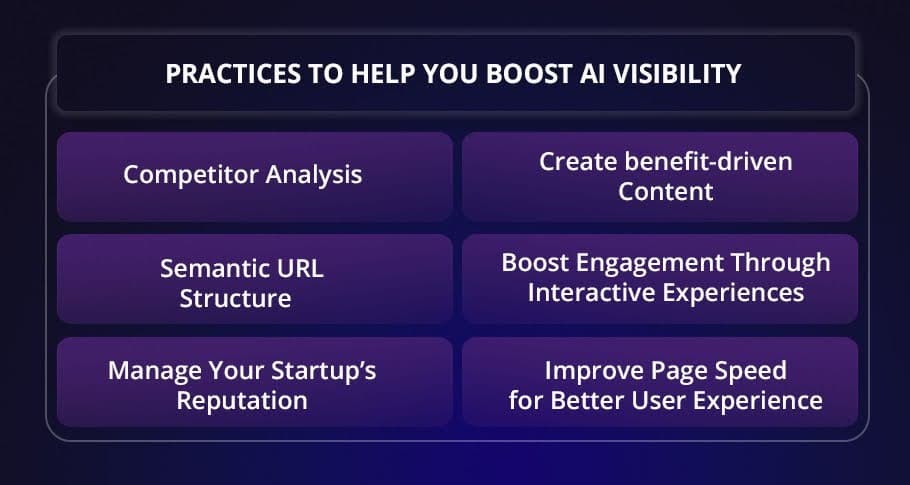
Generative Engine Optimization platforms like ChatGPT select content based on how easily they can extract, validate, and trust the information. Let’s take a look at some of the AI optimization best practices for visibility products to help your content become the best possible answer an LLM can choose.
1. Competitor Analysis
Competitor analysis is the first step and is one of the best ways for AI optimization best practices for visibility products. Always start with extensive research on your competitors because to claim a space in AI discovery, you need to know who’s already there and outwork them. You can start by:
- Start by auditing which competitors show up when people ask for examples, “best developer marketing agency”, “top onboarding tools”, and analyse what those competitors offer. If they offer features like use cases or questions, they answer.
- Then build content that fills the gaps. Answer questions your competitors skip, or provide deeper, updated, more helpful content. This positions you as a go-to reference.
This has always proven to work because LLMs and AI-powered search prioritize completeness, depth, and relevance. If your content is more thorough and answers edge-case questions, offering up-to-date benefits, it’s more likely to be extracted and recommended.
Example: Zendesk built broader customer service education hubs, including FAQs and troubleshooting libraries, hence outperforming rivals where they lacked detail. This expanded authority helps generative engines select it more frequently as a top recommended tool.
2. Create benefit-driven Content
If you have worked on SEO, you might have realised how just writing content doesn’t guarantee visibility on SERP. The content needs to follow a certain format. Similarly, to rhow to rank in ChatGPT search, you need to follow a certain format so that it drives your benefit.
Content Structure & Readability:
- Keep the paragraphs to 3-4 lines only.
- Long paragraphs are hard to read.
- Use clear hierarchical structure H1>H2>H3>H4>H5 with logical subsections.
- Use bullet points, numbered lists, and tables especially for specs or comparisons.
Following this is important because structured, scannable content makes extraction easier, whne it comes to learning how to rank on ChatGPT. Whether it's a human reader or a model scraping for relevant answers, organization helps. Many schema / SEO-best-practice guides also emphasize that structured markup + clear on-page structure improve crawlability, indexing, and user experience.
Example: LeadFormIQ, a sales pipeline automation platform’s content was dense, technical, and feature-focused, meaning users (and AI) struggled to understand why it mattered. They restructured content into:
- shorter paragraphs
- H2/H3 question headings
- before-and-after benefit examples
- bullet-style feature-to-value mapping
This resulted in their bounce rate dropping and AI-tools started referencing the product for benefit-based use cases like “increase sales team efficiency”.
Natural Language Processing
To surface in AI-powered answers, you must speak the language of your users.
- Use conversational, question-style headings and subheadings, for example, “How to integrate our CRM with Slack?” or “What’s the fastest way to onboard remote teams?”
- Include synonyms, alternative phrasings, and natural language variants of key ideas.
- Focus on intent-first writing and answer real pain points and common questions, without any fluff.
Example: SecureAPI discovered that dev teams often ask natural questions like: “How do I stop token leakage in staging?”
Their content lacked those real-phrased queries. So they added Q&A-style subheadings, conversational paragraphs, and synonym + intent keyword variants
Their docs started getting cited in ChatGPT responses related to “API token security best practices.” This worked because LLMs match real user phrasing and not what marketing teams wish users searched for. Keeping technical documentation citation-ready is easier with a structured review, such as using Claude skills to audit API documentation quality instead of relying on ad hoc checks.
Effective Use of Keywords
Place your main target keyword in the Title Tag, H1, and the first paragraph.
- Use semantic keywords naturally through the text, but avoid keyword stuffing.
- Group content into meaningful clusters around themes such as use-cases, pain points, and solutions, rather than isolated articles.
Product Title Length
Too-long titles are not optimal for SEO. This is why the titles must be front-loaded with the most important product attributes. Optimize the product title length to be concise yet descriptive. Aim for 70-100 characters for maximum visibility and impact in search results.
3. Semantic URL Structure
URLs should clearly reflect page content. Semantic URLs help both search engines and AI tools understand context. You should:
- Use clean, human-readable URLs containing primary keywords and content context (e.g. /security/remote-team-phishing-protection rather than /product?id=1234&type=features).
- Use the focus or primary keyword in the URL.
- Ensure URL hierarchy reflects content organization, for example, top-level topic to subtopic/use-case to detailed article.
This will work as structured URLs give a clear context and it reinforces content hierarchy and topic relevance. This clarity helps indexing engines and AI-driven tools establish “what this page is about” quickly. The adoption of schema and structured content across many websites supports that semantic clarity improves discoverability.
4. Boost Engagement Through Interactive Experiences
Internal Linking
Internal linking distributes “authority” across your site, helps search engines and AI tools understand topical relationships, and keeps users exploring, improving engagement metrics. Better engagement signals often correlate with higher rankings or increased AI referral rates. Interlinking boosts site architecture and user journey, so make sure to interlink, especially the product page(s).
Multimedia content
Combining visuals, charts, videos, or infographics with structured content gives you an edge. In your content, you should include diagrams, screenshots, flowcharts, or explainer videos when explaining processes, etc.
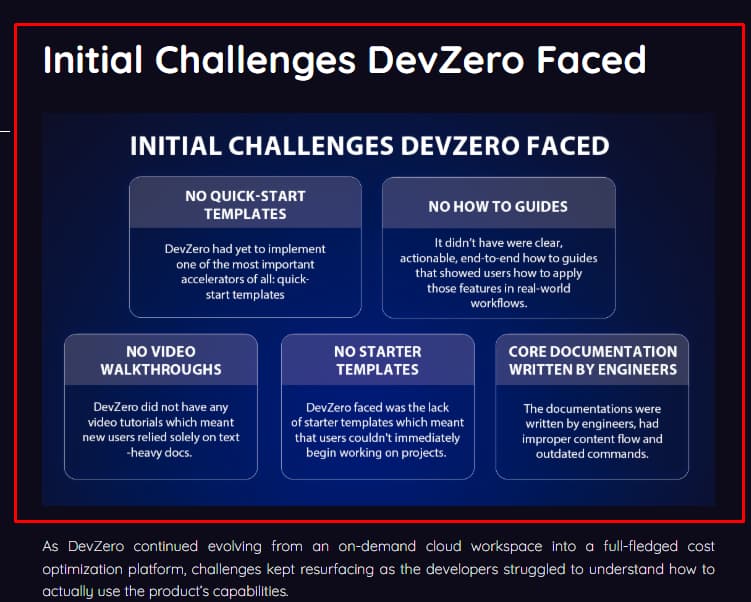
- Use optimized, and descriptive filenames so the context is clear even if the image fails to render.
- Where relevant, supplement content with downloadable assets like templates, sample files, and checklists for deeper engagement.
This works because rich media significantly improves user experience, retention, and engagement, all signals that indicate value. For generative engines like ChatGPT, well-labelled media with alt-text or captions can supply richer context and make your content more usable.
Example: Userpilot uses annotated interface visuals in onboarding guides, improving clarity and keeping visitors engaged longer, which reinforces credibility signals.
Once content is published, distribute it on industry-specific platforms, social communities, and SaaS directories. For example, for a developer marketing topic, distributing the content in developer-centric communities like Devto or Daily.dev will be ideal.
The image below shows how distributing content helped Infrasity rank in ChatGPT.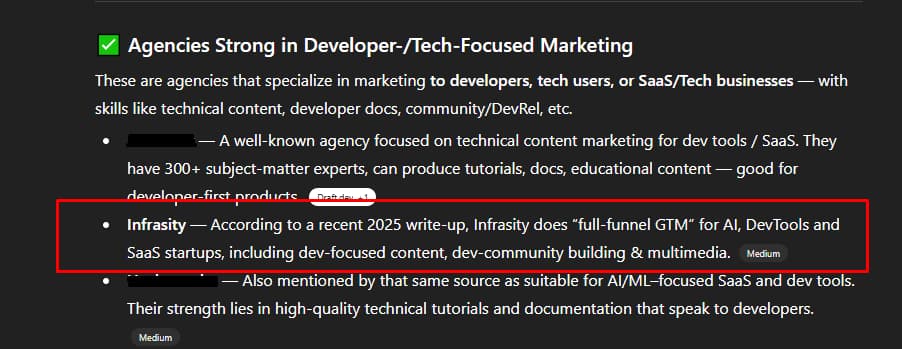
Strong calls to action
Once AI surfaces your content, you want to capture visitors' interest. Including CTAs in your content is crucial because it captures user intent at its peak. When the user has just consumed valuable content and is likely to act. Good conversion metrics reinforce to AI and search engines that your site is valuable, trustworthy, and relevant. This increases the chances your content will continue being surfaced.
You should:
- Include clear, action-oriented CTAs such as “Start Free Trial,” “Download Template,” or “See Demo” close to content that answers a question or solves a pain point.
- Use language that reflects user value, for example, “Get onboarding in 5 minutes”, or “Download compliance checklist”.
- Make sure CTAs are logically placed, for example, after describing a benefit or use case, or next to a downloadable resource
5. Manage Your Startup’s Reputation
Trust/Citation
When AI references a source, it looks for credibility. Mistakes, unverified claims or outdated info can undermine trust, which is one reason it helps to know how to identify AI-generated content that reads as generic or unedited before it ships under your brand. Citation improves site trustworthiness, which is a major ranking factor.
Data from trusted sources signals help AI understand that your content is legitimate and reliable. Without them, even the best-written content may be ignored or misinterpreted.
- Try adding site-credible sources like studies, whitepapers, trusted third-party reviews, or official documentation. If possible, add real case studies or customer stories demonstrating your product’s impact as well.
- Maintain factual accuracy, especially in spec tables, statistics, or performance claims.
6. Improve Page Speed for Better User Experience
FAQ/Q&A Markup
People and AI love direct answers, and adding an FAQ and a QA section makes it easier for AI platforms like ChatGPT to extract and reuse content. Structured Q&A helps AI engines quickly parse question-to-answer pairs. This increases the chances your content will be used verbatim in generative responses, knowledge panels, or answer snippets. Modern SEO/GEO resources recommend this as a core part of AI-search optimization.
Try to implement:
- FAQ Page or QAPage Schema for all questions and answers within the blog post for rich results. This is essential for improved SERP visibility and AI/Voice recognition
Image Optimization
Well-optimized images contribute to better UX, faster load times, and more semantic clarity, all of which improve site credibility and the likelihood of AI referencing your content. Visual elements make your content richer and more usable. Use relevant and high-quality images, screenshots or diagrams.
7. Build Topical Authority Over Time
Ranking in ChatGPT is not about shipping a single high-performing blog and hoping it gets picked up. Generative engines reward depth, consistency, and repeated expertise signals. LLMs learn patterns, not one-off pages. The stronger and more coherent your coverage of a topic, the more likely your content is to be trusted and reused in AI-generated answers.
Publish Around Topic Clusters, Not Isolated Posts
Start by identifying a core topic that maps directly to your product or ICP (for example, “AI search visibility for B2B SaaS”). Create a comprehensive pillar page that explains the concept end-to-end, then support it with focused subpages that address specific questions and use cases, such as:
- How ChatGPT surfaces B2B SaaS tools
- AI-first SEO vs traditional SEO
- Best practices for how to structure content for LLMs
When these pages are intentionally structured and interlinked, they form a clear topical cluster. This makes it easier for AI systems and search engines to understand what your site is an authority on and how individual pieces relate to the broader subject.
Strengthen Context Through Internal Linking
Internal linking is more than navigation; it provides semantic context. Link supporting articles back to the pillar page and cross-link related subtopics using descriptive anchor text that reflects real user intent. This reinforces topical relevance, improves crawlability, and helps LLMs recognize logical relationships across your content ecosystem.
Publish Consistently to Signal Ongoing Expertise
Topical authority is cumulative. Publishing consistently on related themes, weekly or biweekly, depending on resources, creates a pattern of expertise over time. For generative engines, this consistency signals that your site is not just referencing a topic, but actively contributing knowledge within it.
Reinforce Authority With Third-Party Citations
AI systems heavily favor sources that are validated beyond their own domains. Being cited in industry roundups, comparison articles, expert panels, or reputable publications strengthens your authority signals and increases the likelihood of your brand appearing in AI-generated responses.
To increase your chances of being cited:
- Identify industry publications and platforms that regularly publish “best tools,” expert commentary, or trend analysis.
- Personalize outreach to editors or contributors by explaining how your expertise adds value to their audience.
- Contribute differentiated insights, original data, or practical frameworks rather than promotional copy.
When your expertise is reinforced both on-site and across trusted third-party sources, you create a strong authority signal that benefits both SERP rankings and LLM visibility.
Infrasity’s Proven Results in AI Search
Infrasity has helped B2B SaaS early-stage startups optimize for GEO and win prime ranking positions inside LLM responses. Our framework blends AI-first content strategy, LLM-specific metadata, and schema optimization to make your product the most quotable and most trustworthy answer for user queries.
We’re already dominating competitive AI-based search results. For example, for the keyword “developer marketing agency”, Infraisty is ranked #2 on ChatGPT for the query “best developer marketing agency”.
Conclusion: What is the Future of AI Search?
In this era, being seen on AI platforms like ChatGPT has become essential for B2B SaaS startups. GEO is about visibility, credibility and conversion. A well-structured content that delivers high trust signals, clear use-cases, and benefit-first messaging helps decision-makers assess value quickly.
This, combined with internal linking, clean URLs, optimized media, and strong calls-to-action, leads not only to traffic but also to qualified leads, demos, and conversions.
Frequently Asked Questions
1. How do we measure success with AI-driven content?
Since traditional ranking metrics don’t apply directly, track referral traffic from AI-driven sources, engagement time on pages, conversion rates from content pages, and backlinks' share growth as social proof, which helps in AI credibility. Over time, you’ll also see whether AI referrals result in demo signups, trials, or customer inquiries and that’s the real ROI.
2. Does SEO still help rank on ChatGPT?
Yes, but differently. Instead of just keyword stuffing, semantic SEO and E-E-A-T signals (expertise and trust) help LLMs understand context. Strong internal linking and schema markup further enhance AI visibility.
3. What type of content ranks best in ChatGPT?
Content that answers questions clearly: FAQs, product comparisons, tutorials, and data-backed insights. User intent and accuracy matter more than keyword volume when it comes to understand how to rank on ChatGPT.
4. How long does it take to rank on ChatGPT?
Results vary depending on domain authority and content improvements. B2B SaaS startups that fix structure, trust, and clarity often see faster inclusion in AI-generated responses than in traditional SEO ranking shifts.