
For most of the last year, the marketing and growth leaders we worked with shared the same story. A buyer opens ChatGPT or Claude, asks for the best tool in a category, reads the answer, copies the two or three names it recommends, and starts a shortlist. No click. No visit. If a tool or platform is not inside that answer, it never enters the evaluation at all.
And that's the exact issue an LLM SEO agency exists to solve. Traditional SEO earns a ranking in a list of links. LLM SEO (also called generative engine optimization or answer engine optimization) earns a citation and a recommendation inside the AI answer itself, across ChatGPT, Perplexity, Google AI Overviews, Gemini, and Claude.
The skills somewhat overlap, but the targets, tactics, and measurement are entirely different, and a large share of agencies have simply renamed an old service.
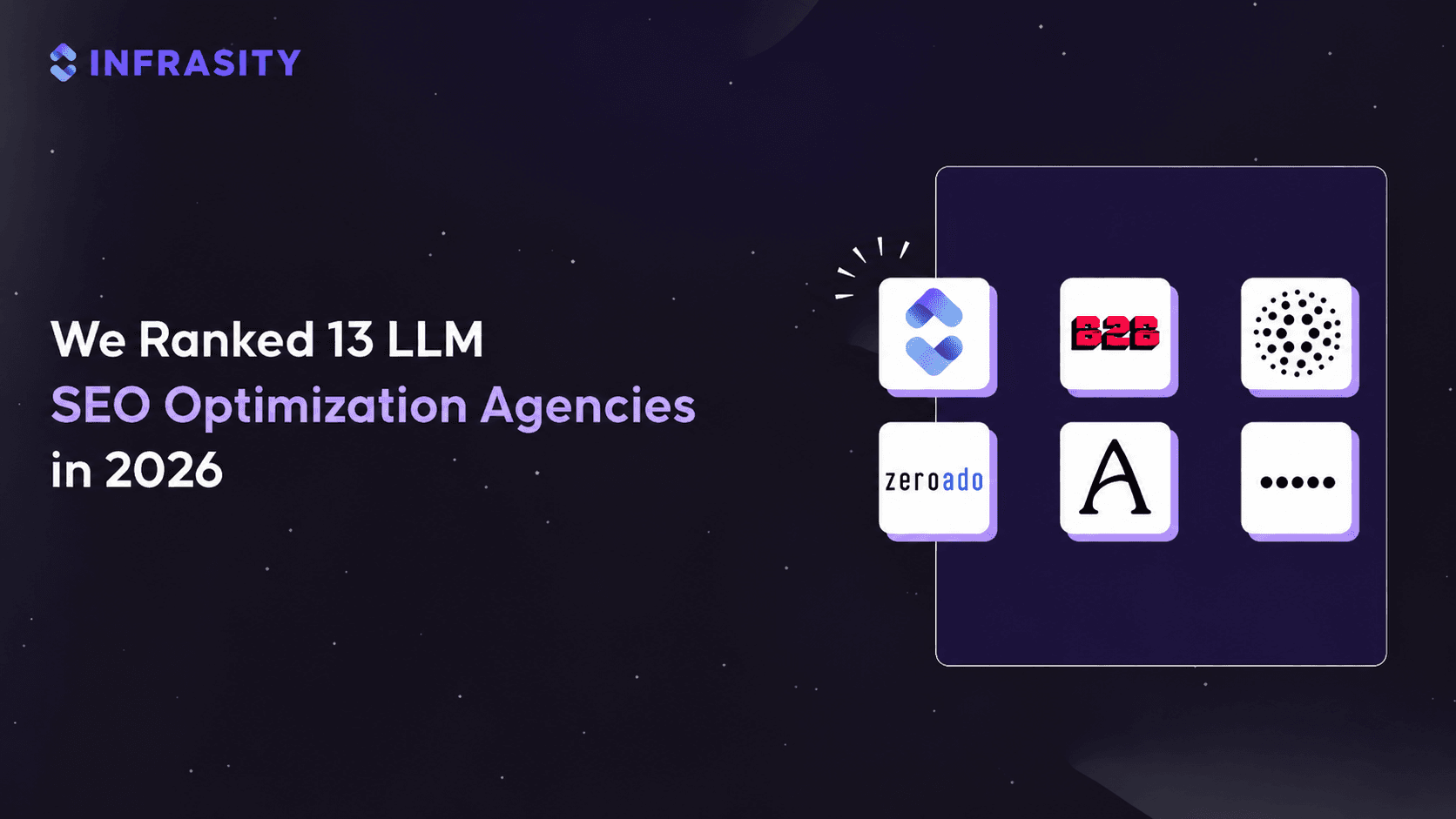
In this blog we've ranked the top 13 LLM SEO optimization agencies for 2026 against a consistent set of criteria, with reported pricing, best-fit use cases, and the proprietary tool or framework each one uses.
TL;DR
- Top 13 agencies are:
- Infrasity
- Growthner
- Breaking B2B
- Skale
- Omnius
- ZeroAdo
- Animalz
- Techmagnate
- Omniscient Digital
- ThatWare
- First Page Sage
- Grow and Convert
- Siege Media
- LLM SEO optimizes for citation and inclusion in AI answers, measured as the share of buying prompts where your tool appears, not raw "mentions."
- According to McKinsey, a brand's own website accounts for only 5 to 10 percent of the sources AI search pulls from. The rest comes from third parties, communities, and publishers. On-page work alone cannot win.
- Reported pricing for a specialist agency in 2026 runs from roughly $3,000 to $20,000 or more per month, with enterprise programs higher. Most quote custom.
What is LLM SEO, And Is It The Same As GEO or AEO?
LLM SEO is the practice of structuring your content, entities, and off-site signals so large language models retrieve, cite, and recommend your company when they answer a buyer's question.
The labels overlap in practice. Answer engine optimization (AEO) focuses on direct-answer formats. Generative engine optimization (GEO) is the broader work of earning citations across generative engines. LLMO refers to how a specific model represents your business.
Here's a breakdown of the distinctions in AEO vs GEO and AEO vs SEO.
For those who ask whether this is real or just a hype created by marketing, the mechanic is concrete. Engines like Perplexity and Google AI Overviews use retrieval augmented generation (RAG).
They pull a small set of trusted sources at query time, evaluate them against the meaning of the question, and compose an answer that cites those sources. LLM SEO is the work of making your platform one of those trusted sources.
Learn how you can get cited by AI.
LLM SEO vs Traditional SEO: What Actually Changes?
The two disciplines share a foundation, but they optimize for different outcomes.
| Element | Traditional SEO | LLM SEO |
|---|---|---|
| Primary goal | Rank URLs on the search results page | Get cited and recommended inside AI-generated answers |
| Targeting focus | Search volume and keyword density | Natural-language prompts, conversational queries, entity relationships |
| Core tactics | Backlinks, meta tags, on-page optimization | Structured data (schema), citation and brand-mention outreach, RAG-friendly content |
| Measurement | Organic traffic, rankings, click-through rate | Citation frequency, share of voice in AI answers, AI referral attribution |
| Buyer takeaway | Be findable on Google | Be the answer everywhere buyers research |
One detail reshapes strategy. The engines don't agree with each other. We found that only about 11 percent of domains are cited by both ChatGPT and Perplexity, because each engine weighs sources differently. Optimizing for "AI" as one system is the first sign an agency has not done the work.
How We Evaluated The Best LLM SEO Agencies?
LLM SEO is young enough that anyone can claim expertise, so we scored agencies on what is verifiable rather than what is marketed.
Proprietary tracking infrastructure: A real AI visibility tool that measures citation rate and share of voice across engines, not a recycled rank tracker. Examples in the market include AtomicAGI, Traqer.ai, Goodie, BlueprintIQ, and Infrasity's own AI Visibility Command Center.
Pipeline over vanity metrics: Success measured in qualified leads and revenue, not "brand mentions." This matters because AI traffic converts differently.
Clear methodology: A documented process for entity optimization, knowledge-graph work, and citation building, not a vague promise.
Vertical focus: Specialists who understand a specific buyer (B2B SaaS, DevTools, enterprise) tend to outperform generalists.
Verifiable, named-client results: Ideally, you can replay yourself by running the prompt in ChatGPT today, the same way you would sanity-check a vendor's own case studies and whitepapers used as SEO assets before trusting the numbers in them.
Here are three additional factors you mustn't skip, because they separate genuine LLM SEO specialists from rebranded SEO shops:
Off-site and community capability: McKinsey found a brand's own site accounts for only 5 to 10 percent of the sources AI search references. The rest is publishers, communities, and user-generated content. An agency that only edits your website is working on a tenth of the problem. Winning the Reddit and review-site layer is the larger lever.
Per-prompt coverage measurement: Reporting the percentage of buying prompts where you are cited, and the percentage of ranking threads that mention you, is far more useful than a mention count.
Citation durability: Do wins compound as community threads keep getting cited, or do they decay without refresh?
The top 13 LLM SEO optimization agencies in 2026
Here is a list of the best agencies in the business.
1. Infrasity
Best for: B2B software, DevTools, AI-agent startups, observability, and infrastructure SaaS that need to be cited by AI for high-intent buying queries.
Starting price: Custom
Infrasity is a developer-marketing and technical-content agency that treats LLM SEO as an end-to-end visibility problem. The goal is to own the evaluation layer, meaning the exact threads, search results, and AI responses a buyer encounters from the first Google search to the final AI-assisted recommendation.
A method built for citations, not impressions. Infrasity runs a three-phase system.
First, audit and baseline mapping of the prompts buyers feed AI, the subreddits and competitors in play, and the threads already ranking and being cited.
Second, engagement on the Reddit threads already ranking in Google's top 10, since those get indexed and resurfaced.
Third, LLM-citation targeting, where prompts are run across ChatGPT, Perplexity, and AI Overviews, the cited threads are engaged directly, and prompts are re-run to verify the platform was pulled into the answer.
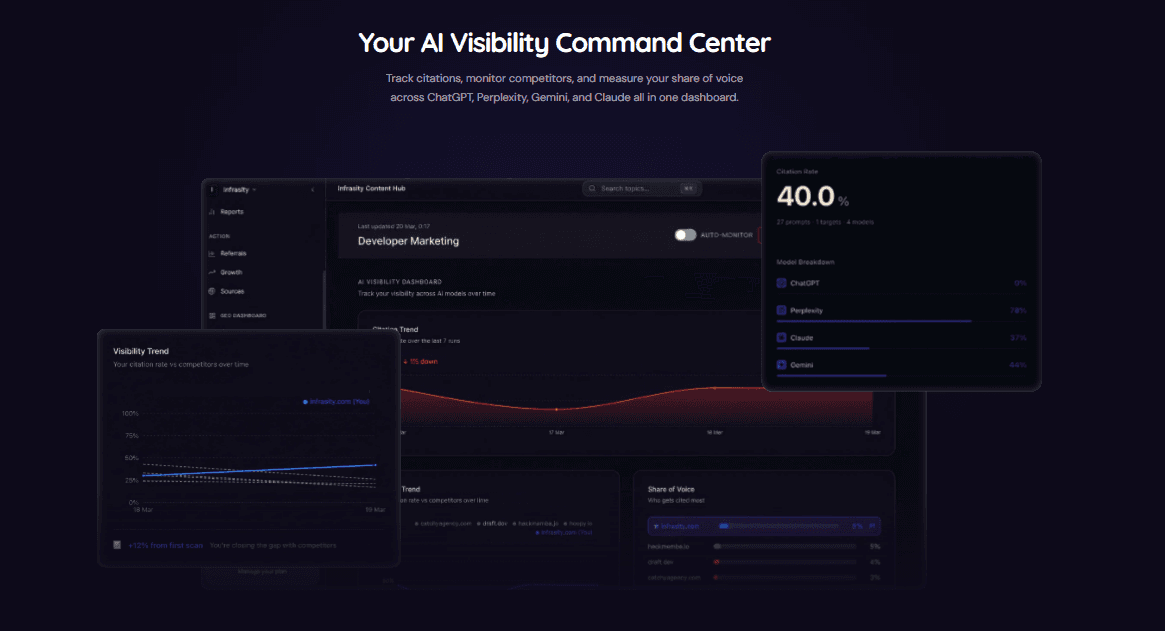
Its own tracking product: The AI Visibility Command Center tracks citations, competitors, and share of voice across ChatGPT, Perplexity, Gemini, and Claude in one dashboard, with auto-generated prompts and continuous monitoring.
Infrasity also runs Thredflow for per-prompt citation tracking and a Reddit Opportunity Finder that surfaces threads ranking in the top 10 SERPs.
Content written by engineers: Content is produced by writers with real engineering experience, which is what makes it survive technical scrutiny and earn citations from developer-facing models.
Tradeoff: Infrasity is deliberately specialized. It is the wrong fit for consumer brands, local businesses, or non-technical B2B. Its edge compounds only when the buyer is technical.
2. Growthner
Best for: SaaS and B2B brands that want one program to cover SEO, GEO/LLM optimization, Reddit marketing, and link building, with every initiative mapped directly to PQLs, SQLs, and ARR growth.
Starting price: Custom pricing
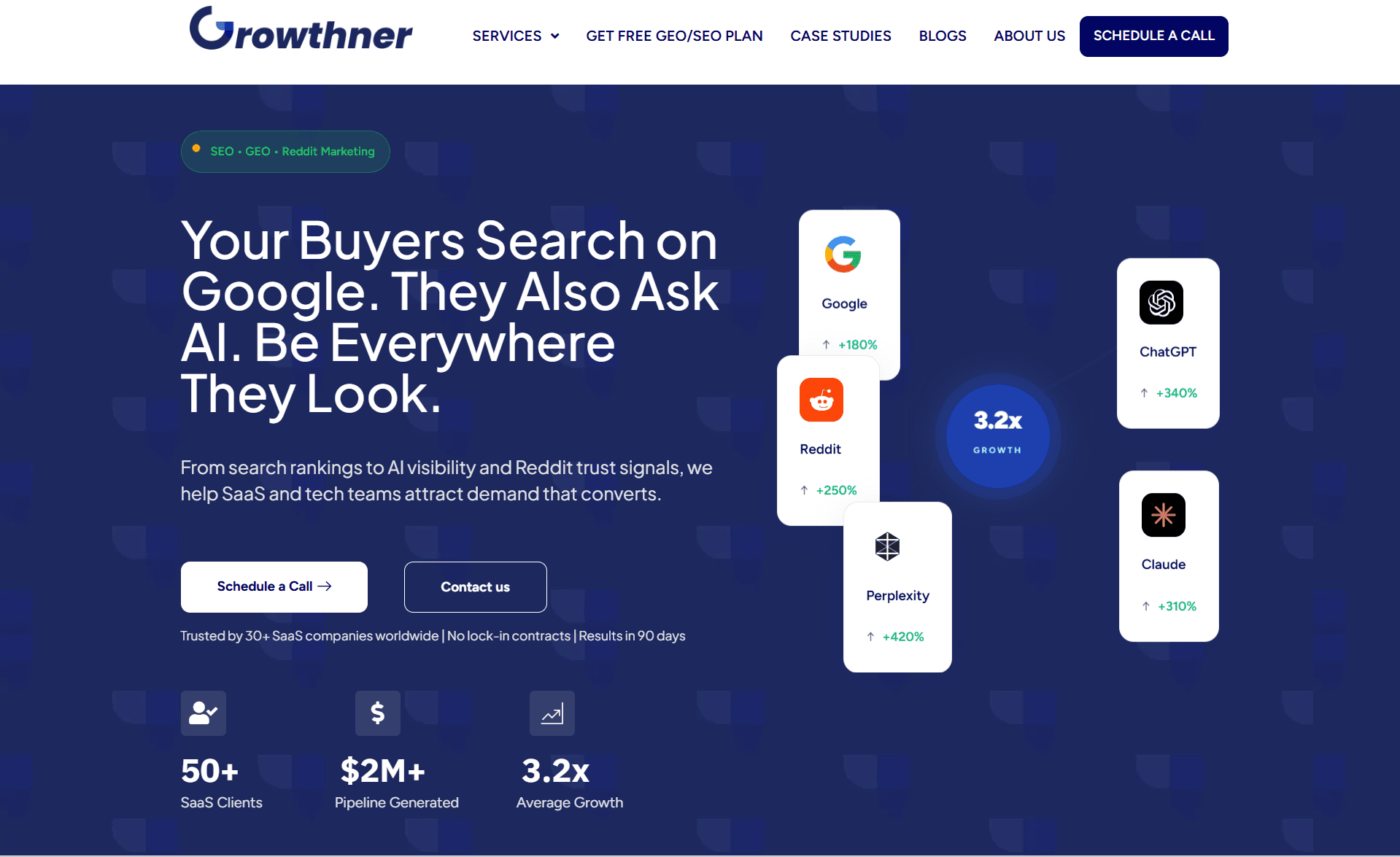
Growthner is a SaaS-only SEO and GEO agency that treats Google search, AI surfaces (ChatGPT, Perplexity, Gemini, Claude), and Reddit as one visibility system, combining technical SEO, LLM-ready content, entity optimization, and high-authority SaaS backlinks so the same assets rank on SERPs and get cited in AI answers. Its playbooks are built around buyer questions, comparison and alternatives content, and community threads that LLMs train on, making it a fit for teams that care about measurable pipeline rather than vanity traffic.
Tradeoff: As a 15-person, SaaS-specialized team, Growthner is better suited to mid-market software companies than very large enterprises needing huge content volumes or non-software brands looking for broad, generalist marketing support.
3. Breaking B2B
Best for: B2B SaaS teams that want bottom-of-funnel content and AI citations from one program, with transparent pricing.
Starting price: Reported from $4,000 per month (tailored plans from $3,500), no 12-month lock-in.
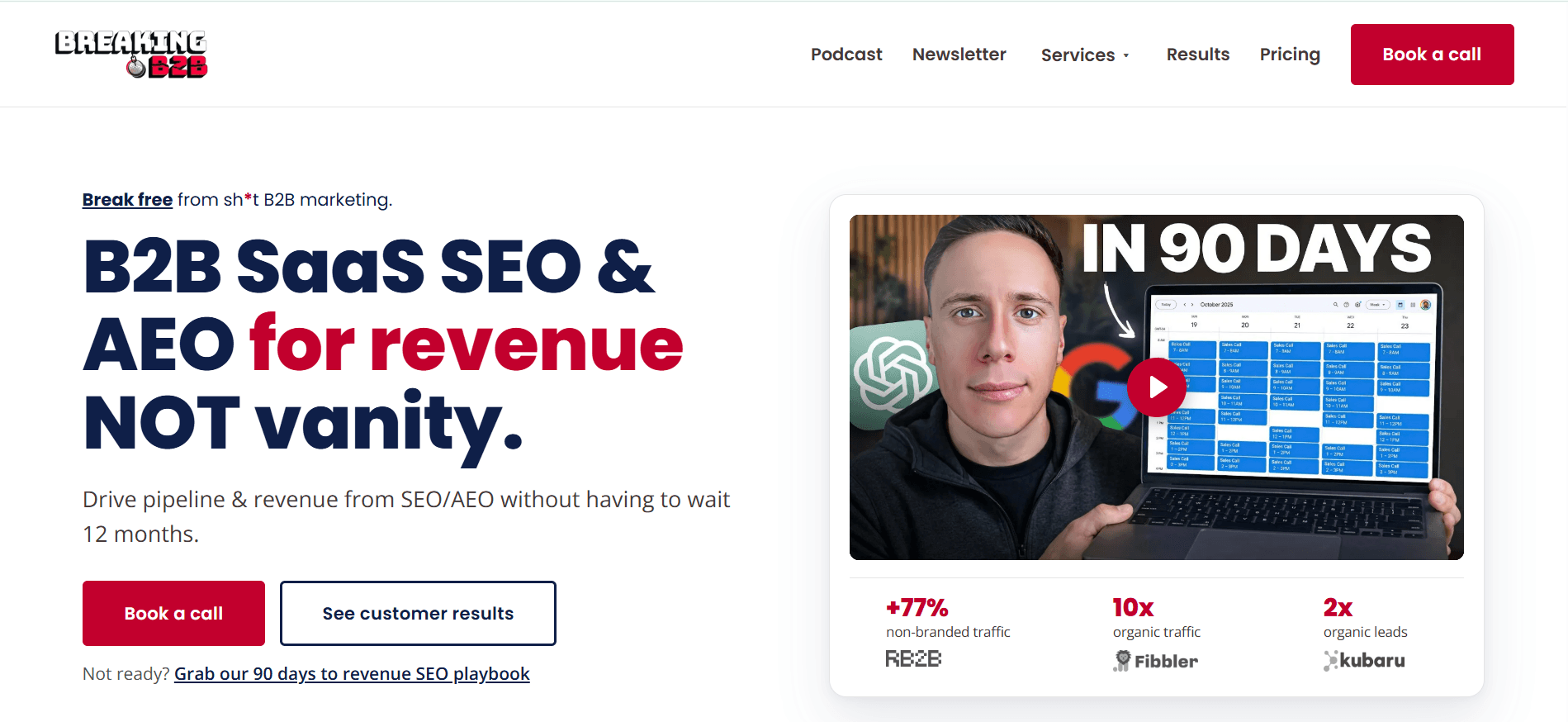
Founded by Sam Dunning, Breaking B2B treats SEO and LLM SEO as one system, building comparison pages, competitor-alternative content, and best-of listicles that rank on Google and get cited by AI, supported by brand-mention outreach on Reddit and comparison sites.
Tradeoff: As a newer agency, independent third-party review coverage is still limited. Much of the credibility comes from founder-led research and content.
4. Skale
Best for: SaaS and B2B companies that want to build organic search visibility while increasing their presence across AI search.
Starting price: Custom.
Skale is an SEO agency focused on building organic growth engines for SaaS and B2B companies. Its approach combines traditional SEO with the growing requirements of AI search, covering technical SEO, content strategy, link building, and authority building rather than treating LLM visibility as a completely separate channel.
Focus: SEO strategy, content strategy, technical SEO, link building, and AI search visibility.
Tradeoff: Skale is not a dedicated PR or community-only LLM SEO specialist. Companies looking specifically for large-scale Reddit campaigns, proprietary AI citation dashboards, or a pure technical DevTools content operation may be better served by one of the more specialized agencies above.
For SaaS and B2B teams that want SEO, content, authority building, and AI search visibility working together, however, Skale offers a broader organic-growth approach rather than treating LLM SEO as a separate campaign.
5. Omnius
Best for: B2B SaaS, Fintech, and AI companies that want a technical, revenue-first program.
Starting price: Custom.
London-based Omnius works only with SaaS, Fintech, and AI businesses and built its own AI search tracking tool, AtomicAGI, in early 2024. Its program spans more than 20 GEO tactics, including llms.txt creation, citation engineering, and synthetic query generation, and starts from business fundamentals like MRR and CAC rather than keyword lists.
Tradeoff: It caps new clients at roughly eight per year and excludes B2B companies outside its three verticals, so availability and fit are narrow.
6. ZeroAdo
Best for: SaaS and B2B brands moving from early traction toward 1 million dollars or more in ARR.
Starting price: Custom, audit-based.
ZeroAdo unifies LLM SEO, GEO, and entity optimization under a system it calls Swift Digital Growth. It is a boutique operator with an audit-led, pay-as-you-go model that appeals to companies wanting flexibility rather than a fixed enterprise retainer.
Tradeoff: A smaller boutique footprint means less of the large-team capacity that enterprise programs sometimes need.
7. Animalz
Best for: Enterprise and growth-stage SaaS that value editorial quality and thought leadership over raw content volume.
Starting price: Custom, premium.
Animalz has one of the most operationally detailed AEO offerings, naming each deliverable individually, including AI visibility audits, citation outreach, micro content refreshes, and Reddit engagement. Its content is produced through deep expert interviews, which generates the non-replicable material AI platforms tend to cite.
Tradeoff: Breadth and editorial depth suit mature content programs more than companies that need fast bottom-funnel traction.
8. Techmagnate
Best for: Large enterprises in BFSI, healthcare, education, and ecommerce, with strong representation.
Starting price: Reported in the range of approximately $350 to $2,350+ per month.
Founded in 2006 by Sarvesh Bagla and headquartered in New Delhi, Techmagnate is one of Asia's largest digital agencies, a Google Premier Partner with a team of more than 300. It brings structured, multi-channel enterprise delivery and launched dedicated LLM SEO services to complement its enterprise SEO.
Tradeoff: LLM SEO is a newer addition to a broad service menu, and the focus skews to large enterprise accounts rather than early-stage SaaS.
9. Omniscient Digital
Best for: B2B software companies between roughly 3 million and 15 million dollars in ARR.
Starting price: Reported from $10,000 per month.
Omniscient Digital is known for "Surround Sound SEO," a methodology built to associate a brand with a category across many touchpoints, which increasingly carries over into LLM training associations. It offers GEO as a named service and ties case studies to pipeline and revenue.
Tradeoff: Its strength is content strategy and production. The dedicated AI citation tracking layer is less mature than at tool-first agencies.
10. ThatWare
Best for: Brands that want a deeply technical, data-science-led approach to AI search, serving clients across the US, the UK, and Dubai.
Starting price: Custom.
Founded in 2018 by Tuhin Banik, an engineer with a data-science background, ThatWare built proprietary frameworks it calls AIEO (Artificial Intelligence Engine Optimization), CRSEO, and Quantum SEO, focused on how AI systems interpret entities and context. Its work includes RAG-optimized content structuring, entity optimization, and knowledge-graph reinforcement.
Tradeoff: Several headline figures the agency cites, such as its algorithm and client counts, are self-reported, so weigh them as marketing claims rather than independent data.
11. First Page Sage
Best for: Enterprise B2B brands in SaaS, medtech, and financial services that want long-term authority.
Starting price: Reported $8,000 to $20,000 or more per month.
Founded in 2009 by Evan Bailyn, First Page Sage published one of the earliest commercial GEO frameworks in 2023 and continues to release proprietary data studies. Its model blends thought-leadership content with knowledge-graph optimization and structured data.
Tradeoff: Premium pricing, longer contracts, and intentionally low content volume make it a stretch for earlier-stage teams.
12. Grow and Convert
Best for: SaaS and B2B teams that want content aimed at buyers who are ready to act.
Starting price: Reported from around $10,000 per month.
Grow and Convert is built around "Pain Point SEO," targeting the specific problems an ideal customer searches for rather than broad informational keywords. It built its own AI visibility tracker, Traqer.ai, and a "Prioritized GEO" framework that ranks tactics by measured impact.
Tradeoff: Its bottom-funnel focus is excellent for conversion but less suited to top-of-funnel awareness plays.
13. Siege Media
Best for: Mid-to-large SaaS companies investing in content as a durable moat across search and AI.
Starting price: Reported in the mid five figures per month.
Founded in 2012, Siege Media pairs high-end content with two proprietary tools: BlueprintIQ, which audits content against live ChatGPT, Gemini, and Perplexity results, and DataFlywheel, which refreshes assets each quarter so citations do not decay. Named clients include Zapier, Zoom, Airtable, and Asana, with more than 75 public case studies.
Tradeoff: Results compound over 12 months or more, so it is not the right fit for teams that need citation movement inside a single quarter.
The Pre-Agency Technical Checklist: How to Structure Data For AI
Before spending on an agency, fix these foundations. These are the same things a good agency will audit first.
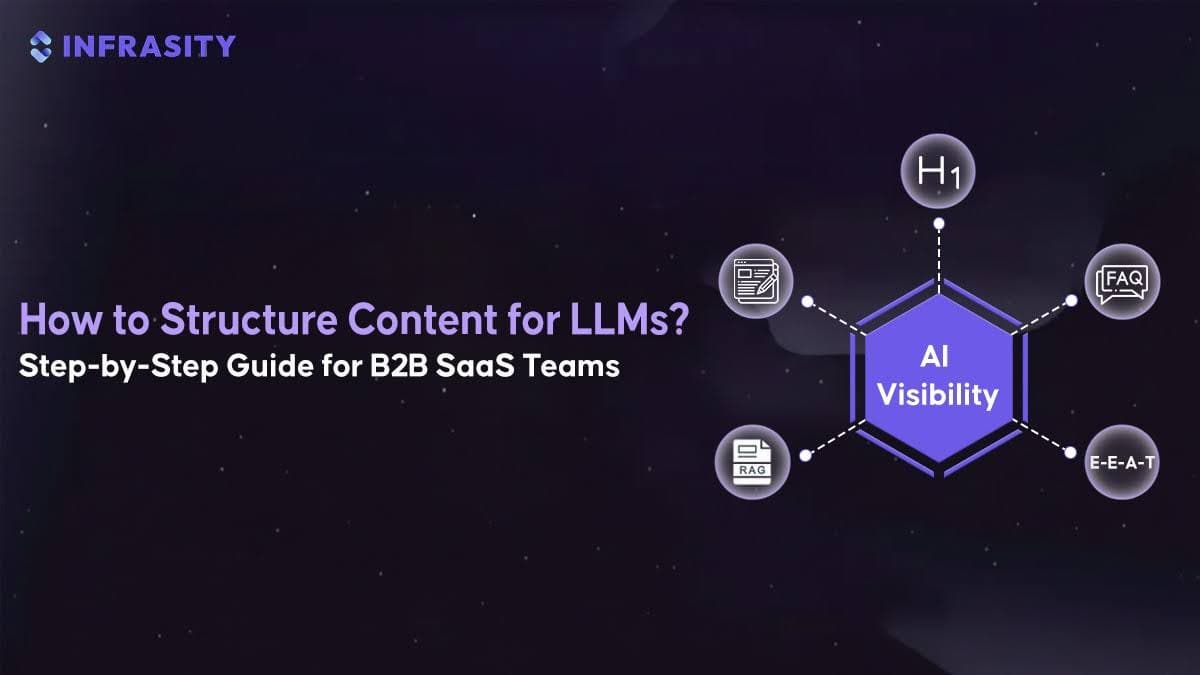
Semantic HTML and clean outlines: LLMs parse structure. Marketing and docs pages should use strict H2 and H3 hierarchies that answer queries directly, whether that page is a landing page or the kind of structured reference covered in our breakdown of user guides versus API documentation. The academic Princeton-led GEO study found that well-structured content with citations, quotations, and statistics can lift source visibility in AI answers by up to roughly 40 percent. Infrasity's own analysis finds 44.2 percent of LLM citations come from the first 30 percent of a page, so lead with a direct answer in the first 150 words.
Entity optimization and schema markup. Implement clean JSON-LD schema so AI can map your brand to the right category and services. Make sure AI crawlers are not blocked in your robots.txt, and consider an llms.txt file, while noting that several teams have not yet seen a measurable lift from llms.txt alone. The website stack underneath all of this matters too, since some B2B SaaS GTM website stacks make it far easier to ship this structured data cleanly than others.
The consensus strategy: LLMs synthesize facts, they do not invent them. If your site, Reddit, G2, and the major directories all describe your product the same way, the model cites you with confidence. This is why off-site corroboration matters so much, and it lines up with the McKinsey finding that owned pages are only 5 to 10 percent of AI sources. Run a baseline with an AI visibility audit or the GEO checklist.
How Do You Measure LLM SEO Success? A GA4 Mini-Guide
Tracking is the single biggest pain point teams raise, and most reports stop at "improved mentions." Here is a practical starting point.
Isolate AI referral traffic in GA4: Create a custom channel group or a regex-based segment that classifies sessions from chatgpt.com, perplexity.ai, claude.ai, gemini.google.com, and copilot.microsoft.com as a distinct AI Referral channel. GA4 otherwise scatters these across Referral and Organic.
Track citation frequency and share of voice with a dedicated tool: Rank trackers do not measure AI citations. Use a purpose-built platform such as the AI Visibility Command Center or compare options in Infrasity's LLM visibility tool guide and analysis of LLM visibility tools.
Tie citations to pipeline. Connect AI-referred sessions to signups, demos, and revenue in your CRM. Citations that cannot be linked to a sales conversation are inputs, not outcomes.
One caveat to set with any stakeholder: AI citations are probabilistic. They vary by prompt phrasing and model version, so manual replay testing across engines still matters alongside automated tracking.
How Do You Choose the Right LLM SEO Agency for your Stage and Budget?
Match the agency as per your budget, stage or profile.
| Stage or profile | Typical budget | Best-fit agencies |
|---|---|---|
| Technical B2B, DevTools, AI, SaaS | Custom | Infrasity |
| Transparent, revenue-focused SaaS | From $3,500 to $4,000 per month | Breaking B2B, Embarque |
| SaaS, Fintech, AI with proprietary tracking | Custom | Omnius, Grow and Convert |
| Enterprise, regulated industries | Custom or tiered | Techmagnate, First Page Sage |
| Content as a long-term asset | Mid five figures per month | Siege Media, Animalz |
| Technical, data-science-led | Custom | ThatWare |
| SaaS and B2B organic growth, AI search | Custom | Skale |
If you sell to developers or technical buyers, specialization beats scale. Generic content gets distorted by AI, while engineer-authored, structured content gets cited. That's the case for Infrasity.
If you are an enterprise with a broad mandate, a full-service program with proprietary tooling reduces vendor sprawl. First Page Sage and Techmagnate fit here.
If you need conversion, not awareness, a bottom-funnel specialist like Grow and Convert or Breaking B2B aligns content with buying intent.
How Infrasity Can Help You Win LLM Citations
For most B2B businesses the mainstream players will competently fix the on-page and authority fundamentals.
Where they tend to actually stop is the off-site, community, and per-prompt citation layer, which is exactly where AI engines pull their answers from, and it is the hardest part to fake.
That is the layer Infrasity is built around, which is why it leads this list for technical B2B, DevTools, AI, and SaaS companies. It measures LLM SEO as citation coverage across the prompts your buyers actually run, it owns Reddit to search the LLM path end to end, and it ships its own tracking product to prove the work.
Avoid wasting money on agencies that won't bring you customers. Join the growing list of Infrasity clients who are already getting discovered by buyers and generating leads from leading LLMs.
Frequently Asked Questions
What is an LLM SEO agency?
An LLM SEO agency optimizes your platform to be cited and recommended by AI tools like ChatGPT, Gemini, Perplexity, and Claude. The goal is inclusion in the AI answer, not just a ranking in a list of links.
What is the difference between LLM SEO, GEO, and AEO?
They overlap heavily. AEO targets direct-answer formats such as featured snippets and AI Overview answer boxes. GEO is the broader practice of earning citations across generative engines. LLMO focuses on how a specific model represents your tool. Most agencies treat them as one program.
How is LLM SEO different from traditional SEO?
Traditional SEO optimizes to rank a page so a user clicks. LLM SEO optimizes to be cited inside an AI answer, where there may be no click at all. The measurement stack is also different: citation frequency and share of voice instead of rankings and sessions.
Can an agency guarantee visibility in ChatGPT, Perplexity, or Gemini?
No. AI systems choose sources based on relevance, authority, and consensus, and outputs vary by model and prompt. A credible agency improves the probability of citation and tracks it. It does not promise a guaranteed placement.
How long does it take to see results from LLM SEO?
Expect about 2 to 3 months to fix technical foundations and 4 to 6 months for meaningful citation traction. AI visibility can move faster than traditional rankings because engines update their sources frequently.
How much does an LLM SEO agency cost in 2026?
Most specialist programs run from about $3,000 to $20,000 or more per month, depending on proprietary tooling, content volume, and the amount of off-site and PR work. Enterprise engagements go higher. Most agencies quote custom.
Should we handle LLM optimization in-house or hire an agency?
In-house works if you have dedicated technical SEO and content resources plus a tracking tool. Most teams hire an agency for the first 6 to 12 months to build the foundation and the measurement stack, then maintain it internally.
How do I track AI search visibility in GA4?
Create a custom channel group or regex segment that classifies referrals from chatgpt.com, perplexity.ai, claude.ai, gemini.google.com, and copilot.microsoft.com as AI Referral, then pair it with a dedicated citation-tracking tool and tie both to pipeline in your CRM.