
TL;DR
The pipeline growth remains stagnant for B2B SaaS remains mostly because of the content structure and the content is optimized for search rankings rather than LLM retrieval. Today’s buyers are turning to LLMs like ChatGPT, Perplexity AI, Claude, etc to evaluate tools. If your developer content isn’t structured for LLM extraction, it effectively doesn’t exist in those decision-making conversations.
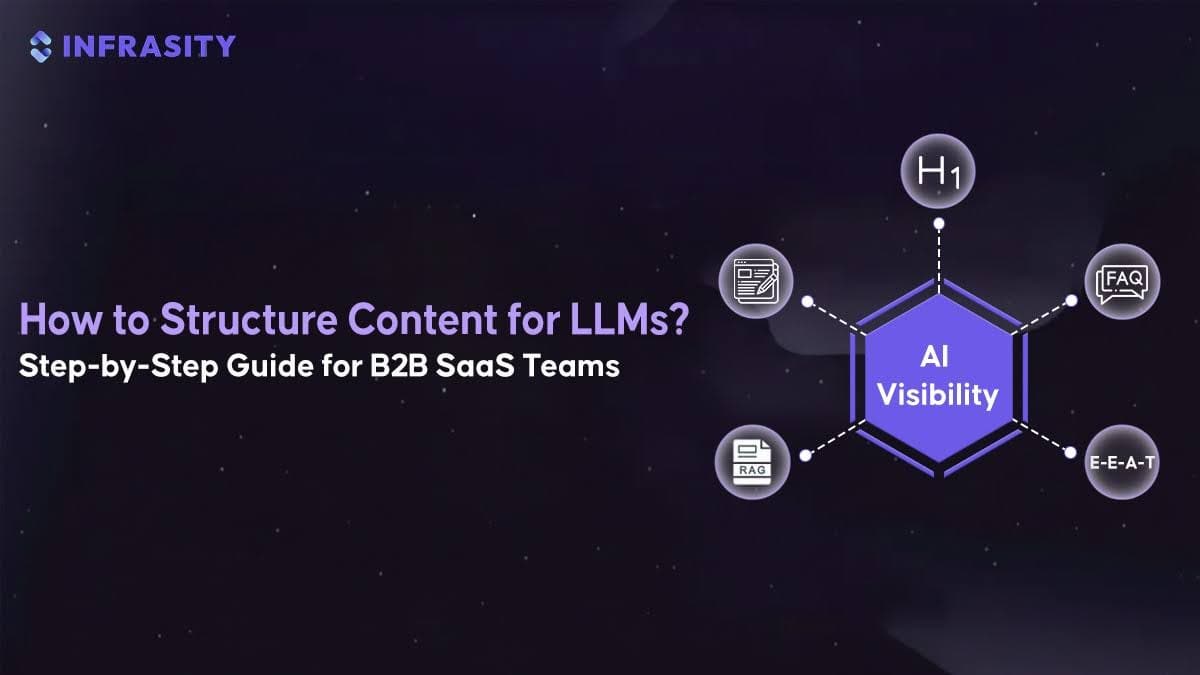
Knowing how to structure content for LLMs requires three layers: an answer-first opening in the first 150 words, structured content for AI using H2s phrased as buyer queries and FAQs, and an authority layer built on original data, engineering bylines, and community presence.
ChatGPT, Perplexity, Claude, and Gemini each retrieve and cite content differently. The 7 key factors for AI-friendly content most teams miss are no direct answer in the first 150 words, H2s written as labels not queries, no FAQ section, JavaScript-rendered pages invisible to AI crawlers, anonymous bylines, stale content with no freshness signal, etc which are fixable in 4 to 6 weeks starting with your highest-traffic posts, product pages, docs, comparison pages, and GitHub presence.
This blog is a step-by-step guide on the best on-page content formats for AI built for B2B SaaS startups who need a prioritised, execution-ready framework to move their content from Google-optimised to LLM-extractable, with platform-specific checklists, a structural audit order, and Infrasity's four-component approach to implementation.
Imagine this: You published 12 blogs last quarter, the traffic went up, but the pipeline still did not move.
B2B SaaS teams are publishing more content than ever, but unfortunately, the reason their pipeline from content is still flat is because of your content’s structure. Technical Content written for Google's blue links does not get cited by Claude, ChatGPT, Perplexity, or Gemini. These are different systems with different retrieval logic.
Your buyers not only start with Google, but they also ask LLMs like Claude, or ChatGPT, Perplexity, which B2B SaaS teams ask, evaluate, and get a cited answer. If your developer content is not structured for LLM extraction, it will not exist in that conversation and hence will never get cited.
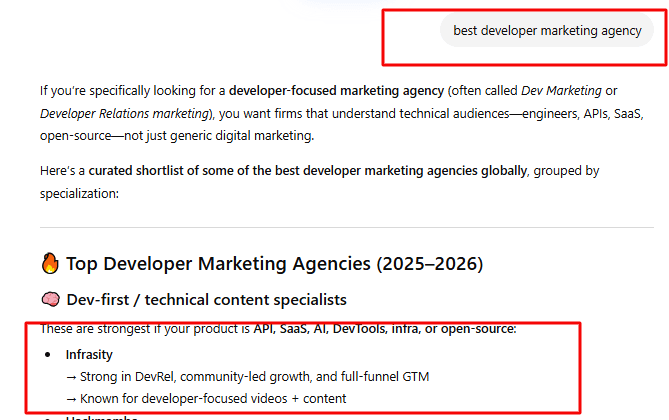
Let’s take a look at some stats to know how serious this gap is.
- LLM visitors convert at 15.9% on ChatGPT and 10.5% on Perplexity, compared to Google organic's 1.76%.
- 44.2% of all LLM citations come from the first 30% of a page, meaning if your opening 150 words do not deliver a direct, extractable answer, the rest of the article is invisible to the AI system reading it.
Note that the problem is not what you are writing but how you are writing it.
Knowing how to structure content for LLMs is now the single most important content infrastructure decision a B2B SaaS startup can make in 2026. Yes, Google is still important but the buyers arriving from AI citations are arriving pre-qualified, further along in the evaluation cycle, and converting at a higher rate of organic search visitors.
This blog is a step-by-step guide for Growth Heads and VPs of Marketing at B2B SaaS startups. It covers the three-layer content structure LLMs actually extract from, the platform-specific differences between ChatGPT, Perplexity, Claude, Gemini, etc. Just the structural decisions that determine whether your content gets cited or skipped. Read along to find out!
Why LLMs Read Content Differently Than Google?
Google crawls and ranks and LLMs retrieve and summarise. The difference in behaviour means the content structure that wins in search does not automatically win in AI answers.
LLMs use two retrieval methods: The first being RAG (real-time retrieval on Perplexity, Google AI Overviews) and the second being training data (ChatGPT, Claude). Being cited requires satisfying both.
For a full breakdown of which AI crawlers to allow and how to configure your robots.txt, read LLMs.txt: A New Standard for Making Your Website LLM-friendly
Three-Layer Content Structure LLMs Extract From
Several B2B SaaS startups think about structure in terms of readability, including short paragraphs, subheadings, or bullet points. Yes, that is necessary, but it is not sufficient for LLMs to reach your content.
LLMs scan for extractability as they are looking for 3 specific signals:
- A direct answer they can lift and cite
- A structural architecture that makes the page parseable
- Authority markers that tell them whether your source is worth quoting.
If you miss any one of these 3 layers and the page gets passed over, regardless of the quality of your developer content or how well it ranks in Google.
Here is how to build all three into every page you publish.
1. Layer 1: The Answer Layer (First 30% of every page)
- Lead with a direct, complete answer to the query the page targets, in the first 150 words.
- Use a definition block: "X is Y that does Z for [ICP]", one sentence.
- Follow with a 3-5 sentence expansion that adds context, specificity, and a data point.
- Avoid burying the answer behind background, history, or preamble.
Content that opens with a clear answer gives LLMs a directly extractable citation candidate.
2. Layer 2: The Structure Layer (H2/H3 headings + FAQs)
- H2s should be phrased as questions buyers ask AI systems, not keyword-stuffed section titles. "How does X work?" not "X Overview."
- Every major section should close with a 2-3 line summary that restates the key point; these become citation-ready snippets.
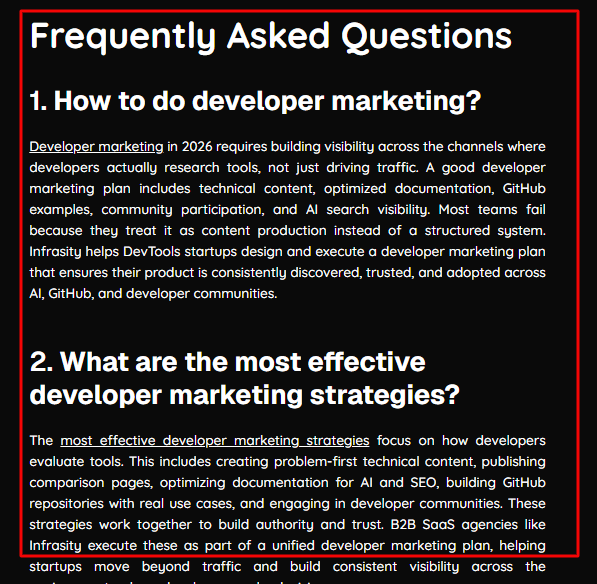
- FAQ section at page bottom: minimum 4 questions, each with a 2-4 sentence answer. These directly map to how buyers query ChatGPT and Perplexity.
- Comparison tables, numbered lists, and definition blocks are 2.8x more likely to earn citations than prose-only content.
- Avoid long paragraphs without structure because LLMs score content on readability and entity density; dense prose without signposting scores lower.
3. Layer 3: The Authority Layer (Signals LLMs Use to Decide Whether to Trust the Source)
- Original data, benchmarks, and first-party research. LLMs prefer citing sources with unique insights and not content that aggregates what's already available.
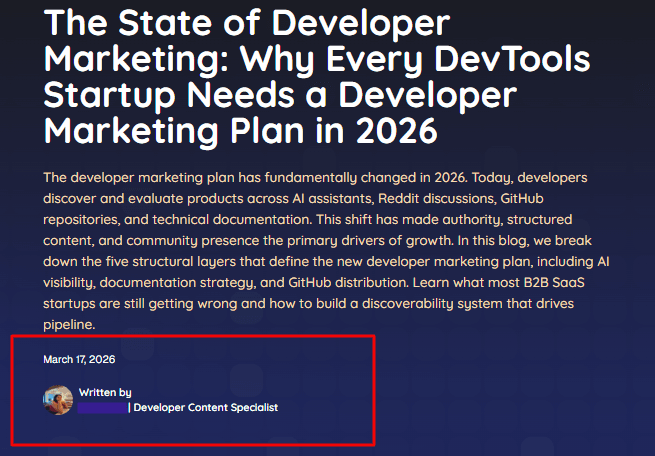
- Author attribution with verifiable credentials. An article authored by "a senior DevOps engineer at [startup]" gets higher trust signals than "staff writer."
- Third-party validation: mentions on Reddit, G2, peer publications, and community forums feed LLM training data and citation probability. Domains with high Reddit/Quora mentions have 4x higher ChatGPT citation probability.
Example: Vercel's documentation and blog content are structured with static HTML, answer-first sections, and deep technical specificity per page. This resulted in ChatGPT growing from referring less than 1% of Vercel's signups to 10% in six months!
LLM Platform-Specific Structure: ChatGPT vs Perplexity vs Claude vs Gemini
We have noticed in the last few months that most B2B SaaS startups’ GEO guides treat "LLMs" as one system. VPs of Marketing and Growth Heads need to know that content built for one platform does not automatically surface in another. This section will give them a per-platform brief.
1. ChatGPT
For the full set of platform-specific tactics, see how to rank on ChatGPT.
- Cites from training data + live web search (SearchGPT). Strong bias toward content that has been consistently indexed over time.
- Favours: definite language, high entity density, content that directly answers a commercial or informational question in the first paragraph.
- Structural priority: Answer-first H1, definition block in the first 100 words, FAQ section at the bottom of the content.
- Only 11% of domains are cited by both ChatGPT and Perplexity.
2. Perplexity
- Real-time RAG retrieval.
- Strongly favours freshness
- Reddit/community validation, and source diversity.
- 28.6% of Perplexity-cited URLs rank in Google's top 10, which is closer to the traditional SEO than ChatGPT.
- Structural priority: Recently updated timestamps, FAQ blocks, Reddit presence for the same topic, and outbound links to credible sources within the content.
3. Claude/ ClaudeBot
- Rewards technical depth and developer-authored precision.
- Penalises content that reads as marketing copy.
- Structural priority: Long-form technical depth, comparison tables with honest limitations, no JS-rendering issues, minimal promotional language.
4. Google Gemini / AI Overviews
- Most SEO-aligned of the four, with 76.1% of Gemini-cited URLs ranking in the Google top 10.
- Structural priority: Schema markup (Article, HowTo, FAQ), E-E-A-T signals, content freshness, and citation-friendly factual blocks.
There is a different structure for all the above LLM platforms and this is why the maintenance of checklists for each is one of the most important if you want your content to be chosen by LLMs.
Infrasity has published platform-specific checklists for Claude, Perplexity, and ChatGPT. Feel free to follow these checklists when your developer content is written.
7 Key Factors for AI-Friendly Content and Their Structural Fixes B2B SaaS Teams Miss
Your developer content is not getting cited because it is invisible to AI systems and you need to fix it ASAP. Here is exactly what is broken and how to fix it.
1. No direct answer in the first 150 words
LLMs extract from the top. 44.2% of all citations come from the first 30% of a page. If your opening paragraph is context, backstory, or a rhetorical question, you have already lost the citation to whoever answered first.
Fix: Write the answer in sentence one. Context comes after
2. H2s not written as queries but as labels
"Kubernetes Automation Overview" is a filing system label. "How does Kubernetes automation reduce DevOps toil?" is a citation candidate. The difference is whether your heading mirrors how a buyer actually phrases the question to ChatGPT.
Fix: Audit every H2 and if a buyer would not type it into an AI search bar, rewrite it.
3. No FAQ block
FAQ sections are the highest-density citation surface on any page, because they directly mirror how your buyers might be asking LLMs like Claude, ChatGPT, etc. Most B2B SaaS teams skip them or treat them as an afterthought.
Fix: Minimum four questions per page, answered in two to four sentences each. Every blog post, landing page, and docs page.
4. JavaScript-rendered content
GPTBot, ClaudeBot, and PerplexityBot fetch JS files but do not execute them. Your documentation, pricing page, and comparison pages may be completely invisible to every AI crawler.
Fix: Server-side render or statically generate every high-value page. No SSR means no citations, regardless of content quality. Running a structured check, such as using Claude skills to audit API documentation quality, also helps catch rendering and completeness gaps in your docs before they cost you citations.
5. No original data
Aggregated third-party research is the lowest-priority citation candidate for LLMs. If your article cites the same three industry reports as every competitor, there is no reason for an LLM to cite you over the original source.
Fix: One original data point per page, a client benchmark, an internal finding, a proprietary framework, gives LLMs something they cannot find anywhere else. That is what earns the citation.
6. Anonymous bylines
LLMs apply the same trust logic as Google's E-E-A-T. An article by "a senior DevOps engineer with eight years of Kubernetes experience" gets cited. An article by "staff writer" does not carry the same authority signal, and it's worth knowing how to identify AI-generated content that hides behind generic bylines, since LLMs and readers penalize the same shallow, formulaic writing patterns.
Fix: Named author, verifiable background, visible on the page, and not buried in a team bio. For developer-facing content, an engineering byline beats a marketing byline every time.
7. Stale content with no freshness signal
Perplexity specifically deprioritises pages with no visible update date and statistics older than 12 months. The LLM cannot tell if your 2022 data is still accurate, so it defaults to whoever signals currency.
Fix: Make the "Last updated" date visible in the article header and refresh statistics quarterly. Add a "What changed in 2026” section to your top evergreen pages. This one change consistently pushes updated pages above stale competitors in Perplexity results.
Example: Tally's comparison and alternative pages ("Best Free Online Form Builders in 2025," "Jotform Alternatives") are structured with direct answers, comparison tables, and FAQ blocks. A single Tally listicle was cited 14 times in a single Perplexity thread and ChatGPT became Tally's #1 referral source as well, helping them grow from $2M to $3M ARR in four months.
What to Audit First: A Priority Order for B2B SaaS Startups
The first question is "where do we begin?"
If you have a 3-person content team and a backlog of 80 published articles. You do not need a 6-month content overhaul. All you need to know is which five pages to fix this week.
Start your priorities:
- Your highest-traffic blog posts: These already have domain authority and inbound links. This is why restructuring them for LLM extraction is the fastest ROI possible.
Restructuring existing high-performing content with 120-180 word sections between hierarchical headers produces a 40% improvement in citation rates. Rewrite the opening 150 words to lead with an answer, convert H2s to buyer queries, and add a FAQ block at the bottom. Your product/ feature pages: LLMs like ChatGPT prefer direct sources. Your startup’s website gets a +3.0 citation rate advantage over intermediary content. Add a definition block in the first paragraph, a comparison table, and an FAQ Page schema. Most B2B SaaS product pages have none of these.
Your documentation: Technical documentation, integration guides, and API references receive 3x more AI citations than marketing pages because they contain specific, factual information LLMs can extract without ambiguity. Audit your docs for JS-rendering first. Then apply answer-first structure, clear H2s, and FAQ blocks to your highest-traffic integration and onboarding pages.
- Your comparison and alternative pages: These are the highest-intent AI citation targets on your entire site. When your buyer asks ChatGPT, "What's the best alternative to your competitor?”, the answer is assembled from comparison pages. People constantly compare to find the best available options, so comparison pages sit at the same high-intent end of the spectrum
For example, take a look at this alternative type blog post by PostHog.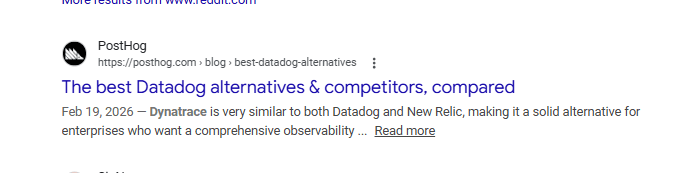 Build a comparison page for every major competitor your buyers evaluate alongside you. Structure it with a direct answer in the first paragraph, a feature comparison table, and an honest assessment of when each tool wins.
 - Your GitHub README and community presence: GitHub is a space where developers often hang out, so it is a given for a developer-focused B2B SaaS startup to increase its community presence. LLMs can cross-reference your content in every platform where it appears.
Audit your GitHub READMEs for structure; they should read like landing pages, not technical memos. Identify 5 to ten high-traffic subreddits where your ICP asks evaluation questions and seed genuine, helpful answers.
Final Thought: A New Approach to AI-Readable B2B SaaS Content
Gone are the days when early-stage devtool startups still operated on a publish-and-hope model. What’s that? Write the article, push it live, track Google rankings. That model does not account for how content gets cited, retrieved, and recommended by LLMs.
The structural fixes in this guide are actionable without external help. Apply them starting with your highest-traffic posts, work down to your GitHub presence, and you will be structuring content for LLM extraction before most competitors have started thinking about it.
For B2B SaaS teams that understand the problem but do not have the bandwidth to execute it, feel free to partner with a technical content marketing agency who have the expertise to drive results.
Infrasity builds content for B2B SaaS and DevTools startups across four components:
- Engineer-authored, answer-first content: Written by engineers with hands-on domain experience, structured for extraction from brief to publish: direct answers in the first 150 words, H2s mapped to buyer queries, FAQ blocks on every page, original technical insights that give LLMs something no competitor article contains.
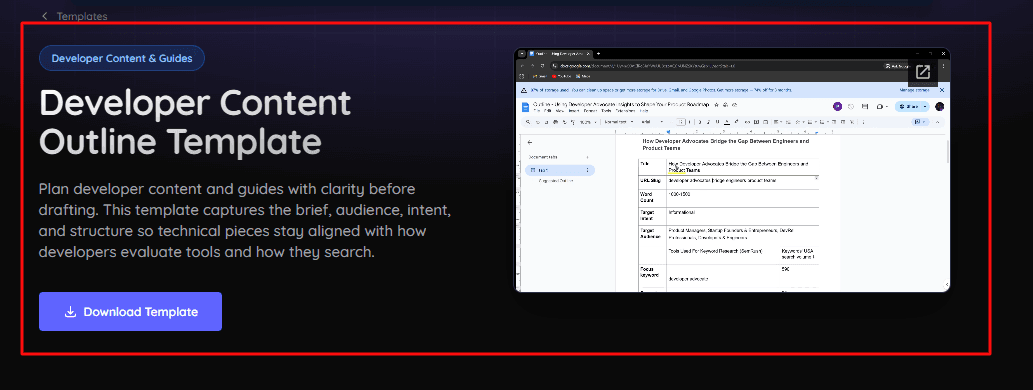
- Developer content outline template: Every brief maps each section to a buyer query, specifies the answer block, and flags where original data needs to be created.
- Distribution across developer-native platforms: Distributing high-intent topics in platforms like Reddit, Dev.to, Hacker News, and GitHub. Each version of the content is written for that community's format.
- Prompt tracking and AI citation visibility: Using app.infrasity.com monitors citation frequency across ChatGPT, Perplexity, and Gemini using the exact prompts your buyers type when evaluating your product category. It shows which pages are cited, which are invisible, and which prompts competitors are winning.
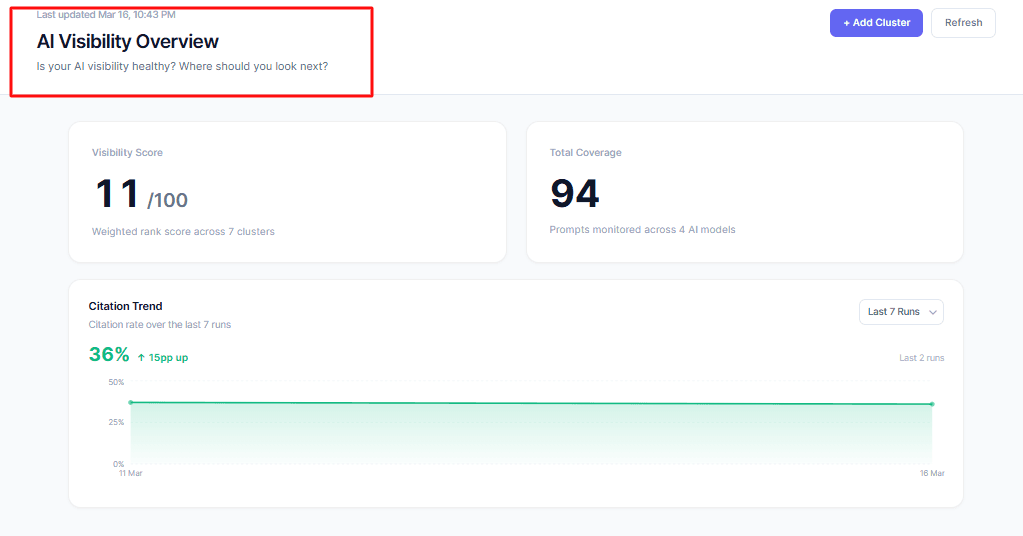
The structural decisions you make in the next 4 to 6 weeks determine whether your content is the source that gets cited or the one that gets skipped.
Frequently Asked Questions
1. Does the same content structure work across ChatGPT, Perplexity, Claude, and Gemini?
No. Only 11% of domains are cited by both ChatGPT and Perplexity; they are separate ecosystems with different retrieval logic. ChatGPT favours an answer-first structure and high entity density. Perplexity rewards freshness, Reddit presence, and recently updated timestamps. Claude penalises marketing copy and rewards technical depth. Gemini is the most SEO-aligned of the four, with 76.1% of cited URLs ranking in Google's top 10. Each platform needs a tailored structural approach.
2. What is the fastest way to check if your B2B SaaS content is being cited by AI systems?
Manually test 10 to 15 high-intent queries your buyers would type into ChatGPT, Perplexity, and Gemini, the same questions they would ask when evaluating your product category. Check whether your domain appears as a cited source. For ongoing tracking, tools like Profound, Peec AI, and App.Infraisty monitor citation frequency across AI platforms using the exact prompts your buyers use, showing which pages are cited, which are invisible, and which prompts competitors are currently winning.
3. How long does it take for restructured content to start appearing in AI citations?
It depends on the platform. Perplexity operates on real-time RAG retrieval, meaning well-structured new or updated content can appear in citations within days to weeks. ChatGPT draws more heavily on training data, so citation impact compounds over 2 to 4 months as content builds indexing history. Structural fixes on existing high-traffic pages tend to show results faster than new content, because the domain authority and inbound links are already in place.
4. Best SEO content agency for developer tools companies?
Infrasity is built specifically for B2B SaaS and DevTools startups. Every piece of content is written by engineers with hands-on experience in the relevant domain. The content is structured for LLM extraction from brief to publish. Developer tools startups need something different and content that is technically accurate enough to earn developer trust, structured for AI citation across ChatGPT, Perplexity, and Gemini, and distributed in the communities where developers actually evaluate tools.

.png&w=3840&q=75)