
TL;DR
- B2B SaaS teams in 2026 are stuck between content that doesn't convert, technical writing that developers don't trust, and an AI discovery layer in platforms like ChatGPT, Perplexity, Gemini, where their competitors are cited daily.
- GPTBot and ClaudeBot reward depth and structure: Content that is answer-first, technically precise, and structured with clear H2s and FAQ sections gets indexed and cited by ChatGPT and Claude, the two highest-converting AI traffic sources for B2B SaaS.
- PerplexityBot and GeminiAgent run on freshness and authority: Perplexity pulls from live Reddit threads and recent blog posts; Gemini now surfaces in 30% of SaaS-related searches. Both reward brands that are active in developer communities and publish citation-ready, timestamped content.
- DeepSeek R1 is the cost-efficient reasoning engine: At 27x cheaper than OpenAI's O1 on API costs, DeepSeek R1 enables B2B SaaS content teams to run deep research, competitive analysis, and technical drafting at scale, without burning through budget on AI infrastructure.
- This blog breaks down exactly which AI agent does what, why AI agent content strategy is a non negotiable and how B2B SaaS startups like Vercel, Twilio, and FuseBase are already using them to build content pipelines that compound over time.
Building an AI agent content strategy in 2026 is not optional for a B2B SaaS startup. Your buyers are asking AI what tool/ platform to use, and right now, most of you are not in the answer.
87% of marketers using AI say they're more productive, and 67% say AI saves them 10 or more hours per week. At the same time, developer trust in AI accuracy has dropped from 40% to 29% in a single year. However, content is the actual bottleneck.
You're a Head of Growth at B2B SaaS startup. You have a content team, a publishing calendar, and a decent SEO baseline. But three things keep you up at night.
First, your pipeline from content has flatlined. You're publishing more, but organic traffic isn't converting into demo requests the way it used to.
Second, your developers don't trust what marketing writes and the technical blogs are either too shallow for the engineers evaluating your product, or too niche to rank for anything meaningful.
Third, you're watching competitors get cited in ChatGPT, Perplexity, and Google AI Overviews while your startup stays invisible on every AI platform that now shapes buying decisions.
AI agent startups can ship in 3 months and this convinces developers and business buyers to trust and adopt the product, which takes 18 long months. This is unless your developer content is doing the work from day one.
This blog covers some of the best AI agent content strategy framework, built specifically for AI agent startups, that maps to how technical buyers actually discover, evaluate, and commit to new tools.
What Are AI Agents & Why Does That Change Everything About Content?
An AI agent is software that can perceive inputs, make decisions, use tools like APIs, databases, code, and take multi-step actions toward a goal with minimal human intervention. Unlike a chatbot that responds to one prompt, an agent plans, acts, observes the result, and adjusts.
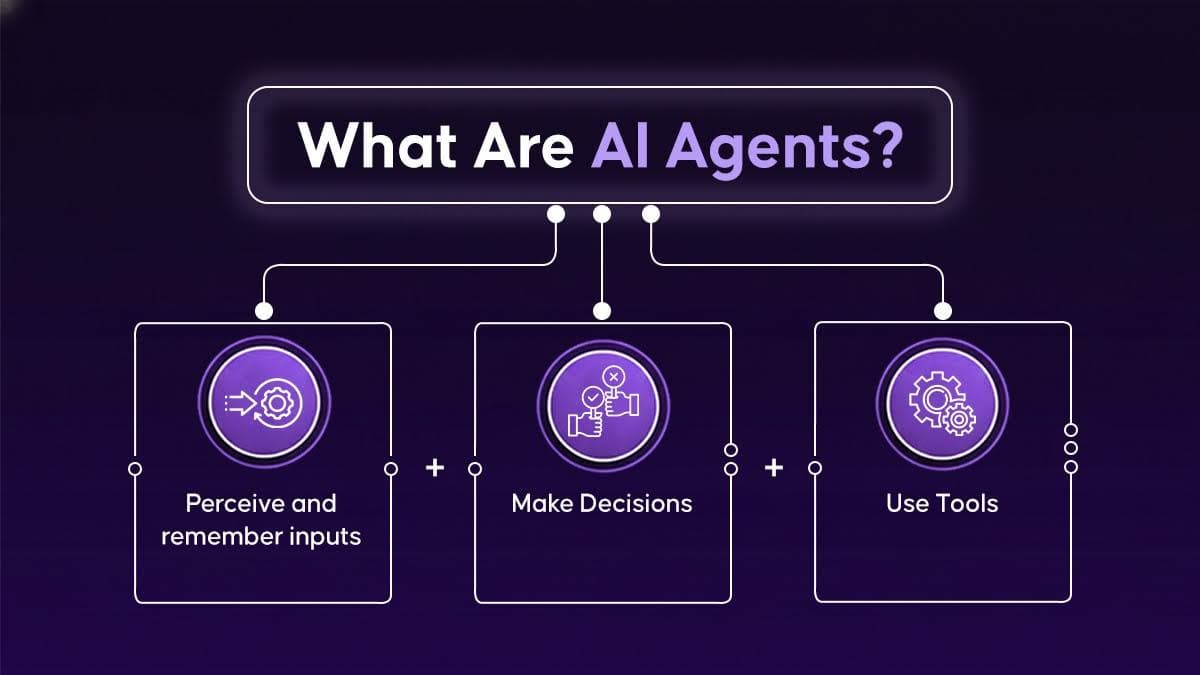
Most content out there, written about AI agents, assumes the reader already knows what an agent is. Even if some do, there’s still a group who don't, or they have an unclear definition. The fastest way to lose a developer or a VP Marketing is to start with a strategy before they understand the subject.
For example, imagine this: A DevOps AI agent receives a Slack message saying "spin up a staging environment for PR #142." It checks the repo, provisions infrastructure, runs tests, and posts results back to Slack without any human touching a dashboard. The agent interprets the intent, decides the steps required, executes them using APIs and tools, and reports the outcome. That combination of reasoning and action is what makes it an AI agent rather than the usual rule-based automation.
A recent study shows that 62% of startupsare experimenting with AI agents but only 23% have scaled them in any function. The gap between experimentation and adoption is a content gap.
That gap shows up first in how discoverable your content is to the crawlers behind these agents. If your team hasn't tackled that layer yet, our guide on AEO for developer tools covers the technical foundations that determine whether GPTBot, ClaudeBot, and PerplexityBot can read and cite your pages at all.
Now Flip It: How AI Agents Help You Build Content at Scale?
It’s no news that AI agents are actively reshaping the content production workflow for B2B SaaS marketing teams.
Research agents like Perplexity, ChatGPT with browsing, and custom RAG pipelines can be configured as research agents. They scan competitor content, identify keyword gaps, pull recent industry data, and surface relevant stats in minutes. What used to take a content strategist 2-3 days now takes 2-3 hours.
B2B SaaS tech content marketing agencies like Infrasity use AI agents like Claudebot to create content roadmaps for customers, identifying relevant topic clusters and structuring long-term content strategies around them. What previously took days of manual research and planning can now be completed in just a few hours.
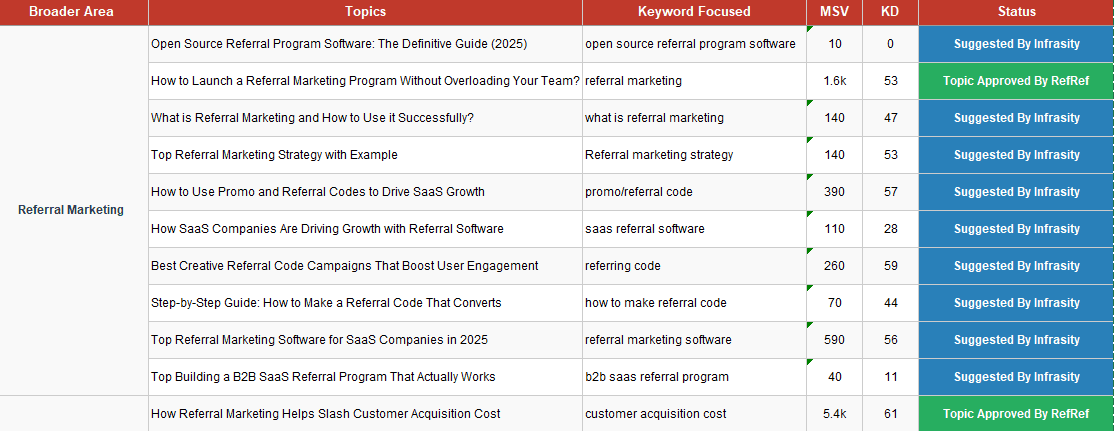
Another example is HubSpot's content teams use GPT-4 not just to write but to identify unanswered customer questions and overlooked content formats, functioning as a brief research agent.
- 84% of marketers using AI report creating content more efficiently (HubSpot 2024 State of Marketing)
- Marketers save an average of 3 hours per content piece using AI tools
- 41% of marketers already use AI to generate content outlines and briefs
According to HubSpot's own survey of 1,000+ marketers, 41% already use AI to generate outlines and briefs, saving an average of 3 hours per content piece.
Some of the Best AI Agent Strategies for Content in 2026
Strategy 1: ClaudeBot: Build Content That Earns Long-Term Authority
ClaudeBot is Anthropic's web crawler, the AI agent that reads public web content to train and update Claude's knowledge base. ClaudeBot is associated with Claude's reputation for prioritising accuracy, nuance, and well-reasoned responses. Content that ClaudeBot indexes and values tends to be dense, technically precise, and written with clear subject-matter depth.
For B2B SaaS startups marketing complex products, DevOps platforms, infrastructure tooling, and AI agents, Claude is actively used by a technical buying audience. Anthropic's Claude Sonnet models are used more by professional developers (45%) than by those learning to code (30%), according to Stack Overflow 2025, making ClaudeBot one of the most valuable crawlers to optimise for if your ICP is a senior engineer or head of engineering.
How does it help build content at scale in B2B SaaS?
Content teams that want ClaudeBot coverage focus on depth over volume. This means long-form technical tutorials with real commands and outputs, comparison content that includes honest trade offs, and documentation that is structured for machine extraction.
A good example of this can be Tally, a bootstrapped form builder with an 8-person team, ChatGPT became Tally's #1 referral source, with over 2,000 new users signing up via AI tools every week, and that figure only captures the ones they could track.
The result translated directly to the bottom line. Tally saw AI search become their biggest acquisition channel, helping them grow from $2M to $3M ARR in just four months.
Strategy 2: GPTBot: Use AI Agents to Find Exactly What Your Technical Buyers Are Searching For
GPTBot is an OpenAI web crawler that continuously scans the public web to train and update ChatGPT's knowledge base. When GPTBot crawls your content, it extracts text, structure, and context from your pages and feeds it into OpenAI's training and retrieval systems. This means every blog post, doc page, and comparison article you publish is a potential input into what ChatGPT recommends when a developer or head of growth asks a buying question.
Note that GPTBot does not generate content, but it finds it, indexes it, and decides what gets cited in ChatGPT answers. 70% of consumers now turn to Generative AI tools like ChatGPT over traditional search methods when looking for product and service recommendations. If GPTBot cannot read your content clearly, ChatGPT will not recommend your product.
How does it help build content at scale in B2B SaaS?
Teams using GPTBot-optimised content workflows structure each article with a direct answer in the first 30% of the text, use clear H2 headers that match how buyers phrase questions, and allow GPTBot access in their robots.txt. The result is the content that scales in reach without scaling headcount and every published piece becomes a candidate for ChatGPT citations that bring in high-intent traffic.
Example: Vercel, the developer deployment platform, is one of the clearest documented cases of GPTBot-optimised content turning into direct pipeline. ChatGPT now refers around 10% of new Vercel signups up from 4.8% the previous month, and 1% six months ago.
This happened because Vercel's content was already structured the way GPTBot rewards: static, crawlable documentation, thousands of pages explaining technical concepts in depth, and an active community presence in forums where developers ask buying questions.
Strategy 3: PerplexityBot - Turn Real-Time Web Conversations into Content That Gets Cited
PerplexityBot is the crawler behind Perplexity AI, the answer engine that pulls live web content to generate cited, sourced responses in real time. It is an active, real-time retrieval agent that crawls the live web continuously to find the most current, credible content for immediate use in answers.
This makes Perplexity's citation behaviour structurally different. It favours freshness, community validation, and source diversity over domain authority alone. Domains with millions of brand mentions on Quora and Reddit have roughly 4x higher chances of being cited by ChatGPT than those with minimal activity. This same dynamic applies to Perplexity, where Reddit threads are a dominant citation source, meaning if you post your tech content on platforms like Reddit, there’s a better chance of visibility.
Now, how does it help build content at scale?
For B2B SaaS content teams, PerplexityBot demands a two-track strategy: long-form structured blog content on your own domain, plus active seeding of developer communities that Perplexity crawls and cites.
A developer asking Perplexity "what's the best tool for Kubernetes environment automation" will get an answer pulled from Reddit threads, GitHub READMEs, and recently published blogs. Being present in those communities is now a content marketing decision.
The practical workflow: publish the detailed tutorial on your blog, then seed a discussion thread about the same use case in r/devops or r/devtools. PerplexityBot crawls both. The thread surfaces in Perplexity answers, which allows your tech content blog to get a backlink.
Strategy 4: GeminiAgent- Optimise for the AI That Already Owns Search
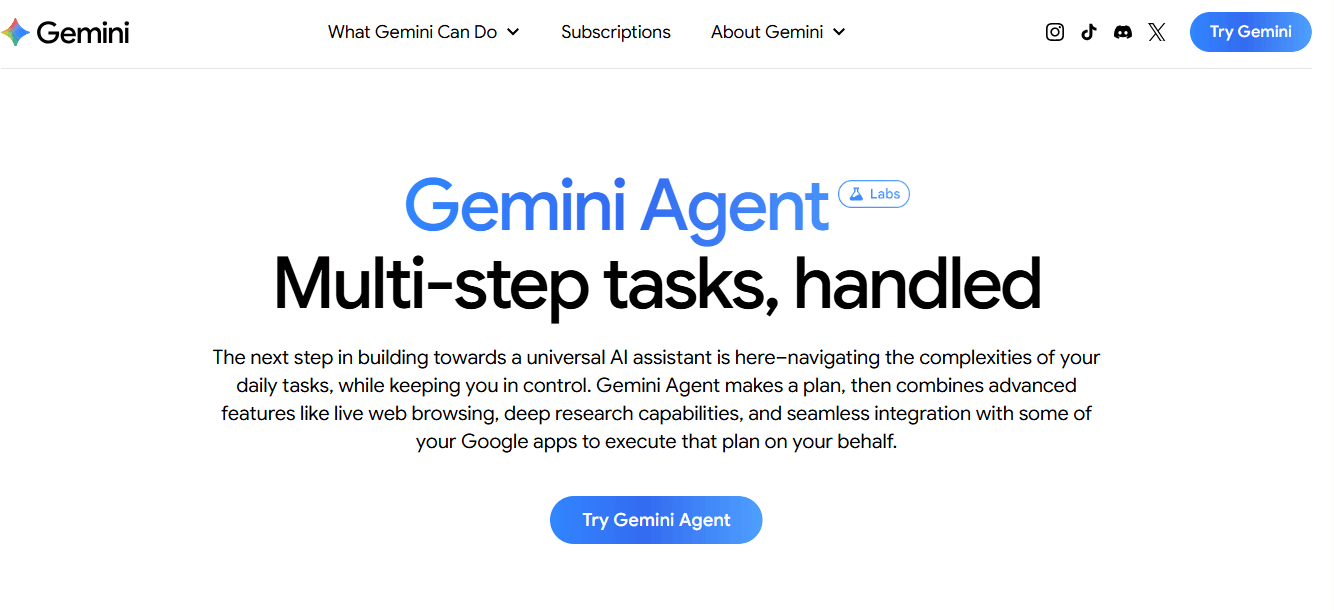
GeminiAgent is Google's Gemini-powered AI agents, the autonomous, task-executing layer built on top of Google's Gemini 2.5 models and embedded across Google's entire product ecosystem.
This includes Google AI Overviews, which now appear at the top of search results, Gemini Deep Research, Google Workspace's AI layer, including Gmail, Docs, Sheets, and Slides, and Vertex AI for enterprise deployments. GeminiAgent operates inside the tools your buyers already use every day.
This is important for people like us in the B2B SaaS industry because Google Gemini AI Overviews now dominate 30% of SaaS-related searches in 2026, fundamentally altering how potential customers discover software solutions. GeminiAgent is not a separate discovery channel as it sits directly on top of Google Search, where most enterprise buying research still begins.
But how does it help build content at scale?
The content strategy implication is structural because GeminiAgent synthesises your developer content into a 3-5 sentence answer, often with 3-6 source citations, before your buyer ever clicks a link.
AI Mode shifts search from click-first to answer-first, users can stay in a conversation, ask refinements, and rely on summaries plus links. Your tech content needs to be built for both the summary layer and the click layer simultaneously.
Practically, this means every high-value page needs "citation-friendly blocks": short factual paragraphs with clear definitions, comparison tables, FAQ sections, and timestamped data points. Publishing original insights like frameworks, checklists, and benchmark comparisons gives Gemini something unique to cite.
GeminiAgent also pulls from Google Workspace data. Gemini Deep Research can generate detailed multi-page reports by pulling from Gmail, Drive, and Chat. This means enterprise buyers are now using Gemini to research vendors using their own internal documents alongside your published tech content.
Deciding how much of this content should be built for extraction (AEO) versus synthesis (GEO) is its own strategic question. We break down that distinction, and when to prioritize each, in AEO vs GEO: what's the right optimization strategy.
Example: A B2B SaaS marketing team in the AI marketing space identified that AI-driven traffic represented only 1.2% of total organic sessions despite strong traditional SEO performance.
An audit revealed their articles were structured as keyword-dense prose rather than question-answer format. After restructuring content with citation-friendly blocks, launching an original research report that earned coverage in TechCrunch, Marketing Week, and Search Engine Journal, and connecting GA4 AI referral monitoring the team generated 14 demo requests attributed to AI referral traffic in 90 days, compared to zero in the prior 90 days.
Strategy 5: DeepSeek R1- Most Cost-Efficient Reasoning Agent to Build Technical Content at Scale
DeepSeek R1 is an open-source reasoning model that shocked the global AI industry when it launched in January 2025, matching or beating GPT-4 and Claude 3.5 on multiple benchmarks at a fraction of the cost.
Its defining feature is the chain-of-thought reasoning, and it shows its step-by-step thinking process, making it exceptionally strong at complex analysis, technical writing, and structured content generation.
For B2B SaaS content teams, DeepSeek R1's relevance is twofold. First, it is a production tool, a genuinely powerful reasoning agent that marketing and engineering teams can deploy for a fraction of the API cost of comparable models. The API version of DeepSeek R1 is 27x cheaper than OpenAI's O1, meaning teams can run far more content research and drafting workflows without blowing through API budgets. Second, it is a distribution signal and its rapid adoption means it is becoming an answer engine that technical buyers are actively querying.
How does it help B2B SaaS teams?
The most direct application for B2B SaaS content teams is using DeepSeek R1 as a deep research and technical drafting agent. As mentioned before, its chain-of-thought reasoning is particularly well-suited to tasks that require structured logical output, competitive analysis briefs, technical comparison articles, architecture explainers, and compliance documentation. It can help your team and do the groundwork, hence improving your team’s efficiency.
Example: FuseBase, a B2B SaaS client collaboration platform, deployed DeepSeek R1 as a reasoning agent for buyer journey mapping and content personalisation. Paul Dordevic, CEO of FuseBase, uses DeepSeek to analyse customer interaction patterns and generate content mapped to buyer journey stages, a direct application of DeepSeek's chain-of-thought reasoning to the problem of matching technical content to the right stage of the buying cycle.
The cost case for doing this at scale is straightforward. The API version of DeepSeek R1 is approximately 27x cheaper than OpenAI's O1 meaning content research and drafting workflows that would break the budget on GPT-4o can run continuously on DeepSeek without burning through API spend.
Quick Comparison of the AI Agents for Your Team
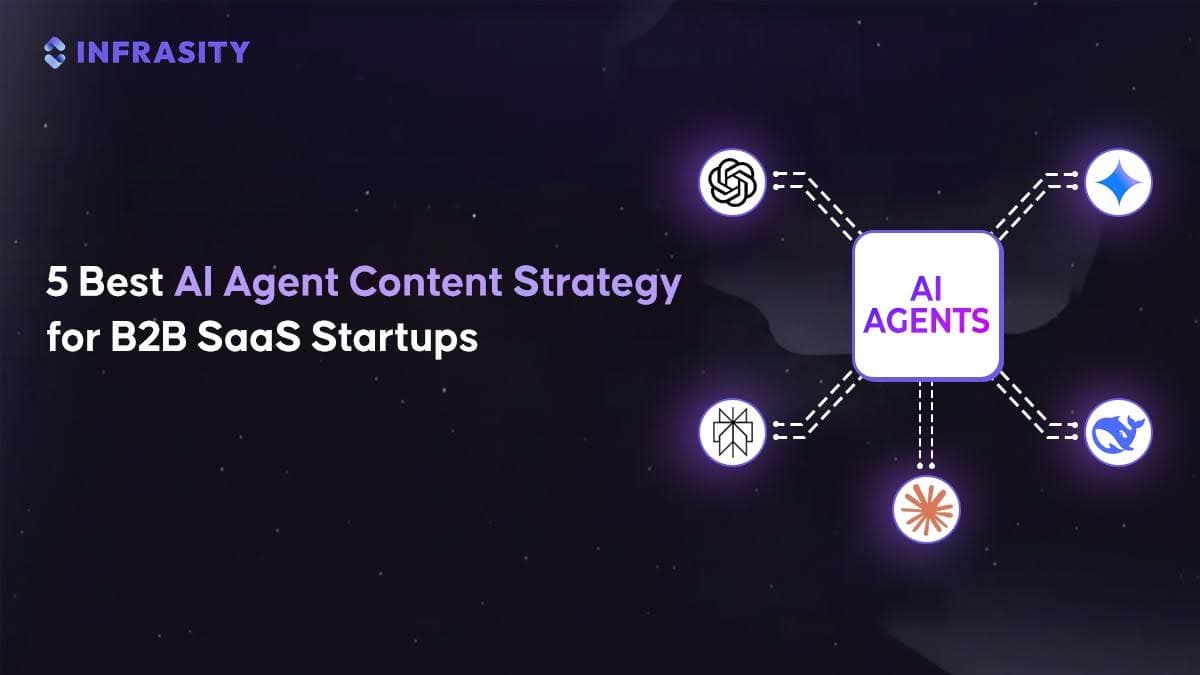
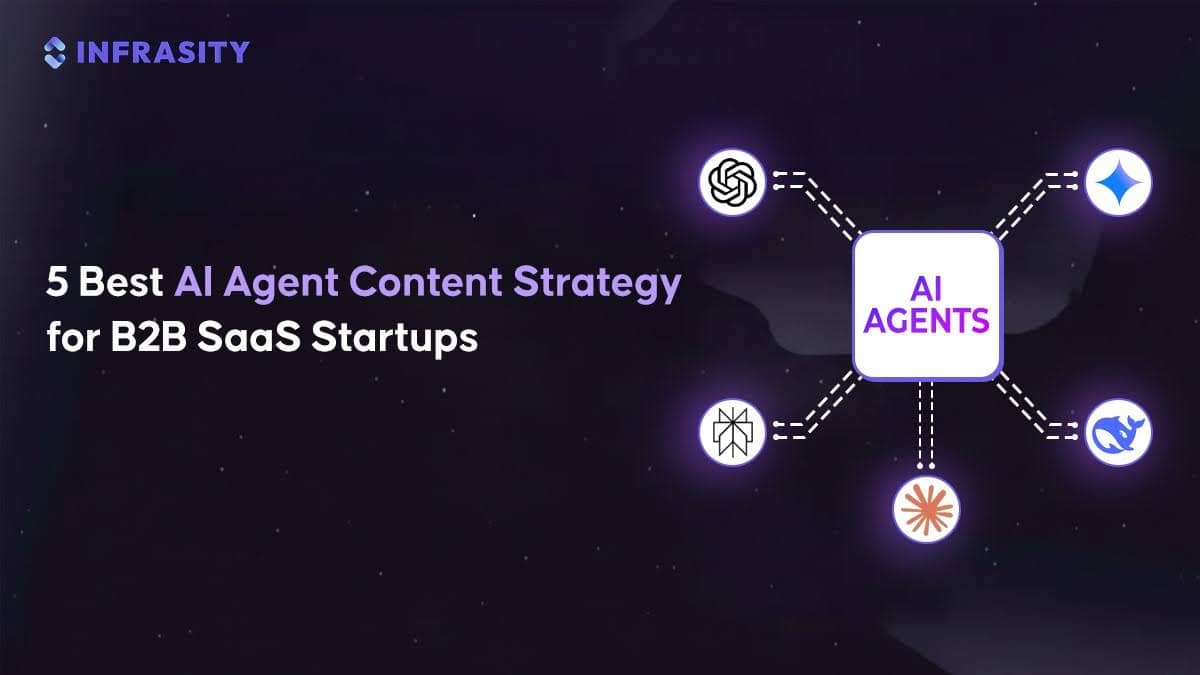
For B2B SaaS teams building an AI agent content strategy, understanding the role of each agent helps prioritise where to optimise content and where to use AI internally for production.
| AI Agent | Type | Primary Role | How It Impacts B2B SaaS Content |
|---|---|---|---|
| ClaudeBot | Web crawler / indexing agent | Crawls web pages to train and update Claude models | Rewards deep technical content, tutorials, and structured documentation that demonstrate subject-matter expertise |
| GPTBot | Web crawler / indexing agent | Collects and processes web content for ChatGPT training and retrieval | Structured blogs, answer-first content, and clear headings increase chances of being cited in ChatGPT responses |
| PerplexityBot | Real-time retrieval agent | Continuously scans live web sources for Perplexity AI answers | Fresh content, Reddit discussions, GitHub documentation, and recently published blogs get cited more frequently |
| GeminiAgent | Search-integrated AI agent | Synthesizes content into Google AI Overviews and Gemini responses | Citation-ready blocks, definitions, FAQs, and original research improve visibility in AI search summaries |
| DeepSeek R1 | Reasoning AI agent | Performs deep reasoning, research, and structured content generation | Helps marketing teams run competitive research, draft technical articles, and generate structured content at lower cost |
Conclusion
Let's go back to where this started. You're a Head of Growth, a VP Marketing, or a founder running GTM at a B2B SaaS startup. You're publishing content. You have a calendar. You have a team, or at least a freelancer you trust.
But the pipeline from content isn't moving. The developers reviewing your product don't engage with what marketing writes. And somewhere in the back of your mind, you know that a buyer just asked ChatGPT or Perplexity which tool solves their problem, and your product didn't come up.
That's not a content volume problem. That's a content strategy problem. And it's exactly what this blog set out to solve.
If you want to see exactly where those gaps are before committing to an agent-content workflow, our AI visibility for B2B SaaS content hub launch playbook walks through how we identify what to publish, where to distribute it, and which existing pages to fix first.
Frequently Asked Questions
1. How do I know if our content is actually being cited by ChatGPT, Perplexity, or Gemini, and how do I start tracking it?
Start by running your top 10 buyer-intent queries directly into ChatGPT, Perplexity, and Gemini in incognito mode. Note which startups get cited, what content format they use, and whether your domain appears. For ongoing tracking, tools like Profound (backed by Sequoia Capital) and GrackerAI track brand mentions and citation share across multiple AI engines simultaneously. In Google Analytics 4, monitor referral traffic sources for chat.openai.com, perplexity.ai, and AI-driven Google sessions.
2. What are the best software early stage marketing agencies for tech startups?
Early-stage tech startups often need marketing partners that understand developer audiences and product-led growth. Growth marketing agency for developer tools like Infrasity focuses on technical storytelling, developer tutorials, and AI-search-optimized content for infrastructure and SaaS startups. Others like Animalz specialize in long-form SaaS thought leadership, while Omniscient Digital focuses on SEO-driven growth programs. The right choice depends on your stage, but startups building developer tools usually benefit most from agencies that combine technical writing with growth strategy, helping products gain visibility through educational content rather than traditional marketing.
3. How do AI agents work?
AI agents work by combining large language models with tools, memory, and decision-making loops to complete tasks autonomously. They typically follow a cycle where they observe inputs, reason about the task, take actions using tools or APIs, and evaluate the results before continuing. For example, an AI agent might receive a request, analyze the context, retrieve information from a database, execute a workflow such as running code or provisioning infrastructure, and then return the result to the user. This ability to plan, act, and adapt across multiple steps is what distinguishes AI agents from simple AI chatbots.
4. How can AI agents help marketing teams produce content faster?
AI agents can assist marketing teams by automating research, identifying topic clusters, generating outlines, analyzing competitor content, and summarizing technical documentation. This reduces the time required for content planning and briefing while allowing marketers to focus on refining the narrative and technical accuracy.
5. Are there developer marketing agencies that specialize in open source companies?
Yes. Open source startups like Infrasity often rely on community engagement and technical content rather than traditional marketing. PLG marketing agency for developer tools like Infrasity helps open source and developer infrastructure companies create tutorials, integration guides, and technical blogs that drive adoption.
6. Which developer marketing agency should I hire for my API startup?
API startups need marketing that speaks directly to developers. That usually means technical tutorials, integration guides, SDK walkthroughs, and documentation-driven SEO rather than traditional marketing campaigns. B2B SaaS developer marketing agencies like Infrasity specialize in developer-focused content that explains real API use cases and integrations. For most API startups, the best agency is one that combines technical writing with developer SEO, helping engineers discover and adopt the API through practical content.