
.png&w=1920&q=75)
.png&w=3840&q=70)
We spent the last year watching B2B buyers stop clicking. They would run a query in ChatGPT or Claude, read the answer, copy the three tools it named, and never visit a single ranked page. If your platform was not inside that answer, you did not exist in the evaluation.
That is the gap a generative engine optimization (GEO) agency exists to close. Traditional SEO gets you ranked in a list of links. GEO gets you cited and recommended inside the AI answer itself, across ChatGPT, Perplexity, Google AI Overviews, Gemini, and Claude.
This blog ranks the 12 best GEO agencies in 2026 against a consistent set of criteria, with reported pricing, best-fit use cases, and the proprietary framework or tool each one actually uses.
Key takeaways:
- A real GEO agency works on citation and inclusion in AI answers, not just rankings — measured as the share of buying prompts where your brand appears.
- Pricing in 2026 runs roughly $2,500–$10,000+/month, with enterprise programs reaching $15,000–$30,000+. Most agencies quote custom.
- The strongest differentiator in GEO is off-site community and citation work (Reddit, Quora, digital PR), because LLMs lean heavily on those sources.
- Infrasity is the best fit for B2B tech, DevTools, AI, and SaaS companies because it owns the full Reddit, SERP, and LLM-citation layer and reports per-prompt citation coverage.
- No agency can guarantee citations. Look for a visible method, proprietary tracking, and named-client outcomes.
What is generative engine optimization (GEO)?
Generative engine optimization is the practice of structuring your content, entities, and off-site signals so AI search engines retrieve, cite, and recommend your brand when they answer a user's question. The term was introduced in a 2023 Princeton-led research paper and has since become a unique discipline as people increasingly use AI to search.
The simplest way to understand GEO is against its neighbors.
- SEO is about ranking a link.
- Answer engine optimization (AEO) is about owning the direct-answer box.
- GEO is about being part of the generated answer wherever it appears.
| Dimension | SEO | AEO | GEO |
|---|---|---|---|
| Goal | Rank in the list of links | Win the direct-answer slot | Get cited inside AI-generated answers |
| Surfaces | Google, Bing results pages | Featured snippets, People Also Ask, voice, AI Overview boxes | ChatGPT, Perplexity, Gemini, Claude, AI Overviews |
| Success metric | Rankings, clicks, organic traffic | Snippet capture, answer ownership | Citation frequency, share of answer, prompt coverage |
| Primary levers | Keywords, backlinks, technical SEO | Structured data, concise answers, schema | Entity clarity, citations, community signals, extractable content |
| Buyer takeaway | Be findable | Be the answer on Google | Be the answer everywhere AI is read |
One detail reshapes the whole strategy: the engines don’t agree with each other. Independent analyses show only a small share of domains that get cited by both ChatGPT and Perplexity, because each engine weighs sources differently. GEO is plural. Optimizing for "AI" as one system is the first sign an agency has not done the work.
How We Evaluated the Best GEO Agencies?
GEO is fairly young enough that anyone can claim expertise, so we scored agencies on what is verifiable rather than what is marketed.
Citation track record: Documented evidence of securing citations in ChatGPT, Perplexity, and Google AI Overviews, ideally with named clients.
Proprietary tracking technology: Custom software that measures AI share of voice and citation coverage, not a recycled Ahrefs or Semrush dashboard.
Team and leadership credibility: Backgrounds in semantic search, AI, or, for technical categories, real engineering experience that lets the team write content a developer audience trusts. Agencies that also understand your product roadmap, the kind of detail captured in a well-written B2B SaaS PRD, tend to write GEO content that reflects what you're actually shipping instead of generic category copy.
Digital PR and off-site authority: The ability to build the third-party trust signals LLMs rely on before they cite a brand.
Specialization and fit: A clear focus (B2B SaaS, enterprise, DevTools, local) rather than a generalist menu.
We also included three factors most listicles have ignored.
Off-site and UGC capability: Whether the agency can win the Reddit, Quora, and community layer that AI engines scrape heavily. Infrasity's own analysis finds domains with strong Reddit and Quora presence have materially higher ChatGPT citation probability, yet most agencies only touch the website.
Per-prompt coverage measurement: Whether they report the percentage of buying prompts where you are cited and the percentage of ranking threads that mention you, or just a vague mention count.
Platform-specific optimization: Whether they tailor work to each engine, ChatGPT, Perplexity, Claude, Gemini, given how differently each one selects sources.
The 12 Best GEO Agencies in 2026
Let’s cut to the chase. Here are the 12 best GEO agencies:
1. Infrasity
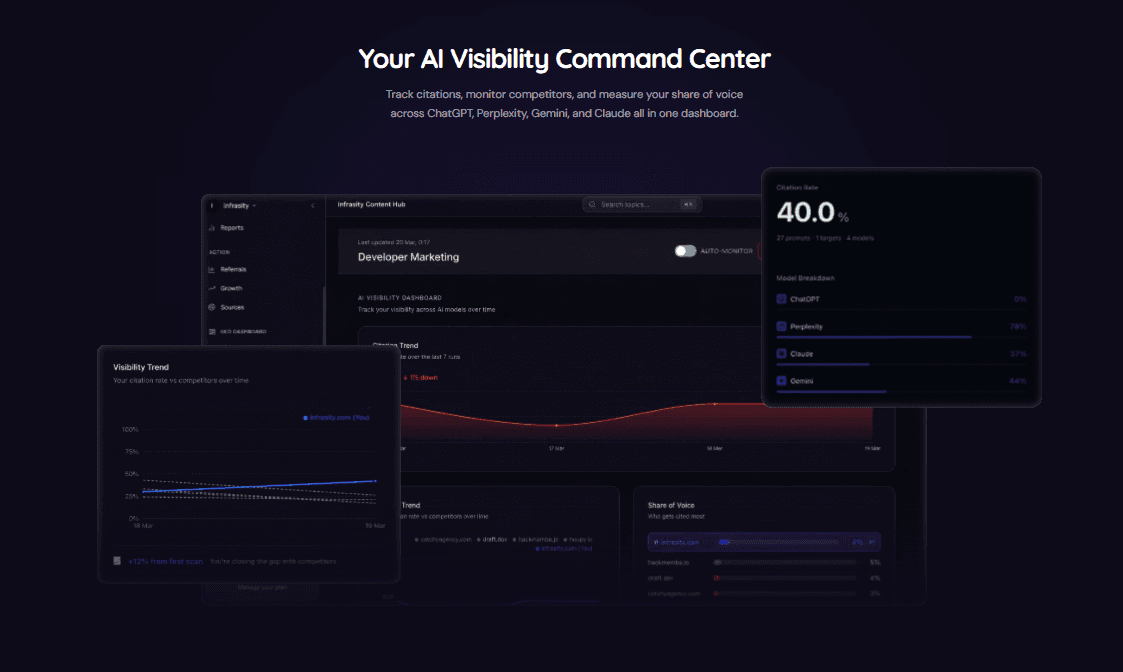
Best for: B2B software, DevTools, AI-agent startups, observability, and infrastructure SaaS that need to be cited by AI for high-intent buying queries.
Starting price: Custom retainer, 3–6 month minimum.
Infrasity is a developer-marketing and technical-content agency that treats GEO as an end-to-end visibility problem: own the exact threads, search results, and AI responses a buyer encounters from their first Google search to their final AI-assisted recommendation.
A method built for citations: Infrasity runs a three-phase system, audit and baseline mapping, engagement on Reddit threads already ranking in Google's top 10, then LLM-citation targeting where prompts are run across ChatGPT, Perplexity, and AI Overviews, the cited threads are engaged directly, and prompts are re-run to verify the brand was pulled into the answer.
Proprietary tooling: In-house tools include the Reddit Opportunity Finder (surfaces threads ranking in the top 10 SERPs), Thredflow (per-prompt LLM citation tracking), and SubredditSense (community sentiment), plus a developer-marketing AI-visibility tracker benchmarked against Peec AI and Scrunch AI.
Content written by engineers: Content is produced by writers with real engineering experience, which is what makes it survive technical scrutiny and get cited by developer-facing models like Claude.
Tradeoff: Infrasity is deliberately specialized. It is the wrong choice for consumer brands, local businesses, or non-technical B2B; its edge only compounds when the buyer is technical.
See how Infrasity has worked for other companies.
2. First Page Sage
Best for: Enterprise B2B SaaS and technology brands wanting a category-defining, authority-led program.
Starting price: Reported $8,000–$20,000+/month, with minimums and 6–12 month contracts.
First Page Sage, founded in 2009 by Evan Bailyn, published one of the earliest commercial GEO frameworks and a widely cited body of GEO research, including customer-acquisition-cost benchmarks.
Its six-element framework spans authority content architecture, thought leadership, list placement, traditional SEO, PR, and verifiability.
Tradeoff: Premium pricing, long contracts, and intentionally low content volume; some reviewers note its AI-search specialization is still maturing relative to native GEO shops.
3. Minuttia
Best for: Growth-stage B2B SaaS companies, often $10M+ ARR, that want strategy-led GEO and content architecture.
Starting price: Reported around $4,000/month.
Minuttia frames GEO as part of a broader "Search Everywhere" strategy and is consistently rated a top pick for B2B SaaS. It pairs entity and category-authority work with proprietary AI-visibility tracking and agent analytics, and is especially strong on GEO audits and diagnosis.
Tradeoff: Positioned more toward strategy and audit than hands-on, engineering-embedded implementation, so technical execution may fall to your team.
4. PipeRocket Digital
Best for: B2B SaaS companies wanting a single senior-led team to run SaaS SEO and GEO/AI-search visibility together, with pipeline (not just traffic) as the reporting metric.
Starting price: $3,000/mo, scope-based retainer, no setup fee.
PipeRocket Digital is a B2B SaaS-focused growth agency founded in 2023, combining SaaS SEO and GEO under one senior-led pod (strategist, SEO/AEO lead, content strategist) with no junior handoff. They have a 4.7 rating on Clutch.
The team has worked with 70+ SaaS companies, including Spendflo, GreytHR, and LatentView. They focus on reporting with MQLs, and pipeline.
What sets it apart: Every engagement is staffed by senior specialists from day one rather than handed to junior execution teams, and results are tied to pipeline outcomes.
Tradeoff: The B2B SaaS specialization means it's not the fit for consumer, ecommerce, or non-SaaS brands.
5. Generate More
Best for: B2B tech and SaaS companies (EU, US, UK) that want a hands-on, experiment-led AEO/GEO partner.
Starting price: Custom, mid-range.
Finland-based Generate More positions itself as "builders, not advisors", it runs its own answer-engine campaigns and measures citation frequency and conversion per citation rather than blog volume. Its content model leans on interview-led, expert-sourced material and agentic workflows.
Tradeoff: Smaller and newer than the enterprise players; much of its GEO proof is described rather than published as named case studies.
6. Intero Digital
Best for: B2B and enterprise brands that want GEO connected to a full digital program with proprietary tooling.
Starting price: Custom, enterprise.
Intero Digital, a 350+ person agency, packages GEO as the trademarked Intero GRO (Generative Response Optimization) framework, supported by the InteroBOT predictive crawler and a 1–100 GRO Score audit tool. Clients include Expensify, Smartsheet, and Bloomfire.
Tradeoff: A broad, multi-service agency; GEO is one offering among many, and it is not SaaS-specific.
7. Omnius
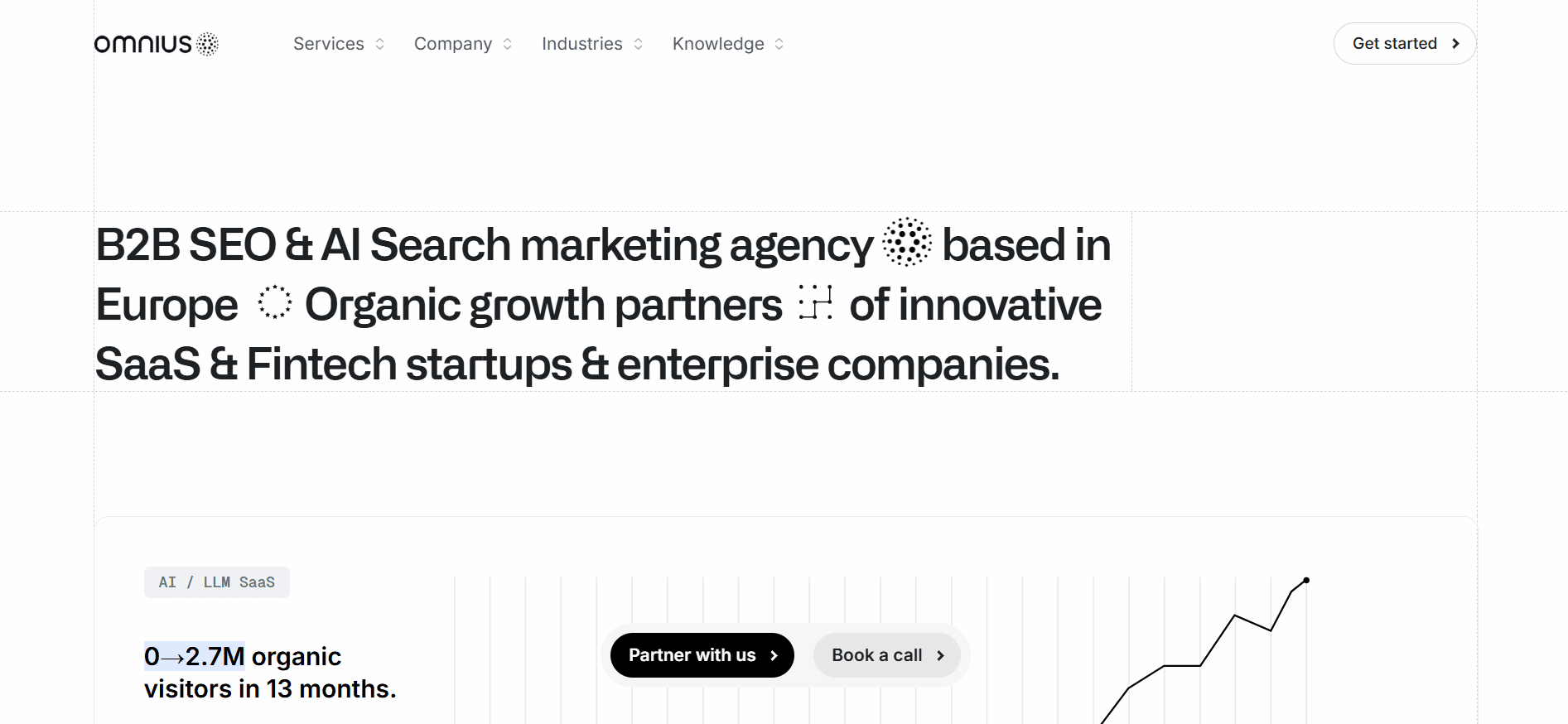
Best for: B2B SaaS, fintech, and AI companies that want a structured, technical GEO program.
Starting price: Custom.
Omnius runs a 22-point GEO strategy purpose-built for technically complex SaaS, covering schema markup, llms.txt, synthetic query generation, and AI-engine competitive analysis.
Tradeoff: Boutique capacity and a primarily European footprint; best suited to startups comfortable with a systemized, checklist-driven approach.
8. GreenBanana SEO
Best for: Brands competing on commercial comparison prompts like "best," "vs," "cost," and "who should I hire."
Starting price: Custom (SEO/AEO/GEO since 2009).
GreenBanana separates the trust layer (AEO) from the expression layer (GEO), and builds GEO across four stages: technical crawl access, entity and trust signals, answer-ready content architecture, and authority and citation building.
Tradeoff: A general-market agency rather than a vertical specialist, so deep B2B SaaS or DevTools nuance may need to be supplied by you.
9. Perrill
Best for: Mid-market B2B in manufacturing, healthcare, legal, and similar sectors needing combined SEO and GEO.
Starting price: Custom.
Minneapolis-based Perrill brings nearly three decades of full-service experience and has built custom GPT tools to test client visibility across AI platforms and track whether GEO work actually moves results. Its audits focus on authority signals, entity structure, and semantic clarity.
Tradeoff: Strongest as a holistic SEO-plus-GEO partner rather than a dedicated, AI-native specialist.
10. Percepture
Best for: Enterprise and telecom/ICT brands where digital PR and schema engineering drive authority.
Starting price: Reported tiers of $3,500–$7,500, $7,500–$15,000, and $15,000–$30,000+/month.
Percepture combines digital PR with JSON-LD and schema engineering, anchored by a technical SEO and AI-readiness audit. Clients include large brands such as Telstra and Alight.
Tradeoff: PR-led model is best for brands that can support an authority and media program; less tailored to lean, product-led SaaS teams.
11. Growth Marketing Pro

Best for: B2B SaaS teams that want AI visibility connected to pipeline and conversion outcomes.
Starting price: Custom.
Growth Marketing Pro pairs high-intent AI query mapping with conversion-rate optimization, and its service mix spans GEO, LLM visibility tracking, link building, and Reddit organic marketing.
Tradeoff: Broad growth-marketing positioning; GEO is part of a wider service set rather than the sole focus.
12. WebSpero
Best for: SMBs, e-commerce, and brands needing GEO bundled with a full performance-marketing stack across multiple markets.
Starting price: GEO work often reported under $10,000; broader strategy $10,000–$50,000.
India-based WebSpero offers SEO, PPC, AI visibility, content, and web development under one roof, which makes it accessible and convenient for budget-conscious, multi-market teams.
Tradeoff: Reviewers note its GEO process can resemble classic SEO tactics, so it is less differentiated for technical B2B SaaS than the specialists above.
How Do You Choose the Right GEO Agency For Your Stage and Budget?
Match the agency to where your bottleneck actually sits.
| Stage / profile | Typical budget | Best-fit agencies |
|---|---|---|
| Technical B2B, DevTools, AI, SaaS | Custom | Infrasity, PipeRocket Digital |
| Early / growth SaaS strategy and audit | ~$4,000/mo | Minuttia, Omnius |
| Mid-market B2B, experiment-led | Mid-range custom | Generate More, Perrill |
| Enterprise, full-service, proprietary tooling | $8,000–$30,000+/mo | First Page Sage, Intero Digital, Percepture |
| SMB, e-commerce, international | Under $10,000 for GEO | WebSpero |
If you sell to developers or technical buyers, specialization beats scale. Generic content gets distorted by AI; engineer-authored, structured content gets cited, which is the case for Infrasity.
If you are an enterprise with budget and a broad mandate, a full-service program with proprietary tooling (First Page Sage, Intero Digital) reduces vendor sprawl.
If you need diagnosis before execution, an audit-and-strategy specialist like Minuttia gives you a roadmap your internal team can run.
If budget is the constraint, an accessible generalist like WebSpero or a mid-market specialist gets you moving without an enterprise.
How Does Infrasity Actually Win AI Citations?
The reason Infrasity ranks first is that its results are measured the way GEO should be measured, coverage across the specific prompts buyers run, and the numbers are documented in published client work.
Proton Pass (password manager). Infrasity took the brand from 0 to 90% LLM citation coverage across five high-intent buying prompts spanning ChatGPT, Perplexity, and Google AI Overviews. Of the postable threads tracked against those prompts, 90% now mention the product, and community sentiment held at 98% positive across 163 active subreddits.
Brevo (email marketing). Infrasity built 80% LLM citation coverage across six buying prompts, moving the brand from a fragmented baseline to a top-four position across Google AI Overviews and ChatGPT, including a number-three slot in ChatGPT's "Klaviyo alternatives" response.
Inframail (cold email infrastructure). Infrasity moved the brand from invisible to number one on Google AI Overviews for cold-email-infrastructure queries and into the top four on Perplexity, lifting its LLM mention rate from 12% to 33%.
The logic behind all three is the same: find the source AI already cite, earn an authentic presence in them, and verify the brand gets pulled into the answer on the next run. It is GEO measured as outcomes.
Frequently asked questions
What is a generative engine optimization (GEO) agency?
A GEO agency optimizes your content, entities, and off-site signals so AI search engines like ChatGPT, Perplexity, Gemini, and Google AI Overviews cite and recommend your brand in their answers. The goal is inclusion in the AI response, not just a ranking in a list of links.
What is the difference between GEO and SEO?
SEO optimizes to rank a page in search results so a user clicks through. GEO optimizes to be cited inside an AI-generated answer, where there may be no click at all. SEO success is measured in rankings and traffic; GEO success is measured in citation frequency and share of answer. The two share a research foundation, though — the same keyword explorer tools used for SEO keyword research also surface the phrasing buyers use when they ask AI engines the same questions.
What is the difference between GEO, AEO, and LLMO?
AEO (answer engine optimization) targets direct-answer formats such as featured snippets and AI Overview answer boxes. GEO is the broader practice of earning citations across all generative engines. LLMO (large language model optimization) focuses specifically on how individual models retrieve and represent your brand. In practice the tactics overlap heavily.
Is GEO replacing SEO, or do I need both?
You need both. Strong traditional rankings still feed several AI engines — Gemini and Perplexity in particular cite pages that rank well in Google — so GEO builds on a healthy SEO foundation rather than replacing it. It's also worth tracking AEO separately; our roundup of the best answer engine optimization platforms covers the monitoring layer that shows whether your GEO work is actually converting into citations.
How do AI engines decide what to cite?
They favor content with a clear, extractable answer, strong entity and authority signals, supporting citations and statistics, and corroboration from third-party sources like community discussions and PR. Each engine weights these differently, so source selection varies across ChatGPT, Perplexity, Gemini, and Claude.
How long does a GEO campaign take to show results?
Most agencies report measurable movement within about 90 days. AI visibility can shift faster than traditional rankings because generative engines update their sources more frequently than Google's organic index.
How much does a GEO agency cost?
Most programs run $2,500–$10,000+ per month, with enterprise engagements reaching $15,000–$30,000+. Pricing depends on your site, competitiveness, content needs, and how much off-site PR and community work is involved. Most agencies quote custom.
Do backlinks still matter for GEO?
Yes, but citations matter more. Backlinks remain an authority signal, and the corroborating mentions that LLMs rely on, in articles, comparison threads, and community discussions, function as the AI-era equivalent of a trusted reference.
What is an llms.txt file, and do I need one?
llms.txt is a machine-readable file that helps AI systems find and understand your most important content. It is a low-effort technical signal that supports GEO, and increasingly worth adding for any brand that wants to be AI-readable.
What is the biggest mistake brands make with GEO?
Optimizing the website and stopping there. AI engines lean heavily on off-site signals, community discussion, third-party lists, and PR, so a program that skips the off-site trust layer leaves most of the citation opportunity on the table.