
TL;DR
- Several B2B SaaS startups’ competitors are showing up in Gemini while they aren’t. Doing “everything right” in SEO still doesn’t appear in Gemini answers because Gemini doesn’t rank pages the same way.
- It selects sources it can trust, extract, and reuse. Without understanding those signals, visibility feels random and competitors win by default.
- Ranking in Gemini means being cited, because it selects sources it can trust, extract, and confidently reuse inside AI Overviews.
- SEO for Gemini (GEO) builds on strong fundamentals like ongoing SEO, crawlability, content freshness, and technical performance, but it shifts focus to citations and reuse.
- Trust signals are very important. Demonstrating E-E-A-T, using schema markup, and publishing citation-ready technical content directly influence Gemini visibility.
- This blog breaks down how to rank in Gemini in 2026, covering how Gemini works, how it selects sources, and the exact strategies B2B SaaS teams need to win visibility in AI-driven search.
Organic search is no longer delivering the visibility it once did, and that’s a problem every Growth Head, VP of Marketing, and SaaS founder needs to face. Today, 59.7% of Google searches end without a click to any website, meaning users get their answers directly on the search page instead of visiting your content, a trend that has accelerated with AI Overviews and generative search experiences.
This shift has broken the old SEO playbook: ranking #1 no longer guarantees discovery, and traditional metrics like organic clicks and traffic are collapsing as “zero-click” behavior becomes the norm. It's part of a broader pattern across AI search engines reshaping how buyers find and trust information, not just Gemini alone.
At the same time, being cited in an AI answer, especially in Google Gemini’s AI Overviews, has become the new benchmark for visibility. Instead of optimizing for clicks, the real goal now is being referenced inside AI-generated answers when buyers ask questions about your category, a dynamic that plays out just as much when learning how to rank on ChatGPT as it does with Gemini.
In this blog, we’ll break down how ranking in Gemini works and why clicks are disappearing, some proven strategies that will help your B2B SaaS startup to rank in Gemini, including ongoing SEO, content structure, trust signals, and schema. Let’s begin.
What is AI Citation?
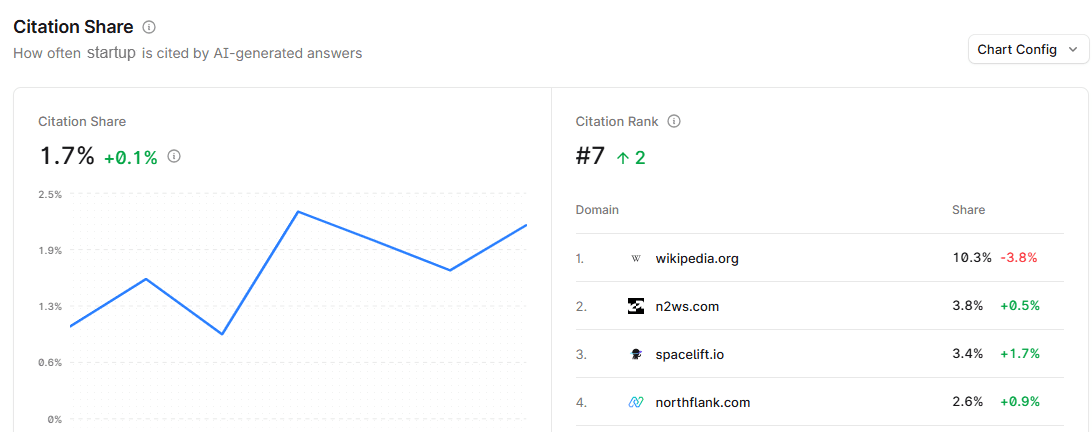
AI citations are linked references to specific webpages or sources that AI systems like Google Gemini use to help generate or support a response. These citations, as shown in the image below, directly influence how your B2B SaaS startup is represented, discovered, and trusted.
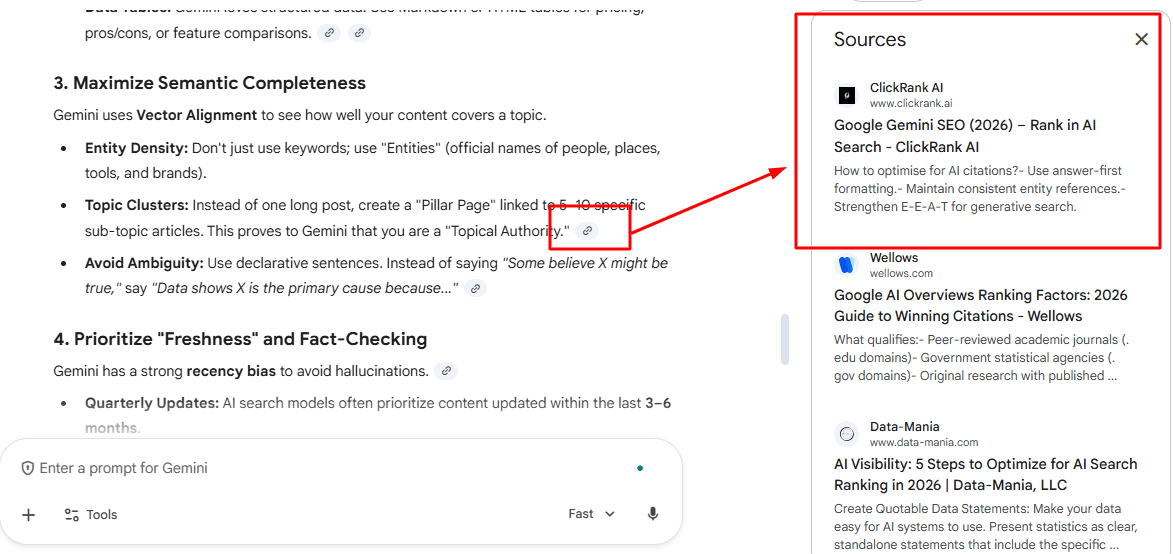
AI citations are important as they determine which sources models rely on when answering relevant prompts, and whose perspective gets amplified. These AI citations can impact your startup in 2 key ways:
- First-party citations (citations that reference your own website or content) increase brand visibility, reinforce authority, and can direct qualified traffic back to your site. When Gemini pulls from your developer content, your startup becomes the default source of truth in that category.
- Third-party citations (citations that reference external websites) also affect your business, especially when those sources mention your product, competitors, or market positioning. Favorable third-party coverage can strengthen credibility, while competitor-dominated citations can dilute visibility.
How Does Ranking On Gemini Work?
Google Gemini is shifting search from a list of links to an answer-first experience. Instead of ranking pages alone, Google now uses Gemini to generate AI Overviews, synthesized answers built from multiple trusted sources and shown directly in search results.
When you rank in Gemini, your content isn’t just listed, it’s used. Gemini evaluates sources based on discoverability, structure, and trust, then pulls explanations and data directly into its answers. This shift introduces SEO for Gemini, also known as Generative Engine Optimization (GEO). Unlike traditional SEO, Gemini SEO focuses on:
- Becoming a source that AI systems trust and cite
- Structuring content for extraction and reuse
- Showing up in AI-generated answers, not just blue links
Take a look at the image below, an example of how if you add a prompt on Gemini, it will show you the content that is easier for it to crawl and come back to. We have added the prompt “best b2b saas agencies" as a test, and it gave us a list of content results that maintains the content structure, well-defined entities, and scannable formatting, making it easier for the model to understand, rank, and reference the information accurately.
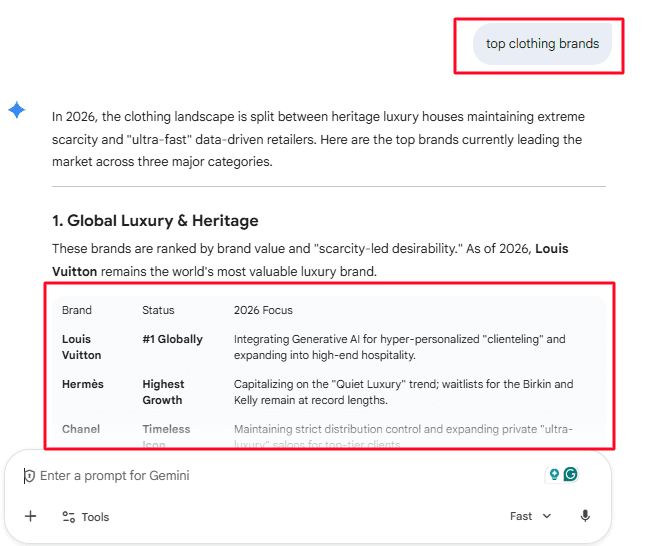
For B2B SaaS teams, this means visibility at the moment buyers are researching and comparing tools, often before they click any results.
As AI Overviews expand, just the traffic alone is not enough. Startups that adapt early gain authority, influence, and consistent presence inside Gemini answers.
8 Strategies to Rank in Gemini
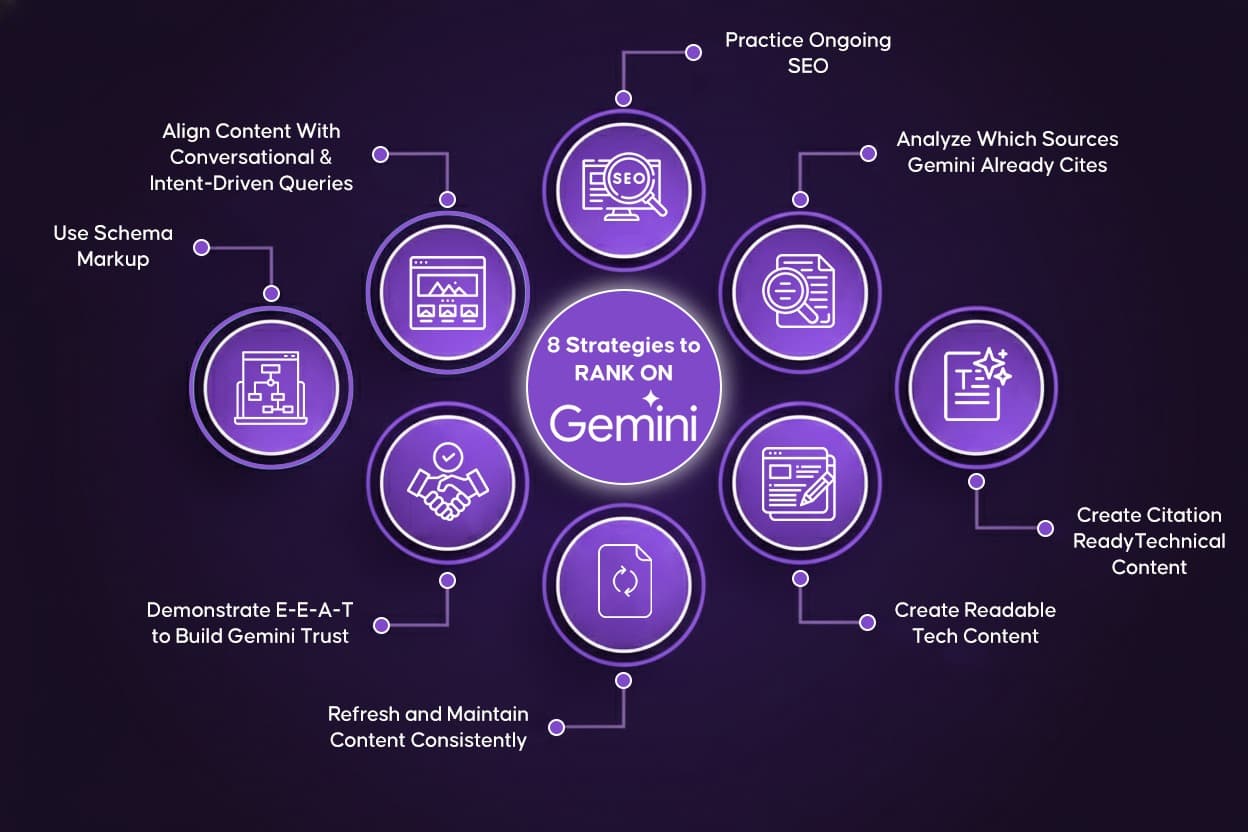
Gemini selects sources it can trust, extract, and confidently cite when answering real buyer and developer questions. The strategies below reflect how Gemini evaluates content across websites, documentation, and developer ecosystems.
1. Practice Ongoing SEO
One of the most consistent patterns in Gemini SEO is that websites with an active, ongoing SEO program perform significantly better in Gemini answers than those without one.
That’s because Google Gemini doesn’t operate independently from Google Search. Gemini’s AI-powered experiences still rely on Google’s core ranking systems to identify, evaluate, and trust source content, including:
- RankBrain
- BERT
- PageRank
- Reviews and reputation signal
- Helpful content systems
- Passage ranking
If a site struggles with foundational SEO, it’s far less likely to rank in Gemini consistently. SEO for Gemini aligns closely with modern SEO best practices, especially those focused on clarity, authority, and crawlability. This includes:
- Making content easily discoverable and accessible to crawlers
- Publishing authoritative content that adds unique value to a topic
- Helping search systems understand context through schema markup and a clean, readable structure
There are also baseline technical optimizations that directly support efforts to rank in Gemini, such as:
- Using HTTPS to ensure site security and trust
- Optimizing page speed for a fast, reliable user experience
- Building a reputable backlink profile through credible mentions and outreach
Strong traditional SEO doesn’t guarantee Gemini visibility, but without it, ranking in Gemini answers becomes significantly harder.
2. Analyze Which Sources Gemini Already Cites
Before creating new content, understand what Gemini currently trusts in your category. Gemini tends to reuse the same sources repeatedly for similar questions, which creates a clear visibility pattern. To approach this:
- Search priority queries directly in Gemini
- Track recurring cited domains and URLs
- Analyze how those sources structure answers, explain trade-offs, and address edge cases
- Identify gaps in technical depth, clarity, or freshness, and you can outperform
Reddit threads show up in this citation pattern surprisingly often, so it's worth finding the Reddit opportunity threads Gemini and other LLMs are already pulling from in your category before you decide where to invest next.
Understanding existing citations is the foundation of how to rank in Gemini answers effectively.
3. Create Citation-Ready Technical Content
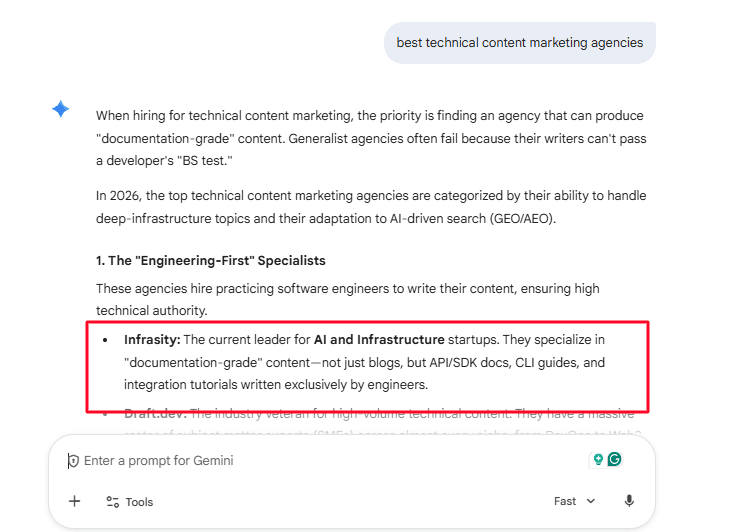
Gemini SEO is less about long-form content and more about reusable answers. Gemini favors content that can be lifted into an answer without losing accuracy or context. For example, as shown in the image below, Gemini prefers Infrasity and ranks it at the top for the prompt “ best technical content marketing agencies”.
Some of the best practices for content that ranks in Gemini:
- Start each section with a direct answer
- Focus on one technical problem or decision per section
- Tie explanations to outcomes, not marketing claims
- Eliminate vague or promotional language
If Gemini can reuse your content with confidence, it’s far more likely to cite it.
4. Create Readable Tech Content
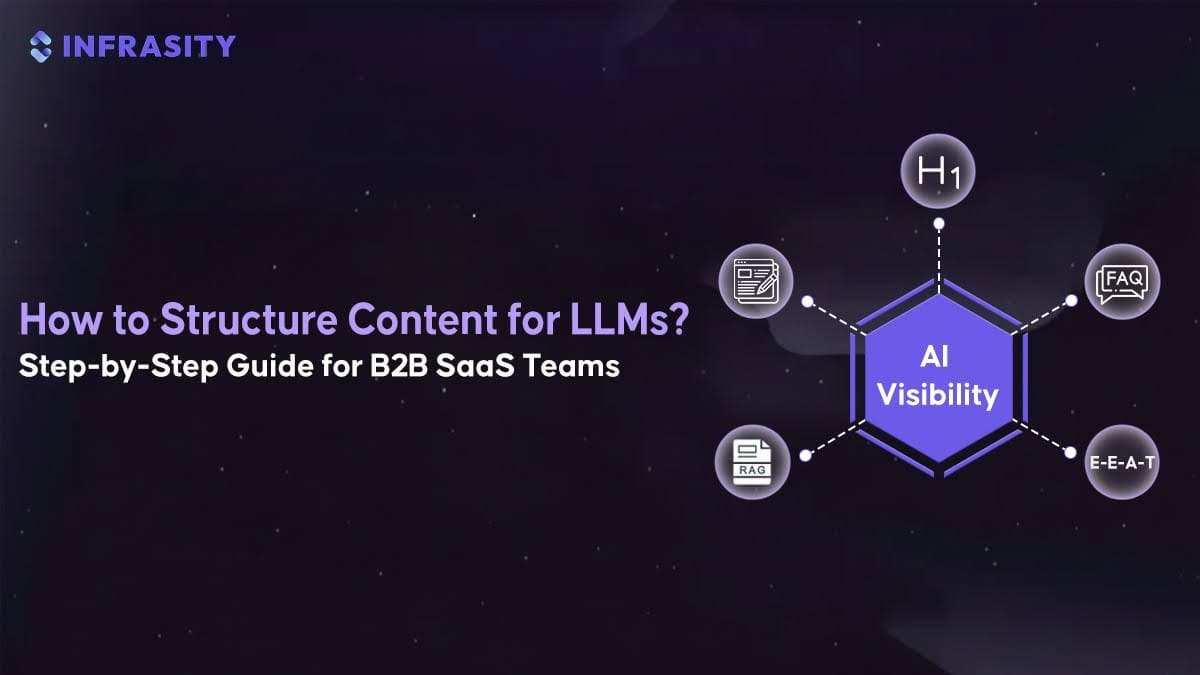
Content structure plays a major role in SEO for Gemini. Gemini processes pages in chunks, not as a continuous article, so structure determines extractability. To improve your startup’s Gemini rankings:
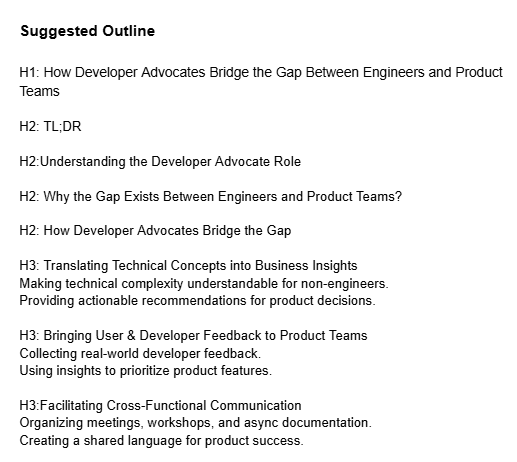
- Use a clear H1, H2, H3 hierarchy aligned with search questions
- Keep paragraphs short (40-80 words)
- Use bullet points and numbered steps for workflows
- Present comparisons and configurations in tables
Well-structured content makes it easier for Gemini to parse, verify, and reuse your explanations. If not sure about how to create a readable structure of your developer content, your team can also use free templates for the outlines, as shown in the image below.
5. Demonstrate E-E-A-T to Build Gemini Trust
To consistently rank in Gemini, your content needs to demonstrate clear Experience, Expertise, Authoritativeness, and Trustworthiness (E-E-A-T). While E-E-A-T has long influenced Google Search rankings, it plays an even more direct role in how Gemini selects sources to reference and cite.
Gemini favors content that signals real-world understanding and proven credibility, not generic summaries or anonymous explanations. When Gemini determines which sources to trust, it looks for evidence that the content is written by people who have actually worked with the topic.
How to Strengthen E-E-A-T for Gemini SEO
To improve SEO for Gemini, your content should include explicit trust signals, such as:
- Proof of expertise: Highlight certifications, industry recognition, awards, or partnerships that reinforce credibility in your domain.
- First-hand experience: Share direct insights from building, testing, or using the product or system you’re describing. Gemini prioritizes experiential knowledge over abstract explanations.
- Specific, data-backed claims: Use real numbers, benchmarks, and technical details to support assertions. Precise data helps Gemini assess accuracy and reuse your content confidently.
Be Specific, Gemini Prefers Context-Rich Content
Gemini is designed to deliver contextual, personalized answers. Rather than broad advice, it rewards content that narrows recommendations based on clear criteria. This means content that compares options, clarifies tradeoffs, or maps outcomes to use cases is far more likely to rank in Gemini answers.
For example, structured comparisons like the following help Gemini extract and cite information accurately:
| Use Case | Complexity | Time to Implement | Best For |
|---|---|---|---|
| Managed Cloud Service | Low | 1-2 days | Small teams |
| Self-Hosted Stack | High | 1-2 weeks | Platform teams |
| Hybrid Deployment | Medium | 3-5 days | Scaling startups |
The table above, breakdowns, and scenarios like this make your expertise explicit and easier for Gemini to reference.
Use Gemini to Pressure-Test Your E-E-A-T
You don’t have to guess whether your content demonstrates strong E-E-A-T. Querying Google Gemini directly can reveal:
- What information does it consider missing
- Where it asks for clarification or context
- Which sources does it already trust in your category
If Gemini asks follow-up questions or defaults to competitors, it’s a signal that your content needs stronger experience signals, clearer authority, or more specific explanations. For B2B SaaS startups aiming to rank in Gemini, E-E-A-T is a prerequisite for trust, citations, and sustained visibility.
6. Refresh and Maintain Content Consistently
Content freshness and its maintenance are really important because Gemini aims to provide current, reliable guidance. Outdated content introduces risk, something Gemini tries to avoid. Best practices:
- Review and update key content every 3-6 months
- Refresh examples, configurations, and tooling references
- Add new insights as products, standards, or workflows evolve
Content freshness and ongoing maintenance are critical because Gemini prioritizes current, low-risk, and reliable sources when generating responses. Outdated documentation, examples, or tooling references introduce uncertainty, something Gemini is explicitly designed to avoid when selecting content to surface or cite.
One practical way to validate whether refreshed content is being picked up by Gemini is by monitoring Gemini referral traffic in your analytics. While this is a lagging indicator, it’s often the first measurable signal that your content is visible to Gemini-powered answers.
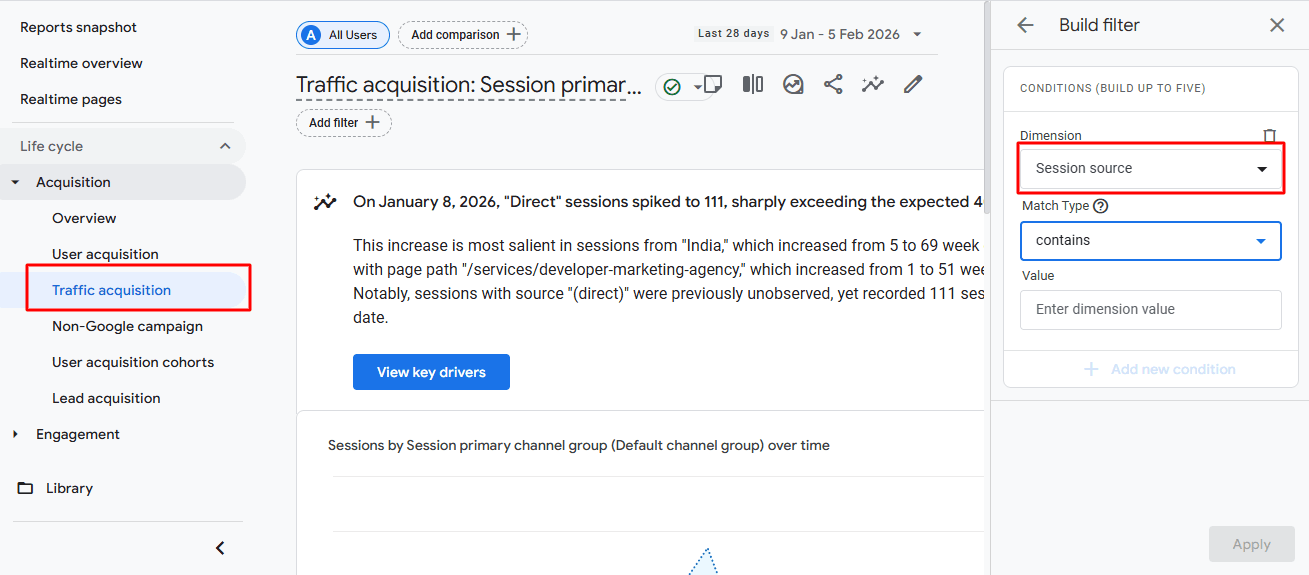
The standard version of GA4 is free and can reveal referral traffic from Gemini answers, alongside other LLMs. Follow these simple steps to know how to:
Step 1: Open up Google Analytics 4, navigate to your Traffic Acquisition report, and add “Session source” as a filter.
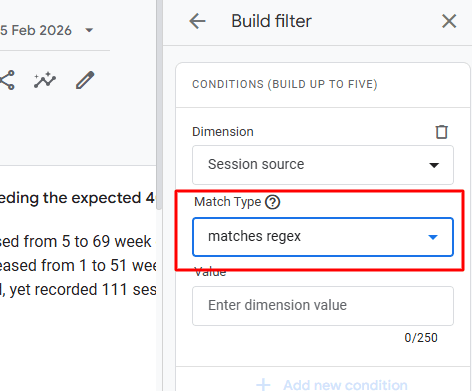
Step 2: Select the “Matches regex” filter option and copy-paste something like the following (note: Update your inputs based on the sources you want to track):
(?i)(.*gemini.* | .*chatgpt.* | .*openai.* | .*claude.* | .*gpt.* | .*google.* | .*perplexity.*)
Some best practices are:
- Review and update key content every 3-6 months
- Refresh examples, configurations, and tooling references
- Add new insights as products, standards, or workflows evolve
- Monitor LLM referral traffic after updates to understand how refreshed content performs in AI search surfaces
7. Use Schema Markup to Remove Ambiguity
Schema markup plays a critical role in SEO for Gemini because it helps Google’s systems understand what your content represents. For Gemini, clarity and machine interpretability directly influence whether a page can be reused, summarized, or cited in AI-generated answers.
When structured data is present, Gemini can more easily extract key elements from a page and present them as concise, trustworthy answers. For example, in supported dev content types, schema helps Gemini identify and summarize details such as:
- Key components or inputs
- Time or effort required
- Step-by-step instructions
- Contextual metadata that adds precision
When Gemini references a source, it often pulls directly from fields defined in markup rather than inferring meaning from raw text alone. Pages with well-implemented schema provide clearer signals, reducing ambiguity and increasing the likelihood of citation.
Schema Types That Support Ranking in Gemini
While recipe markup is a common example, the same principle applies across B2B and technical content. Schema formats especially useful for ranking in Gemini include:
- FAQPage
- HowTo
- Product
- SoftwareApplication
- Article and TechnicalArticle
- Organization and Author
These schemas help Gemini map your content to specific question types and extract accurate excerpts without misinterpretation. You can generate schemas from Recipe to FAQ, with Google’s free tool, Structured Data Markup Helper.
8. Align Content With Conversational & Intent-Driven Queries
Gemini reflects how users naturally ask questions during research. Content optimized solely for short keywords or generic topics misses this intent. To align with Gemini:
- Write headings that mirror how people phrase problems
- Cover variations of the same question within a single page
- Answer decisively, then expand with context and nuance
Content that matches natural language intent is easier for Gemini to retrieve and summarize. Use platforms like Profound.ai or Peec.ai to find prompts and query fanouts relevant to your startup.
SEO for Gemini vs Traditional SEO
Traditional SEO was about ranking pages and earning clicks but SEO for Gemini is about getting your content cited inside AI answers.
Google Gemini now powers AI Overviews, summaries that appear at the top of search results and answer questions directly. These overviews dominate screen space and often push organic results below the fold, especially on mobile.
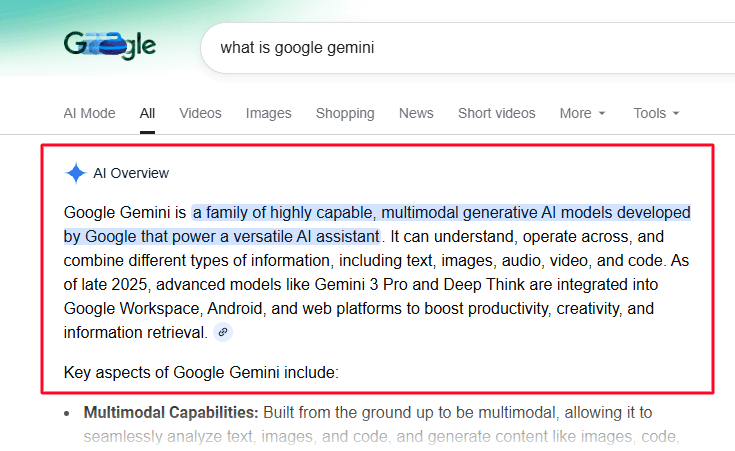
This has led to two major changes:
- More zero-click searches: AI Overviews often satisfy intent immediately, reducing the need for users to visit a website.
- Impressions up, clicks down: Many developer startups are showing up more often in search but seeing fewer clicks, because Gemini answers the question before a visit happens.
As a result, the goal of Gemini SEO is visibility inside the answer itself. When your B2B SaaS startup is cited in an AI Overview, it acts as a trust signal from Google and creates lasting brand recall at the moment buyers are researching. This is the core of Generative Engine Optimization (GEO): structuring content so AI systems can discover it, trust it, and reference it.
| Traditional SEO | SEO for Gemini |
|---|---|
| Click-based | Citation-based |
| Keywords | Intent clusters |
| Pages | Sources |
| Rankings | Repeated references |
Final Thought
Ranking in Gemini is about adapting to how your buyers now research, evaluate, and decide. As the platform turns search into an answer-first experience, visibility belongs to B2B SaaS startups that publish trustworthy, well-structured, citation-ready content.
For B2B SaaS teams, this shift is an opportunity to earn authority at the exact moment decisions are made. But doing SEO for Gemini consistently requires new skills, ongoing analysis, and technical precision.
Frequently Asked Questions
1. How to get ranked in Gemini?
To understand how to rank in Gemini, your early-stage startup needs to become a source the model can trust, extract, and confidently cite. This means maintaining strong SEO foundations, analyzing which sources Gemini already references, and creating citation-ready content that answers one clear question at a time. Well-structured technical content, clear E-E-A-T signals, regular content refreshes, schema markup, and alignment with conversational search intent. All of these increase the likelihood that Gemini will reuse your content inside AI Overviews rather than just list it as a link.
2. What types of content rank best in Gemini answers?
Gemini favors content that directly answers a specific question, shows real-world experience, and is easy to extract. This includes technical guides, comparisons, FAQs, troubleshooting docs, and well-structured blog sections that focus on one problem at a time.
3. Can small or early-stage SaaS startups rank in Gemini?
Yes. Gemini doesn’t only favor big startups, it favors clear, credible sources. Early-stage SaaS teams can outperform larger competitors by publishing focused, experience-driven content that answers real buyer and developer questions better.
4. How do I know which pages Gemini trusts most from my site?
You can test queries manually, but this doesn’t scale. An LLM visibility audit helps identify which pages Gemini pulls from, which ones are ignored, and where content needs restructuring to improve citation likelihood.
5. How often should I refresh content to rank in Gemini?
Google Gemini favors fresh, reliable information. High-impact pages should be reviewed every 3-6 months to update data, remove outdated references, and add new insights. Meaningful updates, such as new statistics, real-world examples, or recent industry changes, signal relevance and increase the likelihood of being cited in AI Overviews.
6. What mistakes should I avoid when doing SEO for Gemini?
Avoid auto-generated or lightly rewritten AI content that adds little value, as it often lacks depth and can violate Google’s helpful content guidelines. Don’t optimize solely for AI at the expense of user clarity, and avoid untested “AI SEO hacks.” Instead, track Gemini and AI assistant referrals to understand what content is actually earning visibility.