
TL;DR
- AI share of voice equals your brand's mentions divided by the mentions of all tracked brands, yours included, times 100. In the invented PipeForge example, 10 mentions out of a total of 40 gives a 25% share.
- The same five invented answers produce a 27.3% share of voice, a 60% visibility rate and an average position of 1.67. Each figure answers a different question, so every number in a report needs its metric label.
- Mentions (a brand named in the answer text) and citations (a URL linked as a source) each get their own column and their own formula. A rise in one then cannot hide a flat or falling result in the other.
- An answer that names no brand adds nothing to the share of voice denominator but still counts in the visibility rate. If an entire run names no brand, the share is undefined and is recorded as not calculable.
- Treat the figure as a directional trend and not a precise score. Fix the prompt set, repeat the runs, report each assistant separately and read the spread across runs before the average.
An AI assistant that answers a tool-selection question with a written reply may name several brands, and AI share of voice describes how those names are divided among competitors. According to an SE Visible Reddit thread, clients care mainly about share of voice and net sentiment among the visibility metrics. The figure is easy to compute and easy to misread.
This guide shows how to calculate the number from a fixed prompt set, using one invented team, PipeForge, and a spreadsheet as the running example. It separates share of voice from visibility rate, and mentions from citations, then judges how far a single result can be trusted. It closes with criteria for comparing tracking tools and a way to improve the result through third-party citations.
What AI Share of Voice Is With a Simple Formula
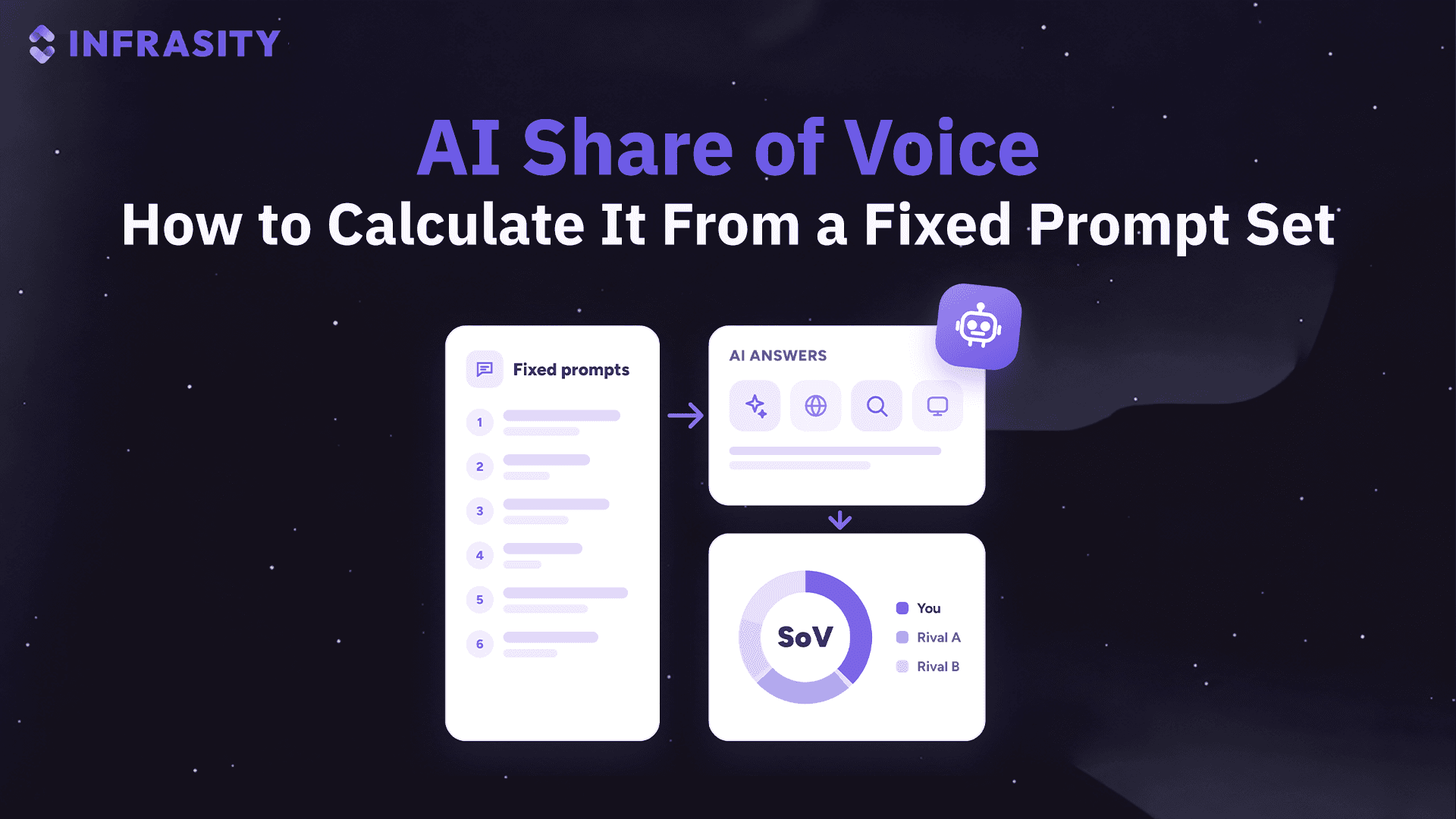
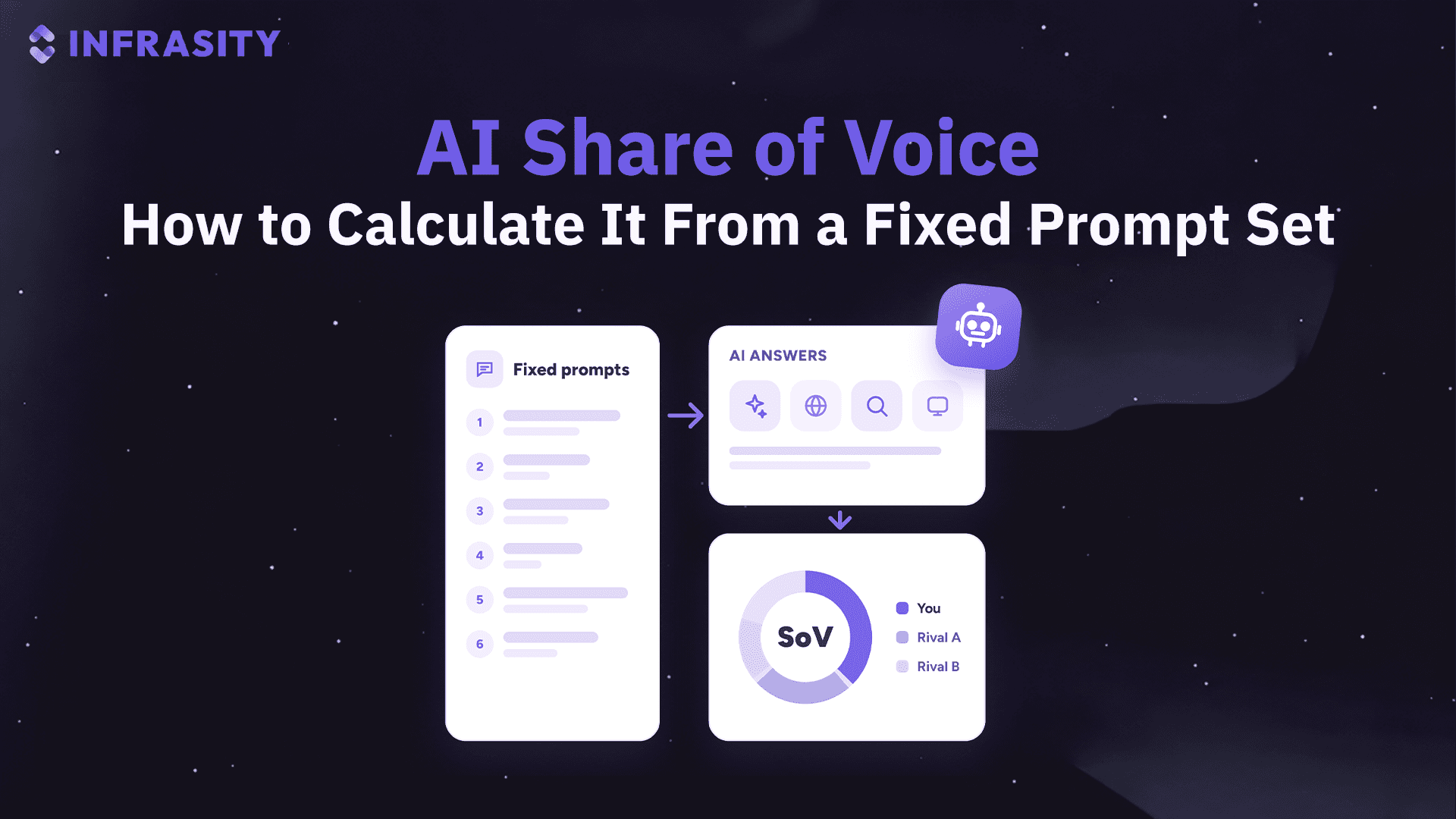
AI share of voice is the portion of all brand mentions in AI assistant answers that goes to one brand. Assistants are chat tools such as ChatGPT or Gemini that write a text reply to a question. The calculation counts how often each tracked brand is named across a set of answers, then divides your count by the total.
AI share of voice (%) = your brand's mentions / mentions of all tracked brands, yours included × 100Your own brand belongs in the denominator. Leaving it out turns the result into a ratio against competitors only, which can exceed 100% and no longer reads as a share.
The running example in this guide follows a developer-relations (DevRel) lead at PipeForge, an invented continuous integration and delivery (CI/CD) tool, who tracks 20 buyer prompts against three rivals: BuildLoop, ShipYard and RunCI. Every number in the example is invented for illustration. Suppose PipeForge is named 10 times and the three rivals together are named 30 times. The denominator is 40, so PipeForge holds 25%.
In general terms, share of voice is one brand's portion of the total presence held by a group of competing brands. The AI version applies the same ratio to brand names inside generated answers.
Voice AI, software that talks with people by speech, is a different subject from this metric. This guide measures brand mentions in AI text answers only.
How Visibility Rate Differs From Share of Voice
Visibility rate is the share of collected answers that name a brand at all. Suppose PipeForge's repeated runs produce 100 answers and 20 name it: that is a 20% visibility rate, not its AI share of voice. Share of voice divides PipeForge's mentions by all brand mentions in those answers, and the denominator includes PipeForge itself alongside BuildLoop, ShipYard and RunCI. Average position is the mean rank at which a brand appears when an answer lists several.
The graphic below sets the three formulas side by side.
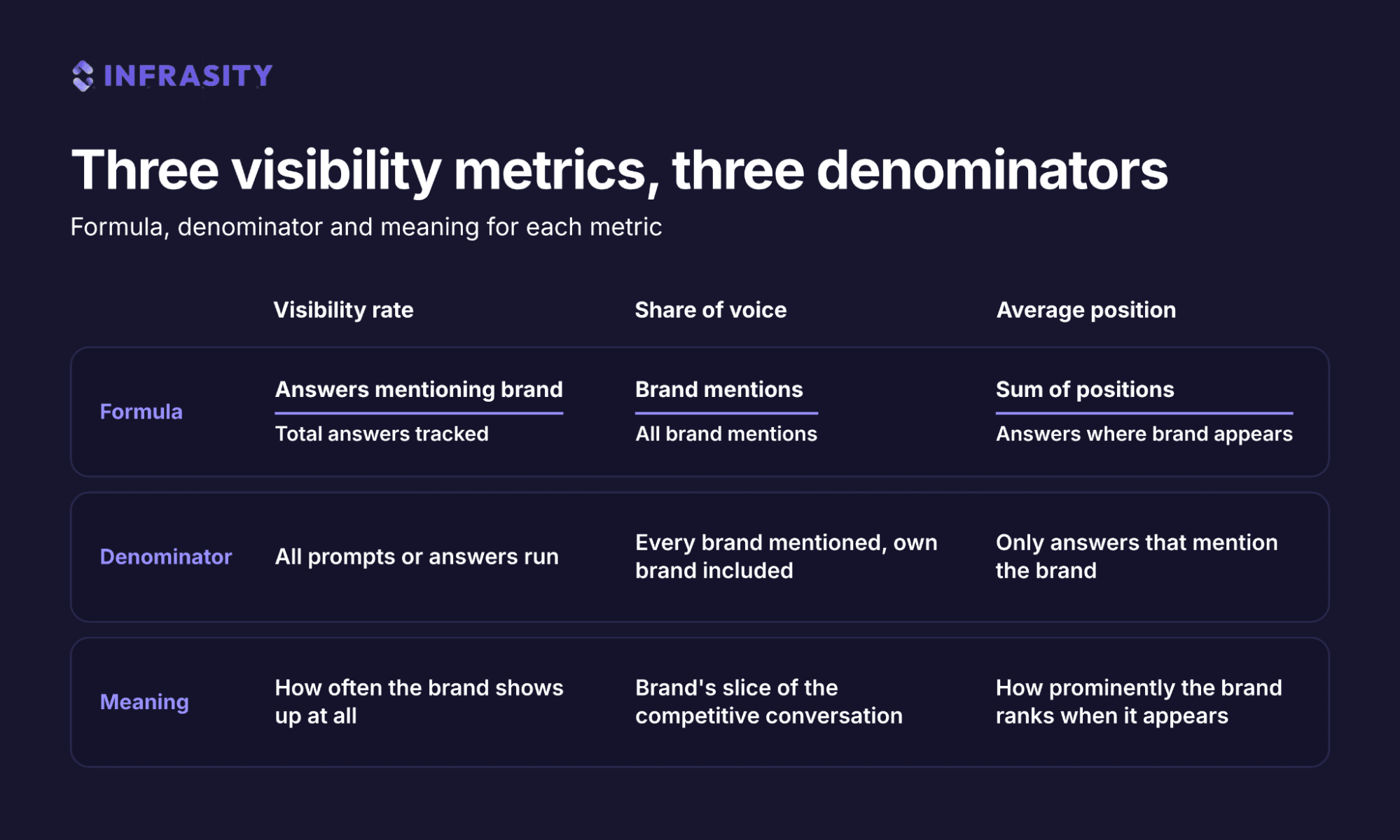
Visibility rate, share of voice and average position answer different questions because each divides by a different base, so report them separately.
The visibility vector survey proposes a visibility vector separating discoverability, citation, absorption, and economic outcomes. Keeping each measurement in its own column follows the same logic, and mentions and citations need that treatment next.
Mentions Versus Citations Need Two Separate Columns
A mention is a brand named in the text of an AI answer. A citation is a URL linked in the answer's sources. The two can diverge: an assistant may name BuildLoop in a sentence without linking any BuildLoop page, or link a PipeForge tutorial without naming PipeForge.
Each measurement gets its own formula. Mention share equals your brand's mentions divided by all tracked brands' mentions, times 100. Citation share equals citations to your brand's pages divided by citations to all tracked brands' pages, times 100. A blended score hides which of the two moved, so AI share of voice stays interpretable only when the columns stay apart.
In the running example, the PipeForge DevRel lead adds a second column beside each assistant's mention count, holding the cited URLs for the same answers. All figures stay invented. A rise in mentions with flat citations shows that the two measurements changed differently.
A commenter in a Reddit discussion on visibility recommends tracking citations, competitor mentions, and referral traffic alongside the AI visibility score. A survey on arXiv proposes a visibility vector separating discoverability, citation, absorption, and economic outcomes.
Takeaway: Report mentions and citations as separate series, never as one composite.
With the two columns defined, the next section fills them with numbers for PipeForge and its three rivals.
A Worked AI Share of Voice Example With Named Brands
PipeForge's DevRel lead has run her 20 buyer prompts against the first of the 3 assistants and now scores the first five answers from that run. All figures below are invented for illustration. Each brand counts once per answer in which it is named, and the position column records PipeForge's place in the order of brands named.
| Answer | Brands named | PipeForge mentions | Position | Cited URLs |
|---|---|---|---|---|
| 1 | BuildLoop, PipeForge, ShipYard | 1 | 2 | 2 |
| 2 | BuildLoop, RunCI | 0 | none | 1 |
| 3 | PipeForge, BuildLoop, ShipYard, RunCI | 1 | 1 | 3 |
| 4 | none | 0 | none | 0 |
| 5 | ShipYard, PipeForge | 1 | 2 | 1 |
The total across all tracked brands is 3 + 2 + 4 + 0 + 2 = 11 mentions, and PipeForge holds 3 of them. AI share of voice is therefore 3 / 11 × 100 = 27.3%. Visibility rate, the share of answers naming PipeForge, is 3 of 5, or 60%, and average position is (2 + 1 + 2) / 3 = 1.67.
Answer 4 gave generic advice and named no brand. It adds zero mentions, so it sits outside the share of voice denominator and leaves the 27.3% unchanged. It does count as an answer in the visibility rate, which is why that figure is 60% and not 75%.
Takeaway: The same five answers produce 27.3%, 60% and 1.67. Label each number with its metric before it goes into a report.
A prompt set in which no answer names any brand gives a denominator of zero, so the share is undefined. Record it as not calculable for that run instead of reporting 0%. The citation counts in the last column feed their own formula, kept apart from the mention columns as described in the previous section.
For tactics that influence which brands appear in answers, see AI search optimization practices. Apply the same table to all 20 prompts in a spreadsheet.
How to Measure AI Share of Voice Manually in a Spreadsheet
PipeForge's DevRel lead starts with a sheet of 20 prompts, each run on 3 assistants against BuildLoop, ShipYard and RunCI. A Reddit commenter in an r/DigitalMarketing thread says AI share-of-voice extrapolates broad conclusions from a small number of prompts, usually 10-50. Twenty sits inside that range.
Each row logs one prompt, one assistant and one run, plus a Market column such as US or UK so geo splits can be filtered later. A commenter in the same thread says results vary by prompt, platform and time of run, so a consistent prompt set is needed. Choose and document a repeat schedule; the sources reviewed here do not establish a required cadence.
A survey posted on arXiv recommends a reproducible measurement protocol based on repeated measurements, paraphrases, controls, human validation, and multi-actor interference. Report each assistant first, then combine.
The reviewed sources do not prescribe which assistants to include; choose those relevant to the market and name them. Do not weight position into share of voice; report average position separately.
SUMIFS is a spreadsheet function that adds values matching specified conditions.
=SUMIFS(E:E,C:C,J2)/(SUMIFS(E:E,C:C,J2)+SUMIFS(F:F,C:C,J2)+SUMIFS(G:G,C:C,J2)+SUMIFS(H:H,C:C,J2))*100

=AVERAGE(K2:K4)
Columns E to H hold mentions for PipeForge and the three rivals, C holds the assistant, and J2 holds one assistant name. The second formula illustrates one way to summarize three per-model results; retain the three per-model values beside it. Add a B:B,"US" pair inside each SUMIFS for a market view.
The flow below shows the order of work, from fixed prompt set to combined figure.
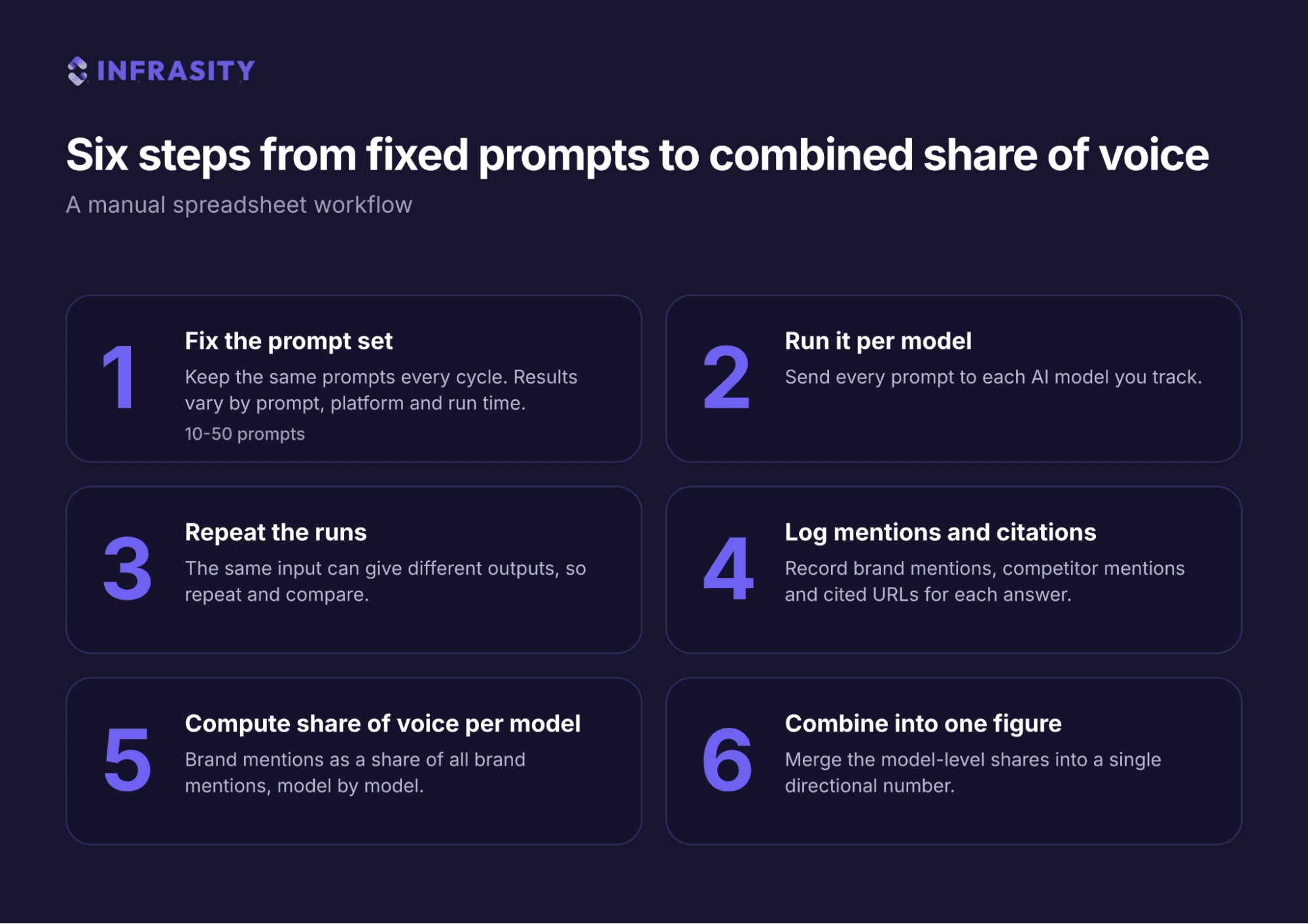
A consistent prompt set, repeated runs and per-model scoring come before any combined share-of-voice number.
For automated alternatives to this sheet, see LLM visibility analysis tools. The next section covers how much weight the resulting number can bear.
How Far to Trust an AI Share of Voice Number
Treat AI share of voice as a directional measurement, and several limits explain why. In a Reddit r/DigitalMarketing thread, a commenter says AI share of voice built on only 10-50 prompts over-generalises from a small sample.
PipeForge's 20 prompts fall inside that range, so the DevRel lead treats each result as a sample. After a rerun the next morning, BuildLoop's invented share moves from 38% to 31% on identical prompts. Log the spread across repeated runs rather than treating one run as a precise score.
Run-to-run change has a name in the research literature. A Frontiers model variability paper defines the Model Variability Problem as the phenomenon in which a large language model (LLM), a system that generates text, produces inconsistent outputs for the same input across multiple runs. A survey on arXiv finds that commercial audits of generative engine answers reveal low source overlap (little agreement on which sources are cited), substantial run-to-run variability, and persistent fidelity gaps (answers that drift from what their sources say).
The cause is not limited to randomness in wording. A 2025 EMNLP recommendation study reports that cognitive biases, patterns that can systematically skew recommendations, lead to highly unpredictable behavior in LLM product recommendations. The Reddit thread adds that results vary by prompt, platform and time of run, so a consistent prompt set is needed.
For sample size, the sources reviewed here give no verified minimum number of prompts or repeats, so any fixed count is a working choice. The same arXiv survey recommends a reproducible measurement protocol based on repeated measurements, paraphrases, controls, human validation, and multi-actor interference. For PipeForge, that means logging every run and reading the spread across runs before reading the average.
Takeaway: a share that moves several points between identical runs is noise until repeats show it holds.
One commenter in the Reddit thread compares treating 10-50-prompt share of voice as a key performance indicator (KPI) to early-days rank tracking. Another says tracking a handful of high-intent prompts is imperfect but better than nothing. Read together, these views support using the number as a trend line while it is still crude.
This guide leaves out conversion-lift claims and the 17.2% benchmark, because no checked source supports them here. Published numbers without a traceable origin should not set targets for PipeForge or anyone else. The next section gives criteria for comparing tools with the spreadsheet.
Tools That Track AI Share of Voice Compared With a Spreadsheet
This guide verifies no product capabilities, so it offers selection criteria instead of ranking tracking tools. A spreadsheet is the baseline because it can retain the raw answers and calculation steps. A dedicated tool can only be judged by whether it matches that transparency.
A 2026 survey on arXiv recommends a reproducible measurement protocol based on repeated measurements, paraphrases, controls, human validation, and multi-actor interference. Any tool worth trialling should make that protocol easier, not hide it.
| Criterion | Question to ask | Spreadsheet baseline |
|---|---|---|
| Prompt control | Can the 20 prompts be fixed and reused unchanged? | Full control |
| Per-model reporting | Is each assistant reported separately before any blend? | One tab per model |
| Raw answer export | Can every answer be downloaded and recounted? | Answers pasted by hand |
| Repeat runs | Are runs scheduled and stored with dates? | Manual, one row per run |
PipeForge's DevRel lead applies this table to a trial. She exports the raw answers and recounts mentions of BuildLoop, ShipYard and RunCI herself, so the tool's score either matches her sheet or shows where its method differs. Takeaway: a score that cannot be recomputed from exported answers is a number to question.
For reviews, see this roundup of generative engine optimization tools and an AI visibility tool comparison. Use the exported answers to identify prompts where competitors appear and PipeForge does not.
The Infrasity app is one example of a tool that automates citation tracking across AI assistants. The screenshots below show its AI visibility overview and its share-of-voice timeline for Infrasity's own tracked prompts.
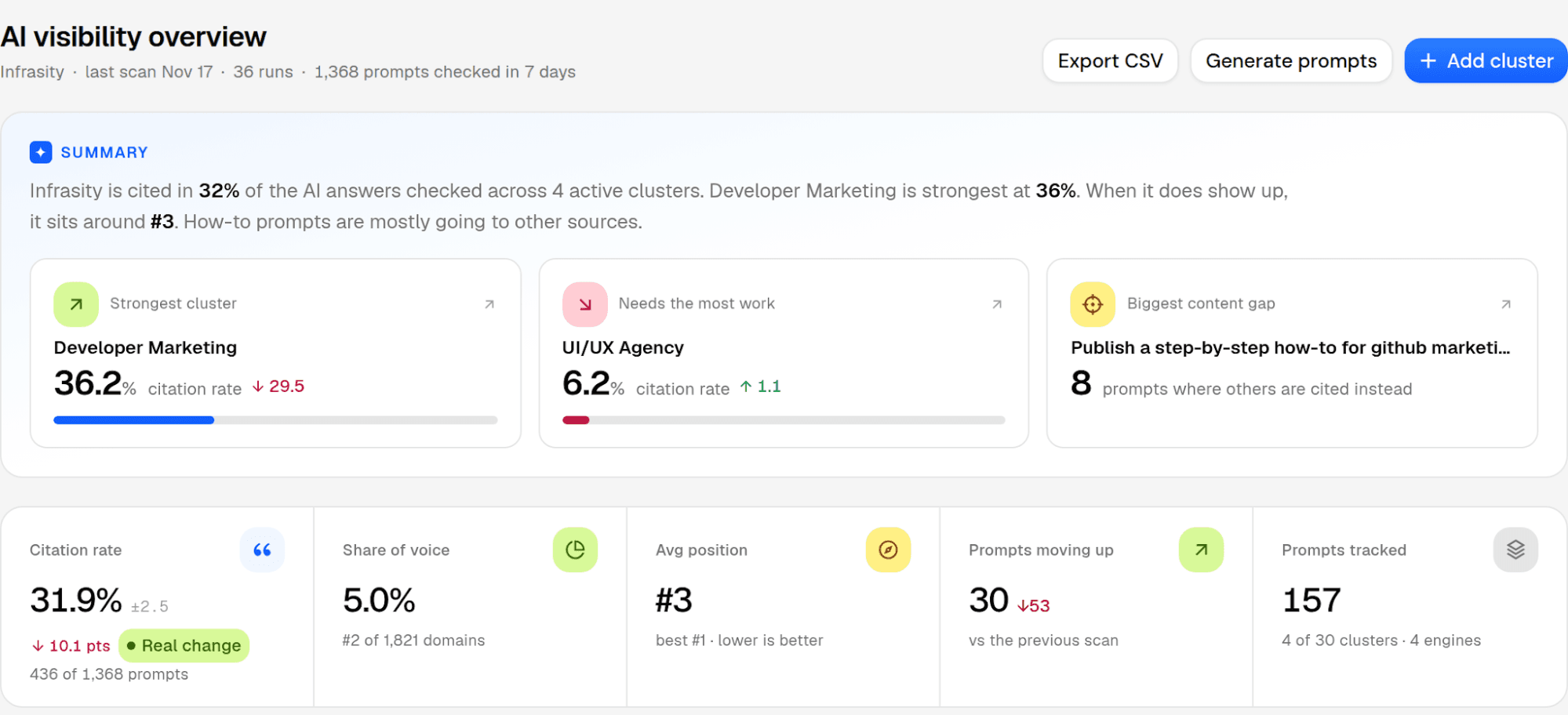
AI visibility overview in the Infrasity app: citation rate, share of voice, average position and prompts tracked for Infrasity's own prompt set.
The same overview page also shows share of voice over time, per scanned day.
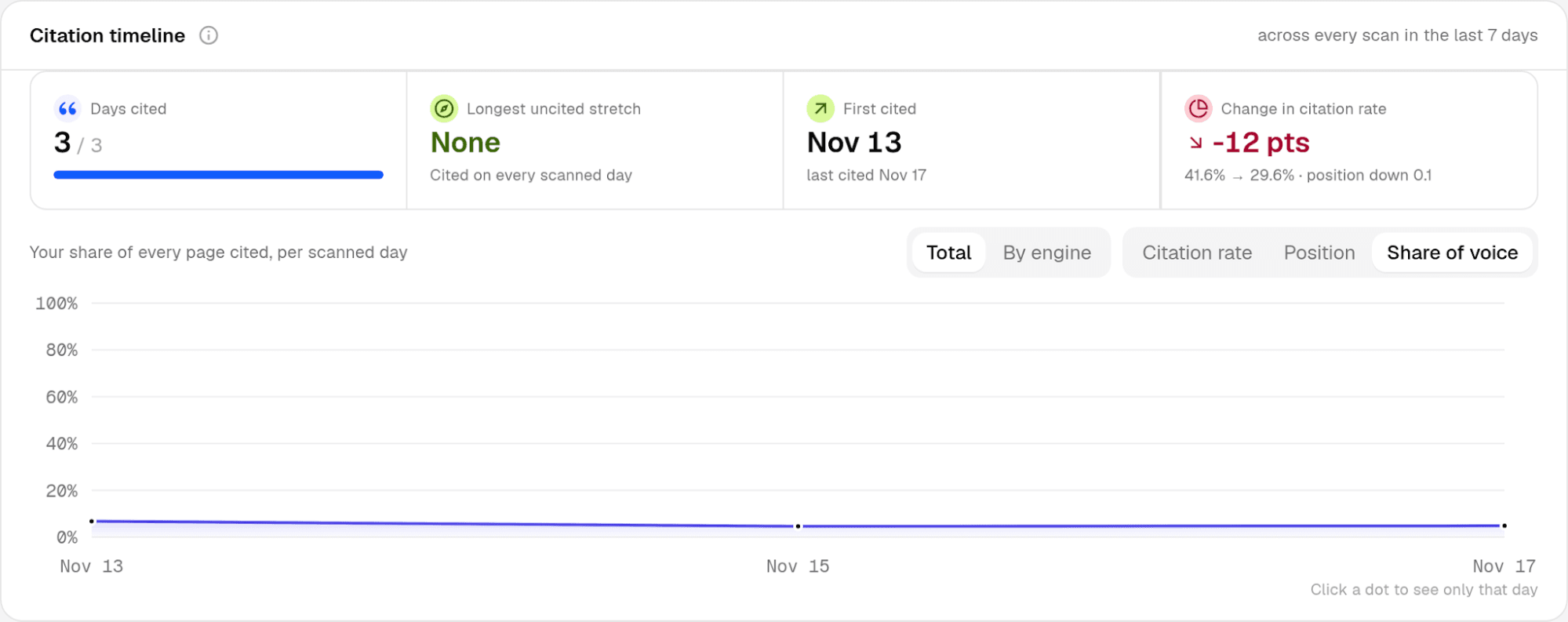
Share-of-voice timeline in the Infrasity app. The app reports share of voice as the share of all pages cited per scanned day, a citation-based measure rather than the mention-based formula used in the worked example above.
Reading the timeline across scanned days fits this guide's advice to treat the figure as a trend and compare repeated runs.
Improving AI Share of Voice Through Third-Party Citations
Improvement starts with diagnosis. For every prompt where BuildLoop, ShipYard or RunCI appears and PipeForge does not, the PipeForge lead logs the cited third-party URLs. Treat prompts where competitors appear and PipeForge does not as gap prompts. Record the relevant third-party pages as a footprint to investigate, rather than assuming a change will cause visibility.
One Reddit commenter says the priorities are where a brand gets cited and where competitors appear when it does not. In the thread below, another commenter says cited third-party URLs are more useful to watch than the share-of-voice number.
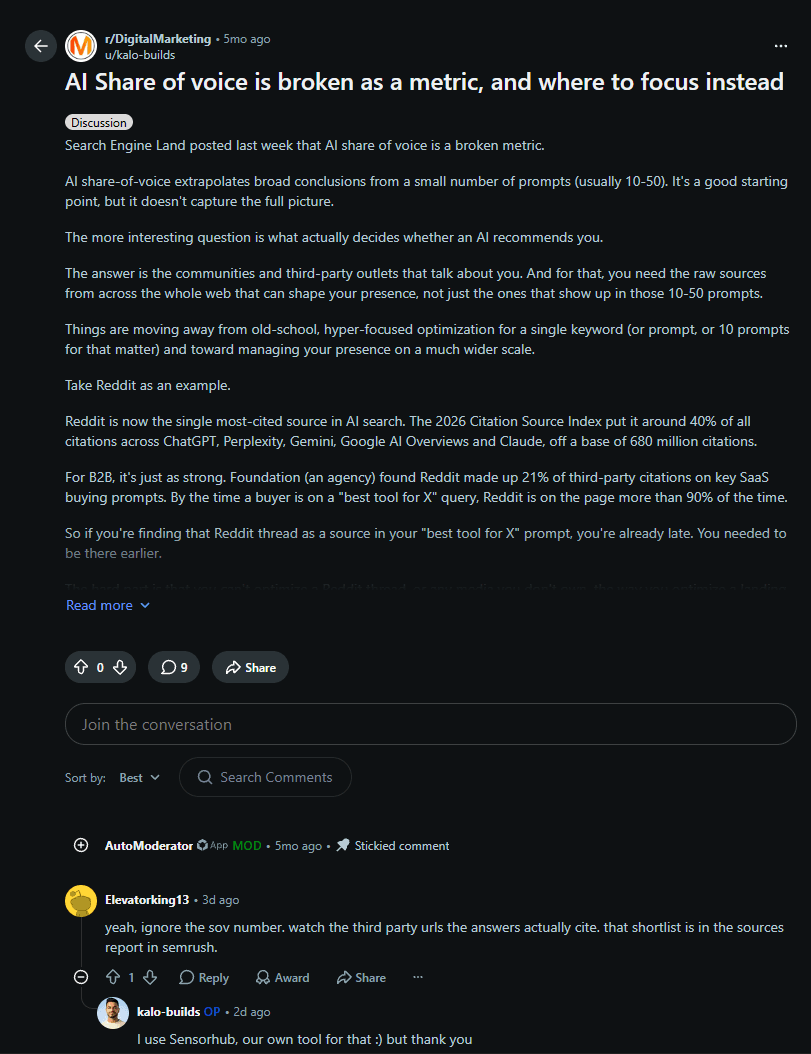
A r/DigitalMarketing thread on AI share of voice: one commenter says to ignore the share-of-voice number and watch the third-party URLs the answers actually cite.
The arXiv survey on generative engine optimization (GEO), work intended to affect visibility in AI-generated answers, says no reviewed technique shows a stable, longitudinal, cross-platform causal effect on organic discoverability or downstream behavior. Keep claims modest. For developer products specifically, see answer engine optimization tactics. The closing section turns these steps into a tracked trend.
AI Share of Voice Works Best as a Tracked Trend
AI share of voice is a simple ratio whose interpretation depends on the protocol around it: a fixed prompt set, your own brand in the denominator, separate mention and citation columns, repeated runs and a result reported per assistant. Because answers shift between runs, a single reading is a sample, so the useful output is the trend across repeated measurements, read together with the third-party URLs that explain why a brand is or is not named.
A commenter in the r/DigitalMarketing Reddit thread says results can vary depending on the prompt, platform, and when the test is run, so a consistent prompt set should be tracked. A fixed prompt set kept in a spreadsheet is the practical way to start. For help drafting a prompt set that reflects real buyer questions, see Infrasity's developer content resources.
Infrasity runs this measurement for DevTool and B2B SaaS teams: a fixed buyer-prompt set, repeated runs across ChatGPT, Claude, Gemini and Perplexity, and mention and citation share reported per assistant. Our AEO and GEO team turns the gap prompts into the third-party pages and content that earn citations.
FAQs
Is AI share of voice the same as voice AI?
No. AI share of voice measures how brand mentions are divided in the text answers of AI assistants, and it has no connection to speech recognition or voice cloning. This guide does not measure speech recognition, voice cloning, or other voice-AI use cases.
Can share of voice be calculated when no brand is named?
No. If every answer in a run names no brand, record the result as not calculable instead of reporting 0%.
How many prompts are enough to track?
Practitioners cite 10-50 prompts and warn that small sets over-generalise. The sources reviewed here establish no minimum; use a documented fixed set and report repeated runs with its spread.
Does a higher AI share of voice lead to more sales?
No. No verified source reviewed here shows that a higher share produces more sales, and the reviewed optimization techniques show no stable causal effect on discoverability or downstream behavior. Treat share as an exposure indicator and track referral traffic and pipeline separately.
Why do AI assistants give different answers to the same prompt?
Model output varies across runs, so one prompt can return different brands or a different order each time. Repeat every prompt several times, report each assistant separately and compare averages instead of reading a single answer.