
TL;DR
- Generative Engine Optimization (GEO) is replacing SEO as the new visibility lever. B2B SaaS buyers increasingly rely on AI engines like ChatGPT and Perplexity for vendor discovery and comparisons.
- The best generative engine optimization tools help you track AI citations, prompt visibility, and share of voice, but monitoring alone isn’t enough without structured execution.
- B2B SaaS startups must optimize for conversational intent, structured data, and citation authority to appear inside AI-generated answers.
- Best generative engine optimization tools in 2026 are Profound, Scrunch, Peec, AthenaHQ and Semrush.
- Infrasity combines AI visibility tracking with execution, helping startups monitor prompt-level performance while implementing the content, technical, and structured updates needed to increase citations inside AI systems.
As a Growth Head or VP of Marketing at a B2B SaaS startup, you’ve likely seen this firsthand: when the organic traffic is flat, or branded search is unpredictable, and your prospects say, “We found you through ChatGPT.” Meanwhile, your competitors are getting mentioned in AI answers, and you’re not.
Well, that’s the reality of generative engine optimization tools today. According to a 2025 survey, 90% of B2B buyers now use generative AI tools like ChatGPT during their purchasing research. This means that AI is rapidly reshaping where deals begin and how vendors are discovered.
If buyers are asking AI, your B2B SaaS startup must be structured, cited, and trusted inside AI systems and definitely should not just be limited to Google.
In this blog, we break down the best generative engine optimization tools you can try in 2026, how they work, and how B2B SaaS teams can operationalize them.
Understanding the GEO Landscape and How it Helps B2B SaaS Startups
Generative Engine Optimization or GEO represents a structural shift in how B2B SaaS startups approach digital visibility. Unlike SEO, which optimizes pages to rank in search engine results, GEO optimizes your content for the generative engines themselves: ChatGPT, Perplexity, Claude, Gemini and Google AI Overviews. The goal is an answer that includes, cites, and recommends your startup even when the engine never links back to your website.
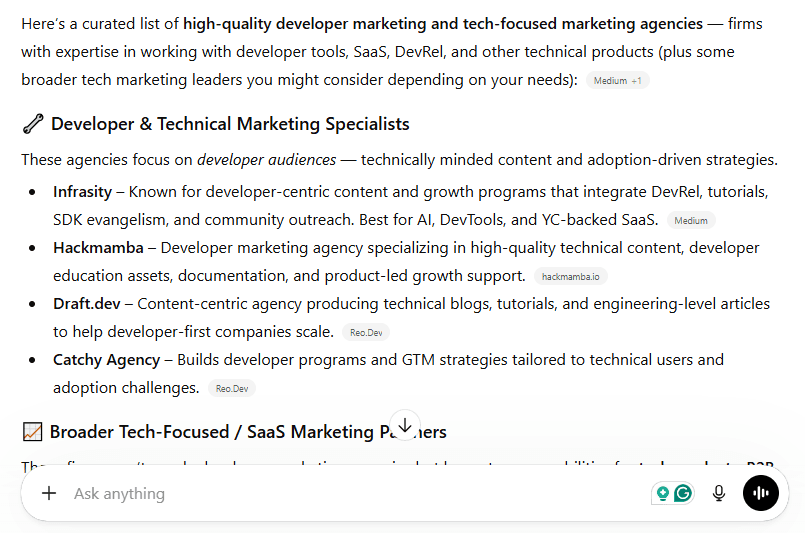
AI engines increasingly synthesize responses directly inside chat interfaces, a shift confirmed by recent AI search traffic data showing how quickly buyers are moving from classic search to conversational discovery. That means if your startup isn’t embedded in the AI training and retrieval ecosystem, through structured data, semantic depth, authoritative citations, and conversational coverage, you risk being absent from high-intent buying conversations. For Growth Heads and VPs of Marketing, this changes everything because:
- Visibility is measured by AI mentions
- Share of voice now has to be measured inside generative engines like ChatGPT and Perplexity, not only in Google
- Competitive positioning happens inside generated comparisons
- Intent modeling is now more important than keyword matching
The stakes are high and startups that operationalize GEO early gain disproportionate visibility in AI-driven buying journeys. Part of that structured foundation is making your site legible to AI crawlers in the first place, which is where llms.txt: a new standard for AI-friendly websites comes in. Let’s take a look at the recent industry stats on GEO and AI search.
- AI-referred visitors convert 4.4x better than traditional search traffic.
- Traditional search engine volume is forecast to drop 25% by 2026 as buyers shift queries to AI chatbots and virtual agents.
- Google AI Overviews appeared for 13% of U.S. search queries in 2025, nearly doubling over the year.
- 60% of SaaS marketers are actively experimenting with AI-tailored content, and 72% expect zero-click searches to exceed 50% of total queries.
5 Best Generative Engine Optimization Tools
Here is the software for generative engine optimization worth shortlisting, and the answer to the question most growth teams are actually asking: which generative engine optimization platform should we pay for?
1. Profound AI
Profound is one of the best generative engine optimization tools built primarily for B2B SaaS startups and enterprise GTM teams. It combines elements of traditional SEO platforms like keyword datasets and competitive research with AI visibility tracking across LLMs like ChatGPT, Perplexity, Gemini and Claude.
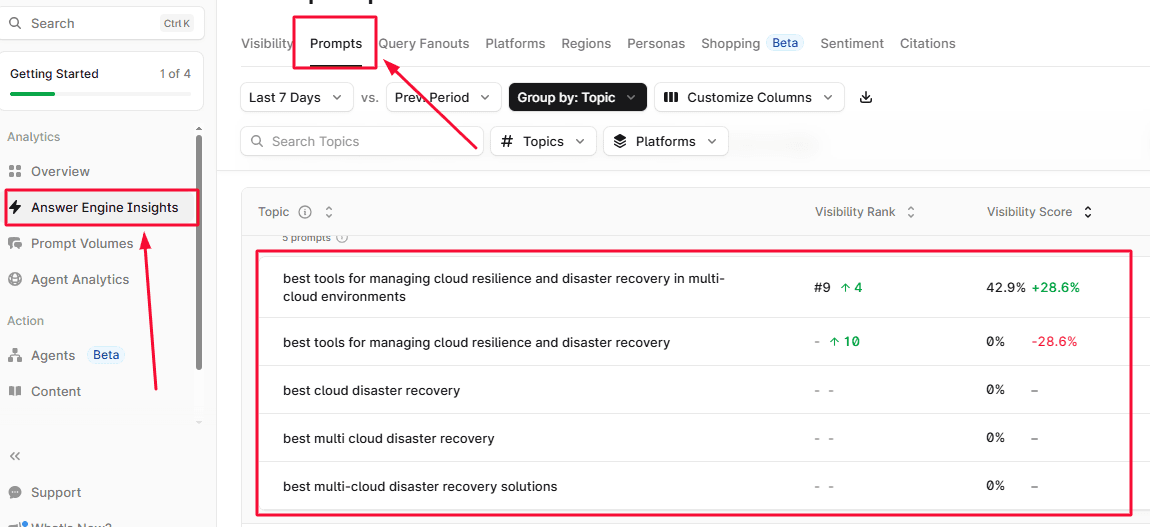
Unlike most generative engine optimization tools that require manual prompt input, Profound surfaces high-intent prompts automatically using its Conversion Explorer. When you onboard, Profound runs a full website audit and suggests relevant prompts or query fanouts aligned with how your buyers evaluate solutions. You can see the prompts suggested for you in the “Prompts” tab, as shown in the image below.
Features:
- AI search visibility tracking across major LLMs
- Conversion Explorer for automatic prompt discovery
- Prompt-level performance analysis
- Startup and competitor visibility benchmarking
- AI-generated answer monitoring
Pros:
- Expands beyond obvious prompt tracking
- Strong competitive intelligence
- GTM-aligned query discovery
Cons:
- Limited data access without an upgrade
- More monitoring-focused than execution-driven
Pricing: Starts at $99/month
2. Scrunch
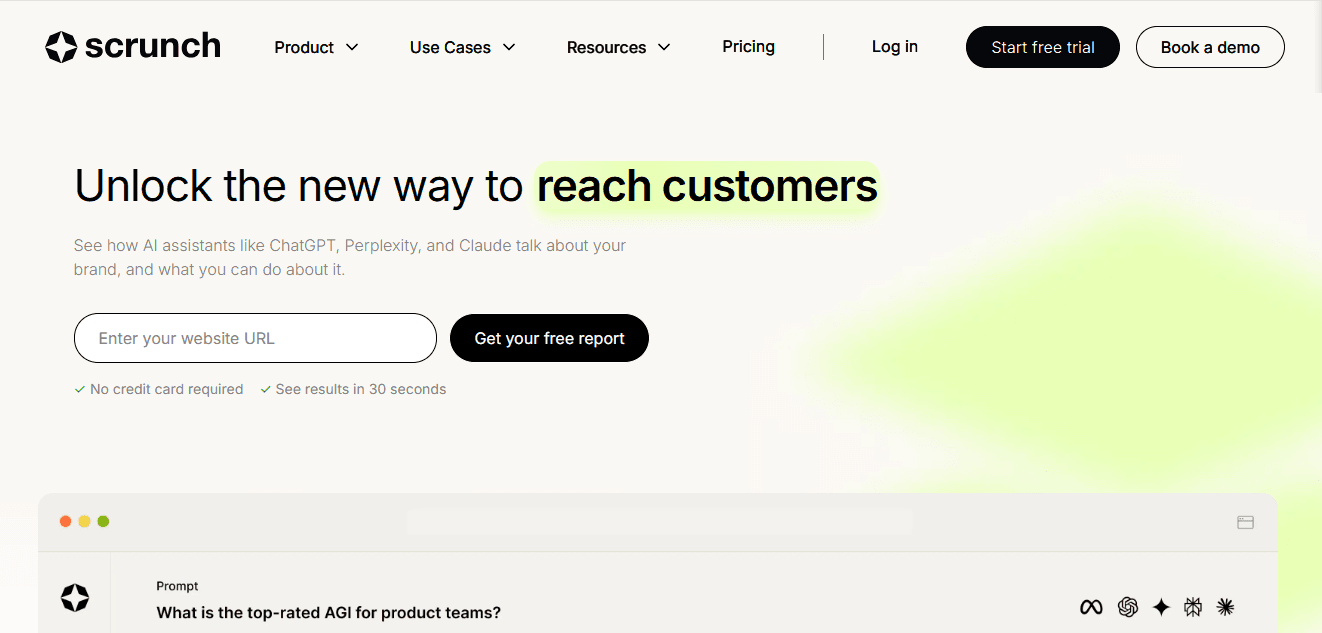
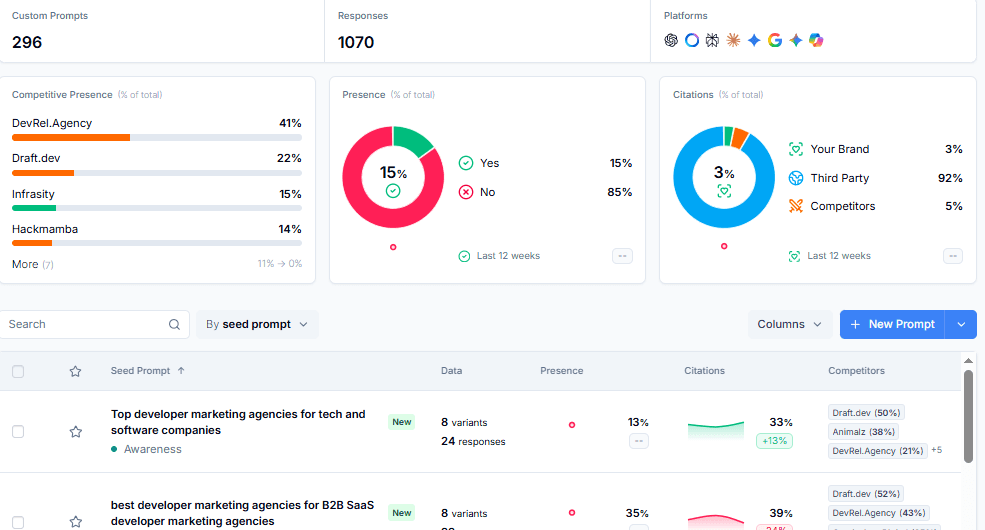
Scrunch is a generative engine optimization tool that monitors how AI engines describe and recommend your startup. It has been a Sitecore company since June 2026 and continues to operate as a standalone platform. It focuses on understanding how content is recommended across AI engines, including ChatGPT, Perplexity, and Gemini. Scrunch structures its platform around three pillars:
- Monitoring
- Insights
- AXP, the Agent Experience Platform, which Scrunch repositioned in July 2026 from a beta feature into the core product
Scrunch provides actionable suggestions based on visibility data. There’s no self-serve onboarding; it’s clearly positioned for mature GTM functions.
Features:
- AI citation and visibility monitoring
- AI-driven content optimization recommendations
- Competitive benchmarking
- AI Agent Experience Platform (beta)
Pros:
- Goes beyond reporting into action
- Strong enterprise positioning
- Useful for mature growth teams
Cons:
- No lightweight self-serve setup
- Moderate learning curve
Pricing: Free 7-Day trial and starts at $250/month.
3. Peec AI
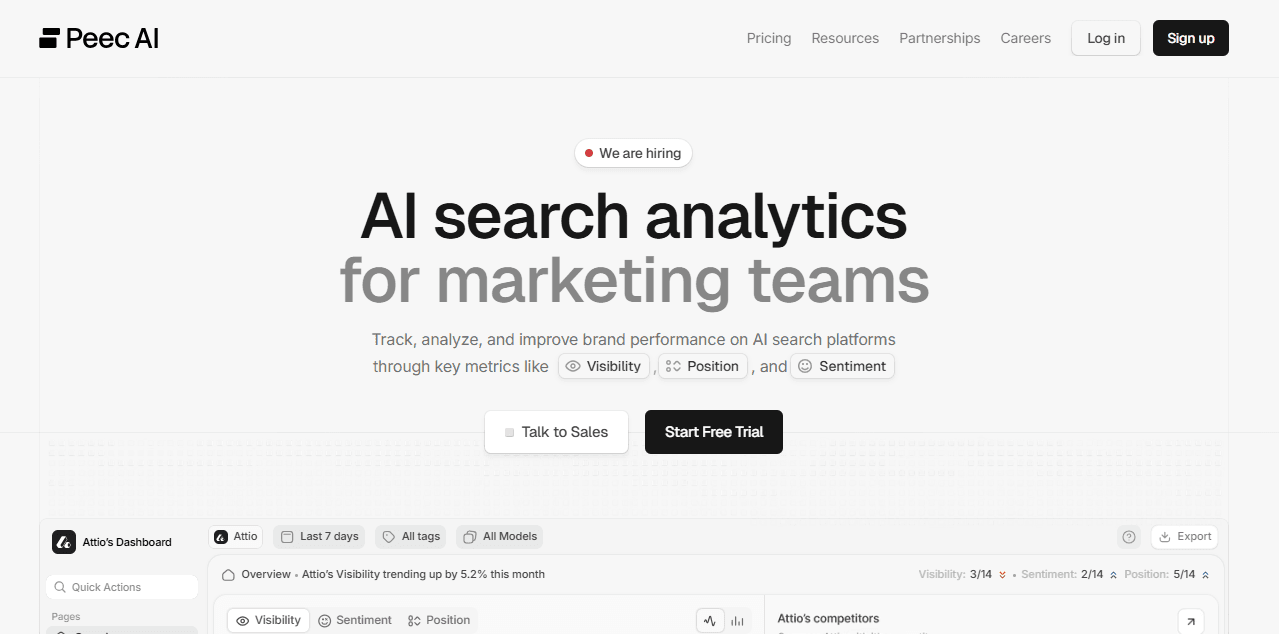
Peec is another one of the top generative engine optimization tools, designed to help B2B SaaS startups monitor, benchmark, and improve how they appear inside LLM platforms. It’s particularly useful for B2B SaaS products that already have branded search demand.
Peec AI positions itself as a tool to help teams to “start winning in AI search.” It surfaces current visibility first, then highlights gaps against competitors.
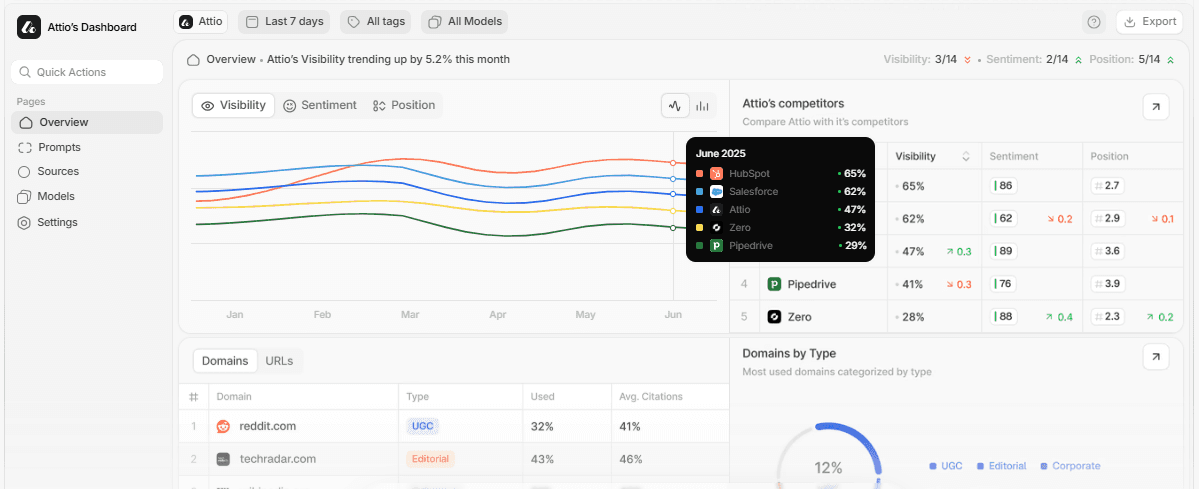
The onboarding experience is strong: once you input your website, you receive a free AI visibility report. The dashboard preloads relevant prompts and shows detailed breakdowns, including visibility score, mentions, and citation sources across LLMs.
Features:
- AI prompt tracking and visibility monitoring
- Competitor benchmarking
- Citation and source analysis
- Visibility scoring across AI models
Pros:
- High usability
- Strong competitor comparison
- Clear visibility breakdowns
Cons:
- Primarily monitoring-focused
- More valuable when the search demand already exists
Pricing: Free 7-day trial, then starts at €89/month
4. AthenaHQ
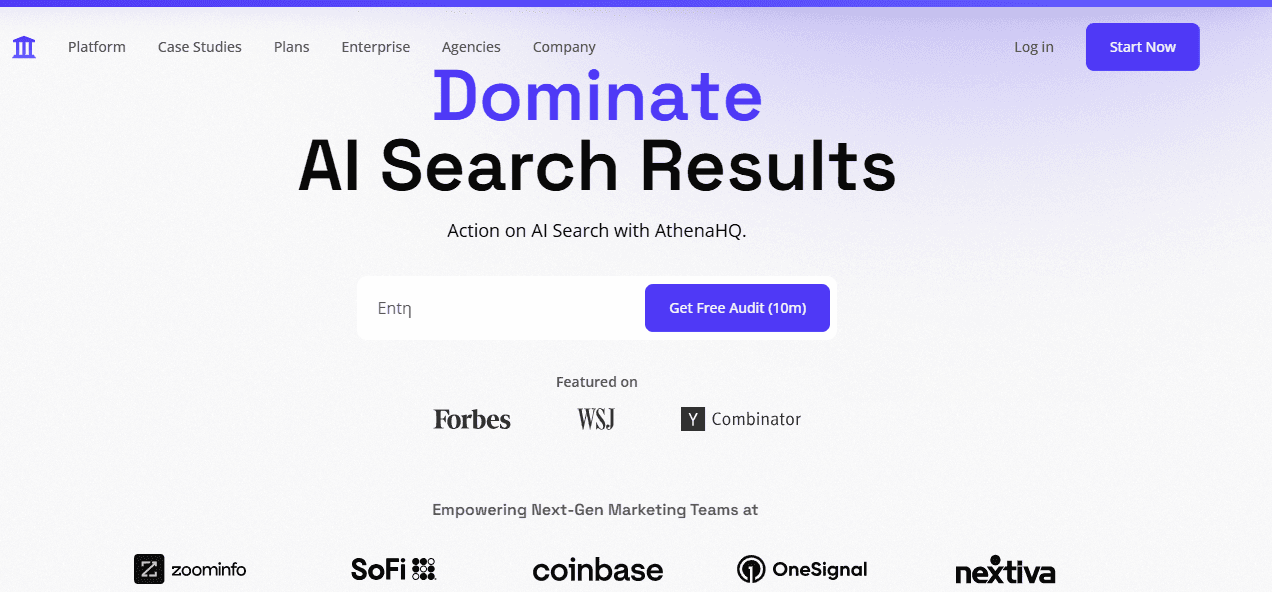
AthenaHQ is a purpose-built GEO and AI search visibility platform designed to show how B2B SaaS startups appear across generative engines, including ChatGPT, Perplexity, Claude, and Gemini. Founded by technical experts with backgrounds in Google Search and generative AI research, AthenaHQ combines monitoring with execution guidance.
During onboarding, AthenaHQ prompts users to add competitors and automatically suggests relevant AI queries, framing visibility within a competitive context from day one. The good news is that it generates a free AI visibility report that can be shared internally.
AthenaHQ stands out by blending GEO tracking with web analytics and conversion-layer reporting, making it feel more like a visibility intelligence system than a surface-level tracker.
Features:
- AI search visibility and GEO tracking
- Prompt discovery and analysis
- 360° AI visibility monitoring
- AI-generated recommendations via centralized action center
- Query-level performance tracking
- Conversion-focused analytics
Pros:
- Combines monitoring with actionable recommendations
- Strong competitive framing
- Advanced analytics depth
- Designed by experts in search and AI systems
Cons:
- Higher pricing at growth tiers
- Better suited for serious, structured GEO programs
Pricing: Self-serve starts between $270 and $295 a month depending on plan and billing, and runs on a credit pool rather than a flat seat price. Enterprise is quoted separately. There is no free trial, though AthenaHQ will run a free visibility scan on your domain.
5. Semrush
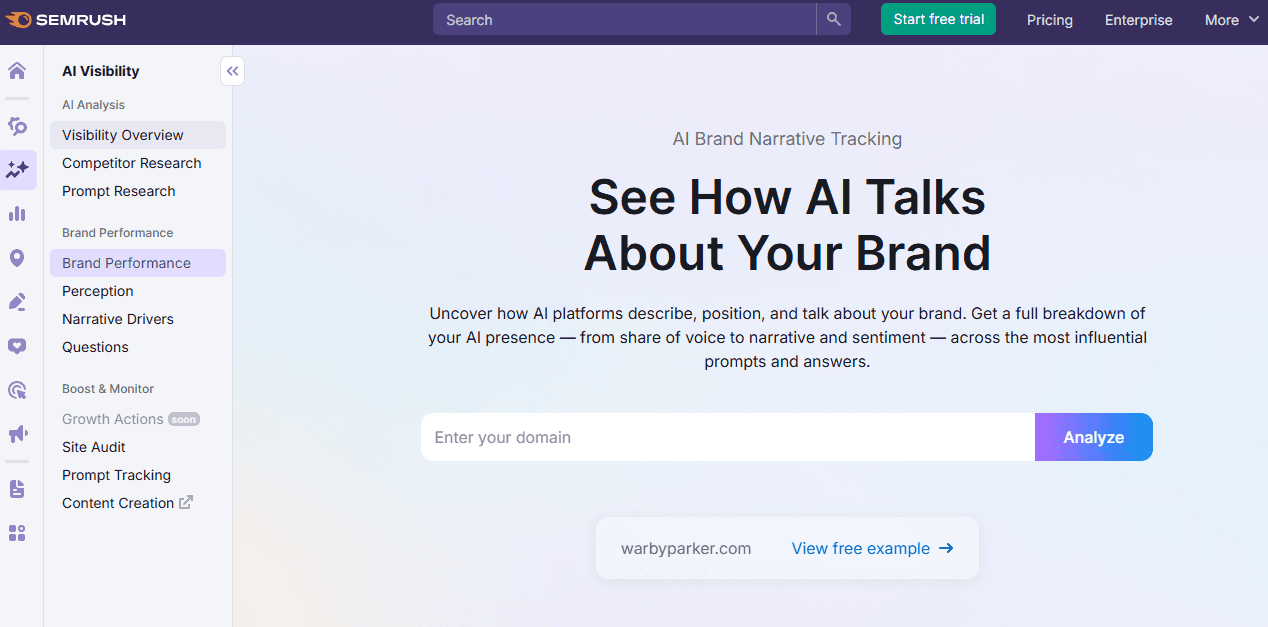
Semrush is the pick if you want SEO tools for generative engine optimization rather than a dedicated GEO platform, since it is a mature SEO suite now layering AI visibility insights onto traditional search tracking. While not built exclusively as a generative engine optimization tool, it provides foundational keyword research, SERP tracking, and emerging AI Overview monitoring.
For startups already invested in SEO infrastructure, Semrush can support GEO experimentation, but it lacks deep LLM prompt tracking workflows compared to specialized tools.
Features:
- Keyword research and tracking
- Competitor analysis
- SERP monitoring
- AI Overview visibility tracking (beta features)
Pros:
- Comprehensive SEO dataset
- Familiar workflow for marketing teams
- Strong technical research capabilities
Cons:
- GEO tracking may not be as specialized as the dedicated tools
Pricing: Free 7-Day trial and starts at $199/month.
Quick Comparison of the Top Generative Engine Optimization Tools
Here are the top-rated generative engine optimization tools for AI search compared side by side, so you can work out which is the best tool for generative engine optimization at your budget.
| Tools | Free option | Entry price | AI Mention Tracking | Prompt Monitoring | Technical SEO | Best For |
|---|---|---|---|---|---|---|
| Profound AI | Free AEO report, no free plan | $99/mo billed yearly, ChatGPT only at that tier | Strong | Moderate | Low | AI visibility reporting |
| Scrunch | 7-day free trial | $250/mo | Strong | Strong | Low | Competitor monitoring |
| Peec AI | Free visibility report on signup | $95/mo (€89), 50 prompts, 3 engines | Moderate | Moderate | Low | Early-stage teams |
| AthenaHQ | Free domain scan, no trial | $270 to $295/mo, credit-based | Strong | Strong | Low | Prompt experimentation |
| Semrush | Limited free plan, 10 lookups a day | $199/mo for Semrush One, the AI visibility bundle | Weak (LLM focus) | Limited | Strong | Traditional SEO teams |
If you are a marketing manager at a B2B company hunting for the best free generative engine monitoring tools, the honest answer is that none of these five run a free forever plan for ongoing monitoring. What you can get for nothing is a one-off read. Profound publishes a free AEO report, Peec AI and AthenaHQ both generate a free AI visibility report once you enter your domain, Semrush keeps a limited free plan capped at ten report requests a day, and Scrunch gives you seven days on a full trial. Those are enough to see where you stand today across ChatGPT and Perplexity. None of them will show you movement week over week, which is exactly the point at which every tool here starts charging.
GEO tooling isn’t limited to visibility trackers, either. If your team also produces developer-facing content, it’s worth pairing this stack with the top AI document generators for developer docs, a related AI-tooling category that helps structure the source content AI engines cite from.
Final Thought: The Next Steps
From what we’ve seen, GEO is actively reshaping how B2B SaaS buyers discover, compare, and shortlist solutions. As we’ve seen in this blog, the best generative engine optimization tools help you monitor visibility across AI systems. But monitoring alone doesn’t create citations, recommendations, or pipeline impact. Execution does.
However, most generative engine optimization tools stop at visibility reporting. They tell you what is happening, but they do not help you operationalize what to change, how to change it, and how to connect it to structured clusters and revenue intent. The real leverage for B2B SaaS startups comes from connecting prompt-level insights to structured execution.
This is where generative engine optimization services for B2B brands earn their keep, and where Infrasity’s GEO tracking app closes the loop. When you use tools like Profound or Scrunch, yes, they surface prompts, show the visibility scores and you see your startups’ competitor mentions. And then? You’re left to:
- Interpret which prompts actually drive revenue
- Rework content manually
- Wait for model refresh cycles
- Retest prompts again
If you need a tool for showing the performance of generative engine optimization to a board or a CEO, this is what that reporting looks like. Inside app.infrasity, growth teams get a live AI Visibility Dashboard that tracks:
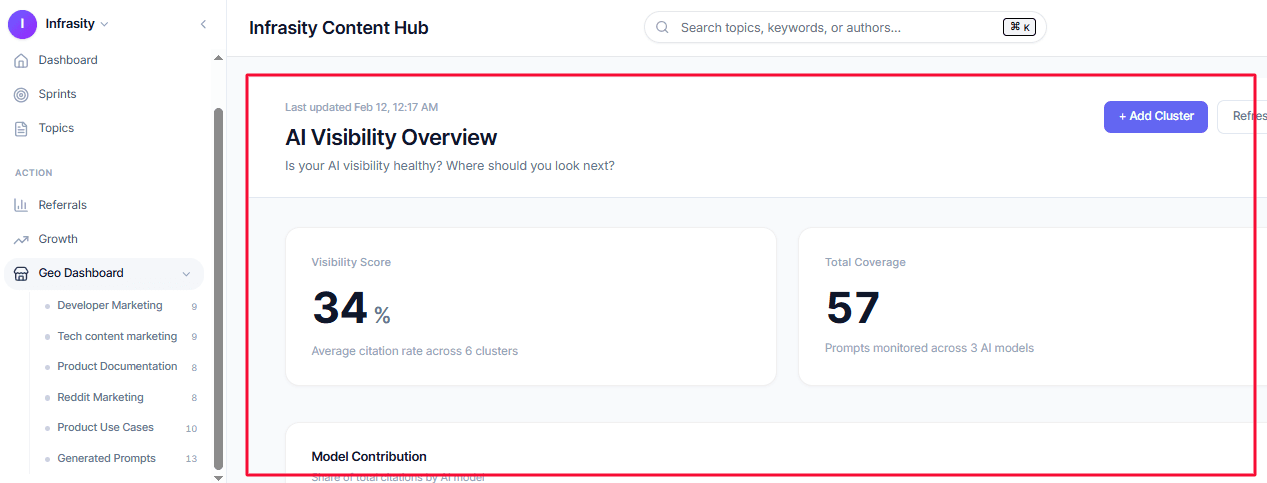
- Visibility score across monitored prompt clusters
- Total prompt coverage across multiple AI models
- Model contribution split (e.g., ChatGPT vs Perplexity vs Claude)
- Citation rate by topic cluster
- Prompt-level ranking changes
- AI referral growth trends
Instead of manually testing prompts in ChatGPT or Perplexity, teams can monitor clusters like Developer Marketing, Product Documentation, or Use Cases and see exactly where citations are strong and where they’re missing.
For example, if “Product Documentation” shows a 24% citation rate while “Developer Marketing” shows 84%, the next move is clear: revamp content depth, structured data, and topical authority in that weaker cluster.
A Practical GEO Execution Roadmap
If you’re a Growth Head or VP of Marketing, your next steps should look like this:
1. Audit AI Visibility: Measure your startup’s citation rate and prompt coverage through an LLM visibility audit and share across ChatGPT and Perplexity.
2. Identify Underperforming Clusters: Analyze which buying-intent topics have low AI citation rates.
3. Align Content to High-Intent Prompts: Shift from keyword-first SEO to conversational prompt modeling.
4. Implement Structured & Technical Updates: Add semantic depth, schema markup, entity clarity, and internal linking improvements.
5. Monitor Model-Level Shifts: Track which AI systems cite you most and where competitor visibility is increasing.
6. Tie Visibility to Pipeline: Measure AI referral traffic and conversion rates from LLM-originated sessions.
Frequently Asked Questions
1. What are the top GEO optimization techniques for AI search visibility?
The most effective GEO techniques focus on making your SaaS visible inside AI-generated answers, not just search rankings. This includes mapping conversational buyer prompts, strengthening semantic depth across key pages, implementing structured data, and building comparison-driven content that AI systems commonly reference. Infrasity approaches this through a structured audit, prompt research, content optimization, and ongoing AI visibility tracking, so improvements are directly tied to citation growth rather than assumptions.
2. What are the best platforms for generative engine optimization vs SEO tracking, and how should B2B companies run both?
SEO and GEO should run in parallel, and not separately. SEO ensures your startup ranks in traditional search, while GEO ensures your content is cited and recommended inside AI-generated answers. For B2B SaaS teams, this means maintaining technical SEO hygiene while layering conversational query optimization and prompt-level tracking on top. Infrasity integrates both approaches so content performs across Google and AI systems simultaneously. On tooling the split is clean. Semrush and the other traditional suites still own rank tracking and technical audits, while Profound, Peec AI, Scrunch and AthenaHQ own prompt-level AI visibility. Most B2B teams end up paying for one of each rather than finding a single platform that does both well.
3. How can I improve LLM visibility for my SaaS?
Improving LLM visibility starts with understanding where your SaaS currently appears inside tools like ChatGPT and Perplexity. From there, you need to align content with high-intent prompts, strengthen topical clusters, clarify positioning, and monitor citation performance continuously. Infrasity supports this by tracking prompt-level visibility and identifying gaps across categories, allowing growth teams to prioritize content updates that directly increase AI citations and share of voice.
4. What are the top AI tools for generative engine optimization for B2B SaaS?
The top AI tools for generative engine optimization currently include Profound AI, Scrunch, Peec AI, Semrush, and AthenaHQ. However, most focus on monitoring. Execution-heavy support, technical SEO updates, structured data, and content revamps are often required alongside tools.
5. How do I check my share of voice in generative engines?
Share of voice in generative engines is the percentage of your tracked prompts where an AI answer names you rather than a competitor, and every tool on this list measures it the same way. You supply a set of buyer prompts, the tool runs them across ChatGPT, Perplexity, Gemini and Google AI Overviews on a schedule, then counts mentions and citations by brand. Peec AI and AthenaHQ report it as a single visibility score with a competitor breakdown, Profound reports it prompt by prompt, and Scrunch reports it alongside the citation sources feeding each answer. If you want a read before paying for any of them, run ten of your highest-intent buyer prompts in ChatGPT and Perplexity by hand, record which vendors get named, and repeat monthly. That is the same measurement done manually, and it is enough to tell you whether you have a visibility problem worth tooling for.
6. What are the best generative engine optimization platforms for mid-market B2B companies?
For mid-market B2B marketing teams the shortlist narrows to three. Peec AI at $95 a month if you want a clean scoreboard and nothing else. Scrunch at $250 a month if competitor monitoring and agent traffic matter more than the line item. AthenaHQ from $270 a month if you want optimization workflows attached to the tracking rather than a dashboard on its own. Profound’s entry tier covers ChatGPT only, which gets thin fast once a mid-market buying committee is researching across several engines. Semrush earns a place only if you are already paying for it and want AI visibility layered onto reporting your team already reads.
7. Is generative engine optimization (GEO) different from traditional SEO?
GEO optimizes content to be cited and summarized correctly by AI systems like ChatGPT, Perplexity, and Google AI Overviews, while traditional SEO optimizes for ranking in classic blue-link search results. The two overlap heavily, but GEO adds emphasis on answer-first formatting, clear entity definitions, and structured data.