
TL;DR
Marketing to developers is one of the most misunderstood disciplines in B2B growth. Developer marketing is the practice of building brand credibility, community trust, and product adoption specifically within technical audiences — and it requires a fundamentally different playbook than traditional B2B marketing where feature matrices and sales calls are the norm.
- Your paid campaigns may be driving traffic and signups, but low activation and weak product engagement signal a deeper issue: you’re applying B2B marketing tactics to a developer audience that prioritizes technical validation over persuasion.
- High-performing Business to Developer (B2D) marketing rests on 3 pillars: Developer Marketing (deep technical content, tutorials, documentation), Developer Relations (DevRel) (community engagement, advocacy, events), and Product-Led Growth (PLG) (self-serve onboarding and community-driven validation).
- The B2D funnel moves from Discovery, Evaluation, Adoption, and Expansion, driven by SEO visibility, GitHub presence, strong documentation, smooth onboarding, and scalable team-wide adoption.
- The real audience isn’t “developers” as a single persona; it includes Developers, DevOps professionals, and Architects, each with different evaluation criteria and influence on adoption.
- This guide breaks down how to identify your technical ICP, choose the right channels (Reddit, GitHub, Discord), build the 3 core B2D pillars, and design a funnel that converts developer interest into long-term expansion.
Are your paid campaigns generating traffic, but the developer still doesn’t convert?
You see clicks, signups but the activation is weak, no one books a demo and a very few move past the first API call. For Growth Heads and VPs of Marketing, this feels like a conversion problem. However, the real issue is usually not traffic, but it’s the fact that you’re applying traditional B2B marketing to a developer audience. Even paid channels need this recalibration — our review of the best B2B SaaS Google Ads agencies covers which paid-search partners actually understand technical, committee-driven buying cycles instead of optimizing for generic form fills.
According to a recent study, when developers sign up, activation rates of 20-40% are a good benchmark, but this still leaves a majority who sign up but don’t engage because the onboarding and product experience weren’t strong enough.
Business to developer marketing (B2D marketing) is an approach designed to build advocacy and awareness among the developers who use or want to use your solutions. Usually, well-performed business to developer marketing programs combine developer marketing and developer relations (DevRel) strategies to drive ongoing engagement throughout the customer journey.
If you are not aware of these two strategies, let’s take a look at the overview of these:
- Developer marketing strategy: Developer marketing focuses on attracting technical audiences through educational and discoverable content. The goal is to earn attention by helping developers understand a problem space, explore use cases, and see how your product fits into their workflow, before asking for commitment.
- DevRel strategy: DevRel strategy begins once there is some level of awareness or engagement. It is centered on building long-term trust with developers through community interaction, technical advocacy, feedback loops, and ongoing support. DevRel strengthens relationships after the initial touchpoint and sustains engagement beyond the first interaction.
Once your understanding is clear on business to developer marketing, read along this guide to understand the audience, best channels, and core pillars of B2D marketing. Let’s get started!
Who is the Audience for Business to Developer Marketing?
The audience for business to developer marketing is developers. But that’s not specific enough to build an effective strategy.
One of the biggest mistakes in B2D marketing is treating “developers” as a single persona because they’re not. The way a backend engineer evaluates a new API is very different from how a cloud architect evaluates infrastructure tooling. Their priorities, risk tolerance, and buying influence vary significantly.
To market effectively to developers, you need to understand the functional buckets they fall into and how each group interacts with your product during the developer journey. Instead of segmenting by a list of job titles, it’s more practical to focus on 3 main groups most B2B SaaS startups encounter.
1. Developers
Developers are the ones writing the code, integrating your APIs, configuring your SDKs, and deciding whether your product actually works in production. If your product is API-first, infrastructure-heavy, or tooling-based, these engineers are often your first point of adoption.
Typical roles include:
- Backend Developer
- Full-Stack Developer
- Frontend Developer
- Mobile Developer
- Software Developer
These developers evaluate:
- Documentation clarity
- SDK quality
- Performance and reliability
- Time to first API call
- Real code examples
2. DevOps
These are the operators who ensure everything works reliably in production. While engineers write and implement code, DevOps is responsible for maintaining the environments where that code runs. They manage infrastructure, deployments, uptime, performance, and system resilience. Their role spans the entire lifecycle
Common titles in this category include:
- DevOps Engineer
- Systems Engineer
- Network Engineer
- SysOps Administrator
- Chief Information Officer
3. Architects
They may not be integrating your product line by line, but they influence whether it makes it into the stack. Their focus is on structure, scalability, and long-term viability. Their common roles include
- Web architect
- Software architect
- Database admin
What are the Best Channels for Business to Developer Marketing?
The best channels for business to developer marketing are places where your target community already is. There, they discuss and work through specific issues in their projects, and just chat with other like-minded developers, post questions about products and tools.
However, dev communities are highly resistant to overt marketing and if your presence feels promotional instead of helpful, you’ll lose trust quickly. Here’s where it actually works.
1. Reddit
Reddit hosts some of the most active developer communities online. These subreddits are strong discovery channels if you participate thoughtfully. Some subreddits you should join are:
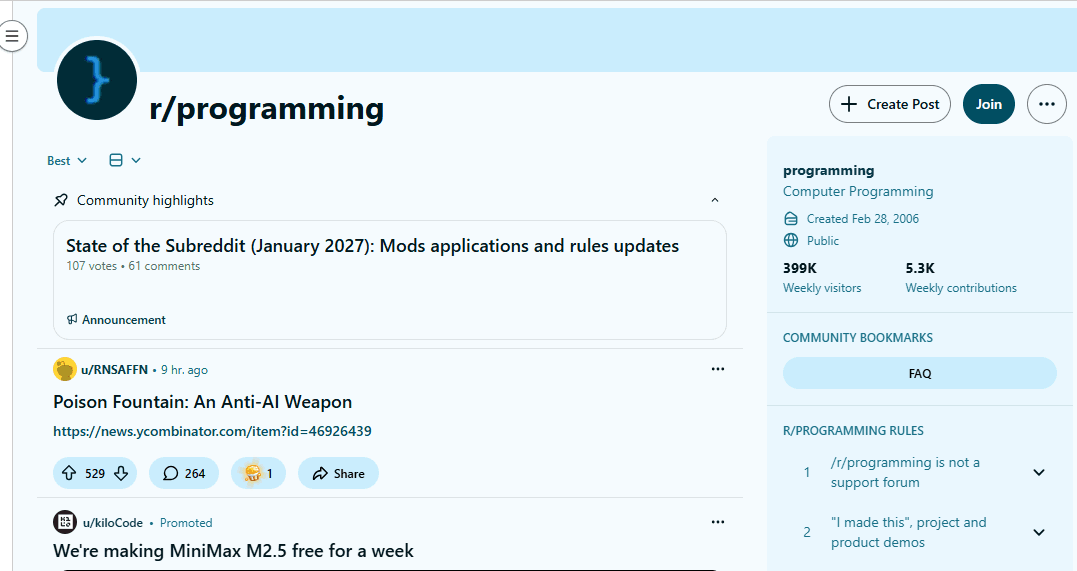
Join these subreddits and start engaging in discussions, answering technical questions, share genuinely useful tutorials.
2. GitHub
If your B2B SaaS startup is building APIs, infrastructure, or developer tooling, GitHub is a core infrastructure for marketing to developers. Here devs check:
- Repo activity
- Stars and forks
- Contribution history
- Issue responsiveness
- Documentation quality
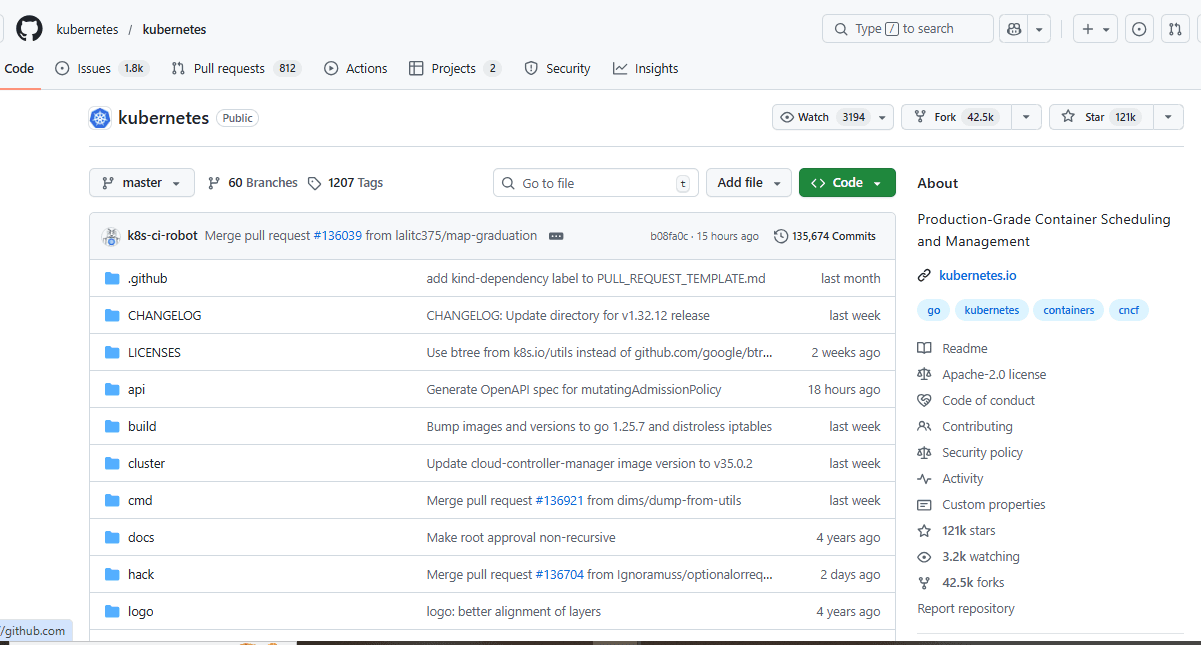
Some communities on GitHub are:
3. Discord
Many developer communities now operate in Discord servers where real-time technical discussions happen daily. These spaces are ideal for early-stage relationship building, collecting product feedback, and supporting power users. Participate as a contributor first.
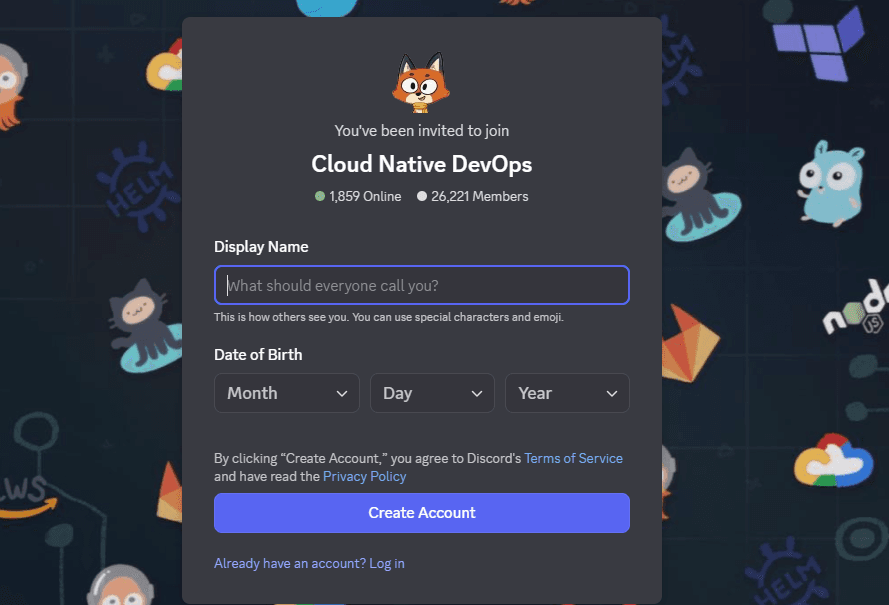
Some communities in Discord that your team can join are:
3 Pillars of High-Performing B2D Marketing?
Developer marketing
Developer marketing focuses on earning attention through education and technical credibility. This approach centers on:
- Deep technical blogs: Deep technical blogs dive into developer-focused topics, including coding challenges, industry trends, and practical software solutions. These blogs go beyond surface-level insights, often providing “how-to” guides, step-by-step tutorials, and real-world problem-solving for issues developers encounter daily.
In contrast, conventional blogs target a broader audience, covering general topics that don’t require technical expertise or coding experience.
Example: Infrasity’s tech content specializes in blogs that balance technical accuracy with accessibility. Instead of generic posts like “10 reasons why our tool is great,” we create content that addresses real developer challenges, such as “Debugging OAuth errors in Node.js” or “Scaling Kubernetes clusters efficiently.”
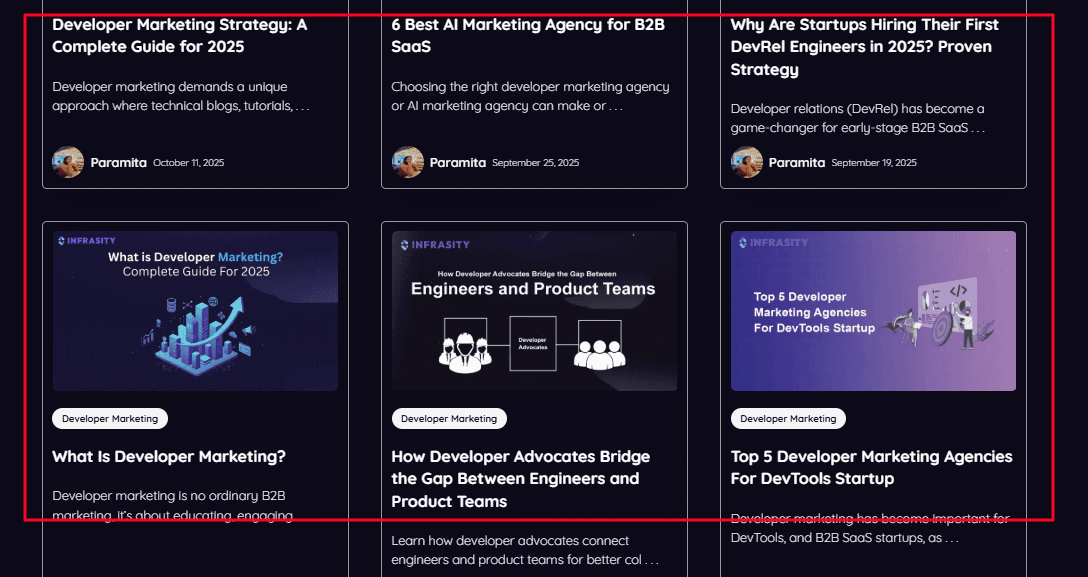
These posts not only educate but also build trust and credibility with technical audiences. Technical accuracy alone isn't enough, though — the tone, visuals, and terminology used across this content still need to trace back to consistent SaaS brand assets, so developers recognize your voice across a blog, a repo, and a changelog.
- Tutorials and implementation guides: Tutorials and implementation guides bridge the gap between awareness and real usage. While deep technical blogs explain concepts and problem spaces, tutorials show developers exactly how to execute a task inside a real environment. High-performing B2D tutorials typically include step-by-step setup instructions, sample repositories or starter templates, etc.
- Explainer videos and Product Walkthrough: Explainer videos and product walkthroughs give developers a visual, step-by-step understanding of workflows, integrations, and real-world use cases. These should be developer-led, created or guided by technical team members who understand actual implementation challenges rather than scripted marketing narratives.
Example: OpenAI regularly publishes technical walkthroughs showing how to integrate its APIs into real applications. Instead of abstract feature overviews, these demos walk through authentication, API calls, parameter tuning, and real implementation patterns.
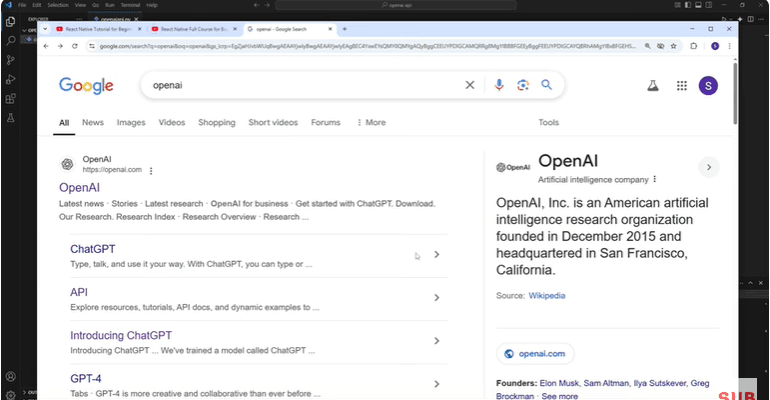
By demonstrating practical workflows and live outputs, developers can evaluate feasibility, performance, and integration effort before committing. These significantly lower evaluation friction and increase trial adoption.
- Product Documentation: Product documentation is arguably the most direct form of developer marketing. Developers convert because they can quickly understand how something works, see it in action, and implement it without friction. Clear, well-structured, example-driven documentation shortens time to value, builds technical confidence, and accelerates adoption.
For example, an authentication and authorization platform built production-ready sample repositories with Supabase integrations. Instead of reading abstract setup instructions, developers could run working authentication flows in minutes, which meant no back-and-forth with support, no ambiguity in implementation. The impact of strong developer experience is measurable. Documentation this clear rarely happens by accident — it usually traces back to a well-scoped B2B SaaS PRD that defined the exact use cases and edge cases worth documenting in the first place.
Developer Relations
Developer Relations begins where developer marketing leaves off. Once awareness is established, DevRel focuses on trust, credibility, and long-term engagement. It’s about cultivating technical advocacy and building genuine relationships with the developer community.
DevRel includes:
- Community engagement (Slack, Discord, GitHub Discussions)
- Technical AMAs and live Q&A sessions
- Gathering product feedback directly from users
- Hosting and participating in industry events
For instance, Infrasity recently attended Web Summit Qatar, and participating in events like these creates high-value touchpoints, strengthens partnerships, and opens doors for technical collaboration.
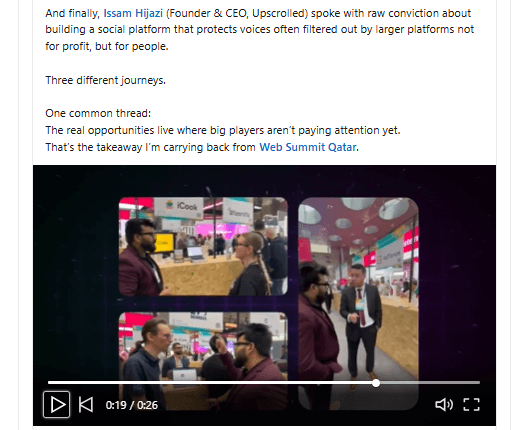
Participating in major developer conferences positions your startup as part of the ecosystem. Speaking sessions, workshops, and sponsorships reinforce authority and technical relevance. For a broader understanding of the developer conference landscape, check out all the upcoming conferences in 2026.
Product-led Growth
Product-Led Growth (PLG) in a B2D means designing your product so that developers can discover value independently and then allowing the community to amplify that value for you.
PLG accelerates when your community becomes an extension of the product itself. When developers:
- Share tutorials on Reddit
- Publish GitHub repos, integrating your tool
- Write independent setup guides
- Recommend your product in technical threads
…those actions function as authentic validation and peer proof in developer communities, consistently outperforming branded campaigns in credibility and speed.
The B2D Marketing Funnel: Discovery to Expansion
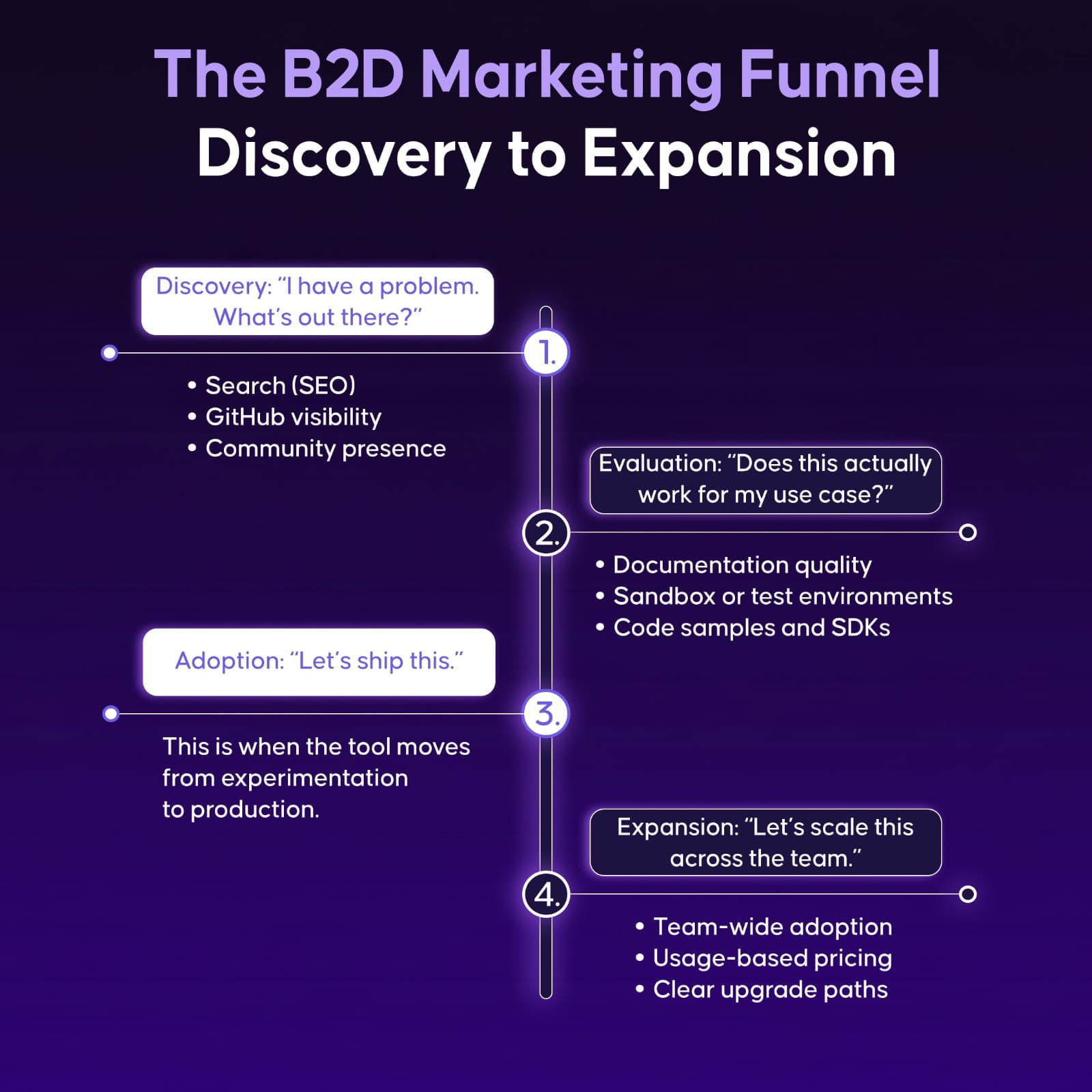
B2D funnel is driven by self-education, peer validation, and product experience. Developers move forward only when technical confidence increases. Here’s how that journey typically unfolds.
Stage 1: Discovery: “I have a problem. What’s out there?”
This stage is intent-driven. A developer is actively trying to solve something, debugging an error, integrating an API, improving infrastructure, or comparing tools.
Discovery typically happens through:
- Search (SEO): Ranking for integration queries, comparisons, and “how to” content.
- GitHub visibility: Open-source projects, SDKs, and active repositories.
- Community presence: Reddit threads, GitHub, Hacker News, Discord communities, Slack groups, and technical forums.
Stage 2: Evaluation: “Does this actually work for my use case?”
Once awareness exists, developers move into validation mode. This phase is practical and highly technical and the evaluation depends on:
- Documentation quality: Clear, technical, up-to-date, with real examples like troubleshooting support, real implementation steps, etc.
- Sandbox or test environments: The ability to try without friction. Free tiers, test keys, and demo environments lower the risk barrier.
- Code samples and SDKs: Copy-paste-ready snippets, clear API references, working integrations
Stage 3: Adoption: “Let’s ship this.”
This is when the tool moves from experimentation to production. Adoption depends on:
- Fast onboarding flow
- Minimal setup complexity
- Reliable SDKs and APIs
- Clear implementation guides
- Strong Developer Experience (DX)
Community support plays a significant role here because if developers see active conversations on Reddit or get quick answers in Slack or Discord communities, their confidence increases.
To support this page, you need fast onboarding, strong developer experience (DX), including reliable SDKs, and support from communities like Reddit and Slack.
Stage 4: Expansion: “Let’s scale this across the team.”
Expansion happens when the product proves its value consistently. This is driven by:
- Team-wide adoption: Easy collaboration and shared environments.
- Usage-based pricing: Aligning pricing with growth ensures that cost increases correlate with tangible value.
- Clear upgrade paths: Enterprise features that make sense as scale increases.
Conclusion
Developer-focused marketing requires a level of technical fluency and community knowledge that most generalist teams do not have on day one. Working with a developer marketing agency accelerates the learning curve dramatically — you get strategic guidance, channel expertise, and network access that would take years to build internally.
Business to Developer marketing is not about louder campaigns; it’s about removing friction across the developer journey. From discovery through GitHub and search, to evaluation via documentation and sandbox environments, to adoption powered by strong DX, every stage requires technical clarity and peer validation.
Growth leaders must move beyond lead volume and focus on activation and product resonance. CTOs and DevRel teams must ensure documentation, SDK reliability, and community engagement are not afterthoughts but strategic levers. When developer marketing, DevRel, and product-led growth work together, trust compounds. And in developer ecosystems, trust is the real growth engine, one that scales far more sustainably than traditional B2B acquisition alone.
Frequently Asked Questions
1. When should a startup invest in DevRel?
Once a B2B SaaS startup starts seeing organic developer interest or early community traction. DevRel compounds growth when there’s something worth advocating for, strong docs, clear product value, and initial adoption signals.
2. How long does B2D marketing take to show results?
Unlike paid demand gen, B2D compounds over time. SEO authority, GitHub visibility, and community trust typically show meaningful impact in 3-9 months, but retention and expansion improve significantly once credibility is established.
3. Where do developers research tools?
Developers research tools while solving a specific problem. They rely heavily on Google for technical queries, GitHub for repository activity and example code, Stack Overflow for real-world validation, and communities like Reddit or Discord for peer recommendations. They trust sources that demonstrate practical implementation over promotional messaging.
4. Best developer marketing agencies for early-stage software startups?
Infraisth is one of the best developer marketing agencies understand technical audiences and product-led growth. Infrasity specializes in deep technical content, documentation strategy, and community-driven growth tailored for API-first and infrastructure startups. Strong agencies focus on GitHub visibility, SEO for integration queries, and developer-first positioning rather than traditional demand generation.
5. How is B2D Marketing different from B2B or B2C?
B2D or Business to Developer marketing is very different from B2B and B2C because the primary evaluator is a technical user who validates products through hands-on experience rather than messaging. Unlike B2B, where sales relationships and executive persuasion often drive deals, B2D relies on documentation quality, GitHub credibility, community proof, and product experience. Unlike B2C, emotional triggers and mass appeal matter far less. Developers prioritize functionality, performance, transparency, and peer validation. In B2D, technical trust and time-to-first-value determine adoption.