
Overview
Developer GTM is highly sensitive to execution gaps. When technical content, community engagement, and product education pause, visibility and momentum are lost during critical growth phases. Hiring-driven delays not only slow output; they also directly impact discovery, evaluation, and onboarding.
Cycloid, a €5M Series A Unified Internal Developer Portal, was getting ready to scale its developer GTM. The plan was to hire a DevRel who could own technical content, represent the brand in community discussions, and produce demo and use-case videos. That search ran close to three months. During that time, content slowed, and other GTM efforts stayed on hold. Through ongoing conversations, it became clear that waiting longer for the right hire would only extend the stall. Instead of continuing to wait, Cycloid decided to separate execution from hiring and move forward without a DevRel in place.
Why DevRel hiring slows developer GTM
Developer growth depends on consistently shipping content, engaging the community, and educating developers.
For Cycloid, the GTM motion slowed because execution was contingent on a DevRel hire. The search for a DevRel who could own technical content, represent the brand in community threads, and produce demo and use-case videos took around three months. During this period, content velocity stalled.
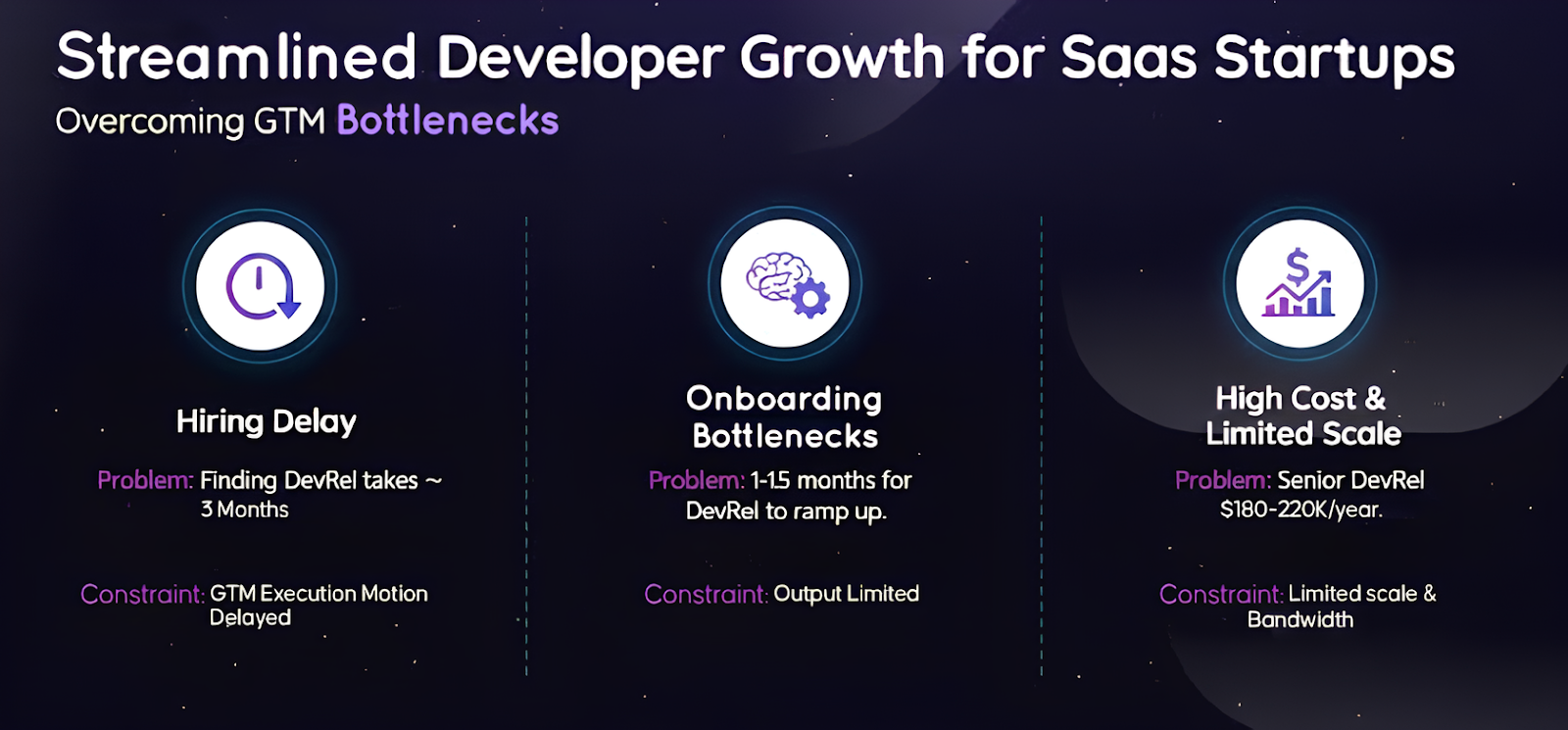
After hiring, onboarding is usually the next blocker. It typically takes one to one and a half months for a DevRel to understand the product well enough to confidently ship content and engage with developer communities with authority.
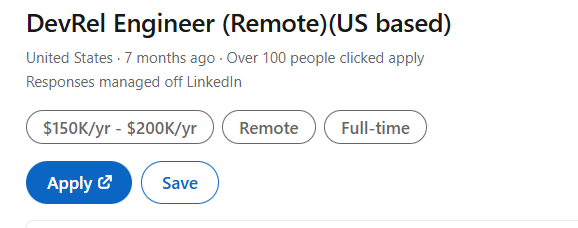
Lastly, cost is another constraint; a senior DevRel hire typically costs $150k–$200k annually, yet output is limited to one person’s bandwidth. Content, documentation, community, and video could not scale in parallel.
The alternative: execution-first developer GTM without a DevRel hire
Execution-first developer GTM removes dependency on hiring and ramping a DevRel role. Instead, Infrasity operates as an engineering-led execution layer, delivering technical content, documentation, community engagement, and product education immediately. For Cycloid, Infrasity acted as an extended DevRel arm, allowing developer GTM to move forward without waiting for hiring cycles or onboarding time. This approach shifts the focus from role ownership to continuous execution, enabling faster output, parallel GTM motion, and scalable developer visibility at a fraction of the cost of a full-time DevRel hire.
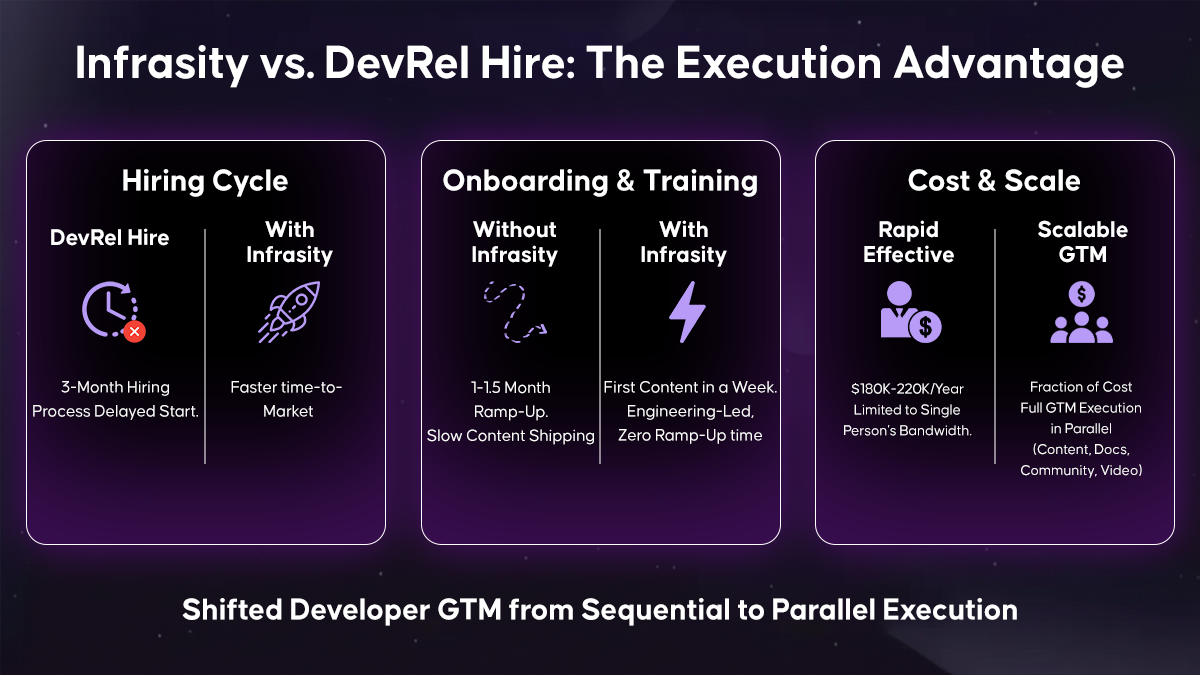
Infrasity replaced the delays and limitations of a DevRel hire with immediate, execution-first developer GTM.
Hiring cycle
Instead of a three-month hiring process, execution started from day one. Technical content, documentation, community engagement, and video production began immediately, without waiting for a role to be filled.
Onboarding and training
While a DevRel typically takes one to one and a half months to ramp, Infrasity shipped the first content piece within the first week. Our engineering-led team operated with existing GTM context, removing the need for long onboarding cycles.
Cost and scale
Rather than committing $180k–$220k annually to a single DevRel, Cycloid accessed a full engineering-led GTM team at a fraction of the cost. This allowed content, documentation, community, and video to scale in parallel instead of being limited by one person’s bandwidth.
This shifted developer GTM from a slow, sequential process to a parallel execution model built for speed and scale.
How did Cycloid scale developer GTM without hiring DevRel?
Once Cycloid decided not to wait on a DevRel hire, Infrasity stepped in as the execution layer for developer GTM. The focus shifted from role ownership to shipping consistently across the channels that influence discovery, evaluation, and adoption.
Technical Content
On the content side, we worked closely with the Cycloid team to produce technical, search-driven content aligned with high-intent developer queries. This included deep-dive blogs, use-case walkthroughs, and platform–engineering–focused pieces designed to rank for competitive keywords and be referenced in comparisons. To avoid content living only on the blog, this work was distributed across multiple platforms such as Medium, Dev.to, and Daily.dev, creating an omnichannel footprint that increased both search visibility and LLM citations.
This distribution strategy ensured Cycloid’s content appeared in more places where AI systems ingest and retrieve information, while also driving referral traffic from developer-heavy platforms. Over time, this led to consistent visibility across search engines and AI answers, rather than relying on a single channel.
Organic Reddit Engagements
In parallel, we activated organic community GTM. Infrasity engaged in relevant developer and platform engineering communities where Cycloid’s ICP already discussed tooling and architecture decisions. This included participating in subreddits such as r/devops, r/platformengineering, r/kubernetes, r/cloudcomputing, and r/sre, contributing context-driven discussions rather than promotional posts. These conversations drove direct referral traffic and reinforced Cycloid’s presence in the community narratives that increasingly surface in AI-generated answers.
Impact Driven:
- Monthly organic clicks grew from 50–60 to 1,000+
- Sustained 20% month-on-month growth
Top Performing Keywords (Current Rankings)
- cloud management portal for MSP – #1
- best idp for platform engineering teams 2025 – #3
- FinOps in CI/CD pipeline – #3
- day 2 operation – #4
New Traffic Channels
- LLM-driven traffic: grew from 0 to 200+/month
- Reddit-driven traffic: 100+ visits/month
See how modern GTM teams execute without friction
DevRel hire vs outsourcing execution: time, cost, and output
Developer GTM is constrained by time, cost, and execution bandwidth. A hiring-led approach concentrates growth responsibilities in a single DevRel role, introducing delays from hiring and onboarding while limiting output to one person’s capacity. Content, community engagement, and product education tend to move sequentially as the role ramps.
In contrast, Infrasity replaces the hiring dependency with an engineering-led execution model. Multiple GTM levers including technical content, documentation, community presence, and distribution are activated immediately and run in parallel, allowing teams to scale developer visibility without waiting for headcount to settle.
| Dimension | DevRel Hire | Infrasity |
|---|---|---|
| Time to start | ~3 months hiring cycle | Execution from day one |
| Time to first output | 1–1.5 months onboarding | First content shipped in week one |
| Annual cost | $180k–$220k + equity | Fraction of the cost, flat engagement |
| Output capacity | Limited to one person | Team-based, multi-specialist output |
| Content types | Blogs, occasional demos | Blogs, docs, videos, community GTM |
| Community presence | Limited by individual bandwidth | Parallel execution across channels |
| GTM motion | Sequential | Parallel and compounding |
| Risk | High commitment before results | Low-risk, fast validation |
Frequently Asked Questions
1. What does a DevRel (Developer Relations) engineer typically do in a SaaS company?
A DevRel (Developer Relations) engineer acts as the interface between a product team and its developer audience. The role typically includes creating technical content such as blogs, tutorials, documentation, and demos that help developers understand and adopt the product. DevRel engineers also engage in developer communities, forums, and events to represent the product, answer technical questions, and gather feedback.
2. How long does it take for a DevRel hire to become productive?
In most SaaS startups and scaleups, hiring a DevRel engineer typically takes around 2–3 months, depending on role seniority and market conditions. After the hire is made, onboarding and product ramp-up usually require an additional 4–6 weeks before meaningful output begins. During this period, the DevRel is learning the product, messaging, developer personas, and community context.
3. How much does it cost to hire a DevRel engineer in the US?
The average cost of hiring a senior DevRel engineer in the United States ranges from $180,000 to $220,000 per year. This estimate usually excludes equity compensation, benefits, travel expenses, and tooling costs.
4. How does outsourcing developer GTM compare to hiring a DevRel engineer in SaaS teams?
Outsourcing developer GTM and hiring a DevRel engineer solve similar problems but operate very differently. A DevRel hire places responsibility on a single internal role, which requires time for hiring, onboarding, and product context before consistent execution begins. Output is constrained by individual bandwidth, making it difficult to scale content, documentation, community engagement, and distribution simultaneously. Outsourced developer GTM shifts execution to an external, engineering-led team that can start immediately.
5. Does outsourcing the developer GTM reduce authenticity with developers?
Outsourcing developer GTM does not reduce authenticity when execution is led by engineers with real implementation experience. Developers primarily evaluate content based on technical accuracy, clarity, and practical usefulness rather than who produced it. Documentation, tutorials, and examples that reflect real-world constraints and trade-offs tend to earn trust
6. How to build DevRel without a hiring team
You can build DevRel without a team by focusing on execution over headcount. Instead of hiring a full-time Developer Advocate immediately, start by shipping consistently across high-impact channels: technical blogs, documentation improvements, GitHub examples, and community engagement. Prioritize search-driven content, participate in relevant Reddit and developer forums with context-first contributions, and create implementation-focused tutorials that reduce onboarding friction. Measure impact through organic clicks, community referrals, activation metrics, and LLM visibility. Early-stage DevRel is less about a formal team and more about sustained, technically accurate execution that builds credibility and drives developer adoption.