
Open source marketing is the work of turning free code into real adoption, active contributors, and eventually pipeline. It is not a slick campaign, and it is not a rising GitHub star count. The projects that win do two unglamorous things well: they remove every bit of problem between a developer's problem and a working install, and they show up where developers actually decide what to use, GitHub, Reddit, Hacker News, and now AI answers.
We build this motion for AI infrastructure and developer-tool teams, and we see the same pattern over and over. A team ships, hits the front page of Hacker News for a day, watches stars climb into the thousands, and still can't tell you how many people installed the thing and kept using it. Stars went up. Adoption didn't.
This blog is the full playbook for fixing that. One note before we start: this is about marketing your open-source project or product. It is not a roundup of open-source marketing tools like Mautic or Listmonk. Different search, different page.
Key Takeaways
- Open source marketing is selling without a price tag. You are not asking for money; you are asking for a developer's time and attention. That changes every tactic.
- GitHub stars are a vanity metric. Real signals are installs that complete, weekly active usage, contributors, and time-to-first-pull-request. You get what you measure.
- In 2026, discovery happens in communities and AI answers. When a developer asks "best open source X" in ChatGPT, Perplexity, or Google's AI Overview, you either show up or you don't.
- Your README is your landing page. Most projects lose people in the first five minutes because the quickstart doesn't work or the value isn't obvious.
- Distribution is a system, not a launch. Reddit contribution, Hacker News, GitHub Trending, Awesome lists, and developer content compound over months, and feed the AI answers above.
- Open source is a distribution model, not a charity. MongoDB turned free code into a $25B+ giant because the developer tinkering on Sunday becomes Monday's enterprise buyer.
What Is Open Source Marketing, and Why Open Projects Still Need It
Open source marketing is everything you do to help developers discover, trust, adopt, and champion a project whose code is freely available.
The end goal is not revenue directly; it is a growing base of users and contributors who make the software more useful and more known.
"If you build it, they will come" is the most expensive myth in open source. There are more than 100 million developers on GitHub and hundreds of millions of repositories. Several libraries usually solve the same problem. If you don't actively communicate what your project does and who it's for, people won't find you, and great code dies in the dark.
Here's the reframe that trips up most marketing leaders: you are selling, even when the software is open. You're just not selling a product for money. You're selling an idea, and the currency you ask for is a developer's time and attention, which they guard far more closely than their company's budget.
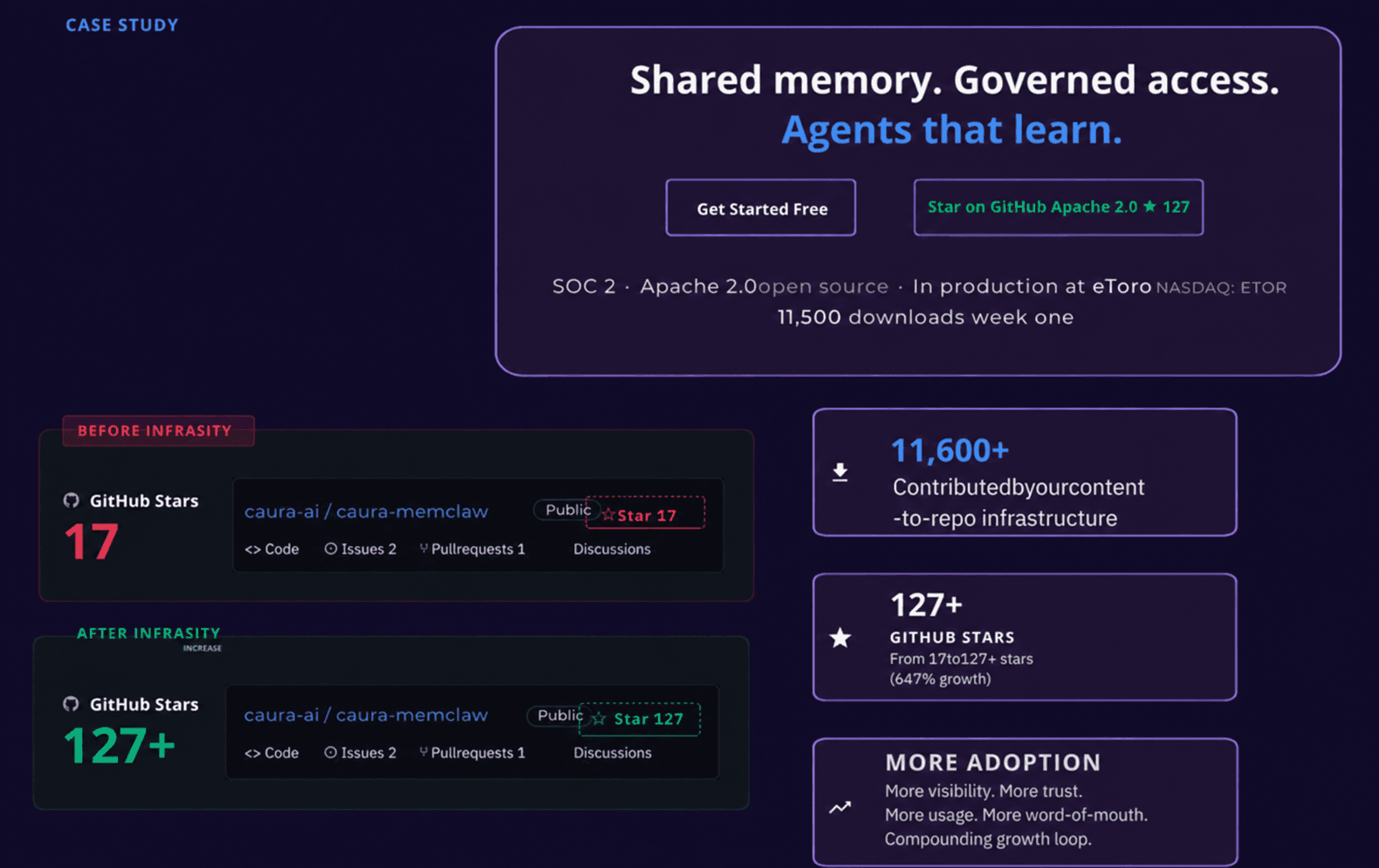
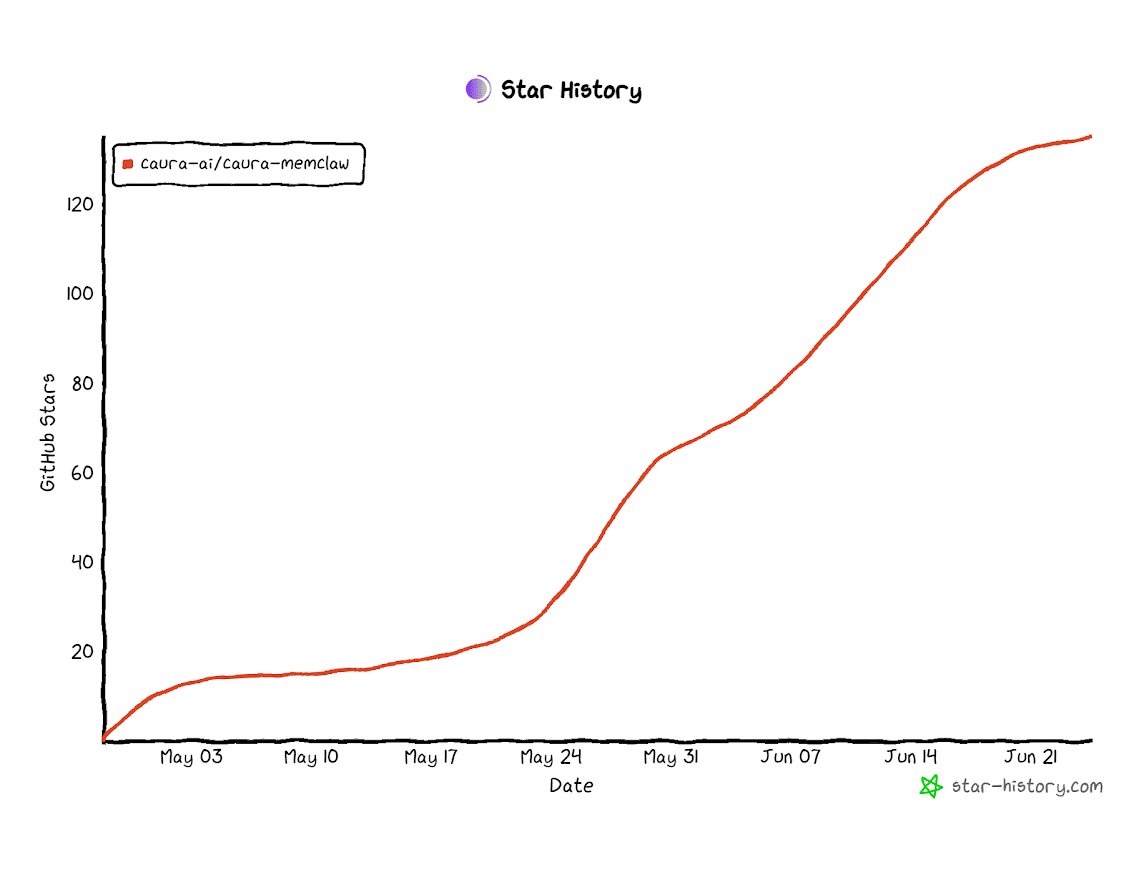
We've seen this firsthand. For one of our clients in the agentic memory space, we created practical use cases and integration examples around agent memory workflows, then amplified them through targeted content. The result was growth from 17 to 127+ GitHub stars and more than 11,600 package downloads.
Want to know the exact secret? Jump to the "Open Source Distribution Playbook" section to know more about.
Want Infrasity to do this for you? Book a Call
Why Does Normal Marketing Fail With Developers?
Because developers can smell a sales pitch instantly, and they reject it. The exact same asset that converts a business buyer, the glossy video, the gated whitepaper, the "request a demo" wall, actively repels the developer evaluating your project with a terminal open.
What works instead is different in kind, not degree:
- Authenticity over polish. A clear README beats a launch video. A working code sample beats a landing page.
- Developer-to-developer proof. A maintainer answering a hard question in a GitHub issue or a Reddit thread does more than a campaign.
- Utility first. Documentation, tutorials, and quickstarts are the marketing. They reduce the time it takes to get value, and time-to-value is the whole game.
This is why developer marketing is its own discipline and why most teams staff it wrong. They hire for campaigns when they need engineers who can write, demo, and earn trust. It's also the core reason Infrasity's content is written by engineers, not marketers. A developer audience can tell the difference in the first paragraph.
If The Project Is Open Source, What Are You Actually Selling?
If the project is free and anyone can copy it, your competitive advantage isn't the code. It's three things enterprises consistently pay for: they don't want vendor lock-in, they want to buy from the people who actually wrote the code, and they want expertise that a giant general-purpose vendor can't match on your specific problem.
That advantage gets packaged into one of three business models. Your model decides your marketing motion, so pick deliberately.
| Model | What you charge for | Examples | Marketing implication |
|---|---|---|---|
| Support & services | The software is open for all; you sell support, managed services, and expertise | Red Hat, Percona, Canonical | Hard to scale. Marketing leans on trust, expertise, and reputation. Watch out, a Red Hat-style player can become your competitor. |
| Open core | Open-source core plus proprietary, differentiated features (often self-hosted) | GitLab, many DevTools | Constant tension over what's free vs. paid. Marketing must keep the open project credible while justifying the paid tier. |
| SaaS (hosted) | The code may be open; customers pay for hosting and operations | Grafana Cloud, Supabase, many cloud services | The cloud unlocks open source's full value. Users don't distinguish open vs. proprietary in a hosted product, so adoption and convenience drive everything. |
Investor Peter Levine of a16z frames the same idea as a virtuous cycle: business innovation (support, open core, SaaS) funds bigger communities, which drive more technical innovation, which pulls in more users.
One practical warning from that talk that founders ignore at their peril, don't burn months agonizing over your license up front. Permissive licenses like MIT and Apache 2.0 dominate for a reason: they're inclusive and encourage contribution. Nail your go-to-market and competitive advantage first, then fit the license to it.
Why GitHub Stars Are a Vanity Metric, And What To Measure Instead?
Stars feel like progress because they go up and to the right. But a star costs a developer one click and commits them to nothing. You can have 10,000 stars and a dead project. Measuring stars is like a SaaS company measuring ad impressions and calling it revenue.
The most useful lesson here comes from our founder when we were working on multiple open source projects: when he set a KPI to measure downloads, he learned that about half the downloads never finished installing, and of the ones that did, only about half were ever actually used.
Downloads were interesting but not sufficient. You get what you measure, so measure the thing that signals real traction.
A better open source growth scorecard maps to three stages a project moves through:
| Stage | The question it answers | Metrics that matter |
|---|---|---|
| Project-community fit | Do developers care enough to gather around this? | Contributors, pull requests, issues opened and resolved, time-to-first-PR (stars belong here, as a weak early signal only) |
| Product-market fit | Are people actually using it? | Installs that complete, weekly active usage, registrations, retention, telemetry on real feature use |
| Value-market fit | Will someone pay for value on top? | Qualified leads from users, conversion to paid, expansion revenue |
This is exactly the philosophy Infrasity measures clients on, product-adoption signals like installs, active users, and API calls, not vanity numbers like impressions and stars. If a "marketing win" doesn't move one of the three columns above, it didn't happen.
Your README Is Your Real Landing Page
For an open-source project, the README is the highest-leverage marketing asset you own. It's the first thing a developer reads after they hear about you, and it decides whether they install in the next five minutes or close the tab. Treat it like a conversion page, because it is one.
The same product documentation best practices that turn a SaaS onboarding flow into a growth lever apply here too: a README that converts answers four questions fast, in order:
- What is this, in one sentence? No jargon, no mission statement. What problem does it solve?
- Why should I trust it? A short proof, who uses it, badges, a quick demo GIF.
- How do I run it right now? A copy-paste quickstart that actually works on a clean machine.
- Where do I go next? Clear links to docs, a good-first-issue list, and the community. Once the project outgrows a single README and needs a real docs site, the choice between a code-first documentation platform and a content-first one decides how much of that upkeep falls on engineers versus writers.
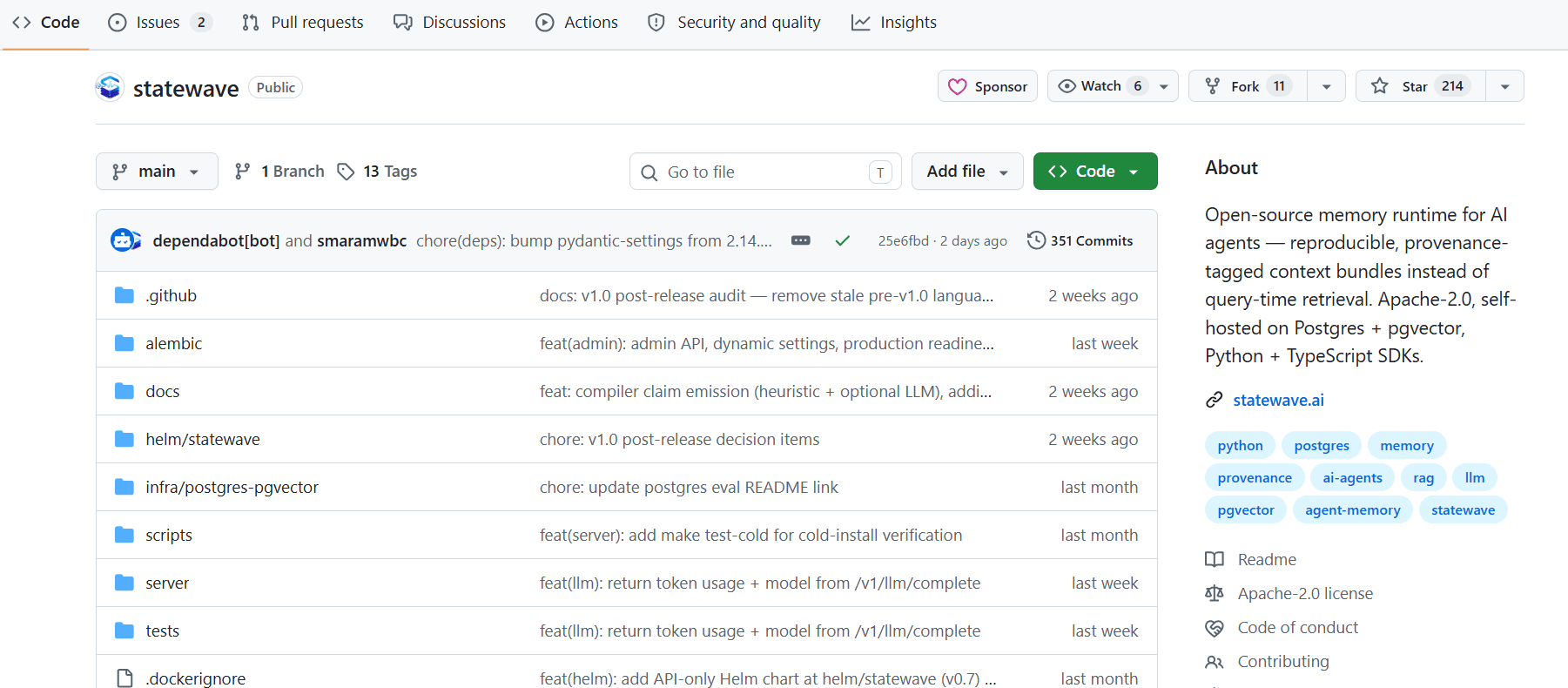
The rest of the repo is marketing too. Fill in your GitHub topics so you're discoverable, write a real CONTRIBUTING guide, add a code of conduct, and label good first issues. This is the friction-removal work behind Infrasity's production demo repos, a developer who can get to "it works" in minutes is a developer you can keep.
How Do Developers Discover Open-Source Tools In 2026?
Two ways, and both are won, not bought: developers ask their communities, and they increasingly ask AI. When someone types "best open source CRM" or "Postgres backup tool" into Reddit, Hacker News, ChatGPT, or Google's AI Overview, your project is either the recommended answer or it's invisible. There is no paid shortcut to that spot.
This is the biggest shift most open source marketing strategy advice still ignores. Search engines used to be the front door. Now a large share of evaluation happens inside AI answers that summarize what the community already says about you, which is exactly why teams are starting to compare tools that track brand citations across ChatGPT, Perplexity, and Gemini the same way they'd track GitHub stars.
If you're not part of the conversation on Reddit and in technical threads, you won't be in the AI answer either, because that's where the models are reading.
We have hard proof this can be engineered. For Brevo, a marketing platform, Infrasity reached 80% citation coverage across LLM answers (53 of 66 target threads) and a top-4 position in Google's AI Overview and ChatGPT for high-intent queries like "Klaviyo alternatives", through 37 authentic mentions across 25 subreddits over roughly a year, at 79% positive sentiment and with zero paid placements.
That is the open-source discovery motion in miniature: be genuinely useful where developers evaluate, and the AI answers follow. It's a dedicated discipline now, which is why AI/GEO optimization sits alongside community work.
The Open Source Distribution Playbook: Where To Show Up and How?
Distribution is a system that compounds over months, not a single launch day. A launch gives you a spike; the system gives you a slope. Here's the sequence that works for developer tools, and where Reddit fits.
Before you launch. Get the README, docs, and a copy-paste quickstart right (see above). Seed three to five design partners who already use it, so launch day has real voices, not crickets.
Launch in the right rooms. Post a "Show HN" on Hacker News, launch on Product Hunt, and share in the specific subreddits where your users live, r/selfhosted, r/devops, r/opensource, or your language- and tool-specific communities. Velocity from these drives GitHub Trending, which compounds the reach.
Earn Reddit presence the right way. This is where most teams either do nothing or get banned. The rule is contribution, not promotion: answer questions, share genuinely useful context, and mention your project only where it actually fits the thread.
Done well, this is what fed the Brevo results above, and it's the difference between being welcomed and being reported. Infrasity runs this as Reddit marketing, and you can map the highest-value threads yourself with the Reddit Opportunity Finder.
Then make it compound. Get listed on the "Awesome" list for your category.
For AI infrastructure, agents, and MCP tools, the lists developers actually browse are the ones to target: awesome-llm-agents, awesome-ai-agents, awesome-agents, awesome-opensource-ai, awesome-ai-memory, awesome-mcp-servers, and awesome-harness-engineering.
Open a pull request that adds your project under the right category with a single-line description, the same sentence you sweated over for your README. A merged entry on a list with thousands of stars is durable referral traffic, and these lists are exactly what LLMs read when they answer "best open source X."
The lists are only half of it. There's a whole discovery layer most teams never submit to, and each entry is a one-time effort that keeps paying out:
- MCP registries. If you ship an MCP server, get into the registries AI clients and developers search directly: Glama MCP Directory, MCP.so, and Smithery.
- OSS discovery and alternatives. Submit to LibHunt (discovery, alternatives, and rankings), OpenAlternative (open-source tool discovery), and Stackshare (tech-stack discovery). These rank you against the proprietary tools you replace, the exact "best open source X" intent you want to own.
- AI tool platforms. FuturePedia and PeerPush put you in front of people specifically hunting for new AI tools and products.
- Trend and stats tracking. Trendshift (GitHub repo stats tracking) and OSS Insight give the market a read on your momentum, and being tracked there is social proof in itself.
- Developer newsletters. A mention in Console.dev or TLDR drops you into the inbox of tens of thousands of engineers in a format they actually trust.
None of these is glamorous, and that's the point. Together they feed the same community signals and AI answers that decide whether you're the recommended tool or invisible.
Publish tutorials and honest comparison content. Do conference talks and demos. Ship technical videos, the format developers actually watch when evaluating.
This multi-channel layer is the engine behind results like Scalekit's +828% organic traffic, and you can pressure-test your own launch readiness with the OSS Launch Visibility Checklist.
How Do You Turn Users Into Contributors and Advocates?
You move people up a ladder: from user, to contributor, to maintainer, to advocate, and you reduce the friction at each rung.
A user who fixes one typo is far more likely to come back than one who only ever downloaded.
The goal of open source community marketing is to make that first contribution easy and the tenth one rewarding.
What this looks like in practice:
- Lower the bar to the first contribution. Maintain a real good-first-issue list, write a clear contributing guide, and respond fast. The first PR is the hardest; everything after is easier.
- Recognize people publicly. Shout-outs, swag, and credit in release notes cost almost nothing and retain contributors. People stay where they feel valued.
- Communicate the roadmap openly. Contributors want to trust that the project isn't being quietly hijacked by one company. Transparency is a retention tactic.
A candid truth from the WordPress marketing community: their biggest struggle is the contributor engagement and a missing marketing vision, volunteers churn when there's a task list but no strategy.
If your community is stalling, the fix is usually a clearer "why," not more issues. This users-to-advocates engine is what we mean by community-led growth, and it's the cheapest, most durable distribution you'll ever build.
What Should I Do Next?
A good open source marketing strategy ignores the star counter and obsesses over two things: removing friction so developers reach value fast, and earning a real presence in the communities and AI answers where tools get chosen.
Get those right and adoption, contributors, and pipeline follow in that order. Get them wrong and you'll have a beautiful repo nobody runs.
That's the exact motion Infrasity builds for AI infrastructure and developer-tool teams, engineering-led GitHub and open source marketing that turns free code into pipeline, with production demo repos, multi-channel distribution, and authentic presence in the threads where developers actually evaluate tools.
Frequently Asked Questions
Is open source marketing different from developer marketing?
It's a specialized branch of it. Developer marketing covers any technical audience; open source marketing adds the community, contributor, and licensing dynamics that come with free, public code. The shared rule is the same: utility over hype.
How do open source companies actually make money?
Three main models: support and services (Red Hat), open core (free core plus paid proprietary features), and hosted SaaS. The free project drives adoption and top-of-funnel demand; the commercial layer captures value from teams and enterprises.
How many GitHub stars do I need to succeed?
The wrong question. A project with 800 stars and 50 active weekly users in a niche can be far healthier than one with 20,000 stars and no usage. Track installs, active usage, and contributors instead.
What's the fastest way to get my first real users?
Make the quickstart flawless, then show up where your users already are, the right subreddit, Show HN, and your category's Awesome list, with genuine contribution rather than link drops.
Can you market an open-source project without a budget?
Yes, early on. Documentation, community participation, and content are largely sweat equity. Budget mostly buys speed and consistency once you've found what resonates.