


To hire a technical writer who actually works out, look for one ability above everything else: can they read a GitHub pull request, interview a busy engineer, and turn it into something a developer will actually read?
Degrees, portfolios, and cheap per-word rates are the wrong filters. The right hire reduces support tickets, speeds adoption, and writes things your engineers don't have to rewrite.
We run an engineering-led technical content team at Infrasity, where the writing is done by engineers with over 5-10 years of experience, so this blog reflects what works in practice and what wastes the budget.
Key Takeaways
- Hire for one skill: turning code and engineer conversations into clear docs. Not degrees, not a pretty portfolio.
- Decide the role first. Internal docs/API reference (technical writer) vs. SEO and developer-marketing content (technical content writer) are different jobs.
- Budget for editing, not just writing. Paying the writer is roughly half the cost. The other half is developmental edits, technical review by your engineers, and copyedits.
- Upwork rarely works for technical writers. The best engineer-writers are publishing on Dev.to, Hashnode, and GitHub, not bidding on gig boards.
- Vet with a paid test, not a portfolio. Portfolios are easy to fake. A short, paid, real-world task tells you everything.
What Does a Technical Writer Actually Do And Is That the Role You Need?
A technical writer turns complex technical information into content a specific reader can use. But "technical writer" hides two distinct jobs, and hiring the wrong one wastes your time. Decide which outcome you're buying before you write a job description, and while you're at it, it's worth knowing the difference between a technical writer and a developer advocate too, since teams often confuse those roles as well.
| Technical writer (docs) | Technical content writer (marketing) | |
|---|---|---|
| Primary output | API reference, SDK docs, user manuals, runbooks, release notes | SEO tutorials, comparison guides, dev-marketing blog posts, thought leadership |
| Reader | Existing users and internal teams | Developers evaluating or discovering your product |
| Measured by | Accuracy, support-ticket deflection, onboarding speed | Organic traffic, signups, product adoption |
| Reports into | Product, engineering, or docs | Marketing, growth, or DevRel |
| Best when | You have a product with ongoing doc needs | You need to grow awareness and adoption |
The Infrasity Technical Writer Hiring Checklist
If you're not sure which model fits your team? Then you're at the right place. We have the right tool, which helps you make the right decision, and it is developed on the same framework Infrasity uses when advising DevTool and B2B SaaS teams.
We have added 28 signals across 6 areas. Each statement points toward one of three models: Full-time, Freelance, or Agency. The more honestly you answer, the clearer the verdict. You can also run the interactive version at.
Why Technical Writing Is Mission-Critical for DevTools and Agentic AI Companies in 2026
The pressure to hire a technical writer hit a new peak in 2026 because two categories of product moved faster than any team can document: DevTools (CLI tools, APIs, SDKs, developer platforms) and AI-agentic systems (autonomous agents, LLM pipelines, AI workflows).
Why DevTools teams feel this first
A DevTool lives or dies on its developer experience. If a developer can't go from "zero" to a working API call in under 15 minutes, they close the tab and try the next option. Every gap in your docs, missing a parameter, an outdated code sample, a runbook that references a deprecated endpoint, is a lost evaluation.
Poor documentation is a churn driver that shows up in your activation metrics before it ever shows up in a support ticket.
DevTools also ship fast. The teams building Kubernetes operators, CI/CD pipelines, and observability platforms are pushing changes weekly. Without a dedicated technical writer or agency embedded in the release cycle, docs fall behind the codebase and engineers spend Friday afternoons updating README files instead of shipping features.
Why agentic AI companies need a different kind of writer
AI-agent products introduce a documentation challenge that traditional SaaS never faced: the product's behavior is probabilistic, context-dependent, and changes with every model update. In agentic AI, the context is different and the area is far more complex, especially with memory agents and context agents.
A human user can read a changelog and reason about what changed. An AI agent cannot. Accurate, current documentation is the only reliable way to communicate what your agent does, what tools it calls, what it won't do, and how to integrate it safely.
This is especially important because these are new and complicated systems for many users, so documentation must make them easy to understand in a fast-changing space.
That means the technical writer for an agentic AI company must understand prompt engineering, tool-call schemas, context-window constraints, and LLM evaluation, not just write clearly. This is a specialist role that generalist writers can't fill.
The common thread between these two
In both categories, the documentation isn't overhead, it's product. A clear quickstart guide is a growth lever. A well-structured API reference is a sales asset. That's why companies like Middleware, Terrateam, and Scalekit treat technical content as a GTM motion.
What Are the 4 Signs It's Time to Hire a Technical Writer?
The signal to hire is rarely "we should have docs." It's a specific cost showing up somewhere else in the business. Here are the four that mean it's time.
- Your engineers are grumbling about writing docs instead of shipping features: An engineer who spent yesterday writing a blog post has to justify that in standup, it's not their highest-leverage work, and they're not motivated to do it. Writing quality suffers and feature velocity drops.
- Support tickets are piling up for basic API or UI questions: Every ticket answering something a doc could have answered is a burden for support and engineering teams. Poor docs are expensive; see examples of bad documentation.
- Developer onboarding takes weeks: If new users can't get to a working integration quickly, your activation and retention suffer, and so does your product-led growth motion, the same motion covered in our breakdown of GTM enablement.
- Content can't keep up with your release cycle: Features ship faster than anyone documents or markets them, so your release notes and content fall behind reality.
If two or more of these are true, then don't ask for, whether to get help or not. Look for which model fits your team.
Full-Time vs. Freelance vs. Agency: Which Model Fits Your Team?
There are exactly three ways to get technical writing done, and each fits a different situation. The trap is choosing on sticker price instead of total cost and fit. Here's the honest comparison.
| Model | Cost | Control | Speed to value | Consistency | Best for |
|---|---|---|---|---|---|
| Full-time hire | Highest fixed cost (salary + benefits + overhead) | Highest | Slow (hiring + ramp) | High once ramped | Continuous internal docs with tooling to maintain |
| Freelancer | Lowest nominal cost | Medium | Fast for one task | Variable | One-off projects, overflow, a single guide |
| Agency / specialized service | Premium, but bundled | Medium-high | Fast (team already exists) | High (built-in editing + QA) | High-volume, high-credibility developer content without building infrastructure |
Now the part most people won't tell you, the Total Documentation Cost (TDC). Paying the writer is only about half of what it costs to publish good technical content.
We have worked with 200+ engineer-writers and have shipped 2,500+ posts, our team spends roughly as much on editing as on writing: copyedits, developmental edits, a technical review, and back-and-forth with the client. Almost no engineer's first draft ships untouched.
So if you pay a freelancer $500-$1,000 for a post but have no budget or person to do the technical review and editing, you won't ship content that drives business value.
TDC = writer cost + your engineers' review time + editing + revisions + the cost of publishing infrastructure.
A Fractional CMO or Chief of Staff doing a build-vs-buy math should price all five.
This is also where a specialized service earns its premium: the editing layer, technical review, and project management are already built in.
More on agencies vs. freelancers here.
Where Do You Actually Find Qualified Technical Writers in 2026?
The best engineer-writers are not bidding on gig marketplaces, you have to go find them. There are three sourcing routes, and you'll usually combine them.
The marketplace route (fastest, most variable)
Upwork, Fiverr, Toptal, Braintrust, and LinkedIn jobs. Upwork and Fiverr are fine for low-skill, straightforward tasks, but they rarely surface writers who can speak with authority to software engineers, there simply aren't enough of them there. Toptal and Braintrust pre-vet, which raises quality and price.
The secret route (best quality, most effort)
The strongest technical writers are already publishing about your stack on Dev.to, Hashnode, Medium, and GitHub. Search those platforms for engineers writing on your topics and reach out directly, the same platforms where the moves in our GitHub marketing strategies playbook get noticed.
For a niche technology, say Scala, you may only find a handful of writers, so you can broaden to an adjacent ecosystem like Java where people bump into the same concepts.
One rule from Hughes that doubles your response rate: send custom outreach, never spray-and-pray. Engineers can tell instantly when you didn't read their work.
The agency / specialized-service route (fastest path to consistent quality)
Specialized teams like Infrasity already have vetted engineer-writers, editing pipelines, and docs-as-code workflows.
You trade a price premium for skipping the recruiting, testing, and editing infrastructure entirely. If you're comparing options.
Here's a breakdown of the top technical writing service companies.
How Do You Vet a Technical Writer Without Wasting Your Engineers' Time?
Vetting is where teams burn the most engineering time and still hire wrong. The fix is to stop trusting signals that are easy to fake and start measuring real output on a small, paid task. Four rules:
Look for experience and curiosity
An English or CS degree matters far less than a track record of deciphering complex software. Do not filter candidates by their major.
Don't trust the portfolio
Nick Jordan, who founded the writer-vetting platform Workello after scaling a legal-AI startup to 1.5M monthly organic visitors, goes further, he argues that even writers with strong portfolios are often weak, and that polished portfolios can be effectively fake. Anyone can show you their best-edited piece.
That's why his platform tests hundreds of writers down to the top few percent rather than reading résumés.
Give a real, complex task
Hand the candidate an existing internal doc that's genuinely disorganized and ask how they'd fix its information architecture and flow. This tests the skill you're actually buying: improving real docs under real constraints. A short paid trial beats an unpaid sample and respects their time.
Run the SME test
Most technical writing is bottlenecked on extracting knowledge from busy engineers. Ask: "Walk me through how you'd prepare for and run an interview with a senior engineer who has 30 minutes and would rather be coding." Their answer reveals whether they can actually operate inside your team.
Then set clear KPIs from day one
Technical accuracy, readability, adherence to your style guide, and time-to-publish. You can pressure-test any existing docs with a free docs audit to set a baseline.
How Much Does it Cost to Hire a Technical Writer in 2026?
Cost depends entirely on the model and the writer's depth, and the public numbers vary because sources measure different things. Here are 2026 ranges to budget against.
| Engagement | 2026 range | Notes |
|---|---|---|
| Full-time (US) | ~$80k–$103k average; senior/specialized $120k–$135k+ | BLS median is ~$91,670; Glassdoor average ~$102k including bonus/stock |
| Freelance (marketplace) | $30/hr median, ~$20–$45/hr typical | Upwork's reported median; fine for generalist work |
| Freelance (experienced/specialized) | ~$60–$130/hr | goLance puts experienced writers at ~$63–$105/hr; SaaS/SEO niches command premiums |
| Project-based | ~$250–$400+ per ~1,500-word post | Long-form (3,000+ words), research-heavy pieces cost more |
| Agency / service | Premium, bundled | Includes vetting, multi-pass editing, technical review, PM, scalability |
Two budgeting notes that separate teams who ship from teams who stall:
- Apply the TDC framework. Add your engineers' review time, editing, and revisions to whatever you pay the writer. The all-in cost is what matters.
- Plan for international payments. The US is the most expensive and hardest market to recruit in, so many of your best writers will be in India, Nigeria, Eastern Europe, or South America.
For context on the full picture, the U.S. Bureau of Labor Statistics reports a technical-writer median wage near $91,670 and projects steady demand through 2033.
How Do You Track Technical Writing Output?
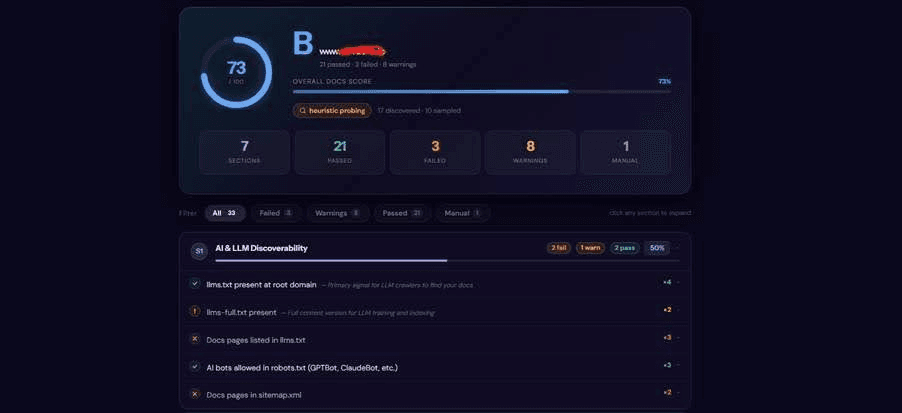
Knowing the cost is only half the equation. The other half is knowing what's being produced, where it is in the pipeline, and whether it's hitting your KPIs. Most teams track technical writing in spreadsheets or Notion pages, which breaks down the moment you have more than one writer or more than a handful of pieces per month.
What to track at a minimum
- Pipeline status: Draft, technical review, editorial review, published. Every piece should have a clear owner and a current stage.
- Time-to-publish: The average calendar days from brief to published post. Anything over three weeks is a signal that your review layer is the bottleneck.
- Technical accuracy rate: The percentage of drafts that require substantive corrections after technical review. A high rate means the writer's access to SMEs is failing.
- Adoption impact: API calls, SDK installs, docs page views, and support-ticket deflection tied to specific published pieces.
How Infrasity tracks it for clients
Infrasity clients can track all of their technical writing, blog posts, documentation, and video scripts directly through app.infrasity.com. The content hub gives you a real-time view of every deliverable in the pipeline, draft submitted, under technical review, in editorial, approved, or published, so you're never guessing where a piece is or when it ships.
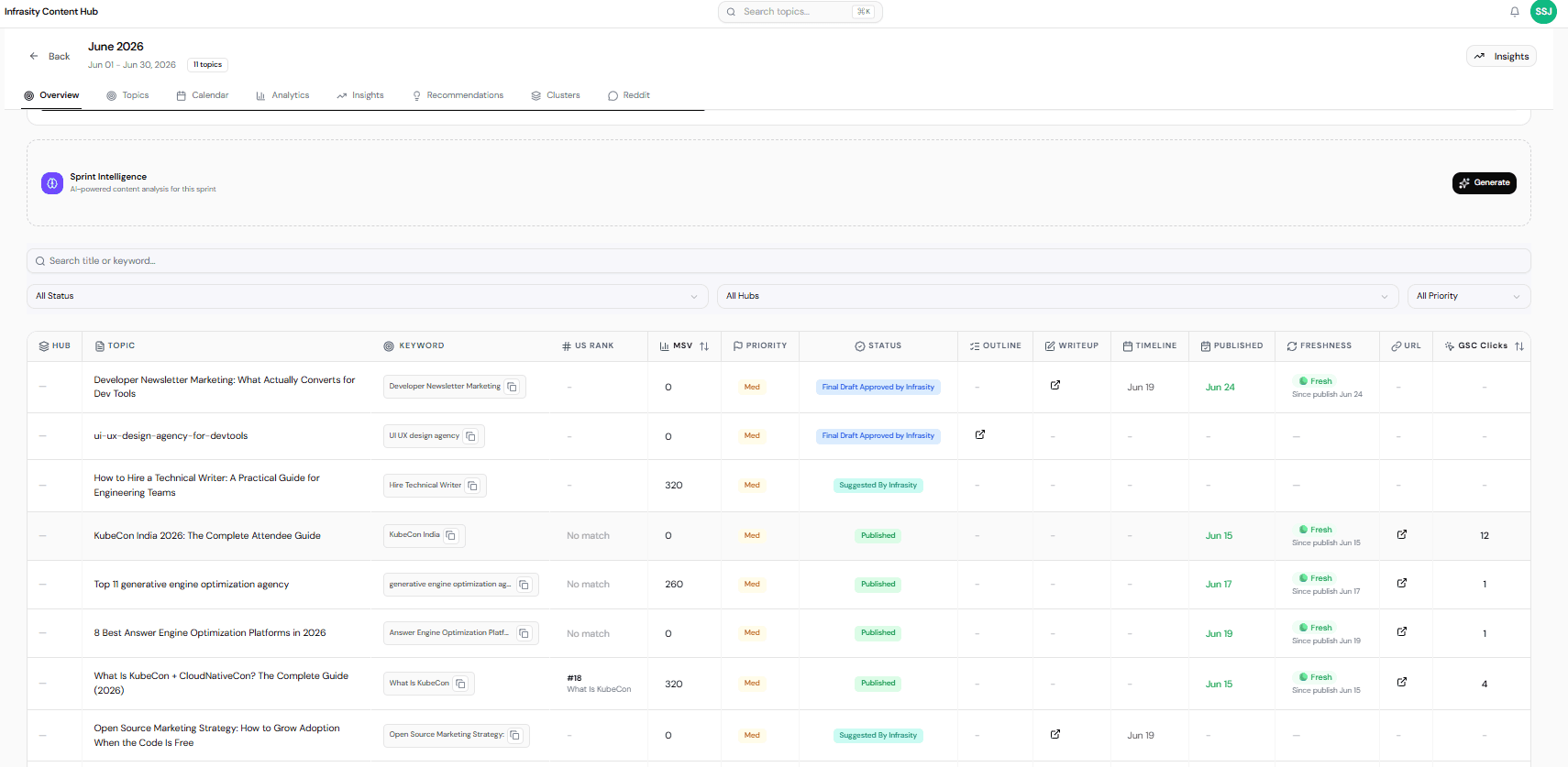
The platform also logs every revision cycle and surfaces which content types are taking the longest to close, which lets you spot bottlenecks early rather than at the end-of-month retro. For teams scaling to 10–20 pieces per month, a centralized tracking layer is the difference between a content machine and a content pile.
How Do You Set a New Technical Writer up to Succeed?
Most technical-writer failures are onboarding failures. A strong writer with no access and no "definition of good" will produce weak work and churn. Get these right in week one:
- Give access to repos, a staging environment, the SMEs they'll interview, your style guide, and three examples of content you consider excellent.
- Don't make them build the infrastructure and write at the same time. Standing up a docs site (Mintlify, GitBook, and the like) is a separate project from producing content; ask for both at once and you'll get neither well.
- Make remote the default. Outside of DoD- or HIPAA-style constraints requiring secured hardware, demanding five days in a cubicle will shrink your talent pool to almost nothing.
- Give bylines and credit. Readers check the author, they want to know a real engineer wrote it, not the marketing team. A credited expert byline is both a motivator for the writer and a trust signal for your readers.
- Build a tight feedback loop and an editing layer. This is the TDC point again: a writer plus an editor plus a technical reviewer is the unit that ships, not a writer alone.
Should You Hire at All or Partner With a Technical Content Team?
For a lot of DevTool and B2B SaaS teams the better-ROI move is to partner rather than hire. The honest decision rule:
Hire in-house when you have a continuous, product-specific documentation need, the tooling to maintain, and enough volume to keep a full-timer busy and ramped. Internal docs that touch your roadmap and codebase deeply often belong in-house.
Use a specialized technical content service when you need high-volume, high-credibility developer content fast, don't want to build recruiting and editing infrastructure, and care more about adoption than headcount.
This is exactly the gap Infrasity fills: the writing is done by engineers who code (5-10+ years of experience), the multi-pass editing and technical review are built in, the workflow is docs-as-code, and success is measured on product-adoption signals like API calls and SDK installs, not vanity metrics like raw pageviews.
For teams that also need docs, our product documentation and technical content GTM services cover the same engineer-led bar, and our product documentation case study shows the outcome.
Frequently asked questions
What's the difference between a technical writer and a technical content writer?
A technical writer produces internal and product docs, API references, SDK guides, runbooks, release notes, for people already using your product. A technical content writer produces SEO and developer-marketing content to attract and convert new developers. Same raw skill, different goal and different team.
How do I test a writer without wasting my developers' time?
Give one short, paid, real-world task: hand them a complex existing doc and ask them to improve its structure and flow, plus one question about how they'd interview a busy engineer. That predicts on-the-job performance far better than a portfolio.
Freelance or full-time for API docs vs. a marketing blog?
Lean full-time (or a docs-focused service) for continuous internal/API documentation tied to your release cycle. Lean freelance or a specialized agency for developer-marketing content and one-off guides.
How much should I expect to pay for a single technical blog post?
Project rates commonly run $250–$400+ for a ~1,500-word post, and more for long-form, research-heavy technical pieces. Remember to add editing and technical-review time to that number.
How do I pay an international freelance writer?
Collect a W-8BEN (international) or W-9 (US), then use a contractor platform like Plane or Deel that handles locally compliant contracts, tax forms, and payments. Avoid relying on PayPal or manual wire transfers once you have more than a couple of writers.
Will AI replace technical writers?
No, but it changes the job. AI accelerates drafts and edits, yet it can't interview your SME, verify that a code sample actually runs, or stake its credibility on technical accuracy. The durable role is the human who owns correctness and judgment; AI is a tool they wield.