

To get your brand cited by ChatGPT, Perplexity, Gemini, Claude, and Google AI Overviews, get named inside the third-party "best X" listicles those engines already cite. Listicles are the single most cited page type in AI answers, taking 21.9% of 1.06 million citations and 40.9% on commercial prompts. The work is finding the right lists, pitching their authors, and paying only where the numbers justify it.
Spending is where the real waste happens. Across 1,211 listicles we tracked in Infrasity's own prompt set, the top 10% of lists earned 65% of all listicle citations. So the job is picking the few lists that every engine keeps going back to, then putting your effort there.
This blog walks through why AI engines lean on listicles, how to find the ones cited in your category, how to pitch authors in a way that gets replies, and what placements cost when money changes hands.
TL;DR
- Listicles are the most cited content format in AI search, and the share climbs on buying-intent prompts, which is where pipeline comes from.
- A small set of listicles carries most citations. In our data, 79% of cited lists showed up on one engine only, while 21 lists were cited by all four.
- Being cited is different from being named. A list can be a source in the answer while your brand stays out of the recommendation.
- Outreach works best when you bring the author something useful: a correction, original data, or a ready-to-paste blurb in their format.
- Paid placements run roughly $100 to $1,000 per mention. They are worth it only on lists cited across engines and prompts, with a
rel="sponsored"link. - Brands already visible in AI answers get added to new listicles faster, because writers increasingly build their shortlists with AI.
Why do AI engines cite listicles more than any other page type?
A listicle is a ranked or grouped roundup, such as "10 best API gateways" or "top observability tools for Kubernetes". AI engines answer recommendation questions by summarising options, and a listicle hands them that summary already structured, with names, short descriptions and comparisons in one place.
The numbers line up across independent studies:
- Wix Studio's AI Search Lab analysed 75,000 AI answers and found listicles take 35.4% of citations in SaaS, well above articles, product pages and comparison pages.
- Ahrefs studied 26,283 source URLs across 750 prompts and found "best X" lists made up 43.8% of page types ChatGPT cited. Of the cited lists, 79.1% had been updated in 2025, so freshness plays a real part.
- The same Ahrefs study found brands placed higher on third-party lists were more likely to appear in ChatGPT's answer.
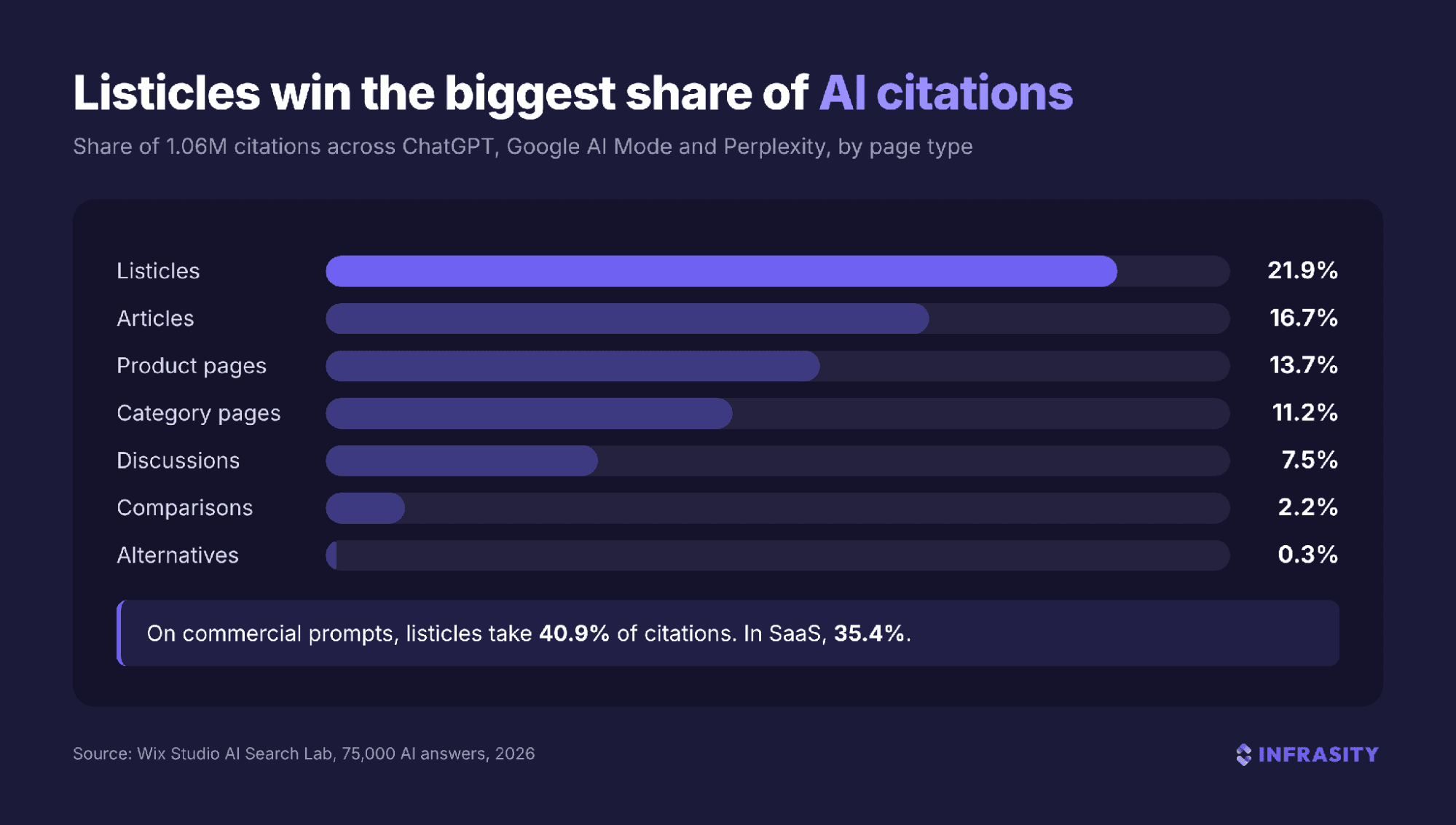
Listicles lead every other page type, and the gap widens on commercial prompts.
We see the same pattern in client work. In our OX Security case study, 22 of the 29 top AI Overview citations came from tools listicles rather than definition pages. The breakdown below comes straight from the Infrasity Content Hub.

Citation share by content format for OX Security in the Infrasity Content Hub. Listicles lead every named format.
One caveat before you build a whole programme on this. Seer Interactive tracked 2M+ citations and saw ChatGPT listicle citations fall 30% from December 2025 to January 2026, while Google AI Overviews held steady. Engines change their sourcing, so treat listicle placements as one strong channel and recheck it every month.
Why a listicle mention converts better than other AI citations
Listicles sit at the bottom of the funnel. Someone asking "best feature flag tool for a 20-person team" has a budget and a shortlist forming, and the listicle AI cites is the shortlist. That is why the format's share jumps to 40.9% on commercial prompts in the Wix data, against a much lower share on informational questions.
For a DevTool or B2B SaaS brand, this changes what a citation is worth:
- A definition page citation tells the engine you know the topic. The reader is still learning and may never come back.
- A listicle mention puts your product name next to two or three competitors at the moment of choice. The reader is comparing, often with a trial page one click away.
There is a trap here worth knowing. Adam Crookes checked AI Overviews by hand across 89 B2B "best X" queries and found only 35% of cited listicles got their own brand named in the answer. His point, in his words: "getting cited is not the same as receiving a brand mention." Your goal is to be a named entry on the list, ideally near the top, so the engine has a reason to repeat your name.
How a handful of listicles control most AI citations
We pulled 30 days of data from the Infrasity Content Hub's listicle tracker for infrasity.com: 85 buyer prompts across four service clusters, run on ChatGPT, Claude, Gemini and Perplexity. That produced 7,842 listicle citations spread across 1,211 unique "best of" pages.
The distribution is steep:
- The top 5% of listicles (61 pages) earned 55% of all listicle citations.
- The top 10% earned 65%, and the top 20% earned 76%.
- 79% of cited lists appeared on one engine only. Just 21 lists, under 2%, were cited by all four.
- Those 21 lists averaged 129 citations each and showed up for 21 different prompts. Single-engine lists averaged 2.5 citations.
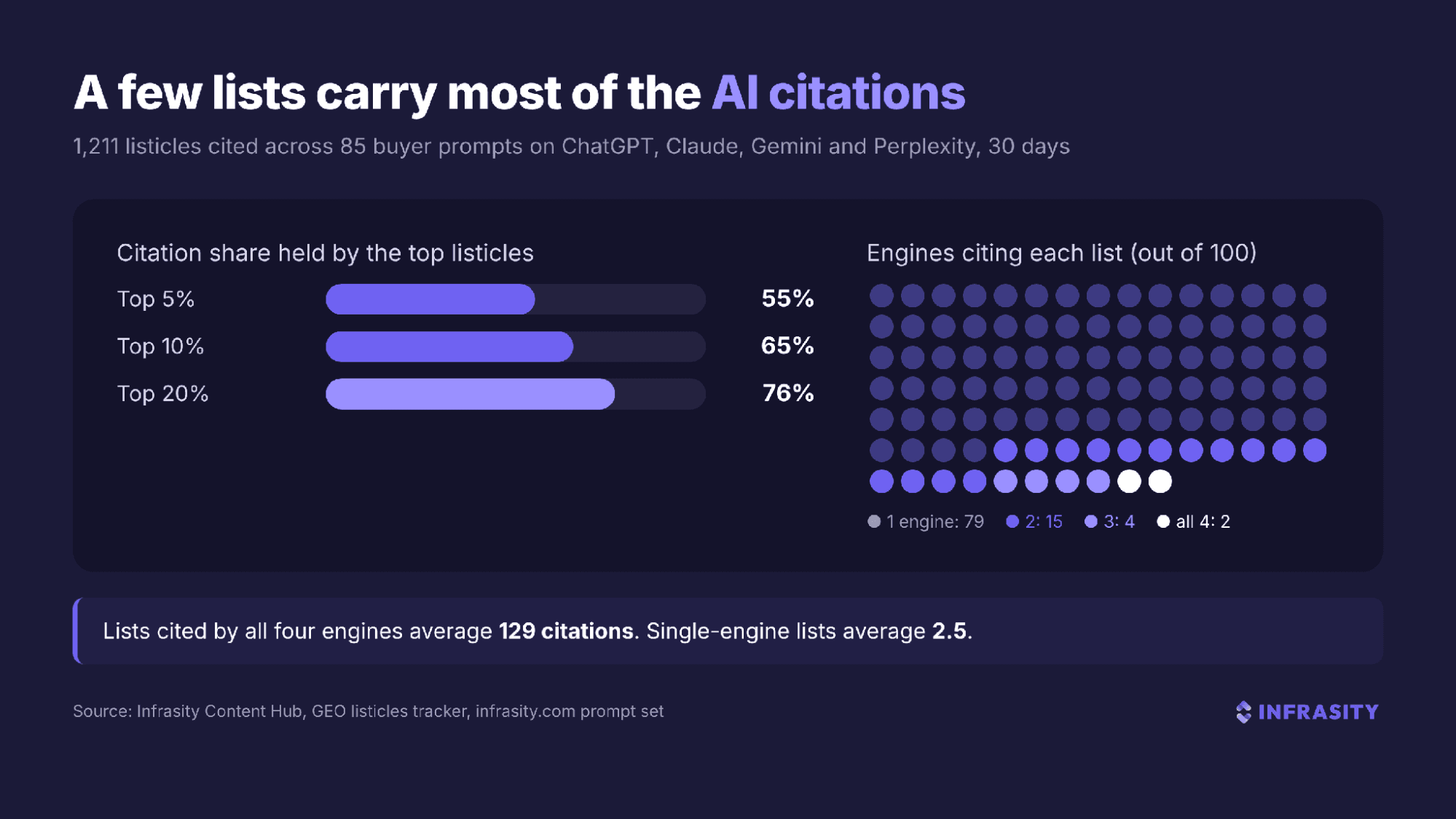
Infrasity Content Hub data: 1,211 cited listicles, 85 prompts, four engines, last 30 days.
Two practical rules come out of this:
- Rank your targets: A list cited by three engines across six prompts is worth more than ten lists each cited once.
- Check every engine separately: Claude cited the most unique listicles in our set, Gemini the fewest. A list that dominates Perplexity can be invisible in ChatGPT, so one engine's view will mislead you.
How to find the listicles AI engines cite in your category?
The output is a ranked list of 20 to 40 listicles worth pitching, with the author and a reason each one should include you.
Build a prompt set from real buying questions
Start with 20 to 30 prompts your buyers would type when they are close to choosing. Pull them from sales call notes, G2 comparisons, Reddit threads and your own Search Console queries.
For a DevTool, good prompts look like:
- best open source API gateway for Kubernetes
- alternatives to LaunchDarkly for small teams
- top observability tools for serverless
- which vector database should I use for RAG in production
Keep the qualifiers buyers use, such as team size, stack, budget or compliance need. Those qualifiers decide which lists get cited.
Run each prompt on every engine, more than once
Run each prompt in ChatGPT (temporary chat), Perplexity, Gemini, Claude and Google with AI Overviews showing. Run it two or three times, because answers vary between runs. For every answer, log the cited URL, the engine, and which brands were named.
A useful tell: links that ChatGPT sends traffic through often carry utm_source=chatgpt.com. In our dataset, 473 of the 2,533 listicle citation rows came tagged that way, which is also how you spot ChatGPT referrals later in GA4.
Add the lists Google already ranks
AI engines lean on pages that rank well, so pull the organic side too:
- Search "[your category]" intitle:best and "[your category]" intitle:top and keep the first two pages.
- Pull competitors' backlinks in Ahrefs or Semrush and filter referring page titles for "best", "top" and "alternatives".
- Note which of those pages also appeared in your AI answer log. Those overlaps go to the top.
Score each list before you pitch
Give each listicle a quick score so you spend outreach time on the ones that move answers:
- Engine spread: cited by one engine, or two or more?
- Prompt spread: does it come up for several of your prompts?
- Competitor presence: does it name your competitors but not you? That is your best opening.
- Freshness: updated in the last 12 months? Stale lists lose citations.
- Editorial signal: does the author explain how products were chosen? Lists with clear inclusion logic are easier to pitch on merit.
Skip lists with no competitors on them, lists untouched for two years, and lists owned by a direct competitor.
Do it faster in the Infrasity Content Hub
The manual version takes a few days per category and goes stale within weeks. The Infrasity Content Hub runs your prompt set on all four engines on a schedule and keeps the listicle view current.
Log in at app.infrasity.com, then open Market and choose Listicles in the left sidebar.
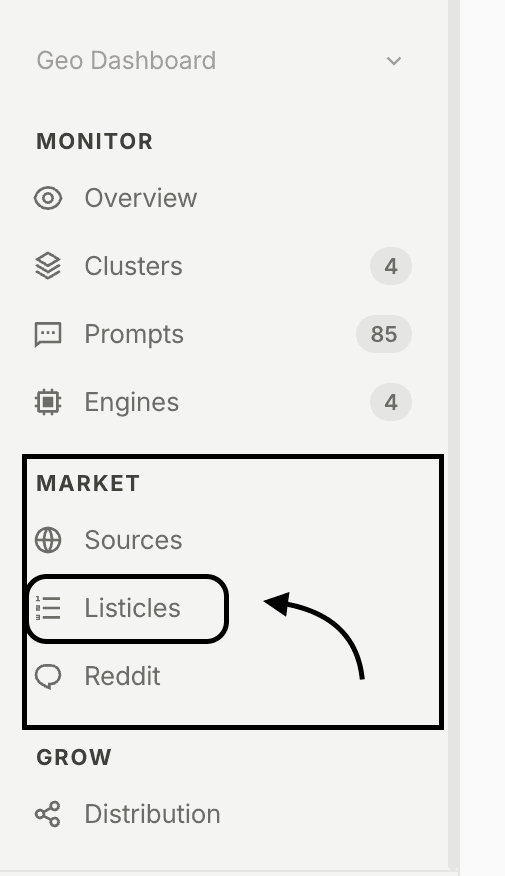
Market, then Listicles, sits under the Monitor section in the Content Hub sidebar.
Filter by cluster, date range and engine, then open the Missing tab to see only the lists that skip you. Listicles are grouped under each buyer prompt, and every row shows the page URL, its citation count, the engines citing it and a Pitch listing button to start outreach.
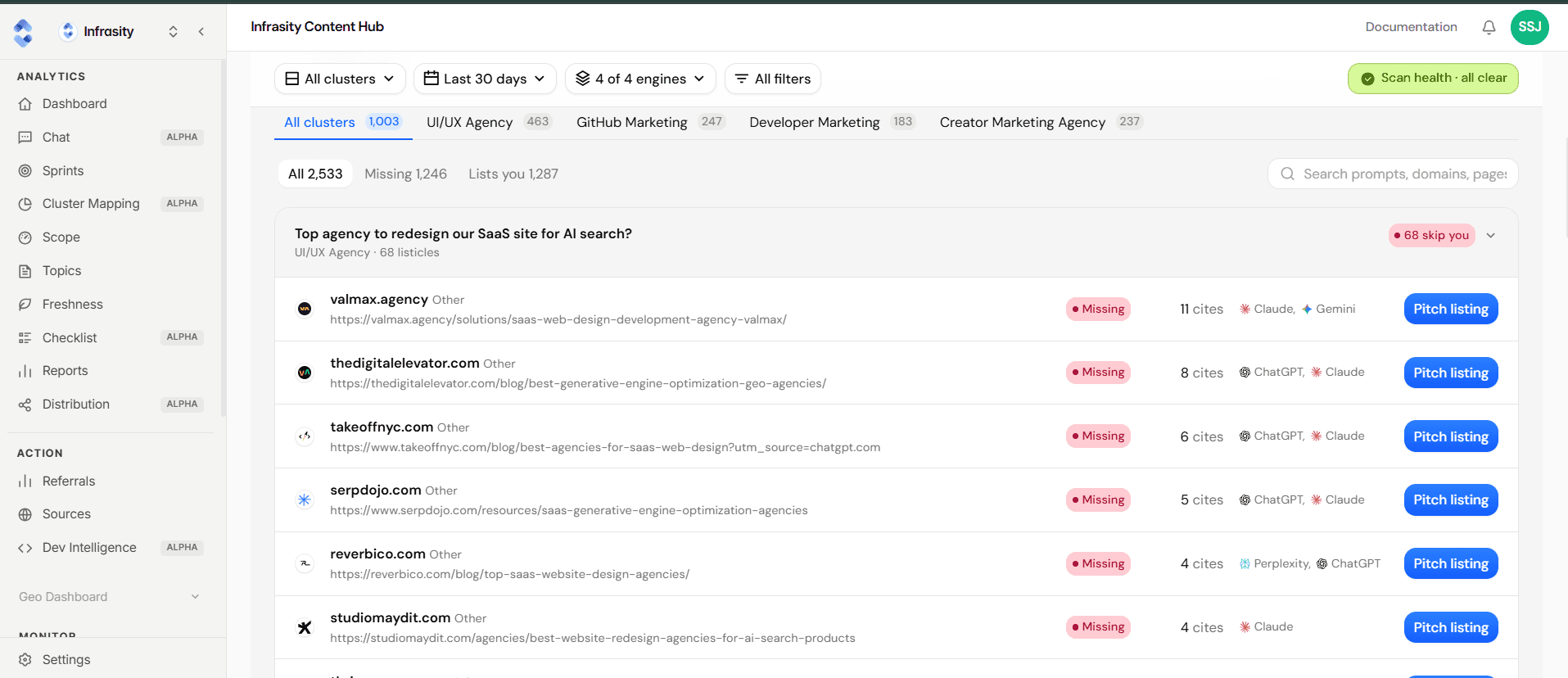
The Listicles page showing cited listicles for one buyer prompt, with citations, engines and a Pitch listing action on each row.
Want this map for your category? Infrasity sets up the prompt set, tracks cited listicles across ChatGPT, Claude, Gemini, Perplexity and AI Overviews, and hands you a ranked pitch list. Talk to our GEO team.
How to pitch listicle authors so they add your brand?
Listicle authors get pitched constantly, and the typical pitch asks for something while offering nothing. Farzad Rashidi, co-founder of Respona, puts cold outreach to pages AI already cites at under 1% success. The pitches that land do part of the author's work for them.
Find the person who can edit the page
Go to the byline author first, then the editor or content lead who owns the blog. Find emails with Hunter or Apollo and check LinkedIn for a role match. Avoid info@ inboxes, which rarely reach anyone with edit access.
Give the author a reason to update the page
Open with something specific about their list, then offer one of these:
- A correction: Outdated pricing, a renamed product, a broken link or a discontinued tool on their list.
- A missing angle: A buyer question the list skips, such as self-hosted options or SOC 2 support, with your product as one answer.
- Original data: A benchmark, a usage stat or a chart they can embed. For DevTools, a reproducible benchmark repo carries far more weight than a claim.
- A paste-ready entry: A 40 to 80 word neutral description in the exact format of their other entries, with pricing and a "best for" line.
Don't ask for the top spot in the first email. Get on the list first and move up as the list gets refreshed.
Offer a fair exchange when the author wants one
Many authors will add a strong product for free. Others want something back, and a fair swap usually beats paying cash:
- A feature in your own roundup or comparison page, with a link.
- A mention in your newsletter or a share from your founder's account.
- A guest post or co-written article on your blog.
- Free credits or an extended trial so they can test the product properly.
- For developer audiences: a joint tutorial, an integration guide, or a spot in your docs' "built with" section.
Keep every swap honest and relevant to readers. A swap that only exists to pass links runs into the same Google policy as paid links.
Write a short pitch
Here is a structure that respects the author's time:
Subject: Missing pick on your category angle]
Hi [Name], your [list title] is one of the few that covers [specific detail]. One gap I noticed: none of the picks handle [buyer need]. [Product] does that for [audience], and [one proof point].
I've drafted an entry in your format below, so it's a quick paste if it fits. Happy to send a trial or data if you want to test it first.
[40-80 word entry]
Follow up once or twice, each time with something new, such as a fresh data point or a fix for something else on the page. Placements usually confirm within two to six weeks.
Pitch lookalike publishers too
Rashidi's better move is to find publishers with similar authority that rank for the same terms, and pitch them a fresher version of the list with your brand on it. New lists from credible sites get picked up quickly when engines favour recent content, and the author has a reason to say yes: a ready topic with a known audience.
Why AI-visible brands get added to new listicles first
There is a compounding effect that rarely shows up in outreach plans. Writers now research "best X" lists the same way buyers do: they ask ChatGPT or Perplexity for a shortlist, then write around it. If your brand already shows up in those answers, you get added to new lists without a single email.
Our data points the same way. Listicles that appear in the same AI answers as Infrasity averaged 13.1 citations and covered 3.6 prompts each. Lists that don't average 2.7 citations across 1.3 prompts, close to a 4.9x gap. Among the 21 lists cited by all four engines, 81% sit alongside Infrasity in the answer. Read that as a correlation. It still matches how the loop works in practice.
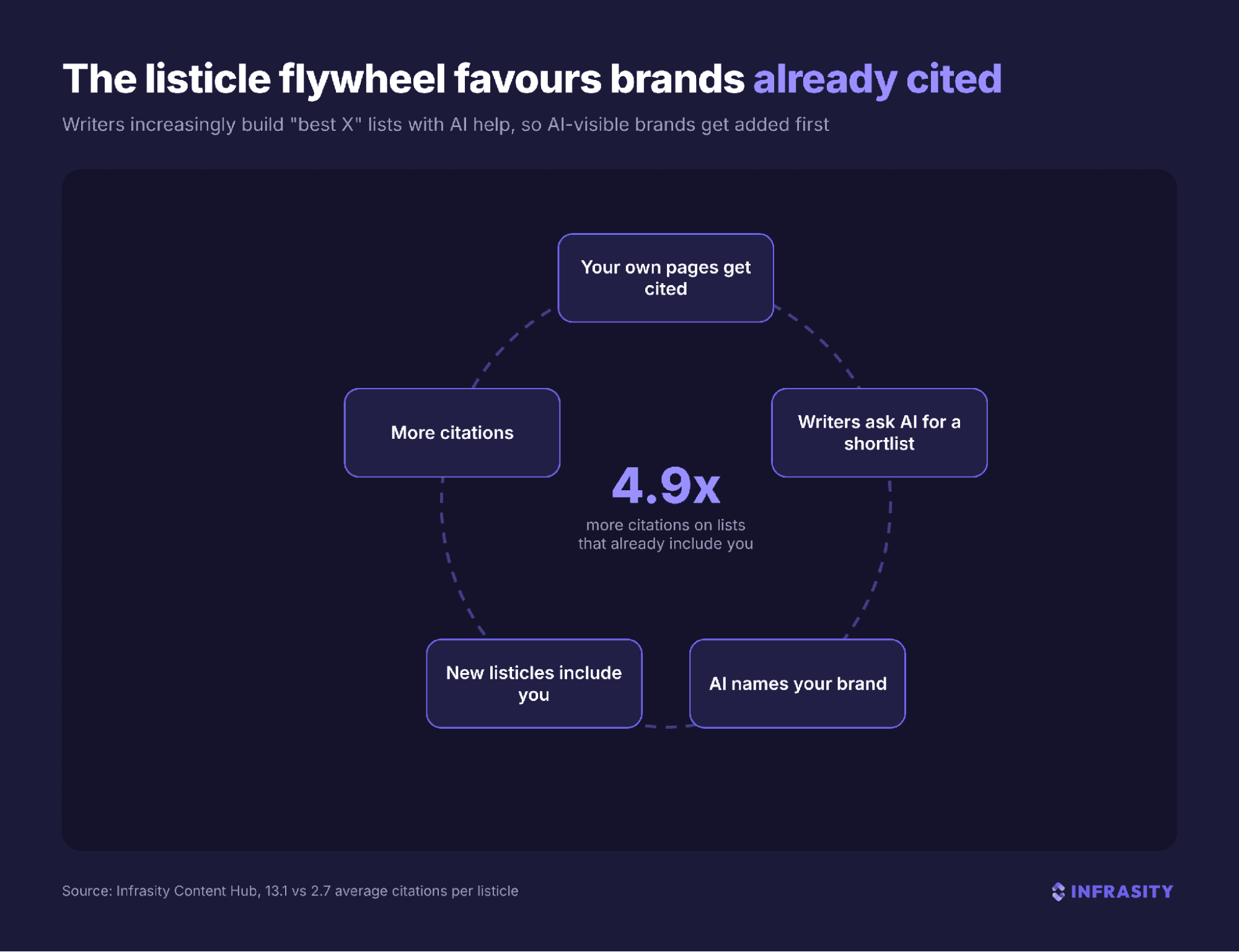
Once you are in the cited set, each new AI-assisted listicle is a chance to be added by default.
So the work splits in two:
- Earn citations on your own pages and communities. Structured comparison pages, clear docs and active Reddit threads give engines something to cite before any listicle does. Our guide on how to rank on ChatGPT covers the page-level side.
- Use outreach to break into the most-cited lists. Once you sit in those lists, the flywheel does more of the work each month.
We saw this with a confidential AI gateway customer. Once its own content and Reddit threads were being cited, ChatGPT started placing it first in its "top confidential AI gateways" table.
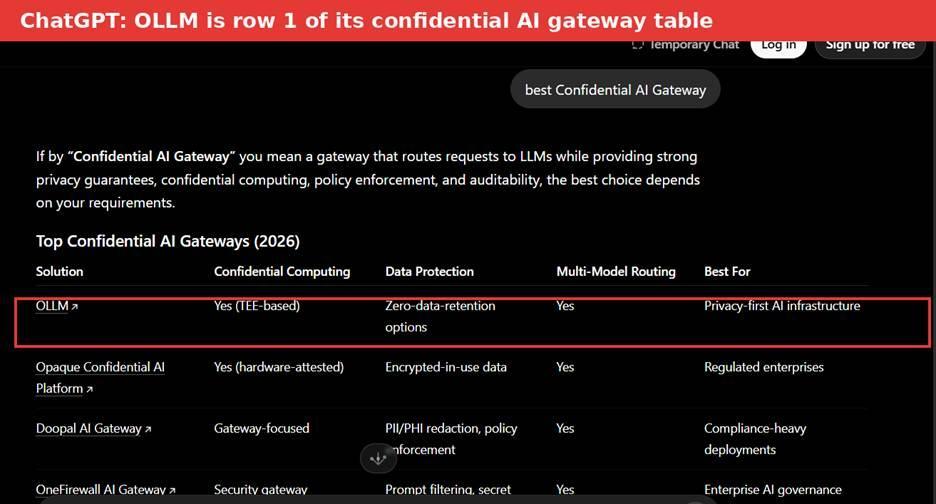
ChatGPT's answer for top confidential AI gateways, with the client in the first row.
Reddit is one of the fastest ways to start that loop, since engines like Perplexity cite discussions heavily. Our Reddit marketing team builds those threads for DevTool and SaaS brands.
What paid listicle placements cost in 2027
Paid placement is common, even though it is rarely discussed in public. In a RevGenius community post, a growth marketer described taking ChatGPT referral sessions from 114 to 879 over five months through third-party roundups. Most of those placements were paid, and some were swaps with partner sites.
Prices vary with the site's authority and how often AI cites it:
- Small or newer blogs: often free, or a gift card and a backlink swap.
- Mid-tier sites: roughly $200 to $300 per placement.
- High-authority, heavily cited lists: $500 to $1,000 or more.
Rokas Stan, founder of AIclicks, puts the general range at $100 to $1,000 per mention, with some authors adding brands for free.
Two rules apply to any paid placement:
- Google's spam policies treat buying links for ranking purposes as link spam, unless the link carries
rel="sponsored"orrel="nofollow". Ask for the sponsored attribute in writing. - Disclosure is the publisher's job, but your brand carries the risk. If a list hides that entries are paid, expect it to lose trust and citations over time.
When paying for a listicle spot is worth it
Paying makes sense on a narrow set of lists. Use the score from earlier and pay only when most of these hold:
- The list is cited by two or more engines.
- It appears for three or more of your buyer prompts.
- It names your direct competitors.
- It was updated in the last 12 months and the author keeps refreshing it.
- The cost per prompt covered is lower than what you would spend creating and ranking your own page for those prompts.
If a list fails these, pitch it on merit or skip it. In our data, the median cited listicle appeared once on one engine. Paying $500 for that is buying a lottery ticket.
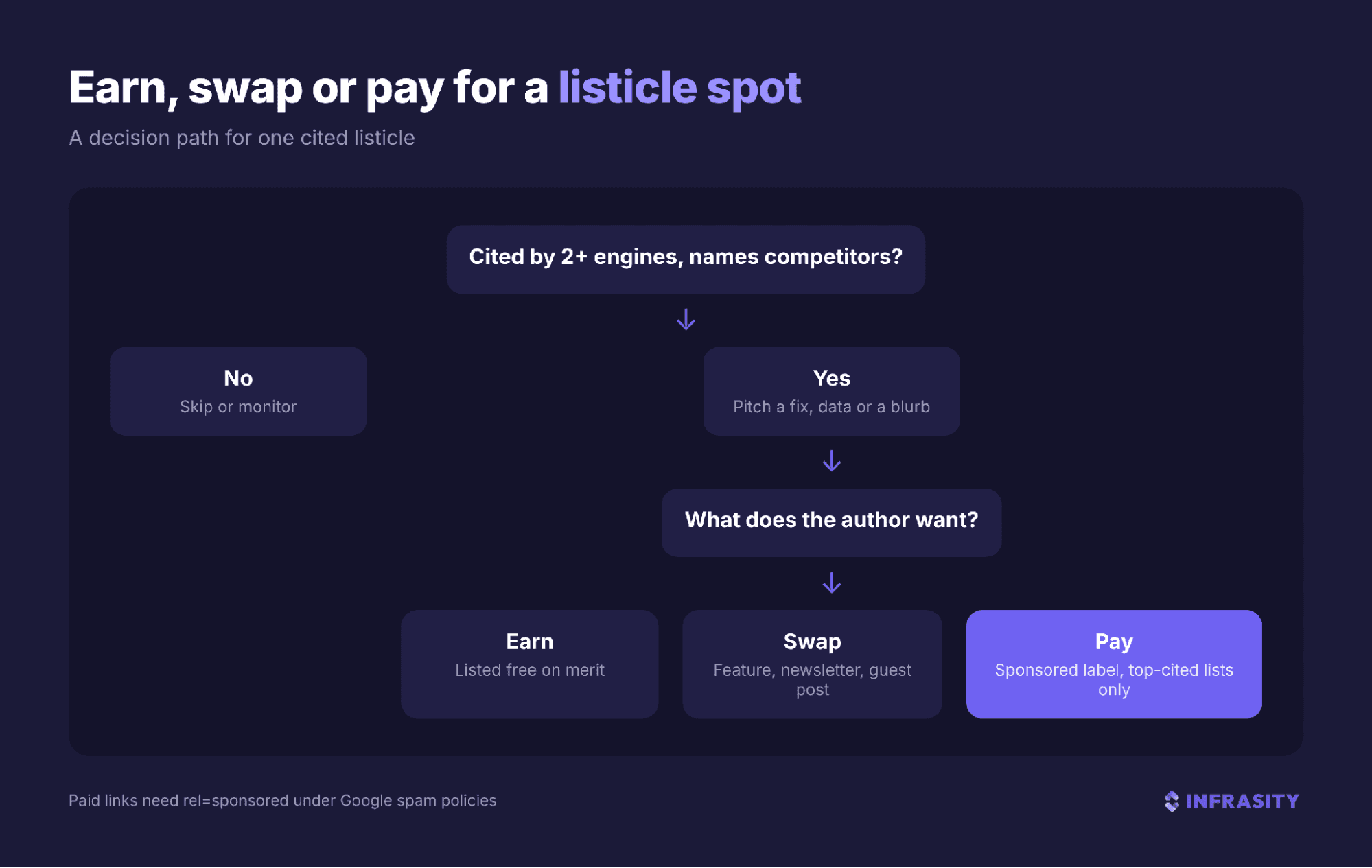
Start with merit, offer a swap when the author wants value back, and pay only for the top-cited lists.
Be careful with self-promotional listicles
Publishing your own "best X" list with your product at number one is tempting, and it does get cited. Lily Ray studied 100 B2B software prompts in AI Overviews and found that when a brand's own self-promotional list was cited, the brand was left out of the recommendation 69% of the time. She also tracked sites with these lists losing organic traffic after Google's May 2026 core update.
Wix's data adds weight here: in professional services, third-party listicles took 80.9% of listicle citations against 19.1% for self-promotional ones. Your own roundup works better as an honest category guide that names competitors fairly, with clear testing criteria, than as a sales page in list form.
How to tell if your listicle placements are working
Track results per prompt, because that is how buyers meet you:
- Mention rate: for each prompt, how often your brand is named across repeated runs on each engine.
- Position: where you appear in the list or answer. Moving from fifth to second changes clicks.
- Placement health: recheck every live placement after four weeks. Lists get refreshed and brands get rotated out.
- Referral traffic: watch AI referrers in GA4, including sessions tagged
utm_source=chatgpt.com.
Expect visible movement within four to eight weeks of the first placements. If a placement goes live and your mention rate on its prompts does not move after two scans, that list was not worth what it cost, and the data tells you where to spend next.
If you want to see where you stand before starting, run our free AEO audit for a quick read on how AI engines see your site.
Get your brand into the lists AI cites
Getting cited in listicles comes down to three moves: find the few lists every engine relies on, give their authors a real reason to include you, and pay only where spread and freshness justify it. Brands that start now also get the compounding benefit, since every new AI-assisted list starts from what engines already know.
Infrasity runs this end-to-end for DevTool and B2B SaaS teams. We track the listicles AI cites for your buyer prompts, pitch the authors, build the pages that earn citations on their own, and report mention rate by engine every month. If you don't know where to start, book a call with Infrasity, and we'll show you which lists are skipping you today.
Frequently Asked Questions
How do I find out which listicles ChatGPT cites for my category?
Run 20 to 30 buying-intent prompts in ChatGPT with temporary chat on, two or three times each, and log every cited URL. Repeat on Perplexity, Gemini, Claude and AI Overviews, since each engine cites different lists. A tracker like the Infrasity Content Hub automates this and shows which lists skip you.
Is it worth paying to be included in a listicle?
Yes, but only for lists cited by two or more engines across several of your buyer prompts, updated recently, and naming your competitors. Most cited listicles appear once on one engine, so paying for them rarely moves AI answers. Pitch those on merit instead.
How much does a paid listicle placement cost?
Practitioners report it at about $100 to $1,000 per mention in 2026. Smaller blogs often add brands for free or for a swap, mid-tier sites charge around $200 to $300, and heavily cited, high-authority lists charge $500 or more.
Do paid listicle placements break Google's rules?
They can. Google's spam policies count paid links that pass ranking credit as link spam. Ask the publisher to mark the link rel="sponsored" or rel="nofollow", and avoid lists that hide paid entries from readers.
Should I publish my own "best X" listicle with my product first?
You can, but keep it honest. Research on AI Overviews found brands were left out of the recommendation 69% of the time when their own self-promotional list was cited. A fair category guide with clear criteria that also names competitors holds up better with readers and engines.
How long does listicle outreach take to show up in AI answers?
Placements usually confirm within two to six weeks of the first pitch. Changes in AI mention rate typically show within four to eight weeks of the first few placements, depending on how often each engine refreshes its sources.
What should I offer a listicle author in exchange for a mention?
Lead with value for their readers: a correction, original data, or a paste-ready entry in their format. If they want something back, offer a feature in your own roundup, a newsletter mention, a guest post or free product credits. For developer audiences, a joint tutorial or integration guide works well.
Can Infrasity get my brand into the listicles AI engines cite?
Yes. Infrasity tracks the listicles ChatGPT, Claude, Gemini, Perplexity and AI Overviews cite for your buyer prompts, runs author outreach, and builds the content and Reddit presence that earns citations without paid placements. You get a monthly report of mention rate by engine and prompt.