

Twitter influencer marketing works for B2B tech when you pay practitioners your buyers already follow on X to show your product solving a real problem, then write the brief around how X ranks posts. X's own ranking code, last synced with production on 22 October 2026, gives a reply 7.6 times the weight of a like and a share via copied link 20 times the weight of a repost.
Below you'll find how X decides who sees a sponsored post, which format to brief, what real sponsored devtool posts look like, how to disclose them, what they cost, and how to measure them when the sales cycle runs for months.
TL;DR
- X ranks posts on predicted replies, quotes, and shares far more than likes. Brief creators for a claim engineers will want to answer or test.
- Pick creators on recent X activity and reply quality. One creator with a large YouTube audience reached 1,478 views on X with a strong benchmark post.
- Put the product inside the first post of a thread. In one sponsored thread we tracked, the post that named the product got 11% of the first post's views.
- Turn on X's Paid Partnership label and start the post with "Ad". The FTC says a platform label alone may not be enough.
- Track every creator with their own link, and add saves per like to your scorecard. Useful technical posts earned close to one save per like in our sample.
What X influencer marketing means for a B2B tech brand
X influencer marketing is paying or partnering with people who have a trusted audience on X, so they post about your product to that audience. In B2B tech, those people are engineers, developer advocates, founders, and educators whose followers build or buy the software you sell.
A few X terms come up throughout this guide:
- Post: a single update, up to 280 characters, or up to 25,000 characters for subscribers to X Premium, X's paid plan.
- Thread: a chain of posts by the same author, read top to bottom.
- Quote post: a repost with the author's own comment added on top.
- Article: a long-form piece published inside X, open to anyone to read but only Premium subscribers to write.
- Space: a live audio room where the host can bring up to 10 other speakers.
- For You feed: the ranked home timeline where most sponsored posts get seen by people who do not follow the creator.
Who you can reach on X in 2026
X is a smaller, more concentrated channel than it was. Pew Research Center puts US adult use of X at 18% in 2026, down from 21% in 2025. In the 2025 Stack Overflow Developer Survey, 17.1% of developers said they use X on a regular basis, against 60.5% for YouTube, 53.7% for Reddit, and 37.2% for LinkedIn.
That makes X a channel you choose on evidence. Use it when your category's builders argue, ship, and post benchmarks there, which is common in AI tooling, developer infrastructure, and open source. Skip it, or keep it small, when a search of X for your category's problems turns up few practitioners.
Why peer voices on X move B2B tech buyers
B2B buyers lean on people they trust more than on vendor messaging. A survey of 279 US B2B buyers run by Bain & Company with Twitter found that buyers trust community sources twice as much as advertisements. The same study found that more than 50% of buyers say manager-level colleagues have a large say in technology purchases.
Newer data points the same way. In LinkedIn's 2026 survey of 1,299 B2B marketers, 70% said buyers rely more on peer voices and experts than on brand-produced content.
Alana Joseph, who runs creator partnerships at HubSpot, described the trade in a HubSpot Live session: "What you're purchasing as a brand is the trust a creator has built" (HubSpot Live). On X, that trust shows up in a specific place: the replies, where engineers question a claim, ask for the config, and share the post with their team.
How X decides who sees a sponsored post
X publishes the code that ranks its For You feed in the xai-org/x-algorithm repository on GitHub and syncs it with production values. A model predicts how likely each viewer is to take each action on a post, and the final score is the sum of those predictions multiplied by a weight per action.
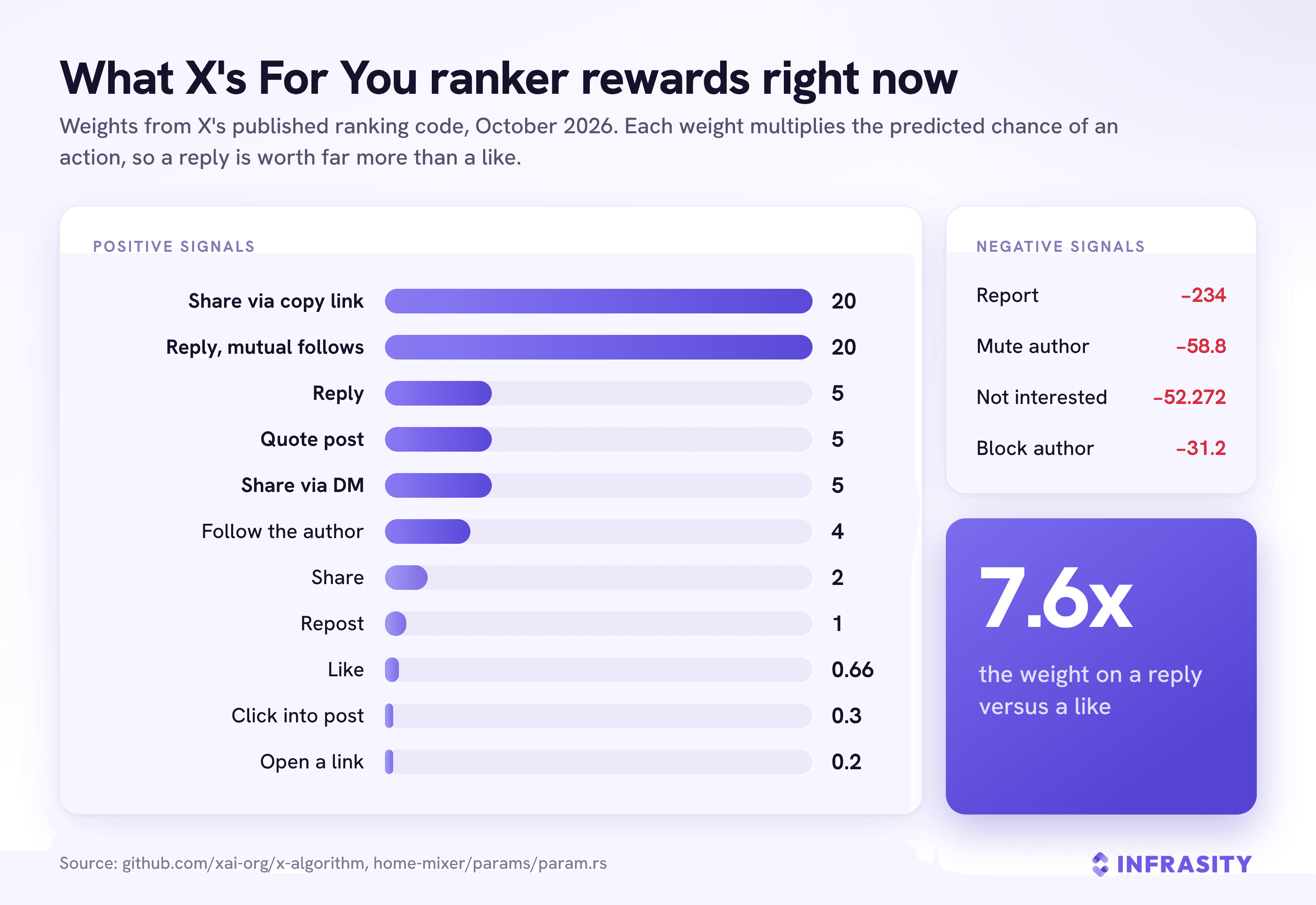
A reply carries 7.6 times the weight of a like in the code X currently runs.
What the current weights say
The weights below come from home-mixer/params/param.rs:
- Conversation and sharing carry the score. A reply (ReplyWeight), a quote of the post (QuoteWeight), and a share via DM each weigh 5.0. A share via copied link weighs 20.0, the largest positive weight.
- Likes and reposts weigh little. A like weighs 0.66 and a repost 1.0.
- Mutual follows add a reply bonus. Since July 2026, replies on original posts from accounts the viewer follows back get an extra 15.0, so a reply there weighs 20.0.
- Negative feedback is heavy. A report weighs -234, a mute -58.8, and "not interested" -52.272.
- Posts age out fast. Posts older than 48 hours are filtered out of For You candidates.
Two warnings come with these numbers. The weights multiply predicted probabilities, so "one report cancels 468 likes" is a misreading that X's own code comments call out. And many blogs still quote the 2023 weights, such as 75 for a reply the author engages with, which no longer exist in the current code.
Three myths the ranking code settles
- Coordinated engagement does nothing: The code comment says an action only counts when it happens on a post X served in the Home timeline, and that "directly navigating to a post (i.e., coordinating via group chat) has no ranking impact." Tactics like engagement networks of linked accounts, which some X growth tutorials still sell, risk account restrictions for no ranking gain.
- Links carry no fixed penalty in the published scorer: Opening a link has a small weight of 0.2, and link posts likely lose reach because people reply and dwell less on them. X's head of product Nikita Bier said in October 2025 that "links are not deboosted", while Elon Musk's advice from 2024 was to write the description in the main post and put the link in the reply.
- Premium no longer multiplies an author's score: The 2023 code gave verified authors a 4x boost with followers and 2x with non-followers, and that code was removed in September 2025. The current X Premium page promises tiered reply prioritization, which helps a creator's replies get seen under other posts.
What the ranking code means for a creator brief
Suppose we have a company selling a CI runner. If its brief says "post about our 3x faster builds", it asks for likes, which weigh 0.66. If the brief asks the creator to post their own before-and-after build times and invite followers to share theirs, it asks for replies and copy-link shares, which weigh 5 to 20.
- Ask for a claim engineers will want to test, compare, or argue with.
- Ask the creator to stay in the replies for the first couple of hours. Replies carry weight, and posts drop out of For You after 48 hours.
- Keep the post itself readable without the link, then place the link in the post or the first reply depending on the creator's own results.
- Never send "go like this" messages to your team. Coordinated engagement has no ranking effect and can raise negative signals.
Which X format to brief for each B2B goal
Each X format does a different job, and the brief changes with it. Match the format to what the post has to prove, then set the length, media, and link rules around it.
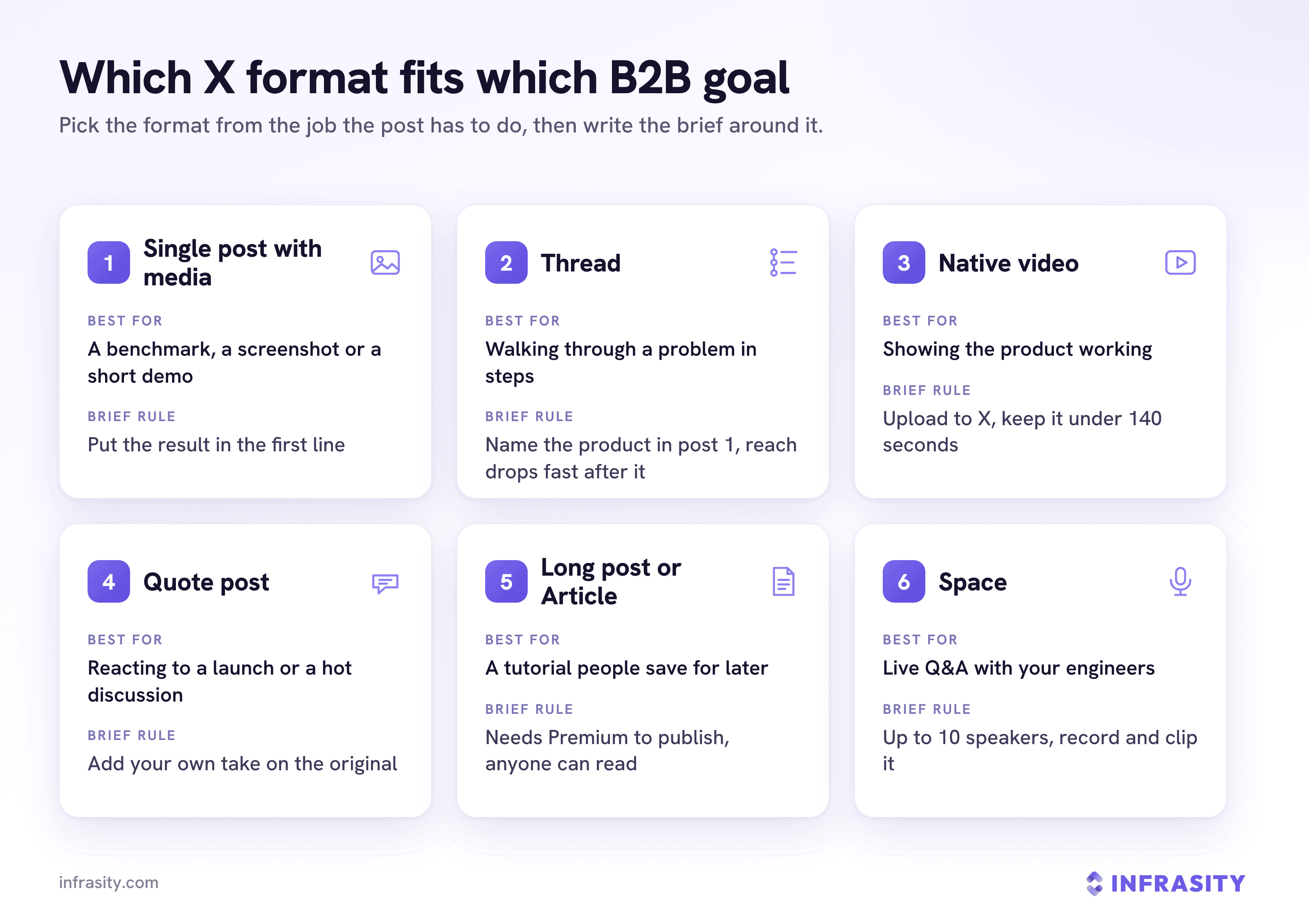
Pick the format from the job the post has to do, then write the brief around it.
Formats with their current limits
- Single post with media: best for one result, such as a benchmark or a before-and-after screenshot. Up to four media items per post.
- Thread: best for walking through a problem in steps. Name the product early, because reach falls after the first post.
- Native video: best for showing the product working. Non-subscribers can upload up to 140 seconds, and Premium allows much longer uploads.
- Quote post: best for reacting to a launch, a release note, or a debate. Posts that people quote earn the same 5.0 weight as posts they reply to.
- Long post or Article: best for a tutorial people save for later. Only Premium subscribers can publish one, and anyone can read it.
- Space: best for a live Q&A between the creator and your engineers. Record it and cut clips for later posts.
Why the product belongs in the first post of a thread
We read every post in one sponsored CI thread for our customer, a GitHub Actions runner product. The first post, which described the slow pipeline, reached 82,239 views. The second post, the first one to name Avrea, reached 9,122 views, which is 11% of the opener.
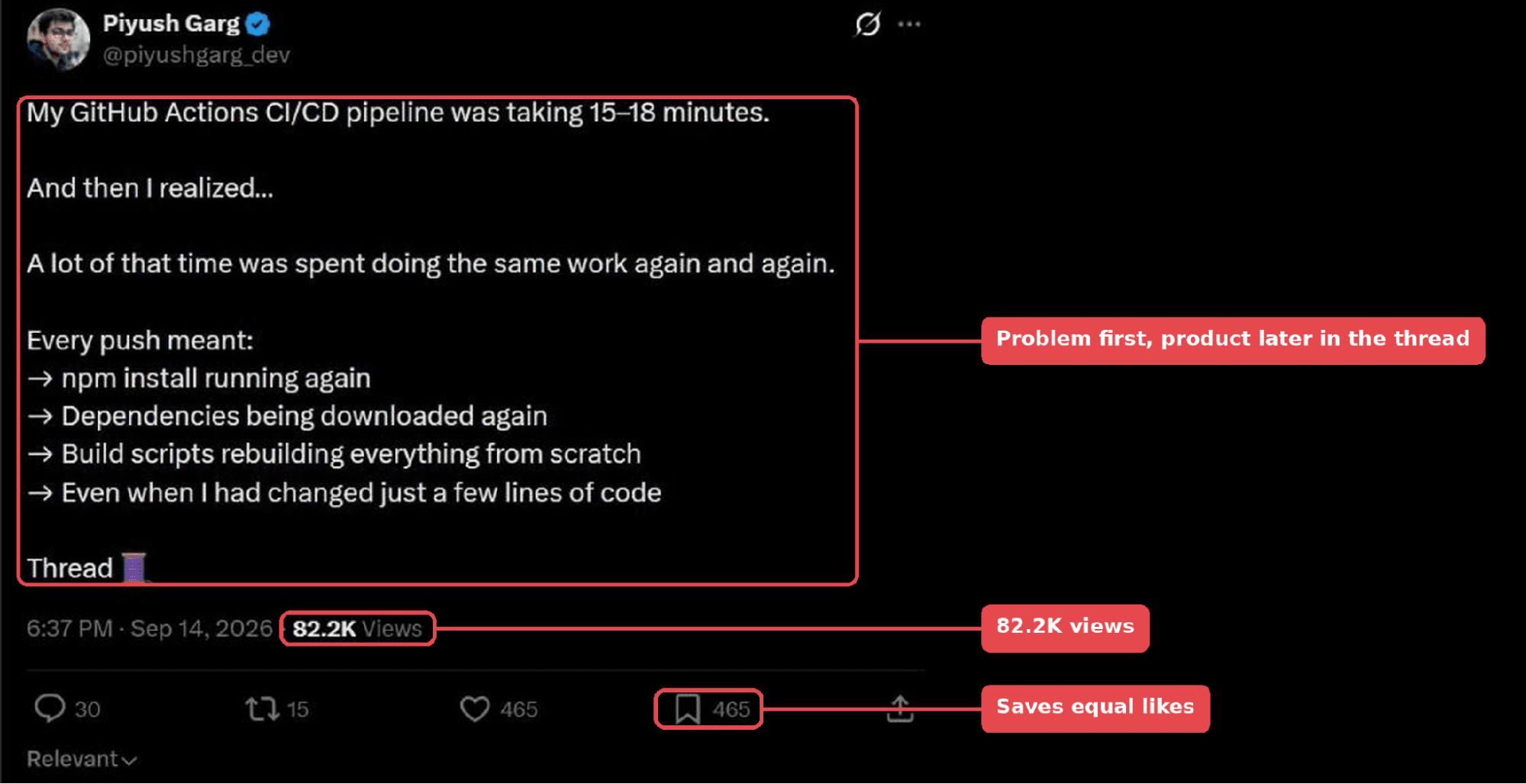
The opener leads with the pipeline problem and holds the product back for a later post.
The opener still did its job: it earned 465 saves, as many as its likes. For a sponsored thread, ask the creator to name the product or show it in post 1, and treat later posts as depth for the readers who click in.
What real sponsored devtool posts on X look like
Sponsored B2B posts on X work best when they read like the creator's normal content. We read five sponsored devtool posts published between December 2025 and September 2026 for WorkOS, Avrea (two posts), Tempo, and Kilo Code, and compared their public counts, including saves (bookmarks).
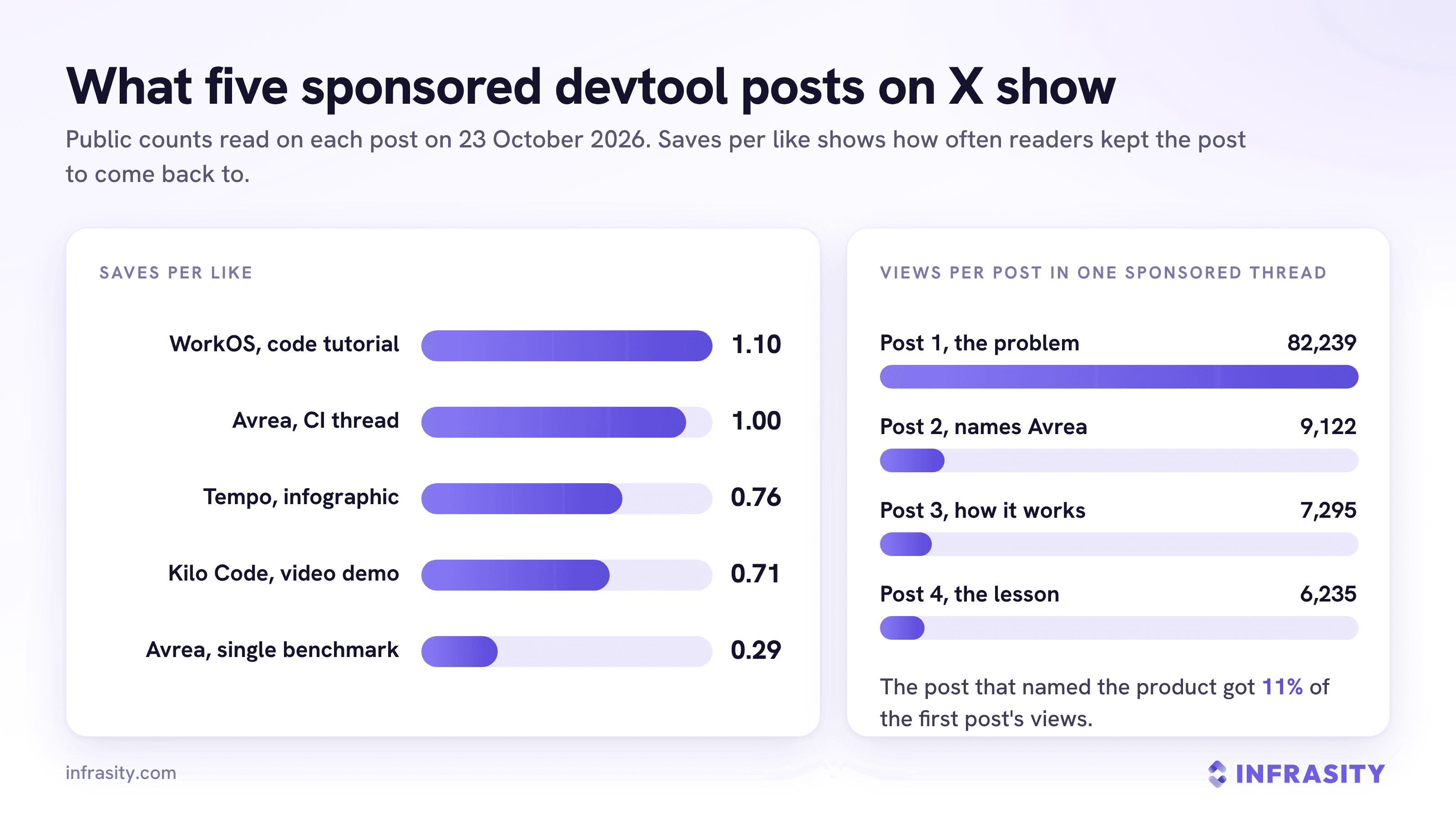
Posts that teach something hold their saves; the post that names the product sits well below the opener.
Saves do not feed X's ranking score in the current code. We still track them, because a technical reader who saves a post plans to come back to it, which is the behavior a B2B brand wants.
WorkOS with Santiago: a code tutorial
Santiago (@svpino) shared a full MCP authentication example built with WorkOS AuthKit and linked the GitHub demo repository. The post reached 33.8K views and earned 545 saves against 496 likes, the highest saves per like in our sample.
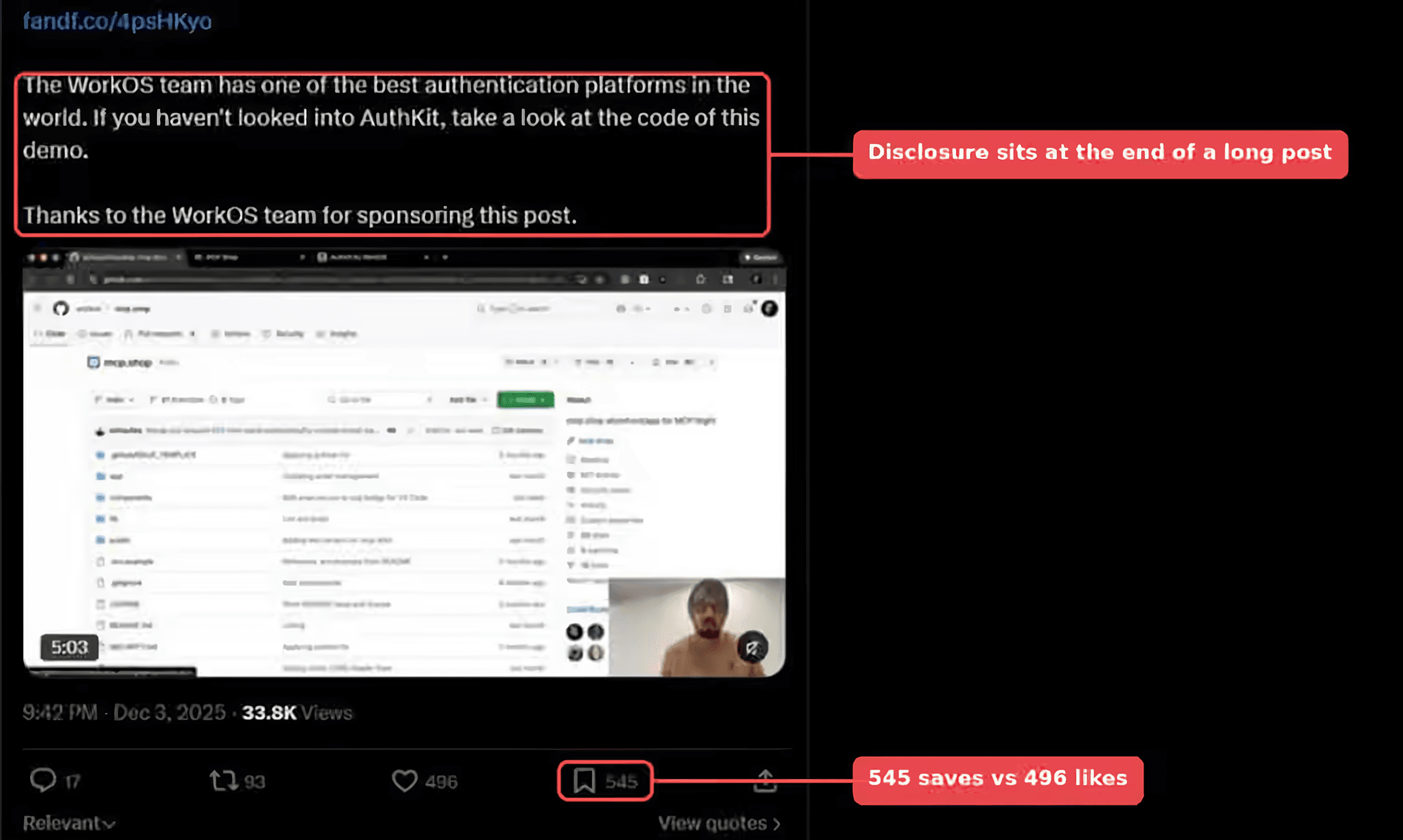
The disclosure sits in the last line of the post, where a reader scrolling the feed can miss it.
Kilo Code with Kunal Kushwaha: a short video demo
Kunal Kushwaha built a 3D globe with Kilo Code, an open-source AI coding agent, and posted a 1:56 native video with a tracked link. The post carries X's Paid Partnership label and reached 26.1K views with 372 saves.
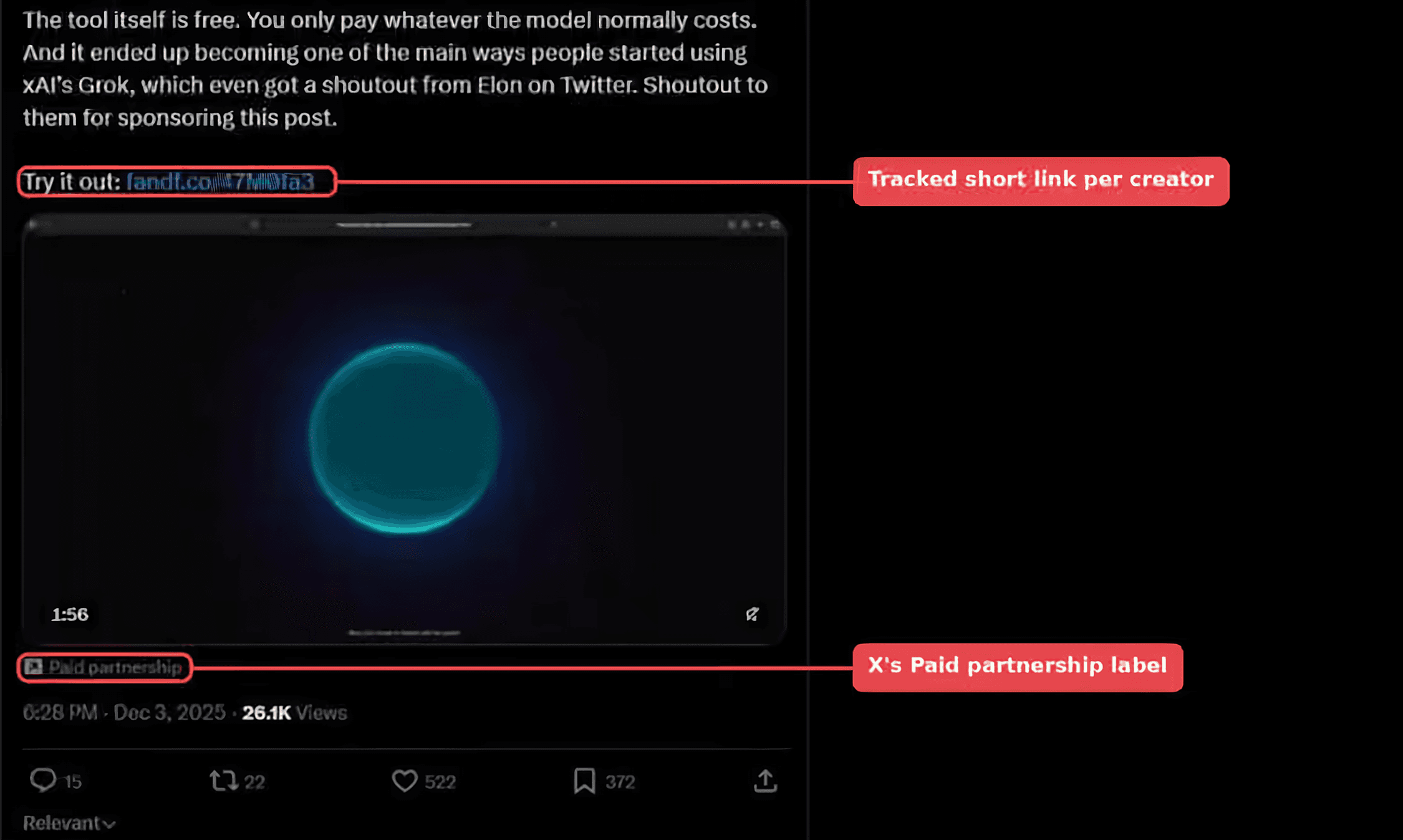
A tracked short link in the post body and X's own Paid partnership label under the video.
Avrea with Cole Medin: a strong benchmark with low reach
Cole Medin ran the same GitHub Actions workflow twice and posted the result: 9m57s on GitHub's runner against 3m24s on Avrea. The link with a per-creator UTM and the sponsor credit sit in a self-reply.
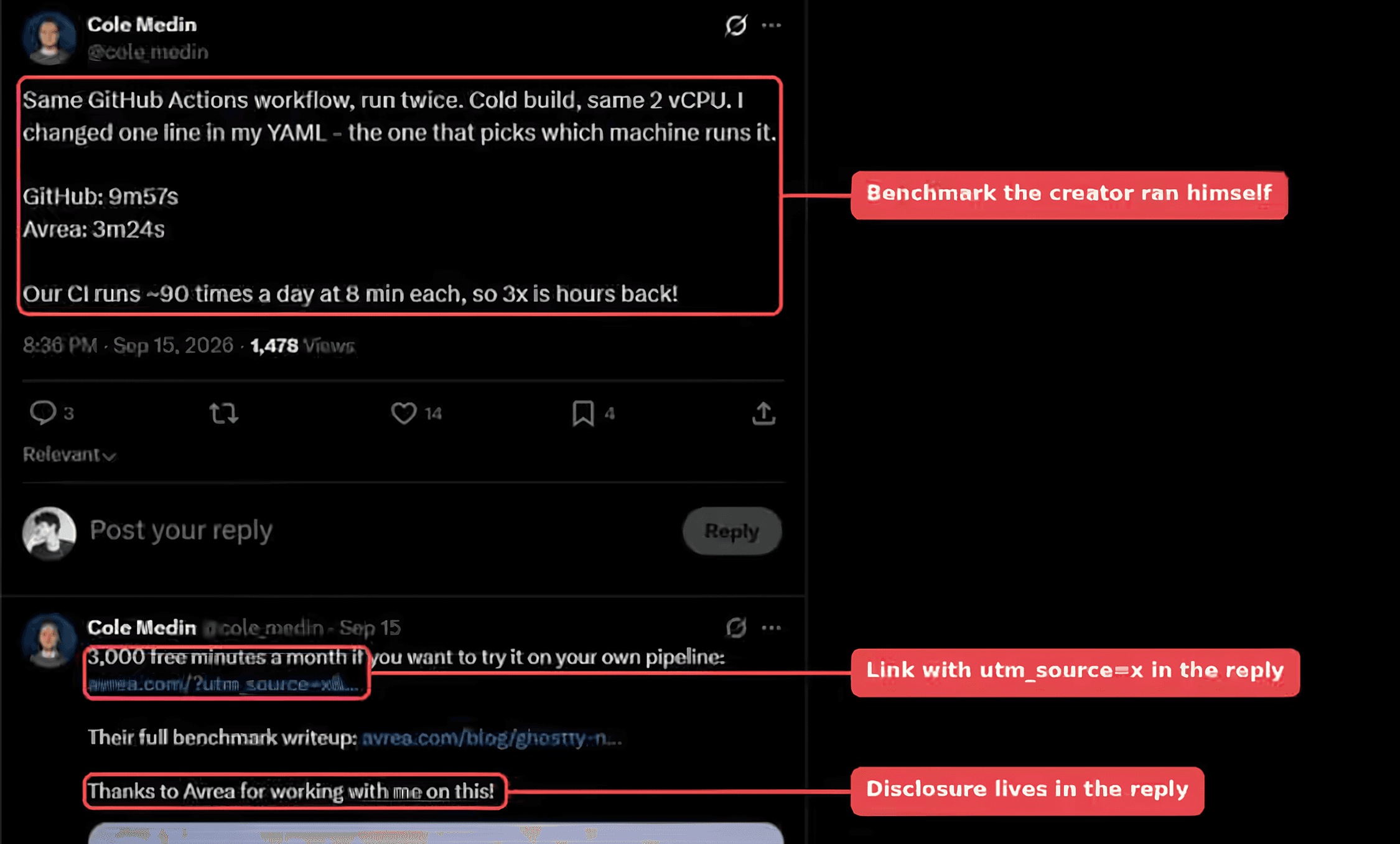
The benchmark sits in the main post while the tracked link and the disclosure sit in the reply below it.
The post reached 1,478 views. Cole Medin is best known for his YouTube channel; his X account had 2,829 followers on 23 October 2026, and a reply under the post notes he had not posted on X in a while. The lesson is about selection: a creator's audience on one platform tells you little about their reach on X, so check recent X activity before you book.
CodeRabbit: X as a founder-led growth channel
CodeRabbit's founder Harjot Gill has said the company did "a lot of work with the taste makers, the influencers," especially on X (Evil Martians podcast). CodeRabbit has not published spend or post counts, so treat this as a practitioner account of what worked for them.
How to find B2B creators on X
The best B2B creators on X are already posting about the problem your product solves. Start from the conversation, then work back to the accounts.
Search the problem before the person
Use X's advanced search to find posts about your buyers' problems, then list who wrote the useful ones. Search the pain in the words engineers use, such as "github actions" slow minfaves:50 lang:en or "mcp server" auth minreplies:10, and add your competitors' names.
- Raise the min_replies: filter until the results show real discussion, since replies carry the most ranking weight.
- Open the replies and check who is talking. Engineers asking follow-up questions is the signal you want.
- Note which accounts keep coming up across several searches over the last 90 days.
Vet each creator on X-specific signals
Score each account on a short, consistent list before you reach out:
- Recent X activity: Several posts a week on X in the last 60 days. Large audiences elsewhere do not transfer to X, a point that also shapes how we pick programming influencers on YouTube.
- Reply quality: Real questions and technical pushback in the replies. Emoji strings and generic praise are a warning sign.
- Audience fit: Followers and repliers who match your buyers, such as platform engineers or AI engineers, and a few students or job seekers if you sell to teams.
- Median reach: Views on the last 10 posts, using the median, because one viral post hides a usual reach that may be a fraction of it.
- Growth pattern: Steady follower growth. Sudden jumps with no viral post behind them suggest bought followers, a point Favikon's creator vetting framework also makes.
- Sponsor history: Past sponsored posts with a visible Ad label that showed the product working, and no direct rival in the same quarter.
We built Influencer OS to shorten this step. It holds thousands of vetted creators across YouTube, LinkedIn, X, Substack, Discord, Dev.to, Medium, and newsletters, graded on ICP fit, with follower count left out of the grade.
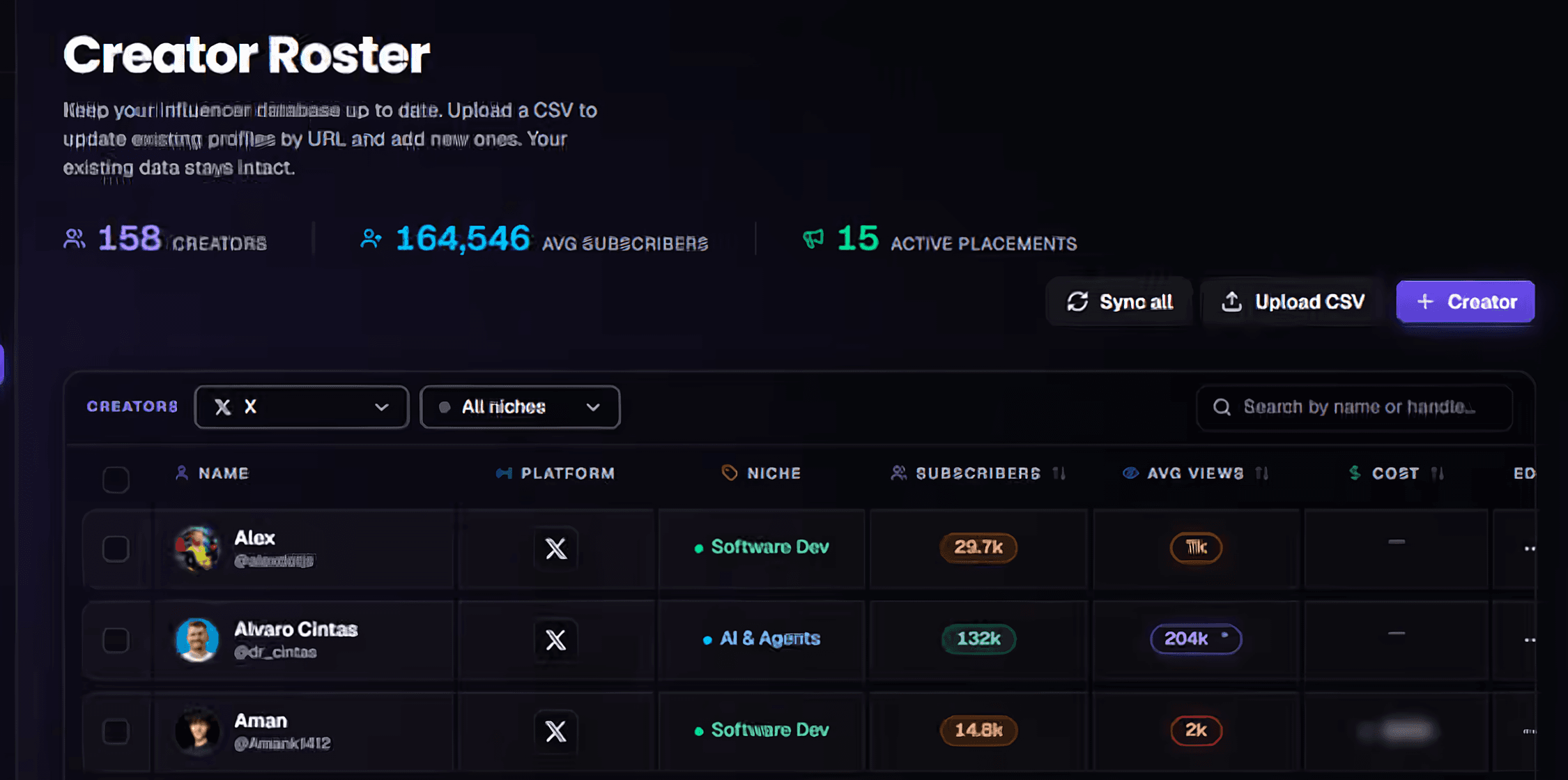
The roster filtered to X alone, which is where the 158 count comes from; the full database spans eight platforms.
How to brief an X creator so the post earns replies
A good brief gives the creator one problem, one proof point, and room to say it their way. HubSpot's creator team moved from fixed scripts to what Alana Joseph calls a "mad lib" format: key messages and must-say facts, with gaps for the creator's own experience (HubSpot Live).
What to put in an X creator brief
- The problem: the specific pain your buyer posts about, in their words.
- The proof: one thing the creator can show or measure themselves, such as a build time, a latency number or a working repo.
- Product access: a sandbox account, credits and an engineer the creator can message.
- Format and length: the format from the table above, plus where the product must appear.
- The link: a unique tracked link, such as ?utmsource=x&utmmedium=creator&utm_campaign=cole, and whether it goes in the post or the first reply.
- Disclosure: "Ad" at the start of the post and X's Paid Partnership label switched on.
- Reply window: how long the creator will answer replies after posting, and who on your team backs them up on technical questions.
- Usage rights: whether you can quote, embed or put paid spend behind the post, and for how long.
What to leave out of the brief
Leave out the script, the hashtags and the adjectives. Phil Agnew, host of the Nudge podcast, makes the point in the same HubSpot session that audiences notice the moment a creator switches to someone else's voice, and stop trusting what follows.
How to disclose sponsored posts on X
Sponsored posts on X need two disclosures: X's own label and a plain "Ad" in the text. X's Paid Partnerships policy says organic posts that are part of a paid partnership must have the Paid Partnership disclosure turned on, which a creator sets in Content Disclosure settings while writing the post.
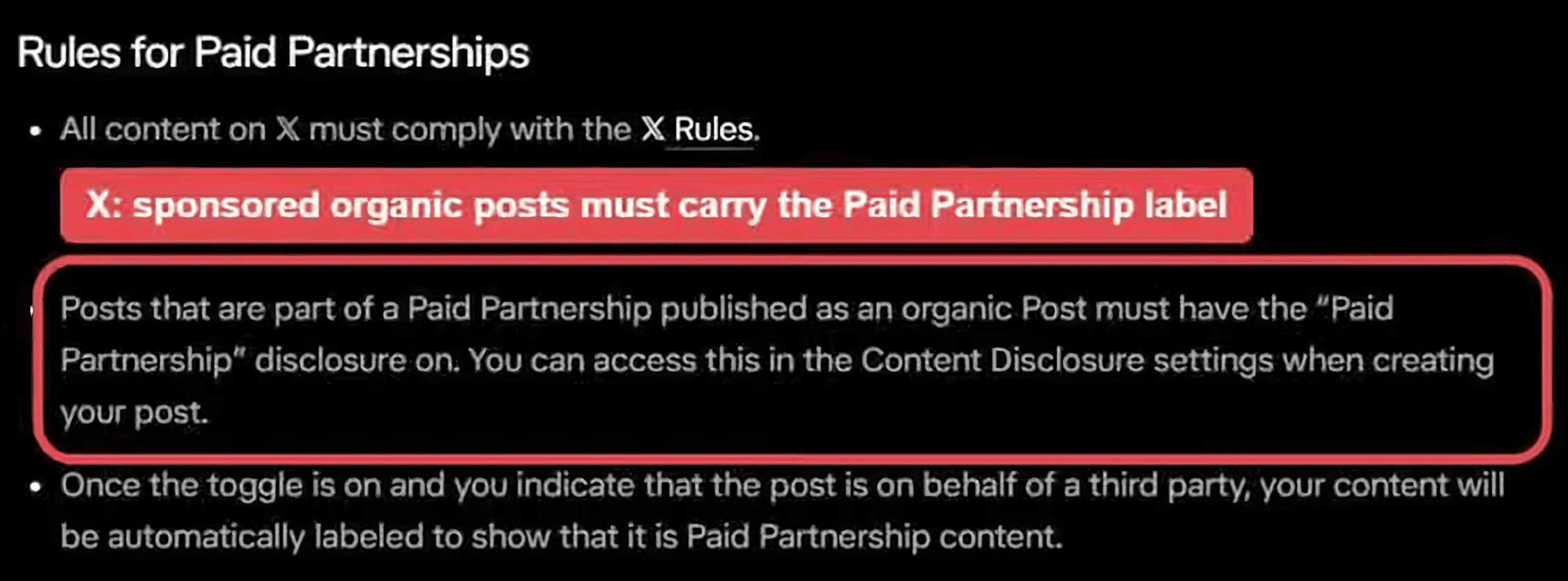
X puts the label in the creator's hands, as a toggle set while the post is being written.
The FTC adds that the platform label alone may not be enough. Its guidance says that starting a post with "Ad:" or "#ad" would likely be effective, that a disclosure in the middle or at the end of a post is easier to miss, and that responsibility rests with the influencer and the brand.
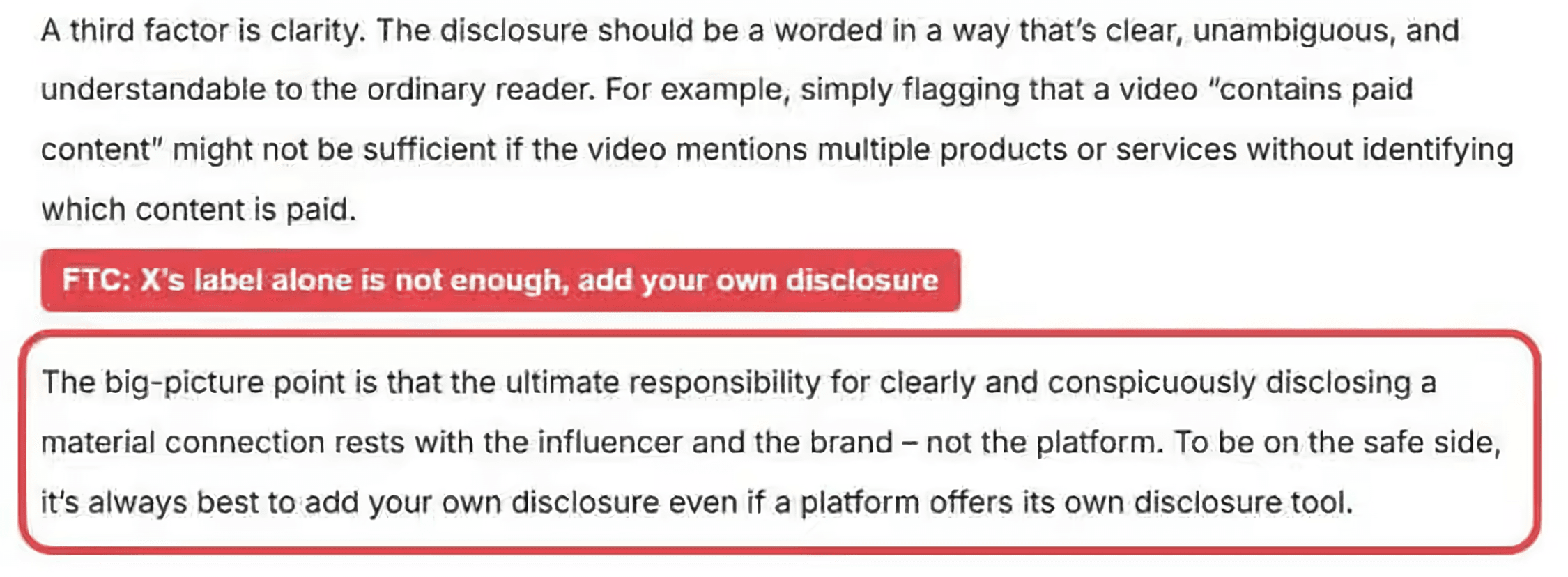
The FTC puts the duty on the brand and the creator, not on X's toggle.
For a brief that works in the US and UK at once:
- Start the post with "Ad" and switch on X's Paid Partnership label. The UK's ASA advises against "sponsored" as the only label, while the FTC says it may be effective, so "Ad" covers both.
- Disclose in every post of a thread that mentions or links the product, since the FTC says viewers may not see more than one post.
- Avoid "thanks to" or a brand tag as the only disclosure. The UK's CMA guidance names "thank you" and brand tags as not enough.
- Check the product category. X does not allow paid partnerships for supplements or pharmaceuticals anywhere, and adds financial products and gambling in the UK, EU and Australia.
What Twitter influencer marketing costs for B2B tech
There is no public rate card for X creators, and none of the top-ranking guides we read gives an X price with a source. In the confirmed creator quotes behind our B2B influencer marketing playbook, a single X thread ranged from $500 to $8,000.
What moves the price of an X placement
- Format and effort: a thread with a benchmark or a recorded demo costs more than a single post, because the creator has to run the test.
- Audience depth: a niche account followed by platform engineers can charge more than a larger general tech account.
- Usage rights: quoting the post on your site, in emails or in ads adds to the fee.
- Paid amplification: putting ad spend behind a creator's post in X Ads needs the creator to grant your ads account permission, so agree it in the contract.
- Exclusivity: keeping rival products off the creator's feed for a set period is a separate line item.
- Reply duty: asking the creator to answer replies for a set window adds time to the deal.
Choosing between an agency, a platform or in-house
Each option removes different work from your team:
- In-house: fits when one person already knows your category's creators and can give the program several hours a week. Ask yourself who answers creators' technical questions within a day.
- A Twitter influencer marketing platform or software: fits when you have a person to run the program and need search, contracts, and tracking in one place. Ask whether it shows post-level analytics for every X placement.
- A Twitter influencer marketing agency: fits when you need outreach, briefs, approvals, and reporting handled for you. Ask any B2B influencer marketing agency for its creator vetting criteria and an example report with link clicks and signups per creator.
Build the pilot budget from four lines:
- Creator fees: number of creators times posts per creator times each quote.
- Engineering time: a few hours per creator for access, answers and fact checks.
- Boost spend: a reserve to put behind the one or two posts that perform best.
- Test reserve: room to swap in a new creator if one underdelivers.
Start with three to five creators for four to six weeks, then rebook the ones whose posts brought the right people.
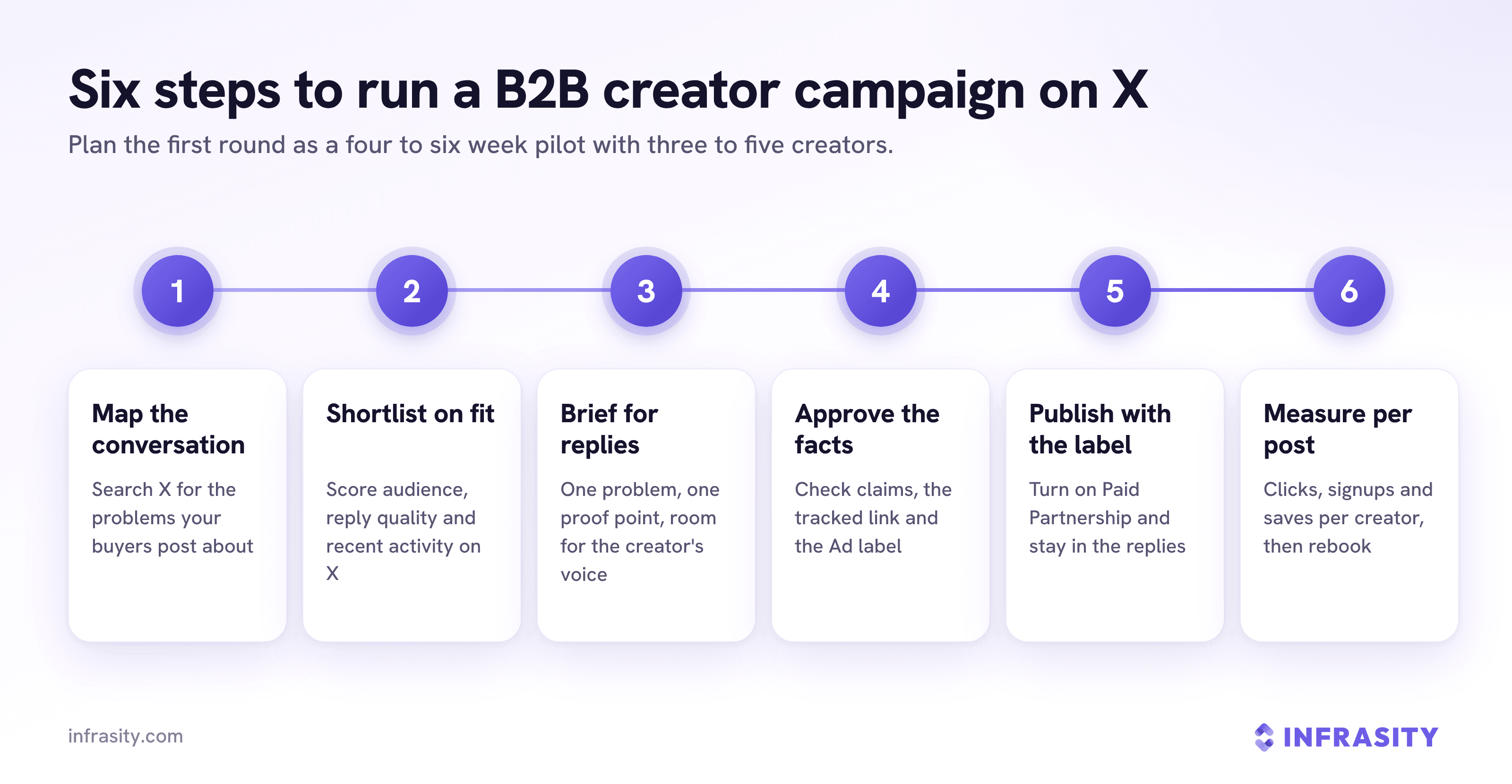
The whole pilot, from searching X for your buyers' problems to rebooking the creators who delivered.
How to measure X creator campaigns in a long B2B sales cycle
Measure each post, then each creator, then the program. Impressions tell you X served a post, and B2B results show up later as signups, product usage and pipeline.
What to ask each creator to share
Ask for a screenshot of the post's analytics at 7 days and 30 days. X's analytics show impressions, engagements, engagement rate, link clicks, profile clicks, detail expands and new follows for each post, and the X API adds fields such as urllinkclicks, bookmark_count and video playback quartiles.
- Replies, quotes, reposts and saves are public, so you can check those yourself.
- Ask for video completion rates on any native video.
How to connect posts to pipeline
- One link per creator. Use a unique UTM or short link for each creator and post, so utm_campaign tells you who sent the visit.
- A required signup field. Add a How did you hear about us? field with creator names in the list, because developers often see a post on their phone and sign up later on a laptop.
- Branded search. Record four weeks of searches for your product name in Google Search Console before launch, then compare the week after each post against that baseline.
- Saves per like. Track it as a quality signal next to clicks. In our sample of five posts, the code tutorial and the step-by-step thread scored 1.0 or higher, and the single benchmark post scored 0.29.
- Pipeline review at 90 days. Join signups to your CRM and look at which creators' audiences became active users and opportunities.
A simple scorecard row per creator keeps the review honest: creator, post URL, views, link clicks, saves per like, signups, activated users and opportunities at 90 days.
For the full model, read our guide on how B2B teams measure influencer marketing ROI.
How Infrasity runs X creator programs for devtools
We run creator programs on X for developer tools and B2B SaaS, from shortlist to reporting. Influencer OS handles discovery, approvals, and per-placement tracking, and nothing publishes without the client's sign-off.
For Rocket, an AI app builder, we ran 90 creator placements across YouTube, X and Instagram, including 20 on X. We scored every creator on a 100-point fit card that gives follower count no points, and spread the budget so the largest single placement carried 12% of total reach.
If you want a shortlist of X creators matched to your stack and buyers, talk to our X creator marketing team for developer tools. We send a shortlist after one call, then scope formats and deliverables around it.
FAQs
Is Twitter influencer marketing worth it for B2B tech companies?
It is worth testing when your buyers already discuss your category on X, which is common in AI tooling, developer infrastructure, and open source. X reaches a smaller share of developers than YouTube or Reddit, so run a four- to six-week pilot with three to five creators before you commit a larger budget.
How much does a sponsored post on X cost?
Prices vary with format, audience depth, and usage rights. In the confirmed creator quotes behind our playbook, a single X thread ranged from $500 to $8,000, and benchmarks, demos, ad rights, and exclusivity all push the price up.
Do sponsored posts on X need a label?
Yes. X's policy requires the Paid Partnership disclosure on sponsored organic posts, and the FTC advises adding your own clear disclosure, such as "Ad" at the start of the post, because a platform label alone may not be enough.
Does X reduce the reach of posts with links?
X's published ranking code has no fixed penalty for links, and X's head of product has said links are not deboosted. Link posts often get fewer replies and less reading time, so keep the post useful on its own and test the link in the post against the link in the first reply.
How do you measure ROI from X influencers in B2B?
Give each creator a unique tracked link, add a "How did you hear about us?" field at signup, and watch branded search after each post. Review signups, product usage and pipeline per creator at 90 days, since B2B buyers tend to convert after several touches.