
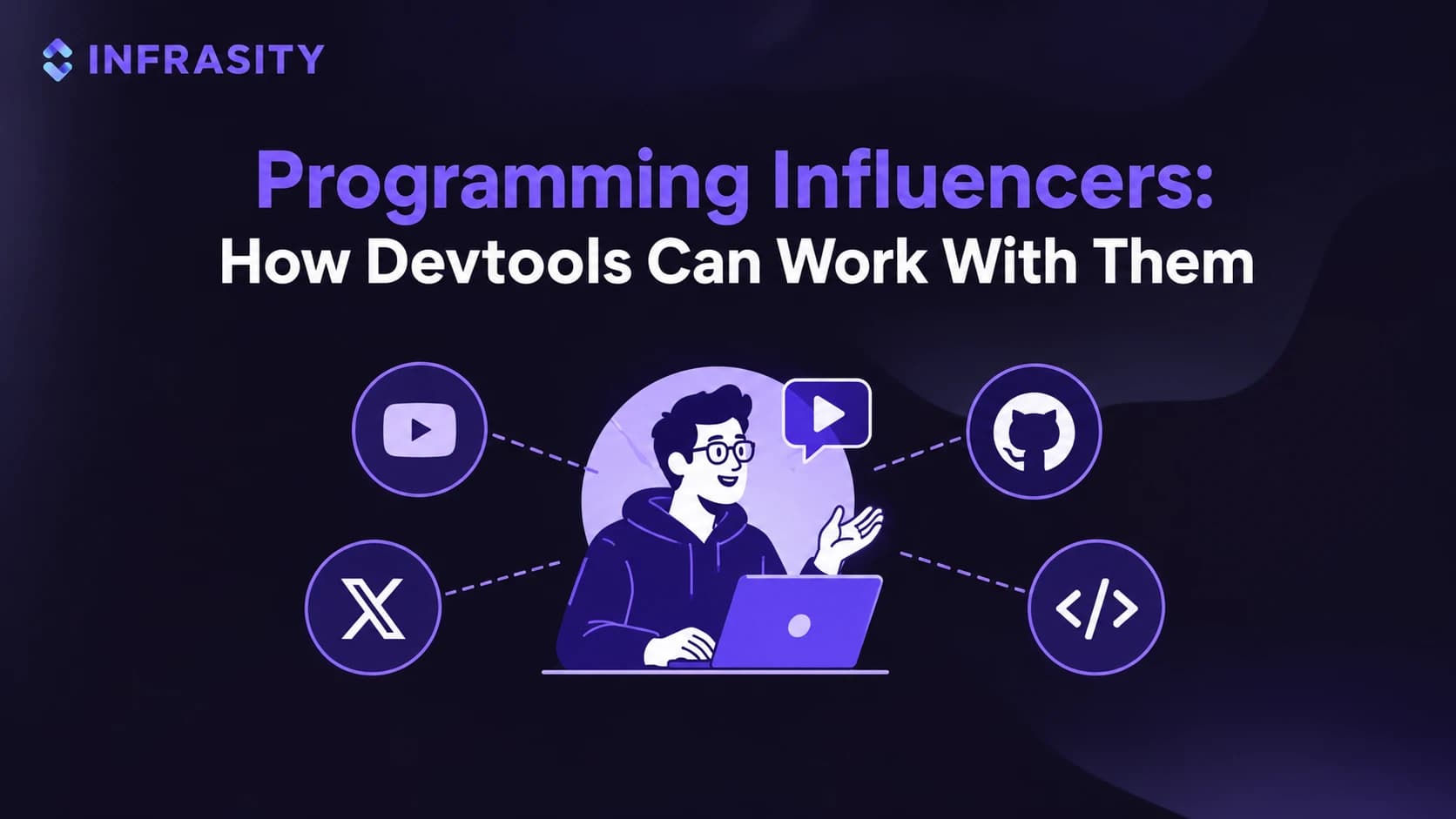
Programming influencers work for devtool brands when the creator builds something real on camera, and your tool is one layer of that build. Clerk learned this the expensive way: its first three Clerk-only videos barely moved signups, and once creators got full creative freedom to build whole apps, the program grew to 20 partners and a 30% increase in YouTube-attributed signups.
This blog covers what the sponsor market on programming YouTube looks like right now, how to pick and brief creators, how PostHog runs its program in-house, and how to measure results when most attribution tools miss the signup.
TL;DR
- We read the descriptions of 103 recent long-form videos across 11 programming channels and found 73 sponsor slots. 42% went to AI-era devtools, and AI code review alone took 16 slots split between three competing brands.
- Programming creators do two different jobs: strategic partners who build with your tool over months, and amplifiers who push one launch. Each needs its own brief, budget, and KPI.
- Integration videos, where your tool sits inside a real build, beat dedicated "here is our product" videos for conversion.
- PostHog runs creators in-house with a full-time role, written engagement benchmarks, and a vanity URL per creator.
- Plan on a 90-day first campaign with 10 to 20 pieces of content before you judge the channel.
Why programming influencers carry more weight with developers than ads?
The engineer who tries a tool on a Saturday project is usually the one who brings it into the team, so the person they watch build things has more pull than any banner.
That trust is now showing up in how devtool companies spend. PostHog's 2023 founder guide called YouTube much more expensive for reaching developers and pointed startups at newsletters. By 2026, its handbook describes long-form YouTube as its strongest acquisition channel.
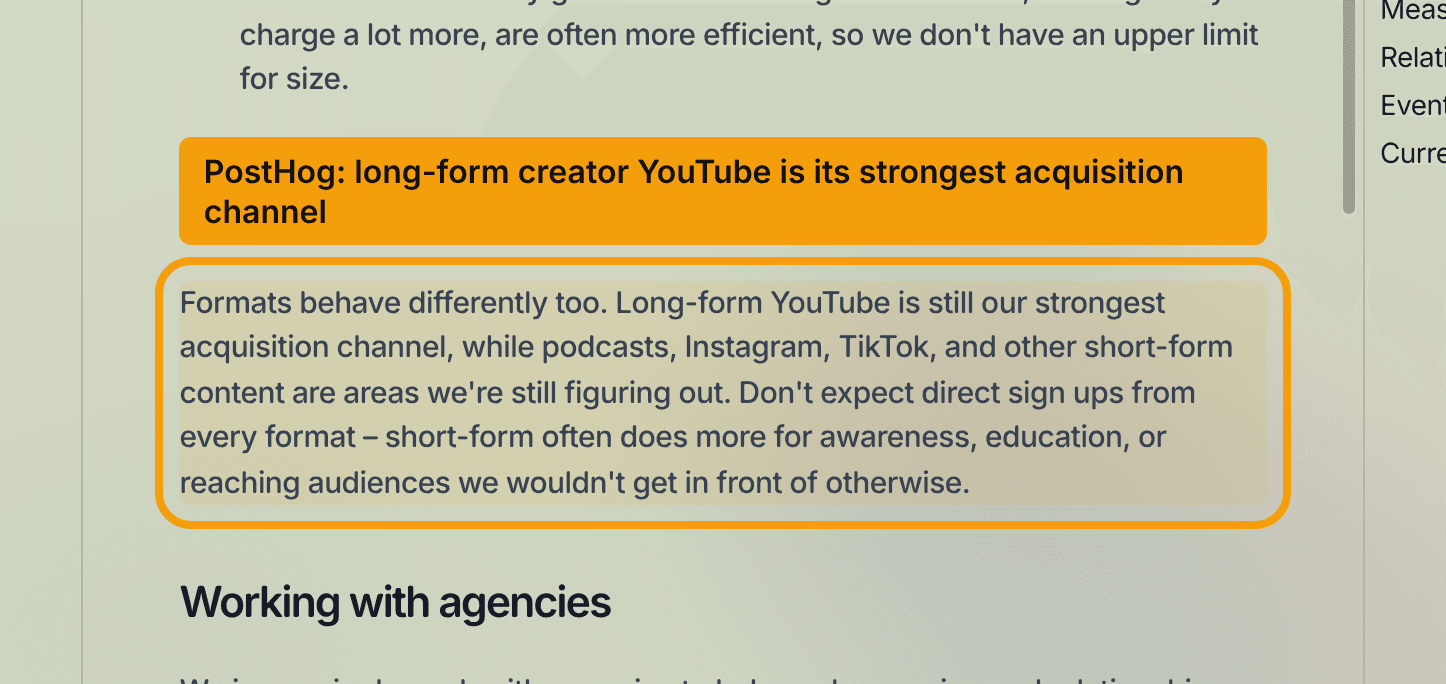
PostHog's own handbook, three years after it called YouTube too expensive for startups.
The wider devtool market is moving the same way, with less certainty. In a survey of about 50 devtool marketers discussed on Scaling DevTools, influencer and video marketing had the lowest measurable ROI of any channel and the highest experimentation rate.
- Our reading: teams are buying creators before they know how to measure them. The brands that win this phase are the ones that set up attribution on day one, covered later in this guide.
- AI search adds pressure. When LLM answers are shaped by whoever publishes the most content, developers fall back on the people they already follow, which makes a creator's audience a durable asset.
What sponsor slots on programming YouTube look like in 2026
To see who is buying, we pulled the 15 latest uploads from 11 programming channels through YouTube's public feeds and read every description for sponsor lines and tracked partner links. Shorts and the creators' own products were left out, which left 103 long-form videos and 73 sponsor slots.
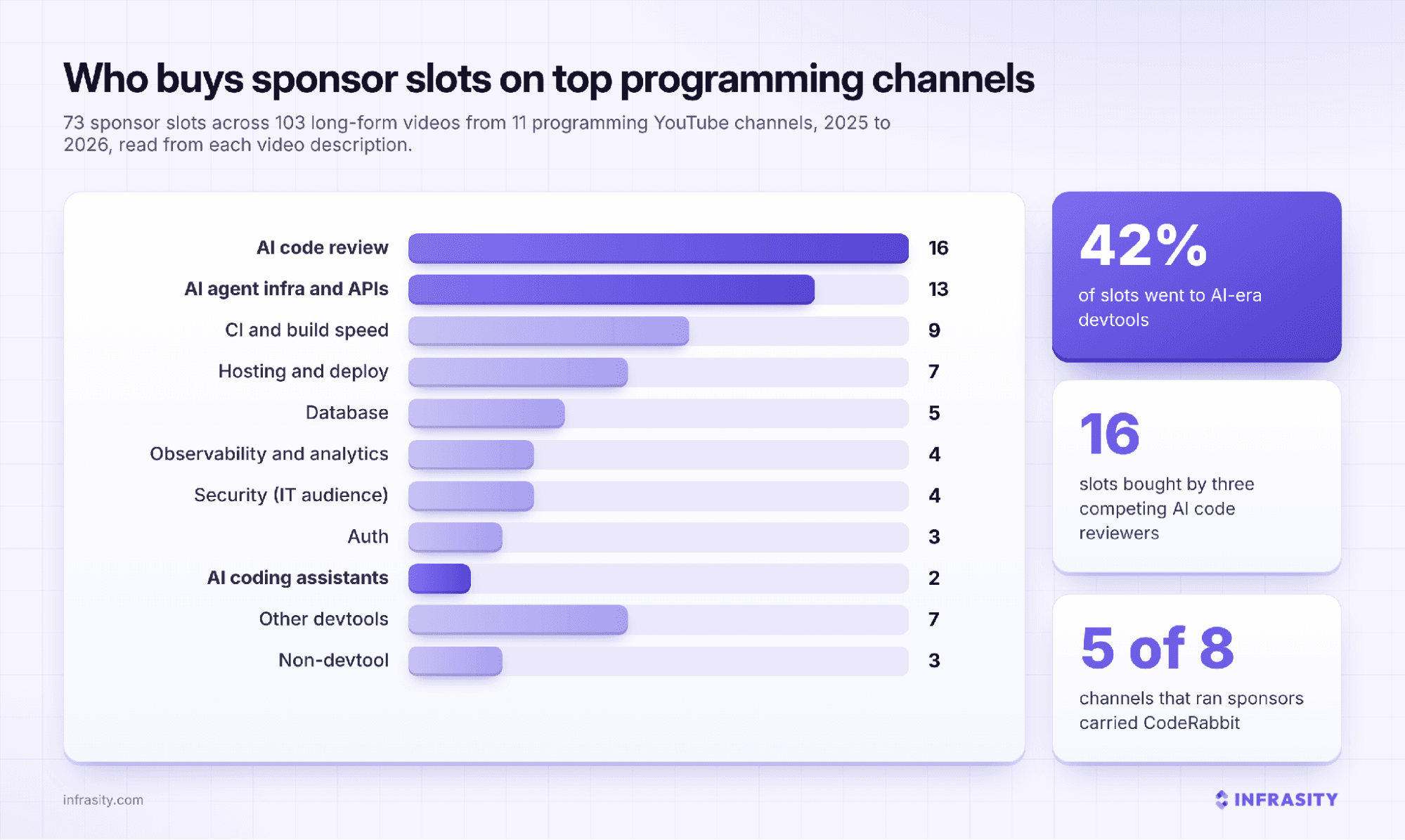
AI code review, agent infrastructure and coding assistants took 31 of the 73 slots between them.
The channels checked were Fireship, Theo, The PrimeTime, ThePrimeagen, Ben Davis, Traversy Media, Web Dev Simplified, NetworkChuck, Hussein Nasser, Coding Garden, and Beyond Fireship. Three patterns stood out:
- AI tooling owns the inventory: AI code review, agent infrastructure, and coding assistants took 31 of 73 slots. Leave out NetworkChuck's IT and homelab audience, and it rises to 47%.
- Rivals share the same creators: CodeRabbit, Greptile, and Macroscope split 16 code review slots, often on the same channels within weeks. A viewer who sees three code reviewers in a month starts comparing them, which helps the best demo and hurts everyone else.
- Sponsorship density is close to saturation: Theo and Ben Davis ran a sponsor on every video checked, and Fireship on 14 of 15. Hussein Nasser ran none, which tells you some creators simply do not take reads.
What this means for your plan:
- If your category is crowded like observability, MCP, or CI/CD, negotiate a category exclusivity window (for example, no direct rival for 60 to 90 days) and pay for it. It is cheaper than losing the comparison.
- If your category is quiet like agent memory, the field is open. Classic auth, database, and hosting sponsors that were everywhere in 2023 and 2024 barely appeared in this window, so a well-placed integration can stand out.
- Smaller channels sell full inventory too. Ben Davis has under 46K subscribers and sold every video, so "small" does not mean "available" or "cheap".
Creators also sell the audience they have, and the good ones say so plainly. Theo's sponsor page leads with viewer age and how many React developers watch, with prices on request only.
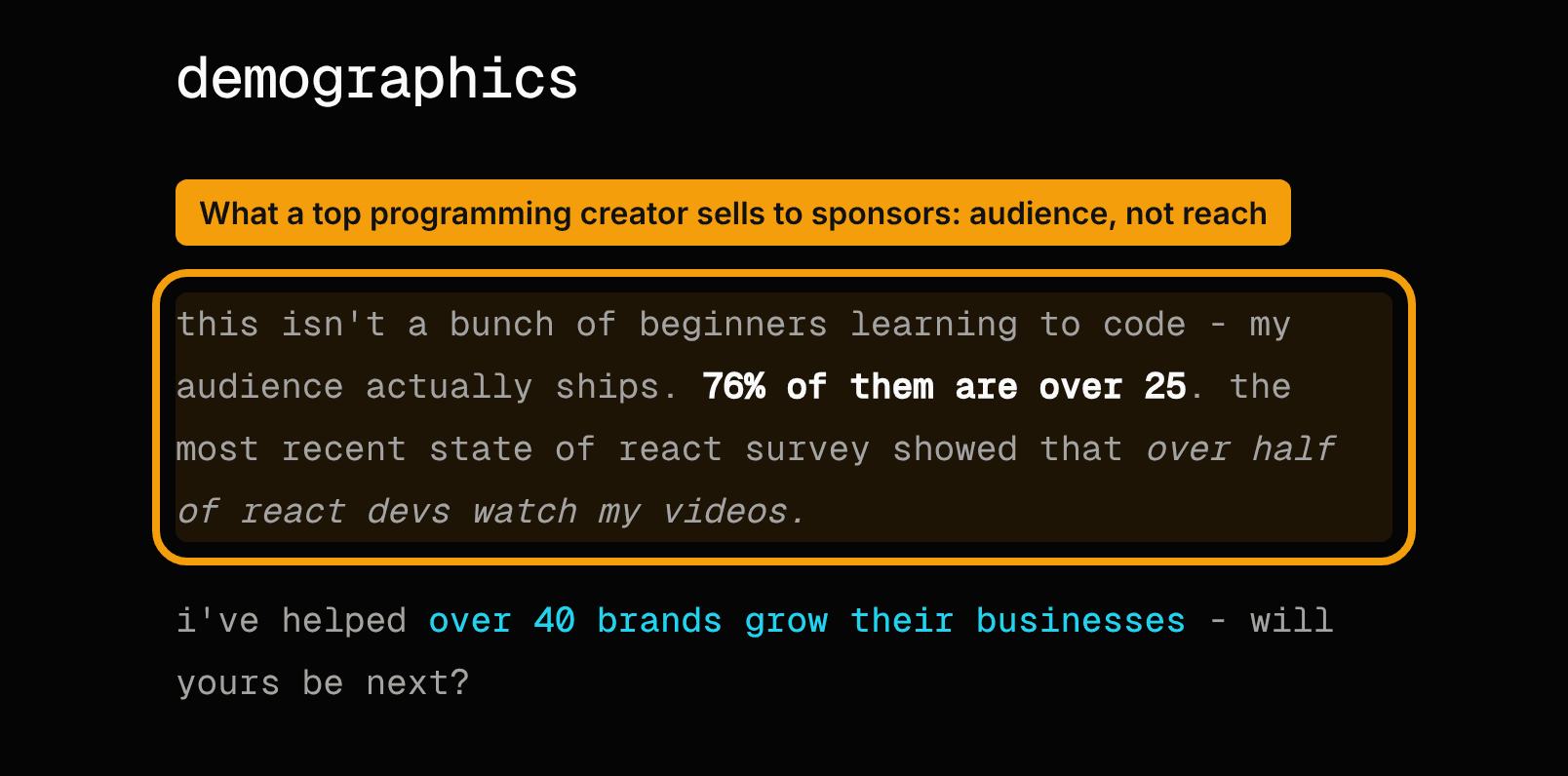
What a top programming creator sells to sponsors: audience composition, not raw reach.
Strategic partners and amplifiers need different briefs and budgets
Most programs mix two jobs without noticing, then judge both by the same number. Neill Gernon, who has run creator programs for devtools such as Clerk and Snyk, splits them on Reo.dev's channel into high-fit strategic partners and a looser group used for launch noise.
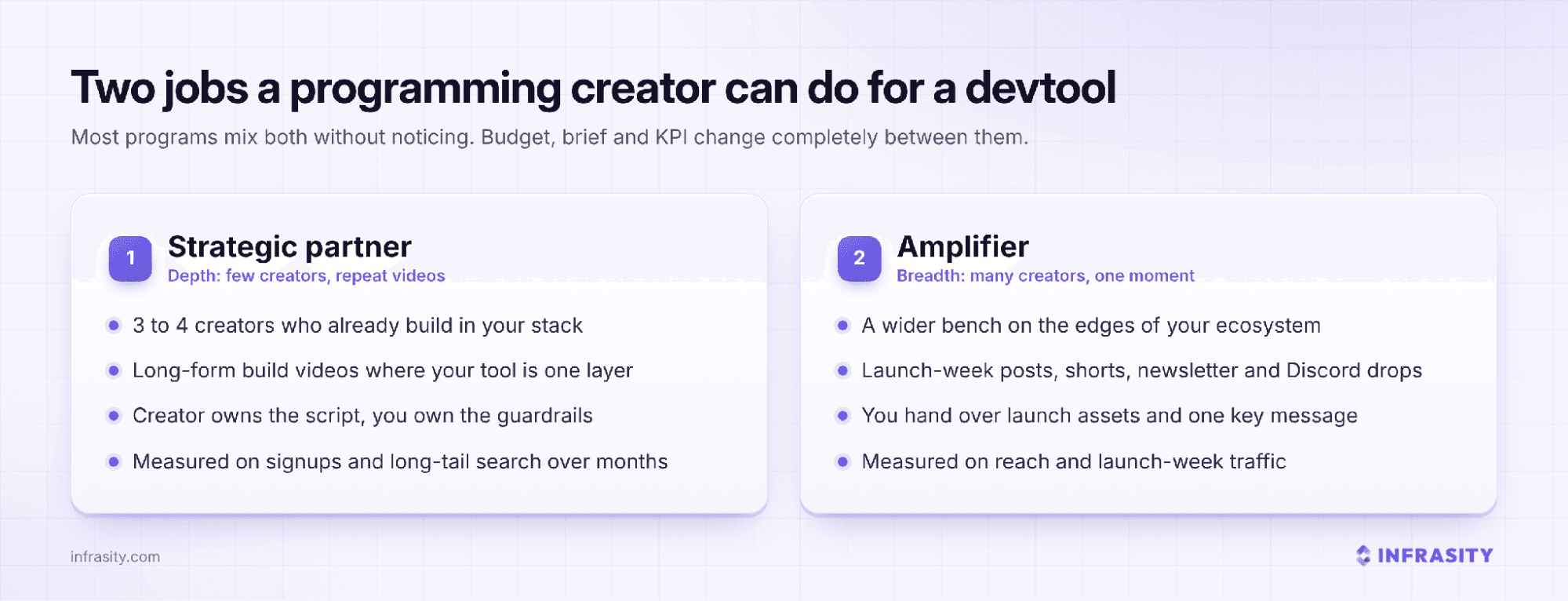
Budget, brief and KPI all change between the two jobs, which is why mixing them hides results.
Strategic partners are a short list of creators whose audience is your ICP and who already build with tools next to yours.
- They make long-form build videos where your tool is one layer, and they repeat over months.
- Judge them on signups and the long-tail search traffic their videos keep pulling.
- Snyk is a good reference point: it amplifies its own hackathons, webinars and launches with creators on a steady quarterly cadence.
Amplifiers sit on the edges of your ecosystem. A React-adjacent creator who would not make a full tutorial on your tool can still drop your launch into a newsletter, a Discord or an X thread.
- Brief them with launch assets and one message, then judge them on reach and launch-week traffic.
- Keep them away from your docs and onboarding pages, where you need depth.
For a sense of how this plays out at launch time, see our guide on launching a SaaS product with creators.
How to pick programming influencers who fit your devtool
Follower count is the weakest signal you can use. When we compared rate cards for our B2B influencer marketing playbook, subscriber count explained almost none of the price variation (r² of 0.001), and cost per thousand subscribers ranged from $2.57 to $233.
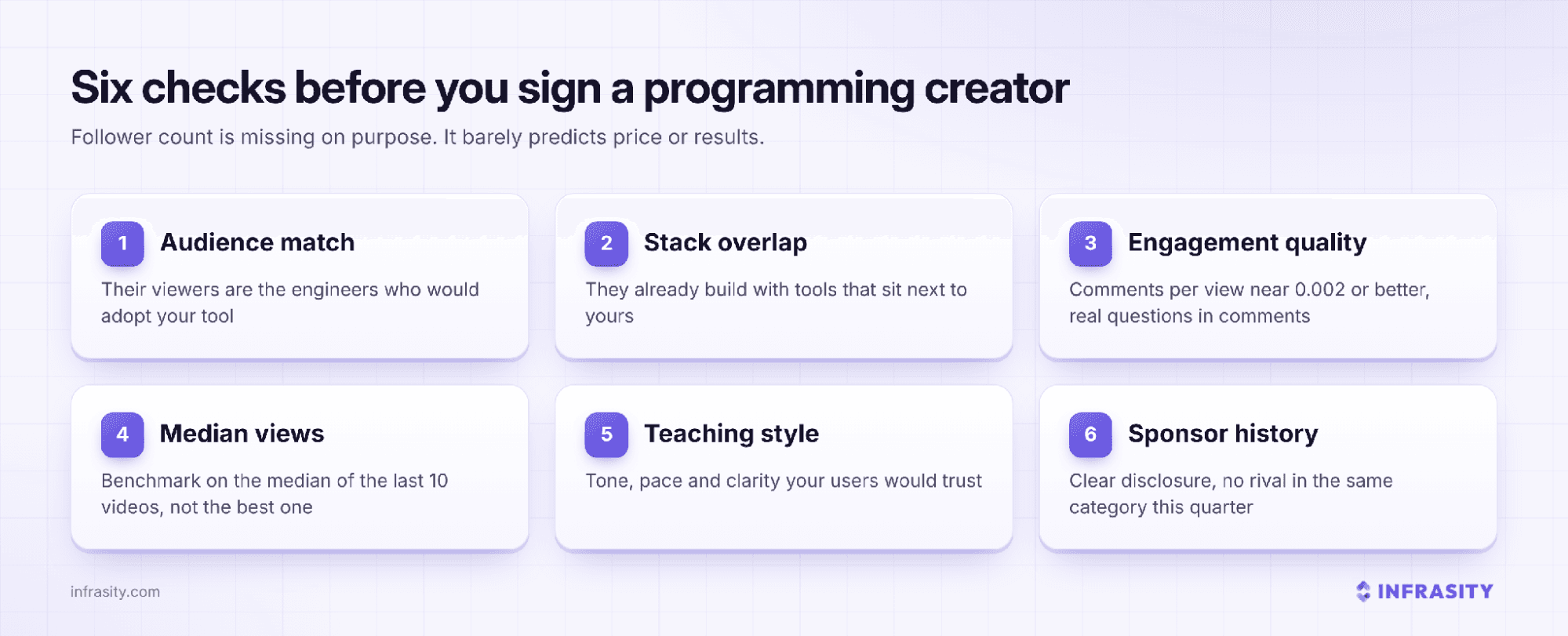
Follower count is left out on purpose: it barely predicts price or results.
Use these checks instead:
- Audience match. A frontend creator's viewers judge tools differently from SREs or data engineers, so match the creator's niche to the engineers who would adopt your product. PostHog, for example, avoids channels about interview prep, career growth, and heavy computer science.
- Stack overlap. The best partners already use tools that sit beside yours, so your product slots into a workflow they show anyway.
- Engagement quality. PostHog writes down its bar: comments per view of 0.002 to 0.005 counts as good, and anything under 5,000 views per video is not worth its time.
- Median views. Benchmark the median of the last 10 videos. One viral upload hides a channel that usually gets a third of that.
- Credibility. Some creators stop coding once YouTube becomes the full-time job. Lewis of Coding with Lewis talks openly about this credibility gap in dev content, so check that recent videos show real building.
- Sponsor history. Look for clear disclosure and no direct rival booked in the same quarter.
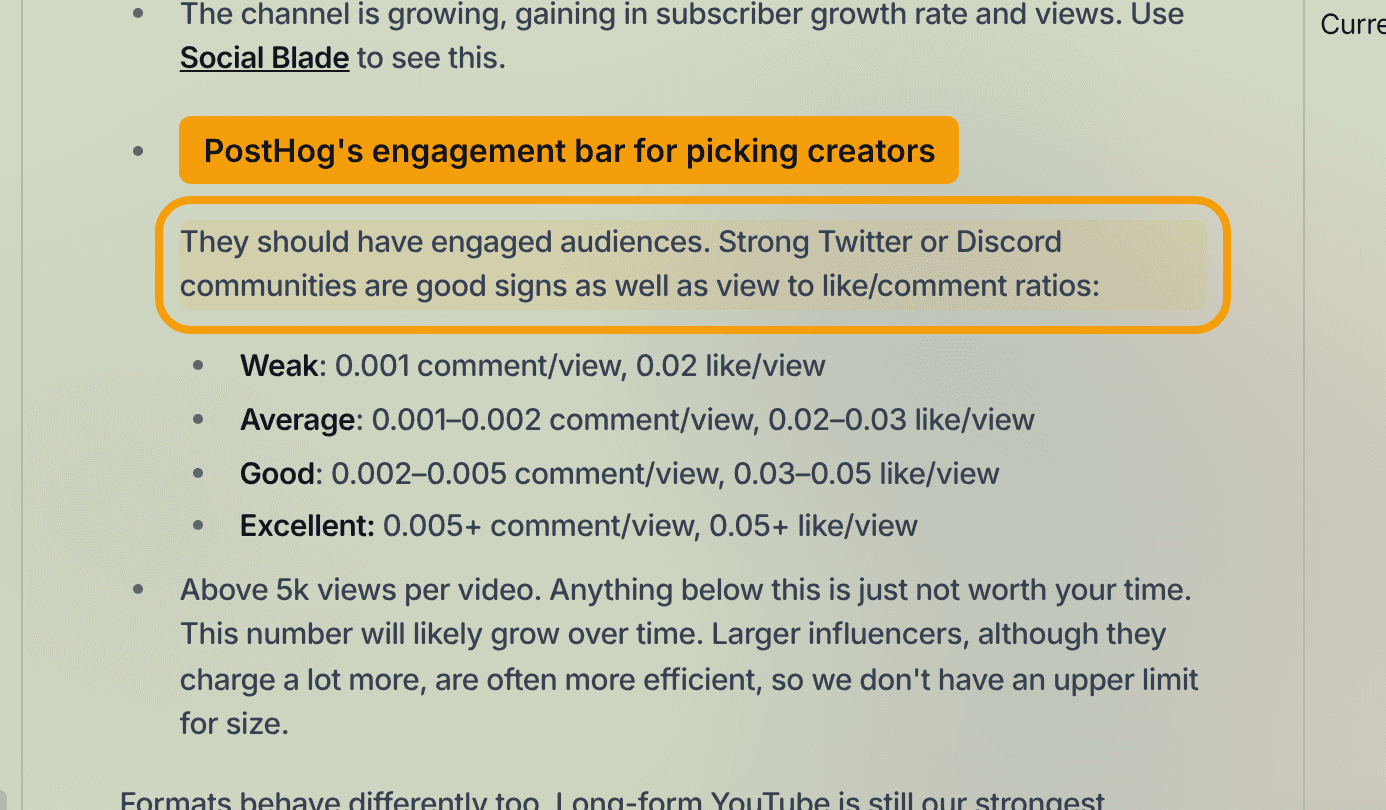
PostHog publishes the exact ratios it screens on, which is rare enough to borrow outright.
Ask your own engineers too. Neill Gernon, CEO of Plug Dev, notes that devtool CEOs and dev teams usually already know one or two creators they trust, and that list is often the best starting shortlist. For smaller budgets, our breakdown of micro influencer marketing for B2B covers why smaller audiences can convert better.
Why integration videos convert better than dedicated sponsored videos
A dedicated video is all about your product. An integration video is the creator building something they would build anyway, with your tool doing one job inside it.
Clerk tested both. Its first three long-form Clerk-only videos drew "paying people to praise it" reactions and did not move metrics, so it switched to creators building whole apps with Clerk as the auth layer.
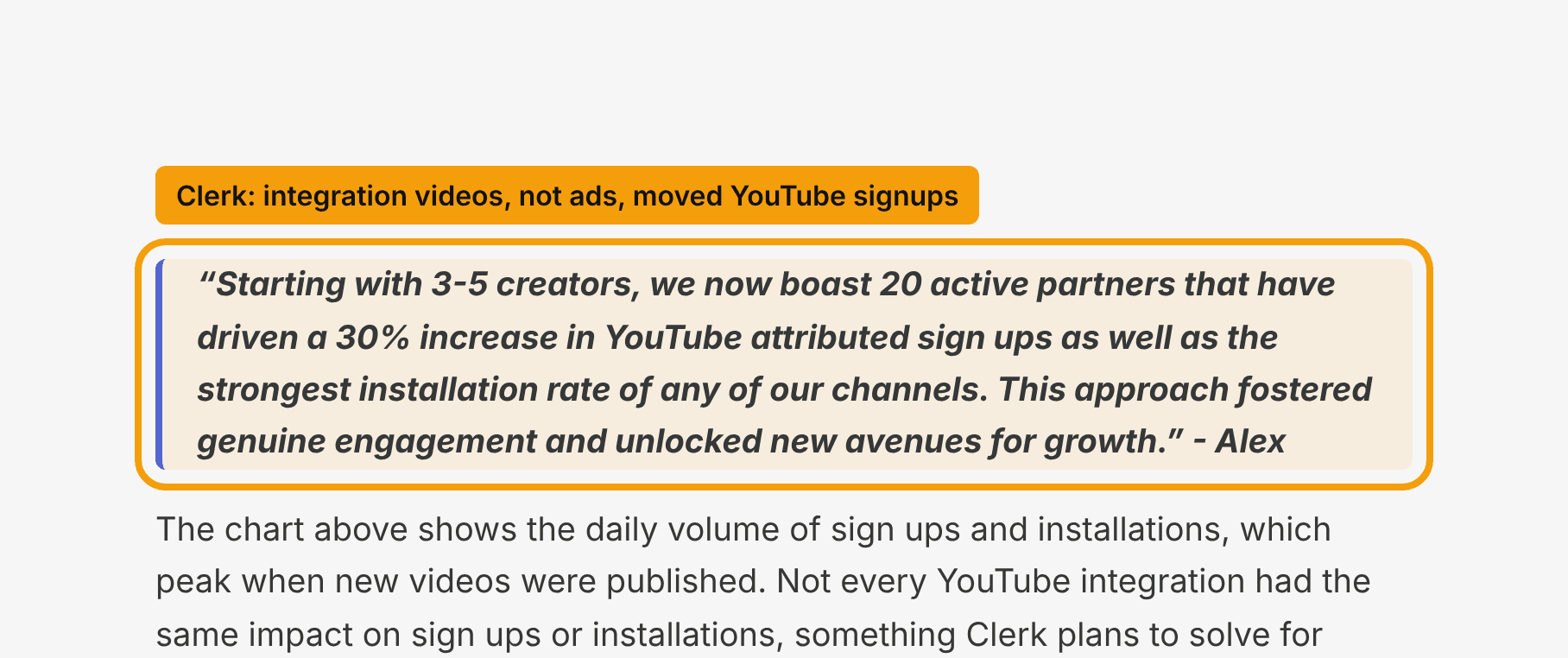
Clerk's result after switching from dedicated videos to integrations: 20 partners and a 30% lift in YouTube-attributed signups.
How to brief for integrations:
- Give the creator the problem your tool solves and two or three facts that must be right. Leave the script to them, since they know their audience better than you do.
- Be specific in the facts. PostHog tells creators to skip vague labels like "an analytics platform" and to lead with its free tier and setup time.
- Keep your positioning stable across creators. Jason Lengstorf makes the point on Scaling DevTools that developers only adopt a tool once they have a clear, consistent picture of where it fits in their workflow.
There is one case for dedicated videos. If your product is new to YouTube search, a few dedicated videos from smaller creators, aimed at the problem statements people search for, can give you a base of findable content. Treat that as search groundwork and measure it on views over time.
Our YouTube creator marketing for developer tools service is built around integration briefs and the engineering support creators need to build with your product.
How PostHog runs its creator program in-house
PostHog is the clearest public example of a devtool running creators without handing the whole thing to an ad agency. It writes the program down in its public handbook, staffs it with its own people, and treats creators as long-term partners.
It started by trying to build its own audience. PostHog ran a YouTube channel from late 2022 to mid-2023, and even a video that hit 3,000 views in a week made no noticeable dent in signups.
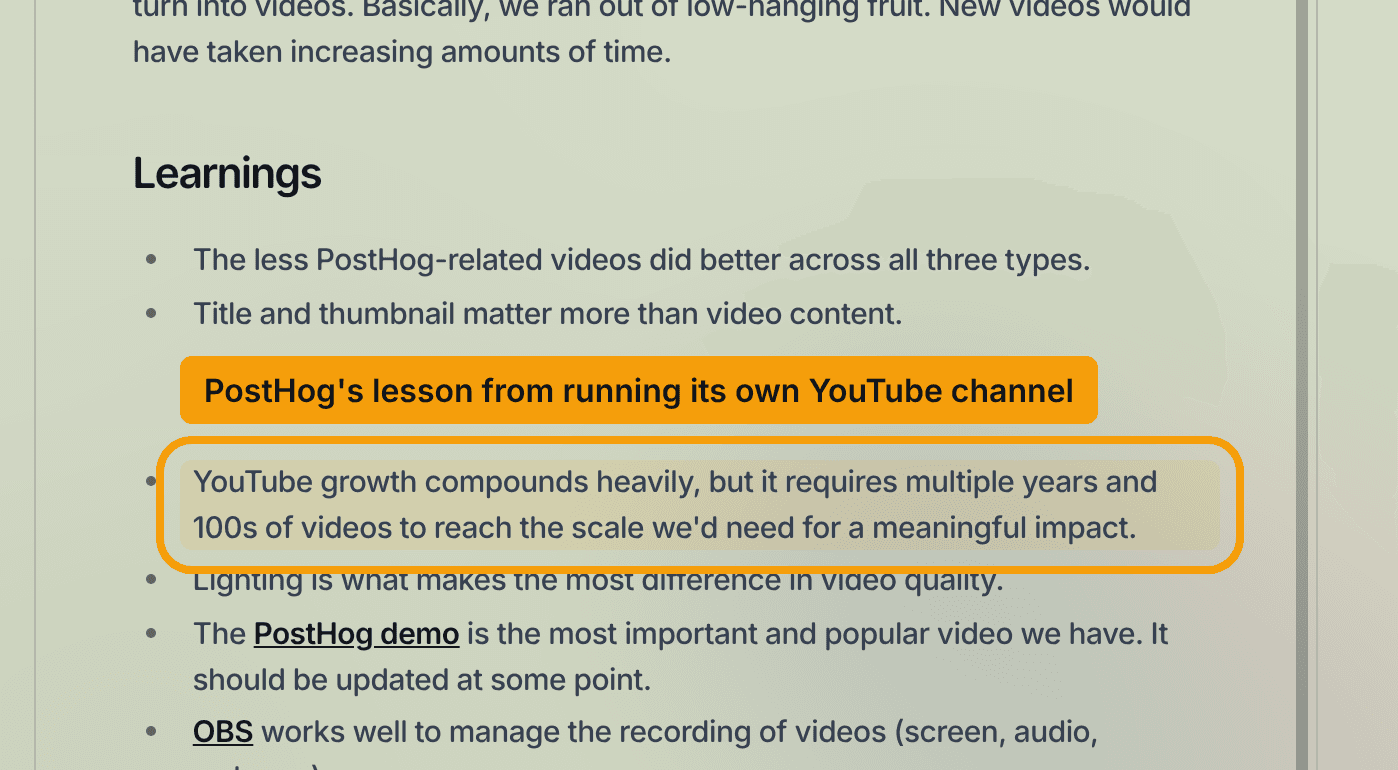
The lesson that pushed PostHog from building an audience to borrowing one.
So PostHog switched to established creators. The marketing handbook names Theo and Fireship among the creators it sponsors, and its sponsorship page calls influencers the main focus of its commercial spend.
What the program looks like from the outside:
- A dedicated owner. PostHog hired a full-time Influencer Wrangler at $100K to $190K to own YouTube, X and TikTok creators plus podcast and newsletter slots.
- Repeat partners. A third-party tracker logs 50 sponsored videos across 22 creators, about 2.3 videos per creator, so most creators get booked again.
- Written selection rules. Engagement ratios, a 5,000-view floor, channel growth checked on Social Blade, and a preference for creators who already use PostHog.
- Simple, strict tracking. The link sits in the top three lines of the description, each creator gets a vanity URL such as posthog.com/theo with utm_source set to the creator, and new users are asked to mention the creator at signup.
- Honest value accounting. Alongside CPM and signups, PostHog counts what it cannot attribute: new audiences, reusable clips and the strength of the relationship.
- Launch coordination. Product marketers flag launches about a month ahead and supply messaging, demo access and a technical contact.
What other devtool teams can take from this:
- Write your creator rules down before you scale, so a new hire or agency can apply them the same way.
- Budget for repeat bookings from the start. The second video with a good creator usually does more than the first video with a new one.
- Give one person ownership. Creator programs stall when content, DevRel and growth each own a piece of them.
How to run your first 90-day programming influencer campaign
Short tests kill good creators. Neill Gernon recommends a three-month first campaign with enough budget for a real sample, and puts the floor for a YouTube campaign at about $30K because large creators use up budget fast.
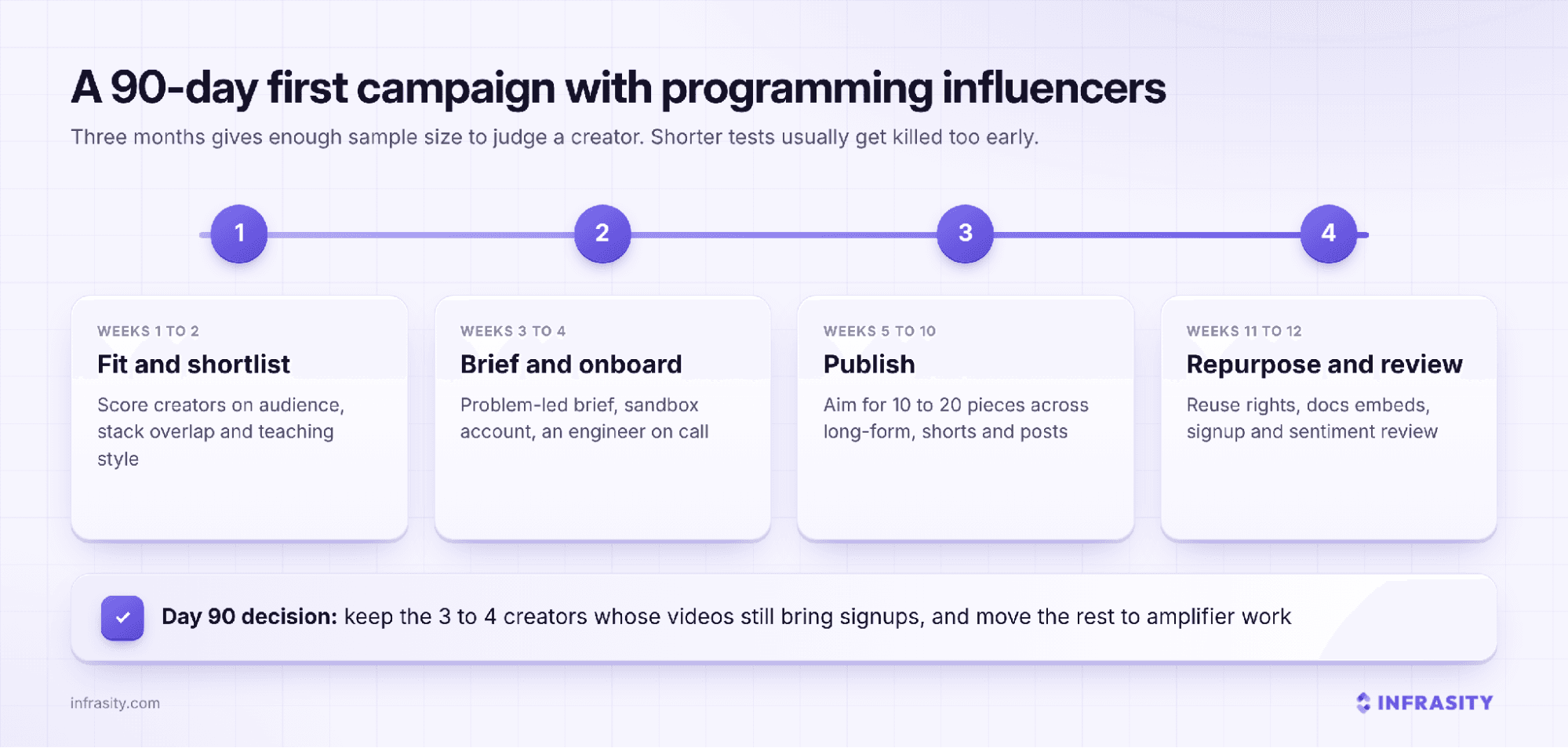
Three months is the minimum that gives enough sample size to judge a creator fairly.
Weeks 1 to 2: fit and shortlist. Score 15 to 25 creators on the six checks above and pick 3 to 5 to test.
Weeks 3 to 4: brief and onboard.
- Write a problem-led brief and give each creator a sandbox account, credits, and an engineer they can message.
- Put usage rights, exclusivity and kill fees in the contract before signing, since adding reuse rights later costs more.
Weeks 5 to 10: publish. Aim for 10 to 20 pieces across long-form videos, shorts, and posts. Ask creators who also run a newsletter, Discord, or X account to cross-post.
Weeks 11 to 12: repurpose and review. Cut clips for paid placements, embed the best video in your docs, and review signups next to qualitative signals before you rebook.
On budget, start where your data is. A small founder on Indie Hackers reported 130 signups from a single $500 video, after pitching 40 creators to land one. That is a ceiling worth knowing, and the 40 pitches it took are the effort to plan for.
Who should own the influencer campaign depends on your team. DevRel is usually best placed to brief creators and support builds, while growth or marketing owns budget and measurement. If you have neither, our DevRel as a service team covers the technical support side.
How to measure programming influencer campaigns when UTMs miss most signups
Developer attribution leaks at every step. Ad blockers strip UTMs, developers watch on a phone and sign up on a laptop days later, and PostHog found that only about 10% of signups fill in an optional "where did you hear about us" field.
Stack your signals instead of trusting one:
- Per-creator links. A short link or vanity URL per creator, placed in the top three lines of the description.
- Signup mentions. A required "how did you hear about us" field with creator names in the dropdown.
- Branded search. Watch searches for your product name in the week after each video goes live.
- YouTube search share. Count how many top results for your brand name are creator videos. This keeps working long after the campaign.
- AI answer presence. Creator videos and transcripts get cited in AI answers, which our AEO service tracks for devtool clients.
- Community sentiment. Neill Gernon points out that brands trend, good or bad, in private creator Discords. Ask creators what their audience said.
Judge each creator on 90 days of data rather than a single video. For the full ROI model, see our guide to measuring influencer marketing ROI.
Running inbound and outbound creator programs together
Outbound sponsorships reach audiences you do not have yet. An inbound creator program catches the developers already using your product who happen to have an audience.
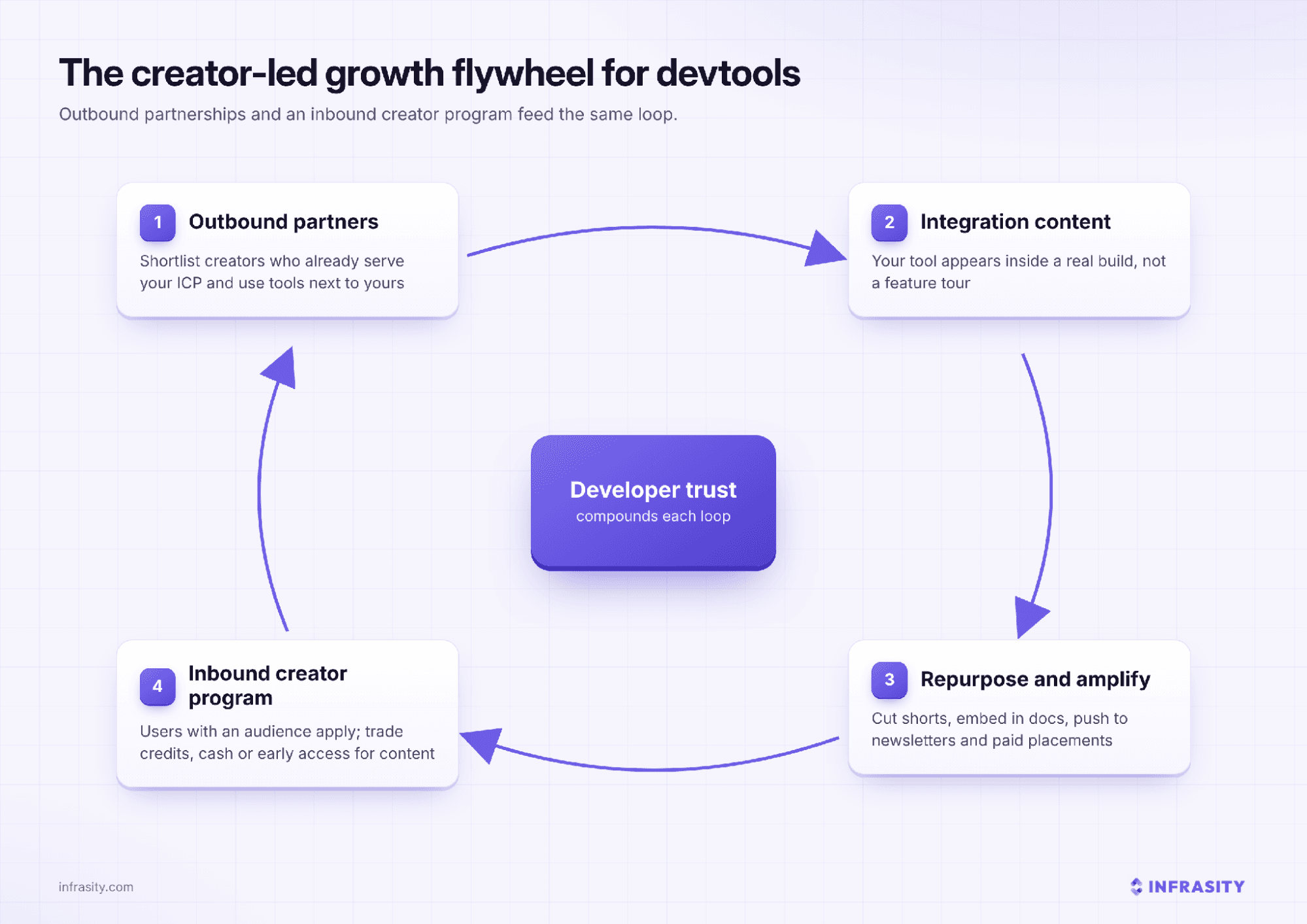
Outbound partnerships and an inbound creator program feed the same loop.
We know a bunch of devtools run both. Clerk moved from outbound YouTube deals to an open creator program that offers creative freedom, performance reports, and free Clerk Pro, and Neon and Snyk run inbound programs next to their outbound creator work.
- Value exchange. Offer credits, cash, early access, merch, or co-marketing in return for content. Match the offer to the creator's size.
- Spot creators in your signups. A user with a YouTube channel or a large X following who signs up is a partner lead. Flag them in your CRM.
- Feed the loop. Inbound creators who perform well move into your outbound strategic partner list, and their videos become docs embeds, ads and newsletter content.
How Infrasity runs programming influencer programs for devtools
Infrasity has worked with some of the largest creators; finding and vetting them can eat up the first month of a program. We built Infrasity Influencer OS to shorten that, so clients can see their program run in one place.
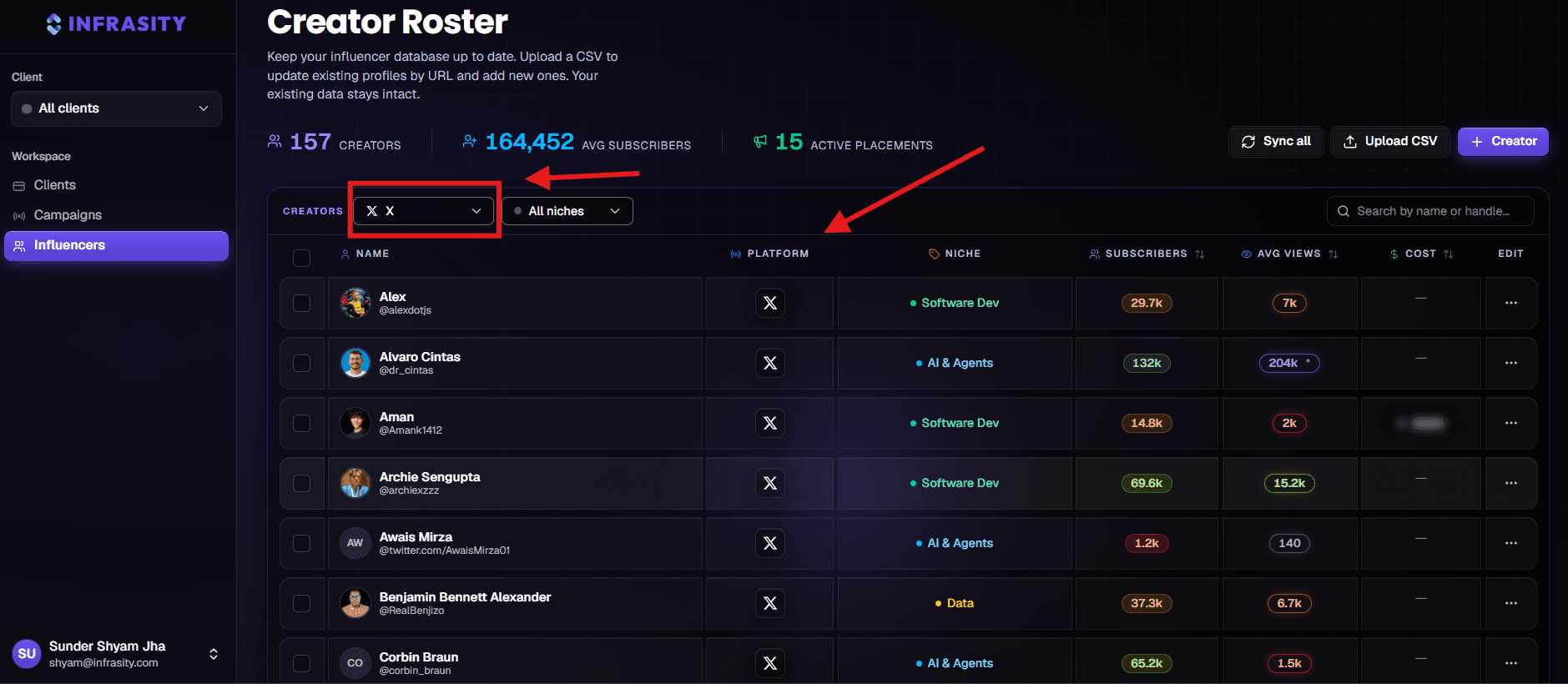
The roster filtered to X creators. The full database spans YouTube, LinkedIn, X, Substack, Discord, Dev.to, Medium, and newsletters.
- Discovery and roster. 737 vetted creators across YouTube, LinkedIn, X, Substack, Discord, Dev.to, Medium, and newsletters, graded on ICP fit.
- Campaign builder and approvals. Briefs, timelines, and drafts in one view, and nothing publishes without your approval.
- Reports. Reach, engagement, and attributed signups per creator and per channel, using a link per placement.
For Rocket, an AI app builder, we ran 90 placements with more than 80 creators across YouTube, X, and Instagram. The largest single placement brought 12% of total reach, against 85.6% in a competitor program we benchmarked, and 14 of the top 20 YouTube results for "rocket.new" are now creator videos. Repeat creators averaged 1.41x the views of first placements, which matches what PostHog and Clerk found.
If you want a creator shortlist matched to your stack and ICP, talk to our B2B influencer marketing team. We send a shortlist after one call, then scope formats and deliverables around it.
Frequently Asked Questions
What are programming influencers?
Programming influencers are developers and educators who build audiences by teaching, reviewing or building software on YouTube, X, LinkedIn, newsletters and Discord. For devtool brands, the valuable ones are those whose viewers are working engineers who choose tools.
How much does it cost to sponsor a programming YouTuber?
Prices vary widely and track audience quality more than subscriber count. In our rate research, YouTube videos ranged from about $1,100 to $20,000, and a realistic first YouTube campaign usually needs around $30K across several creators.
Should devtool brands pay for dedicated videos or integrations?
Integrations, in most cases. Clerk's dedicated videos did not move signups, while integration videos where creators built full apps lifted YouTube-attributed signups by 30%. Dedicated videos make sense mainly to build search presence for a product YouTube does not know yet.
How do you measure programming influencer ROI?
Use a vanity URL or short link per creator, a required "how did you hear about us" field, and branded search lifts after each video. Review 90 days of results per creator before deciding, since developer signups often come days after the view.
How many programming influencers should a devtool start with?
Start with 3 to 5 creators over a 90-day campaign. Keep the 3 or 4 whose videos keep driving signups as strategic partners and move the rest to launch amplification.