
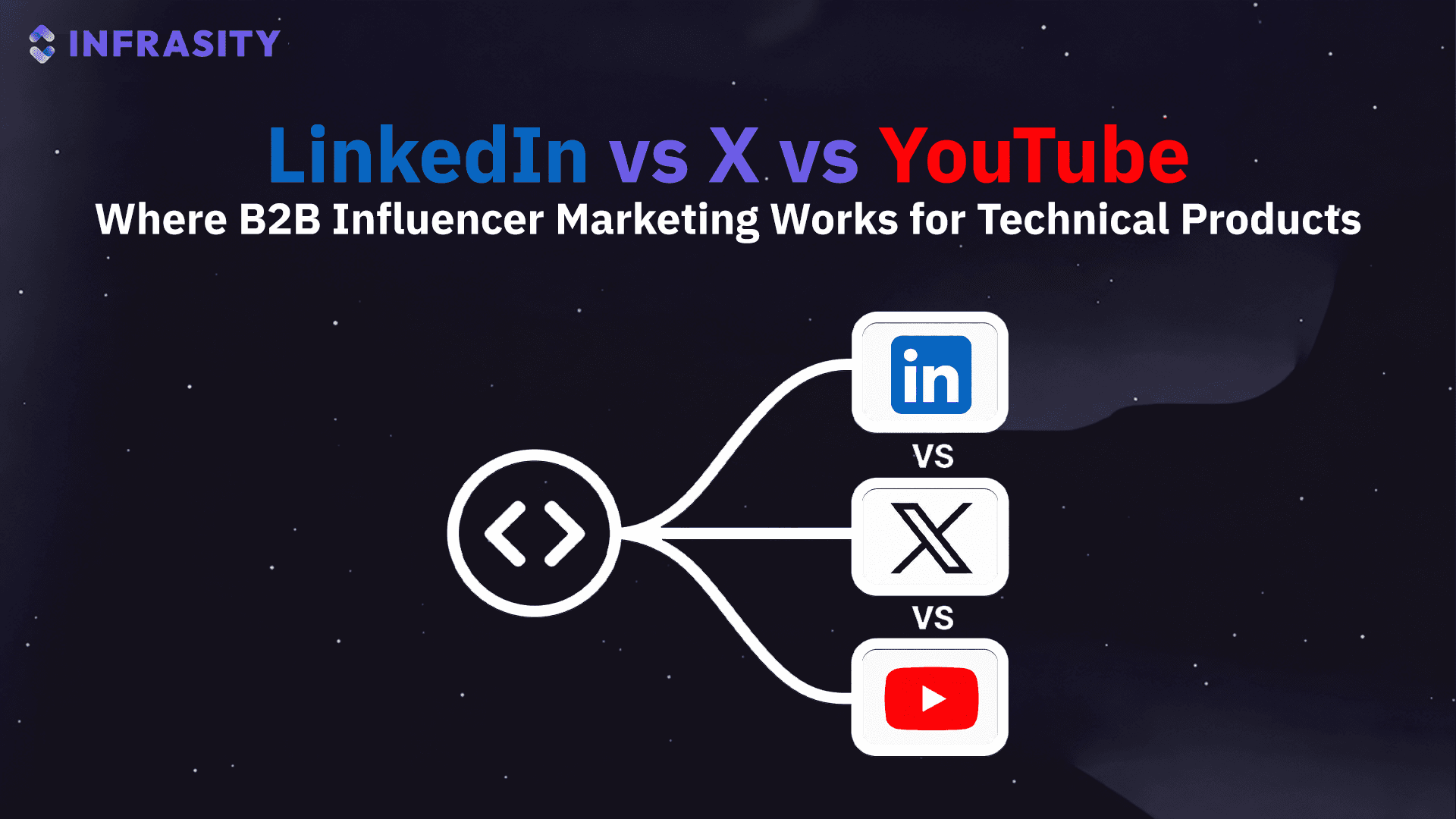
If you're picking one platform for a B2B creator campaign around a technical product, pick by the job. X wins launch-week attention from developers, LinkedIn wins the trust of the people who sign, and YouTube wins the long tail of search and AI answers. The difference in lifespan alone is large: a YouTube video takes about 10.6 days to collect half of its engagement, while an X post does it in 52 minutes, according to Scott Graffius's 2026 half-life data. That's roughly a 290x gap, and it explains most of what follows.
Below, we walk through what each platform does inside a B2B influencer marketing plan, why devtools need a different setup than general SaaS, real campaigns with numbers, a scenario-by-scenario pick, and the 90-day sequence we'd run for a launch.
TL;DR
- Use X when developers need to hear about something this week: a launch, an open-source release, a new feature. An X post collects half its engagement in about 52 minutes, so it's built for bursts.
- Use LinkedIn when the people who approve the purchase need to trust you. It's where engineering managers, CTOs, and procurement read, and small practitioner creators (15K to 40K followers) tend to beat big names there.
- Use YouTube when the goal is proof that keeps working: tutorials, build-alongs and comparisons that rank in search, get cited by AI assistants, and keep sending trial users for months.
- One number worth knowing: YouTube is the most-cited domain in Google's AI Overviews at 29.5% and the top domain in Google's AI Mode, yet it accounts for just 0.2% of ChatGPT's citations.
- For most funded devtools, run them in order: record YouTube proof in the six weeks before launch, fire the X threads inside a 48 to 72-hour window, then carry the signups and benchmarks to buyers on LinkedIn over the quarter that follows.
What job does each platform do in a B2B creator campaign?
Each platform rewards a different kind of content and holds attention for a different length of time. Once you see the lifespan gap, the choice gets much simpler.
X is a launch amplifier
X moves fast and rewards timing. Developers, founders and open-source maintainers still use it to find new tools, and a good creator thread can put a product in front of thousands of engineers in an afternoon. Cole Stark, CMO at Pieces, described X in a developer marketing webinar as the place where "people discover new products," and then "they might recall it later when they see it on YouTube." In other words, X starts the memory. It rarely finishes the sale.
LinkedIn is where the devtool buying group reads
LinkedIn posts live for about a workday, which is long enough for a manager, an architect and a CTO to see the same creator post before Friday. Carl McCarthy, founder of the influencer agency Yard Live, said in the same webinar that the idea that developers aren't on LinkedIn is a cliché: "they are, especially when you're going up higher up the food chain." For a devtool, that's the part of the org chart that owns budget.
YouTube is one of the biggest search engines and also ranks on search engines
YouTube behaves like a search engine. A tutorial published today can still bring in trial users a year later, because people search for how to do something and the video ranks. McCarthy put it something like this: YouTube "is head and shoulders above everything else" for evergreen content, and "if you do catch lightning in a bottle it can make your quarter."
Our take: treat these as three separate jobs. Most failed creator campaigns we see picked a platform that couldn't do the job they needed done.
Why do devtool creator campaigns need a different plan than other B2B SaaS?
A devtool has two audiences with different habits: the developer who tries the product and the leaders who approve it. General SaaS campaigns can often speak to one buyer persona. With a devtool, you have to win both, usually on different platforms.
Developers want to see the product working
Developers are more likely to trust a creator who builds something with the tool on screen than one who reads a script about it. That's why a 30-second sponsor read on a dev YouTube channel often underperforms. Stark's advice in the webinar was direct: if a YouTuber offers "a 30 second pre-roll for $10,000, run away." McCarthy's version: "if you want an ad, buy an ad."
Video is a normal way for developers to learn. In the Stack Overflow 2025 Developer Survey, 50% of developers said they'd learned to code in the past year through videos outside a formal course, and the figure was 55.2% among 18 to 24-year-olds. Technical documentation still led at 67.8%. Our takeaway is that the creator videos that work for devtools look a lot like documentation with a person in it: a real task, real code, and the result on screen.
The approval chain sits mostly on LinkedIn
The developer who loves your CLI rarely signs the contract. An engineering manager owns the rollout, a CTO signs off on the risk, and security and finance approve the spend. Each of those people reads different platforms.
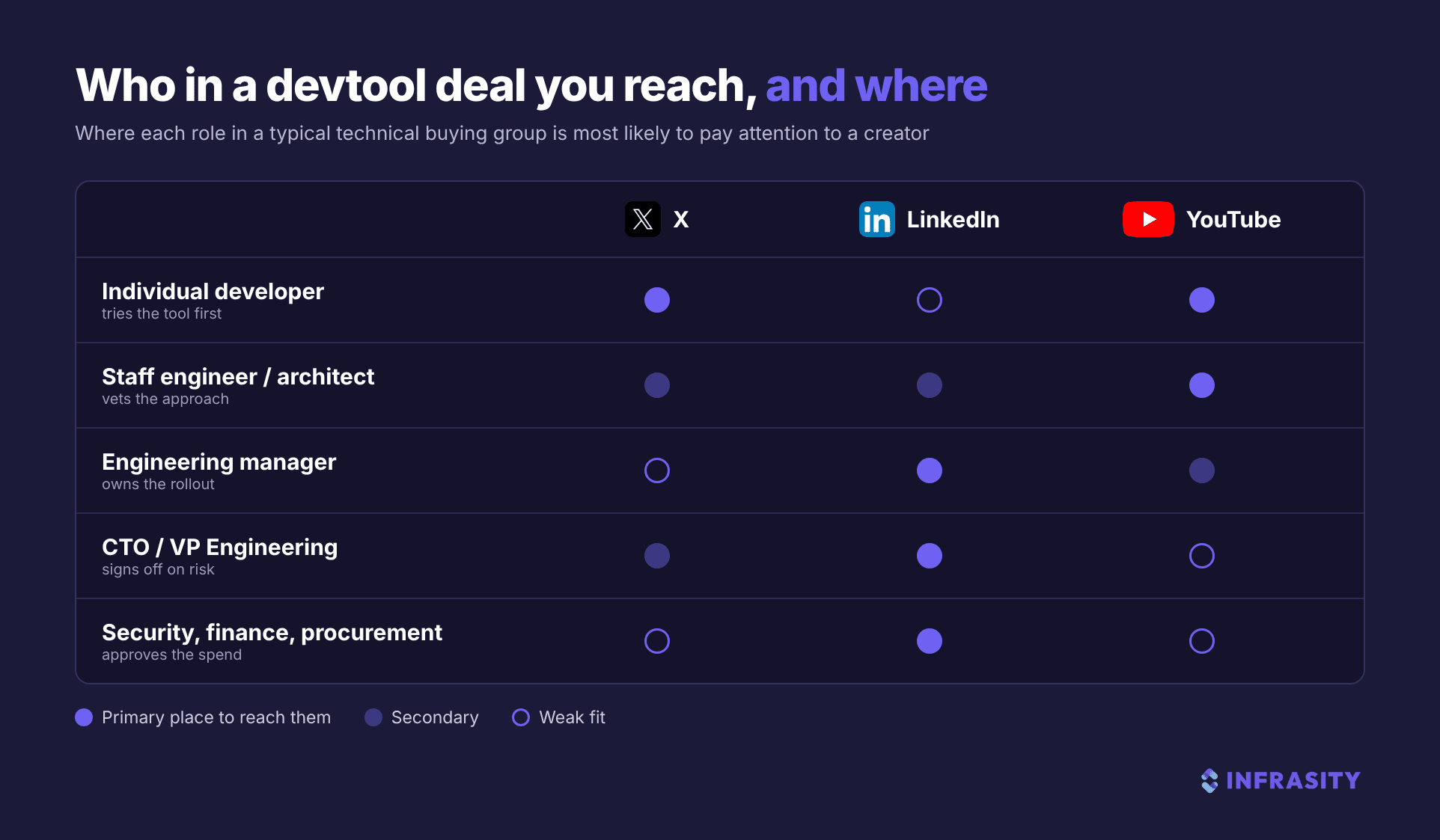
Developers sit on X and YouTube; the people who approve the spend sit on LinkedIn.
This is the main reason a devtool shouldn't copy a generic B2B influencer playbook. A LinkedIn-only campaign can win the CTO's attention while the developers who'd champion the tool never hear of it. An X-only campaign can earn 2,000 GitHub stars and zero pipeline. We cover how to set up developer-facing distribution in more detail in our guide to developer marketing.
The proof has to survive technical scrutiny
A developer audience will check the claims. If a creator says the tool cuts build time in half, someone in the replies will ask for the benchmark. That pushes devtool campaigns toward formats with room for detail (long-form video, threads with code, posts with screenshots of real output) and toward creators who have shipped software themselves.
What does B2B influencer marketing look like in 2026?
Budgets are moving toward creators, and the money is coming out of paid ads. Here's what the most recent data says about where B2B influencer marketing stands now.
- Average annual influencer budgets grew 171% year over year, and 71% of organizations increased their investment, according to CreatorIQ's State of Creator Marketing report (1,723 brands, agencies and creators). Nearly two-thirds of the new spend came from traditional paid and digital channels.
- In a LinkedIn survey of more than 1,700 tech buyers, 67% said they engage with influencer content during the consideration stage, as reported by BuzzInContent.
- Vendors are 20x more likely to be chosen when the whole buying group knows them rather than only the technical champion, per LinkedIn research covered by PPC Land.
- Adoption is still early. Walsh estimates that only about 3% of B2B companies that could run creator programs are doing it today.
That buying-group number is the one we'd underline for devtools. It says winning the developer champion alone leaves most of the deal unconvinced, which is the strongest argument against a single-platform creator plan.
When is X the right platform for a technical creator campaign?
X is the right call when timing matters more than lifespan: a product launch, an open-source release, a funding announcement or a new feature developers have asked for. It's the wrong call when you need a buyer to remember you three months from now.
Small, specific creators beat big accounts on X
The B2B creators who move numbers on X are usually founders, staff engineers and indie hackers with small audiences. An agency founder who runs X launch campaigns said in this breakdown of B2B creator campaigns on X that the most valuable people he sees "have like between 5 and 10,000 followers," and that a B2B launch might need only "10, maybe 15 of these creators" where a consumer brand on TikTok would need hundreds. One of his campaign posts reached 440,000 impressions at a cost of about $6 per acquired user.
X works best as a coordinated burst
Because X posts fade within an hour, spacing creator posts across a month wastes most of them. Line them up inside a 48 to 72-hour window, point every thread at the same proof (a demo video, a repo, a live playground), and have your team ready in the replies. We've written a phased plan for this in our guide to launching a developer tool on X.
Some of the fastest-growing developer products of the past two years grew mostly through developers talking in public. Cursor passed $200M ARR without spending "a single dollar on marketing," according to Bloomberg, as reported by MarketScale with growth credited to developer word of mouth.
Lovable crossed $100M ARR eight months after launch, per TechCrunch, and its CEO shares product and revenue updates openly on X. Neither company credits X alone, and we wouldn't either. What these cases show is that X is where developer word of mouth becomes visible, and a creator campaign there works best when it adds fuel to a product people already want to talk about.
Keep the reach in perspective. Only 10% of US adults use X daily, compared with 84% who use YouTube at all, according to Pew Research's 2025 social media study. X's value for devtools is the concentration of builders, founders and early adopters, so pick creators for who follows them.
Watch the link penalty
For years, X marketers put links in the replies because link posts seemed to get less reach. In July 2026, X's head of product Nikita Bier said "you do not need to put the links in replies anymore," and Elon Musk said the platform hadn't penalized links "for over a year," as PPC Land reported. We'd still ask creators to post the demo clip natively and test the link both ways, because a native video is what stops the scroll whether or not a link is attached.
When is LinkedIn the right platform for a technical creator campaign?
LinkedIn is the right call when the goal is pipeline: demo requests, enterprise trials, or getting a tool approved by a team that's already curious about it. It's also the platform where small creators produce the most predictable results.
The Vector test: $12,000 in, $1.1 million in pipeline
Vector, a B2B platform, spent $12,000 testing LinkedIn creators (seven creators, one post each per month for three months), and the test generated $1.1 million in pipeline, as described in this breakdown of eight B2B influencer campaigns. The creators were small: their average follower count was around 13,000, but they had high trust with a specific audience. That's the pattern we see most often on LinkedIn. A niche audience that matches the buyer is worth more than reach.
Follower count tells you little on LinkedIn
David Walsh, founder of the B2B creator marketplace Limelight, said on the Executive Brand podcast that "follower count is meaningless on LinkedIn for the most part." His team reviewed 30,000 LinkedIn profiles over three months to find roughly 3,500 to 4,000 creators worth working with. His recommended setup is about 20 creators with 15,000 to 40,000 followers each, posting consistently, at roughly $500 to $1,000 per post.
Creator video that looks native beats polished ads
On LinkedIn, a polished commercial gets recognized as an ad and skipped. The founder of a B2B video agency made this point in a talk on LinkedIn video ads, using CrowdStrike as the example: the company works with its own creator ambassador who posts vertical videos about IT security, so a decision maker scrolling the feed sees a person talking, not a brand. He also noted that LinkedIn posts get indexed by search engines, which X posts generally don't.
LinkedIn is also putting real money into video. Video views on the platform rose 36% year over year and the number of LinkedIn creators has nearly doubled since 2021, according to Reuters, via The Star. Favikon's 2026 analysis of LinkedIn creator campaigns found that Storylane's comedy shorts were about 30% of its sponsored posts but drove about 66% of the engagement, and that Synthesia runs 85 to 90% of its creator activations on LinkedIn.
Thought Leader Ads can stretch the budget, in some accounts
Thought Leader Ads let you put paid spend behind a creator's or employee's post. In a benchmark of 2,828 ads across 211 companies, ZenABM found a median cost per landing-page click of $3.06 for Thought Leader Ads against $13.23 for single-image ads. The same article cites an analysis by Philip Ilic where Thought Leader Ads were cheaper in only 34 of 173 accounts. Our view: boost the creator posts that already performed organically, and compare the cost against your own image ads before scaling.
Expect a slow build
LinkedIn isn't a launch-day channel. Sam Dunning, who runs a SaaS SEO agency, said on Michelle J. Raymond's B2B podcast that his LinkedIn ads showed little for three or four months, and then "halfway through month four the inbound demos just started flowing." Budget for a quarter before judging a LinkedIn program.
When is YouTube the right platform for a technical creator campaign?
YouTube is the right call when the product needs to be shown, not described, and when you want the content to keep working long after the campaign ends. For most devtools, that makes it the anchor of the plan.
YouTube videos keep getting found
A YouTube video's half-life is about 10.6 days, against 23 hours for LinkedIn and under an hour for X. And that only counts engagement. Search traffic continues long after, because people look for tutorials when they have the problem. Hootsuite and Wix both ask YouTube creators to target specific high-intent keywords, according to the campaign breakdown, which turns a sponsored video into a ranking asset.
YouTube feeds AI answers
YouTube is the most-cited domain in Google's AI Overviews, with a 29.5% citation share, and it's also #1 in Google's AI Mode at 16.6%, according to BrightEdge's analysis of AI search citations. In Perplexity it ranks fifth at 9.7%. In ChatGPT it's 0.2%.
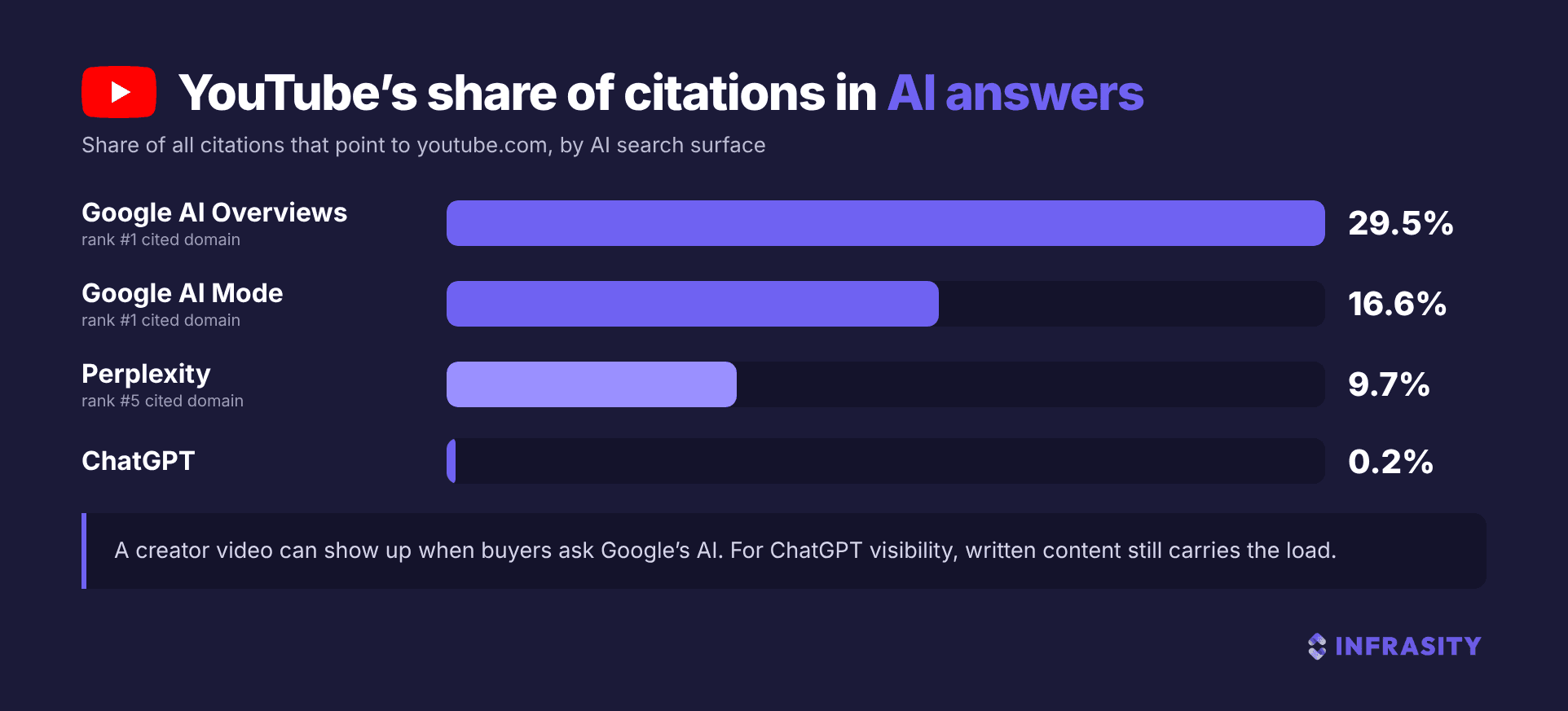
A creator video can surface when a buyer asks Google's AI. For ChatGPT, the written version still does the work.
This changes how we'd brief a YouTube creator.
A video titled and structured around the question a buyer asks ("how to add auth to a Next.js app", "Postgres vs DynamoDB for an event store") has a real chance of being pulled into Google's AI answer for that question. For ChatGPT, the same video does little on its own, so pair it with a written version on your blog or docs.
Dunning also mentioned on the podcast that embedding a relevant YouTube video in a page "seems to be a bit of a cheat code for visibility." If AI visibility is part of the goal, our GEO and AI search optimization work covers that written side.
Devtool companies that share their playbook lean on YouTube
PostHog's public handbook says "long-form YouTube is still our strongest acquisition channel", with short-form used mostly for awareness. The team screens for creators averaging more than 5,000 views per video, tracks each one with a personal redirect link (posthog.com/theo, for example), and notes that "the best creators are usually users first." Clerk's growth team described a similar approach in a post on how it picks YouTube partners: it searches YouTube for creators who already mention Clerk, pays a flat fee or a CPM-based rate, and doesn't dictate the content.
Pay for integrations over sponsor reads
The best devtool sponsorships on YouTube put the product inside the build. A 20-minute "build a SaaS with X" video where the creator uses your auth, database or API for real is more likely to drive signups than a sponsor slot at minute two. It also gives the video a reason to rank for your category terms.
How do the three platforms compare for B2B creator campaigns?
Here's how the three platforms stack up on the factors that usually decide the budget. Numbers come from the sources cited above; the rest is our judgment from running creator programs for technical products.
| Factor | X | YouTube | |
|---|---|---|---|
| Best job | Launch burst, community buzz | Pipeline, buyer trust | Proof, search, AI citations |
| Post half-life | 52 minutes | 23.2 hours | 10.6 days |
| Creator sweet spot | 5K to 20K followers | 15K to 40K followers | Niche dev channels, 10K to 300K subs |
| Typical cost signal | $250 to $500+ per post | $500 to $1,000 per post | Higher per video, longer payback |
| Primary reader | Developers, founders | Managers, CTOs, budget owners | Developers, architects |
| Shows up in search or AI answers | Rarely | Sometimes | Often |
| Time to judge results | Days | One quarter | One to two quarters |
| Main KPI | Signups, stars, CPA | Demo requests, pipeline influenced | Activation, views over time, citations |
Which platform should you pick for your situation?
At this point you probably want a straight answer for the thing you're doing next quarter. Here are the scenarios we see most often.
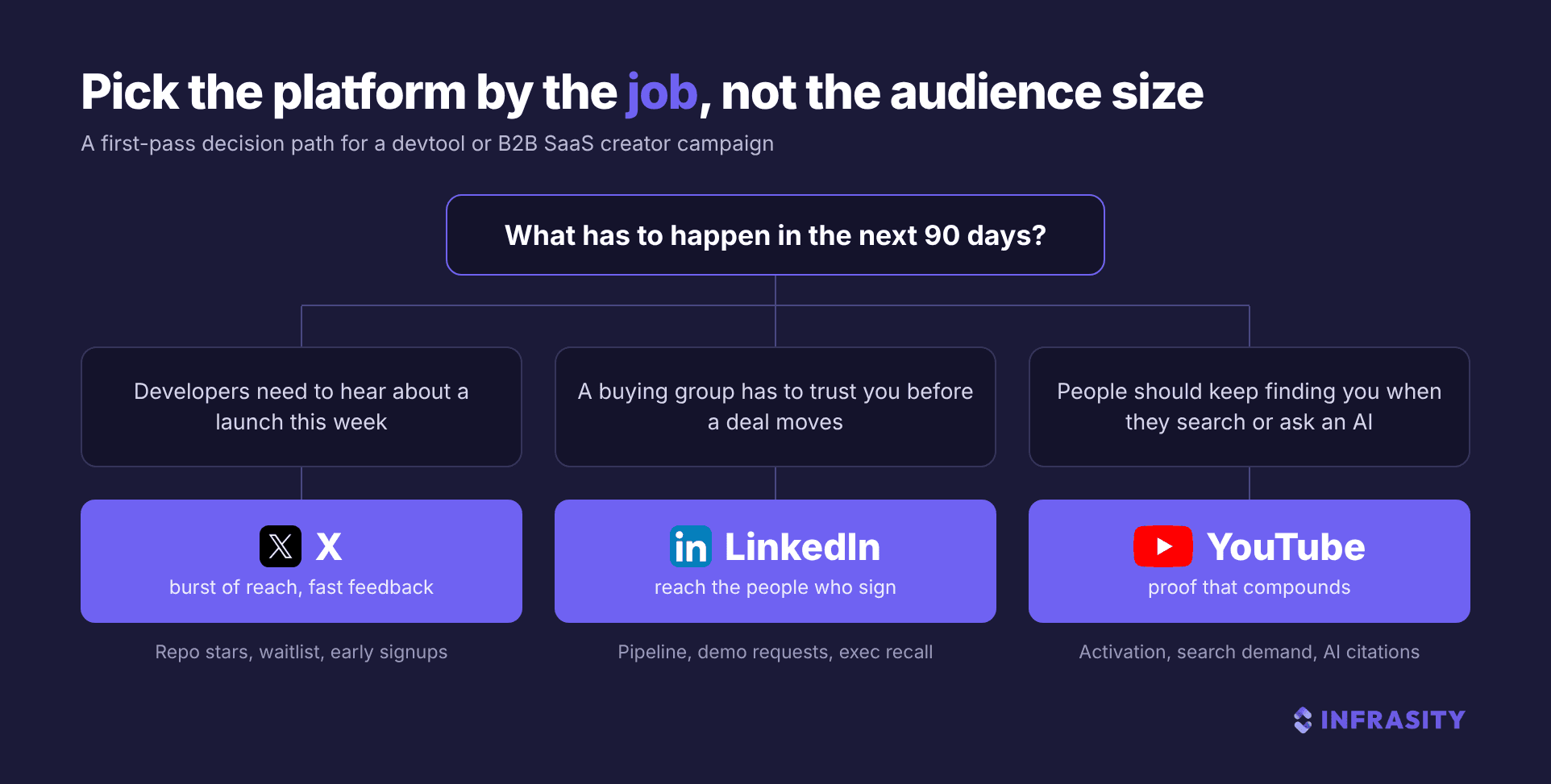
Start from what has to happen in the next 90 days, and the platform usually picks itself.
You're launching an open-source project or a free tier
Start on X, with YouTube support. Open-source launches live or die on the first 72 hours of attention, and X is where maintainers and early adopters watch. Have at least one creator video ready so the threads can point to a real demo.
You're a Series A devtool selling to platform or DevOps teams
Lead with LinkedIn, backed by YouTube. Platform teams buy after a manager and an architect agree. Use practitioner creators on LinkedIn to reach the managers, and a deep YouTube walkthrough the architect can check.
You're an AI coding or agent tool with a self-serve plan
Put YouTube and X first, together. These products sell on visible results, and developers want to see the agent work before they install it. Build-along videos drive activation, and X threads with short clips drive the first wave.
You sell security or infrastructure to enterprises
LinkedIn should carry most of the budget. Security buyers want a credible person explaining risk in plain words, and the purchase passes through people who don't read X. YouTube helps later, for the engineers who'll do the rollout.
You're an API-first product
Start on YouTube. API products need to show the first call and the first useful result. A tutorial that ranks for "how to [do the job] with an API" can keep sending developers for a long time, and AI assistants cite those videos when people ask how to do the task.
You're creating a new category
Run all three, in sequence. A new category needs explanation (YouTube), attention (X), and executive buy-in (LinkedIn). Skipping any one leaves a gap someone else fills.
How should you sequence a creator campaign across all three platforms?
For a funded devtool launch, we'd rarely put the full budget on one platform. Each platform does its job better when the others feed it, so the order matters more than the split.
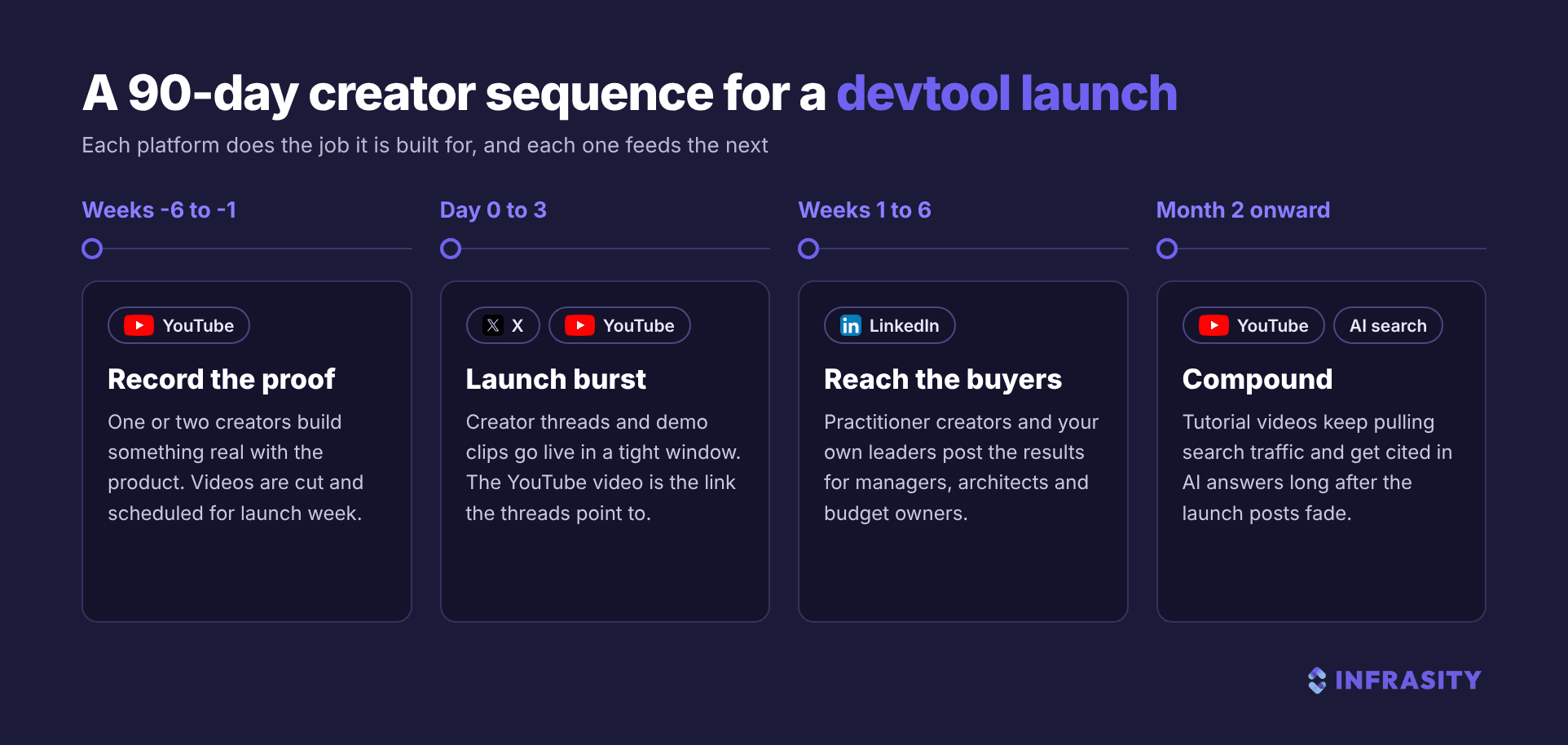
Each platform does the job it is built for, and each one feeds the next.
The order follows from the lifespan data. YouTube proof gets recorded first, because it takes the longest to make and every other post needs something real to point at. X carries launch week, because that's when attention is cheap and timing matters. LinkedIn takes over once there are results to talk about (signups, a customer quote, a benchmark), because those are what a CTO or a procurement lead responds to. Then YouTube keeps working in search and AI answers after the launch posts are gone.
If you need help briefing creators for each stage, our guide on how to brief creators for a developer product launch covers the brief we use.
How do you measure a B2B creator campaign on each platform?
Each platform needs its own success measure. Judging a LinkedIn program on launch-week signups, or a YouTube video on first-week views, leads teams to cut the channel that was working.
- On X, track cost per signup, repo stars, waitlist adds and replies from your target accounts within 72 hours of the burst. Use a unique link or code per creator.
- On LinkedIn, track demo requests, self-reported attribution ("where did you hear about us?"), and pipeline influenced over a quarter. Walsh's suggestion is to put paid spend behind the creator posts that performed best organically, so results become trackable.
- On YouTube, track views at 30, 90 and 180 days, trial signups from the description link, and whether the video shows up when people ask AI assistants about your category. Our list of GEO metrics to track AI search visibility covers how to measure the last one.
A practical rule we use: give X a week, LinkedIn a quarter, and YouTube two quarters before calling a result.
What mistakes do teams make when choosing between these platforms?
The same few mistakes come up again and again in technical creator programs. Most of them come from treating all three platforms as one channel.
- Picking creators by follower count. On every platform here, the evidence above points to small creators with a matching audience doing better per dollar.
- Buying a sponsor read instead of an integration. Developers skip ads, and a read gives the video no reason to rank.
- Spreading X posts across a month. X attention fades within an hour, so scattered posts never build momentum.
- Judging LinkedIn too early. Dunning's demos started in month four.
- Running a launch with no YouTube asset. Without a video, the X threads have nothing to show, and nothing is left working once the posts fade.
- Writing the script for the creator. Walsh said that in his experience, "nine times out of 10 there's no red lines, no edits done" to creator drafts, because good creators already know what lands with their audience.
Here is how Infrasity can help you
If you want a team to plan and run this across all three platforms, Infrasity's B2B influencer marketing agency shortlists technical creators on X, LinkedIn, and YouTube, briefs them around real product use, and reports results by platform. For the YouTube side, we also produce technical video content with our in-house engineers.
Frequently Asked Questions
Is LinkedIn or X better for B2B influencer marketing?
LinkedIn is better when the goal is pipeline and the buyer is a manager, CTO or budget owner. X is better for launch-week reach with developers and founders. Many devtool teams use X for the launch and LinkedIn for the following quarter.
Do developers use LinkedIn?
Yes, and senior engineers, managers, and CTOs use it more than junior developers. Treat LinkedIn as the place to reach the people who approve a devtool, and X or YouTube as the place to reach the people who try it first.
How much does a B2B creator post cost on each platform?
Practitioners report roughly $500 to $1,000 per LinkedIn post for creators with 15K to 30K followers, and $250 to $500 or more for a post from a small B2B creator on X. YouTube integrations cost more per video but keep driving views and signups for months, so compare them on cost per signup over six months.
Why is YouTube good for AI search visibility?
YouTube videos are indexed by Google and are frequently cited in AI answers, so a tutorial can surface when someone asks an assistant how to do a task. Text posts on X rarely surface this way, and LinkedIn posts do only sometimes.
How many creators do you need for a devtool launch?
You usually need fewer than people expect. On X, 10 to 15 well-matched creators can carry a B2B launch. On LinkedIn, around 20 practitioner creators posting over a quarter is a common setup. On YouTube, one or two strong build-along videos are often enough to anchor the campaign.
Should a devtool startup with a small budget pick one platform?
Yes, in most cases. If the product needs to be seen working, start with one YouTube integration and reuse clips on X. If the sale depends on managers and executives, start with three to five LinkedIn practitioner creators.