
Pick creators by the lead time their format needs, then by how well their audience matches the problem your product solves. Follower count comes third, and it's a weak signal. Across 28 YouTube placements in one devtool campaign we measured, subscriber count explained only 29% of the variation in views a placement delivered. The other 71% came from fit, format and topic.
That gap is the whole argument. A launch has a fixed date and no second attempt, so the creator who needs six weeks to build something real has to be chosen in a different week from the one who posts a reaction on launch morning.
Below, we cover what to screen for, how many creators a launch needs, what each one costs, when to lock them, and the point at which you pull one.
TL;DR
- Lead time decides the order you pick in. Builders get chosen 8 to 6 weeks out, explainers at 5 to 4 weeks, amplifiers inside the last fortnight.
- In our Rocket campaign, subscriber count explained 29% of view variation, and price had almost no relationship to audience size at all.
- Spreading the roster is risk management. One campaign we benchmarked put 85.6% of its views in a single video, which means one creator's bad week was the whole launch.
- Budget on a one-in-seven conversion from contact to published post, so 15 live placements start from a longlist near 100.
- Developer creators cost more than consumer rate cards suggest. Of 52 quotes we hold, only 12% sit under $500, and sixteen creators in the same subscriber band quoted between $420 and $30,000.
- For developer tools, screen on whether the creator can read your docs, hit an error, and recover on camera. Reach tells you much less.
What counts as a micro influencer when you're launching?
If you want the tier definitions and the economics behind them, we've covered why smaller technical audiences convert better in B2B separately. This piece assumes you've settled the tier and are now choosing actual people.
Why follower count is the wrong first filter
Everyone says reach is a vanity metric and then builds the shortlist by sorting on followers anyway. Here's what happened when we measured it properly on a campaign of our own.
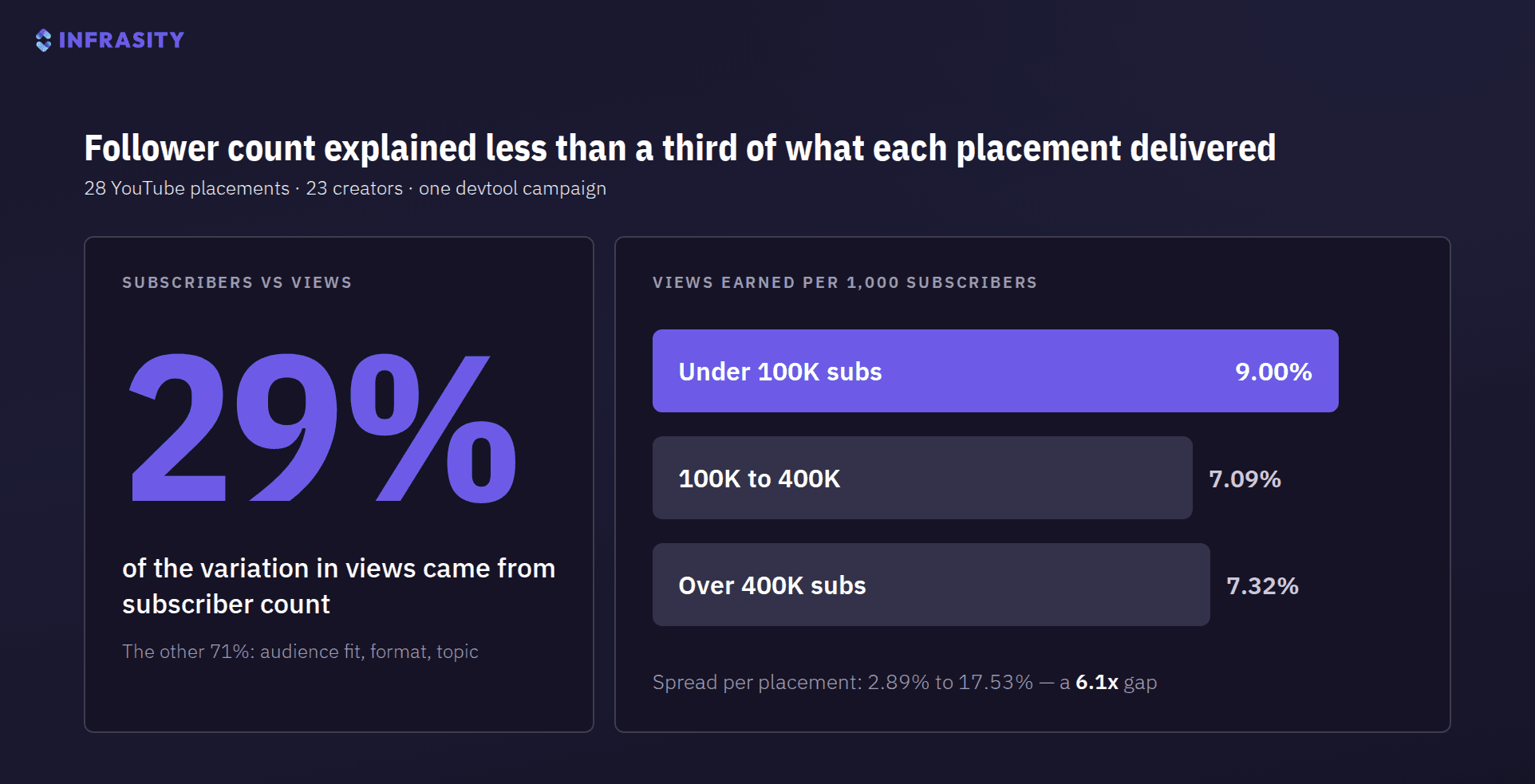
Measured across Infrasity's Rocket creator campaign, 90 placements over 11 months.
Three things fall out of that data, and each one changes a selection decision.
Subscriber count is a weak predictor of views
The correlation between a creator's subscriber count and the views their placement earned came out at r² = 0.288. In simple terms, if you ranked our creator list by subscribers and expected the reach to follow, you'd be wrong about 71% of the time. The creators who over-delivered did so because the video topic sat exactly where their audience already had a question.
Smaller creators returned more views per subscriber
View-through rate, which is views divided by subscribers, ran from 2.89% to 17.53% across the roster. That's a 6.1x spread. Creators under 100,000 subscribers averaged 9.00%, against 7.32% for creators above 400,000. The biggest channel on the list, at 568,000 subscribers, posted the single worst ratio.
Price tracks almost nothing
Cost per 1,000 subscribers ranged from $2.57 to $233.10, and the relationship between asking price and audience size was effectively zero (r² = 0.001). Creators price on confidence, inbound demand, and how much they want to make the video. Two channels of the same size can quote figures an order of magnitude apart, which means negotiating is normal rather than rude. We counter at 65% to 75% of the ask and land most of them.
What actually predicts whether a creator moves your launch
If reach is unreliable, you need signals that aren't. These four are the ones we screen on, in this order, and each one is checkable in a few minutes without a tool.
Does the audience already have the problem?
Read the comments on the creator's three most recent relevant videos, not the video itself. You're looking for people describing the situation your product fixes, in their own words. A creator whose comment section is full of "what theme is this" has an audience that likes watching them. A creator whose comments are full of "how do you handle this at more than ten services" has an audience that buys things.
Has the creator shipped with a tool like yours before?
Past integration work is the single best predictor of whether they'll produce something credible rather than a read-out of your talking points. It also tells you how they handle a product that misbehaves on camera, which yours will.
What does the median view count look like, not the best one?
Pull the last ten relevant videos and take the median. Channels with one breakout video and nine quiet ones are priced on the breakout, and your launch gets one of the nine. Looking at the median is the difference between forecasting and hoping.
Would you show this video to your own engineers?
This is the fastest disqualifier we have. If the people who built the product would be embarrassed by the creator's technical accuracy, your buyers will notice too, and a developer audience is unforgiving about it.
Note what isn't on that list. In published surveys of B2B marketers, engagement rate ties for fourth place among partner-selection criteria, behind professionalism and brand alignment. Our own data says the same thing in a different way: the signals that predicted performance were about topic match, not audience behavior in aggregate.
How many creators does a launch need?
Teams usually ask this as a budget question and get a budget answer. It's a risk question, and the logic is unforgiving if you focus on it.
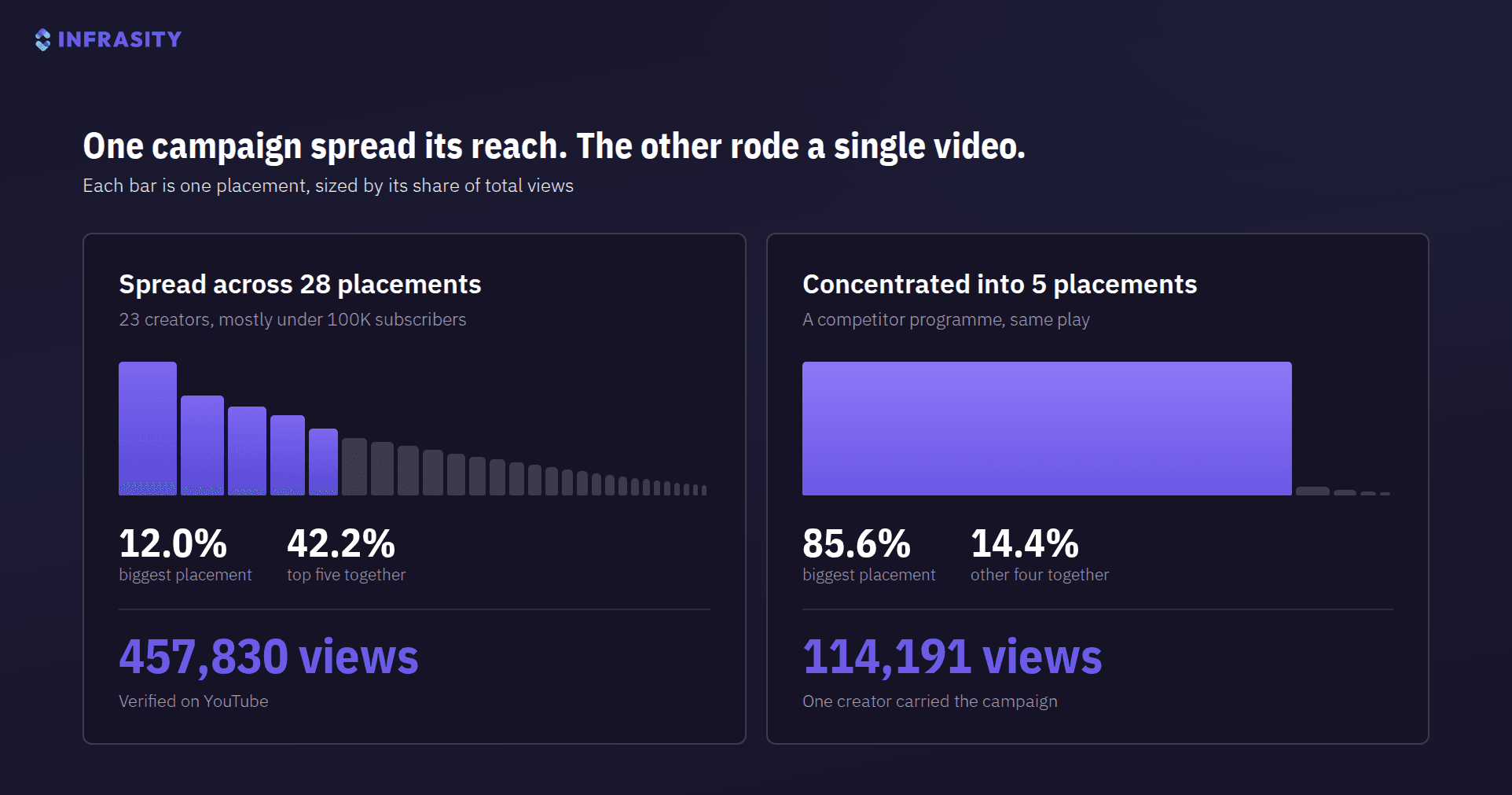
Two creator programs in the same category, both counted from public view data.
Across our Rocket placements, the largest single video carried 12.0% of total views, and the top five carried 42.2%. A competitor program running five placements had one video deliver 85.6% of its views. Both reached people. Only one of them would survive that creator having a bad month, a delayed upload, or an algorithm that decided not to push the video.
Then there's attrition, which almost nobody publishes. The one worked example we found on the whole SERP shows a seller contacting 42 creators, getting 14 replies, 9 acceptances, and 6 published posts. That's a 14% contact-to-post rate, and it matches what we see. Plan on roughly one in seven.
So the real sequence runs backward from the number of placements you want live on launch day. For 15 placements, start from a longlist near 100, expect to have real conversations with about 20, and sign around 20 to 25 to absorb the people who go quiet in week three. Teams that build a list of 20 and sign 15 are counting on a reply rate we've not seen anyone get.
Which creator do you lock, and when?
We have seen one question often left unanswered: a launch runs on a calendar, so which decision happens in which week?
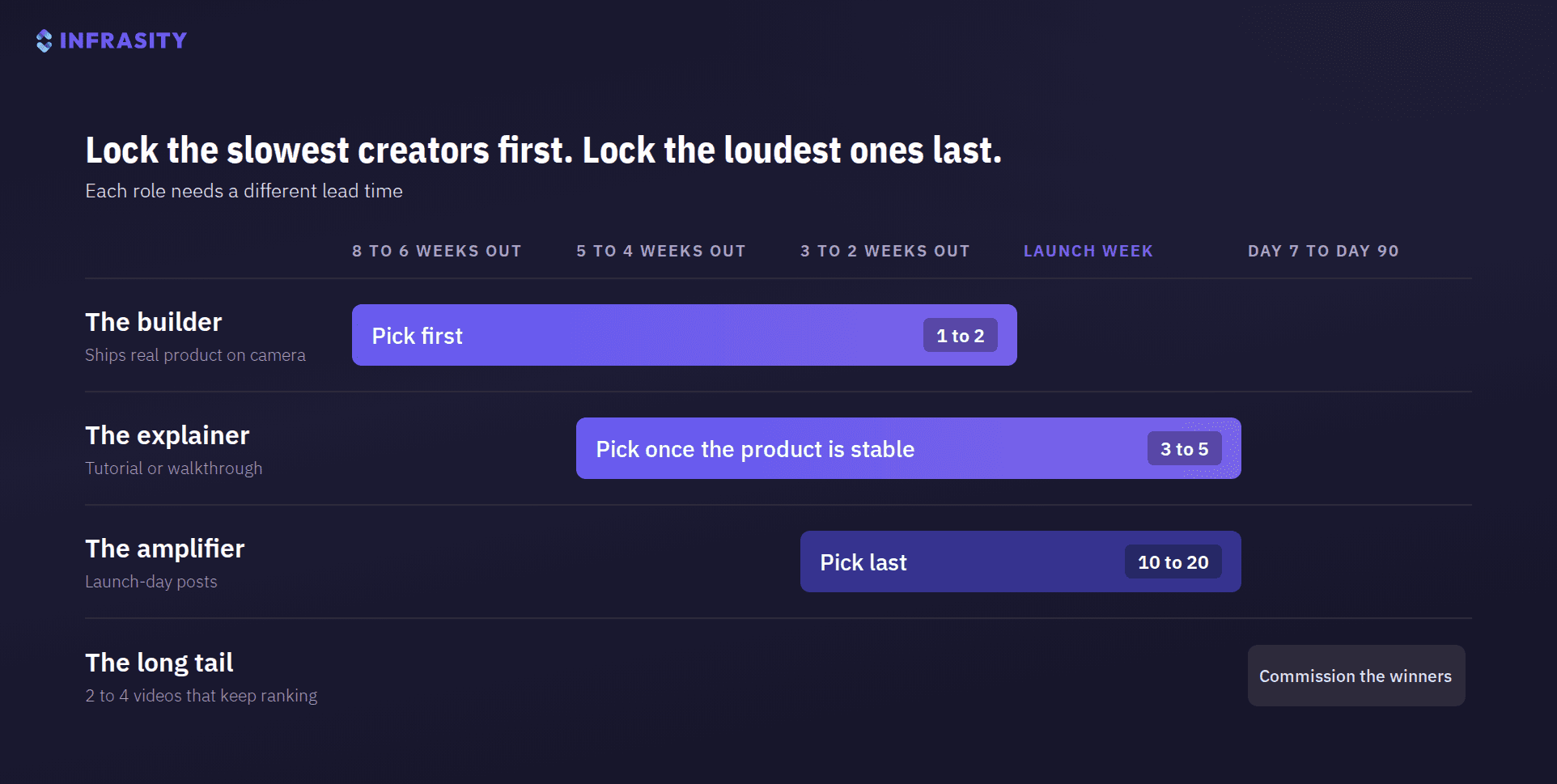
Infrasity's sequencing, with roster sizes derived from a one-in-seven contact-to-post rate.
The ordering principle is lead time, not importance. A creator who's going to build something real with your product needs weeks of calendar before they can film, and they need a product stable enough to build on. If you go to them four weeks out, you've already lost the format. The amplifiers are the reverse case: they're reacting to assets that have to exist first, so choosing them early just gives them longer to forget.
The builder, locked 8 to 6 weeks out
One or two people who'll ship something real on camera. They need the longest runway and the most hand-holding, and they produce the asset everything else points at. Pick these before the product is finished, and accept that they'll find bugs. That's a feature of the arrangement.
The explainer, locked 5 to 4 weeks out
Three to five tutorial or walkthrough creators whose videos answer a question people already type. These carry most of the durable value, since they keep returning traffic long after launch week. In the Stack Overflow Developer Survey 2025, the single most-wanted content format among developers was lists of recommended tools and frameworks at 47.6%, ahead of long-form articles at 40.8% and video at 25%.
The amplifier, locked 3 to 2 weeks out
Ten to twenty creators posting short-form commentary during launch week. Individually small, collectively the thing that makes the launch look like an event rather than an announcement. Brief them late and brief them loosely, because the value here is their own take.
The long tail, commissioned after launch
Two to four follow-up videos bought from whoever performed. This is the cheapest high-confidence spend in the whole program, and almost nobody budgets for it. Repeat creators in our campaign averaged 20,355 views against 14,454 for one-off placements, a 1.41x lift.
If you want the full week-by-week calendar that surrounds these decisions, we've written it up in how to launch a SaaS product with creators.
What changes when you're launching a developer tool
Here's what we'd change for launching a developer tool, and why the consumer playbook breaks.
The product has to survive being used on camera
A beauty product looks the same in every video. A developer tool either installs or it doesn't. The creator will run your quickstart live, hit an error, and either recover or not, and that recovery is the content. So the screening criterion becomes whether the creator debugs well in public, which you can check by watching them hit a problem in any previous video.
This also means your pre-launch work is engineering work. If the first ten minutes of your product don't produce a visible result, no creator can save the launch, and booking twenty of them just distributes the disappointment.
Your buyer is the practitioner, not the budget holder
In the Stack Overflow Developer Survey 2025, 47.4% of developers reported having influenced a technology purchase or endorsed a tool at work, including 19.8% who influenced a major addition to the tech stack. That's from 37,341 responses to that question. Meanwhile, Gartner found 67% of B2B buyers now prefer a rep-free buying experience, up from 61% a year earlier, in a survey of 646 buyers in late 2025.
Put those together, and the creator isn't a megaphone pointed at a decision maker. They're the thing the practitioner finds while deciding on their own, before anyone in your pipeline knows they exist.
Pick the surface where developers already are
The same survey reports the platforms developers use for community: Stack Overflow at 84.2%, public GitHub at 66.9%, YouTube at 60.5%, Reddit at 53.7%. YouTube and Reddit are the two where sponsored creator content is both normal and tolerated, which is why they carry most devtool creator programs. GitHub and Stack Overflow reward presence, not placement, so they belong in a different budget line.
Check who the creator works for
Most credible developer creators have day jobs. A staff engineer with 30,000 subscribers may work at a company that competes with you, sells against you, or has a partnership that makes your deal awkward. This is the conflict that consumer influencer guidance never has to handle, and it's the most common reason we drop someone late.
Free access alone triggers disclosure
Under the FTC's endorsement guides, a material connection includes "monetary payment or the provision of free or discounted products", and it applies whether or not you required a post in return. Early access to a private beta counts. The guides also state that a disclosure hidden behind a "more" link "is not unavoidable", which rules out the below-the-fold caption most creators default to. The advertiser carries liability too, so this belongs in your brief rather than in the creator's conscience.
What should you pay a micro creator for a launch?
These are 52 real quotes, collected from developer, DevOps, and AI creators while sourcing for live client campaigns in October 2026. One quote per creator, for a dedicated video. Client names withheld.
| Subscriber band | Quotes | Lowest | Median | Highest | Median cost per 1,000 subscribers |
|---|---|---|---|---|---|
| Under 10,000 | 4 | $175 | $410 | $650 | $99.11 |
| 10,000 to 50,000 | 16 | $420 | $1,850 | $30,000 | $58.49 |
| 50,000 to 100,000 | 12 | $800 | $6,750 | $12,000 | $82.91 |
| 100,000 to 500,000 | 14 | $800 | $5,300 | $20,000 | $19.26 |
| Over 500,000 | 6 | $1,100 | $5,300 | $25,000 | $6.27 |
Read the medians down the column, and the pricing logic looks orderly. Read the lowest and highest columns across any single row, and it falls apart.
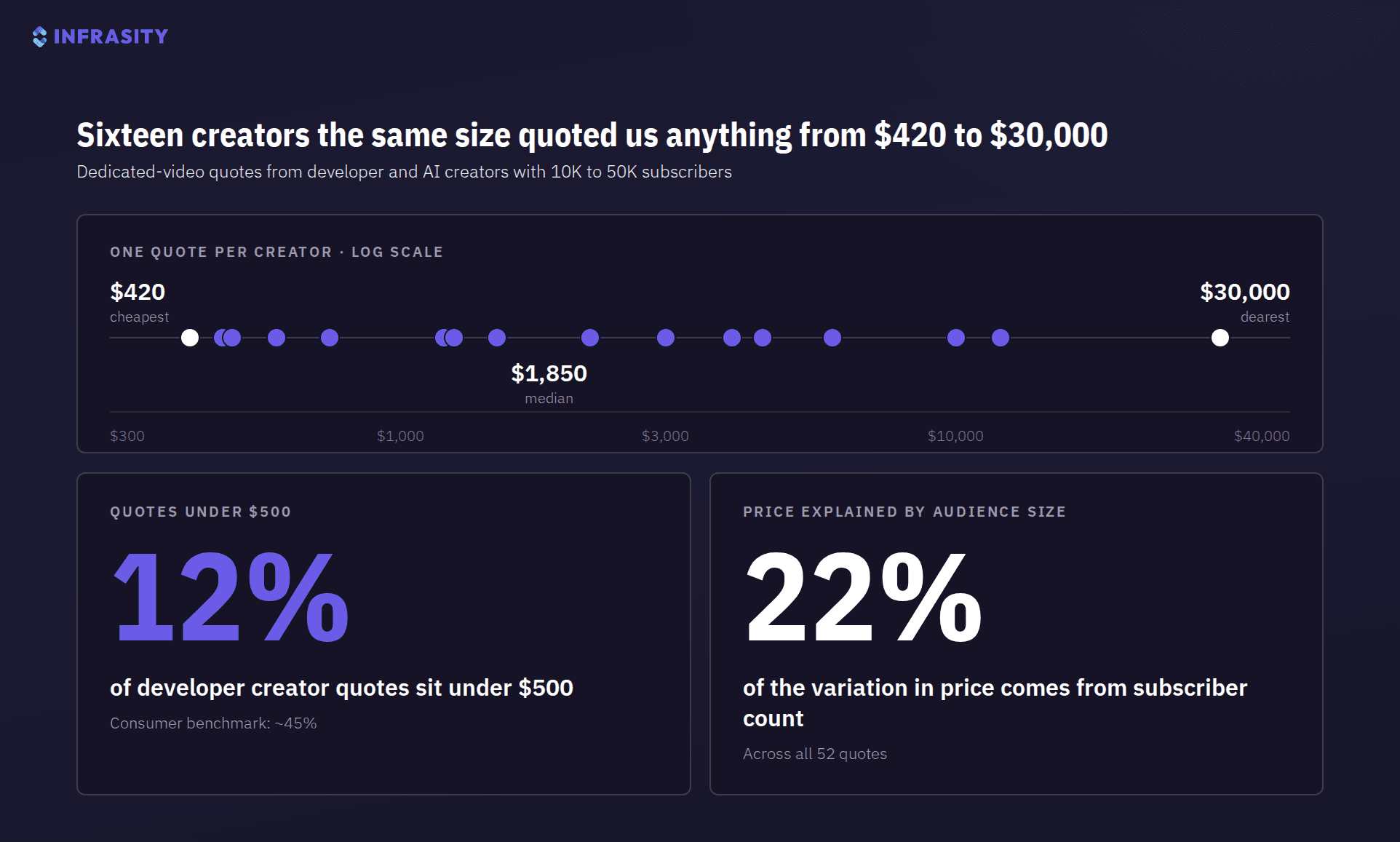
Every dedicated-video quote we hold in one subscriber band, plotted on a log scale.
Three findings worth acting on.
Developer creators are not a cheap channel. Only 12% of our quotes come in under $500. In the published consumer benchmark covering more than 600 marketing professionals, roughly 45% of micro-tier engagements land under that figure. If you budget a devtool launch off a consumer rate card you'll be out by a factor of four.
Audience size barely sets the price. Across all 52 quotes, subscriber count explains 22% of the variation in asking price. That lines up with what we found on the delivery side in the Rocket campaign, where price and audience size were effectively unrelated. Two independent datasets, same conclusion: the number on the invoice is about demand and production effort, not reach.
Everything is negotiable, and creators expect it. Across the deals where we hold both figures, accepted counter-offers landed near two thirds of the original ask. That's a small sample and we won't pretend otherwise, but it matches the 65% to 75% range we use as a default opening position.
One line item teams routinely forget: paid usage rights, which add roughly 30% to 50% on top of the base fee and are what let you run the creator's video as an ad afterwards. For a launch, that's often the highest-return money in the budget, because the asset is already made.
If creator sourcing and rate negotiation is the part you'd rather hand over, Infrasity's B2B influencer marketing team does exactly this for devtool and AI infrastructure launches, from longlist to signed deliverables.
How do you avoid paying for an audience that isn't there?
Fraud screening is the one part of creator selection with good published guidance and bad published numbers. Knowing which is which saves you from budgeting against a statistic that was never measured.
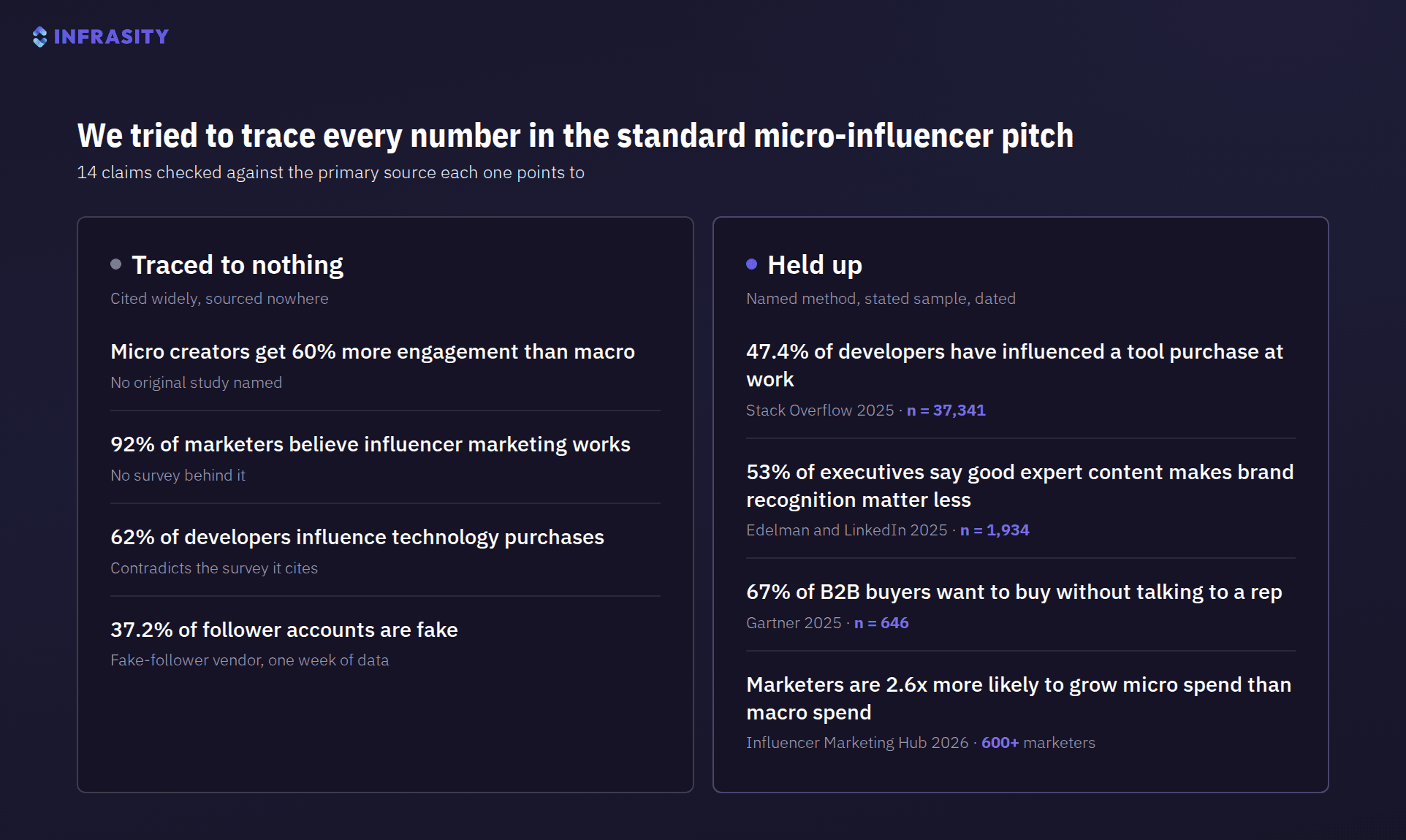
We followed each claim back through every intermediate citation to see where the trail ended.
The most quoted statistic in this entire category, that micro creators earn 60% more engagement than macro creators, traces to no original study. We followed it through four intermediate pages, and it ends at an unattributed infographic. The same goes for "92% of marketers believe influencer marketing is effective," and for the fake-follower prevalence figures, which come from a company selling a fake-follower score and rest on a single week of data.
What does hold up is narrower and more useful. In a May 2026 survey of more than 600 marketing professionals, fake or bot followers were the most-cited quality problem, accounting for 56.5% of all reported fraud issues, and only 7.22% of teams use any AI tooling to detect it. That's a statement about what goes wrong, not about what share of followers are fake, and the difference matters when you're writing a contract.
For screening, the effective checks are unglamorous. Compare median views to follower count and treat anything under about 1% as a stop. Read the comments for template language repeated across unrelated posts. Check whether follower growth has steps in it, since organic growth is lumpy but not vertical. And ask for the creator's own analytics screenshot covering the last 90 days, which separates people who track their work from people who don't.
When should you pull a creator?
The omission is costly, because launch week is the worst possible time to invent a decision rule. Write the threshold down while you're still calm.
The failure case worth internalizing comes from the only published example we could find: a creator with roughly 28,000 followers delivered 8,900 views, 11 clicks, and zero attributed orders. The video wasn't bad. The audience just had no reason to care.
Our rule is three gates, each with a date attached.
- Fourteen days out, no draft and no reply to two messages: Release them and move to a reserve. Creators who go quiet before launch rarely come back on time.
- Launch week, the post lands but the tracked link produces fewer than a handful of clicks in 48 hours: Don't renew, don't commission follow-ups, and spend the long-tail budget elsewhere.
- At any point, the content misstates what the product does: Ask for a correction once. If it doesn't come, the placement is a liability rather than an asset, because the people who notice are the ones you're trying to convince.
What you shouldn't do is judge a tutorial creator on launch-week clicks. Those videos are search assets, and they compound over months, so measuring them on day three is how teams cut the thing that was about to work.
How will you know the picks were right?
Launch-day numbers tell you about the posts. Creator selection shows up later, on a different clock, which is why so many programs get canceled one quarter before they'd have proved themselves.
Measure three things, each over its own window. In the first 48 hours, per-creator tracked link clicks and comment sentiment tell you whether the audience match was real. By day 30, branded search volume and direct sign-ups catch the people who saw the video and came back later. At 90 days, match a "how did you hear about us" open-text field against your creator list, since that's the one mechanism that survives a buying process longer than a cookie window.
Set the window to your sales cycle rather than your reporting cycle. We've written up how to measure creator pipeline over a 90-day window in more detail, including why last-click attribution systematically undercounts creator programs.
How Infrasity picks launch creators
Creator discovery and vetting is the single most outsourced function in influencer marketing, named by 19.44% of teams in the 2026 benchmark survey, and the reason is time rather than skill. Screening 100 channels properly takes a week that most launch teams don't have.
Infrasity runs this end-to-end for devtool and AI infrastructure companies: longlist construction against the queries your buyers type, median-reach screening, conflict checks against the creator's employer, rate negotiation, and per-creator tracking so the wrap report shows which picks worked.
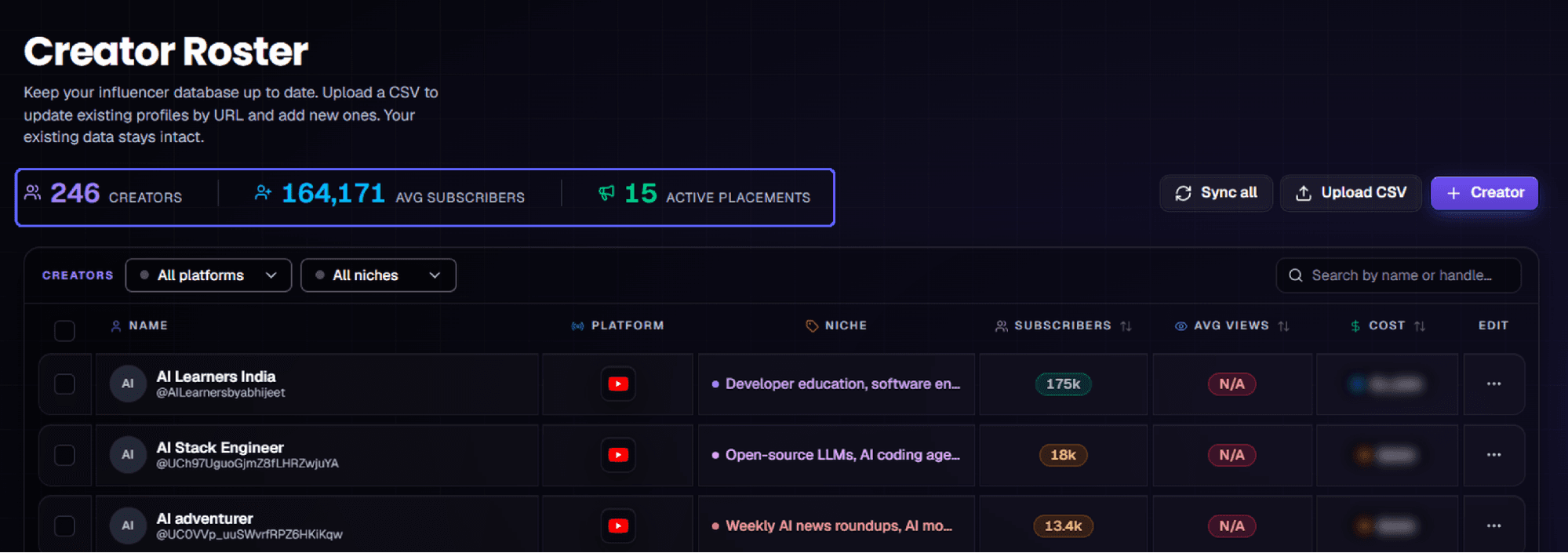
Infrasity's own roster, which is where the 52 quotes in this article come from. Creator rates are hidden here.
The roster runs to thousands of creators across YouTube, Instagram, LinkedIn, and X, tagged by niche so a shortlist starts from the problem rather than from a follower threshold. Every rate in the table above came out of real negotiations on it.
If you'd rather see the output before the pitch, the Rocket creator campaign write-up shows the full placement-by-placement data this article draws on, including the ones that underperformed.
Conclusion
Start with the longlist and the calendar, in that order. Write down your launch date, count backward to find which week each creator role has to be locked, and build a list roughly seven times the size of the roster you want live. Then screen on audience problem match and median reach, and let follower count decide nothing more than which budget bracket someone sits in.
The first step takes an afternoon: pull the ten queries your buyers search for, find who already ranks for them, and read the comments. That list is your longlist, and it's better than anything a discovery tool will hand you. If you'd like someone to run it alongside you, book a call with Infrasity.
Frequently Asked Questions
How many micro influencers do I need for a product launch?
Plan for 15 to 25 live placements for a meaningful launch, built from a longlist of about 100 creators. The contact-to-post rate runs near one in seven, so a shortlist the same size as your target roster will leave you short. Cap any single creator at roughly 15% of expected reach so one quiet video can't sink the week.
Should I pay micro influencers in cash or product access?
Pay cash for anything with a deadline attached. Product access works for building a relationship ahead of a launch, but it buys goodwill rather than a delivery date, and under FTC rules, free access is a material connection that has to be disclosed anyway. Treat free access as the start of a conversation, not as compensation.
What engagement rate should I look for?
Use median views against follower count instead, and treat anything under about 1% as a reason to stop. Engagement rate is easy to inflate, and published benchmarks disagree, partly because platforms calculate it against followers and views inconsistently. Comment quality tells you more in five minutes than any rate does.
How far before launch should I start contacting creators?
Eight weeks for creators who'll build something with your product, four to five weeks for tutorial creators, and two to three weeks for launch-week amplifiers. The constraint is production time, not availability. Starting everyone at once means your builders get rushed and your amplifiers go cold.
Do micro influencers work for B2B and developer tools?
Yes, and the evidence points to technical categories being a better fit than many consumer ones. A 2024 peer-reviewed review of 74 studies found micro influencers have limited pull in luxury but notable influence in technology and other considered, high-priced purchases. The mechanism is that a practitioner recommendation reaches the person evaluating the tool, who in B2B is usually not the person signing.
What's the biggest mistake teams make when picking launch creators?
Sorting the shortlist by follower count and booking the top of the list. In our own campaign data, subscriber count explained only 29% of the variation in views, and price had almost no relationship to audience size. The teams that do well pick on-topic matches and spread the budget across more creators than feels comfortable.