
TL;DR
- Marketing for startups is the work of proving a market exists and winning the first customers on a small budget, so the order of tasks follows milestones rather than revenue bands. One task per stage keeps a two-person team from running every tactic at once.
- A Reddit r/startups thread has commenters suggesting a pre-launch waitlist with a free-trial reward to collect leads and feedback. The same thread suggests direct outreach for a very narrow niche.
- A pre-revenue budget starts from runway and cash flow, because no verified source used here gives a dependable spend percentage. A Stack Overflow answer on startup pitfalls lists assuming that Google AdWords advertising will work.
- An Ask HN commenter, edw519, wrote that founders have more passion for their product than any outsider. Hiring advice in forum threads is opinion, so set the handoff trigger before launch.
- Track funnel and retention metrics from the first customer, one number per step. Developer buyers need technical evidence, so test each channel against replies and demo requests rather than borrowed benchmarks.
Early companies have more marketing tasks than hours, and marketing for startups is where that gap shows first, because every channel competes for the same founder time. A stage-based order with one or two channels gives a small team a way to choose, while a long list of tactics leaves most of them half-run.
This guide defines startup marketing and sets out a stage order, then covers demand validation without an audience, founder-led work before the first hire and how to choose the first channels. It continues with AI answer citations, budgeting before revenue, selling to developer buyers and the funnel metrics to track. One hypothetical seed-stage team building a Kubernetes cost-monitoring tool carries the examples throughout. The guide reviews no tools or agencies and relies only on verified sources, so it names no spend percentages or payback periods where none exist.
What Marketing for Startups Covers Before Any Channel Choice
Marketing for startups is the work of proving that a market exists and winning the first customers before the company has a brand, an audience or a large budget. Its goal is learning: which buyers have the problem, what they will pay for and where they can be reached. Established-company marketing starts from a known customer base and optimizes it, so its goal is growth in pipeline and revenue from channels that already work.
Three terms carry the rest of this guide. Market validation is the process of collecting evidence that real buyers want a product, through conversations, sign-ups or payments. A channel is a repeatable route to reach buyers, such as search, direct outreach, communities or paid ads. A waitlist is a sign-up list that collects interest before launch.
Proof is the second difference. A mature company can point to historical conversion data, while a startup has to produce its first evidence itself. A Stack Overflow answer on startup pitfalls for developers lists this as a common mistake: building a product because the technology is interesting, not because a market exists. Evidence of demand therefore comes before any spend on channels.
This guide follows one hypothetical team. Two founders at a seed-stage company are building an open-source-based Kubernetes cost-monitoring tool for platform engineers, the people who run internal infrastructure for other developers. They have no audience and little budget, so each marketing task they take on has to produce proof that someone wants the tool. For how this buyer group shapes strategy, see developer marketing as strategy.
With these definitions in place, the next step is to put the work in an order that fits the company's stage.
A Stage-Based Order for Startup Marketing Work
Marketing for startups moves through milestones rather than revenue bands, so a stage ends when its task is finished. This plan uses no ARR bands, and each move to the next stage depends on a milestone being met. Founders in a Reddit thread on MVPs disagree on whether a product must exist as an MVP before promotion can work.
The running example is a two-person seed-stage team building an open-source-based Kubernetes cost-monitoring tool for platform engineers. With no audience yet, their first task is a waitlist page. The same thread suggests a pre-launch waitlist with a free-trial reward as a way to collect leads and feedback.
The diagram below pairs each of the four stages, validating demand, winning first customers, finding a repeatable channel and handing off founder-led work, with one marketing task.
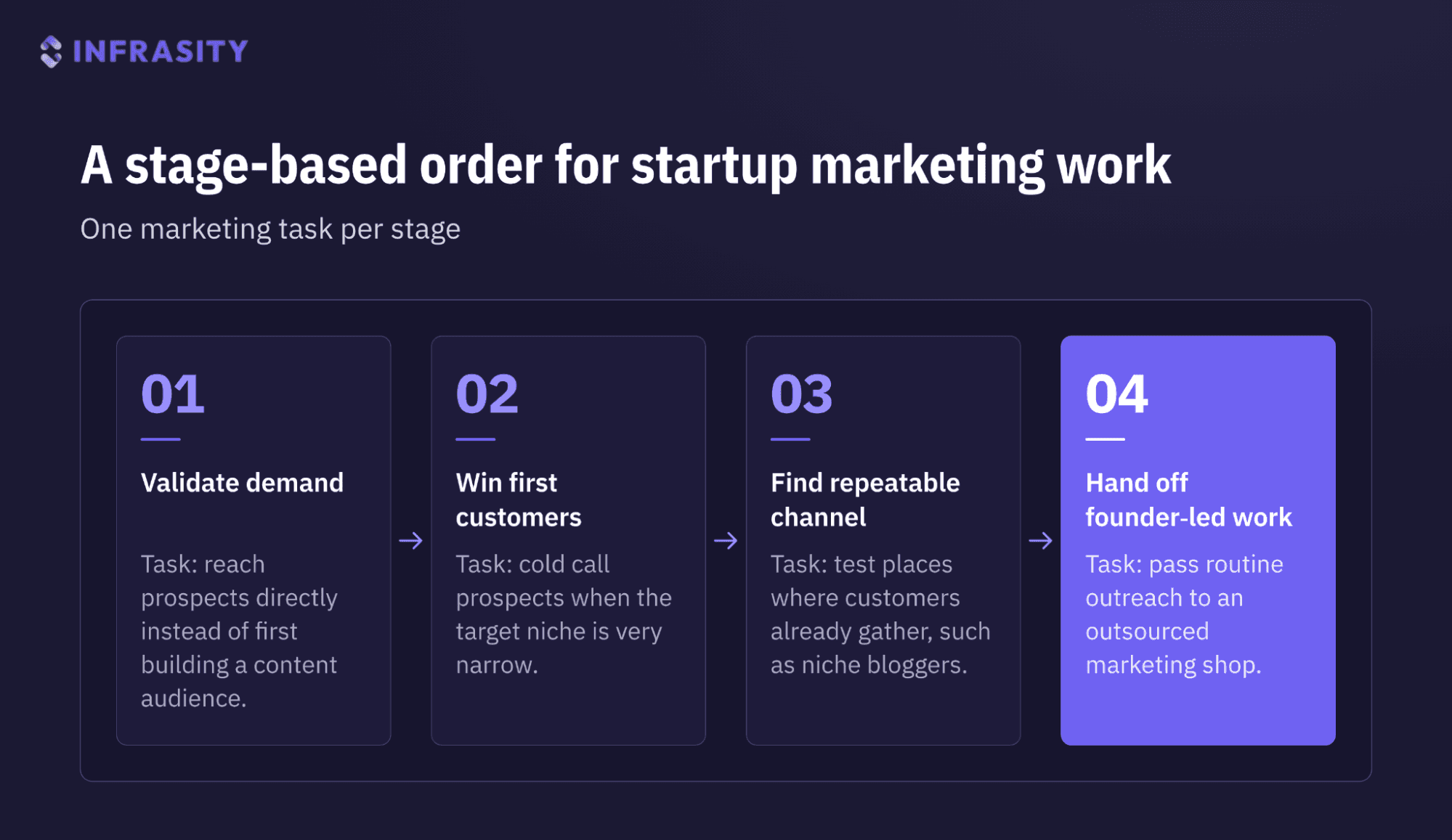
Give each startup stage a single marketing task so a small team does not run every tactic at once.
Each stage carries a single task, which keeps a small team from running every tactic at once. For the wider set of options at each stage, see early-stage SaaS growth levers. The first stage, validating demand with no audience, comes next.
Validating Demand Without an Existing Audience
A Reddit thread in the r/startups community frames the problem directly: the original poster wants to validate demand and find clients without first spending months building a content audience. Commenters in that thread suggest a pre-launch waitlist with a free-trial reward as a way to collect leads and feedback. In the running example, the two-person Kubernetes cost-monitoring team puts up a waitlist that offers a free trial to anyone who signs up.
A waitlist works as a cheap test. Signups show whether the pitch resonates, and the replies show what platform engineers want fixed first.
The same Reddit thread covers narrow markets. One commenter suggests direct outreach over content or online lead capture when the niche is very narrow. Another user, richexplorer_, put it bluntly in that thread: "your niche is so tight just cold call them honestly".
The team has no audience, but it can list platform engineers at companies running Kubernetes and contact them one by one. Direct conversations at that scale cost time rather than money, which suits a team with little budget. For another route to developer audiences, see developer influencer marketing campaigns.
Whether anything must be built before promotion is contested. In that thread, founders disagree on whether a product must exist as an MVP, a minimum viable product, before promotion can work. Commenter scott12333 argued for building first, writing "otherwise people will have a difficult time caring about something in the pipeline."
Takeaway: Treat a waitlist and outreach as tests of interest, and show a working version to the first contacts whenever one exists.
Once those first conversations start, the founders are the ones holding them, which is where founder-led marketing begins.
How Founder-Led Marketing Works Before the First Hire
The two founders in the running example write their launch posts and repository docs themselves. As edw519 wrote in an Ask HN thread, "You have more passion for your product that any outsider." The thread appears below.
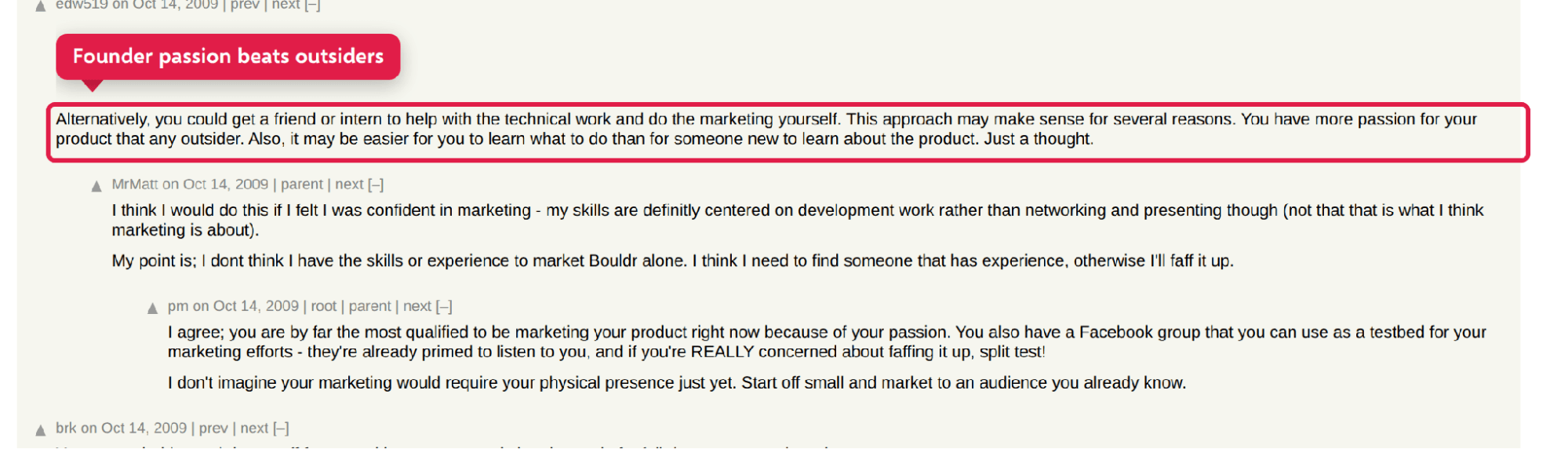
Hacker News Ask HN thread on finding a marketing person for a startup, where edw519 argues the founder has more passion for the product than any outsider.
Hiring views in that thread are opinions. One commenter suggests an outsourced marketing shop rather than a full-time marketer at the early stage. Another holds that a founder or intern may learn marketing faster than a newcomer can learn the product.
Tip: Define the handoff trigger before launch, such as a weekly hours cap on founder posting. The team hires once that cap is reached.
Once roles are settled, the next question is which one or two channels the founders should use first.
How to Choose One or Two Channels First
Choosing channels for marketing for startups comes down to three filters: the buyers already gather there, a founder can run it without hiring, and a test produces a signal quickly. A list of ten tactics fails all three, because a two-person team cannot run more than one or two properly.
Start with where the audience already is. A Hacker News thread advises finding where customers already are, such as endorsements from bloggers who love the niche, rather than only where you are not yet. Our example team, two founders building an open-source-based Kubernetes cost-monitoring tool for platform engineers, applies this by listing the newsletters, repositories and community channels that platform engineers already read.
The niche then narrows the list. A Reddit r/startups thread suggests direct outreach over content or online lead capture for a very narrow niche. Platform engineers at companies that run Kubernetes form a narrow group, so the team picks direct outreach first and technical content about its open-source repository second.
Takeaway: Two channels the founders can run themselves beat six they can only sample.
The table below sorts the usual options by the stage where each fits best. It is a judgment aid for a small team, not a ranking of results.
| Channel | Stage where it fits | Founder time |
|---|---|---|
| Direct outreach | Pre-revenue, narrow niche | High, per conversation |
| Content | After early conversations reveal buyer questions | Steady and recurring |
| Paid ads | After a message already works in unpaid channels | Low time, needs cash |
| PR | After a concrete milestone worth announcing | Moderate |
| Events and speaking | After a clear niche and a working demo | High |
| Partnerships | After first customers can act as references | Moderate |
SEO and content take longer to show results than paid ads, but this guide gives no payback periods for either. Verified sources here contain no dependable time-to-payback figures, so a month range would be invented. Measure each channel against the team's own signals, such as replies and demo requests, instead of borrowed benchmarks.
Paid ads carry their own risk for an early team. A Stack Overflow answer on startup pitfalls lists assuming that advertising on Google AdWords will work. Treat ads as a test to run once outreach or content has produced a message that already converts.
PR, events, speaking and partnerships suit a team with a milestone to announce, a demo that holds up and customers willing to vouch for it. Before those exist, each one spends founder hours that outreach and content would use better. The example team parks all three until its first customers can speak for the product.
For video as a content format, see YouTube B2B marketing practices. Once the two channels are running, a separate question arises: whether AI answer engines cite the brand when buyers ask them about the category.
Tracking AI Answer Citations With a GEO Dashboard
No verified data here shows that AI search traffic converts well, so the two-person Kubernetes cost-monitoring team treats it as a channel to measure. The Infrasity GEO Dashboard tracks how often ChatGPT, Claude, Gemini and Perplexity cite the brand.
The overview summarizes how often AI engines cite the brand, with tiles for citation rate, share of voice, average position, prompts moving up and prompts tracked.
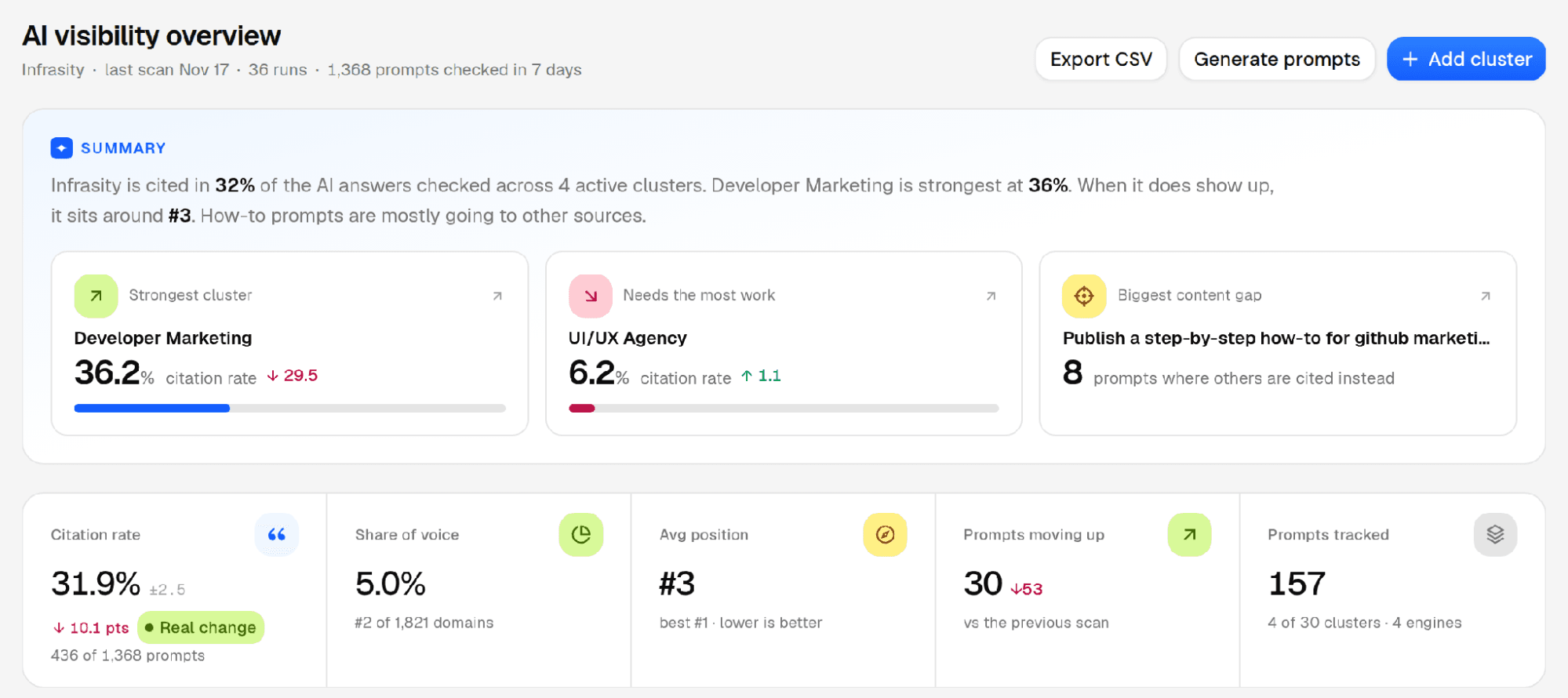
The AI visibility overview in the Infrasity app: citation rate, share of voice, average position and prompts tracked for the brand.
A baseline like this lets the founders judge whether AI answers deserve one of their first two channels. For tool comparisons, see answer engine optimization platforms. Whatever the result, every channel needs money behind it, so the next section sets a budget before revenue exists.
Setting a Startup Marketing Budget Before Revenue Exists
No verified source used in this guide gives a dependable marketing spend percentage for pre-revenue startups, so this section sets none. A pre-revenue budget starts from runway, the number of months the cash on hand covers at the current burn, and from cash flow, the timing of money entering and leaving the account.
Cash timing carries the weight here. A Stack Overflow answer warns that startups can fail from cash flow problems even when they sell many units. Marketing spend therefore comes after payroll and infrastructure are covered.
The two-person Kubernetes cost-monitoring team applies this by fixing a small monthly marketing ceiling after salaries and hosting. It spends the first part on waitlist and outreach tooling instead of ads. A capped line item keeps experiments from eating into runway.
Advertising a startup can still include paid ads, as a small test with a stop date. A Stack Overflow answer lists assuming that Google AdWords advertising will bring customers as a pitfall. A fixed-budget test aimed at one audience shows whether clicks turn into waitlist signups before more cash goes in.
For creator-led reach to technical buyers, see B2B influencer marketing strategies. Developer buyers respond to a different kind of proof than general audiences, which the next section covers.
Marketing to Developer Buyers of B2B Infrastructure Products
Developer buyers read documentation and test a product before they talk to anyone, so the pitch needs technical evidence rather than claims. For the wider discipline, see what developer marketing covers.
One answer in a Stack Overflow thread on startup pitfalls lists creating a website that describes product features instead of customer benefits as a pitfall. The two-person Kubernetes cost-monitoring team in this guide can apply that by building its homepage around the result a platform engineer wants, a clearer view of cluster spend, instead of a list of exporters and dashboards. Takeaway: lead with the outcome, then back it with docs and a working install.
The same Stack Overflow thread says technical founders often lack the business and marketing skills needed to sell a product. Engineering founders can treat selling as a skill to practise through the outreach and founder-led work covered earlier. For channel tactics aimed at this audience, see marketing to developers for B2B SaaS.
With the pitch and the audience settled, the next question is which numbers show whether any of it is working.
Funnel Metrics Worth Tracking From the First Customer
Metrics for marketing for startups follow the funnel, one number per step. Activation is the share of signups who reach first meaningful use, retention is the share of users who keep returning, and customer acquisition cost (CAC) is total acquisition spend divided by customers won. The Kubernetes cost-monitoring team would count waitlist signups who connect a first cluster as activated.
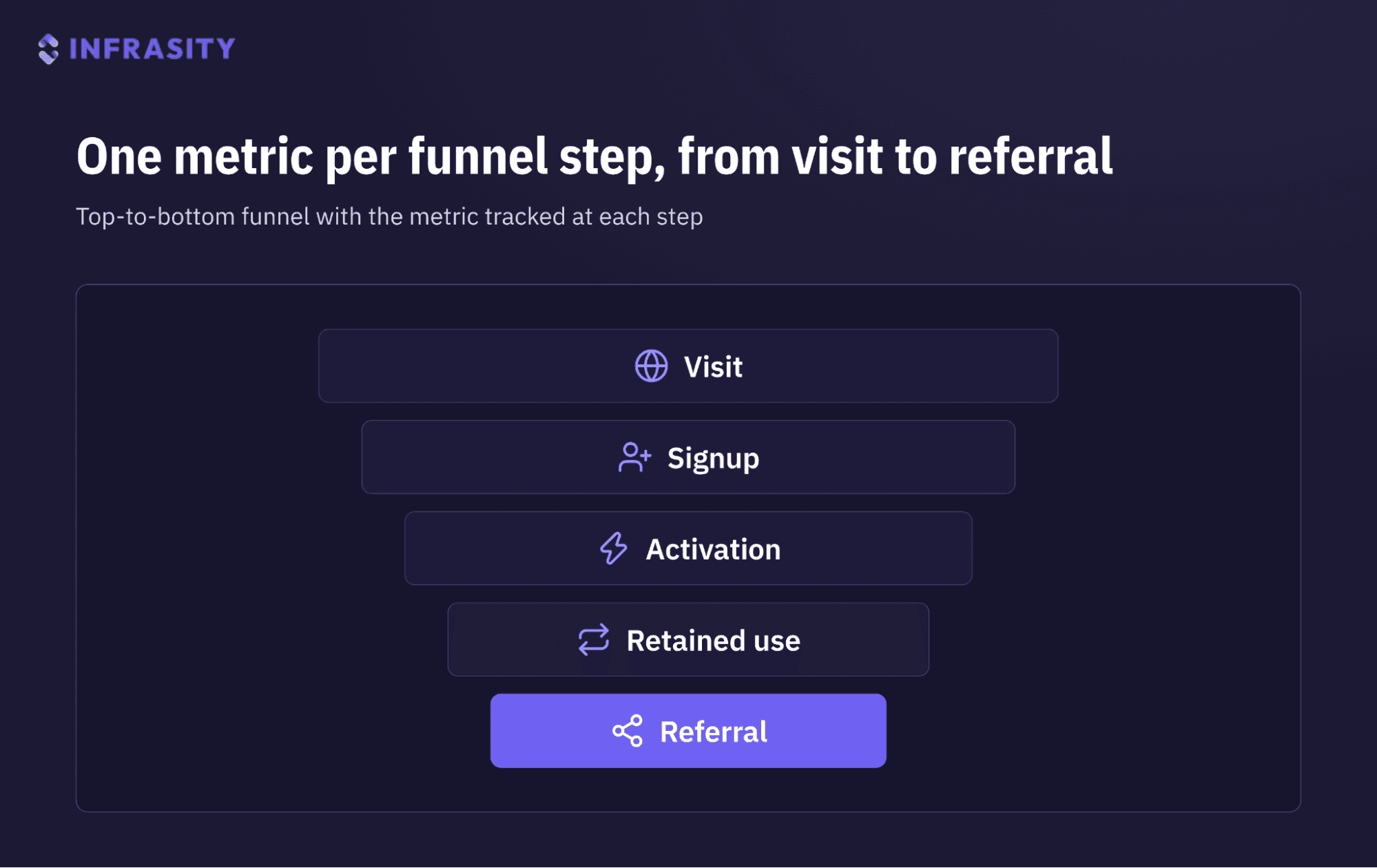
Track one number at each funnel step, so you can see where prospects drop off before the handoff from founder-led work.
Each step gets one number, and none needs an outside benchmark to be useful. A Stack Overflow answer on startup pitfalls notes that profitable businesses can still fail from cash flow problems, so founders should track cash. For stage definitions, see B2B SaaS funnel stages. Agree in advance which metric readings trigger the handoff from founder-led work, then carry that rule into the closing section.
Match Channels to Your Stage Then Track Retention
Marketing for startups works when the order follows the company's stage: prove demand with a waitlist and direct outreach, run one or two channels the founders can staff, fund them from runway and cash flow, and track funnel and retention numbers from the first customer. Evidence from each stage decides what the team does next, and the handoff from founder-led work is agreed before it is needed.
For the next stage, explore Infrasity's developer-first content services for technical guides and use-case content aimed at developer and infrastructure buyers. Teams that want to see how often AI engines cite their brand can look at the GEO Dashboard for citations.
Infrasity helps seed and Series A DevTool and B2B SaaS teams pick their first channels, publish technical content that developer buyers trust, and track whether AI engines cite them. If you want a plan for your stage, book a call with Infrasity.
FAQs
How do you launch a small business from the marketing side?
Start with a waitlist and direct outreach, then add one channel. A Reddit r/startups discussion has commenters recommending a pre-launch waitlist that rewards sign-ups with a free trial. The same discussion suggests contacting buyers directly when the niche is very narrow. Add content or paid tests only after those conversations show what buyers ask.
Does a startup need a minimum viable product before promoting it?
Opinions split. Founders in a Reddit r/startups discussion disagree on whether a product must exist as an MVP before promotion can work. A waitlist lets a team test interest before building much, and a working demo strengthens outreach once one exists.
Should a startup hire a full-time marketer first?
There is no settled answer, and the advice here is opinion. One Ask HN commenter suggests an outsourced marketing shop over a full-time marketer at the early stage. Founders can decide the handoff trigger in advance and revisit it as hours and cash allow.
Is Google Ads a safe first channel for a startup?
No. A Stack Overflow answer on startup pitfalls lists assuming that Google AdWords advertising will work as a mistake. Run ads as a small, time-limited test once unpaid channels have produced a message that already converts.
What are the best business startups to launch?
That depends on idea selection, which this guide does not cover. It covers how to market a company once an idea exists, from validation to retention metrics. Choosing an idea belongs in a separate guide, and checking demand with real buyers is a sound first filter.